

Note: This article contains affiliate links. If you click on these links and make a purchase, I may earn a small commission at no extra cost to you. This helps support my research and content. Read my full affiliate disclosure here.
Picking the right homeowner chainsaw changes how quickly and safely routine yard tasks get done. You want a tool that is easy to start, comfortable to hold for extended periods, and powerful enough to handle fallen limbs, pruning, and small tree work without overwhelming you. This guide examines a shortlist of top homeowner chainsaws suited to general residential use. We evaluate each option for power delivery, weight and balance, safety systems, and serviceability so you can match a saw to your yard tasks and physical comfort. Read on for practical notes that make it easier to choose the right saw for your needs.
Top Picks at a Glance
| Best Overall The best all-around choice for most situations | DEWALT 20V MAX 12" Brushless Cordless Chainsaw Kit (DCCS621P1) |  |
| Best Quality Built to a higher standard if you want something more solid | Husqvarna 120 Mark III 14" Gas Chainsaw (38cc) |  |
| Best Value The sweet spot between price and what you get | CRAFTSMAN 16-Inch Corded Electric Chainsaw (CMECS600) |  |
| Best Budget The cheapest option that still gets the job done reliably | WEN 18-Inch Corded Electric Chainsaw (15-Amp, CP1518) |  |
| Highest Rated A top-rated pick with lots of positive feedback | Milwaukee M18 FUEL 16 in. Cordless Chainsaw (Tool Only) |  |
| Most Popular A crowd favorite that many people choose with confidence | Oregon CS1500 15A Corded Electric Chainsaw with PowerSharp Self-Sharpening |  |
| Best Seller A high-volume bestseller chosen again and again | Supstable Mini Cordless Chainsaw (6" & 8" Bars) with 1000W Brushless Motor and Two Batteries |  |
DEWALT 20V MAX 12" Brushless Cordless Chainsaw Kit (DCCS621P1)

| Power Source | Battery Powered |
|---|---|
| Horsepower | 0.7 hp |
| Chain Length | 12 inches |
| Included Components | Chainsaw, sheath, DCB205 battery and charger |
The DEWALT 20V MAX 12" cordless chainsaw kit is a gas-free, compact tool intended for routine homeowner cutting and light jobsite work. It pairs a high-efficiency brushless motor with a 20V MAX battery and charger, delivering up to about 100 cuts per charge for tasks like pruning limbs, cutting firewood, and ripping small beams. The low-kickback 12" bar and chain plus a lightweight, balanced body make it easy to control for precise cuts and reduce user fatigue. Because it is battery powered there are no fumes, cold starts, or carburetor maintenance, which simplifies storage and seasonal use. Limitations are its power envelope and bar length: this is not built for large-diameter trees or extended heavy-duty logging where a larger gas saw would be faster and refillable fuel offers longer continuous runtime. Expect straightforward maintenance for the chain and standard battery recharge planning for longer jobs.
Best for: Homeowners who want a low-maintenance, easy-to-use chainsaw for routine yard work, limb pruning, and small firewood cutting and who prioritize convenience over maximum cutting power.
Less Ideal for: Property owners who need a tool for felling large trees or doing continuous, heavy-duty logging should choose a larger gas-powered or pro-grade electric saw instead.
- Brushless motor for improved efficiency and longer runtime
- Includes battery and charger so it is ready to use out of the box
- Low-kickback 12-inch bar and chain improves safety and control for homeowners
- Lightweight, compact design reduces fatigue and makes precise cutting easier
- Limited bar length and power compared with full-size gas chainsaws, so not suited for very large trunks or heavy-duty felling
Verdict: A convenient, low-maintenance cordless chainsaw that gives homeowners controlled, fume-free cutting for everyday yard jobs.
Husqvarna 120 Mark III 14" Gas Chainsaw (38cc)

| Power Source | Gas Powered |
|---|---|
| Horsepower | 1.88 hp |
| Chain Length | 14 inches |
The Husqvarna 120 Mark III is a straightforward, homeowner-focused gas chainsaw built for yard work, pruning, and small to medium limb cutting. Its 38-cc X-Torq two-cycle engine delivers usable power and improved fuel efficiency while Air Injection keeps larger debris away from the air filter, which can extend time between maintenance tasks. The 14-inch bar makes the saw easy to maneuver around branches and in tight spaces and the LowVib system reduces felt vibration for more comfortable handling during longer sessions. Safety features like the inertia-activated chain brake and a separate choke/stop control help reduce mishaps and simplify starting. This model prioritizes reliable cutting performance without pro-level bells and whistles, so you get efficient operation and lower emissions in a lightweight package. Expect the usual gas-saw upkeep such as mixing fuel, periodic chain sharpening, and basic maintenance; it is not a substitute for a professional-grade saw when tackling large-diameter trees or heavy logging work.
Best for: Ideal for homeowners and property owners who need a reliable, easy-to-handle gas saw for pruning, firewood splitting, and routine yard maintenance and prioritize practical cutting performance.
Less Ideal for: Not the best choice for professional arborists or anyone who regularly cuts large-diameter trees or needs a high-displacement saw for continuous heavy-duty use.
- Efficient X-Torq engine improves fuel use and lowers emissions
- Air Injection pre-filters large debris to help protect the air filter
- LowVib technology reduces vibration for more comfortable use
- Inertia-activated chain brake adds a key safety layer during operation
- 14-inch bar limits cutting capacity for larger trunks and heavy-duty logging work
Verdict: Buy this if you want a compact, fuel-efficient gas chainsaw that delivers reliable homeowner-grade cutting and comfortable handling.
CRAFTSMAN 16-Inch Corded Electric Chainsaw (CMECS600)

| Power Source | Corded Electric |
|---|---|
| Horsepower | 3.5 hp |
| Chain Length | 16 inches |
| Included Components | 16-in. bar and chain |
The CRAFTSMAN 16-inch corded electric chainsaw is a simple, no-fuss tool for homeowners who need reliable cutting power without gas maintenance. The 12-amp motor and 16-inch low-kickback bar and chain let you handle limb trimming, small tree felling, and cutting firewood with consistent power as long as you have an outlet. Practical touches include auto-oiling with a visible oil window and tool-free chain tensioning so you can top up oil and adjust the chain quickly on the job. Being corded means steady torque and less vibration than some smaller battery models, but you are limited by cord length and need to manage an extension for larger yards. It is lightweight for an electric saw and straightforward to maintain, making it a good seasonal tool for yard cleanup; however it is not intended for heavy professional use or long runs away from power. For a homeowner who prioritizes reliable cutting performance and low maintenance, this model covers the essentials well.
Best for: Homeowners who want a dependable, low-maintenance chainsaw for regular yard work and seasonal cleanup and who have ready access to outdoor power.
Less Ideal for: Landscapers, loggers, or users who need cordless portability for remote jobs or extended heavy-duty cutting sessions.
- Steady corded power suitable for consistent cuts without battery swaps
- 16-inch low-kickback bar and chain for safer homeowner use
- Auto-oiling with oil window simplifies lubrication and monitoring
- Tool-free chain tensioning for quick on-site adjustments
- Corded design restricts mobility and requires an extension for larger properties
- Not designed for heavy professional workloads or prolonged continuous cutting
Verdict: A straightforward, low-maintenance corded chainsaw that gives homeowners reliable cutting power for routine yard work.
WEN 18-Inch Corded Electric Chainsaw (15-Amp, CP1518)

| Power Source | Corded Electric |
|---|---|
| Included Components | Electric Chainsaw, Corded, 15-Amp, 18-Inch |
| Model Number | CP1518 |
The WEN 18-inch corded electric chainsaw is a straightforward homeowner saw that plugs into standard power and delivers 15 amps of cutting power for limb pruning, small tree work, and firewood prep. It runs an 18-inch chain at up to 41 feet per second and includes practical features you will use in the yard such as an auto-oiler for chain lubrication, tool-free chain tensioning, a kickback brake, and a cable strain relief notch to secure extension cords. The saw’s lightweight design reduces operator fatigue during longer sessions, and because it is electric there are no gasoline fumes or engine maintenance. Limitations are typical of corded electrics: you need a nearby power source or a long heavy-duty extension cord, and it is not intended for heavy commercial logging or very large trees. For routine homeowner cutting and occasional firewood splitting, this model provides accessible power and simple maintenance at a value-oriented level.
Best for: Homeowners who want an affordable, low-maintenance saw for pruning, small tree work, and occasional firewood without dealing with gasoline engines.
Less Ideal for: Landscapers, tree services, or anyone who regularly cuts large-diameter trees and needs the mobility and power of a gas or professional-grade saw.
- Corded 15-amp motor provides consistent power without gasoline or engine upkeep
- Auto-oiling system keeps the chain and bar lubricated during use
- Tool-free chain tensioning makes adjustments quick and easy
- Lightweight design reduces operator fatigue for homeowner tasks
- Requires a nearby power source or long extension cord which limits remote use
- Not suited for heavy commercial cutting or very large trees
Verdict: A budget-friendly, low-maintenance electric chainsaw that gives homeowners reliable corded power for routine yard cutting tasks.
Milwaukee M18 FUEL 16 in. Cordless Chainsaw (Tool Only)

| Power Source | Battery Powered |
|---|---|
| Horsepower | 5.3 hp |
| Chain Length | 16 inches |
The Milwaukee M18 FUEL 16 in. cordless chainsaw is a tool-focused model that brings high power and convenient cordless operation to homeowner cutting tasks. It uses the M18 battery platform (battery and charger sold separately) and is built around a 16-inch Oregon bar and chain with an automatic oiler and variable speed trigger so you can control cut speed for different wood types. In practice this saw handles hardwood and mid-size logs quickly and is reported to deliver many cuts per charge with higher-capacity M18 packs. Notable features include the brushless FUEL motor for stronger acceleration and reduced maintenance compared with brushed motors, and a compact build that makes limbing and pruning easier in tight spaces. Important limitations are that the battery and charger are not included so you must already own or purchase compatible M18 batteries to realize the reliability benefits, and run time depends heavily on battery capacity. For homeowners who want near-professional cutting performance without gas fuss, this is a dependable cordless option when paired with a robust M18 battery.
Best for: Homeowners who prioritize a reliable, high-performance cordless saw and either already own M18 batteries or are prepared to invest in them for consistent, gas-free cutting around the yard.
Less Ideal for: Casual users who want an all-in-one package with battery and charger included or people needing very long continuous cutting sessions without spare batteries.
- Powerful brushless motor claims faster cuts than gas models for efficient work
- Automatic oiler maintains chain lubrication for consistent cutting performance
- Variable speed trigger gives precise control for pruning or larger cuts
- Compatible with the M18 battery ecosystem so higher-capacity packs boost runtime
- Battery and charger are not included so additional purchase is required
- Run time and cutting output depend on which M18 battery you use
Verdict: Choose this Milwaukee M18 FUEL 16 in. cordless chainsaw if you want near-professional cordless cutting performance and already use or plan to buy M18 batteries for dependable, gas-free operation.
Oregon CS1500 15A Corded Electric Chainsaw with PowerSharp Self-Sharpening

| Power Source | Corded Electric |
|---|---|
| Horsepower | 2400 watts |
| Chain Length | 18 inches |
| Warranty | 2 year |
The Oregon CS1500 is a homeowner-focused corded chainsaw designed for trimming limbs, cutting firewood, and general yard cleanup. It delivers steady 2400-watt (15 amp) power with an 18-inch guide bar and an integrated PowerSharp system that sharpens the chain in a few seconds without removal. Typical use is straightforward: plug in, tension the chain tool-less with the side cover ring, sharpen with the lever, and rely on the automatic oiler to keep the bar lubricated. Notable features include low-noise electric operation, a chain brake for safety, and quick startup compared with gas saws. Practical benefits are minimal maintenance, no fuel mixing, and reduced downtime thanks to the on-board sharpener and automatic lubrication. Limitations are those of corded tools: you need access to an extension cord and reach is constrained by cord length, and it lacks the fuel-independent range of cordless or gas models. It is a solid choice for regular homeowner tasks where convenience, quiet operation, and easy upkeep matter more than remote mobility.
Best for: Homeowners who want a low-maintenance, easy-to-use chainsaw for regular yard work and occasional firewood cutting and who prioritize convenience and quiet operation over off-grid mobility.
Less Ideal for: Ranchers, forestry workers, or anyone who needs long cordless runtime or the unrestricted range of a gas-powered saw should consider other options.
- Integrated PowerSharp self-sharpening reduces downtime and keeps cutting performance consistent
- Automatic oiler supplies continuous lubrication to the bar and chain
- Tool-less chain tensioning makes adjustments quick and user-friendly
- Instant electric start and lower noise compared with gas models
- Corded design limits range and requires a suitable outdoor-rated extension cord
- Not suitable for remote jobs where no power is available
Verdict: Choose the CS1500 if you want a powerful, quiet, low-maintenance corded chainsaw with an on-board self-sharpener for dependable homeowner use.
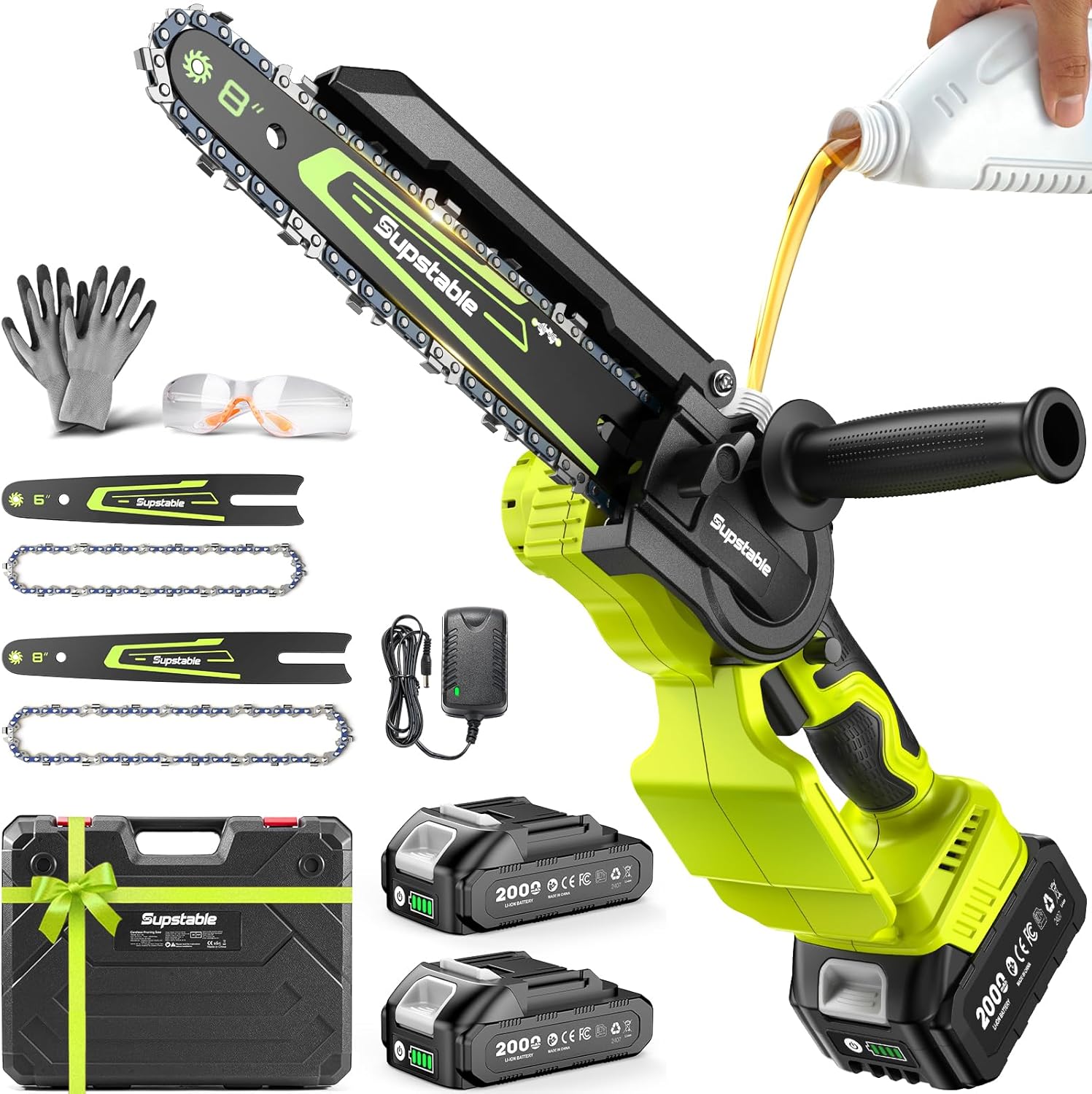
Supstable Mini Cordless Chainsaw (6" & 8" Bars) with 1000W Brushless Motor and Two Batteries
| Power Source | Battery Powered |
|---|---|
| Horsepower | 1000 watts |
| Chain Speed | 32ft/s |
| Included Components | 2 batteries, charger, 6" & 8" guide bars, gloves, goggles, suitcase |
The Supstable mini cordless chainsaw is a homeowner-focused tool that combines a 1000W brushless motor with two interchangeable guide bars so you can swap between a 6-inch bar for precise pruning and an 8-inch bar for slightly larger cuts. It ships as a complete kit with two 2.0Ah batteries, a charger, carrying case, gloves, and goggles so you can start trimming branches, cutting firewood, and doing routine yard maintenance right away. Notable features for everyday users include the brushless motor for steadier power and longer life, an automatic oiler to reduce maintenance, and a safety lock and debris baffle for safer operation. The tool is lightweight and easy to handle, which reduces fatigue when working on ladders or in tight spots. Limitations to consider are its mini chainsaw bar lengths and battery capacity, which make it best for small-to-medium limbs rather than heavy felling or large logs, and it requires you to supply lubricating oil for the oiler. For a risk-averse homeowner wanting a usable, low-maintenance cordless option for routine yard work, this kit covers the essentials.
Best for: Homeowners who prioritize a safe, easy-to-use cordless tool for routine tree trimming, branch pruning, and small firewood jobs and who prefer a ready-to-run kit with basic protective gear.
Less Ideal for: People who need a chainsaw for heavy felling, milling, or frequent large-log cutting should choose a full-size gas or professional electric chainsaw instead.
- 1000W brushless motor delivers steady power with lower vibration and longer motor life
- Two interchangeable guide bars (6" and 8") let you adapt between precise pruning and larger branch cuts
- Comes as a full kit with two batteries, charger, carrying case, gloves, and goggles for immediate use
- Automatic oiling system reduces chain maintenance and keeps cutting smooth
- Small bar lengths and 2.0Ah batteries limit runtime and capacity for large logs or heavy-duty cutting
Verdict: A compact, low-maintenance cordless kit that gives risk-conscious homeowners a safe and ready-to-use option for routine pruning and small wood cutting.
Choosing the Right Homeowner Chainsaw: Key Factors to Consider
Engine or Motor Output
How much power the saw produces directly affects what it can cut cleanly and how it behaves under load. For homeowners, steady, predictable output matters more than peak horsepower. Gas engines and electric motors deliver power differently: gas provides more torque for thicker wood and longer cutting sessions, while corded electric models offer consistent RPMs and fewer emissions.
Match the output to your tasks. Regular pruning and small-diameter limb cutting only need modest output, while occasional removal of medium trees benefits from higher torque. Overpowered saws increase weight and vibration, so choose an output level that fits the typical diameter you will cut.
Bar Length and Cutting Capacity
The guide bar length determines maximum single-pass cut diameter and affects maneuverability. Shorter bars, around 12 to 14 inches, are easier to control and better for pruning and light work. Longer bars increase cutting capacity but can add weight and make one-handed control impossible.
Consider storage and transport too. A slightly longer bar gives flexibility for unexpected larger limbs, but avoid a length that forces awkward handling. Homeowners should balance a bar long enough for likely needs with the reality of their strength and how they plan to position the saw during cuts.
Weight, Balance, and Ergonomics
A chainsaw that feels well balanced reduces user fatigue and improves control during cuts. Total weight matters less than how that weight is distributed relative to the handles and bar. Lightweight saws are easier for extended tasks and for users of smaller stature, but extremely light models sometimes sacrifice vibration damping or stability during heavier cuts.
Grip design, handle orientation, and throttle placement affect everyday comfort. Look for anti-vibration mounts and a handle shape that lets you hold the saw securely with both hands while keeping wrists neutral. Good ergonomics reduce the chance of slips and make precise cuts simpler.
Safety Systems and Kickback Control
Safety features can prevent the most common serious accidents. Chain brakes that stop the chain quickly, low-kickback chain designs, chain catchers, and clearly labeled shutoff switches are essential homeowner considerations. Some saws include inertia-activated chain brakes that engage automatically on sudden upward motion to reduce kickback risk.
User training and wearing appropriate protective gear remain crucial, but selecting a saw with passive and active safety elements lowers the odds of injury during routine yard work. Inspect how easy it is to reach safety controls and how intuitively they operate under stress.
Start Procedure and Maintenance Accessibility
A saw that is easy to start and simple to maintain will be more usable over time. Gas models vary in starting systems and may offer features like primer bulbs, choke arrangements optimized for cold starts, or easy-access spark plugs. Electric chainsaws remove the pull-start variable but introduce cord management or battery charging considerations.
Routine maintenance tasks such as chain tensioning, bar cleaning, air filter access, and chain sharpening should be straightforward. If routine parts like drive sprockets and chains are commonly available, long-term ownership is less frustrating for a homeowner.
Gas Versus Electric for Home Use
Gas and electric chainsaws each have strengths for residential work. Gas models usually provide higher torque, making them better for thicker limbs and longer continuous cuts, but they require fuel mixing, more maintenance, and produce exhaust. Electric saws, either corded or battery-powered, deliver quieter operation, simpler starts, and lower maintenance burdens, which many homeowners find attractive.
Consider your typical work session and local regulations. If you work far from a power outlet or need sustained high-power cuts, gas is often more practical. For occasional pruning, light limbing, and backyard cleanup, battery models offer enough power with less setup and fewer emissions.
- Gas: higher torque, longer run for heavy work, more maintenance
- Battery: convenient starting, lower maintenance, quieter
- Corded: constant power, limited by cable length
Reducing Vibration and Fatigue
Vibration makes repetitive cutting uncomfortable and can reduce precision. Look for models with anti-vibration mounts, rubberized handles, and balanced weight distribution to lower hand-arm vibration during use. Taking short breaks and alternating tasks also reduces fatigue during longer sessions.
Keep in mind that vibration control often trades off with weight and raw cutting capacity. Prioritize vibration damping if you frequently prune or work for longer periods with the saw in hand.
- Check handle cushioning and anti-vibration systems
- Balance matters more than absolute weight for comfort
- Plan work in short segments to manage fatigue
Maintenance Tasks Every Homeowner Should Know
Routine upkeep keeps a chainsaw reliable and safe. Learn to check and adjust chain tension, clean the bar groove and oil ports, inspect the chain for damage, and sharpen or replace the chain as needed. For gas models, basic carburetor and spark plug checks are important; for battery models, follow safe charging and storage practices.
Simple habits like keeping the chain properly lubricated and storing the saw in a dry place extend component life and cut down on unexpected failures.
- Adjust chain tension before each use
- Keep the chain lubricated and the bar groove clean
- Inspect safety components regularly
Storage, Transport, and Neighborhood Considerations
How you store and move the saw matters for longevity and compliance with local noise expectations. Use a protective scabbard for the bar during storage and transport. For gas saws, drain or stabilize fuel for long-term storage. Battery packs should be kept cool and partially charged if stored for long periods.
Be mindful of noise when scheduling cutting sessions. Electric models are quieter and often better suited to dense neighborhoods or early-morning work.
- Use a scabbard for safe transport
- Stabilize or drain fuel for long-term storage of gas saws
- Charge batteries per manufacturer recommendations
Accessories That Make Work Faster
A few well-chosen accessories improve efficiency and safety. A sharp, spare chain ready for quick swaps minimizes downtime. A proper sharpening file or a small bench grinder helps maintain cutting performance. Protective gear such as gloves, eye protection, and chaps reduces injury risk and allows you to work more confidently.
A basic maintenance kit and a compact tool set for tightening bar bolts and adjusting tension will save time and frustration during yard sessions.
- Keep a spare chain and sharpening tools on hand
- Wear appropriate personal protective equipment
- Carry a small tool kit for field adjustments
How We Chose the Best Homeowner Chainsaw
We focused on features and performance metrics that matter to homeowners using a chainsaw for routine yard work rather than commercial logging. Selection began with models designed for residential use and excluded heavy-duty professional saws and specialty engines that require commercial training. Key evaluation criteria included engine or motor output and torque at typical loads, because predictable cutting power reduces snagging and makes cuts cleaner. Weight, balance, and vibration control were assessed to gauge handling and user fatigue during tasks like pruning and limb removal. Safety features such as chain brakes, chain catchers, low-kickback chains, and user-accessible shutoffs were required for inclusion. Ease of starting, routine maintenance access, and availability of basic replacement parts were considered to ensure long-term usability. Finally, noise and emissions characteristics were reviewed for homeowner-appropriate neighborhoods and small properties. We excluded models lacking basic safety hardware or those with maintenance demands that exceed typical homeowner capabilities. The final list emphasizes controllable power, manageable weight, straightforward servicing, and sensible safety systems aligned to residential use.
FAQ
What bar length should I choose for typical yard work?
Most homeowners find a 12 to 16 inch bar covers common tasks. Shorter bars are easier to handle for pruning and light limbing, while bars toward 16 inches add capacity for thicker branches without becoming excessively heavy.
Are battery chainsaws powerful enough for fallen tree limbs?
Battery chainsaws often handle small- to medium-diameter limbs well, depending on battery size and motor design. For very large limbs or frequent heavy cutting, a higher-torque gas model tends to be more practical.
How often should I sharpen the chain?
Sharpen the chain whenever you notice slower cutting, increased kickback, or excessive dust instead of wood chips. For regular household use, this may be after several hours of cutting; frequent users will need to sharpen more often.
What safety gear is essential when using a homeowner chainsaw?
At minimum wear eye protection, hearing protection, sturdy gloves, and chainsaw chaps or cut-resistant trousers. Boots with good traction and a hard toe are also recommended for stability and protection.
Can a homeowner maintain a gas chainsaw themselves?
Yes, homeowners can perform routine maintenance like chain tensioning, air filter cleaning, spark plug checks, and basic carburetor adjustments. More complex repairs should be handled by a trained technician.
Final Verdict
Choose a homeowner chainsaw that matches your typical cutting tasks and personal comfort. Prioritize a balance of cutting power and manageable weight, and insist on clear safety features and easy access to maintenance points. Tradeoffs are inevitable: higher power increases capacity but adds weight and maintenance. If you mostly prune and do occasional limb work, favor ease of handling, vibration control, and simple starting. For frequent heavier cuts, accept extra weight in exchange for more torque and a longer bar.
