

Note: This article contains affiliate links. If you click on these links and make a purchase, I may earn a small commission at no extra cost to you. This helps support my research and content. Read my full affiliate disclosure here.
Living in an apartment changes how you choose insect repellent. You need products that control mosquitoes, flies, and other indoor pests without filling shared walls and small rooms with strong chemicals or residues. This guide focuses on compact, low-odor, and apartment-appropriate options that work well in bedrooms, kitchens, balconies, and entryways. We shortlisted six top-performing insect repellents for apartment use and evaluated each on indoor safety, application method, and residue or odor. The following picks cover sprays, plug-ins, and topical formats so you can match product type to where and how you spend time in your home.
Top Picks at a Glance
| Best Overall The best all-around choice for most situations | Wondercide Indoor Pest Control Spray, Peppermint, 16 fl oz |  |
| Best Quality Built to a higher standard if you want something more solid | Raid Ant & Roach Killer Spray, Fragrance Free, 17.5 oz (2-pack) |  |
| Best Value The sweet spot between price and what you get | Raid Flying Insect Killer Spray, 18 oz |  |
| Best Budget The cheapest option that still gets the job done reliably | Spectracide Bug Stop Home Barrier Ready-to-Use Spray, 32 oz |  |
| Highest Rated A top-rated pick with lots of positive feedback | Fooxem Ultrasonic Pest Repeller, 7-Pack (Plug-in) |  |
| Most Popular A crowd favorite that many people choose with confidence | Mighty Mint Peppermint Oil Insect Repellent Spray, 16 oz |  |
Wondercide Indoor Pest Control Spray, Peppermint, 16 fl oz

| Unit Count | 16 Fluid Ounces |
|---|---|
| Item Form | Spray |
| Target Species | Ants, Roaches, Spiders, Flies, Fleas, Ticks, Mosquitoes, Silverfish, Moths, Gnats |
| Active Ingredients | 4.2% Cedar Oil; 1.5% Peppermint Oil; 2.2% Sodium Lauryl Sulfate; 0.1% Sesame Oil |
Wondercide Indoor Pest Control is a ready-to-use peppermint-scented spray designed to kill and repel flying and crawling household pests including ants, roaches, spiders, flies, fleas, ticks, mosquitoes, moths, and gnats. It is typically used around baseboards, windows, doors, under sinks, in cabinets, on furniture and carpets, or sprayed directly on visible insects from 8 to 12 inches. Key features include a plant-derived active blend led by cedarwood and peppermint oils, a multi-surface sprayer with adjustable nozzle, and labeling that emphasizes safe use around people and pets when directions are followed. In practical terms this makes it a straightforward option for spot treatments and routine preventative spraying in kitchens, bathrooms, pet areas and living spaces. Limitations to keep in mind are that it must contact flying insects to kill them, surfaces can be slippery when wet, and some people may experience mild skin or eye irritation if misused. For someone looking to reduce reliance on synthetic pesticides while keeping indoor pest problems under control, this product delivers an easy, plant-based approach.
Best for: Buyers who prioritize practical, lower-toxicity solutions and want a versatile, easy-to-use indoor spray for routine spot treatment and prevention around the home and pet areas.
Less Ideal for: People who need long-duration residual control or professional-grade pesticide strength for large infestations should consider stronger or specialized treatments.
- Plant-powered formula with cedarwood and peppermint oils as primary active ingredients
- Kills and repels a broad list of common indoor pests including fleas, ants, roaches and flies
- Ready-to-use spray with adjustable nozzle for targeted or mist application
- Labeled safe for use around people and pets when directions are followed
- Must directly contact flying insects to be effective against them
- Can cause mild skin or eye irritation and surfaces may be slippery when wet
Verdict: A practical, plant-based indoor spray for homeowners who want an easy, lower-toxicity way to kill and repel common household pests while using a product safe for family and pets when used as directed.
Raid Ant & Roach Killer Spray, Fragrance Free, 17.5 oz (2-pack)

| Unit Count | 35 Ounce |
|---|---|
| Included Components | 17.5 oz, 2 ct |
| Target Species | Insects |
| Special Features | Washable |
| Active Ingredients | Imiprothrin (0.060%) Cypermethrin (0.100%) |
This Raid Ant & Roach Killer is an indoor aerosol formulated to kill a wide range of crawling insects on contact and to leave residual protection on non-porous surfaces. Typical use is spraying cracks, baseboards, garbage can edges and other insect pathways until surfaces are wet, then allowing treated areas to dry; the label recommends retreating as necessary to maintain control. Notable features include a fragrance-free formula to avoid lingering odor and active ingredients (imiprothrin and cypermethrin) that deliver both quick knockdown and several weeks of residual action on many surfaces. Practical benefits for waterbug control include targeted application where roaches hide and the ability to keep populations suppressed for up to 13 weeks on certain surfaces when used as directed. Important limitations are that it is for indoor surface use only, cannot be sprayed toward people, pets, or plants, and is flammable and pressurized so storage and application require care; it also should not be used on porous vinyl and requires repeat treatments on some surfaces to maintain control.
Best for: Buyers focused on fast, reliable elimination of indoor roaches and waterbugs who want a no-odor aerosol they can apply directly to infestation sites and re-treat periodically to keep populations down.
Less Ideal for: People looking for an outdoor perimeter solution, a pet-safe alternative, or a one-time permanent fix should consider other products or professional pest control services.
- Fragrance-free formula avoids lingering chemical smell indoors.
- Kills a broad list of crawling pests including roaches and waterbugs.
- Provides residual control for weeks on non-porous surfaces when applied as directed.
- Easy aerosol application for spot treatments in cracks, baseboards and sinks.
- Contains strong insecticides and petroleum distillates, requiring precautions and keeping people and pets away during application.
- Not suitable for porous surfaces and requires repeat applications to maintain control in some areas.
Verdict: Choose this fragrance-free Raid spray when you need a strong, fast-acting indoor treatment that knocks down waterbugs and provides weeks of residual control on treated surfaces.
Raid Flying Insect Killer Spray, 18 oz

| Unit Count | 18 Ounce |
|---|---|
| Item Form | Spray |
| Target Species | Insects |
| Specification Met | EPA |
| Active Ingredients | d-Phenothrin 0.125%, prallethrin 0.100% |
Raid Flying Insect Killer is an 18 oz aerosol spray designed to kill mosquitoes, flies, gnats, small moths, wasps and similar flying pests on contact and by misting treated areas for short-term residual control. For indoor use you close doors and windows, spray with a sweeping motion into the air about three feet from walls and fabrics, then leave the room to allow the mist to work before ventilating after two hours. Notable features include a water-based formula that dries without a greasy residue and an "Outdoor Fresh" scent that reduces strong chemical odor. The product is EPA-specified and includes active pyrethroid ingredients for rapid knockdown. Practical benefits are quick results when insects are present and the ability to treat entry points like screens and around doors for continued control. Important limitations are the required safety precautions: the spray is harmful if inhaled or contacted, contains flammable ingredients, and rooms must be vacated and ventilated for a set time after use, which makes it less convenient for frequent or casual indoor use around children, pets, or food preparation areas.
Best for: Buyers who need a fast, reliable indoor solution to eliminate mosquitoes and other flying pests and who are comfortable following strict safety and ventilation steps after treatment.
Less Ideal for: Households that need frequent quick-turnaround sprays around children, pets, food areas, or where leaving rooms closed for extended ventilation is impractical.
- Kills a wide range of flying insects on contact including mosquitoes and flies
- Mist application allows room treatment without having to target each insect
- Water-based formula that dries without a greasy residue and has milder scent
- EPA-specified formulation with fast-acting pyrethroid active ingredients
- Requires vacating treated area and two hours of ventilation before re-entry
- Contains flammable ingredients and chemicals that require careful handling
Verdict: Use this aerosol when you want fast, on-contact elimination of mosquitoes and other flying insects and can follow the required safety and ventilation steps.
Spectracide Bug Stop Home Barrier Ready-to-Use Spray, 32 oz

| Unit Count | 32 Fluid Ounces |
|---|---|
| Item Form | Spray |
| Target Species | Insects |
| Active Ingredients | Gamma-Cyhalothrin |
Spectracide Bug Stop Home Barrier is a 32-ounce ready-to-use spray designed for quick spot treatments and perimeter applications around homes. It sprays a clear, water-based formula that claims contact kill of ants, roaches, spiders, fleas and ticks and offers extended control on non-porous surfaces for up to 12 months for cockroaches. Typical use is spraying entry points, baseboards, door thresholds and foundation gaps outdoors or treating hiding spots indoors where insects congregate. Notable features include a non-staining, low-odor formula and an adjustable nozzle for a narrow fan spray to limit overspray. In practice this makes application straightforward for homeowners who want fast results without mixing concentrates, and the long residual on certain surfaces can reduce how often you need to re-treat. Important limitations are that it contains a synthetic pyrethroid active ingredient so it is not an organic option and safety precautions are needed around children, pets and food-prep surfaces. It works best as part of an overall exclusion and sanitation approach rather than as the sole solution for heavy infestations.
Best for: Homeowners looking for an affordable, no-mix perimeter spray to reduce common household insects with occasional maintenance sprays and fast contact knockdown.
Less Ideal for: People seeking organic, botanical, or insecticide-free pest control methods or those needing a professional-strength solution for heavy infestations.
- Ready-to-use formula requires no mixing and is easy for quick spot or perimeter treatments
- Water-based clear formula that is non-staining and low in odor
- Adjustable nozzle for targeted narrow fan spray to reduce waste and overspray
- Provides extended residual control for cockroaches on non-porous surfaces
- Suitable for both indoor and outdoor perimeter applications
- Contains a synthetic pyrethroid (gamma-cyhalothrin) so it is not an organic or natural option
- Requires careful application and pet/child precautions around treated areas
Verdict: A simple, budget-friendly ready-to-use perimeter spray that delivers quick contact kills and extended control on hard surfaces for routine home pest defense.
Fooxem Ultrasonic Pest Repeller, 7-Pack (Plug-in)

| Unit Count | 7 Count |
|---|---|
| Power Source | no |
| Number of Pieces | 7 |
The Fooxem seven-pack of plug-in ultrasonic repellers is built for straightforward, low-maintenance pest control across multiple indoor rooms. Each unit plugs into a standard outlet and offers three modes—Enhanced, Medium, and Silent—so you can tune intensity for living rooms, kitchens, basements, or bedrooms. The devices claim wide indoor coverage when placed unobstructed and about 10–50 inches above the floor, and their low power draw (about 3–5 watts) and compact form make them easy to leave running 24/7 without adding noticeable noise or energy cost. A practical benefit is avoiding traps, sprays, or cleanup, which simplifies managing multiple problem areas with one purchase. Important limitations are inherent to ultrasonic devices: effectiveness depends on placement and open line-of-sight to pests, results can vary by building layout and pest species, and they are intended for indoor use only. If you need a chemical-free, set-and-forget supplement to other control methods across several rooms, this pack is a convenient option.
Best for: Buyers who want a reliable, low-effort, chemical-free way to supplement indoor pest control across several rooms and prioritize continuous, maintenance-free devices.
Less Ideal for: People needing guaranteed elimination of heavy infestations or outdoor/structural pest control should choose traps, baits, or professional services instead.
- Seven units cover multiple rooms without buying extras
- Three adjustable modes let you balance intensity and quiet operation
- Plug-in, low-power design for continuous, maintenance-free use
- Performance depends on unobstructed placement and may be limited by room layout or furnishings
Verdict: A convenient seven-pack for homeowners who want a low-maintenance, chemical-free ultrasonic solution to deter common indoor pests across multiple rooms.
Mighty Mint Peppermint Oil Insect Repellent Spray, 16 oz
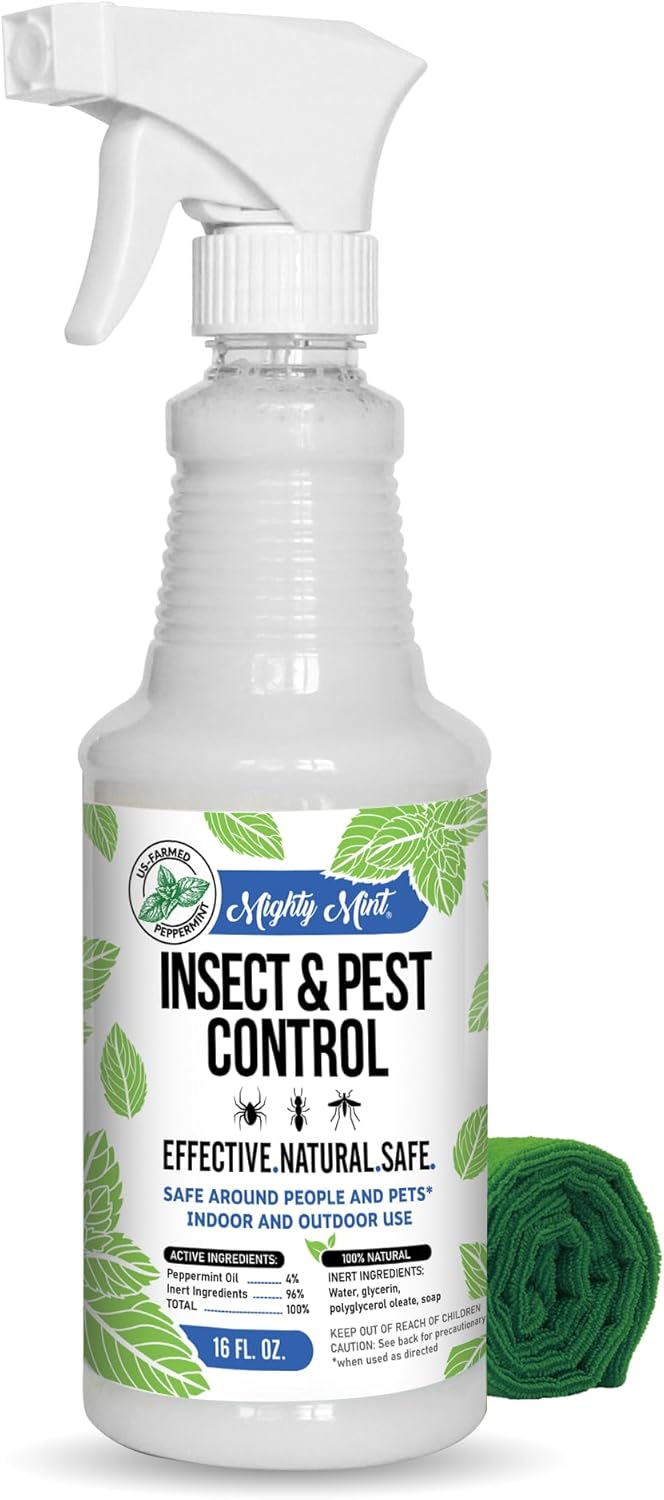
| Ingredients | Water, Glycerine, Polyglycerol oleate, Soap, Peppermint oil |
|---|---|
| Use Areas | Indoor / Outdoor |
| Size | 16 oz |
Mighty Mint is a plant-based, ready-to-use spray that uses concentrated peppermint oil to repel a broad range of household and patio pests. You apply it directly to problem areas such as baseboards, entryways, patios and around outdoor seating; the manufacturer recommends shaking and spraying until surfaces are covered and repeating applications two or more times per week for best results. Notable features include a peppermint-only scent profile, a formulation that avoids synthetic fragrances and the convenience of a 16 oz spray bottle for targeted spot treatments. Practical benefits are that it is safe to use around people and pets when dry and does not leave obvious stains on most surfaces, and the scent can make treated areas smell fresher than chemical alternatives. Important limitations are that it is a repellent rather than a pesticide so it works by discouraging pests rather than killing them, effectiveness depends on regular reapplication and it should not be applied when pollinators are present or to skin or food-contact surfaces.
Best for: Buyers who prioritize natural, low-toxicity solutions and want a targeted spray to reduce insects around patios and entryways while keeping family and pets in mind.
Less Ideal for: Anyone needing a one-time extermination or long-term residual pesticide for severe infestations should consider professional treatments or products formulated to kill pests rather than repel them.
- Plant-based peppermint formula that avoids synthetic fragrances
- Ready-to-use spray for quick, targeted indoor and outdoor applications
- Safe for people and pets when used as directed and allowed to dry
- Nonstaining on most surfaces and leaves a fresh mint scent
- Repels rather than kills insects so regular reapplication is needed to maintain protection
- Strong peppermint concentration may bother scent-sensitive individuals and requires keeping children and pets away until dry
Verdict: Choose Mighty Mint when you want a pet-friendly, plant-based spray to reduce patio and entryway insects with a fresh peppermint scent.
Choosing the Right Insect Repellent for Apartment: Key Factors to Consider
Indoor Safety and Ventilation Needs
Indoor safety matters because apartments have limited airflow and adjacent living spaces. Choose products with clear indoor use instructions and ingredients appropriate for confined areas. If a product requires opening windows or running fans, factor that into where you will use it and whether neighbors or building policies allow it.
Consider how long you will be in the treated area after application. Some aerosol sprays settle quickly and are fine after a short airing period, while other treatments are designed for continuous low-emission release. Pay attention to any guidance about use around pets, children, and people with respiratory sensitivities.
Odor, Residue, and Surface Compatibility
Odor is especially important in apartments because smells can linger on fabrics, furniture, and in shared ventilation. Look for low-odor formulas or devices with scent controls if you are sensitive or have neighbors nearby. Residue can mark walls, curtains, and countertops; prefer treatments that leave minimal residue or that specify safe contact with fabrics and finished surfaces.
If you plan to use a device on a balcony or near planters, ensure the active ingredients are safe for nearby plants and will not leave oily deposits on railings or glass doors. Cleanability and the ability to concentrate treatment away from upholstery are useful considerations.
Application Method and Room Suitability
Apartment living often requires small-footprint solutions. Decide whether you need a quick topical repellent for personal protection, a targeted spray for a room, or a continuous device for sustained control. Plug-in diffusers and passive emitters are good for bedrooms and living rooms when long-term coverage is desired without repeated spraying.
Topical repellents are practical for sitting on a balcony or entering a doorway but are less useful for whole-room control. Portable battery or USB-powered units can be moved between rooms, while larger devices may be overkill in smaller apartments.
Target Pest Profile
Different insects respond to different active ingredients and delivery methods. Mosquitoes and gnats are often deterred by topical actives or aerosol spot treatments. Houseflies and pantry pests may be better managed by traps or quick-contact sprays. Identify the primary pest you want to control and choose a format designed for that behavior.
In multi-issue situations, combining a personal repellent with a room device can provide layered protection, but always confirm compatibility of active ingredients when using multiple products in the same space.
Noise, Light, and Nighttime Use
Noise and light from continuous devices matter in shared apartment living. Some plug-in units emit a faint hum or have indicator LEDs that can disturb sleep or bother neighbors in thin-walled buildings. Look for quiet models or those with dimmable lights for bedroom use.
Also consider whether the device runs continuously or on a timer. Timed cycles reduce noise and exposure during sleeping hours while still providing periodic control.
Maintenance, Refills, and Waste
Apartment dwellers often prefer low-maintenance solutions. Check how often refills or cartridges must be replaced and whether components are recyclable. Refillable units usually produce less waste and can be more economical long term, but consider the footprint of storing refills in a small space.
Also consider how easy it is to clean surfaces where you apply sprays or set traps. Units with washable components or simple disposable pads are generally easier to maintain in tight living quarters.
Best Formats for Small Spaces
Different delivery formats suit different apartment scenarios. Plug-in diffusers and passive emitters are ideal for continuous, low-maintenance coverage in living rooms and bedrooms. They keep active ingredients controlled and reduce the need for repeated manual application.
Topical sprays and wearable repellents are practical when you move between indoor and outdoor spaces, such as balconies or shared entryways. Traps and adhesive strips work well in kitchens or pantry areas where flies and small crawling insects are the main concern.
- Plug-in diffusers: steady coverage with minimal user action
- Topical repellents: personal protection for short exposures
- Traps and adhesive strips: targeted control for flies and pantry pests
- Battery or USB units: portable coverage for multiple rooms
How to Use Repellents Safely in Multiunit Buildings
When you live close to neighbors, be mindful of cross-unit exposure. Avoid heavy-spray applications near shared vents or windows that open into common areas. Use low-odor or contained devices when possible to minimize drift to adjacent units.
Always follow label instructions about air circulation and reentry times after application. If someone in your building has respiratory sensitivities, choose odorless or very mild options and position devices away from shared air paths.
- Position devices away from HVAC intakes and shared vents
- Vent rooms briefly after aerosol use before occupying
- Communicate with housemates about timing and placement
Balcony and Window Strategies
Balconies and windows are common entry points for insects in apartments. Use targeted measures at these hotspots to reduce indoor pressure. A combination of window screening, door sweep seals, and a nearby emitters or topical spray can interrupt insect entry without treating your whole apartment.
For balcony plants, choose repellents and devices that will not harm foliage or leave visible residues. Place traps or emitters near the door rather than directly among potted plants when possible.
- Seal gaps with weatherstripping and door sweeps
- Place emitters near entry points rather than inside plant clusters
- Use physical barriers like fine-mesh screens for windows and balcony doors
Managing Odor and Residue on Fabrics
Fabrics and Upholstery in apartments trap smells and residues more readily than hard surfaces. If you must spray indoors, choose low-residue formulations and test on a hidden fabric patch first. For continuous devices, place them where air currents carry emissions away from curtains and bedding.
Regular cleaning of fabrics and rotating treated areas helps prevent buildup. Wash slipcovers and curtains periodically if you use room treatments near soft furnishings.
- Test sprays on hidden fabric patches
- Position devices to avoid direct contact with curtains and bedding
- Wash soft furnishings periodically if using continuous emitters nearby
Combining Personal and Room Treatments
Layered protection often works best in apartments. Use a personal repellent when you are on the balcony or near entrances and a low-emission room device for overall coverage. This reduces the need for high-exposure whole-room treatments and concentrates stronger actions where you are most likely to be bitten.
When combining products, check labels to ensure active ingredients are compatible and do not create additive exposures that could irritate sensitive occupants.
- Use personal protection for short exposures and a diffuser for continuous coverage
- Avoid mixing strong aerosol treatments with continuous emitters in the same small room
- Stagger application times to minimize combined exposure
How We Chose the Best Insect Repellent for Apartment
We selected products using criteria that reflect real apartment living and indoor use. Safety for indoor exposure was a primary filter, favoring formulations with clear ingredient labeling and guidance for ventilated application. Next we assessed low-odor performance because strong scents travel through vents and shared walls and quickly become a nuisance in compact spaces. Application flexibility was another core criterion. We prioritized options that work in smaller rooms and near sleeping areas, including low-residue sprays, controlled-release devices, and wearable or topical formats suited for brief indoor use. Effectiveness against common indoor pests-mosquitoes, houseflies, and occasional gnats-was judged by product-type suitability and documented active ingredients rather than unverified efficacy claims. We also considered residue and surface safety, ensuring choices are easy to clean from furniture, fabrics, and balcony surfaces. Ease of use and maintenance mattered too: refillable units, simple settings, and predictable run times ranked higher. Exclusions included outdoor-only formulations that require wide-open airflow, professional fumigation equipment, and products lacking clear indoor use instructions.
FAQ
Are plug-in insect repellents safe to use in bedrooms?
Often yes, provided the product is labeled for indoor use and you follow ventilation guidance. Choose low-odor units and position them away from sleeping faces and bedding. If anyone in the room has respiratory sensitivities, use caution or select an alternative such as a timed device or topical repellent.
Can I use outdoor spray products on my balcony?
It depends. Many outdoor formulations require open airflow and may leave residues that harm plants or stain surfaces. Prefer products labeled for balcony or patio use and avoid heavy aerosol sprays near potted plants and finished surfaces.
How long should I wait to reenter a room after using an aerosol repellent?
Reentry times vary by product, but usually waiting 10 to 30 minutes while airing the room is sufficient for low-odor, indoor-labeled sprays. Always follow the product label for the precise reentry interval and ventilate the space if possible.
Will a trap or adhesive strip handle a pantry fly problem?
Often yes. Traps and adhesive strips can catch adult flies and reduce visible numbers, but addressing the source-decayed food, open containers, or poor sanitation-is necessary for lasting control. Combine traps with improved food storage and regular cleaning.
Are wearable or topical repellents appropriate for apartment balconies?
Yes. Topical and wearable repellents are practical for short exposures on balconies or near entryways because they protect the person without treating the whole unit. Use formulations suitable for skin and follow application timing guidance.
Do continuous devices bother neighbors in shared buildings?
They can if placed near shared ventilation or if they emit strong fragrances. Choose low-emission or low-odor units and install them away from vents and windows that open to neighbor units to reduce the chance of cross-unit exposure.
Final Verdict
In apartments, prioritize indoor safety, low odor, and application formats suited to smaller rooms. Think about where insects enter, how long you will occupy treated spaces, and whether occupants have sensitivities. Smaller, contained devices or personal repellents paired with targeted sealing and sanitation usually offer the best balance of effectiveness and minimal disruption. Weigh tradeoffs between continuous coverage and stronger short-term treatments. Choose options that match your living pattern, maintain good ventilation after application, and prefer low-residue formulas when treating near fabrics and shared surfaces.
