

Note: This article contains affiliate links. If you click on these links and make a purchase, I may earn a small commission at no extra cost to you. This helps support my research and content. Read my full affiliate disclosure here.
If codling moths are chewing into your apples or pears, choosing the right insecticide for Codling Moth matters for fruit set, harvest quality, and pollinator safety. You need products that interrupt the moth lifecycle at the right time, control larvae before they enter fruit, and fit your spray schedule and safety comfort level. This guide shortlists the top insecticide options for Codling Moth scenarios and explains how each was evaluated for real garden and small-orchard use. Expect clear criteria on timing, effectiveness against larvae, and safe application practices to help you pick the best fit for your trees.
Top Picks at a Glance
| Best Quality Built to a higher standard if you want something more solid | Bonide Captain Jack's Deadbug Brew 16 oz Concentrate |  |
| Best Value The sweet spot between price and what you get | Bonide Captain Jack's Bt Thuricide Ready-to-Use Spray, 32 oz |  |
| Best Budget The cheapest option that still gets the job done reliably | Southern Ag Thuricide BT Caterpillar Control, 16 oz concentrate |  |
| Highest Rated A top-rated pick with lots of positive feedback | Monterey Spinosad Insecticide, 32 oz (concentrate) |  |
| Most Popular A crowd favorite that many people choose with confidence | Bonide Captain Jack's Deadbug Brew Ready-to-Use Spray, 32 oz |  |
| Best Seller A high-volume bestseller chosen again and again | Atticus Talak 7.9% Bifenthrin Indoor/Outdoor Insecticide Concentrate, 32 oz |  |
Bonide Captain Jack's Deadbug Brew 16 oz Concentrate

| Unit Count | 16 Ounce |
|---|---|
| Item Form | Spray |
| Target Species | Insects |
| Active Ingredients | Spinosad (Mixture of Spinosyn A and Spinosad D) |
Bonide Captain Jack's Deadbug Brew is a concentrated spinosad insecticide designed for use on vegetables, fruits, ornamentals, and other garden plants. You mix the 16 fl oz concentrate with water and apply it with a trigger, hand-held, backpack, or hose-end sprayer to target caterpillars, beetles, borers, leaf miners, and similar chewing pests. Because the active ingredient is spinosad, the product is approved for organic gardening and is selective enough that it does not significantly impact many predatory beneficial insects and mites when used as directed. In practical use it provides quick knockdown of listed pests and is suitable for protecting squash and other cucurbits from feeding damage. The main limitations are that it must be mixed and applied correctly following label rates and safety instructions and that repeated broad use can still affect non-target insects if timing and coverage are not careful. For gardeners focused on protecting food crops, it is a straightforward, effective option when integrated with scouting and spot treatments.
Best for: Gardeners who prioritize practical, effective pest control for edible gardens and want an organic-approved concentrate they can mix and apply themselves to protect squash and other crops.
Less Ideal for: Gardeners seeking a ready-to-use spray or those unwilling to follow label mixing and safety instructions should consider alternative formats or professional application.
- Contains spinosad, an active ingredient approved for organic gardening and effective against caterpillars and beetles
- Concentrate mixes with water for use with trigger, backpack, hand-held, or hose‑end sprayers
- Labeled for use on a wide range of vegetables, fruits, and ornamentals including cucurbits
- Designed to minimize impact on many predatory beneficial insects and mites when used as directed
- Requires careful mixing and application per label to avoid harming non-target insects
- Not a residual solution for all pests so repeat applications or scouting are often necessary
Verdict: A practical, organic-approved spinosad concentrate that reliably controls chewing pests on squash and other garden crops when mixed and applied correctly.
Bonide Captain Jack's Bt Thuricide Ready-to-Use Spray, 32 oz

| Unit Count | 32 Ounce |
|---|---|
| Item Form | Spray |
| Target Species | Insects |
| Active Ingredients | Bacillus Thuringiensi,Lapidapteran Active Toxins |
Bonide Captain Jack's Bt Thuricide is a ready-to-use biological spray that delivers Bacillus thuringiensis (Bt) to control caterpillars and worm-stage insects. You apply it with the trigger sprayer directly to the tops and undersides of leaves when you first see feeding damage; it is labeled for use on vegetables, fruit, shade trees and ornamentals and can be used up to the day of harvest on edibles. Because it kills by ingestion, treated pests stop feeding within a couple of days while birds, earthworms and many beneficial insects are largely unharmed. The product is convenient for small-to-medium infestations since it needs thorough coverage and repeat applications for new larvae. It is approved for organic gardening and comes in a 32-ounce bottle that is easier to use than concentrates for spot treatments, but using a ready-to-use bottle across a large property can become time consuming compared with hose-end or pressurized sprayers.
Best for: Gardeners who prioritize proven, low-risk biological control and want an easy spray for spot treating caterpillars on edible and ornamental plants; ideal for those who value safety around beneficials and pets.
Less Ideal for: People needing fast-contact knockdown for a large-scale outbreak or who must treat many acres quickly should consider concentrates or professional application methods instead.
- Targets caterpillars and worm-stage pests with a proven Bt active ingredient
- Safe for use on edible plants up to day of harvest when label directions are followed
- Ready-to-use trigger bottle requires no mixing for quick spot treatments
- Labeled for a wide range of plants including vegetables, ornamentals and shade trees
- Requires insects to ingest product so results are not immediate and depend on good spray coverage
- Ready-to-use bottle is less efficient for treating large areas compared with concentrates or hose-end applicators
Verdict: A convenient, organic-ready Bt spray that reliably controls caterpillars and worm pests while protecting beneficials, ideal for careful gardeners treating spot infestations.
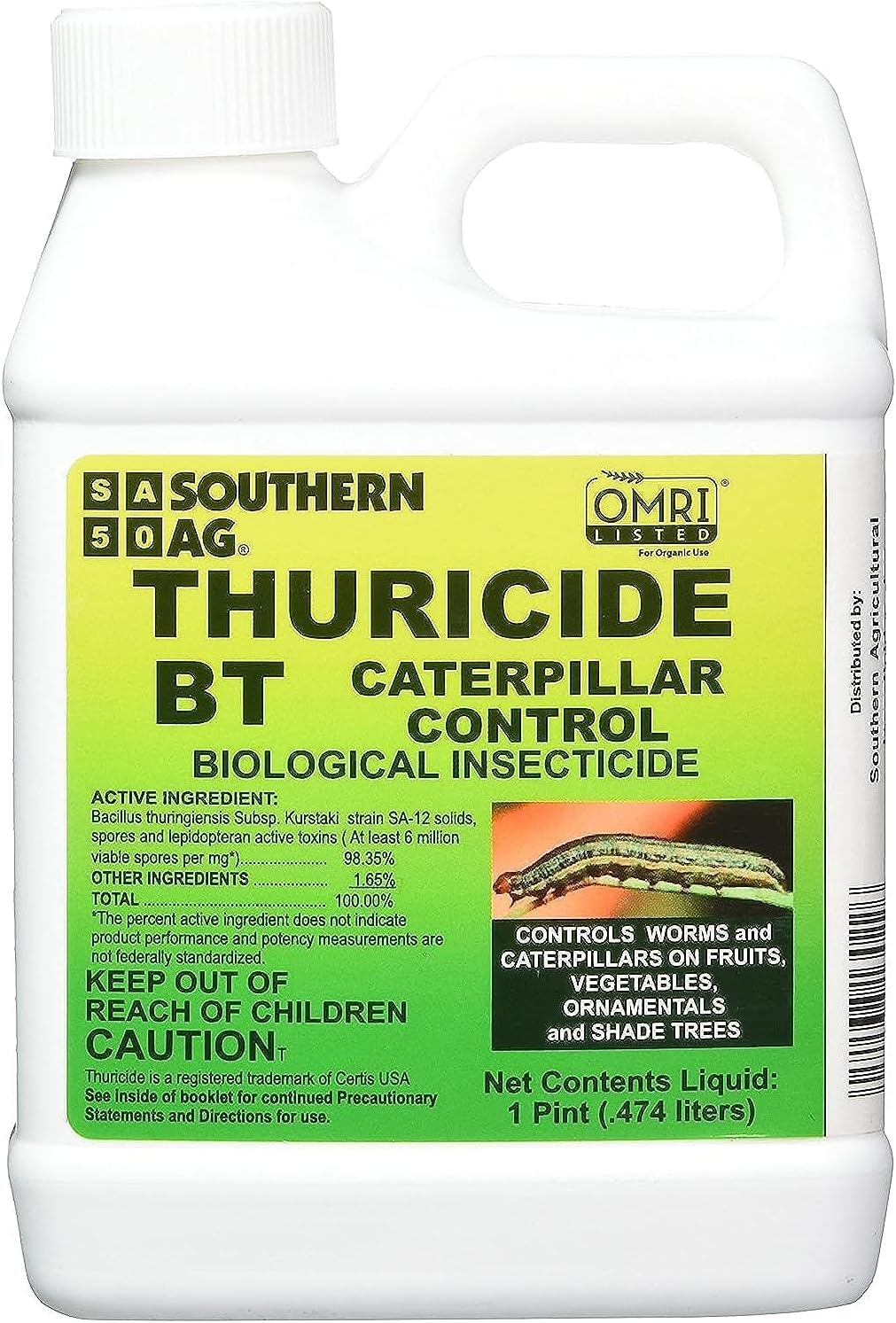
Southern Ag Thuricide BT Caterpillar Control, 16 oz concentrate
| Item Form | Liquid |
|---|---|
| Target Species | Caterpillar |
| Liquid Volume | 16 fluid ounces |
| Specification Met | OMRI |
| Active Ingredients | Bacillus Thuringiensis Kurstaki |
Southern Ag Thuricide is a concentrated biological insecticide that supplies Bacillus thuringiensis kurstaki (Btk) in a liquid form for treating lepidopteran larvae on edible and ornamental plants. Mix at the recommended rate and apply as a thorough cover spray, optionally with a spreader-sticker; typical uses include treating cabbage loopers, hornworms, and other caterpillars on vegetables, shrubs, and trees. Its OMRI listing and very low toxicity to people and pets make it a good fit for organic gardens and for use near food crops. Because Btk works by ingestion, applications must be timed to match young larvae feeding activity and thoroughly coat foliage to be effective. It does not provide systemic or long-lasting residual control, so repeat applications are usually needed during active infestations. The product is straightforward to mix and apply and is useful where selective, low-toxicity control is preferred over broad-spectrum chemical insecticides.
Best for: Gardeners who need a low-toxicity, organic-compatible option to control caterpillars on vegetables, fruit trees, and ornamentals and who are willing to monitor for early-stage larvae and reapply as needed.
Less Ideal for: Growers who need fast knockdown of large infestations without repeat applications or those seeking a systemic insecticide that protects new growth.
- OMRI listed biological control suitable for organic gardens
- Targets lepidopteran caterpillars specifically, sparing many beneficial insects when applied correctly
- Low toxicity to humans and pets, safe for use on edible crops when used as directed
- Concentrated liquid format allows dosing flexibility for different spray volumes
- Effective only if larvae ingest treated foliage and mainly controls younger instars
- No systemic or long residual action so multiple applications are needed during outbreaks
Verdict: Choose this OMRI-listed Btk concentrate when you want a budget-friendly, low-toxicity biological spray for targeted caterpillar control in organic orchards and vegetable gardens.
Monterey Spinosad Insecticide, 32 oz (concentrate)

| Unit Count | 32 Fluid Ounces |
|---|---|
| Item Form | Oil |
| Target Species | Insects |
Monterey Spinosad is a concentrated, spinosad‑based insecticide designed for home garden use to control caterpillars, leafminers, borers, thrips and many other chewing and crawling pests. Mixed into a trigger, backpack, or hose‑end sprayer, it can be applied to ornamentals, vegetables, lawns, citrus and fruit trees; the concentrate format makes it easy to cover larger areas on a schedule. The product is OMRI listed, fast acting, and practically odorless since spinosad is derived from naturally occurring bacteria. Safety directions on the label are clear and recommend protective clothing and thorough washing after handling. Limitations are that it is a broad contact toxin so beneficial insects like bees and predatory insects can be affected if applied during bloom or while pollinators are active, and you must follow label rates and reentry intervals for edible crops. For gardeners who prioritize reliable, organic‑approved control of chewing insects, this concentrate is a practical tool; those wanting an ant‑specific baiting strategy or systemic option will need a different product.
Best for: Gardeners who want a reliable, organic‑approved concentrate to quickly reduce chewing and boring insect populations across vegetables, ornamentals and fruit trees and who are comfortable following label safety and mixing instructions.
Less Ideal for: People seeking a targeted ant bait or a systemic insecticide for soilborne pests or those who need a product safe to spray during active bloom are better off with specialist ant baits or systemic products.
- OMRI listed for use in organic gardening
- Effective against a wide range of chewing and boring insects including caterpillars and leafminers
- Concentrate format works with trigger, backpack, or hose‑end sprayers for flexible coverage
- Fast acting and essentially odorless when applied properly
- Contact action can harm beneficial insects if applied when pollinators are active
- Requires mixing and careful adherence to label instructions for safe use
Verdict: Choose this OMRI‑listed spinosad concentrate when you need dependable, fast control of chewing garden pests across vegetables, ornamentals and fruit trees.
Bonide Captain Jack's Deadbug Brew Ready-to-Use Spray, 32 oz

| Item Form | Spray |
|---|---|
| Target Species | Insects |
| Liquid Volume | 32 fluid ounces |
| Active Ingredients | Spinosad 0.5% |
Bonide Captain Jack's Deadbug Brew is a 32 oz ready-to-use spinosad spray formulated for organic gardening and aimed at controlling chewing and some leaf-feeding insects. You use it like a typical foliar spray, shaking the bottle and applying thoroughly to the tops and undersides of leaves on vegetables, fruit trees, and ornamentals. The active ingredient spinosad is effective against caterpillars, beetles, loopers, thrips, and similar pests and is labeled to spare many predatory beneficial insects when used as directed, which helps maintain biological control in the garden. The built-in spray nozzle makes application quick for small to medium beds and container crops. Limitations are that it is a contact and stomach poison so thorough coverage is required and repeat applications may be necessary for heavy infestations; it is not systemic and will not protect new growth after application. Also users must follow safety directions and avoid use when pollinators are active.
Best for: Gardeners who prioritize practical, low-fuss pest control for vegetables and fruit and who want an organic-approved spray they can apply quickly without mixing.
Less Ideal for: Large acreage growers or those who need long-lasting systemic protection should look for professional or systemic options instead.
- Contains spinosad, an approved active ingredient for organic gardening that targets many chewing pests
- Ready-to-use spray with integrated nozzle for simple, no-mixing application
- Label supports use on a wide variety of vegetables and fruit crops
- Designed to have limited impact on many predatory beneficial insects when used properly
- Works by contact and ingestion so thorough coverage and repeat applications are necessary
- Not systemic, so new growth after treatment is unprotected
Verdict: A convenient, organic-approved spinosad spray that delivers effective contact control of common foliage-feeding pests on cucurbits and other garden crops.
Atticus Talak 7.9% Bifenthrin Indoor/Outdoor Insecticide Concentrate, 32 oz

| Active Ingredient | Bifenthrin |
|---|---|
| Formulation | Suspension Concentrate |
| Liquid Volume | 32 fluid ounces |
| Length of Control | Up to three months |
| Target Species | Insects |
Talak 7.9% is a liquid concentrate for treating lawns, landscaping, outdoor living areas and indoor perimeter spots like baseboards and cabinets. You dilute the concentrate with water to create a spray for barrier treatments, spot applications or lawn mixes; label rates explain how much to mix per gallon depending on the use. The product uses bifenthrin, a proven broad-spectrum active ingredient, and the manufacturer states it controls over 75 species and can give residual control for as long as three months. Its water-based formula dries clear, leaves no odor or visible residue, and is not phytotoxic on plants when used per label. Practical benefits include flexible indoor and outdoor use, clear drying, and a bottle designed for easier pouring. Important limitations are that solutions should be mixed only for same-day use, it is not registered for sale in a few states, and it is not approved for fogger application, so professional-style misting methods are not appropriate.
Best for: Buyers who want a single, reliable product to protect yards, patios and building perimeters from a wide range of common pests and prefer conservative, label-driven application practices.
Less Ideal for: People seeking ready-to-use sprays or fogger-compatible products or those in states where this formulation is not registered should look at alternatives.
- Broad-spectrum control listed for 75+ indoor and outdoor pest species
- Water-based formula that dries clear and leaves no odor or residue
- Flexible label directions for lawns, landscapes, hardscapes and indoor perimeter treatments
- Long residual activity up to three months when applied at recommended rates
- Mixed spray solutions cannot be stored and must be used the same day
- Not approved for fogger application and not available for sale in some states
Verdict: A versatile, water-based bifenthrin concentrate that delivers long-lasting, broad-spectrum outdoor (and perimeter indoor) control when used according to the label.
Choosing the Right Insecticide for Codling Moth: Key Factors to Consider
Timing Relative to Codling Moth Lifecycle
Effective control depends on treating at the right windows. Codling moth management targets newly hatched larvae before they bore into fruit, so sprays timed to egg hatch or early larval stages are far more effective than late-season attempts after larval entry. Follow local degree-day models or pheromone trap catch thresholds to plan applications.
Missing the timing window means the active ingredient never contacts the vulnerable stage, which makes even potent materials ineffective. Planning a spray calendar and tracking moth flight with traps will help you apply the insecticide when it does the most work.
Mode of Action and Larval Susceptibility
Different insecticides work in different ways: some act as stomach poisons that must be ingested by larvae, others are contact neurotoxins, and some interfere with development. For codling moth control you want products that affect neonate larvae or disrupt metamorphosis before fruit entry.
Understanding the mode of action helps you rotate chemistries across seasons to reduce resistance buildup. Choosing a product whose mode of action matches the vulnerable behavior of codling moths increases the odds of successful suppression.
Residual Activity and Reapplication Interval
Residual protection describes how long a spray remains effective on foliage and fruit surfaces. Short-residual materials may require more frequent applications timed to moth flights, while longer-residual options can reduce labor but increase exposure windows for non-target organisms.
Balance residual duration with safety needs and label preharvest intervals. Consider weather exposure-rain and heavy sunlight reduce residue life-so check recommended reapplication intervals after wash-off events.
Pollinator and Beneficial Insect Safety
Fruit trees rely on pollinators and host many beneficial predators and parasitoids that suppress secondary pests. Some insecticides are highly toxic to bees and lacewings, while others have minimal impact when applied outside bloom or used at low-impact times.
Plan applications for times of low pollinator activity, avoid spraying during bloom unless the product label allows it, and prefer targeted treatments that reduce non-target exposure. Choosing materials compatible with beneficials is essential for long-term orchard health.
Application Method and Equipment Needs
Practical application depends on available equipment and the size of the planting. Backyard growers often use hand-held or backpack sprayers, while larger plantings might use ATVs or tractor sprayers. Some formulations are ready-to-use sprays, others are concentrates that require mixing and more precise calibration.
Consider droplet size, coverage needs for canopy height, and whether the formulation can be effectively applied from your sprayer. Ease of mixing, tank stability, and the need for adjuvants also affect how readily you can get consistent control.
Preharvest Interval and Residue Considerations
Preharvest interval, or PHI, determines how long before harvest an insecticide must not be used. For tree fruit destined for fresh eating, choose products with PHIs that align with your harvest schedule to avoid residues above allowable thresholds.
Residue persistence also affects follow-up treatments and when fruit is safe for consumption. Read label restrictions carefully to match spray timing with your intended harvest date and postharvest plan.
Monitoring and Timing Strategies
Successful codling moth control starts with monitoring. Place pheromone traps in the canopy before expected flight and check counts twice weekly during warm periods. Track first flight and use local degree-day guidance to predict peak egg hatch so you can time insecticide applications to when neonate larvae are active on fruit.
Weather and orchard microclimates alter flight timing, so pair trap data with regional advisories. For small plantings, even a single well-timed application around first hatch can greatly reduce fruit entry, but larger or high-pressure sites often need multiple treatments spaced according to residual claims.
- Use at least two traps per orchard block or per 10 trees in a backyard planting.
- Record trap catches and dates to build a local flight calendar for future seasons.
Integrating Pheromone Mating Disruption and Cultural Controls
Mating disruption and cultural practices reduce pressure and make insecticide applications more effective. Removing dropped and infested fruit, thinning dense foliage, and pruning to improve spray penetration lower population growth. In sites using mating disruption, you may see reduced trap catches but should still monitor for any residual activity to time spot treatments.
Cultural controls are low-cost and reduce reliance on chemicals, but they are most effective when used in combination with properly timed insecticide applications during peak hatch windows.
- Keep the orchard floor clean to prevent larvae from completing life cycles in dropped fruit.
- Avoid heavy nitrogen fertilization late in the season that can create sheltered growth favored by moths.
Choosing Low-Impact Options for Pollinator Safety
If bees forage near your trees, prioritize products that are less toxic to pollinators and apply them outside bloom periods or at night when pollinator activity is low. Some materials break down quickly and pose lower residual risk when used correctly. Protective application timing and targeted spot treatments reduce harm to beneficial insects.
Consider placing pollinator-friendly plantings away from spray zones and communicate spray timing to neighboring gardeners who keep hives or pollinator habitats.
- Apply sprays late in the evening when bees are not active.
- Avoid broad-spectrum contact insecticides during bloom unless the label explicitly allows use without pollinator harm.
Application Tips for Backyard and Small-Orchard Sprayers
For small operations, calibration and coverage matter more than application horsepower. Use a nozzle that produces a medium-fine spray for canopy penetration and adjust pressure for even coverage without runoff. Mix concentrates carefully and keep records of rates and dates to maintain legal and safe use.
Ensure good coverage of fruit and upper canopy where moths lay eggs. Spot-treating high-pressure trees while leaving low-pressure areas on a wider reapplication schedule can conserve materials and reduce non-target exposure.
- Wear appropriate PPE as specified on the label and follow mixing instructions closely.
- Rinse sprayers and dispose of rinse water according to guidelines to avoid contamination.
Resistance Management Practices
Rotate modes of action across seasons and within the same season where possible to slow resistance development. Using the same chemistry repeatedly selects for tolerant populations. Integrate non-chemical tactics such as mating disruption, sanitation, and natural enemies to maintain effectiveness of available insecticides.
Record the modes of action you use each season and avoid back-to-back applications of products with the same mechanism. Consultation with local extension services can help identify resistance reports and recommended rotation strategies.
- Alternate products with different modes of action labeled for codling moth control.
- Use monitoring to reduce unnecessary applications and preserve susceptibility in the moth population.
How We Chose the Best Insecticide for Codling Moth
We prioritized options that show reliable larval suppression, work at recommended timing windows for codling moth, and can be used safely in small orchards or backyard fruit trees. Evaluation focused on control mode and lifecycle targeting, residual activity and reapplication interval, safety profile for beneficial insects and humans, and compatibility with integrated pest management practices. We also considered ease of application for typical backyard sprayers and tank mixes, label clarity for timing and preharvest intervals, and material availability to typical gardeners. Exclusions included products that are expressly restricted to commercial use only, materials with no documented efficacy against codling moth life stages, and obsolete chemistries no longer supported by current guidance. The result is a set of insecticide classes and formulations suited to backyard and small-scale orchard timing, safety, and practical application constraints.
FAQ
When should I start monitoring for codling moth in my orchard?
Begin in spring as temperatures warm and buds open. Deploy pheromone traps before expected first flight and check them regularly to detect the start of adult activity and guide spray timing.
Can I spray insecticide during bloom if codling moth pressure is high?
Spraying during bloom increases risk to pollinators. Only use products explicitly labeled as safe during bloom and prefer evening applications when pollinators are less active. Whenever possible, avoid bloom sprays and use cultural or mating disruption measures instead.
How many applications are usually needed in a season?
The number varies with pressure, product residual, and monitoring data. Low-pressure backyard situations sometimes need a focused series around peak hatch, while high-pressure sites often require multiple applications spaced per label reapplication intervals.
Will trunk banding or pheromone traps control codling moth without sprays?
Mating disruption can greatly reduce mating and subsequent egg laying in larger uniform plantings, but in small or border plantings it may be less effective alone. Traps are valuable monitoring tools but do not provide population-level control by themselves unless used with mass-trapping strategies.
How does weather affect spray effectiveness?
Rain shortly after application can wash off residues and shorten protection, and high UV can degrade some materials faster. Wind affects coverage and drift, so pick calm windows and reapply if heavy rain occurs within the protection window.
What safety precautions should I follow when applying insecticides?
Always follow label instructions for personal protective equipment, mixing, and application. Keep people and pets away from treated trees until the label-specified reentry interval has passed, and avoid spraying during windy conditions to limit drift.
Final Verdict
Choose insecticides that align with your timing strategy, equipment, and safety priorities. Prioritize products that target neonate larvae and fit into an IPM plan that includes monitoring, sanitation, and rotation of modes of action. Weigh residual needs against pollinator safety and PHI constraints to pick an approach that protects fruit while minimizing non-target impacts. With careful monitoring and proper timing, you can significantly reduce codling moth damage and preserve healthy trees for future seasons.
