

Note: This article contains affiliate links. If you click on these links and make a purchase, I may earn a small commission at no extra cost to you. This helps support my research and content. Read my full affiliate disclosure here.
If crazy ants have moved into your yard, garden beds, or home perimeter, picking the right insecticide matters for quick relief and lasting control. You need a product that works on the species present, leaves an effective residual where ants forage, and can be applied without harming plants, pollinators, or family members. This guide reviews a short list of the top insecticides for crazy ants across common use situations, from spot treatments on patios to perimeter barrier applications. Each shortlisted option was evaluated for how it behaves in a real garden setting, safety in use, and how long control typically lasts. Read on for practical notes that will help you match an insecticide to your application and environment.
Top Picks at a Glance
| Best Overall The best all-around choice for most situations | Syngenta Advion Ant Gel Bait, 30 g |  |
| Best Quality Built to a higher standard if you want something more solid | Atticus Talak 7.9% Indoor/Outdoor Bifenthrin Insecticide Concentrate (1 gal) |  |
| Best Value The sweet spot between price and what you get | Syngenta Advion Ant Gel (4 Tubes, 30 g each) |  |
| Best Budget The cheapest option that still gets the job done reliably | Raid Ant Killer Baits, 8 Count (Child-Resistant) |  |
| Highest Rated A top-rated pick with lots of positive feedback | Alpine WSG Insecticide — 5 × 10 g Packets with Chemical-Resistant Gloves and Pest ID Card |  |
| Most Popular A crowd favorite that many people choose with confidence | Ortho Home Defense Insect Killer for Indoor & Perimeter, 1.33 gal. with Comfort Wand |  |
| Best Seller A high-volume bestseller chosen again and again | TERRO Liquid Ant Killer Bait Stations, 12-Pack (T300B) |  |
Syngenta Advion Ant Gel Bait, 30 g

| Item Form | Gel |
|---|---|
| Target Species | Insects |
| Active Ingredients | Indoxacarb |
Advion Ant Gel is a concentrated, professional-style ant bait formulated around indoxacarb and a highly palatable gel matrix to lure foraging ants and carry toxicant back to the colony. You apply small dabs of the translucent, nonstaining gel in ant trails, near nesting sites, or in voids where ants forage; workers feed on the gel and transfer it through trophallaxis, which helps suppress entire colonies rather than just worker ants. The formulation is touted for lasting integrity with low odor and high attractiveness to sweet-feeding species, so you do not need frequent reapplication in protected spots. Because it is a targeted bait rather than a broadcast insecticide, it is practical for spot treatments in kitchens, pantries, and around baseboards as well as sheltered outdoor locations. Important limits are that it is a bait product requiring worker-mediated distribution so results are not instant and indoor use requires keeping it away from children and pets.
Best for: Buyers who prioritize effective colony-level control and want a concentrated, professional-style bait for spot treatments inside homes or in sheltered outdoor locations.
Less Ideal for: People needing immediate knockdown of visible ants or those who require a product for widespread outdoor perimeter treatments should consider different control methods.
- Contains indoxacarb, a potent active ingredient with a unique mode of action
- Highly palatable, translucent gel that attracts sweet-feeding ants
- Maintains formulation integrity for extended periods in sheltered application sites
- Suitable for indoor and sheltered outdoor spot treatments
- Relies on worker feeding and transfer so colony elimination can take several days to weeks
- Not intended for broad outdoor broadcast use or exposed wet areas
Verdict: Choose Advion Ant Gel when you want a high-performance, worker-transferred bait that targets colonies rather than just knocking down visible ants.
Atticus Talak 7.9% Indoor/Outdoor Bifenthrin Insecticide Concentrate (1 gal)

| Active Ingredients | Bifenthrin |
|---|---|
| Formulation | Suspension Concentrate |
| Unit Count | 128 Fluid Ounces |
| Specification Met | EPA |
Talak 7.9% is a water-based bifenthrin concentrate meant as a flexible indoor and outdoor insect control product. You dilute the concentrate with water and apply it as a spray for perimeter barrier treatments, to turf, to ornamentals, or to interior baseboards and other problem areas. The label lists control of more than 75 pests including mosquitoes and ticks, and the formula is designed to kill on contact and provide residual control for up to three months. Practical benefits include a clear, odor-free spray that dries without staining and a bottle that allows easier small pours for accurate mixing. Important limitations are that mixed solutions should be used the same day and it is not approved for fogger use, so it is best for targeted spray applications rather than broadcast fogging. As with any bifenthrin product, users should follow label directions closely and consider nonchemical options for integrated mosquito management.
Best for: Buyers who want a single, versatile insecticide to treat both perimeter and landscape mosquito problems and prefer a product that delivers residual control without odors or visible residue.
Less Ideal for: People seeking a ready-to-use fogging or misting solution or those who need an insecticide they can pre-mix and store for later use.
- Broad-spectrum control listing more than 75 indoor and outdoor pests including mosquitoes and ticks.
- Water-based formula that dries clear, leaves no residue, and is odor-free for use around living areas.
- Long residual effect with label claim of up to three months of control per application.
- Mixes with water for adjustable application rates across lawns, landscapes, and surfaces.
- Bottle design supports easier small pours to reduce mess when measuring concentrate.
- Mixed spray cannot be stored and must be used the same day.
- Not approved for use in foggers, limiting application methods to direct sprays.
Verdict: A versatile, long-lasting bifenthrin concentrate that provides broad-spectrum mosquito and perimeter control for users who want one product for indoor and outdoor applications.
Syngenta Advion Ant Gel (4 Tubes, 30 g each)

| Unit Count | 4.23 Ounce |
|---|---|
| Included Components | 4 Tubes x 30-Grams, 1 Plunger and 2 Tips |
| Item Form | Gel |
| Active Ingredients | 0.05% indoxacarb |
| Target Species | Insects |
Advion Ant Gel is a user-friendly gel bait intended to control common household and structural ant species by exploiting worker foraging behavior. You apply small spots or short lines of the odorless gel along active trails, in cracks and crevices, and near entry points; foraging workers consume the bait and carry it back to the nest where it is shared, helping to eliminate the queen and other nestmates. The kit ships with four 30 g tubes plus an applicator plunger and tips for precise placement, which makes targeting tight spaces straightforward. Its non-repellent formula with 0.05% indoxacarb is formulated to be attractive to a range of species including Argentine and carpenter ants, and it is labeled for both indoor and outdoor use. Limitations to note are that it is a chemical bait so safety precautions are needed around children and pets and efficacy depends on ants accepting the bait matrix versus other available food sources.
Best for: Homeowners and renters who want a targeted, easy-to-apply solution to eliminate established ant infestations and prefer a bait that works via worker-mediated transfer to treat whole colonies.
Less Ideal for: People seeking non-chemical or immediate-contact kill methods or those who need a one-time spray rather than ongoing baiting strategies should consider other options.
- Non-repellent gel formulation designed for worker ants to feed and transfer bait to the colony
- Includes four 30 g tubes plus a plunger and application tips for precise placement
- Labelled for both indoor and outdoor use, suitable for common pest species
- Odorless formula that is easy to place along trails, cracks, and crevices
- Contains a chemical active ingredient so it must be kept away from children and pets
- Effectiveness depends on ants preferring the bait over other available food sources
Verdict: Choose Advion Ant Gel when you want a precise, bait-based solution that encourages workers to carry poison back to the nest for colony-level control.
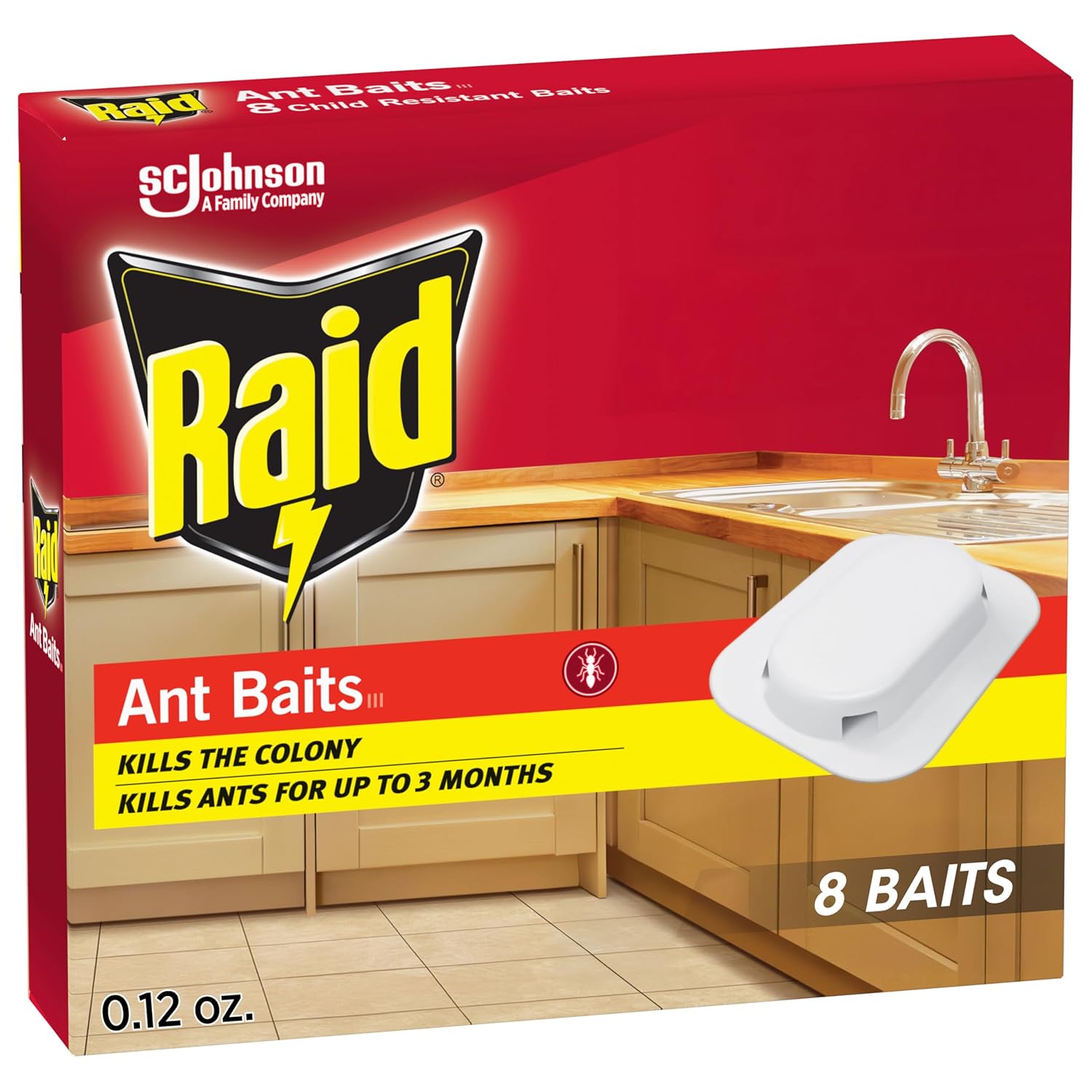
Raid Ant Killer Baits, 8 Count (Child-Resistant)
| Package quantity | 8 Count |
|---|---|
| Child safety | Child-resistant |
| Intended use | Indoor |
| Effect duration | Up to 3 months |
These Raid Ant Killer Baits are small, ready-to-use indoor stations that dispense an attractive liquid bait ants carry back to the colony, which can eliminate the nest over time. You place the bait along walls, in corners, and near entry points where small ants forage; after ants feed, the active ingredient is shared with other colony members, including the queen, and protection can last for weeks. The child-resistant design reduces accidental access in homes with children while the compact stations are low-profile and easy to position. Because they are prefilled and disposable, there is no mixing or measuring, which makes them convenient for quick treatment in kitchens, pantries, and baseboards. Limitations are that the product is for indoor use only and may be less effective if competing food sources are left available or if multiple heavy infestations require broader perimeter treatment. For someone looking for a simple, no-fuss bait to try first, these are a practical option.
Best for: Budget-minded homeowners or renters who want an easy, low-effort indoor solution to control small ant trails and try baiting before calling for broader treatments.
Less Ideal for: People needing immediate knockdown for very large or outdoor ant colonies or those who prefer non-chemical mechanical control methods.
- Ready-to-use prefilled bait stations that require no setup
- Child-resistant design reduces accidental access
- Bait formula is transferred through the colony to target the queen
- Compact, low-profile stations are easy to place along walls and entry points
- Intended for indoor use only, not suited for outdoor colony control
- May be less effective if other food sources are available or in very large infestations
Verdict: A low-cost, no-fuss indoor bait station that effectively targets small ant colonies by having foragers carry bait back to the nest.
Alpine WSG Insecticide — 5 × 10 g Packets with Chemical-Resistant Gloves and Pest ID Card

| Package contents | 5 x 10 g packets, gloves, pest ID card |
|---|---|
| Formulation | Water-soluble granules (WSG) |
| Intended use | Indoor and outdoor pest control |
Alpine WSG comes as concentrated 10 g packets of water-soluble granules that you mix for spot or perimeter treatments, and the package here includes chemical-resistant gloves and a pest identification card. In practice it is used to create ready-to-use sprays for cracks, crevices and baseboards where German roaches hide, or as a perimeter treatment around structures. The included gloves help reduce exposure when handling concentrates and the pest card is a handy quick reference for identifying common household insects. Because it is a granular WSG formulation it offers flexible dilution rates for higher or lower intensity treatments depending on infestation severity. Limitations are that it requires correct mixing and careful application to avoid contact with surfaces where people or pets may be exposed, and it does not include an applicator so you will need a spray bottle or pump sprayer. For buyers prioritizing dependable roach control, the packet format and protective gloves make this a practical option when used with proper safety precautions.
Best for: Best for homeowners or pest-control-minded users who want a reliable, concentrated roach treatment they can mix to match infestation severity and who follow safety procedures when handling insecticides.
Less Ideal for: Not a good fit for users who need a ready-to-use product or who prefer non-chemical control methods.
- Concentrated water-soluble granules allow flexible dilution for spot treatments or broader perimeter applications
- Includes chemical-resistant gloves to reduce exposure when handling concentrate
- Pest identification card helps confirm target species before treatment
- Packet format is easy to store and measure for consistent mixing
- Requires mixing and separate spray equipment which adds setup time
- No applicator included so an appropriate sprayer must be purchased or supplied
Verdict: A concentrated, packeted WSG insecticide with gloves and a pest ID card that gives reliable, flexible treatment options for German roach control when mixed and applied correctly.
Ortho Home Defense Insect Killer for Indoor & Perimeter, 1.33 gal. with Comfort Wand

| Item Form | Spray |
|---|---|
| Target Species | Insects |
| Liquid Volume | 1.33 gallons |
| Active Ingredients | Bifenthrin 0.05%, Zeta-Cypermethrin 0.0125% |
This 1.33 gallon Ortho Home Defense spray is designed to treat both indoor problem spots and the outdoor perimeter of a home to reduce ants, roaches, spiders and many other crawling and flying insects. It comes with a battery-powered Comfort Wand that delivers a continuous spray so you can apply a uniform band around foundations, patios and entry points without bending or pumping. The formula with bifenthrin and zeta-cypermethrin is intended to kill on contact and establish a barrier that the manufacturer says lasts up to 12 months for ants, roaches and spiders on non-porous indoor surfaces. In real-world use that means fewer repeat treatments in busy yard perimeters and around doors and windows. The spray dries clear with minimal fumes which helps for indoor use near kitchens and living areas. Limitations are that this is a chemical insecticide so users should follow safety directions around children, pets and plants and it is not a specific solution for pests not listed on the label. For homeowners focused on strong, perimeter-level protection this product simplifies application and covers a large area per container.
Best for: Homeowners who want a performance-focused perimeter treatment to reduce recurring yard and entry-point insect problems and prefer a ready-to-use product that is easy to apply.
Less Ideal for: People seeking organic or non-chemical control methods or those who need a targeted solution for pests not listed on the label should consider alternative products.
- Includes battery-powered Comfort Wand for continuous, fatigue-free application
- Ready-to-use 1.33 gallon container covers large perimeters without mixing
- Formula creates a barrier claimed to provide up to 12 months protection against ants, roaches and spiders on non-porous indoor surfaces
- Dries clear and gives off minimal fumes, making indoor use more practical
- Contains synthetic insecticides so precautions are required around children, pets and ornamentals
- Protection claims are specific to certain species and surfaces so results vary by pest and conditions
Verdict: A powerful, ready-to-use perimeter and indoor spray for homeowners who want long-lasting, performance-oriented protection against common yard and household insects.
TERRO Liquid Ant Killer Bait Stations, 12-Pack (T300B)

| Unit Count | 12 Count |
|---|---|
| Item Form | Liquid |
| Target Species | Insects |
| Active Ingredients | Sodium Tetraborate Decahydrate (Borax), 5.40% |
Terro Liquid Ant Killer bait stations are prefilled, single-use traps designed for indoor control of common sugar-loving ants. You place the small stations along baseboards, in corners, under appliances, or on countertops where you see ant activity. Worker ants are drawn to the sweet liquid, feed on it, and take it back to the nest so the borax-based active ingredient can eliminate the colony over days to weeks. The product is easy to use with no mixing or setup and the 12-pack gives coverage for several rooms. Because the bait is contained inside a low-profile plastic station, it reduces incidental contact risk compared with loose sprays or powders and lasts for weeks while ants continue to visit. Limitations are that the formula targets sugar-preferring species so very protein- or grease-attracted ants may ignore it, and control can take 2 to 4 weeks for larger infestations. Also stations should be placed away from pets and children despite the contained design since the bait contains borax.
Best for: Homeowners who prioritize an easy, low-hassle indoor solution and want a bait that works at the colony level with minimal hands-on pest handling.
Less Ideal for: People who need immediate knockdown of ants or who have pets or children that frequently access treated areas and cannot reliably keep them away from placed stations.
- Ready-to-use stations require no mixing or setup
- Designed to be carried back to the nest for colony-level control
- Low-profile enclosed bait reduces messy exposure compared with loose liquids or sprays
- 12 stations provide coverage for multiple rooms or hotspots
- Formulation is sugar-based so less effective on ants that prefer protein or grease
- Control can take 2–4 weeks for large or established colonies
Verdict: A simple, low-contact indoor bait system that reliably reduces sugar-loving ant infestations by getting worker ants to carry borax back to the colony.
Choosing the Right Insecticide for Crazy Ants: Key Factors to Consider
Residual Control Duration
How long an insecticide continues to affect ants after application is a primary factor. Longer residuals reduce the need for repeat treatments, but longevity depends on formulation, active ingredient, and where you apply it. For example, products applied to hardscape or bare soil often persist longer than sprays on foliage because plant surfaces can degrade residues faster.
Consider the tradeoff between residual life and environmental exposure. Extended residuals are helpful for perimeter barriers and around structures, while shorter residuals may be preferable when treating flower beds visited by pollinators. Read label directions for re-entry and reapplication intervals to avoid overuse and to match the residual to your management goals.
Application Method and Versatility
Insecticides come as concentrates, ready-to-use sprays, baits, granules, and dusts. The application form affects precision, coverage, and suitability for different parts of the garden. Baits are often best for attacking colony food pathways and can reduce ant numbers with less non-target exposure. Granules are useful for treating perimeter soil or mulched beds without wetting plants. Liquid concentrates and ready-to-use sprays offer flexible coverage for visible trails and infested areas.
Choose a form that matches the area you need to treat and the equipment you have. Some formulations allow spot treatment to limit non-target exposure, while others are intended for broad barrier applications. Versatility matters when you need both perimeter protection and targeted nest interventions.
Safety Around People, Pets, and Pollinators
Safety labels and stated precautions should guide product selection when treating near living spaces and garden plants. Look for explicit instructions on safe distances from play areas, pet exclusion times, and whether treated surfaces may be used by pollinators. Some insecticides require keeping pets and children away until residues dry, while certain baits reduce exposure because they are placed in tamper-resistant stations.
You should also consider timing applications to reduce pollinator contact, for example applying late evening when bees are less active. Choosing a product with clear mitigation steps and lower non-target toxicity will help reduce risks while still achieving control.
Targeting Foraging Trails and Nest Sites
Crazy ants travel long foraging paths and may nest in soil, under mulch, or inside structures. Effective control requires treating the right places: along trails, at entry points, and near nest sites if identified. Products that work on contact plus provide residual protection along trails are valuable because they quickly reduce visible activity and then suppress returning workers.
Baiting strategies are effective when ants accept the bait and carry toxicants back to the colony. Consider whether your situation is better addressed by direct-contact suppression for immediate relief or baiting for longer-term colony reduction. Inspecting the site to locate trails and likely nest areas improves placement and overall success.
Label Restrictions and Garden Compatibility
Always check label restrictions for use on or near edible plants, water features, and certain landscape materials. Some products permit application to ornamentals and non-bearing fruit trees but prohibit use directly on vegetables or herbs. Others specify buffer zones around ponds or storm drains to protect aquatic life.
Garden compatibility also covers phytotoxicity risks. Certain formulations may stress tender transplants or blooms. Following label rates and avoiding application during hot, sunny periods will reduce phytotoxicity. Ensuring the product is labeled for the locations you plan to treat prevents misuse and potential harm to plants or the environment.
Weather Tolerance and Rainfastness
Outdoor conditions strongly affect insecticide performance. Rain shortly after application can wash away residues and reduce effectiveness, while intense sun and heat can speed chemical degradation. Check label guidance for rainfast periods and ideal application windows to maximize efficacy.
Products with better adhesion, encapsulation, or systemic activity retain effectiveness longer in variable weather. Plan applications during stable weather forecasts and use formulations suited to your climate so treatments persist long enough to impact foraging ants and colonies.
Preparing the Site Before Treatment
Survey areas where ants are active to find trails, nest entrances, and points of entry into structures. Removing food sources, trimming vegetation that contacts foundations, and cleaning up spills reduces attractiveness and improves insecticide placement.
Clear loose debris and sweep patios before applying a perimeter spray so residues reach the surface rather than clinging to mulch. For baits, position stations along active trails and out of direct sun to keep the bait palatable.
- Map visible trails and mark likely nest sites
- Remove food debris and standing water
- Trim vegetation away from structures to reduce bridge points
When to Use Baits Versus Contact Treatments
Baits are preferable when you can identify active trails and want to suppress colonies via poisoned food transfer. They are less disruptive to beneficial insects when used properly and can offer longer-term reduction of worker populations.
Contact sprays or barrier treatments are better for rapid knockdown along foundations, patios, and around door thresholds. These are useful when immediate reduction of visible ants is necessary but may require follow-up treatments or complementary baiting to address colonies.
- Use baits for colony-level control and long-term suppression
- Use contact or barrier sprays for immediate reduction of foraging workers
- Combine methods for faster and more durable results
Safe Application Practices in Vegetable and Flower Beds
When treating beds with edible plants, choose products labeled for use in those areas or apply non-spray options like targeted baits set in stations. Avoid spraying foliage of edible crops unless the label explicitly allows it and follow pre-harvest intervals.
For ornamentals, avoid applying sprays to open blooms to reduce pollinator exposure. Apply late in the day when pollinator activity is low and use spot treatments to limit non-target contact.
- Confirm label permissions for edibles before treating
- Use bait stations rather than broadcast sprays when possible
- Time applications to minimize pollinator exposure
Monitoring and Follow-Up
After an application, monitor activity for several days to a couple of weeks depending on the product's expected residual. Look for reductions in trail traffic and check bait stations for uptake. Reapply or switch tactics if there is no measurable decline in activity.
Maintain good sanitation and structural caulking to prevent re-infestation. Follow label reapplication intervals and avoid overlapping treatments that could increase non-target risks.
- Inspect treated areas daily for the first week
- Record which placements and methods yielded the best uptake
- Seal entry points and reduce attractants to prevent reinvasion
Environmental Considerations and Non-Target Protection
Protect pollinators and aquatic life by respecting label buffer zones and avoiding application during bloom or near standing water. Use targeted treatments and baits that reduce drift and exposure.
Consider mechanical and cultural controls as part of an integrated approach. Trimming, sanitation, and moisture management decrease ant habitat and let insecticides target remaining problems more effectively.
- Avoid treatments during peak pollinator activity
- Keep products away from gutters and storm drains
- Combine cultural controls with chemical tools for sustainable results
How We Chose the Best Insecticide for Crazy Ants
We screened products based on the features that matter most when treating crazy ants in outdoor and near-home settings. Key evaluation criteria included residual efficacy under realistic garden conditions, how the material is applied (granule, liquid concentrate, ready-to-use), label directions for use around gardens and edible plants, and the safety profile for people, pets, and pollinators. We also considered how well products perform against colonies and foraging trails, including whether they allow targeted baiting or require broad perimeter sprays. Weather tolerance and rainfastness were checked because outdoor treatments often face sun and rainfall that reduce effectiveness. Ease of mixing, dosage clarity on the label, and availability of application equipment were used to judge practicality. We excluded products that lack clear label instructions for residential or garden use, materials with restricted-use classifications that are not accessible to typical gardeners, and formulations unsuitable for spot or perimeter application. The resulting shortlist represents materials that balance effective control of crazy ants with practical application methods and sensible safety directions.
FAQ
How long after application will I see crazy ant activity decrease?
You will often see a noticeable decline in foraging activity within 24 to 72 hours with contact products, while baits may take several days to a week as the toxicant is carried back to the colony. Results depend on the product type, colony size, and placement quality.
Can I use insecticide around vegetable beds and herbs?
It depends on the product label. Some formulations are cleared for use near edibles with specified pre-harvest intervals and application limits. When in doubt, use bait stations or treat non-bearing areas and follow label directions closely.
Will rain wash away treatments and make them ineffective?
Rain can reduce effectiveness, especially if it occurs shortly after application. Choose products labeled as rainfast or follow label guidance on reapplication intervals. Applying during stable dry weather improves persistence.
Are baits better than sprays for long-term control of crazy ants?
Baits can be more effective at colony-level suppression if ants accept and carry the bait back to nest sites. Sprays often provide faster knockdown of visible workers but may require follow-up to impact colonies. Combining both approaches is common.
How should I protect pets and family during and after treatment?
Follow label precautions regarding re-entry times and keep pets and children away from treated areas until residues dry or until the label permits access. Use bait stations placed out of reach to reduce accidental ingestion.
What if treatments do not reduce ant activity?
Inspect for missed trails, improper placement, or bait avoidance. You may need to change formulation or placement strategy, improve sanitation, or consult extension resources for identification and targeted tactics. Avoid repeated overlapping applications that increase non-target risks.
Final Verdict
Choose an insecticide based on where the ants forage and nest, whether you need immediate knockdown or colony-level control, and the safety constraints around people, pets, and pollinators. Prioritize formulations and application methods that fit the garden area you are treating and follow label directions for timing and reentry. Combining targeted baits with perimeter or trail treatments often gives the best balance of quick relief and longer-term suppression.
