

Note: This article contains affiliate links. If you click on these links and make a purchase, I may earn a small commission at no extra cost to you. This helps support my research and content. Read my full affiliate disclosure here.
Hornworms can strip tomato, pepper, and eggplant foliage in a single night, so choosing the right insecticide matters for keeping plants productive without stressing them. This guide covers the top shortlisted insecticide options for hornworms, showing how each performs in garden use and why certain formulations suit different situations. You will find picks that prioritize quick control, gentle handling for edible plants, and straightforward application techniques. We evaluated products across practical gardener-focused criteria like knockdown speed, residual protection, and safety on edible crops. The following selections represent the best-balanced choices for managing hornworms in small to medium vegetable plots and container gardens.
Top Picks at a Glance
| Best Overall The best all-around choice for most situations | Bonide Thuricide BT Concentrate, 16 oz Ready-to-Mix |  |
| Best Quality Built to a higher standard if you want something more solid | Bonide Captain Jack's Deadbug Brew 16 oz Concentrate |  |
| Best Value The sweet spot between price and what you get | Southern Ag Thuricide BT Caterpillar Control Concentrate, 16 oz |  |
| Best Budget The cheapest option that still gets the job done reliably | Southern Ag Thuricide HPC Concentrate 8 oz (Bacillus thuringiensis) |  |
| Highest Rated A top-rated pick with lots of positive feedback | Monterey Spinosad Insecticide, 32 oz (concentrate) |  |
| Most Popular A crowd favorite that many people choose with confidence | Bonide Captain Jack's Bt Thuricide Ready-to-Use Spray, 32 oz |  |
| Best Seller A high-volume bestseller chosen again and again | Bonide Captain Jack's Deadbug Brew Ready-to-Use Spray, 32 oz |  |
Bonide Thuricide BT Concentrate, 16 oz Ready-to-Mix

| Unit Count | 16 Ounce |
|---|---|
| Item Form | Spray |
| Target Species | Worm & Caterpillar |
| Active Ingredients | Bacillus thuringiensis |
Bonide Thuricide is a BT-based liquid concentrate intended for spot and broadcast spraying to control caterpillars, cutworms, and other worm pests on vegetables, ornamentals, and fruiting plants. You mix the concentrate with water in a garden sprayer (label suggests 1 to 4 teaspoons per gallon) and apply to foliage when larvae are actively feeding, making sure to coat leaf undersides. Because it is Bacillus thuringiensis it works by ingestion, so treated insects stop feeding and die over a few days rather than immediately. The product is approved for organic gardening and is described as harmless to birds, earthworms, and many beneficial insects when used as directed. Practical benefits include suitability for use up to the day of harvest on many vegetables and a familiar, well-established active ingredient gardeners trust. Limitations are that control requires thorough coverage and correctly timed applications, and results are slower than fast-acting contact insecticides so repeated applications may be needed for heavy infestations.
Best for: Gardeners who want an organic-approved, targeted way to manage cutworms and caterpillars on vegetables and ornamentals and who are willing to apply treatments carefully and on schedule.
Less Ideal for: Users seeking immediate knockdown of heavy infestations or a single-application cure; those who prefer broad-spectrum contact insecticides for instant results should consider other options.
- Contains Bacillus thuringiensis, an organic-approved active ingredient effective against caterpillars and worms
- Ready-to-mix liquid concentrate lets you adjust dilution rate for spot treatments or larger areas
- Safe for use up to the day of harvest on many vegetables when label directions are followed
- Low impact on birds, earthworms, and many beneficial insects when applied correctly
- Requires ingestion by pests so control is slower and depends on larvae actively feeding
- Needs thorough coverage and potentially multiple applications for heavy infestations
Verdict: A trusted BT concentrate for gardeners who want an organic, low-impact way to control cutworms and caterpillars with correctly timed, thorough applications.
Bonide Captain Jack's Deadbug Brew 16 oz Concentrate

| Unit Count | 16 Ounce |
|---|---|
| Item Form | Spray |
| Target Species | Insects |
| Active Ingredients | Spinosad (Mixture of Spinosyn A and Spinosad D) |
Bonide Captain Jack's Deadbug Brew is a concentrated spinosad insecticide designed for use on vegetables, fruits, ornamentals, and other garden plants. You mix the 16 fl oz concentrate with water and apply it with a trigger, hand-held, backpack, or hose-end sprayer to target caterpillars, beetles, borers, leaf miners, and similar chewing pests. Because the active ingredient is spinosad, the product is approved for organic gardening and is selective enough that it does not significantly impact many predatory beneficial insects and mites when used as directed. In practical use it provides quick knockdown of listed pests and is suitable for protecting squash and other cucurbits from feeding damage. The main limitations are that it must be mixed and applied correctly following label rates and safety instructions and that repeated broad use can still affect non-target insects if timing and coverage are not careful. For gardeners focused on protecting food crops, it is a straightforward, effective option when integrated with scouting and spot treatments.
Best for: Gardeners who prioritize practical, effective pest control for edible gardens and want an organic-approved concentrate they can mix and apply themselves to protect squash and other crops.
Less Ideal for: Gardeners seeking a ready-to-use spray or those unwilling to follow label mixing and safety instructions should consider alternative formats or professional application.
- Contains spinosad, an active ingredient approved for organic gardening and effective against caterpillars and beetles
- Concentrate mixes with water for use with trigger, backpack, hand-held, or hose‑end sprayers
- Labeled for use on a wide range of vegetables, fruits, and ornamentals including cucurbits
- Designed to minimize impact on many predatory beneficial insects and mites when used as directed
- Requires careful mixing and application per label to avoid harming non-target insects
- Not a residual solution for all pests so repeat applications or scouting are often necessary
Verdict: A practical, organic-approved spinosad concentrate that reliably controls chewing pests on squash and other garden crops when mixed and applied correctly.
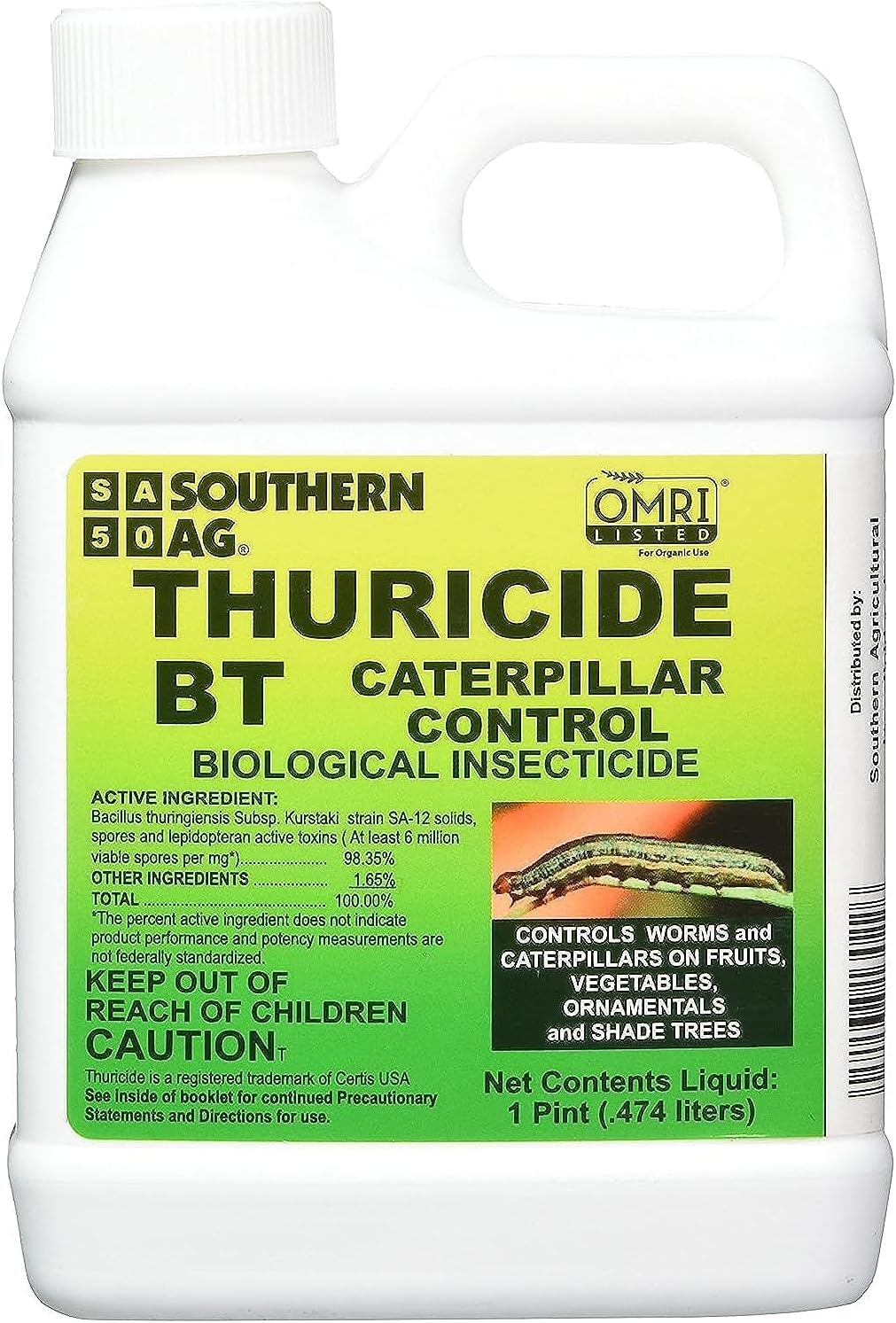
Southern Ag Thuricide BT Caterpillar Control Concentrate, 16 oz
| Item Form | Liquid |
|---|---|
| Target Species | Caterpillar |
| Liquid Volume | 16 fluid ounces |
| Specification Met | OMRI |
| Active Ingredients | Bacillus Thuringiensis Subsp. Kurstaki |
Thuricide BT is a concentrate biological insecticide that targets lepidopteran larvae such as hornworms and cabbage worms by delivering Bacillus thuringiensis kurstaki spores and toxins. You mix the concentrate with water (manufacturer suggests about 2 to 4 teaspoons per gallon), add a spreader-sticker if desired, and apply as a thorough cover spray to leaves where caterpillars feed. It is OMRI-approved and widely used in organic and conventional gardens because it is low in toxicity to people and pets while specifically disrupting caterpillar guts after ingestion. Practical benefits include selective control of hornworms without broad-spectrum insecticide damage to beneficial insects when used correctly and compatibility with edible crops. Limitations are that it must be eaten by the pest to work so timing and coverage matter, it provides no knockdown contact kill, and repeated applications are often required during heavy infestations or after rain.
Best for: Gardeners who want an effective, low-toxicity way to control hornworms and other caterpillars on vegetables and fruiting plants while maintaining organic-friendly practices.
Less Ideal for: Growers needing immediate knockdown of visible caterpillars or those who prefer a one-time broad-spectrum spray solution.
- Targets caterpillars specifically using a biological agent effective against hornworms and other lepidopteran larvae
- OMRI-approved formulation suitable for organic gardening
- Low toxicity to humans and pets compared with conventional chemical insecticides
- Concentrate format allows treating multiple applications or larger areas from one bottle
- Requires ingestion by the pest so must be applied thoroughly and timed before heavy damage
- Not an instant contact killer and may need repeated applications, especially after rain
Verdict: A reliable, organic-friendly concentrate for gardeners who prioritize targeted, low-toxicity control of hornworms and other caterpillars.
Southern Ag Thuricide HPC Concentrate 8 oz (Bacillus thuringiensis)

| Item Form | Liquid |
|---|---|
| Liquid Volume | 8 fluid ounces |
| Target Species | Insects |
| Specification Met | USDA |
Southern Ag Thuricide HPC is a concentrated biological insecticide based on Bacillus thuringiensis designed to control caterpillars and worm pests on vegetable gardens, fruit trees, shrubs and ornamentals. You mix 2 to 4 teaspoons per gallon of water, add a spreader-sticker if desired, and apply as a thorough cover spray to foliage where larvae feed. Its OMRI-friendly formulation and low toxicity to people and animals make it suitable for organic or more cautious applications. Because it targets lepidopteran larvae specifically, it is effective against caterpillars such as cabbage loopers and imported cabbageworms but will not control non-lepidopteran pests. As a concentrate, a single 8 oz bottle stretches to multiple gallons of spray, which is cost-efficient for treating small to medium plots. Limitations include the need for correct timing and coverage since Bt must be eaten by larvae to work, and repeated applications may be required during active infestations or heavy rain periods.
Best for: Gardeners who need an affordable, organic-compatible solution for caterpillars and similar larvae and prefer a low-toxicity product that can be mixed to treat multiple beds or trees.
Less Ideal for: People who need a broad-spectrum insecticide for aphids, beetles, or other non-lepidopteran pests or those wanting an immediate knockdown contact spray.
- Biological active ingredient (Bacillus thuringiensis) safe for use around people and animals when used as directed
- OMRI-approved formulation suitable for organic gardening
- Concentrated 8 oz bottle covers many gallons of spray, making it economical for repeated treatments
- Clear labeled use on vegetables, citrus, nuts, shrubs, trees and flowering plants
- Only targets lepidopteran larvae so it will not affect non-caterpillar pests
- Requires ingestion by larvae and good spray coverage for effectiveness
Verdict: Buy this if you want a budget-friendly, organic-compatible concentrate that reliably controls caterpillars in vegetable and ornamental plantings.
Monterey Spinosad Insecticide, 32 oz (concentrate)

| Unit Count | 32 Fluid Ounces |
|---|---|
| Item Form | Oil |
| Target Species | Insects |
Monterey Spinosad is a concentrated, spinosad‑based insecticide designed for home garden use to control caterpillars, leafminers, borers, thrips and many other chewing and crawling pests. Mixed into a trigger, backpack, or hose‑end sprayer, it can be applied to ornamentals, vegetables, lawns, citrus and fruit trees; the concentrate format makes it easy to cover larger areas on a schedule. The product is OMRI listed, fast acting, and practically odorless since spinosad is derived from naturally occurring bacteria. Safety directions on the label are clear and recommend protective clothing and thorough washing after handling. Limitations are that it is a broad contact toxin so beneficial insects like bees and predatory insects can be affected if applied during bloom or while pollinators are active, and you must follow label rates and reentry intervals for edible crops. For gardeners who prioritize reliable, organic‑approved control of chewing insects, this concentrate is a practical tool; those wanting an ant‑specific baiting strategy or systemic option will need a different product.
Best for: Gardeners who want a reliable, organic‑approved concentrate to quickly reduce chewing and boring insect populations across vegetables, ornamentals and fruit trees and who are comfortable following label safety and mixing instructions.
Less Ideal for: People seeking a targeted ant bait or a systemic insecticide for soilborne pests or those who need a product safe to spray during active bloom are better off with specialist ant baits or systemic products.
- OMRI listed for use in organic gardening
- Effective against a wide range of chewing and boring insects including caterpillars and leafminers
- Concentrate format works with trigger, backpack, or hose‑end sprayers for flexible coverage
- Fast acting and essentially odorless when applied properly
- Contact action can harm beneficial insects if applied when pollinators are active
- Requires mixing and careful adherence to label instructions for safe use
Verdict: Choose this OMRI‑listed spinosad concentrate when you need dependable, fast control of chewing garden pests across vegetables, ornamentals and fruit trees.
Bonide Captain Jack's Bt Thuricide Ready-to-Use Spray, 32 oz

| Unit Count | 32 Ounce |
|---|---|
| Item Form | Spray |
| Target Species | Insects |
| Active Ingredients | Bacillus Thuringiensi,Lapidapteran Active Toxins |
Bonide Captain Jack's Bt Thuricide is a ready-to-use biological spray that delivers Bacillus thuringiensis (Bt) to control caterpillars and worm-stage insects. You apply it with the trigger sprayer directly to the tops and undersides of leaves when you first see feeding damage; it is labeled for use on vegetables, fruit, shade trees and ornamentals and can be used up to the day of harvest on edibles. Because it kills by ingestion, treated pests stop feeding within a couple of days while birds, earthworms and many beneficial insects are largely unharmed. The product is convenient for small-to-medium infestations since it needs thorough coverage and repeat applications for new larvae. It is approved for organic gardening and comes in a 32-ounce bottle that is easier to use than concentrates for spot treatments, but using a ready-to-use bottle across a large property can become time consuming compared with hose-end or pressurized sprayers.
Best for: Gardeners who prioritize proven, low-risk biological control and want an easy spray for spot treating caterpillars on edible and ornamental plants; ideal for those who value safety around beneficials and pets.
Less Ideal for: People needing fast-contact knockdown for a large-scale outbreak or who must treat many acres quickly should consider concentrates or professional application methods instead.
- Targets caterpillars and worm-stage pests with a proven Bt active ingredient
- Safe for use on edible plants up to day of harvest when label directions are followed
- Ready-to-use trigger bottle requires no mixing for quick spot treatments
- Labeled for a wide range of plants including vegetables, ornamentals and shade trees
- Requires insects to ingest product so results are not immediate and depend on good spray coverage
- Ready-to-use bottle is less efficient for treating large areas compared with concentrates or hose-end applicators
Verdict: A convenient, organic-ready Bt spray that reliably controls caterpillars and worm pests while protecting beneficials, ideal for careful gardeners treating spot infestations.
Bonide Captain Jack's Deadbug Brew Ready-to-Use Spray, 32 oz

| Item Form | Spray |
|---|---|
| Target Species | Insects |
| Liquid Volume | 32 fluid ounces |
| Active Ingredients | Spinosad 0.5% |
Bonide Captain Jack's Deadbug Brew is a 32 oz ready-to-use spinosad spray formulated for organic gardening and aimed at controlling chewing and some leaf-feeding insects. You use it like a typical foliar spray, shaking the bottle and applying thoroughly to the tops and undersides of leaves on vegetables, fruit trees, and ornamentals. The active ingredient spinosad is effective against caterpillars, beetles, loopers, thrips, and similar pests and is labeled to spare many predatory beneficial insects when used as directed, which helps maintain biological control in the garden. The built-in spray nozzle makes application quick for small to medium beds and container crops. Limitations are that it is a contact and stomach poison so thorough coverage is required and repeat applications may be necessary for heavy infestations; it is not systemic and will not protect new growth after application. Also users must follow safety directions and avoid use when pollinators are active.
Best for: Gardeners who prioritize practical, low-fuss pest control for vegetables and fruit and who want an organic-approved spray they can apply quickly without mixing.
Less Ideal for: Large acreage growers or those who need long-lasting systemic protection should look for professional or systemic options instead.
- Contains spinosad, an approved active ingredient for organic gardening that targets many chewing pests
- Ready-to-use spray with integrated nozzle for simple, no-mixing application
- Label supports use on a wide variety of vegetables and fruit crops
- Designed to have limited impact on many predatory beneficial insects when used properly
- Works by contact and ingestion so thorough coverage and repeat applications are necessary
- Not systemic, so new growth after treatment is unprotected
Verdict: A convenient, organic-approved spinosad spray that delivers effective contact control of common foliage-feeding pests on cucurbits and other garden crops.
Choosing the Right Insecticide for Hornworms: Key Factors to Consider
Mode of Action and Targeting
Knowing how an insecticide affects hornworms determines both how quickly you will see results and how likely resistance is to develop. Some chemistries act on the nervous system for fast paralysis and death, while others interfere with growth or feeding behavior and take longer to reduce damage.
Choosing a product with a clear mode of action helps you rotate treatments if you have recurring infestations. Targeted modes of action can reduce collateral harm to beneficial predators when applied correctly, which matters in small vegetable plots where biological control often helps keep pests in check.
Residue Duration and Reapplication Window
Residue duration affects how often you must reapply and how well the product protects newly emerged foliage. Short-residual insecticides may require more frequent applications but can reduce exposure to beneficial insects; long-residual products lower application frequency but increase the period when non-targets may be affected.
Understand the label's stated residual activity and follow reapplication intervals closely. In vegetable gardens, also note pre-harvest intervals to ensure harvested fruit is safe. Planning around the crop growth stage and harvest schedule reduces the risk of unnecessary residues on edible produce.
Crop Safety and Label Directions for Edibles
Not every insecticide is labeled for use on food crops. For tomatoes, peppers, and other hornworm-hosting plants, selecting products explicitly approved for edible plants avoids illegal or unsafe use. Labels indicate maximum application rates, allowable plant stages, and required time between last application and harvest.
Carefully reading label directions ensures you do not harm the crop by burning foliage or leaving residues that exceed recommended limits. Many gardeners prefer formulations marketed as safe for edible gardens, but always confirm the label for specific crops and harvest intervals.
Application Method and Equipment Needs
The formulation you choose should match the equipment and skill you have. Ready-to-use sprays and hose-end products simplify application for small plots and container gardens, while concentrates require measuring and mixing but reduce packaging waste and often cost less per application.
Consider nozzle type, spray coverage, and whether a foliar spray, soil drench, or bait is best for your hornworm situation. Some methods provide better canopy penetration for large plants, others are designed for spot treatment. Match the method to plant size and the infestation extent to avoid wasted product or poor control.
Impact on Beneficial Insects and Pollinators
Many vegetable gardens rely on beneficial insects and pollinators. Broad-spectrum insecticides can harm these helpful populations if applied while pollinators are active or to flowering plants. Choosing lower-impact products or using targeted timing reduces collateral damage.
Apply sprays in the early morning or late evening, avoid treating open blossoms when bees are present, and favor application methods that limit drift. Some chemistries are less disruptive to natural enemies and pollinators; incorporating them into an integrated pest management approach preserves biological control services.
Safety, Handling, and Storage
An insecticide's label gives required personal protective equipment, mixing instructions, and storage guidance. For backyard gardeners, ease of safe handling matters: simplified mixing directions, clear PPE recommendations, and small-package options reduce mistakes.
Safe storage away from children, pets, and food is essential. Choose products whose container and label make correct mixing and disposal straightforward. Also check whether the product requires special disposal or local restrictions to avoid compliance issues.
When To Treat For Hornworms
Treating at the right time keeps damage limited and preserves plant vigour. Inspect plants frequently during warm months and look for leaf skeletonizing, large green caterpillars, and dark frass. Early detection when caterpillars are small makes control easier and reduces the need for broad applications.
If you find a handful of hornworms, spot-treating foliage or handpicking at night can be effective. Larger, widespread infestations call for a garden-wide foliar application timed to reach feeding caterpillars on the upper and lower leaf surfaces.
- Inspect undersides of leaves and stems weekly during peak season
- Act quickly on visible feeding or droppings to protect fruit set
- Spot treatments work for low counts; broader sprays for heavy pressure
Timing Applications Around Flowering and Harvest
Align insecticide use with flowering and harvest to protect pollinators and ensure safe produce. Avoid treating during peak bloom when bees visit flowers. If treatment is necessary, target foliage rather than flowers, and choose application times when pollinator activity is low.
Observe pre-harvest intervals on the label and plan your spray schedule so the final application occurs well before picking. That reduces residue risk and gives plants time to recover from any application stress.
- Spray in early morning or late evening to avoid pollinators
- Mask blossoms when possible and focus on leaf coverage
- Respect label harvest intervals before picking fruit
Combining Cultural Controls With Chemical Options
Chemical controls are most effective when combined with good cultural practices. Maintain healthy plants through regular watering, balanced fertilization, and pruning to reduce stress that makes foliage more attractive to pests. Crop rotation and removing volunteer solanaceous plants limit local hornworm reservoirs.
Encourage natural predators by providing habitat and avoiding unnecessary broad-spectrum treatments. Hand removal and spot treatment reduce chemical use and preserve beneficial insect populations, creating a more resilient garden ecosystem over time.
- Remove and destroy heavily infested foliage to reduce larvae supply
- Keep beds weeded and eliminate nearby nightshade volunteers
- Use targeted sprays only when thresholds are exceeded
Application Tips for Large Plants and Tall Vines
Tomato and pepper plants can grow tall and bushy, so getting good spray coverage matters. Use a nozzle that produces a medium to fine spray and move through the canopy to reach undersides of leaves where hornworms feed. For very large vines, consider a second pass after 24 hours to hit newly accessible surfaces.
Support vines and prune to improve airflow and access. Better visibility into the canopy helps you spot early signs of hornworm damage and makes applications more effective while using less product.
- Adjust nozzle angle to reach leaf undersides
- Make multiple, lighter passes rather than one heavy spray
- Prune dense growth to improve spray penetration
Dealing With Severe Infestations
When hornworm numbers are high and fruit loss is imminent, choose the method that gives the fastest reliable reduction while still following label safety directions for edible crops. In severe cases, combine immediate hand removal with a broad application that matches your crop safety needs.
After an emergency treatment, monitor closely and follow reapplication intervals. Reintroduce cultural and biological measures quickly to prevent rebound and reduce reliance on repeated chemical use.
- Prioritize rapid knockdown when fruit set is threatened
- Follow up with monitoring and targeted reapplications
- Reinforce cultural controls to prevent future outbreaks
How We Chose the Best Insecticide for Hornworms
We focused on selection criteria gardeners actually use when choosing an insecticide for hornworms. Key evaluation criteria included the insecticide's speed of knockdown against hornworms, the residual activity period on foliage, safety and label allowances for edible crops, application method versatility (spray, dust, or topical), and ease of use including re-entry and pre-harvest interval clarity. We also considered formulation stability for backyard storage and the degree of non-target impact on beneficial insects when used as directed. Excluded from consideration were products with unclear labeling for edible crops or those requiring specialized commercial licensing. We prioritized formulations that provide dependable caterpillar control while offering clear guidance for safe use around vegetables and companion plants. The shortlisted options balance immediate control with sensible reapplication intervals and minimal disruption to common garden maintenance routines.
FAQ
How quickly will an insecticide stop hornworm feeding?
It depends on the product chemistry. Neurotoxin-based products often cause paralysis and visible reduction in feeding within 24 hours. Growth-regulating materials can take several days to show results. Expect variation based on larval size and application coverage.
Are there insecticides that are safe to use on tomatoes and peppers?
Yes, many formulations are labeled for use on edible solanaceous crops. Always check the label for specific crop listings and pre-harvest intervals. Following label directions prevents crop damage and ensures harvested produce meets safety guidance.
Will insecticides harm beneficial insects in my vegetable garden?
Some products can affect beneficials, especially if applied broadly during bloom. Choosing targeted application methods, timing sprays for low pollinator activity, and selecting lower-impact chemistries reduces harm. Combining chemical treatment with habitat for predators helps preserve beneficial populations.
How often should I reapply treatments for hornworms?
Reapplication frequency depends on residual activity specified on the label. Short-residual products may need reapplication every few days under heavy pressure, while longer-residual options extend protection for a week or more. Always follow label intervals to avoid overuse.
Can I use insecticides in a container tomato or balcony garden?
Yes, many garden formulations are suitable for containers. Use conservative application rates and avoid runoff into shared spaces. Containers often need spot treatments because pests are easier to find and remove by hand in smaller plantings.
Is handpicking hornworms still worthwhile if I plan to spray?
Handpicking reduces the number of larvae and can make sprays more effective by lowering overall pest load. It is particularly useful for small gardens and early infestations and reduces the amount of chemical needed to regain control.
Final Verdict
When selecting an insecticide for hornworms, prioritize a balance between rapid caterpillar control and safety for edible plants and beneficial insects. Focus on a product whose mode of action, residual period, and label permissions match your planting schedule and garden size. For most home vegetable gardeners, combine targeted chemical use with cultural controls and careful timing to protect pollinators and harvest safety. That approach reduces repeat treatments and helps you keep ripening fruit productive and pest damage minimal.
