

Note: This article contains affiliate links. If you click on these links and make a purchase, I may earn a small commission at no extra cost to you. This helps support my research and content. Read my full affiliate disclosure here.
If you manage a large lawn or property, the right large leaf vacuum can cut hours from seasonal cleanup and keep gutters, beds, and driveways clear. You want a machine rugged enough to handle heavy, wet leaves and long run times, but still manageable to move and empty. This guide shortlists six top-performing large leaf vacuums and explains how they compare on the practical features gardeners care about: suction and shredding capability, collection volume, durability, and ease of use. Below we explain the evaluation criteria, walk through the factors that matter for big yards, and provide helping context so you can pick the right unit for your landscape and workload.
Top Picks at a Glance
| Best Overall The best all-around choice for most situations | Greenworks 48V Brushless 3-in-1 Leaf Blower, Vacuum & Mulcher with Two 4.0Ah Batteries |  |
| Best Quality Built to a higher standard if you want something more solid | EGO Power+ LV5000 Cordless Leaf Vacuum, Mulcher and Blower (Tool Only) |  |
| Best Value The sweet spot between price and what you get | YDblac 40V Cordless 3-in-1 Leaf Blower Vacuum Mulcher (YD2602) |  |
| Best Budget The cheapest option that still gets the job done reliably | Heywork 3-in-1 Corded Leaf Vacuum Mulcher, 450 CFM (Handheld) |  |
| Highest Rated A top-rated pick with lots of positive feedback | SuperHandy Towable Leaf and Lawn Vacuum – 180‑Gallon, 15HP Electric Start, Serrated Impeller |  |
| Most Popular A crowd favorite that many people choose with confidence | WORX Trivac WG509 3‑in‑1 Corded Leaf Blower/Vacuum/Mulcher |  |
Greenworks 48V Brushless 3-in-1 Leaf Blower, Vacuum & Mulcher with Two 4.0Ah Batteries

| Power Source | Battery Powered |
|---|---|
| Voltage | 48 volts |
| Air Flow Capacity | 520 cfm |
| Maximum Speed | 240 miles_per_hour |
| Additional Features | Adjustable Speed, Leaf Vacuum, Turbo |
This Greenworks kit is a versatile cordless solution for homeowners who want blower, vacuum, and mulching functions in one tool. It runs on a dual-battery 48V system (two 4.0Ah batteries) and the brushless motor produces the advertised 520 CFM and 240 MPH, which handles dry and wet leaves, matted grass, and small debris quickly. Switching between blower and vacuum/mulch modes is tool-free and fast, and the 12:1 mulching ratio noticeably reduces bag volume for easier disposal. Dual batteries and a dual-port charger let you swap cells and keep working while the other battery charges, with a typical runtime around 25 minutes per 4.0Ah battery at medium speed. Variable speed, cruise control, and an ergonomic handheld form make it comfortable for routine yard work, but the unit is best for homeowners with medium to large yards rather than commercial use. Noise is around 71 dB which is typical for this class. Expect moderate runtime limits at top speed and the usual need to recharge spare batteries for extended sessions, but for balanced performance and convenient cordless operation this package covers most seasonal cleanup needs.
Best for: Homeowners who want a single, cordless tool to handle regular seasonal leaf cleanup across medium to large yards and value convenience, versatility, and easier storage over commercial power.
Less Ideal for: Contractors or users who need all-day continuous operation without battery swaps should consider gas or professional electric options instead.
- High airflow and speed (520 CFM / 240 MPH) effective on wet and packed debris
- Includes two 4.0Ah batteries and dual-port charger for extended runtime and quick recharges
- Tool-free conversion between blower, vacuum, and mulcher with a 12:1 mulch reduction
- Brushless motor for better efficiency, lower vibration, and longer motor life
- Variable speed and cruise control improve control and reduce hand fatigue
- Single-battery runtime is limited at high power so continuous heavy use requires spare batteries
- At about 71 dB it is not significantly quieter than many gas or cordless competitors
Verdict: A well-rounded cordless 3-in-1 blower/vacuum/mulcher kit that balances strong airflow, dual-battery runtime, and tool-free versatility for homeowners handling seasonal yard cleanup.
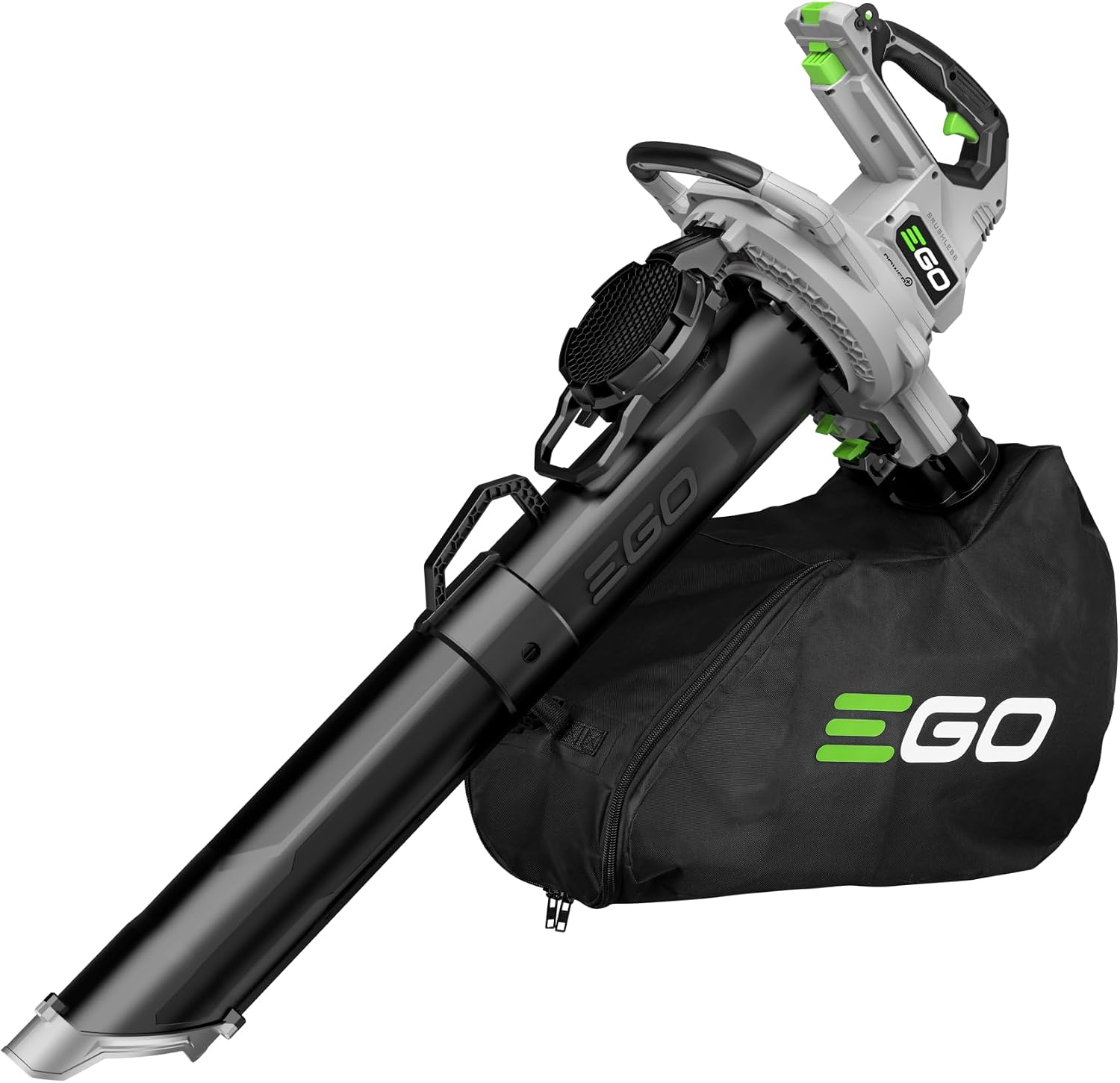
EGO Power+ LV5000 Cordless Leaf Vacuum, Mulcher and Blower (Tool Only)
| Power Source | Battery Powered |
|---|---|
| Form Factor | Handheld |
| Blower Performance | Up to 500 CFM, up to 210 MPH |
| Mulching Ratio | 16:1 |
| Included | Vacuum tube, blower tube, leaf bag, tapered nozzle, shoulder strap |
The EGO Power+ LV5000 is a performance-focused cordless yard tool that combines vacuuming, mulching, and blowing into a single handheld unit. In vacuum mode the large metal six-blade impeller shreds leaves to a 16:1 ratio so you dramatically reduce yard waste volume and empty the included 40L bag far less often. Switching between blower and vacuum is fast and tool-free, and the blower delivers up to 500 CFM and 210 MPH for effective clearing around hard surfaces and tight spots when the tapered nozzle is attached. The variable speed dial and auxiliary soft-grip handle let you tune power and comfort for different tasks, and IPX5 weather resistance makes it usable in light wet conditions. Battery and charger are sold separately; EGO recommends a 6.0Ah ARC Lithium battery for long runtimes that can reach about 90 minutes on low. The unit is handheld and ergonomic, but runtime depends entirely on battery choice and high-speed runtime is much shorter, so plan for a spare battery for large properties or continuous heavy work.
Best for: Buyers who prioritize strong, gas-like performance from a cordless tool and want a single machine to vacuum, mulch, and blow large leaf loads efficiently.
Less Ideal for: Casual users with very small yards or those who prefer an all-in-one kit that includes battery and charger should consider simpler or bundled options.
- True 3-in-1 design combines vacuum, mulcher, and blower for versatile yard cleanup
- Six-blade metal impeller achieves a 16:1 mulching ratio to greatly reduce yard waste volume
- Powerful blower output up to 500 CFM and 210 MPH for efficient clearing
- Variable speed control and auxiliary soft-grip handle improve control and comfort
- IPX5 weather-resistant construction for use in a range of outdoor conditions
- Battery and charger are not included so runtime depends on separately purchased batteries
- High-power runtime drops to about 15 minutes, requiring larger or extra batteries for extended heavy use
Verdict: Choose the LV5000 when you want cordless, gas-equivalent leaf-clearing power with heavy-duty mulching to cut yard waste volume.
YDblac 40V Cordless 3-in-1 Leaf Blower Vacuum Mulcher (YD2602)

| Power Source | ac |
|---|---|
| Voltage | 110 volts |
| Form Factor | Handheld |
| Additional Features | Adjustable Speed |
| Item Highlight | 600 CFM 160 MPH; 40L collection bag; 2×4.0Ah batteries |
The YDblac YD2602 combines blowing, vacuuming, and mulching into a single cordless unit aimed at routine yard cleanup. In use you switch between modes to blow leaves into piles, vacuum them into the 40L collection bag, then run the mulcher to reduce debris at a quoted 15:1 ratio. Two included 4.0Ah batteries extend runtime and a 6-speed control plus a turbo boost lets you match power to the job, from light leaf pickup to heavier, slightly damp debris. Built-in wheels and an ergonomic handle ease handling for longer sessions, and the 600 CFM / 160 MPH performance is strong enough for small to medium yards and patios. Important limits to note are the handheld form factor which still requires some lifting despite wheel support and the cordless runtime will depend on chosen speed and battery state; very large properties may need additional charging cycles. For buyers prioritizing a bagged cordless vacuum that mulches well, this is a practical, feature-rich option.
Best for: Buyers who want a dependable cordless bagged leaf vacuum that handles regular yard and patio cleanup with flexible power control and reduced bag volume.
Less Ideal for: Not the best choice for commercial landscapers or homeowners with very large properties who need continuous runtime or a backpack/ride-on blower solution.
- Three functions in one unit: blowing, vacuuming, and mulching for versatile yard cleanup
- Includes two 4.0Ah batteries to reduce downtime during extended tasks
- Six speed settings plus turbo boost let you tailor power and conserve battery
- Large 40L collection bag and 15:1 mulching ratio reduce the number of bag disposals
- Handheld design still places load on the user despite wheel support
- Runtime will vary by speed and may be insufficient for very large properties without extra batteries
Verdict: A versatile cordless leaf vacuum that combines strong airflow, mulching, and included spare battery capacity for reliable bagged yard cleanup.
Heywork 3-in-1 Corded Leaf Vacuum Mulcher, 450 CFM (Handheld)

| Power Source | ac |
|---|---|
| Air Flow Capacity | 450 cfm |
| Maximum Speed | 158 miles_per_hour |
| Wattage | 1800 watts |
| Noise Level | 65 db |
This Heywork handheld unit functions as a blower, vacuum, and mulcher so you can clear driveways, patios, and lawns without switching tools. It runs on mains power and the 1800 W motor produces up to 450 CFM and 158 MPH for moving dry leaves and light debris; switching between blowing and vacuuming is tool-free. The built-in mulcher reduces leaf volume roughly 15:1 and feeds debris into a 40L collection bag, which cuts the number of trips to the compost or bin. At about 3.4 pounds plus a shoulder strap and support wheels for vacuum mode, it is easy to carry and maneuver on flat surfaces. Practical limits are that it needs a power cord so reach is constrained and it is best for light-to-moderate debris rather than heavy, wet material or commercial workloads. Noise is moderate at 65 dB, and the plastic construction keeps weight down but may not be as rugged as higher-end pro units. For regular homeowner cleanup it offers a convenient, multi-function solution.
Best for: Homeowners who want a dependable, all-in-one electric tool for regular yard maintenance and seasonal leaf cleanup and prefer low-maintenance corded equipment over batteries.
Less Ideal for: Users with very large properties, commercial landscapers, or those who need to handle heavy wet debris should choose a higher-powered or gas-powered unit instead.
- Three functions in one unit: blower, vacuum, and mulcher for versatile yard cleanup.
- Strong airflow of up to 450 CFM and 158 MPH for moving dry leaves and light debris.
- Built-in mulcher with a 40L collection bag reduces leaf volume and emptying frequency.
- Lightweight handheld design with shoulder strap and support wheels improves portability and ease of use.
- Corded power limits reach and requires an extension for larger yards.
- Plastic construction may feel less durable than professional metal-bodied units.
Verdict: A reliable, lightweight corded 3-in-1 blower/vacuum/mulcher that makes routine homeowner leaf cleanup faster and less frequent.
SuperHandy Towable Leaf and Lawn Vacuum – 180‑Gallon, 15HP Electric Start, Serrated Impeller

| Capacity | 180 gallons |
|---|---|
| Engine | 15HP electric start |
| Impeller | 16 in. serrated steel impeller |
| Power Source | gas_powered |
| Form Factor | Tow-Behind |
This towable leaf and lawn vacuum is built for large properties and commercial-style cleanup where uptime matters. It pairs a 15HP electric-start gas engine with a 16-inch serrated steel impeller to pull and shred leaves, grass clippings, and light debris into a 180-gallon collection bag so you make fewer stops. The unit connects via a pin hitch to riding mowers or small tractors and rides on 13-inch pneumatic wheels that help traverse uneven turf. The one-hand dump lever lets a single operator empty the hopper quickly without lifting or detaching parts, which saves time on repeated loads. Expect sturdy, serviceable components but standard gas maintenance such as fuel, oil, and impeller inspection. It is heavy and designed to be towed rather than moved by hand, so storage and transport require suitable equipment and space. If you need a reliable, high-capacity machine to reduce collection cycles and keep crews moving, this model delivers straightforward performance with familiar maintenance needs.
Best for: Property owners or small landscape contractors who prioritize dependable, high-capacity debris collection and want equipment that minimizes stops and keeps crews productive.
Less Ideal for: Casual homeowners with small yards or anyone who needs a lightweight, walk-behind solution for tight spaces should consider smaller, hand-operated vacuums instead.
- Large 180-gallon collection bag reduces frequency of emptying on big jobs
- 15HP electric-start gas engine provides consistent suction power for heavy debris
- Serrated 16-inch steel impeller shreds material for more compact collection
- One-hand dump mechanism allows fast, single-operator emptying
- Tow-behind design with 13-inch pneumatic wheels improves stability over rough terrain
- Requires towing vehicle and storage space due to tow-behind form factor
- Needs routine gas-engine maintenance and occasional impeller inspection
Verdict: A high-capacity, towable vacuum built for reliable, commercial-style leaf and debris collection that keeps crews working with fewer stops.
WORX Trivac WG509 3‑in‑1 Corded Leaf Blower/Vacuum/Mulcher

| Power Source | Corded Electric |
|---|---|
| Air Flow Capacity | 350 cfm |
| Maximum Speed | 210 miles_per_hour |
| Mulch Ratio | 18:1 |
The WORX WG509 Trivac combines a blower, vacuum, and mulcher in a single corded unit to simplify seasonal yard cleanup around homes. You use it in blow mode to move leaves from driveways, patios, and lawn edges, switch to vacuum to collect debris into the included bag, and engage the metal‑impeller mulcher to reduce leaf volume roughly 18:1 for easier disposal or composting. Variable speed control helps dial back airflow for delicate spots or ramp up for bigger piles, and corded power means uninterrupted runtime for medium‑sized yards. The quick mode switch and removable collection bag make transitions and emptying straightforward. Important limitations are that it is corded so you need an outlet or extension cord and the unit is best suited to hard surfaces and moderate leaf volumes rather than very large properties; heavier professional jobs may benefit from backpack or gas models. For homeowners who want a reliable, no‑battery‑worry electric tool, the WG509 offers efficient cleanup with minimal fuss.
Best for: Homeowners who prioritize reliable, continuous electric power and a single tool to handle regular leaf cleanup on driveways, patios, decks, and small to medium yards.
Less Ideal for: People with large acreage, frequent heavy debris or professional landscaping needs should consider petrol or backpack blowers built for extended heavy use.
- 3‑in‑1 design replaces separate blower, vacuum, and mulcher for simpler storage and use
- Strong airflow (350 CFM, 210 MPH) handles wet leaves and stubborn debris on hard surfaces
- Metal impeller mulches leaves to an 18:1 ratio, reducing bag changes and making composting easier
- Variable speed and a quick switch between modes let you adjust power for different tasks
- Corded power requires an outlet or extension cord which limits mobility
- Not intended for very large properties where commercial or backpack units perform better
Verdict: Buy this if you want a dependable corded 3‑in‑1 blower/vacuum/mulcher that delivers strong airflow and efficient mulching for routine home yard cleanup.
Choosing the Right Large Leaf Vacuum: Key Factors to Consider
Suction and Shredding Capability
Strong suction plus an effective shredding mechanism determines how much leaf volume is reduced before reaching the bag. For large properties, shredding reduces the number of trips to empty the collector and limits clogging in wet conditions. Look for units that handle whole leaves, small twigs, and damp material without frequent jams.
Shredding also affects how easy it is to compost or dispose of collected material. Finely shredded leaves break down faster in compost, which is useful if you plan to reuse the waste. Conversely, weak shredding forces more manual raking or bagging, increasing labor on big jobs.
Collection Capacity and Bag Design
Collection capacity directly impacts how often you must stop working to empty the unit. Larger bags or hoppers are essential on acreage or multi-zone landscapes to maintain efficiency. Consider both the stated volume and how easy the bag is to remove and reattach during frequent stops.
Bag material, closure systems, and access points matter for handling. Rigid hoppers can be easier to tip and empty but add weight. Soft bags save weight and fold for storage but take longer to empty cleanly. For heavy wet leaves, choose designs that minimize clogging at the throat where the vacuum feeds the bag.
Power Source and Run-Time
Power options affect performance, convenience, and operating cost. Gas engines typically deliver sustained power and longer runtime between refuels, which is helpful for very large areas. Electric corded models give consistent suction but are limited by cord length and outlet access. Battery-powered units offer cleaner operation and quiet running but require planning around battery life and spares for large jobs.
Consider how long a unit runs at full suction and whether it maintains power under load. For battery systems, check battery capacity and the availability of additional batteries so you can swap and continue when needed.
Mobility, Maneuverability, and Weight
How easily you move the vacuum across turf, gravel, and beds dictates day-to-day usability. Larger units often weigh more but may have pneumatic tires, steering features, or folding handles that ease transport. Lightweight units are simpler to lift into storage but may lack stability when pulling heavy loads.
Evaluate handle ergonomics, wheel size and tread, and whether the unit can be collapsed for transport. For properties with slopes, pick units with good traction and a low center of gravity to reduce tipping risk during operation or unloading.
Durability and Serviceability
Durable construction keeps a large leaf vacuum working across seasons. Metal impellers and reinforced housings resist wear from sand and grit, while robust fasteners and replaceable components extend service life. Pay attention to how easy it is to access wear parts for inspection and replacement without specialized tools.
Serviceability also affects teardown and cleaning after wet or gummy leaf loads. Units that allow quick removal of the intake throat, bag clamps, and impeller housing reduce downtime and make routine maintenance practical for busy homeowners or grounds crews.
Noise, Vibration, and Operator Comfort
Noise level matters in residential settings and for operator fatigue during long sessions. Lower noise units are more comfortable to run and reduce disturbance to neighbors. Vibration affects control and can make long jobs unpleasant; look for dampened handles and balanced impeller assemblies.
Comfort features such as adjustable handle height, simple throttle or speed controls, and clear exhaust routing improve the operator experience and reduce the chance of repetitive strain over several hours of cleanup.
How Large Leaf Vacuums Fit Into Yard Maintenance
Large leaf vacuums are designed to bridge the gap between hand raking and full-scale landscape debris collection. They speed removal of extensive leaf fall across lawns, driveways, and beds while reducing physical strain compared with repeated raking and lifting. For many properties a vacuum can complete tasks in a fraction of the time and produce a more consistent result.
Consider using a leaf vacuum as part of a seasonal routine: initial passes for heavy accumulation, followed by targeted runs in beds and along fences. That approach minimizes time spent on detailed handwork and keeps debris from smothering turf or clogging beds.
- Best for large lawns, estates, and maintenance of multiple zones
- Helpful for preparing turf for winter and for speeding spring cleanup
- Reduces bag volume when shredding is effective, easing composting
Planning Workflows for Big Jobs
Plan cleanup by sectioning the property into manageable passes so you can maximize collection capacity and reduce emptying cycles. Start at the farthest point from the yard exit and work toward your access point to avoid repeated transport over cleaned areas.
For battery or corded options, map out power access and recharge points ahead of time. For gas units, factor in refueling pauses and check oil and air filters at the start of a session to avoid mid-job downtime.
- Work from high to low accumulation areas to keep momentum
- Carry replacement bags or a tarp to transfer material when emptying is inconvenient
- Inspect intake and impeller periodically during long sessions to prevent clogs
Storage, Winterizing, and Maintenance
Proper storage extends the life of large leaf vacuums. Clean out leaf debris and dry bags before storing to prevent mold and corrosion. For gas engines, follow general small-engine winterizing: drain or stabilize fuel, change oil if needed, and remove spark plugs if long-term storage is planned.
Inspect seals, fasteners, and moving parts at the end of each season. Replace worn impeller blades or bag straps promptly. Keeping a short maintenance checklist makes spring startup quicker and reduces unexpected failures during peak leaf season.
- Empty and dry bags before storage to prevent mildew
- Check and grease wheel bearings where applicable
- Keep a small parts kit with common fasteners and a spare bag strap
Composting and Disposal Options
Shredded leaf material is excellent for composting because smaller particles decompose faster and mix more evenly with green waste. If your goal is on-site composting, prioritize a unit that produces finer mulch and avoids contaminating the load with soil and gravel.
If disposal is required, shredded material takes less volume in municipal composting programs and may reduce the number of collection sacks. For areas with disposal restrictions on yard waste, check local rules on shredded versus bagged leaves to select a workflow that complies with regulations.
- Shred for faster composting and lower transport volume
- Avoid vacuuming significant soil or gravel to keep compost clean
- Store shredded leaves in breathable bags or bins until ready to compost
Safety and Neighborhood Considerations
Wear eye and ear protection when operating powerful leaf vacuums, and avoid loose clothing that could catch on moving parts. Be cautious when vacuuming near flower beds or delicate shrubs; strong intakes can pull in small plants and mulch.
Consider noise and operating hours to remain courteous to neighbors. Low-noise units and using the machine during daytime hours help minimize complaints and fit better into shared-residential environments.
- Use PPE and watch for thrown debris from impellers
- Avoid operating on steep slopes where traction is limited
- Coordinate schedules with neighbors when working close to shared property lines
How We Chose the Best Large Leaf Vacuum
We evaluated large leaf vacuums using criteria that match real yard conditions and maintenance routines. Primary considerations included suction and shredding effectiveness for whole-leaf and partially decayed material, collection capacity to reduce emptying frequency on large properties, and engine or motor durability for repeated seasonal use. Mobility and handling were assessed to ensure units can be moved across long lawns, inclines, and tight beds without excessive effort. Noise and vibration levels were considered because prolonged use in residential areas matters to neighbors and to operator comfort. Ease of maintenance and availability of durable components were also part of the filter to favor units with straightforward cleaning, accessible impellers, and replaceable wear parts. We excluded lightweight handheld units and small-garden tools that do not offer the collection volume or power needed for large yards. We also filtered out machines with limited serviceability or unclear specifications. The final shortlist represents machines that meet minimum thresholds across suction/shred performance, collection capacity, handling, and durability while offering clear tradeoffs depending on yard size and operator preference.
FAQ
Can a large leaf vacuum handle wet leaves?
Often yes, but wet leaves are heavier and can reduce shredding efficiency. Machines with stronger suction and robust impellers cope better, and units with larger collection throats are less prone to clogging. For consistently wet conditions, expect more frequent emptying and occasional manual clearing of jams.
Should I choose gas, corded electric, or battery for a big property?
It depends on yard size and preferences. Gas offers long runtime and sustained power for very large areas. Corded electric gives steady suction but is limited by cord reach. Battery systems are quieter and lower maintenance but require planning for battery swaps on long jobs.
How often do I need to empty the collection bag on an acre property?
Frequency varies with leaf density, shredding ratio, and bag size. On heavy fall days, expect multiple emptying cycles per hour with smaller bags. Choosing a higher-capacity bag or a unit with stronger shredding reduces the number of stops.
Are large leaf vacuums suitable for debris other than leaves?
Many units handle small twigs, pine needles, and light yard litter, but they are not designed for large branches or rocks. Avoid feeding materials that can damage impellers or create dangerous projectiles.
What maintenance keeps a leaf vacuum reliable season after season?
Regularly clean intake areas and bags, inspect impeller blades for wear, tighten fasteners, and service engines or batteries per manufacturer guidance. Addressing small issues like loose belts or clogged screens early prevents larger failures during peak use.
Can shredded leaves be used directly in compost piles?
Yes. Shredded leaves break down faster and mix more readily with green materials. Balance shredded brown leaves with nitrogen-rich greens to speed decomposition and avoid compacting the pile.
Final Verdict
For large yards, prioritize units with strong suction and effective shredding to minimize emptying and speed cleanup. Collection capacity, mobility, and serviceability determine how practical a machine is for repeated seasonal use. Expect tradeoffs: heavier, higher-capacity units reduce stops but require easier transport, while battery or electric options offer quieter operation but may need charging or cord planning. Choose the features that match your property size, terrain, and tolerance for maintenance to get the most consistent, efficient results.
