

Note: This article contains affiliate links. If you click on these links and make a purchase, I may earn a small commission at no extra cost to you. This helps support my research and content. Read my full affiliate disclosure here.
Choosing the right mulch for weed and pest control changes how your beds perform throughout the season. The right material reduces weed pressure, discourages pest habitat, and helps soil retain moisture so plants stay healthier with less hands-on weeding. This guide outlines seven shortlisted mulches that are effective for active weed suppression and lowering pest problems in garden beds, borders, and around shrubs. We evaluated options by how well they block light and weeds, how they influence insect and rodent activity, and how they affect soil health and moisture. Below you will find concise guidance on each mulch type and clear criteria to help you pick the best option for your plot, planting style, and pest pressures.
Top Picks at a Glance
| Best Overall The best all-around choice for most situations | GranuCide Cedar Granules (8 lb) |  |
| Best Quality Built to a higher standard if you want something more solid | Double Tree Forest Products Incense Cedar Wood Chips, 8 qt |  |
| Best Value The sweet spot between price and what you get | PlantBest Coco Mulch Compressed Block (expands to 2.5 cu ft) |  |
| Best Budget The cheapest option that still gets the job done reliably | Peppy Plant Cocoa Bean Shell Mulch (4 Quarts) |  |
| Highest Rated A top-rated pick with lots of positive feedback | Capital Forest Products Cedar Mulch 3.0 Cu Ft |  |
| Most Popular A crowd favorite that many people choose with confidence | Wood Smith USA 100% Natural Cedar Chips, 4 Quart Bag |  |
| Best Seller A high-volume bestseller chosen again and again | HealthiStraw GardenStraw Premium Garden Mulch, 3 cu ft |  |
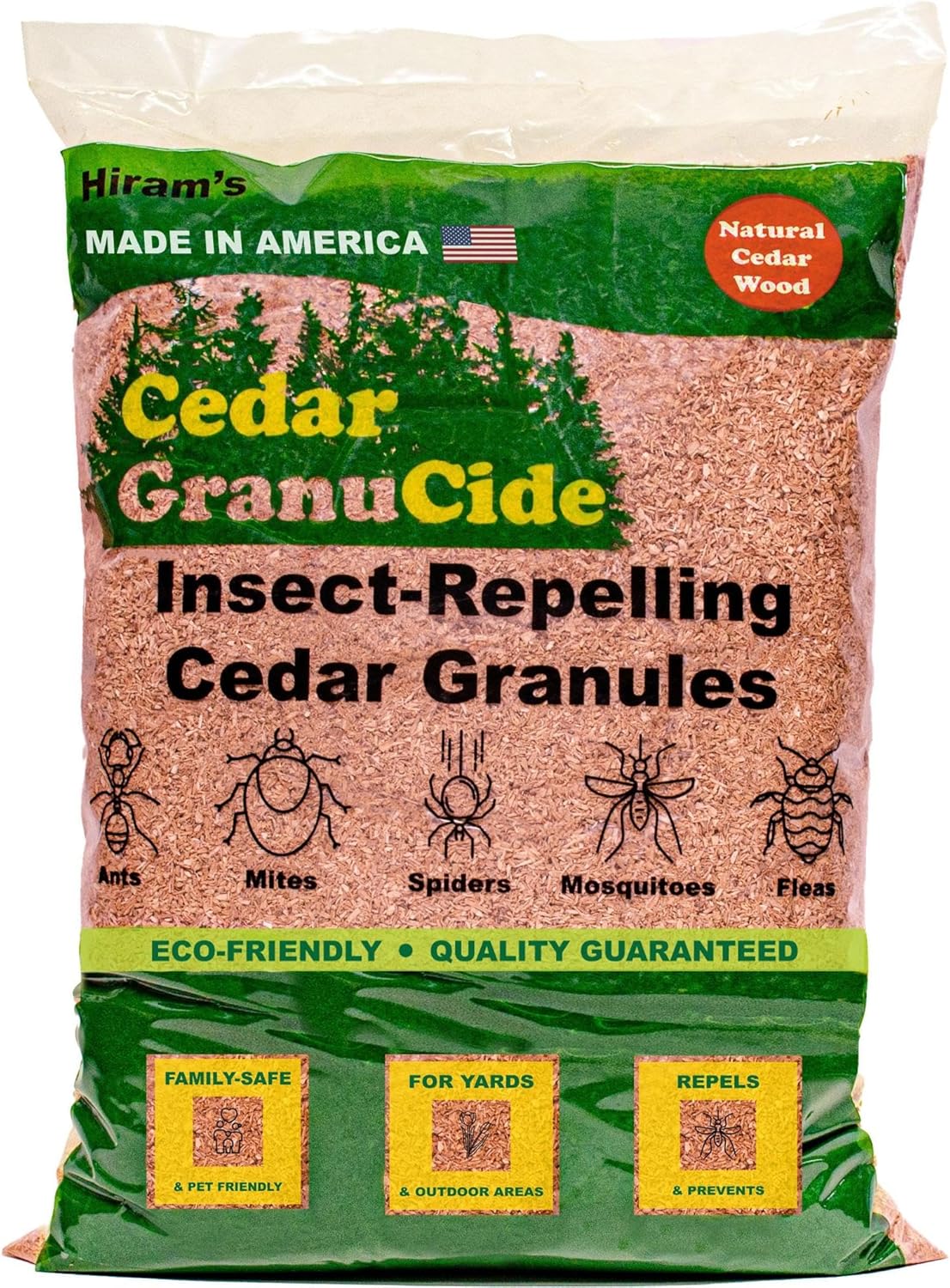
GranuCide Cedar Granules (8 lb)
| Ingredients | 100% cedar granules |
|---|---|
| Directions | Sprinkle in indoor and outdoor areas such as potted plants, gardens, lawns, patios, and perimeters |
| Made in | America |
| Weight | 8 pounds |
GranuCide Cedar Granules are coarse cedar chip shavings sold as an easy-to-use, chemical-free option for deterring insects around yards, patios, and potted plants. You apply them by sprinkling a thin layer around garden beds, along foundations, in planters, or inside sheds where pests congregate. The product is made from untreated Pacific Northwest cedar and emits a natural aroma that repels mosquitoes, ants, spiders, fleas, chiggers and other common garden pests without pesticides. As a mulch the granules also serve decorative and moisture-conserving purposes while being safe for children and pets. Limitations to expect are that the scent fades with time and rain so reapplication is necessary after heavy watering or storms, and a single 8 lb bag covers a modest area compared with larger bulk mulches. For someone focused on nonchemical, maintenance-light pest reduction, the granules offer a low-risk, dual-purpose solution that is straightforward to use and fits small to medium areas where targeted insect control is desired.
Best for: Gardeners who prioritize effective, low-toxicity pest control and want a simple mulch-based solution for small to medium beds and container plantings.
Less Ideal for: Homeowners who need wide-area or long-lasting insect control without reapplication or those who prefer a fully maintenance-free approach.
- 100% natural untreated cedar provides a nonchemical insect deterrent
- Pleasant aroma that repels a broad list of common garden pests
- Safe for use around children and pets when applied as directed
- Also functions as a decorative mulch that helps retain soil moisture
- Scent and repellent effect diminish over time and after heavy watering requiring periodic reapplication
- 8 lb bag is relatively small so multiple bags are needed for larger beds
Verdict: Choose these cedar granules when you want a pet-safe, chemical-free mulch that reduces common garden pests while also improving soil cover.
Double Tree Forest Products Incense Cedar Wood Chips, 8 qt

| Material Type | Cedar |
|---|---|
| Item Form | Chip |
| Scent Name | Cedarwood |
| Package Size Name | 8 Quart |
These Double Tree incense cedar chips are a versatile loose wood-chip product intended for garden beds, potted plants, chicken coops and pet litter. The bag contains shredded cedar made from salvaged Sierra Nevada incense cedar that is kiln-dried and packed, so the chips are consistent in size and reasonably low in moisture for easy spreading. In the garden the chips work as a decorative mulch layer that helps retain soil moisture and can reduce minor weed germination when applied at typical mulch depths. The natural cedar scent also helps mask odors, which is why people use it in coops and litter boxes. Because this is a small 8-quart bag of chips it is best for spot applications, raised beds, container gardens or refreshes rather than large landscape projects. The product is 100 percent cedar and does not contain blended fillers, but expect the aromatic oil to be strong for sensitive pets or people until the chips weather. If you need bulk coverage you will need multiple bags or a larger size from the same brand.
Best for: Buyers who want a high-quality, multipurpose cedar chip for small-scale garden tasks, container beds, coop bedding or litter box use and who value a convenient, ready-to-use bag.
Less Ideal for: Landscapers or homeowners needing to mulch large areas should consider bulk mulch options or larger bag sizes instead.
- Made from real incense cedar salvaged and kiln-dried for consistent chips
- Multipurpose use: suitable for mulch, potted plants, chicken coop bedding and litter boxes
- Natural cedar scent helps control odors without added chemicals
- Small 8 quart size is easy to handle and convenient for spot improvements
- Small bag size means multiple bags are required for larger beds
- Strong cedar aroma may be overpowering for some people or sensitive animals
Verdict: A convenient small-bag, real-cedar chip that delivers moisture retention and natural odor control for spot gardening and bedding applications.
PlantBest Coco Mulch Compressed Block (expands to 2.5 cu ft)

| Item Form | Block |
|---|---|
| Coverage | 2.5 cubic feet |
| Specific Uses For Product | gardening and landscaping |
| Mixing Ratio | 6 fold in 5 minutes |
| Target Species | plants |
This compressed coco mulch block is designed to expand quickly with water into a lightweight, easy-to-spread mulch for flower beds and borders. One 9.1 lb block soaks up water and expands to roughly 2.5 cubic feet, making it simple to store and handle compared with bulky bags. The coconut fibers form a cohesive layer that helps retain soil moisture, reduce watering frequency, and suppress weed growth while resisting mild washout on slopes. It is peat-free and made from renewable coconut coir, so it avoids dyes and chemicals and can last through up to two seasons in typical garden use. Mixing and expansion are fast using the provided water ratio, and the material is useful around plants, trees, and walkways. Limitations are that coverage claims assume a 1.5-inch depth so you may need more than one block for larger beds, and it will gradually decompose over time so expect to top up after a season or two.
Best for: Gardeners who want an easy-to-store, peat-free mulch for flower beds and borders that conserves water and reduces weed pressure without heavy bags.
Less Ideal for: People needing permanent, decorative bark that lasts many years or those covering very large beds where buying in bulk loose mulch is more economical.
- Expands with water to a usable mulch, reducing storage bulk and handling weight
- Made from renewable coconut coir with no dyes or chemicals
- Helps retain soil moisture and can reduce how often you need to water
- Fibrous structure suppresses weeds and resists minor erosion on slopes
- Coverage is calculated at a 1.5-inch depth so larger beds may require multiple blocks
- Will break down over time and typically needs replenishing after one to two seasons
Verdict: A compact, peat-free coco mulch that expands with water to give flower beds moisture-retaining, weed-suppressing coverage with easy storage and handling.
Peppy Plant Cocoa Bean Shell Mulch (4 Quarts)

| Unit Count | 128 Ounce |
|---|---|
| Included Components | Cocoa Mulch |
| pH | Around 5.8 |
| Fertilizer value | Approx. 2.5-1-3 |
Peppy Plant Cocoa Bean Shell Mulch is a decorative organic mulch made from cocoa bean shells intended for use in flower beds, around shrubs, and in potted plants. Applied as a 1 to 3 inch surface layer, it helps retain soil moisture and forms a light barrier that reduces weed emergence while slowly releasing nutrients as it decomposes. The product emphasizes a pleasant chocolate aroma and a mild fertilizer value (approximately 2.5-1-3) plus a slightly acidic pH near 5.8, which suits many ornamentals. It is sold in a small 4 quart/128 ounce package, so it is convenient for trialing in small beds or containers but not practical for large-scale projects. A key safety limitation is that the mulch contains theobromine and should not be used where dogs can access it. Expect good cosmetic and moisture benefits for small areas and container gardens, but factor in the limited coverage per bag when planning for weed control over larger landscapes.
Best for: Buyers looking for an affordable, attractive mulch to trial in small beds, containers, or accent areas who prioritize moisture retention and added soil nutrients over bulk coverage.
Less Ideal for: Homeowners who need to mulch large landscapes or who have pets that roam the mulched areas should choose a different product or apply this mulch only in pet-free zones.
- Made from cocoa bean shells that slowly add nutrients to soil as they break down
- Helps retain moisture, reducing watering frequency for planted areas
- Forms a surface layer that suppresses weed growth
- Pleasant chocolate aroma that enhances small outdoor or indoor spaces
- Contains theobromine and is unsafe for areas accessible to dogs
- Small 4 quart bag provides limited coverage, requiring multiple bags for larger areas
Verdict: A small, budget-friendly cocoa shell mulch that improves moisture retention and soil nutrients while suppressing weeds in small beds and containers.
Capital Forest Products Cedar Mulch 3.0 Cu Ft

| Unit Count | 1 Count |
|---|---|
| Manufacturer | CAPITAL FOREST PRODUCTS |
| Item model number | CFD_1301215 |
| UPC | 742638888222 |
This cedar mulch is a straightforward, naturally aromatic ground cover intended for garden beds, foundations, and patios. Made from processed cedar, it lays down easily to help block light, reduce weed germination, slow erosion, and hold soil moisture for planted areas. Typical use is spreading a 2 to 3 inch layer around perennials, shrubs, and foundation plantings where weed suppression and moisture retention are priorities. The cedar material also gives a clean, natural appearance and a pleasant scent while resisting rapid decomposition compared with some softer mulches. Limitations are that cedar does not form the tight mat that some synthetic weed barriers provide and will need occasional replenishing as it breaks down and settles; it also does not replace mechanical weeding or pre-emergent herbicides in heavy weed situations. For gardeners seeking a low-maintenance, natural mulch that contributes to healthier soil and fewer surface weeds, this is a reliable choice.
Best for: Gardeners who prioritize a durable, natural mulch to reduce weeding and conserve moisture around beds and shrubs and who prefer a low-maintenance, long-lasting organic option.
Less Ideal for: People who need an immediate, maintenance-free impermeable barrier against weeds or who prefer a non-organic, permanent solution for high-traffic mulched areas.
- Natural cedar composition helps suppress weed germination and retain soil moisture
- Pleasant cedar scent and attractive natural appearance for beds and foundations
- Resists rapid breakdown compared with softer mulches, so it lasts longer between refreshes
- Helps reduce erosion on slopes and around plantings when applied evenly
- Does not form a solid barrier like landscape fabric and will require periodic top-up
- May be less effective alone against aggressive perennial weeds without additional control methods
Verdict: Choose this cedar mulch if you want a natural, longer-lasting organic layer that reduces surface weeds and helps retain soil moisture in garden beds.
Wood Smith USA 100% Natural Cedar Chips, 4 Quart Bag

| Brand Name | Wood Smith USA |
|---|---|
| Unit Count | 148.92 Ounce |
| Number of Packs | 1 |
| Volume | 1 |
These 100% natural cedar chips are a lightweight, aromatic mulch sold in a 4-quart bag that works best as a top dressing for potted plants, hanging baskets, and small garden patches. The cedar scent helps deter some insects and can freshen indoor potting mixes, while the chips also help retain surface moisture and reduce light reaching weed seeds. Because the bags are hand sifted and packed, quality is generally consistent for small jobs, and the product is easy to spread with minimal tools. The obvious limitation is the small volume — a single 4-quart bag covers only a very small area, so multiple bags are required for beds or larger weed-control projects. The chips are also coarse compared with fine mulches, so they are better for decorative surface cover than for forming a dense, weed-suppressing mat. Handle the product carefully to avoid inhaling dust and follow guidance if using around animals.
Best for: Buyers looking for an inexpensive, small-quantity mulch to refresh pots, hanging planters, or to try cedar for insect control in limited areas.
Less Ideal for: Gardeners who need to cover large beds or who want a fine-textured mulch for dense weed-smothering should choose larger bulk bags or finer mulches instead.
- Natural cedar composition that repels some insects and adds a pleasant scent
- Small 4-quart bag useful for potted plants, hanging baskets, and spot treatments
- Helps retain surface moisture and reduces light to surface weed seeds
- Hand-sifted and hand-packed for generally consistent small-batch quality
- Very small volume so not cost-effective for large beds
- Coarse chip size offers less dense weed suppression than finer mulches
Verdict: A handy, low-cost 4-quart cedar chip bag for small-scale potting and spot weed control where you want a natural scent and insect-repellent benefits.
HealthiStraw GardenStraw Premium Garden Mulch, 3 cu ft

| Net volume | 3 cu ft |
|---|---|
| Intended use | Garden mulch, lawn seeding, compost-friendly |
| Material | 100% wheat straw |
| Source | Sustainably sourced, non-GMO |
HealthiStraw GardenStraw is a 3 cubic foot compressed bale of cleaned wheat straw formulated for use as garden mulch and seed protection. It is designed for vegetable, herb, flower and shrub beds where you want a lightweight, compostable mulch that retains soil moisture and suppresses weeds. The straw is processed to reduce dust and stray seeds and the short, specially cut fibers interlock when watered so the mulch stays in place without chemical tackifiers. For bushes you can apply a 2 to 3 inch layer around the drip line to cut evaporation, reduce compaction and gradually add organic matter as it breaks down. Practical benefits include easy spreading from a compressed bale, fast composting into the soil, and reduced watering needs. Limitations are that straw is less decorative than bark or wood chips and will decompose faster, so it requires periodic replenishing; it also provides less long-term weed barrier than heavier mulches. For gardeners focused on soil health and moisture conservation, it is a straightforward, low-risk choice.
Best for: Gardeners who prioritize soil health and want an easy-to-apply, compostable mulch for shrubs and mixed beds that reduces watering and improves organic matter over time.
Less Ideal for: People seeking a long-lasting, decorative mulch or a heavy-duty weed barrier for high-traffic beds should consider wood chips or stone instead.
- Cleaned, non-GMO wheat straw with reduced dust and seeds
- Fibers interlock when wetted so the mulch stays in place without binders
- Helps retain soil moisture and can reduce watering needs substantially
- Composts quickly and adds organic carbon to improve soil structure
- Decomposes faster than wood mulches so it needs topping up more often
- Less decorative and provides a lighter-duty weed barrier compared with heavier bark or rock mulches
Verdict: A clean, fast-composting straw mulch that conserves moisture and improves soil health, making it a safe, practical choice for mulching bushes.
Choosing the Right Mulch for Weed and Pest Control: Key Factors to Consider
Weed Suppression Effectiveness
How completely a mulch blocks light and prevents weed seeds from germinating is the single biggest practical factor for gardeners. Dense, continuous covers such as thick organic layers or tightly laid inorganic mats keep light from reaching dormant seeds and reduce the need for frequent hand weeding. Materials that break down quickly or shift with wind and water leave gaps where weeds can establish.
Consider how the mulch behaves over a season. Some mulches compact and form a near-impermeable mat, while others loosen and need replenishing. If you are dealing with persistent perennial weeds or heavy seed rain, choose a material and application depth that maintains coverage through the active growing months.
Pest Attraction and Habitat
Mulch can either deter or attract pests depending on texture, moisture retention, and chemical properties. Coarse, dry mulches discourage certain pests by reducing moisture and hiding places. Fine, constantly wet mulches can create conditions that favor slugs, snails, and some soil-borne insects. Some organic mulches also temporarily tie up nitrogen during decomposition, altering root vigor and indirectly affecting plant resistance to pests.
Think about the pests common in your garden. In areas prone to slugs or voles, avoid mulches that stay damp and create thick, insulating layers directly at the base of plants. In contrast, mulches that dry quickly and allow airflow at the soil surface tend to be less inviting to moisture-loving pests.
Decomposition Rate and Soil Health Effects
All organic mulches decompose over time and feed the soil, but the rate varies widely. Fast-decomposing materials supply nutrients faster but require more frequent topping up and can temporarily immobilize nitrogen. Slow-decomposing mulches maintain a stable cover longer, reducing labor and keeping weeds suppressed, but they add organic matter more slowly.
Consider your long-term soil goals. If building soil organic matter is a priority, a mulch that steadily breaks down is useful. If immediate, low-maintenance weed control is the aim, choose materials with a slower breakdown rate or combine organic mulch with a physical barrier underneath.
Moisture Management
Mulch affects soil moisture by reducing evaporation and moderating temperature swings. This can be beneficial for drought-prone gardens but may worsen problems in sites with poor drainage by keeping soil too wet and encouraging root rot and moisture-loving pests. The ideal mulch balances moisture retention with enough permeability to avoid prolonged saturation.
Match the mulch to your microclimate and soil type. In sandy soils, a moisture-retaining mulch helps conserve water. In heavy clay or poorly drained sites, choose a more breathable mulch or shallower application to prevent waterlogging and pest issues associated with standing moisture.
Maintenance Frequency and Labor
Different mulches require different levels of upkeep. Light, fibrous materials may need topping up several times a season, while coarse wood chips or inorganic covers can go years with little attention. Consider how often you want to inspect beds, reapply material, or move mulch away from plant stems.
Also factor in seasonal chores like raking or replacing decomposed mulch, and whether you are prepared to remove mulch in spring for annual planting. The best choice balances weed and pest control benefits with the maintenance you are willing to perform.
Safety and Plant Compatibility
Some mulches change the soil pH or temporarily reduce available nitrogen, which affects sensitive plants differently. Other materials may harbor fungal spores or seeds if they are not properly aged. Choose mulches that are compatible with the species you are growing and consider pre-composted or aged materials for vegetable beds to avoid introducing weed seeds or pathogens.
Also think about accessibility and safety: fine dust from some mulches can irritate during application, and heavy inorganic covers may be difficult to move. Select materials that fit the physical needs and safety considerations of your garden routines.
How Different Mulches Influence Pest Behavior
Mulch type and structure directly shape microhabitats at the soil surface. Loose, cooling, and moist conditions are attractive to slugs and snails, while dry, coarse layers discourage them by reducing surface humidity. Rodents are more likely to nest under deep, soft mulches that provide insulation and cover.
Some plant-based mulches emit volatile compounds during decomposition that can repel or attract particular insects. Understanding these patterns helps match mulch choice to the pest profile in your garden rather than relying solely on blanket rules.
- Coarse, airy mulches reduce slug and snail activity by allowing the surface to dry.
- Dense, fine mulch near stems creates hiding spots for small mammals and insects.
- Aged, well-composted materials are less likely to harbor viable weed seed than freshly chipped material.
Combining Mulch With Physical Barriers and Planting Practices
Mulch works best as part of an integrated approach. Laying a permeable landscape fabric or cardboard under a mulch layer can dramatically increase weed suppression without preventing water penetration. For planting areas where you will be frequently changing plants, choose temporary barriers that are easy to remove.
Proper planting technique also matters. Keep mulch pulled back a few inches from trunks and crowns to reduce pest access and moisture trapping at the stem, and avoid piling material directly against plant bases.
- Use cardboard or heavy kraft paper under organic mulches for long-term beds.
- Pull mulch back from stems to reduce rot and pest entry points.
Seasonal Timing and Mulch Renewal
When you apply and refresh mulch changes its effectiveness. A thick application in spring suppresses summer weeds and moderates summer heat. Applying mulch too early in wet spring conditions can prolong soil cold and dampness, which affects seedling growth and may increase pest problems.
Plan renewal cycles so the surface remains intact through the main weed season. Light top-dressing in midseason can close gaps created by decomposition or settling without disturbing roots.
- Apply thicker layers after soil has warmed to prevent prolonged cool, wet conditions.
- Top-dress thin spots midseason rather than completely removing the old layer.
Mulch Use Around Vegetables Versus Ornamental Beds
Vegetable beds often benefit from well-aged or sterilized organic mulches to avoid introducing weed seed or pathogens. Some gardeners prefer lighter coverings that are easy to remove at planting and harvest time. Ornamental beds tolerate longer-lasting, coarser materials that enhance structure and reduce maintenance.
Consider accessibility for harvesting and the need to occasionally turn or amend vegetable soil. Mulches that integrate into the soil work well in perennial ornamentals but can make annual bed work more labor-intensive.
- Use aged compost or straw in vegetable rows to balance weed control and soil safety.
- Use long-lasting wood chips in perennial ornamental beds to reduce reapplication frequency.
Environmental and Neighborhood Considerations
Some mulches can alter runoff patterns or release fine particles that affect nearby paths and drains. In shared spaces, choose materials that do not blow into neighbors' yards or public walkways. Also consider the source of organic mulches; locally sourced materials reduce transport impacts and often suit the local ecosystem better.
If wildlife is common in your area, select mulches that do not provide nesting materials or easy cover for animals that may damage plants.
- Avoid very lightweight mulches in windy sites unless secured with a physical layer underneath.
- Prefer locally sourced, well-composted materials when possible.
How We Chose the Best Mulch for Weed and Pest Control
We selected mulch options that perform well specifically where weed suppression and pest reduction are the priority. Our editorial filters favored materials that create a stable physical barrier to light and seed germination, reduce ground-level moisture patterns that attract pests, and limit hiding places for common garden insects and rodents. We also prioritized mulches that decompose in a predictable way so they do not suddenly expose soil or encourage pest-attracting conditions. Evaluation criteria included the material's light-blocking and weed-smothering ability, natural pest-repellent properties or tendency to discourage pests, decomposition rate and effects on soil biology, and practical handling factors such as application ease and maintenance frequency. We excluded decorative-only products that offer little weed control and lightweight materials that blow away or thin out quickly. Products that introduce known pest-attracting additives were also ruled out. The final list contains materials suited to typical garden beds, shrub borders, and small-scale vegetable plots where minimizing weeds and pests is the main goal.
FAQ
Will mulch prevent all weeds from emerging?
Mulch greatly reduces weed emergence but rarely eliminates all weeds. Persistent perennial weeds or seeds already in the soil can push up through thin or settling mulch. A combination of adequate depth, periodic topping, and a physical barrier under the mulch improves suppression.
Can mulch increase pests like slugs or voles?
Yes, certain mulches that stay moist and remain thick near the soil surface can attract slugs, snails, and small mammals. Choosing coarser, dryer materials or using a shallower layer near vulnerable plants reduces this risk.
Is it safe to use mulch in vegetable gardens?
Vegetable beds can benefit from mulch, but use well-aged or sterilized organic materials to avoid bringing in weed seed or pathogens. Keep mulch a few inches away from plant stems and use lighter layers where you need to access soil for planting and harvesting.
How deep should mulch be applied for effective weed and pest control?
Effective depths vary by material, but a general guideline is 2 to 4 inches for most organic mulches. Too shallow a layer will let weeds through, while too deep a layer can create overly moist conditions that attract pests. Adjust depth based on mulch type and local conditions.
Can I layer different mulches to get combined benefits?
Layering can work well, such as a cardboard or paper base for weed suppression topped with coarse chips for airflow and durability. Ensure layers allow water infiltration and do not create a compacted, anaerobic layer that harms roots.
Final Verdict
When weed and pest control are the priorities, choose mulches that form a stable, light-blocking surface while matching moisture and decomposition behavior to your site conditions. Prioritize materials that discourage pest habitat, maintain good airflow at the soil surface, and fit the maintenance rhythm you want. Balance short-term suppression with long-term soil health by selecting mulches that either decompose at a helpful rate or are easy to renew. With the right choice and proper application, mulch can reduce weed labor and lower pest pressures while supporting healthier garden beds.
