

Note: This article contains affiliate links. If you click on these links and make a purchase, I may earn a small commission at no extra cost to you. This helps support my research and content. Read my full affiliate disclosure here.
Centipede grass needs a gentle, targeted feeding approach because it grows slowly and prefers low nitrogen. The right fertilizer helps maintain deep green color, supports root health, and avoids the rapid topgrowth that causes extra mowing and disease pressure. This guide covers seven shortlisted fertilizers for centipede grass chosen for their nutrient profile and application fit for home lawns and small properties. You will find practical notes on nutrient balance, release type, timing, and ease of use so you can pick an option that suits your soil, watering routine, and maintenance goals.
Top Picks at a Glance
| Best Overall The best all-around choice for most situations | Scotts Turf Builder Lawn Food, 12.5 lb |  |
| Best Quality Built to a higher standard if you want something more solid | The Andersons Core 24-6-12 Professional All-Purpose Lawn Fertilizer (18 lb) |  |
| Best Value The sweet spot between price and what you get | Scotts Turf Builder Southern Lawn Food (14.06 lb) |  |
| Best Budget The cheapest option that still gets the job done reliably | ferti-lome Centipede Lawn Fertilizer 15-0-15, 16 lb |  |
| Highest Rated A top-rated pick with lots of positive feedback | Ferti-lome Slow Release Nitrogen Lawn Fertilizer 15-0-15 with Iron (2 Pack) |  |
| Most Popular A crowd favorite that many people choose with confidence | Scotts Green Max Lawn Food (covers 5,000 sq. ft.) |  |
| Best Seller A high-volume bestseller chosen again and again | Scotts Turf Builder Weed & Feed5 Granular Lawn Fertilizer (33.95 lb) — 12,000 sq. ft. |  |
Scotts Turf Builder Lawn Food, 12.5 lb

| Item Form | Powder |
|---|---|
| Specific Uses For Product | Lawn |
| Coverage | 5,000 sq. ft. |
| Target Species | grass |
| Mixing Ratio | 32:0:4 |
Scotts Turf Builder Lawn Food is an all-purpose granular fertilizer designed to thicken and green lawns while building stronger roots. It is applied with a broadcast or drop spreader to wet or dry turf and can be used across seasons in spring, summer, or fall. The powder formula supplies nutrients that help grass absorb water and nutrients better than an unfed lawn, and the instructions include spreader settings for easy, even application. For quicker green-up you can water the lawn lightly after applying, but watering is not required. Practical benefits include straightforward application, compatibility with any grass type, and a coverage claim that makes planning simple for small to medium yards. Important limitations are that it is a general lawn food rather than a centipede-specific formulation and the bag size covers 5,000 sq ft so larger lawns will need multiple bags or a larger product option. Safety advice recommends keeping it away from children and water bodies and wearing gloves during use.
Best for: Homeowners looking for a straightforward, reliable lawn food to maintain an even, greener lawn across seasons and who prefer an easy spreader-applied product.
Less Ideal for: Gardens or turf managers who need a centipede-tailored low-nitrogen fertilizer program or who manage large acreage where a single 12.5 lb bag is insufficient.
- Works on any grass type so it can be used on centipede grass with standard feeding needs
- Builds stronger, deeper roots to improve water and nutrient uptake
- Clear application instructions and spreader settings for even coverage
- Can be applied to wet or dry lawns and used in multiple seasons
- Not a centipede-specific NPK formula so it may not match the low-nitrogen preference some centipede lawns require
Verdict: A simple, dependable lawn food that strengthens roots and greens any turf, making it a practical choice for centipede lawns needing a general seasonal feed.
The Andersons Core 24-6-12 Professional All-Purpose Lawn Fertilizer (18 lb)

| Item Form | Granules |
|---|---|
| Coverage | 6200 sqft |
| Target Species | Lawn Grass |
| Mixing Ratio | 4:1:2 |
This Andersons Core 24-6-12 granular fertilizer delivers a high-nitrogen 4:1:2 blend with both quick- and slow-release nitrogen plus iron and micronutrients to green and thicken turf while feeding for up to six weeks. It is applied with a broadcast or drop spreader and is meant to be swept or blown off hard surfaces back into the lawn and watered in for best results. Super-fine particles increase particle count per square foot for more even distribution, and the package covers about 6,200 sq ft, making it suitable for medium-sized yards. Practical benefits include strong early greening and sustained feeding between applications, and the added iron helps correct pale or yellowing patches. Expect to reapply every four to six weeks during active growth to maintain results. Limitations are that timing and watering are important to avoid runoff, and the high nitrogen content may be more than centipede grass needs if used too frequently, so follow recommended rates for low-maintenance, slow-growing turf types.
Best for: Buyers who prioritize rapid, visible improvement in lawn color and vigor and who follow repeat feeding schedules to maintain performance.
Less Ideal for: Homeowners who prefer minimal-input, low-growth lawns or those unwilling to follow application timing and watering guidelines should consider lower-rate or specialized centipede formulations instead.
- High 24-6-12 NPK ratio provides strong greening and growth stimulus
- Includes iron and micronutrients for deeper greening and improved turf color
- Super-fine granules promote more even spread and soil contact
- Combination of quick and slow release nitrogen supplies immediate results and up to six weeks of feeding
- Covers up to 6,200 sq ft from a single 18 lb bag
- High nitrogen formulation can be too strong for low-maintenance or slow-growing turf if overapplied
- Requires careful timing and watering to prevent wash-off during heavy rain
Verdict: Choose this fertilizer if you want a high-performance, quick-plus-extended feeding formula that delivers noticeable greening and sustained turf feeding when applied correctly.
Scotts Turf Builder Southern Lawn Food (14.06 lb)

| Item Form | Granules |
|---|---|
| Application Method | spreader |
| Target Species | Southern lawns, Southern grass |
| Mixing Ratio | 32-0-10 |
| Coverage | 5,000 sq. ft. |
Scotts Turf Builder Southern Lawn Food is a granular fertilizer made for southern warm-season grasses such as centipede, St. Augustine, zoysia, bermuda, and bahia. You apply it with a broadcast or drop spreader during the active growing season; Scotts lists spreader settings and recommends light watering if you want quicker greening. The formula uses slow- and water-smart release nitrogen in each granule so every particle supplies nutrients for even coverage and a feeding that can last about six weeks. Practical benefits include encouraging deeper roots for better drought and heat resistance and straightforward application for homeowners using a standard spreader. Limitations to note are that it contains phosphorus so local restrictions may apply and it is a single-purpose lawn food without weed control or pest ingredients, so you will need separate products if you want those functions. The 14.06 lb bag covers an area up to 5,000 square feet, making it a reasonable size for small to mid-size yards.
Best for: Homeowners with centipede or other southern warm-season lawns who want a simple, reliable feed to build greener turf and stronger roots without added weed killers.
Less Ideal for: Gardeners who need combined weed-and-feed or insect control or who manage large acreages requiring higher-coverage bags should consider specialized or larger-capacity products.
- Formulated specifically for southern warm-season grasses including centipede grass
- Slow-release, all-in-one granules provide even, blade-by-blade feeding
- Builds deeper roots to help lawns resist heat and drought
- Clear application guidance and spreader settings for easy DIY use
- Does not include weed control or insect treatment
- Contains phosphorus which may be restricted in some areas
Verdict: A practical, centipede-friendly granular fertilizer that builds deeper roots and keeps southern lawns greener with a single, easy application.
ferti-lome Centipede Lawn Fertilizer 15-0-15, 16 lb

| Analysis | 15-0-15 |
|---|---|
| Item Form | Granules |
| Coverage | 5000 |
| Target Species | Centipede, St. Augustine, Bermuda, Zoysia, etc. |
This 16 lb bag of ferti-lome 15-0-15 is a straightforward granular fertilizer formulated for centipede and several warm-season grasses. It supplies 15% nitrogen and 15% potash with slow-release nitrogen to promote greener color while reducing the risk of burn, and the formula includes extra iron for improved grass coloration. Typical use is an early spring and early fall application at the recommended 4 lbs per 1,000 sq ft, which the bag covers up to about 5,000 sq ft. The granular form makes it easy to apply with a broadcast spreader or by hand for small lawns. Practical benefits are predictable, steady feeding and targeted suitability for centipede and warm-season species. Limitations are the zero phosphate content, so it will not correct phosphorus deficiencies, and the bag weight means you may need multiple units for larger properties. Also follow standard safety precautions to avoid contact with skin and pets.
Best for: Budget-minded homeowners with centipede or warm-season lawns who want an affordable, easy-to-apply feed that improves color without aggressive quick-release nitrogen.
Less Ideal for: Lawns showing signs of phosphorus deficiency or very large properties where bulk or professional-grade formulations are preferred.
- Slow-release nitrogen reduces risk of fertilizer burn and provides steady feeding
- Formulated specifically for centipede and other warm-season grasses for targeted results
- Added iron improves lawn coloration
- Covers up to 5,000 sq ft at the recommended rate for efficient coverage
- No phosphate in the formulation so it will not address phosphorus deficiencies
- 16 lb bag may be insufficient for larger lawns requiring multiple bags
Verdict: A cost-conscious, easy-to-use granular fertilizer that provides steady, iron-enhanced feeding for centipede and other warm-season lawns.
Ferti-lome Slow Release Nitrogen Lawn Fertilizer 15-0-15 with Iron (2 Pack)

| Item Form | Granules |
|---|---|
| Specific Uses For Product | Lawn Care |
| Target Species | Lawn Grass |
| Mixing Ratio | 15-0-15 |
| Number of Packs | 2 |
This two-pack of Ferti-lome slow-release granular fertilizer is designed to provide steady nitrogen feed and iron supplementation for Centipede and other common turf grasses. Each 16 lb bag covers up to 4,000 sq ft and the 15-0-15 formula releases nitrogen gradually, so you do not need to reapply as frequently as with quick-release products. It is typically broadcast with a spreader in spring and fall at the recommended rate (16 lbs per 4,000 sq ft), and the added iron helps deepen lawn color while micronutrients support overall vigor. The multi-grass compatibility makes it a practical, reliable option when you have mixed turf or are switching varieties. Expect consistent, even feeding and reduced risk of short-term burn when applied correctly. Limitations are that it does not contain phosphorus, so it will not correct phosphorus deficiencies, and results depend on correct application timing and spreader calibration. For growers needing immediate greening or specific soil nutrient corrections, a supplemental product may be required.
Best for: Homeowners who prioritize a steady, low-maintenance feeding schedule and want a dependable fertilizer for Centipede or mixed turf across medium to large lawns.
Less Ideal for: Gardeners who need immediate nutrient correction or a phosphorus-containing starter fertilizer should consider alternatives targeted to those needs.
- Slow-release nitrogen for extended feeding and fewer applications
- Includes iron and micronutrients to improve lawn color
- Two-bag bundle covers large areas or multiple applications
- Compatible with Centipede and a wide range of common turf grasses
- No phosphorus in the 15-0-15 formula so it will not address low soil phosphorus
- Requires correct spreader calibration and timing to avoid uneven application
Verdict: Choose this two-pack if you want a reliable slow-release nitrogen fertilizer that keeps Centipede and common turf steadily fed with less frequent applications.
Scotts Green Max Lawn Food (covers 5,000 sq. ft.)

| Item Form | Granules |
|---|---|
| Coverage | 5000 square feet |
| Specific Uses For Product | Lawn |
| Target Species | lawn grass |
Scotts Green Max Lawn Food is a granular, 2-in-1 lawn fertilizer that feeds turf and supplies 5% iron to accelerate greening within days. It is applied with a broadcast or drop spreader following the label settings and lightly watered in for fastest results. Notable features include a guaranteed nonstaining formula when used as directed and coverage for a typical small-to-medium lawn (5,000 sq ft per bag). In practice this product delivers rapid cosmetic greening and helps even out color, which is useful for seasonal touch-ups or to revive thin areas. It is formulated for any grass type and can be used in spring, summer, or fall, but users should follow recommended spreader settings and sweep excess granules off hard surfaces to protect waterways. The main limitations are that it is a straight lawn food focused on greening rather than a broad fertility program or weed control, so gardeners seeking long‑term soil correction or preemergent weed prevention will need complementary products or a feeding schedule. Keep product away from children and avoid eye contact during handling.
Best for: Homeowners who want quick, reliable color improvement for a small to medium centipede lawn and prefer a product with clear application guidance and broad user acceptance.
Less Ideal for: Gardeners focused on long-term soil nutrient correction, integrated weed control, or those managing very large properties should consider a different or supplemental program.
- Fast visible greening due to 5% iron content
- Granular formula compatible with standard spreaders and simple application
- Nonstaining formulation when used as directed reduces mess on sidewalks and driveways
- Covers up to 5,000 sq ft from a single bag, convenient for small to medium lawns
- Not formulated as a weed control or soil renovation product; additional treatments may be required
- Single-application bag provides cosmetic results but is not a complete year‑long fertility plan
Verdict: Choose this product if you want a trusted, fast-acting granular lawn food that delivers noticeable deep greening for a centipede lawn with minimal fuss.
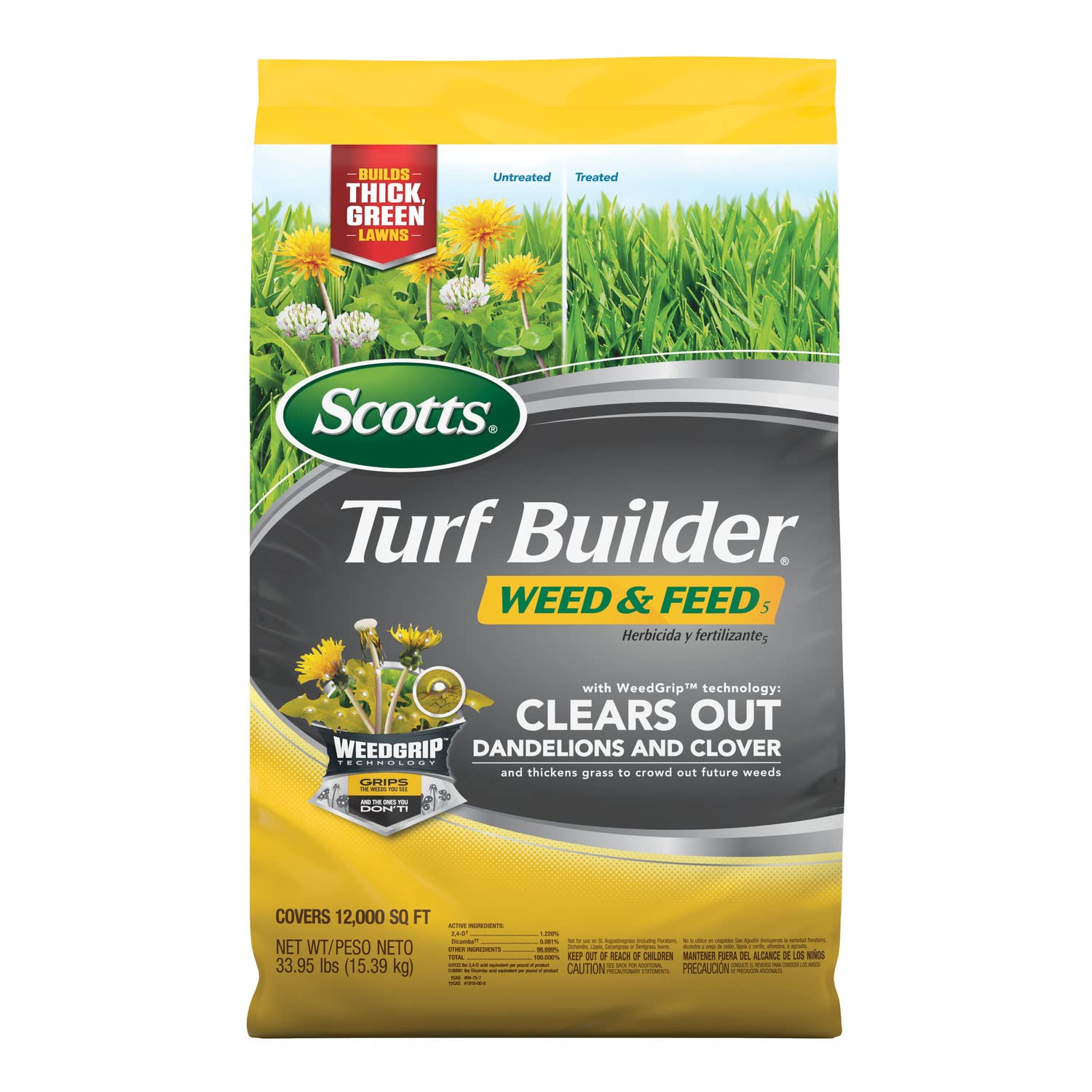
Scotts Turf Builder Weed & Feed5 Granular Lawn Fertilizer (33.95 lb) — 12,000 sq. ft.
| Item Form | Granule |
|---|---|
| Coverage | 12000 square feet |
| Active Ingredients | 2.4-D, Dicamba |
Scotts Turf Builder Weed & Feed5 is a granular combination product that kills many common broadleaf weeds while delivering nutrients to thicken turf. You apply it with a broadcast, drop, or handheld spreader to a wet lawn when weeds are actively growing and daytime temperatures are between 60°F and 90°F. The bag covers up to 12,000 square feet and the formula uses WeedGrip technology plus active herbicides 2,4-D and dicamba to control dandelion, clover and other listed weeds. Practical benefits include reducing visible weeds while feeding the grass so it can crowd out future weeds, and simplified application when you want one product instead of separate fertilizer and herbicide steps. Important limitations are explicit species restrictions and timing rules: do not use on St. Augustinegrass, bentgrass, dichondra, carpetgrass or lippia, and avoid application if rain is expected for 24 hours; it is also labeled for use only when temperatures and turf conditions meet the directions. Risk-averse homeowners should follow label safety guidance and keep people and pets off treated areas until dust settles.
Best for: Homeowners with common warm- or cool-season turf (including centipedegrass) who want a straightforward, single-step product to reduce broadleaf weeds while feeding the lawn and who prefer clear label instructions to minimize application risk.
Less Ideal for: Gardeners who maintain sensitive or excluded turf species or who prefer separate, manual control of weeds and fertilization for more precise timing or reduced herbicide use.
- Combines broadleaf weed control and fertilizer in a single application
- Covers up to 12,000 sq. ft. from one 33.95 lb. bag
- Instructions and spreader settings provided for even application
- Proven active ingredients (2,4-D and dicamba) that target common lawn weeds
- Contains herbicides that require careful timing, application conditions, and post-application precautions
- Not safe for several turf types including St. Augustinegrass and bentgrass
Verdict: A convenient weed-and-feed granule that kills common broadleaf weeds while feeding and thickening lawns across large areas, ideal for homeowners wanting one-step lawn care for centipedegrass-friendly turf.
Choosing the Right Fertilizer for Centipede Grass: Key Factors to Consider
Nitrogen Release Type
Centipede grass responds best to modest, steady nitrogen rather than large quick-release doses. Slow-release or polymer-coated nitrogen reduces the chance of rapid topgrowth that forces extra mowing and invites disease. A fertilizer labeled with a percentage of slow-release nitrogen helps you predict how long each feeding will last.
Quick-release formulas can produce a fast green-up but often require more frequent mowing and increase the risk of nitrogen loss through runoff. Matching the nitrogen release profile to your watering frequency and seasonality ensures a steady appearance without excessive growth spurts.
NPK Ratio Suited to Centipede
Centipede lawns typically need lower nitrogen relative to potassium and phosphorus than many other turfgrasses. Look for an analysis with modest nitrogen and adequate potassium to support stress tolerance and root strength. Excessive phosphorus is rarely needed for established centipede turf unless a soil test indicates a deficiency.
Choosing a balanced NPK that prioritizes steady nitrogen and adequate potassium helps maintain overall lawn vigor while preventing the soft, disease-prone growth that comes with overfeeding.
Soil pH and Amendment Needs
Centipede prefers slightly acidic soils. If your soil is too alkaline, nutrient uptake can suffer even when fertilizer is correctly applied. Testing pH and adjusting with sulfur or lime as appropriate is often as important as selecting the right fertilizer.
Some fertilizers include soil-conditioning components or sulfur-containing compounds that can nudge pH over time. Understanding your baseline soil chemistry helps you choose a fertilizer that complements any pH adjustments you plan to make.
Application Practicality
Ease of application affects whether you will feed on the recommended schedule. Granular fertilizers should be compatible with common broadcast or drop spreaders and have uniform granule size to prevent streaking. Liquid concentrates work well for small lawns or spot treatments but require a sprayer and careful calibration.
Packaging that is easy to measure and calibrated spreader settings listed by bag weight make consistent application simpler. Consider how often a product needs reapplying and whether that frequency fits your maintenance routine.
Environmental Loss and Timing
Reducing nutrient runoff and leaching protects nearby plantings and waterways. Slow-release formulas and split-season applications lower the chance of loss after heavy rain. Timing applications to avoid forecasted heavy precipitation and to align with active growth windows reduces waste.
Local climate and soil texture both affect leaching risk. Sandy soils need more conservative feeding and materials that bind nitrogen longer, while clay soils hold nutrients but can become waterlogged, affecting uptake.
Compatibility With Herbicide and Cultural Practices
If you plan to use selective herbicides, overseed, or perform core aeration, consider how fertilizer timing and formulation interact with those practices. Some herbicides require a waiting period before fertilizing, and new seedlings often need different feeding than established turf.
Coordinating fertilizer type and schedule with your other lawn care tasks minimizes stress on centipede grass and maximizes the benefit of each cultural practice.
When to Fertilize Centipede Grass
Centipede grass grows slowly and has specific seasonal windows when it will take up nutrients best. Late spring through early summer, as soil temperatures rise and the turf enters active growth, is the primary feeding window. A light follow-up in mid to late summer can help sustain color without pushing excessive topgrowth.
Avoid high-nitrogen applications in early spring or fall when centipede is not actively growing. Timing feeds for periods of consistent growth improves uptake efficiency and reduces waste.
- Primary feeding: late spring when soil is warming
- Optional summer touch-up if color fades
- Avoid heavy fall applications that stimulate soft growth
Interpreting Bag Analysis and Labels
Read the NPK numbers and the fine print on nitrogen sources. Labels that specify water-soluble and slow-release nitrogen percentages give a clearer picture of how the product will behave. Also check for secondary nutrients like iron and magnesium if you want deeper color without extra nitrogen.
Look for clear spreader settings and recommended application rates per 1,000 square feet. Ambiguous labeling makes consistent application difficult and raises the risk of over- or under-feeding.
- Find slow-release percentage on the label
- Check for micronutrients that affect color
- Use recommended spreader settings when provided
Adjusting Fertilizer Plans Based on Soil Test Results
A soil test is the most reliable way to know what your lawn actually needs. Test results tell you existing nutrient levels and pH, allowing you to choose a fertilizer that supplies missing elements rather than blanket-feeding everything.
If tests show low potassium or an unusual pH, prioritize products or amendments that address those specific needs. For routine maintenance with normal test results, use a balanced, slow-release formula timed to the growing season.
- Test every 2 to 3 years for established lawns
- Match fertilizer inputs to measured deficiencies
- Avoid routine phosphorus application unless tests indicate a need
Best Practices for Application
Calibrate your spreader and apply in overlapping passes to avoid stripes. Water in lightly after applying granular fertilizer to begin nutrient release, but avoid heavy irrigation that could move nutrients below the root zone. For liquid feeds, follow dilution instructions closely and apply in calm conditions to reduce drift.
Measure lawn area accurately so you apply the correct rate. Overapplication leads to stress and potential disease, while underapplication will not correct color or vigor problems.
- Calibrate spreader and use steady walking pace
- Light watering after granular application
- Avoid applying before heavy rain
Managing Common Problems Without Overfeeding
If centipede shows uneven color, diagnose with a soil test and spot-treat rather than blanket high-nitrogen feeding. Many discoloration issues stem from compaction, shade, pests, or pH imbalance rather than simple nutrient shortage.
Address cultural issues such as aeration, mowing height, and drainage first. Correcting these often restores vigor without increasing fertilizer frequency or rates.
- Use spot treatments for small patches
- Fix compaction and drainage before upping fertilizer
- Match mowing height to centipede recommendations
How We Chose the Best Fertilizer for Centipede Grass
We prioritized fertilizers that match centipede grass physiology and typical homeowner maintenance. Evaluation focused on nutrient balance tuned for low-to-moderate nitrogen, the presence and proportion of potassium and phosphorus for root and stress resistance, and whether the product uses slow-release or controlled-release nitrogen to prevent flush growth. We also judged ease of application, including spreader compatibility and granule consistency, plus packaging that supports accurate dosing. Soil and pH adjustment potential was considered since centipede performs best near slightly acidic conditions. Environmental impact and leaching risk were weighed by preferring formulations that reduce quick-release nitrogen loss. Excluded items included high-nitrogen turf blends intended for fast-growing grasses, fertilizers with unspecified analysis or vague ingredient lists, and products designed solely for sod establishment rather than routine maintenance. The final picks reflect a balance of predictable feeding, practical application, and support for centipede grass-specific needs.
FAQ
How often should I fertilize centipede grass during the growing season?
Most centipede lawns do well with one main feeding in late spring and an optional light application in mid-summer. Frequency depends on fertilizer release type and soil fertility; slow-release products often require fewer applications.
Can I use a general lawn fertilizer on centipede grass?
You can, but choose a general fertilizer with a modest nitrogen ratio and slow-release characteristics. Avoid high-nitrogen blends formulated for fast-growing turf, as these can overstimulate centipede grass.
Will applying more fertilizer make my centipede lawn greener faster?
Applying extra quick-release nitrogen can produce rapid greening but often leads to weak, disease-prone growth and more mowing. A steady, balanced feeding approach gives longer-lasting color with fewer negative side effects.
How important is soil pH for nutrient uptake in centipede grass?
Soil pH is very important. Centipede prefers slightly acidic soil, and incorrect pH can lock up nutrients even if fertilizer is applied. A soil test will show pH and guide any lime or sulfur adjustments needed.
Should I change my fertilizer if I aerate or overseed?
After aeration, soil tends to absorb inputs more effectively, so stick to recommended rates and consider a light feeding if the turf shows low fertility. For overseeding, use starter or lower-nitrogen formulas suited to new seedlings rather than the same maintenance feed used on established turf.
Final Verdict
Choose fertilizers for centipede grass that supply modest, steady nitrogen and support root health rather than pushing fast topgrowth. Prioritize slow-release formulations, proper NPK ratios, and products that align with your soil test and maintenance schedule. Balance application practicality and environmental risk when deciding. If you focus on timing, accurate dosing, and addressing pH or cultural issues first, you will maintain a healthy centipede lawn with fewer inputs and more predictable results.
