

Note: This article contains affiliate links. If you click on these links and make a purchase, I may earn a small commission at no extra cost to you. This helps support my research and content. Read my full affiliate disclosure here.
Choosing the right seed starting mix matters because young seedlings are fragile and respond directly to soil texture, moisture retention, and drainage. The right dirt seed starting mix gives seeds consistent contact with moisture for fast germination, strong early roots, and fewer damping-off problems. This guide covers seven shortlisted mixes that suit indoor flats, heated trays, and small greenhouse benches. We evaluated mixes for particle texture, water-holding balance, disease risk, and ease of transplanting. Read on for practical notes that help you match a mix to your growing setup and seed types.
Top Picks at a Glance
| Best Overall The best all-around choice for most situations | SunGro Horticulture Organic Seedling Mix (8 Quart) |  |
| Best Quality Built to a higher standard if you want something more solid | Espoma Organic Seed Starter Premium Potting Mix, 16 qt |  |
| Best Value The sweet spot between price and what you get | Burpee Organic Coconut Coir Seed Starting Mix (Coir Brick, expands to 8 qt) |  |
| Best Budget The cheapest option that still gets the job done reliably | Back to the Roots 3-in-1 Seed Starting Mix, 6 Quart, Organic Peat-Free |  |
| Highest Rated A top-rated pick with lots of positive feedback | Premier Horticulture Pro-Mix HP Mycorrhizae High Porosity Growing Medium |  |
| Most Popular A crowd favorite that many people choose with confidence | Miracle-Gro Indoor Potting Mix for Seed Starting, 8 qt. (2-Pack) |  |
| Best Seller A high-volume bestseller chosen again and again | Back to the Roots Organic Seed Starting Mix — Expanding 12 Quart Block |  |
SunGro Horticulture Organic Seedling Mix (8 Quart)

| Brand Name | SUN GRO |
|---|---|
| Style Name | Peat Moss |
| Volume | 8 quarts |
SunGro Horticulture Seedling Mix is a fine-textured, peat-based starting mix formulated to germinate seeds in flats, pots, and plug trays. It contains sphagnum peat moss, perlite for lightness and drainage, and an organic wetting agent to promote even water absorption, which helps maintain consistent moisture for small seeds. The mix also includes a silicon-enriched additive called RESiLIENCE intended to support stronger seedlings and reduce wilting during establishment. Typical use is filling trays or small pots, keeping the medium evenly moist but not waterlogged, then transplanting seedlings once roots are established. Practical benefits include predictable moisture retention, a clean fine texture that allows delicate roots to develop, and OMRI listing for organic onion transplants and other edible starts. Limitations are its small 8 quart volume for larger onion seed programs and that peat-based mixes dry out faster than heavier soils, so frequent monitoring is required; it also provides limited long-term nutrients so potting up into a richer mix or fertilizing before transplant is necessary.
Best for: Gardeners who want an organic, predictable seed starting medium for small to medium onion seed batches and who prioritize reliable germination over bulk volume.
Less Ideal for: Commercial growers or anyone starting very large quantities of onion seedlings should choose larger-volume or more nutrient-dense starting media.
- Fine, light texture suitable for delicate seed germination
- Organic wetting agent promotes uniform water absorption
- OMRI listed so safe for organic edible starts
- Contains perlite for improved drainage and root aeration
- Small 8 quart bag may not be cost-effective for starting large onion batches
- Peat-based mix has low long-term nutrient content and needs fertilizing before transplant
Verdict: A reliable OMRI-listed seed starting mix that delivers even moisture and a fine texture ideal for producing healthy onion seedlings in small home gardens.
Espoma Organic Seed Starter Premium Potting Mix, 16 qt

| Brand Name | Espoma |
|---|---|
| Volume | 16 quarts |
| Unit Count | 598.4 Ounce |
| Model Number | SS16 |
Espoma Organic Seed Starter is a peat-based, lightweight potting mix designed specifically for germinating seeds and rooting cuttings. The blend of sphagnum peat moss and perlite gives good aeration and drainage while the formula includes yucca extract to improve wetting and lime to balance pH. It also contains Myco-tone mycorrhizae to help early root establishment and improve nutrient access during the seedling stage. Typical use is filling trays, cells, or small pots for seeds and softwood cuttings; its fine texture and moisture retention reduce damping-off risk when used with proper sanitation and watering. Because it contains no synthetic fertilizers, it is appropriate for organic growing but you will need to begin light feeding once true leaves form or when transplanting. The bag size covers routine home-seed-starting needs, and the product is straightforward to handle and mix for small-scale propagation projects.
Best for: Gardeners focused on reliable seed germination and strong early root development who want an organic, ready-to-use mix for trays and small pots.
Less Ideal for: Growers wanting a peat-free or pre-fertilized seed mix or those starting very large volumes commercially should consider alternatives tailored to those needs.
- Formulated for seedlings with peat and perlite for balanced aeration and moisture retention
- Includes Myco-tone mycorrhizae to support early root development
- Organic ingredients with no synthetic fertilizers, suitable for organic growing
- Contains yucca extract to improve wetting and lime to help stabilize pH
- No starter nutrients included so plants need feeding after true leaves appear
- Peat-based mix is not the most sustainable choice for gardeners preferring peat-free media
Verdict: Choose this organic seed starter when you want a ready-to-use mix that promotes rapid root development and reliable germination for home seedlings and cuttings.
Burpee Organic Coconut Coir Seed Starting Mix (Coir Brick, expands to 8 qt)

| Brand Name | Burpee |
|---|---|
| Item Highlight | OMRI Listed coconut coir expands with water to 16 qts of growing mix; ideal for seed starting and seedlings. |
| Included Components | Coir |
| Ingredients | Coconut Coir |
Burpee’s compressed coconut coir brick is a simple, space-saving seed starting medium: add water and the brick expands into about 8 quarts of loose coir suitable for sowing seeds and potting seedlings. It is OMRI listed and made from recycled coconut husks, so it holds moisture well while maintaining good aeration around roots, which helps germination and early root development for vegetables, herbs, and flowers. The dehydrated brick is easy to store and transport compared with bulky bagged mixes, and it mixes readily with compost or a small amount of fertilizer when you need extra nutrients. Because it is essentially pure coir, you should plan to add starter nutrients or blend with organic potting mix for longer-term growth since it contains no built-in fertilizer. Some gardeners may find it slower to rehydrate if not broken apart first, and the product is a single concentrated brick so you must expand a full unit even when you need less volume. For someone optimizing space and wanting a reliable, low-mess seed-start medium, this is a practical choice.
Best for: Gardeners who value compact storage and a reliable, sterile medium for starting vegetable and herb seeds and who plan to amend or feed seedlings after germination.
Less Ideal for: Those who want an all-in-one potting mix with built-in fertilizer or growers who need small precise single-use portions without expanding a whole brick.
- OMRI listed organic coir made from recycled coconut husks
- Expands with water to about 8 quarts per brick for compact storage
- Good moisture retention with improved aeration for seed germination
- Mixes easily with compost or potting soil to tailor nutrient levels
- Contains no nutrients so you must add starter fertilizer for sustained growth
- Sold as a concentrated brick so you may over-expand when only a small amount is needed
Verdict: A compact, organic coir brick that gives practical gardeners an easy-to-store, moisture-retentive seed starting medium they can amend as needed.
Back to the Roots 3-in-1 Seed Starting Mix, 6 Quart, Organic Peat-Free

| Unit Count | 192 Fluid Ounces |
|---|---|
| Style Name | 3-in-1 Seed Starting Mix |
| Brand Name | Back to the Roots |
| UPC | 810667035822 |
This 6-quart Back to the Roots 3-in-1 Seed Starting Mix is a peat-free, organic blend aimed at making seed starting and early potting simple. You use it straight from the bag to fill trays, small pots, or starter cells; the mix includes coconut coir for water retention, dolomitic limestone to balance pH, mycorrhizae to support root uptake, and yucca extract for moisture control. Practically, that means fewer extra amendments for a new gardener and a more forgiving environment for delicate seedlings. The formula is designed to drain well while retaining enough moisture for even watering, and the included nutrients and worm castings can reduce early feeding. Limits to note are the small 6-quart volume, which is best for hobby-scale starting rather than large beds, and a lighter texture that may dry faster in very hot, exposed conditions. For budget growers who want an all-in-one starter mix without experimenting with multiple additives, this is a convenient choice.
Best for: Great for budget-minded home gardeners who want a single, ready-to-use seed starting mix that reduces extra amendments and simplifies starting herbs, vegetables, and flowers.
Less Ideal for: Not the best fit for landscapers or gardeners starting large numbers of plants or filling large containers where bulk bagged mixes would be more economical.
- Peat-free organic formula with coconut coir for moisture retention and aeration
- Includes mycorrhizae and worm castings to support early root development and nutrient uptake
- pH balancing with dolomitic limestone reduces the need for corrective amendments
- Ready-to-use blend suitable for seed trays, small pots, and indoor container starts
- Only 6 quarts per bag, so multiple bags are needed for larger projects
- Light, fast-draining texture can require more frequent watering in hot or windy conditions
Verdict: A convenient, peat-free all-in-one starter mix that saves time and extra purchases for home gardeners starting small batches of seeds.
Premier Horticulture Pro-Mix HP Mycorrhizae High Porosity Growing Medium

| Item Form | Loose Fill |
|---|---|
| Specific Uses For Product | Plant Growth, Root Development |
| Coverage | Medium |
| Target Species | crops, plants |
| Mixing Ratio | 75:25 |
This Pro-Mix HP with mycorrhizae is a loose, high-porosity peat-based medium designed for seed starting, rooting cuttings, and water-sensitive or low-light crops. You use it like a standard potting mix: fill trays or containers, water thoroughly, and plant seeds or transplants. Notable features include added Glomus intraradices mycorrhizal inoculum to support early root establishment and a formulation that emphasizes air capacity and extra drainage, which helps prevent damping off in overwatered starts. The mix is practical for small-scale greenhouse or indoor seed starting where reliable drainage and oxygenation at the root zone matter. Limitations are that it is peat-based, so it will dry out faster than heavier mixes and requires regular monitoring of moisture and feeding since it is not a complete long-term potting soil. Also the package size is large, so it is best for gardeners who will use it across many flats rather than a single small project.
Best for: Growers who prioritize reliable, fast-rooting starts and need a consistent, well-draining medium for seed trays, cuttings, or low-light seedlings.
Less Ideal for: Casual gardeners who want a low-maintenance all-in-one potting soil for long-term container plants or those who prefer peat-free blends.
- Contains mycorrhizal inoculum to support early root growth
- High porosity provides excellent air capacity and extra drainage
- Formulated for water-sensitive crops and rooting cuttings
- Peat-based mix dries faster and needs more frequent watering
- Not a complete long-term potting soil so requires supplemental fertilization
Verdict: Choose this high-porosity, mycorrhizae-enhanced mix when you need a dependable, well-draining medium that promotes fast, healthy root development for seed starting and cuttings.
Miracle-Gro Indoor Potting Mix for Seed Starting, 8 qt. (2-Pack)
| Brand Name | Miracle-Gro |
|---|---|
| Item Type Name | Potting Mix |
| Number of Packs | 2 |
| Volume | 8 quarts |
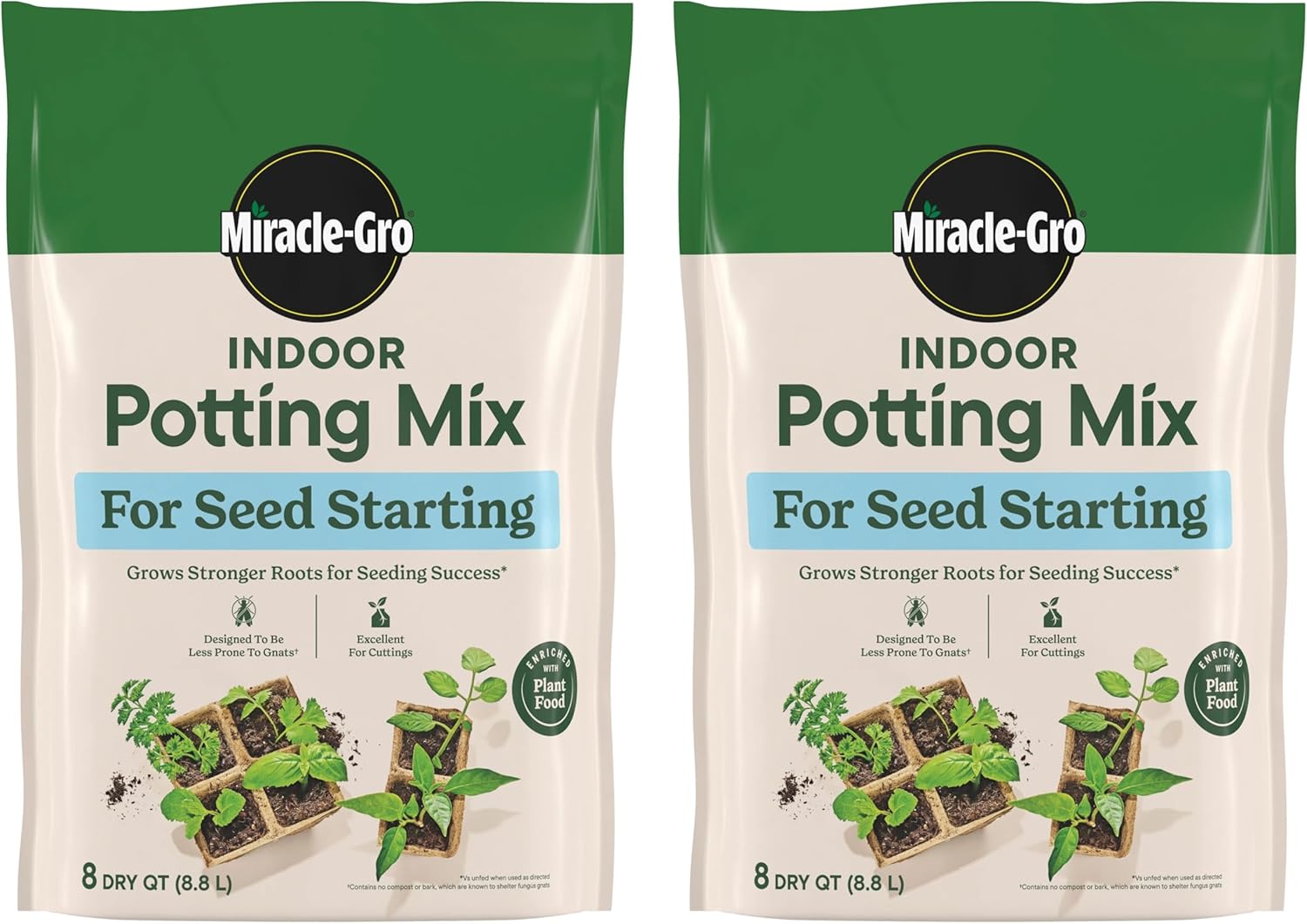
This two-pack of Miracle-Gro Indoor Potting Mix is designed specifically for starting seeds and rooting cuttings indoors. The blend is lightweight and pre-enriched with plant food so seedlings get a nutrient boost during early root development, and the manufacturer says it yields stronger roots compared with unfed mixes when used as directed. It is intended for vegetables, flowers, and herbs and works well in cell trays and small containers; one 8 qt. bag will fill roughly three 72-cell trays. Notably, the formula omits compost and bark, which helps lower the chance of fungus gnat infestations in damp seed-starting setups. Use it by filling trays or pots, keeping the mix evenly moist, and shielding newly sown seeds from direct sun until germination. Important limitations are standard for enriched mixes: it contains fertilizer (so handle carefully) and it is a seed-starting medium rather than an all-purpose potting soil for mature plants, so you will likely transplant seedlings into a different mix or amend soil later.
Best for: Buyers who want a low-effort, indoor seed-starting medium that supports faster root development and reduces common pest risks while following proven seed-starting practices.
Less Ideal for: Gardeners who need a permanent potting soil for mature container plants or who prefer fully organic, compost-rich mixes should consider alternatives.
- Lightweight, ready-to-use formula tailored for seed germination and cuttings
- Pre-enriched with plant food to support early root and seedling growth
- Excludes compost and bark to reduce habitat for fungus gnats
- Comes as a two-pack so you have enough mix for multiple trays
- Contains fertilizer which requires careful handling and storage
- Intended for seed starting so not formulated as long-term potting soil for mature plants
Verdict: A practical, low-risk seed-starting mix that boosts early root growth and reduces fungus gnat risk, making it a reliable choice for indoor vegetable seedlings.
Back to the Roots Organic Seed Starting Mix — Expanding 12 Quart Block

| Volume | 12 quarts |
|---|---|
| Item Type Name | Seed Starting Mix |
| Unit Count | 384 Fluid Ounces |
| OMRI Listed | Yes |
| Peat Free | Yes |
This compressed seed starting mix is a coir-based block that expands to 12 quarts of loose, ready-to-use seedling soil after adding water. It is designed for starting seeds, potting up seedlings, and amending small pots for herbs, vegetables, and flowers. Notable features include an OMRI-listed organic formulation, balanced pH and low electrical conductivity to support nutrient uptake, and compact storage compared with bulky soil bags. In practice the block is easy to hydrate and fluffs up quickly, producing a light, airy medium with good water retention and aeration for root development. The convenience of a single expanding block and beginner-friendly handling makes it a reliable choice for cautious gardeners who want predictable results without mixing multiple ingredients. Limitations are that it is a single-purpose starter mix rather than an all-in-one fertilized potting soil and larger projects will need multiple blocks, so plan quantities ahead.
Best for: Practical gardeners who want a reliable, easy-to-use organic starter medium for small-scale seed trays, pots, and indoor seedlings and who prioritize predictable, low-fuss results.
Less Ideal for: Gardeners needing a ready-to-use, fertilized all-purpose potting soil for large container gardens or immediate long-term container plantings should consider an enriched potting mix instead.
- Expands to 12 quarts from a compact compressed block for easy storage and transport
- OMRI-listed organic and peat-free formulation suitable for organic growing
- Neutral pH and low electrical conductivity support seedling nutrient uptake
- Light, fluffy texture promotes good aeration and root development
- Simple to hydrate and use, friendly for beginners and low-effort setups
- Sold as a bare starting mix without added fertilizer for later stages
- Single block size requires purchasing multiple units for larger seed batches
Verdict: A compact, OMRI-listed organic seed starter that reliably expands into a light, neutral-pH medium for predictable, beginner-friendly seed starting.
Choosing the Right Dirt Seed Starting Mix: Key Factors to Consider
Particle Texture And Consistency
Particle size determines how well seeds sit in contact with the medium and affects water movement. A mix that is too fine turns into a crusted, poorly-aerated surface that impedes root growth and can increase damping-off risk. Conversely, a mix with too many large particles will allow seeds to dry out and can lead to uneven germination.
Look for a blend that feels uniform when moistened: fine enough for close seed contact but with some coarser components to create microscopic air pockets. Consistent texture between batches is important so you do not need to change watering technique every season.
Moisture Retention Balance
Seeds need steady moisture for germination but not constant saturation. The best dirt seed starting mixes hold water long enough for roots to form while releasing excess to prevent oxygen-starved roots.
Consider how you water and whether you use bottom heat or domes. Mixes with peat or coir offer good water-holding capacity, while perlite or vermiculite helps moderate that retention. Your choice should match how often you can check trays and how quickly they dry under your grow lights or greenhouse conditions.
Drainage And Aeration
Air in the root zone is as important as moisture for healthy seedlings. Good drainage prevents standing water and gives roots access to oxygen, reducing leggy or weak growth.
A quality seed starting mix combines water-holding ingredients with coarse materials that create channels for air. For indoor starts under lights, faster drainage reduces soggy surfaces and lowers risk of fungal issues. For cooler, slower-drying environments, choose a mix with a touch more water retention.
Disease Risk And Sterility
Young seedlings are vulnerable to damping-off and other soil-borne diseases. Many seed mixes are pre-sterilized or use components that are less likely to support pathogens. Sterility reduces early losses and makes your starting routine more reliable.
Even with a sterile mix, hygiene of trays, tools, and watering water matters. If you prefer organic inputs, be aware that some untreated natural materials can carry microbes. Look for clear labeling on sterilization or pathogen management if disease reduction is a priority.
Nutrient Approach And Starter Fertility
Some mixes are formulated purely for germination and contain little to no nutrient, expecting you to transplant into richer soil or begin light feeding later. Others include a low level of starter fertilizer to support early growth without burning tender roots.
Decide whether you want a neutral medium that gives you control over feeding, or a lightly fortified mix that supports the first few true leaves. Consider the seedlings you grow: fast-developing vegetables usually tolerate small starter nutrients, while very tender seedlings may do better in a nutrient-neutral medium initially.
Handling And Transplant Integrity
When seedlings are ready to move, the medium should hold together enough to lift plugs or flats without crumbling, yet allow roots to expand into the new potting soil. A mix that collapses makes delicate root systems prone to damage; one that compacts can strangle early roots.
Consider whether you use cell packs, soil blocks, or open flats. Some mixes are optimized for cohesion in small plugs; others are loose for open flats. Handling characteristics also affect how easily you can separate seedlings during transplanting and how much root disturbance they experience.
Match Mix Texture To Seed Size
Fine-seeded plants like lettuce, celery, and many herbs need a very fine, even surface so tiny seeds maintain contact with moisture. Larger seeds such as squash or beans tolerate and often prefer a slightly coarser mix that drains faster and warms up more quickly. If you start a wide variety of seeds, choose a versatile mix and adjust sowing depth and surface tamping rather than switching media for every crop.
- Fine seeds benefit from a sifter or a small layer of fine mix on top to ensure contact.
- Large seeds can be planted deeper into a coarser portion of the mix to avoid oversaturation.
Watering Techniques For Seedling Success
How you water interacts with the mix choice. For mixes that hold water well, bottom-watering or misting keeps the surface from crusting. For faster-draining mixes, top watering may be necessary to ensure consistent moisture at the seed level. Use clear, shallow trays to observe moisture and adjust frequency rather than relying on a fixed schedule.
- Bottom-watering: fill tray reservoir to lift moisture into the plug.
- Top-watering: use a gentle spray to avoid disturbing seeds.
- Use a moisture meter or your finger to check the top 1 inch of media for dampness.
Sanitation And Seedling Health Practices
Even with a sterilized mix, sanitation around trays reduces losses. Clean trays and tools, allow good air circulation, and avoid over-watering. A humidity dome helps germination but remove it promptly once cotyledons open to reduce fungal growth. Position a small fan for gentle airflow and keep seed flats on a heated mat only when needed. These practices complement a good mix by minimizing environmental triggers for disease.
- Sterilize trays between cycles with a mild bleach solution or hot water rinse.
- Remove domes when seedlings unfurl to lower humidity.
When To Start Feeding Seedlings
If your chosen mix is low in nutrients, wait for the first true leaves before applying a weak fertilizer solution. For mixes with starter fertility, delay feeding until growth slows or leaves show paler color. Excessive early feeding can burn tender roots and stunt growth. Use a diluted balanced fertilizer and increase strength gradually. Observe leaf color and vigor as the best guide rather than fixed timing.
- Begin feeding at one-quarter strength, then move to half strength as seedlings mature.
- Monitor for nutrient burn signs such as brown leaf edges or stunted growth.
Adjusting Mixes For Home-Made Blends
If you blend your own seed-starting dirt, balance water-holding elements like coir or peat with drainage components such as perlite or fine grit. Sterilize or heat-treat homemade mixes if you reuse them or suspect contamination. Keep a consistent recipe so your watering routine remains predictable. Small tweaks like adding a little vermiculite for tiny seeds can make a big difference without changing the entire blend.
- Typical home mix: 50 percent peat or coir, 30 percent perlite, 20 percent vermiculite or fine grit.
- Always moisten and screen homemade mixes before use to remove large clumps.
How We Chose the Best Dirt Seed Starting Mix
To build this roundup we focused on characteristics that actually affect seed-starting success in real garden and greenhouse conditions. We prioritized mixes with a fine but not powdery particle size for even seed-to-soil contact, consistent water retention without waterlogging, and good drainage to keep roots oxygenated. Disease risk was a key filter; mixes with a history of mold, fungal contamination, or persistent damp-soil pathogens were excluded unless they used sterilization methods or pathogen-resistant components. We also assessed transplant handling – how well the media holds together when lifting seedlings and whether it allows roots to exit the plug without tearing. Nutrient approach mattered: some mixes are designed only for germination and others include light starter nutrients; both are valid but were judged on clarity of purpose. Physical consistency across bags and minimal dust at handling were additional factors. We excluded mixes formulated for mature container plants or heavy-amendment garden soil blends because those do not provide the fine texture and moisture control seed starting requires.
FAQ
Can I use garden soil to start seeds in flats?
Garden soil is usually too heavy and contains microbes and weed seeds that can harm young seedlings. It tends to compact, reducing oxygen at the root zone. For reliable germination use a lighter, sterile seed starting mix or sterilize garden soil thoroughly before using it.
How do I tell when seedlings need transplanting from seed trays?
Transplant when seedlings have their first set of true leaves and show a healthy root mass visible at the bottom or sides of the plug. Avoid waiting until roots are densely pot-bound. Also check that the plant is sturdy and that watering cycles are keeping pace with the number of plants in the tray.
Should I pre-moisten seed starting mix before sowing?
Yes. Pre-moistening ensures even moisture distribution and avoids disturbing tiny seeds when you water. The mix should be moist but not dripping; squeeze-test it – a few droplets may appear but it should not stream water.
Is bottom-watering better than top-watering for seed starting?
Bottom-watering is often gentler and helps prevent surface crusting, especially for fine mixes and tiny seeds. Top-watering can be useful with coarser mixes or when trays lack reservoirs. Both methods work if you monitor moisture at seed depth and avoid over-saturating.
How long will a seed starting mix stay usable after opening the bag?
If stored in a cool, dry place and resealed, most mixes remain usable for a season or two. Exposure to moisture invites mold or pests. For long-term storage keep bags sealed and check texture before use; discard any mix with a musty odor or visible contamination.
Final Verdict
Choose a dirt seed starting mix that matches the seeds you grow and the conditions you provide. Prioritize particle texture and a moisture balance that matches your watering routine, then check for drainage and disease-reduction features. Decide whether you want a neutral germination medium or a lightly fortified starter mix based on how soon you plan to transplant and feed. Focus on mixes that handle transplanting without crumbling and that deliver consistent batch-to-batch texture. With those tradeoffs in mind you can pick a mix that gives faster germination, healthier roots, and fewer early losses, making your seed-starting easier and more predictable.
