

Note: This article contains affiliate links. If you click on these links and make a purchase, I may earn a small commission at no extra cost to you. This helps support my research and content. Read my full affiliate disclosure here.
Slugs can quickly strip seedlings, chew prized leaves, and undo weeks of careful gardening. Choosing the right garden slug killer matters because different methods vary in speed, safety for pets and wildlife, and suitability around vegetables and ornamentals. This guide covers five shortlisted options that work in typical gardens and patios and explains how we judged each choice. You will find clear criteria on effectiveness, application safety, and garden fit so you can pick an approach that protects plants without creating new problems. Read on to see the key tradeoffs and practical tips for using slug control in real outdoor gardening situations.
Top Picks at a Glance
| Best Overall The best all-around choice for most situations | Ortho Bug-Geta Snail & Slug Killer |  |
| Best Quality Built to a higher standard if you want something more solid | Monterey Sluggo Plus Granular Snail & Slug Killer, 1 lb |  |
| Best Value The sweet spot between price and what you get | Monterey Sluggo Snail & Slug Killer — 2.5 lb Jug (Iron Phosphate) |  |
| Highest Rated A top-rated pick with lots of positive feedback | Monterey Sluggo Maxx Slug and Snail Killer, 10 lb |  |
| Most Popular A crowd favorite that many people choose with confidence | Corry's Slug and Snail Killer Pellets, 1.75 lb |  |
Ortho Bug-Geta Snail & Slug Killer

| Unit Count | 1 Ounce |
|---|---|
| Item Form | Spray |
| Target Species | Insects |
| Active Ingredient | 1.0% Sulfur |
Ortho Bug-Geta Snail & Slug Killer is a granular bait designed to reduce slug and snail damage in vegetable gardens, ornamentals, fruit trees, and greenhouses. You scatter the pellets around plants in the evening when slugs and snails are most active, reapplying as the bait is consumed or at least every three weeks. Its sulfur-based formula lures pests to feed, causes them to stop feeding and die within one to three days, and the product can persist through light rain for up to three weeks. Being OMRI listed means it can be used in organic settings and is advertised as safe to use around pets and wildlife when used as directed. Practical benefits include ease of use with no mixing, suitability for many planting situations, and longer residual activity so you do not need very frequent applications. Limitations are that heavy infestations or very wet conditions require more frequent or heavier application and dead pests may go out of sight, so damage reduction rather than immediate visible carcasses is the typical result.
Best for: Gardeners who want a straightforward, organic-approved bait to protect vegetables, ornamentals, and fruiting plants with minimal fuss and periodic reapplication.
Less Ideal for: People with chronically saturated soil or large commercial operations who need an immediate, high-volume control method should consider alternative or supplemental strategies.
- OMRI listed for organic use so suitable for organic gardens when used as directed
- Ready-to-use pellet form requires no mixing or equipment
- Remains effective after rain or sprinkling for up to three weeks
- Works on a wide variety of slugs and snails and can be used around vegetables, fruit trees, and ornamentals
- Contains sulfur as the active ingredient which may require careful placement and adherence to label directions
- Less effective in continuously waterlogged areas and may need more frequent reapplication during heavy rain
Verdict: A simple, OMRI-listed pellet bait that gives gardeners multi-week protection against slugs and snails with no mixing required.
Monterey Sluggo Plus Granular Snail & Slug Killer, 1 lb

| Active ingredients | Spinosad and Iron phosphate |
|---|---|
| Form | Granular bait |
| Coverage | Treats up to 2,000 sq ft per 1 lb |
| OMRI listed | Yes |
Sluggo Plus is a granular bait designed to protect vegetable beds, ornamentals, fruit trees and greenhouse plants by attracting and killing slugs and snails and suppressing listed insects such as earwigs and cutworms. You scatter the granules around plants or in affected areas; the bait is formulated to remain effective through normal rain or light sprinkling and treats up to about 2,000 square feet per pound. Key features are the dual active ingredients—spinosad for quick control and iron phosphate that breaks down into soil-beneficial phosphate—and the product's OMRI listing, which makes it suitable for organic gardening. In practice it offers reliable, targeted control without the mess of liquid sprays and is easy to reapply after heavy rain. Limitations are that it is a contact/ingested bait so it will only affect pests that consume it, and heavily infested sites may require follow-up applications for ongoing pressure or to control other nonfeeding pests.
Best for: Gardeners focused on dependable, performance-oriented slug and snail control who prefer OMRI-listed products and simple granular application for beds, borders, or small orchards.
Less Ideal for: Those who need a non-bait solution for nonfeeding pests or who prefer immediate contact sprays for visible active infestations in high-moisture environments.
- Dual active ingredients combine fast-acting spinosad with iron phosphate that degrades to fertilizer
- OMRI listed for use in organic gardening
- Granular form is easy to scatter and stays effective through normal rain or light watering
- One pound treats up to approximately 2,000 square feet, covering larger areas with a single bag
- Only affects pests that consume the bait so survivors or nonfeeding stages may persist
- May require reapplication after very heavy rain to maintain protection
Verdict: Choose Sluggo Plus when you want a proven, OMRI-listed granular bait that delivers reliable, large-area control of slugs and snails.
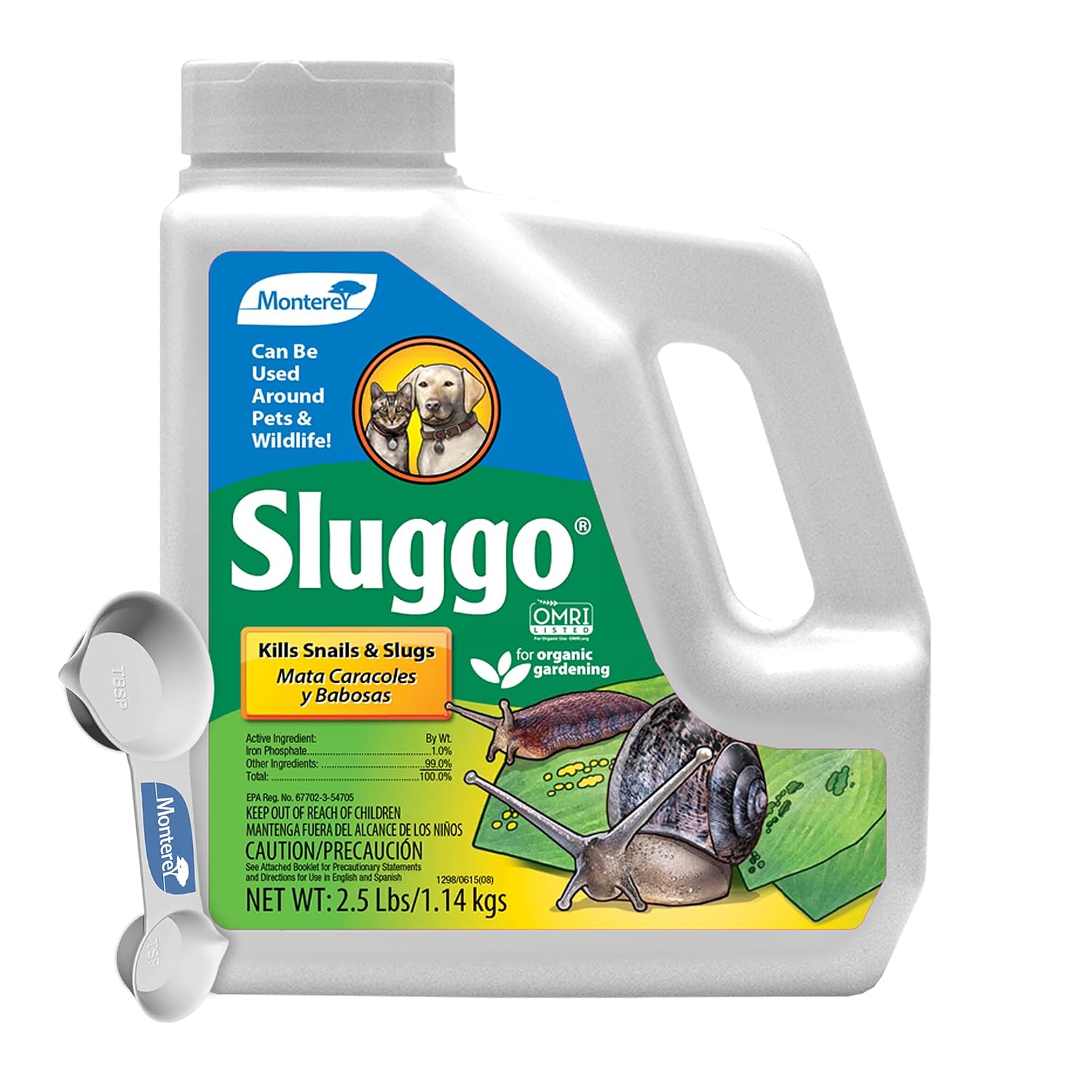
Monterey Sluggo Snail & Slug Killer — 2.5 lb Jug (Iron Phosphate)
| Unit Count | 40 Ounce |
|---|---|
| Item Form | Powder |
| Target Species | Slug |
| Liquid Volume | 1.13 kg |
| Active Ingredient | Iron Phosphate 1.0% |
Monterey Sluggo is a granular iron phosphate bait formulated to attract and control slugs and snails without harming pets or wildlife. Apply the granules around plants, along borders, or with a broadcast spreader for larger areas, ideally in the evening when slugs are most active. The OMRI listing makes it suitable for certified organic and home garden use, and the active ingredient remains effective after normal rainfall, so bait does not wash away easily. Safety directions recommend wearing gloves and eye protection when handling the concentrate. Practical benefits include easy scatter application, compatibility with edible and ornamental plantings, and a wildlife-friendly active ingredient. Limitations are that very heavy rain can require reapplication and control relies on repeated baiting rather than a one-time cure, so expect to monitor populations and reapply as needed during peak slug seasons.
Best for: Gardeners who want a practical, pet- and wildlife-friendly way to reduce slug and snail damage across vegetable beds, ornamentals, and lawns and who prefer products compatible with organic practices.
Less Ideal for: People seeking an instant kill or single-application solution for severe infestations or those who prefer non-bait mechanical controls like traps or barriers.
- OMRI listed iron phosphate formula safe for use in organic gardens
- Granular form is easy to scatter by hand or with a spreader for larger beds
- Effective after normal rain so treatment remains active until heavy washout
- Suitable for use around vegetables, ornamentals, lawns, greenhouses and berries
- Requires periodic reapplication after heavy rainfall or during high slug pressure
- Control is population management rather than immediate elimination
Verdict: A pet- and wildlife-friendly, OMRI-listed granular bait that provides reliable slug and snail control for organic-minded gardeners.
Monterey Sluggo Maxx Slug and Snail Killer, 10 lb

| Ingredients | Iron Phosphate (3.0%) |
|---|---|
| Weight | 10 lb |
| OMRI Listed | Yes |
| Water Resistance | Remains effective after rain or sprinkling |
Monterey Sluggo Maxx is a concentrated iron phosphate bait designed to control slugs and snails across large areas. Applied as granular bait around vulnerable plants, it delivers a 3.0% iron phosphate formula that the manufacturer says is roughly three times stronger than standard 1% products, so you can expect quicker reductions in slug activity. The granules are water resistant, so they retain effectiveness after rain or irrigation and reduce the need for immediate reapplication. It is OMRI listed for organic gardening and labeled safe to use around pets, wildlife, and edible crops when used as directed, which makes it suitable for vegetable beds, ornamentals, lawns, and greenhouses. The product claims high coverage per pound, letting a single container treat a large area, which helps keep labor and repeat purchases down. Limitations to note are that it still relies on correct placement to intercept pests and that effectiveness depends on slug pressure and environmental conditions rather than being an instant fix.
Best for: Gardeners and landscapers who prioritize dependable, long‑lasting slug control and want a product that is safe to use around edibles and pets while covering large areas efficiently.
Less Ideal for: People who need immediate knockdown of heavy infestations or who prefer non‑bait mechanical controls like traps or barriers.
- Higher concentration iron phosphate formula for faster control than standard 1% baits
- Water-resistant granules remain effective after rain or sprinkler events
- OMRI listed and labeled safe for use around edible crops, pets, and wildlife when used as directed
- High coverage per pound reduces frequency of reapplication and treats large areas
- Performance still depends on correct bait placement and local slug pressure
- Not an instant kill; results occur over days as slugs feed and stop damaging plants
Verdict: Choose Sluggo Maxx when you want a reliable, pet‑ and edible‑safe iron phosphate bait that covers large areas and holds up after rain.
Corry's Slug and Snail Killer Pellets, 1.75 lb

| Item Form | Pellets |
|---|---|
| Target Species | Insects |
| Unit Count | 1 Count |
| Item Weight | 1.8 pounds |
Corry's Slug and Snail Killer is a pellet bait designed to control common slugs and snails around the home. You scatter the pellets around plants or on soil in the morning or evening, where pests eat the bait then retreat to hide and die over three to six days. The formula stays effective when wet and is cleared for use in vegetable and fruit gardens up to and including day of harvest, which makes it practical for edible beds. It is marketed as safe for people and pets to re-enter treated areas immediately after application, and the product is easy to apply without special equipment. Limitations include the need to reapply after heavy disturbance of the area and that control is gradual rather than immediate, so expect a few days before populations drop. Also follow basic safety steps to avoid eye or skin contact when handling the pellets.
Best for: Gardeners who want a straightforward, low-effort way to reduce slug and snail damage in lawns and edible beds while keeping costs down.
Less Ideal for: Users seeking an immediate kill or a non-bait mechanical solution should consider traps or barriers instead of a bait-based product.
- Effective pellet formulation that kills slugs and snails within about 3–6 days
- Approved for use in vegetable and fruit gardens up to day of harvest
- Remains effective in wet conditions so performance is less impacted by rain
- People and pets can re-enter treated areas immediately after application
- Control is not instantaneous and requires several days for full effect
- Requires periodic reapplication if soil is disturbed or after heavy rain events
Verdict: A simple, budget-friendly pellet bait that reliably reduces slug and snail populations in lawns and vegetable gardens within a few days.
Choosing the Right Garden Slug Killer: Key Factors to Consider
Effectiveness Against Active Feeding
How quickly a control method stops slugs from feeding matters when young plants are at risk. Rapid knockdown reduces visible damage and saves vulnerable seedlings. Some approaches deliver immediate lethal or deterrent effects while others act more slowly as a bait or barrier. Consider whether you need fast symptom relief or longer-term suppression.
Effectiveness also depends on slug pressure and local conditions. Heavy infestations often require a combination of strategies rather than a single application. Monitor damage patterns and reapply or augment methods when signs of renewed activity appear.
Safety for Pets, Wildlife, and Pollinators
Safety is a top concern if you have pets, children, or wildlife visiting the yard. Some slug controls are toxic to mammals or birds if ingested, while others pose minimal secondary risk. Choose options with clear, low-risk profiles around animals and avoid placing baits in accessible spots when necessary.
Protection for pollinators and beneficial insects is also important. Methods that kill or repel only slugs or that use physical barriers reduce collateral harm compared with broad-spectrum toxicants. Read label instructions and use placement strategies to minimize exposure of non-target species.
Compatibility With Edible Gardens
If you grow vegetables, herbs, or fruit, confirm that a product or method is safe for use around edibles. Some treatments are labeled for food crops, while others are not recommended within harvestable areas. Consider timing of applications relative to harvest and whether you can keep control measures away from raised beds and container-grown edibles.
For container gardens and small plots, choose low-residue options or physical barriers that do not require frequent reapplication. That makes it simpler to maintain edible production without added contamination risks.
Ease of Application and Maintenance
Gardening is easier when slug control is simple to deploy and maintain. Some methods need frequent reapplication, nightly placement, or active monitoring, while others provide longer windows of protection with less work. Factor in how much time you can commit to maintenance and whether the method fits your garden routines.
Also consider placement complexity. Barriers and traps work well in compact beds but can be awkward in large borders. Choose approaches that match the scale and layout of your beds to keep maintenance manageable.
Durability in Wet Weather
Many slug control options are affected by rain and irrigation. Pelleted baits can dissolve or wash away, and some barriers become less effective when saturated. Durability in wet conditions matters in spring and fall when slugs are most active and weather is often wet.
Select products that retain effectiveness after light rain or plan for protected placement. For persistent wet conditions, favor physical or mechanical controls that are not dependent on dry exposure.
How Slug Behavior Affects Control Success
Slugs are nocturnal and hide in damp, cool spots during the day. That means baiting and trapping tend to work best when placed near likely daytime refuges such as dense mulch, stone edges, or plant bases. Observing where slugs congregate helps you target interventions rather than treating the whole garden indiscriminately.
Because slugs move and feed at night, barriers and cleanup of hiding places can reduce populations over time. Removing debris, keeping soil edges trimmed, and reducing overly damp microclimates lowers the number of refuges and increases the effectiveness of any control you use.
- Inspect beds at dawn or dusk to locate slug trails and feeding damage.
- Target placements where slugs hide rather than scattering treatments randomly.
- Combine habitat modification with active control for longer-term reduction.
Safe Placement Strategies in Mixed Gardens
Placement is crucial when you have pets or children. Put any bait or treated area where animals cannot easily access it, such as inside low tunnels, under shelters, or within enclosed raised beds. Physical barriers can often be placed around plant crowns to protect seedlings without exposing pets to substances.
For edible plants, consider barriers or traps rather than broad application baits. Where baits are used, follow label guidance about withholding periods before harvest and avoid placing products directly on crop surfaces.
- Use elevated trays or covered traps in container gardens.
- Anchor barriers so animals do not knock them over.
- Move baits away from paths and areas pets frequent.
Integrating Multiple Methods for Better Control
No single tactic eliminates slugs in every situation. Combining cultural controls, physical barriers, and targeted treatments often gives the best results. For example, hand-picking at dusk, removing hiding spots, and installing a perimeter barrier will reduce numbers and make any chemical or bait option more effective.
Rotate or alternate control types if pressure remains high. Using a range of compatible measures reduces the chance that one weak point will allow population rebounds.
- Start with habitat reduction and sanitation.
- Add targeted traps or localized baiting only where needed.
- Monitor results and adjust methods if damage continues.
Timing Treatments for Peak Slug Activity
Treat when slugs are most active to maximize uptake and reduce wasted effort. Cool, wet evenings and early mornings are prime feeding times. Applying controls shortly before expected activity increases the chance slugs encounter baits or barriers while they are foraging.
Avoid treating during prolonged dry spells when slugs are less active and may not contact controls. Conversely, after heavy rains, re-evaluate placements because some materials may wash away or be less effective.
- Check local weather and time applications for cool, damp periods.
- Reapply or reposition controls after heavy irrigation or rain.
- Use nightly or weekly monitoring to time follow-up actions.
Long-Term Garden Practices That Reduce Slug Pressure
Long-term reduction comes from cultural changes that make the garden less hospitable. Improve drainage, reduce continuous thick mulches near plant crowns, and avoid overcrowding that creates constant shade and moisture. These adjustments reduce the number of refuges available to slugs.
Encouraging natural predators, such as birds and ground beetles, also helps. Provide habitat that supports these beneficials without creating additional damp hiding places for slugs.
- Create well-drained planting beds and avoid overwatering.
- Thin dense groundcovers near young plants.
- Install simple habitat features for slug predators while maintaining tidy planting zones.
How We Chose the Best Garden Slug Killer
We prioritized products and methods that deliver consistent slug reduction in a typical backyard or container garden while minimizing risks to pets, wildlife, and non-target invertebrates. Key evaluation criteria included effectiveness at reducing active slug feeding, safety profile around edible plants and pets, ease of application and maintenance, and suitability for different garden situations such as raised beds, containers, or sprawling borders. Longevity of control and weather resistance were considered so products that fail after rain were downgraded. We also looked for options with clear usage guidance and straightforward cleanup. Excluded from consideration were methods that rely on unproven home remedies with no reliable field evidence or options that require specialist licensing to apply. We did not include techniques that are impractical at garden scale or that present avoidable hazards to children or beneficial wildlife. The final shortlist balances rapid knockdown, ongoing protection, and safety to help gardeners choose an approach that fits their planting and household needs.
FAQ
Are slug control methods safe to use around vegetable beds?
It depends on the method. Some options are labeled safe for use in edible gardens when applied according to instructions, while others are not recommended near harvestable crops. Choose low-residue or physical barrier approaches when possible and follow any specified withholding periods.
How often do I need to reapply slug control treatments?
Reapplication frequency varies by method and weather. Pelleted baits and residual treatments often need reapplication after heavy rain or when consumption is high. Barriers and traps require less frequent attention but still need monitoring and occasional cleaning or relocation.
Will removing mulch help reduce slug problems?
Yes. Thick, constantly damp mulches create daytime refuges that protect slugs. Reducing mulch thickness near seedlings, improving airflow, and removing debris can make control measures more effective and lower overall slug habitat.
Can I rely on biological controls alone to stop slugs?
Biological controls, such as encouraging predators, contribute to long-term suppression but usually do not eliminate heavy infestations quickly. They work best when combined with habitat modifications and targeted interventions for immediate relief.
Is hand-picking slugs effective in larger gardens?
Hand-picking is effective for targeted spots and small plots, but it is labor-intensive for large areas. It works best as part of an integrated plan that includes habitat reduction and localized traps or barriers to lower overall numbers.
Final Verdict
Choosing the right Garden Slug Killer comes down to balancing rapid control with safety and garden fit. Prioritize methods that match your planting situation: low-residue or barrier options near edibles, targeted baits in contained areas, and cultural changes to reduce long-term pressure. Consider weather durability and maintenance needs so your chosen approach remains effective through wet periods and active slug seasons. Focus on a combination of habitat management, targeted control, and ongoing monitoring. That approach reduces damage fast while protecting people, pets, and beneficial wildlife so you can keep plants healthy with minimal disruption.
