

Note: This article contains affiliate links. If you click on these links and make a purchase, I may earn a small commission at no extra cost to you. This helps support my research and content. Read my full affiliate disclosure here.
If you spend time maintaining patios, pavers, or pathways, tough weeds that regrow from roots can ruin the look and create slipping hazards. Choosing an extra strong patio weed killer matters because the right product removes established weeds quickly without damaging stone, concrete, or surrounding plantings. This guide covers seven shortlisted options that perform well in hardscape situations and explains the practical tradeoffs between speed, residual control, and surface safety. We'll summarize how each choice was evaluated so you can pick the approach that fits your patio material and gardening priorities.
Top Picks at a Glance
| Best Overall The best all-around choice for most situations | Roundup Dual Action 365 Weed & Grass Killer Plus 12 Month Preventer, 1 gal. |  |
| Best Quality Built to a higher standard if you want something more solid | RM43 Concentrated Extended Control Weed Killer (1 gallon) |  |
| Best Value The sweet spot between price and what you get | Roundup Weed & Grass Killer4 Refill, 1.25 gal |  |
| Best Budget The cheapest option that still gets the job done reliably | Spectracide Weed & Grass Killer Concentrate, 16 fl oz |  |
| Highest Rated A top-rated pick with lots of positive feedback | Roundup Pro Concentrate Herbicide (2.5 gal) |  |
| Most Popular A crowd favorite that many people choose with confidence | Compare-N-Save 75324 Herbicide, 1-gallon (glyphosate concentrate) |  |
| Best Seller A high-volume bestseller chosen again and again | Roundup Weed & Grass Killer with Comfort Wand, 1.33 gal. |  |
Roundup Dual Action 365 Weed & Grass Killer Plus 12 Month Preventer, 1 gal.

| Unit Count | 128 Fluid Ounces |
|---|---|
| Item Form | Spray |
| Coverage | 300 square feet |
| Active Ingredients | Triclopyr; Fluazifop-P-Butyl; Imazapic; Diquat Dibromide |
This one-gallon Roundup Dual Action 365 combines fast-acting contact herbicides with a longer-lasting residual to both kill visible weeds and prevent new growth for up to a year when applied correctly. It is intended for non-lawn areas such as cracks in driveways, sidewalks, patios, gravel and under decks. The Comfort Wand one-touch continuous spray makes treating a contiguous area less fatiguing and helps deliver an even application. Visible wilting can appear within hours and treated areas become rainproof in roughly 30 minutes. The label stresses spraying the entire target area, not just individual plants, because the preventer works by creating an invisible soil barrier. Practical limits include use only on non-lawn surfaces and adherence to label rates and reapplication intervals; it is not suitable for spot-spraying near desirable plants or for use on turf you want to keep. If you need a fast, long-lasting solution for clearing and keeping paved and gravel areas weed-free, this product streamlines both tasks in a single application.
Best for: Buyers who want a straightforward, long-lasting solution to clear and keep paved, gravel, and other non-lawn areas weed-free with minimal repeated effort.
Less Ideal for: Gardeners who need selective control inside lawns, around flower beds, or who prefer an organic or nonchemical approach should consider other products or methods.
- Kills existing broadleaf and grassy weeds and many tough species.
- Provides up to 12 months of prevention when the entire area is treated.
- Comfort Wand with one-touch continuous spray reduces hand fatigue and promotes even coverage.
- Fast visible results in hours and becomes rainproof in about 30 minutes.
- Formulated only for non-lawn areas so it will damage desirable turf and plants if misapplied.
- Requires treating the entire area to establish the preventive barrier rather than only spot-treating visible weeds.
Verdict: If you need a single product that quickly kills weeds and then prevents new growth for up to a year in non-lawn areas, this is a convenient, long-lasting option.
RM43 Concentrated Extended Control Weed Killer (1 gallon)

| Unit Count | 128 Fluid Ounces |
|---|---|
| Item Form | Spray |
| Coverage | 17297 square feet |
| Active Ingredients | glyphosate |
RM43 is a concentrated glyphosate‑based weed killer blended for broad, long‑lasting vegetation control on noncrop areas. You mix it with water and apply through a sprayer to drive down perennial weeds, fence lines, gravel areas, and other places where you want no plant growth. The formula pairs glyphosate with a second herbicide and a surfactant so it kills to the root and claims prevention of new growth for up to a year while becoming rainfast in about two hours. A single gallon treats a large area, making it suitable for larger properties or professional use. Important practical limits are safety and site restrictions: it must not be used near desirable plants or crops and requires cautious handling to avoid drift and contact with skin and eyes. For routine spot treatments it is concentrated enough that careful measuring is needed, and it is intended only for areas where total vegetation removal is acceptable.
Best for: Buyers who need a powerful, long‑lasting solution for clearing and keeping large nonplant areas free of vegetation, including property managers and professional landscapers focused on durable results.
Less Ideal for: Gardeners who need selective weed control around ornamentals or vegetable beds or those who want an organic or low‑toxicity option should choose a different product.
- Concentrated one‑gallon formula treats large areas, reducing trips to refill
- Combination of glyphosate and a second herbicide for deeper, longer control
- Rainfast in about two hours so results are less affected by light rainfall
- Designed for total vegetation control and claims up to 12 months of prevention
- Not selective so will kill desirable plants and must be applied only to noncrop areas
- Requires careful mixing and handling because of strong active ingredients
Verdict: Choose RM43 when you need a concentrated, professional‑strength herbicide that kills to the root and provides long‑term vegetation control on noncrop areas.
Roundup Weed & Grass Killer4 Refill, 1.25 gal

| Unit Count | 160 Fluid Ounces |
|---|---|
| Coverage | 375 square feet |
| Item Form | Spray |
| Active Ingredients | Triclopyr, Fluazifop P-Butyl, Diquat Dibromide |
This 1.25 gallon Roundup Weed & Grass Killer4 refill is designed to be poured into an empty spray container to treat weeds and grassy weeds around beds, walkways, driveways, foundations, and other hardscape edges. It contains multiple active ingredients that attack broadleaf weeds and grasses to the root and promises visible wilting within hours and rainproofing in as fast as 30 minutes, which makes it convenient when weather windows are short. The refill covers about 375 square feet and is intended for use in and around established plantings when applied carefully to avoid drift onto desirable plants. Practical benefits include fast action, the ability to replant some areas within a specified wait period, and compatibility with the brand’s comfort wand refills so you avoid frequent repurchasing of small bottles. Important limitations are that it is a nonselective herbicide so it will damage desirable plants if misapplied and treated areas should be kept clear of people and pets until spray dries; follow label directions closely for safe use and replanting intervals.
Best for: Buyers who prioritize reliable, fast-acting weed control for routine maintenance of beds, edges, and hardscape areas and who follow label directions to minimize risk.
Less Ideal for: Gardeners who need selective control inside densely planted flower beds or who prefer organic or nonchemical weed management methods.
- Kills a broad range of weeds and grasses to the root, including dandelion and crabgrass
- Fast visible results in hours and becomes rainproof in about 30 minutes
- Large 1.25 gal refill reduces need for frequent repurchases and covers roughly 375 sq ft
- Formulated to refill compatible spray wand for easy application around beds and hardscapes
- Nonselective formula that will harm desirable plants if it drifts or is oversprayed
- Requires careful handling and adherence to label safety and replanting intervals
Verdict: Choose this refill if you want a fast, proven, large-format herbicide that quickly kills tough weeds and grasses and refills a compatible spray wand for area-wide maintenance.
Spectracide Weed & Grass Killer Concentrate, 16 fl oz
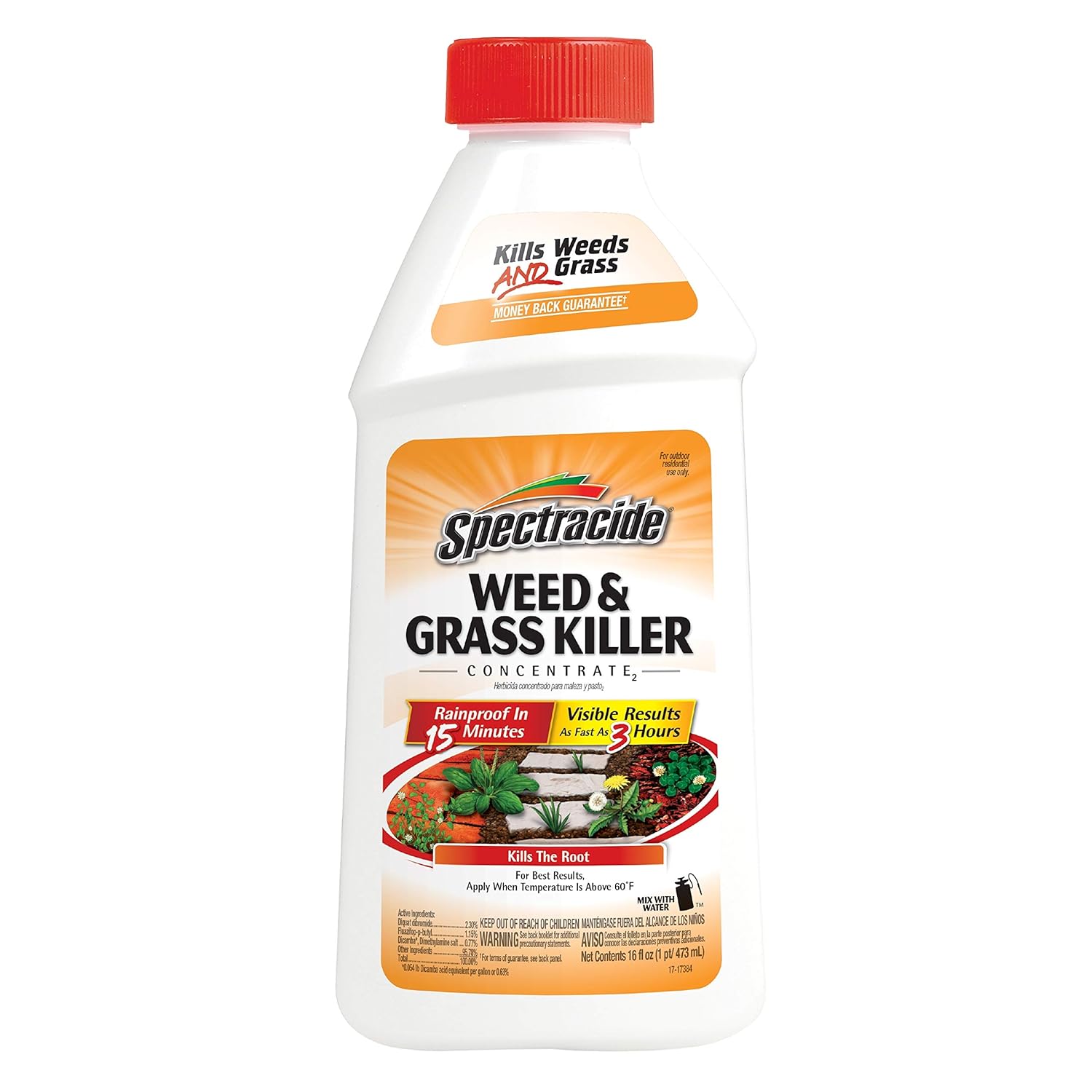
| Unit Count | 16 Fluid Ounces |
|---|---|
| Item Form | Spray |
| Coverage | 7 fl oz per gallon covers up to 300 sq ft |
| Rainproof time | 15 minutes |
| Visible results | As fast as 3 hours |
This Spectracide concentrate is a practical, fast-acting option for clearing unwanted weeds and grasses from hard surfaces and around garden beds. You mix the 16 fl oz bottle with water and apply with a tank sprayer for spot treatments; the label rate (7 fl oz per gallon) covers roughly 300 sq ft per treatment. The formula is rainproof after 15 minutes and can show visible dieback in as little as three hours, letting you replant in treated areas after about a day. It is nonselective, so it kills foliage down to the root and requires care to avoid desirable plants. Because it is a concentrate, small bottles treat a larger area than ready-to-use sprays, which is useful for recurring patch treatments while keeping storage space low. Important limits are the usual safety precautions for herbicides and the need to shield nearby plants and follow temperature guidance for best results. For someone wanting a straightforward, effective knockdown of pavement and edge weeds, this performs reliably when used as directed.
Best for: Buyers who want a cost-effective, no-nonsense herbicide to tackle spot infestations on driveways, walkways and edges and who are comfortable mixing and applying a concentrate.
Less Ideal for: Customers who need a gentle or selective lawn-safe product or who prefer ready-to-use sprays with no mixing should look elsewhere.
- Concentrated formula covers a larger area per ounce than ready-to-use products
- Fast visible results in as little as 3 hours and rainproof after 15 minutes
- Kills weeds and grasses down to the root for longer-lasting control
- Nonselective formula can damage desirable plants if oversprayed
- Requires mixing and a separate tank sprayer rather than a ready-to-use bottle
Verdict: A concentrated, fast-acting spot herbicide that delivers economical, root-killing weed control for paved areas and edges.
Roundup Pro Concentrate Herbicide (2.5 gal)

| Unit Count | 300 Fluid Ounces |
|---|---|
| Liquid Volume | 2.5 gallons |
| Coverage | Up to 435,600 sq. ft |
| Item Form | Liquid |
Roundup Pro Concentrate is a liquid herbicide intended for mixing in sprayers to treat large lawns, fields, and commercial areas. The 2.5 gallon jug is a concentrate that dilutes at rates from about 1 to 10.5 ounces per gallon of water, letting you cover up to the manufacturer-stated area without frequent refills. It is formulated to be rainfast in roughly an hour and is best applied when weeds are actively growing and temperatures are above 60°F. Practical benefits include high coverage per container and compatibility with stainless steel or plastic sprayers for standard application workflows. Important limitations are the need for careful dilution and protective handling, strict restrictions around water and runoff, and regulatory or local sale limitations in some states. Users should follow label directions for safety, keep people and pets away until spray dries, and expect that effective use requires proper equipment and basic pesticide handling practices.
Best for: Buyers who need a high‑coverage, performance-oriented herbicide for treating large yards, fields, or commercial properties and who are comfortable following pesticide mixing and safety instructions.
Less Ideal for: Casual gardeners with small beds or people unwilling to handle concentrated pesticides should choose ready-to-use alternatives or nonchemical methods.
- Concentrated formula covers very large areas from a single container
- Rainfast within about one hour which reduces loss from light rain
- Compatible with standard stainless steel or plastic sprayers for easy mixing and application
- Requires precise dilution and proper protective equipment during mixing and application
- Not for use near water or where runoff may occur and restricted in some jurisdictions
Verdict: Choose this concentrate when you need a professional-strength herbicide that treats very large areas with fewer refills.
Compare-N-Save 75324 Herbicide, 1-gallon (glyphosate concentrate)

| Active Ingredients | glyphosate |
|---|---|
| Liquid Volume | 1 gallons |
| Item Form | Spray |
| Coverage | 25000 square_feet |
This one-gallon Compare-N-Save concentrate uses glyphosate to kill a wide range of annual and perennial weeds and grasses by foliar uptake down to the roots. It is mixed with water to create ready-to-use spray: the label recommends about 1.5 ounces per gallon for general use and up to 2.5 ounces per gallon for tougher perennials, with the full gallon making multiple gallons of spray for larger areas. Typical uses include clearing driveways, walkways, fence lines, garden preparation, lawn renovation, and stump or brush treatment. Notable features are fast visible results in 2 to 4 days, rainproofing within about two hours, and broad area coverage when diluted (manufacturer states it can cover thousands of square feet at recommended rates). Important limitations are that glyphosate will kill any green plant it contacts so careful targeting and protective gear are required, it has no residual pre-emergent activity, and label directions must be followed for safe use around edible gardens. For commercial lawn work, its concentration and economy make it effective but it demands disciplined application to avoid off-target damage.
Best for: Commercial landscapers or property managers who need an economical, fast-acting nonselective herbicide for clearing large areas and preparing sites for renovation while following safety protocols.
Less Ideal for: Home gardeners seeking a selective lawn-safe product or people who need a long-lasting pre-emergent should consider alternatives.
- Concentrated formula stretches to many gallons of ready-to-use spray for large-area work.
- Fast visible control with results often in 2 to 4 days and rainproofing in about two hours.
- Broad-spectrum activity against annual and perennial weeds and grasses, including root kill.
- Simple dilution instructions let crews mix strength for general or tougher targets.
- Nonselective glyphosate will damage or kill desirable plants if drift occurs.
- No residual activity so repeat treatments or follow-up prevention are required for long-term control.
Verdict: A cost-effective, concentrated glyphosate concentrate that delivers fast, large-area weed and grass control when used with proper precautions.
Roundup Weed & Grass Killer with Comfort Wand, 1.33 gal.

| Item Form | Liquid |
|---|---|
| Coverage | 400 sq. ft. |
| Liquid Volume | 1.33 gallons |
This Roundup package pairs a 1.33 gallon liquid formulation with a Comfort Wand for easier spraying around beds, walkways, and foundations. It is formulated to kill common broadleaf weeds and grasses down to the root, with visible wilting in hours and rainfast protection in about 30 minutes, so treated areas are less likely to wash away after a brief rain. The wand offers one-touch continuous spray, which reduces hand fatigue during spot treatments and makes edging and targeted applications simpler than using a separate sprayer. Coverage is listed at about 400 sq. ft., appropriate for small yards, beds, or multiple spot-treatment sessions. Important limitations are that this is a nonselective herbicide so it will damage desirable plants if contacted and the product directions include replanting wait times of 1 to 30 days depending on use. Users should follow label precautions about keeping people and pets away until spray has dried and applying only in calm conditions to avoid drift.
Best for: Buyers who want a straightforward, ready-to-use herbicide for targeted spot treatments and edging where quick, reliable weed control is the priority and minimizing application fuss matters.
Less Ideal for: Large properties or users who need selective lawn-safe control should consider professional application methods or products formulated specifically for turf.
- Fast visible results in hours and rainproof in as fast as 30 minutes
- Comfort Wand with one-touch continuous spray reduces hand fatigue and improves targeting
- Kills a wide range of broadleaf weeds and grasses to the root
- Ready-to-use liquid requires no mixing and covers up to 400 sq. ft.
- Nonselective formula will damage desirable plants if contacted
- Container and wand limit treatment area per refill compared with larger tank sprayers
Verdict: A convenient, ready-to-use herbicide with a Comfort Wand that delivers fast, reliable spot control of broadleaf weeds and grasses for homeowners who want an easy, low-fuss solution.
Choosing the Right Extra Strong Patio Weed Killer: Key Factors to Consider
Speed Of Action
How quickly a product visibly wilts or kills weeds matters when you need tidy hardscapes fast. Rapid knockdown is useful for patios and walkways because it reduces mowing or hand-pulling interruptions and restores a neat appearance within days.
Fast-acting formulations often use contact-active ingredients that scorch foliage, so you should balance urgency with thorough root control. If you want immediate results for an event or high-traffic area, prioritize speed. For long-term suppression you may accept slower visible results if root control is better.
Root Kill And Residual Control
Weeds that regrow from underground parts require systemic activity or residual soil action to prevent quick returns. Products that target roots reduce repeated hand-weeding and lower the need for repeat applications.
Residual control can be helpful on cracks and tight joints, but long soil persistence increases the risk to nearby desirable plants. Consider how long you need suppression versus the exposure of adjacent beds when choosing a stronger formulation.
Surface Compatibility And Masonry Safety
Patio surfaces vary widely: poured concrete, natural stone, brick, and sealed pavers each respond differently to chemicals. Strong formulations can stain, etch, or strip jointing sand and sealants if not labeled safe for the surface.
Check product guidance for treated surface types and recommended dilution rates. On delicate or newly sealed surfaces, test a small inconspicuous patch first. Surface-safe options reduce cleanup needs and protect finish longevity.
Application Method And Coverage
Ease of use affects how often you actually treat problem areas. Options include ready-to-use sprays, hose-end applicators, or concentrated mixes for pump sprayers. Concentrates offer better economy for large patios but require accurate mixing.
Consider nozzle type, spray pattern, drift control, and whether a brush or heat method is recommended for stubborn joints. Practical application features speed the job and reduce wasted product.
Safety For Adjacent Plants And People
Strong herbicides can harm nearby ornamental plants, vegetables, or turf if they drift, leach, or splash. Look for products with lower volatility and clear buffer guidance for planting distances.
Also account for re-entry intervals, safe handling, and cleanup procedures. If children, pets, or edible gardens are nearby, prioritize formulations and application methods that minimize exposure risk.
Environmental Persistence And Runoff Risk
A product with long persistence can protect surfaces longer but increases the chance of runoff into storm drains and soil. On sloped patios or after heavy rain, soluble active ingredients may move offsite and affect surrounding vegetation or water features.
Choose a formulation with appropriate persistence for your climate and landscape, and follow label directions for timing applications to avoid immediate rain events.
Matching Strength To Patio Material
Different hardscape materials tolerate chemicals differently. Concrete and unsealed natural stone are more forgiving than some polished or sealed surfaces. For sealed pavers and decorative stone, use formulations that explicitly state surface compatibility or opt for lower-strength contact treatments applied carefully.
If your patio has jointing sand or polymeric joints, avoid aggressive solvent-based products that can dissolve binders. For frequent use areas consider mechanical removal for dense infestations combined with targeted spot treatment to protect surface finishes.
- Test any new product on an inconspicuous area first
- Avoid solvent-based solutions on polymeric or sealed joints
- Use spot treatments for cracks and seams to limit surface exposure
When To Use Repeat Applications Versus One Strong Treatment
A single very strong application can be attractive for immediate control, but persistent root systems may still require follow-up. Repeat light treatments spaced weeks apart sometimes control regrowth with less impact on adjacent plants.
For invasive or well-established weeds, plan for at least one follow-up inspection within 2 to 6 weeks. Combine chemical treatments with mechanical removal when feasible to reduce total chemical input.
- Inspect treated areas after two weeks to catch survivors
- Follow label intervals to avoid overapplication
- Combine physical removal with herbicide use for best long-term control
Application Best Practices For Safe, Effective Results
Apply on dry, calm days to minimize drift and maximize uptake. Avoid treatments immediately before rain to prevent runoff and dilution. Use low-pressure spray settings and a coarse nozzle to reduce misting.
Wear appropriate protective gear and keep pets and children off treated surfaces until the product has dried and the label re-entry time has passed. Rinse equipment and avoid discharging rinse water into garden beds.
- Choose calm weather and avoid windy conditions
- Use coarse nozzles and low-pressure settings
- Keep treated areas dry until fully absorbed and follow re-entry guidance
Nonchemical Alternatives And Integrated Strategies
Mechanical methods such as scraping joints, using a narrow hoe, or applying boiling water can be effective for small infestations and avoid chemical risks. For long-term control, improving joint density and applying polymeric sand can reduce seed establishment.
Consider combining a nonchemical first pass with spot herbicide treatments for stubborn regrowth. Solarization with clear plastic can work on sunny patios when weed cover is extensive and you can keep the area sealed for weeks.
- Use mechanical removal for small or fledgling patches
- Improve jointing materials to reduce future seed germination
- Solarize when you can block access for several weeks
Managing Risk Around Plantings And Water Features
Create a buffer zone between the patio edge and planted beds, or use physical barriers when treating close to desirable plants. Rinsing and neutralizing runoff pathways reduces the chance of herbicide contact with ornamentals.
For patios near ponds or streams, avoid soluble systemic products that can move in water. Use targeted contact treatments and keep application volumes low to reduce runoff potential.
- Establish physical buffers or barriers where possible
- Avoid treating before heavy rain near water features
- Choose low-runoff application methods when working close to sensitive areas
How We Chose the Best Extra Strong Patio Weed Killer
We focused on products formulated for persistent weeds in hardscape areas and evaluated options by concrete, garden-safe performance, and usable practicality. Key criteria included: speed of action to knock down visible growth quickly; root control to limit regrowth from established tap or fibrous roots; surface compatibility to avoid etching or discoloring masonry and pavers; application safety for adjacent ornamental plants and lawn; and ease of application including coverage rate and required equipment. We excluded products intended only for turf, indoor use, or general-purpose broad-acre spraying where surface safety and precision are not primary concerns. We also filtered out formulations that require specialized licensing or commercial-only equipment. The shortlisted items passed these filters and demonstrate measurable differences on the concrete criteria above, so gardeners can weigh faster knockdown against longer residual control and surface sensitivity.
FAQ
How soon will weeds disappear after applying an extra strong patio weed killer?
Visible wilting often appears within 24 to 72 hours for fast-acting products, while systemic action that kills roots can take one to three weeks. Speed depends on weed species, weather, and product formulation.
Will a strong patio weed killer damage my pavers or concrete?
Some concentrated formulations can stain or etch sensitive surfaces, especially sealants and polymeric joints. Choose products labeled safe for your material and test a small area first to avoid unexpected damage.
Can I use extra strong patio weed killers near vegetable beds or lawns?
It depends on the product and application method. Drift, splash, or runoff can harm nearby plants, so maintain a buffer, use spot treatments, and follow label guidance about distances and re-entry intervals.
How often should I retreat a heavily infested patio?
Inspect after two to six weeks and retreat based on regrowth. Some situations require a follow-up within a month, while persistent root systems may need periodic maintenance treatments over a growing season.
Are there nonchemical options worth trying before using a strong herbicide?
Yes. Physical removal, scraping joints, applying boiling water, solarization, and improving joint materials are effective for many small to moderate infestations and reduce the need for repeated chemical use.
Is runoff a concern when using strong weed killers on patios?
Runoff is a potential risk, particularly on sloped surfaces or before rain. Follow label timing, use minimal effective volumes, and avoid application before forecasted heavy precipitation.
Final Verdict
When choosing an extra strong patio weed killer, prioritize the balance between rapid knockdown and surface compatibility. Consider how long you need residual control, the risk to adjacent plants or water features, and how easy the product is to apply safely. For most patios, targeted spot treatments combined with mechanical cleaning or improved jointing offer the best long-term results. Make your final choice based on the patio material, nearby plantings, and whether you prefer immediate cosmetic results or slower root-focused suppression.
