

Note: This article contains affiliate links. If you click on these links and make a purchase, I may earn a small commission at no extra cost to you. This helps support my research and content. Read my full affiliate disclosure here.
Growing corn demands steady, balanced feeding through fast growth and ear fill. Choosing the right plant food for corn affects stalk strength, tassel development, and how well plants convert nutrients into kernels. In this guide we shortlisted the top options gardeners use to feed corn in garden beds and small plots, then evaluated them on nutrient profile, ease of application, and consistency in the field. Use the evaluation notes to match a feeding schedule to your soil test and growing timing. Below are our top picks and what to expect from each feeding approach.
Top Picks at a Glance
| Best Overall The best all-around choice for most situations | TPS NUTRIENTS Corn Fertilizer Liquid Plant Food, 1 Gallon |  |
| Best Quality Built to a higher standard if you want something more solid | HyR BRIX Slow-Release Sweet Corn Fertilizer, 16-7-10, 5 lb Bucket |  |
| Best Value The sweet spot between price and what you get | TPS NUTRIENTS Liquid Corn Fertilizer, 32 oz |  |
| Best Budget The cheapest option that still gets the job done reliably | TPS NUTRIENTS Corn Fertilizer Liquid Plant Food, 8 oz |  |
| Highest Rated A top-rated pick with lots of positive feedback | HyR BRIX Slow-Release Sweet Corn Fertilizer, 16-7-10, 20 lb |  |
| Most Popular A crowd favorite that many people choose with confidence | True Organic Blood Meal — High‑Nitrogen Organic Fertilizer, 3 lb |  |
| Best Seller A high-volume bestseller chosen again and again | TPS Nutrients High Nitrogen Liquid Fertilizer for Corn, 8 oz |  |
TPS NUTRIENTS Corn Fertilizer Liquid Plant Food, 1 Gallon

| Item Form | Liquid |
|---|---|
| Specific Uses For Product | Corn Plants |
| Liquid Volume | 128 fluid ounces |
| Target Species | Corn |
This one-gallon liquid corn fertilizer supplies concentrated nitrogen and supplemental kelp and minerals to support rapid vegetative growth and stronger stalks. It is designed for backyard plots, raised beds, and small-scale corn plantings where frequent, fast nutrient uptake matters. Use every one to two weeks during active growth by diluting per label directions and applying to the soil or as a root drench for quick availability. Notable features include a high-nitrogen formula with two nitrogen sources and added kelp for trace minerals, which helps green up plants and encourage root development. Practical benefits are rapid absorption from the liquid form, easier feeding in containers and beds, and targeted nutrition geared to corn’s needs. Limitations are that coverage is listed as low so larger plantings will require multiple gallons, and liquid feed schedules mean more frequent applications than slow-release granular options. Soil testing and modest, regular use will deliver the best, consistent results for small to medium corn plots.
Best for: Gardeners growing corn in backyard plots, raised beds, or containers who want a fast-acting liquid feed to promote vigorous early and mid-season growth.
Less Ideal for: Large-scale growers or field-scale plantings who need broad, economical coverage from bulk or granular fertilizers.
- High-nitrogen formula formulated specifically for corn to support strong stalks and leaf growth
- Liquid form for fast nutrient uptake and easy application in beds and containers
- Includes kelp and minerals to supply trace nutrients and support root health
- Low coverage makes it less economical for large-acreage plantings
Verdict: A convenient, high-nitrogen liquid feed tailored to small-scale corn growers who want quick, visible growth and stronger stalks.
HyR BRIX Slow-Release Sweet Corn Fertilizer, 16-7-10, 5 lb Bucket

| NPK Analysis | 16-7-10 |
|---|---|
| Form | Granules |
| Application Method | Side-dress and Broadcast |
| Coverage | 450 square feet |
| Included Components | Measuring scoop |
This 5 lb HyR BRIX formula is a granular, slow-release fertilizer made for sweet corn, popcorn, ornamental corn, and field corn and is intended to feed a corn patch for the entire season with a single application. It uses a 16-7-10 NPK mix plus calcium and sulfur and multiple nitrogen sources so nitrogen is available steadily rather than in a single flush. The bucket includes a scoop and the label gives clear directions for side-dressing or broadcasting up to the stated coverage, which makes it easy to apply in raised beds or in-ground rows before or shortly after planting. The blend also contains earthworm castings and leonardite-derived humic acids to help improve nutrient uptake and soil health over time. Practical limitations are that the 5 lb size covers a modest area and repeated granular applications or larger sizes will be needed for extensive plantings, and direction-following is necessary to avoid placement too close to stems or seed. For gardeners who want a straightforward, one-application feeding tailored to corn, this product simplifies midseason nutrition.
Best for: Gardeners who prioritize reliable, low-maintenance feeding for corn and want a single, predictable application that supports steady growth and ear development.
Less Ideal for: Growers managing very large acres or commercial plots who need bulk coverage or those preferring liquid or foliar feeding methods for precise in-season adjustments.
- Slow-release 16-7-10 formula provides steady season-long nutrition in one application.
- Formulated specifically for all corn types so directions and NPK suit ear development and sweetness.
- Includes earthworm castings and humic acids to support nutrient uptake and soil health.
- Clear application instructions for side-dress and broadcast use and a measuring scoop included.
- 5 lb bucket covers a limited area so larger plots require multiple units or larger sizes.
- Granular form requires proper incorporation or watering after application to activate nutrients.
Verdict: Use this slow-release, corn-specific granular fertilizer when you want a dependable one-application feed that supports steady growth and better ear quality.
TPS NUTRIENTS Liquid Corn Fertilizer, 32 oz

| Item Form | Liquid |
|---|---|
| Specific Uses For Product | Corn Plants |
| Unit Count | 32 Fluid Ounces |
| Coverage | Low |
This 32 oz liquid corn fertilizer from TPS Nutrients supplies readily available nitrogen and supplemental kelp and minerals to support fast summer growth and stronger stalks. It is designed for small gardens, raised beds, and backyard plots where quick uptake matters; you apply it every one to two weeks during active growth so corn gets consistent feeding through the vegetative phase. The liquid form makes it easy to mix and deliver directly to the root zone, which helps young plants green up and build robust leaves and stems. Notable features are its two nitrogen sources and added kelp for trace nutrition, which together target both vigorous growth and root support. Because it is a concentrated liquid, careful measuring is required and repeated applications are needed rather than a single seasonal treatment. Follow handling precautions and keep it away from children and pets. For a risk-averse gardener this product offers a focused, easy-to-use option for improving corn vigor when used according to directions.
Best for: Gardeners growing sweet corn in backyard plots, raised beds, or containers who want a simple, fast-acting liquid feed to encourage vigorous vegetative growth and healthier stalks.
Less Ideal for: Large-acreage growers or anyone seeking a single-application granular program for broad field coverage should consider different, bulk fertilizer options.
- Liquid formula for faster nutrient uptake compared with granular products
- Formulated specifically for corn with a high-nitrogen focus to promote strong stalks and leafy growth
- Includes kelp and mineral nutrition to provide trace elements and root support
- Sized for small gardens and raised beds with a 32 oz unit that is easy to handle
- Requires repeated applications every 1–2 weeks rather than a single seasonal feeding
- Coverage listed as low so multiple bottles may be needed for larger plots
Verdict: Choose this liquid corn fertilizer if you want a small-garden, fast-acting nitrogen feed to boost stalk strength and leafy growth.
TPS NUTRIENTS Corn Fertilizer Liquid Plant Food, 8 oz

| Item Form | Liquid |
|---|---|
| Target Species | Corn |
| Unit Count | 8 Fluid Ounces |
| Coverage | Low |
This 8 ounce liquid corn fertilizer from TPS Nutrients supplies fast-acting nitrogen and additional kelp and mineral nutrition aimed at promoting strong stalks, healthy leaves, and better root development. It is designed for use in backyard plots, raised beds, and small garden setups where targeted feeding of corn is needed. The liquid form makes it easy to dilute and apply for quick uptake compared with granular products, so you can correct a nutrient shortfall midseason or give plants a boost during rapid growth. Notable features are a high-nitrogen formula and dual nitrogen sources intended to support vigorous vegetative growth. Because the bottle is small and labeled for low coverage, this product is best for gardeners with a few rows or containers rather than large acreage. Expect frequent reapplication for larger plantings and plan your schedule to avoid overfeeding during tasseling and ear development. The straightforward formulation and small package make it convenient for hobby growers who want a focused nitrogen feed without complicated mixes.
Best for: Gardeners growing a few rows of corn, raised bed growers, or hobbyists who need an easy-to-apply, nitrogen-focused boost during the growing season.
Less Ideal for: Commercial growers or anyone managing large plantings who need high-coverage bulk fertilizer and precise nutrient formulation.
- Liquid formula for faster nutrient uptake compared with granular fertilizers
- High nitrogen focus supports strong stalk and leaf growth for corn
- Includes kelp and mineral nutrition to support root health and plant vigor
- Small 8 oz bottle is convenient for backyard gardens and raised beds
- Low coverage means frequent reapplication or multiple bottles for larger plots
- No detailed N-P-K numbers provided on the listing to guide precise dosing
Verdict: A compact, easy-to-use liquid nitrogen feed that is well suited to backyard corn growers who want a quick growth boost.
HyR BRIX Slow-Release Sweet Corn Fertilizer, 16-7-10, 20 lb
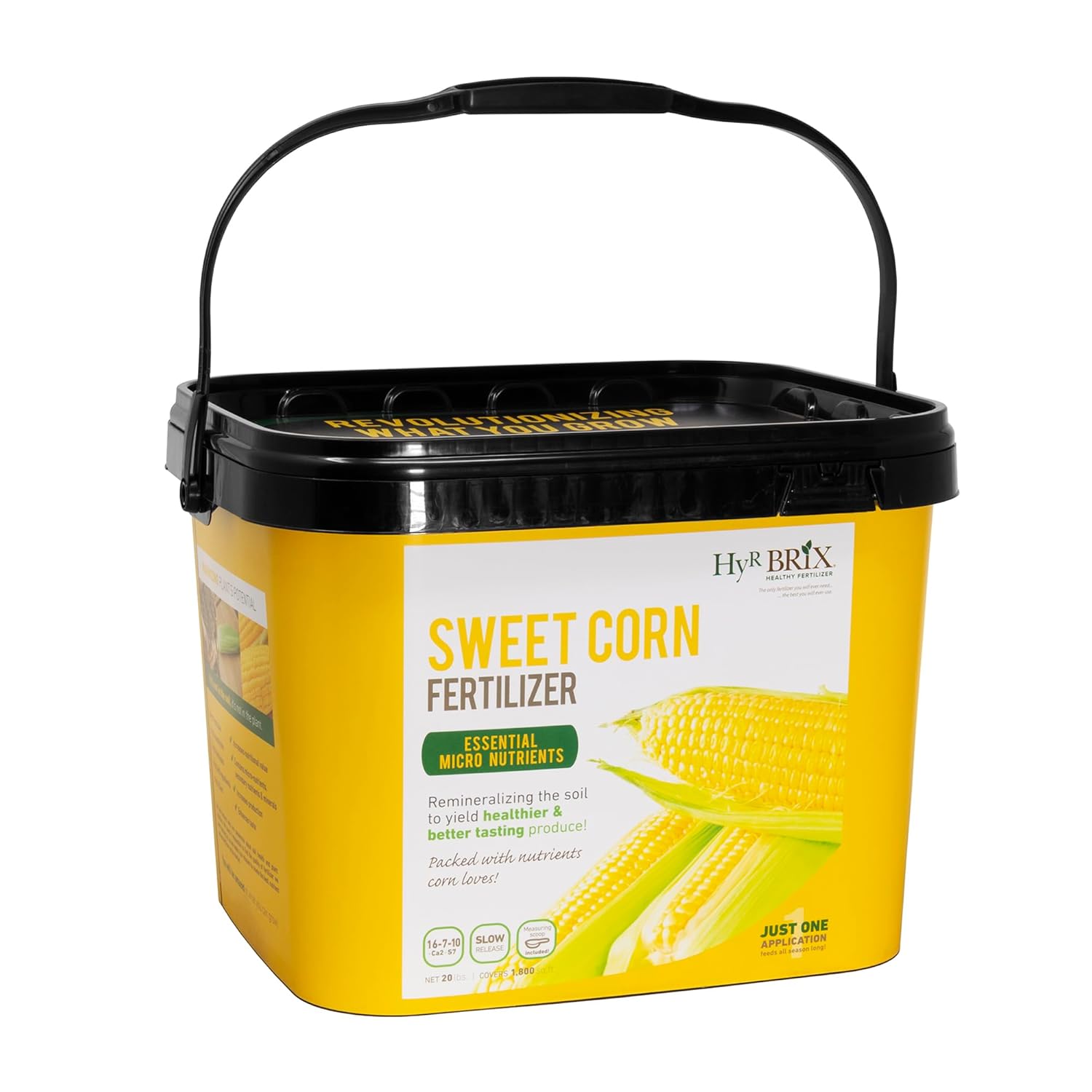
| NPK Analysis | 16-7-10 |
|---|---|
| Item Form | Granules |
| Application Method | Side Dressing, Broadcast Spreading |
| Coverage | 1,800 square feet |
| Included Components | Measuring Scoop |
This HyR BRIX 16-7-10 granular formula is designed to feed corn varieties from planting through harvest with a single application. It is typically broadcast or side-dressed before or shortly after planting, then watered in to activate the slow-release nutrients. The blend uses multiple nitrogen sources plus calcium, sulfur, and micronutrients to support steady vegetative growth and ear development, while added earthworm castings and leonardite-derived humic acids aim to improve nutrient uptake. A 20 lb bucket claims coverage up to 1,800 sq ft and includes a measuring scoop for consistent application. Practical benefits include reduced need for repeat fertilizing during the season and a product profile targeted to promoting fuller, sweeter ears when paired with good watering and pollination. Limitations are that performance still depends on correct application rate and soil conditions, and users wanting immediate, high-available nitrogen may see slower early green-up because the formula is slow release.
Best for: Gardeners who prioritize dependable, low-maintenance nutrition for backyard corn and want a single application that feeds through the season without frequent refeeding.
Less Ideal for: Growers who need a quick nitrogen boost for immediate greening or those managing very small container-grown corn should consider a fast-release or starter-specific product instead.
- Slow-release NPK (16-7-10) provides season-long feeding in a single application
- Enriched with humic acids and earthworm castings to enhance nutrient uptake
- Includes measuring scoop and covers up to 1,800 sq ft per 20 lb bucket
- Formulated specifically for all corn types to support ear size and sweetness
- Slow-release formulation can delay rapid early green-up compared with fast-release fertilizers
- Effectiveness depends on proper application and existing soil health
Verdict: Choose this for reliable, one-application, slow-release nutrition tailored to produce fuller, sweeter ears of corn with less seasonal fuss.
True Organic Blood Meal — High‑Nitrogen Organic Fertilizer, 3 lb

| Item Form | Granules |
|---|---|
| Unit Count | 48 Ounce |
| Mixing Ratio | 12-0-0 |
| Specific Uses For Product | Agriculture, Gardening |
True Organic Blood Meal is a simple, single-ingredient granular fertilizer that supplies a concentrated source of nitrogen for leafy, heavy-feeding vegetables and ornamentals. It is typically applied to soil in spring and fall or worked into potting mixes for container crops to encourage rapid green growth. The product is made from blood meal and labeled with a 12-0-0 analysis, so it delivers mostly nitrogen without added phosphorus or potassium. Practical benefits include easy application, suitability for both beds and containers, and an organic input that supports soil microbial activity rather than introducing synthetic chemicals. The 3 lb bag is sized for small to medium gardens and the stated coverage gives a clear guideline for treating around 100 sq ft. Important limitations are that it only supplies nitrogen so it should be paired with a balanced fertility plan for blooms or root development, and like all high-nitrogen amendments it can burn plants if overapplied or placed in direct contact with roots. For risk-averse gardeners, following the mixing ratio and recommended timing will help get vigorous foliage without surprises.
Best for: Gardeners who prioritize predictable, organic nitrogen boosts for leafy crops and want a straightforward product with established application timing and coverage guidance.
Less Ideal for: Growers seeking an all-in-one fertilizer for blooms, fruits, or complete feeding regimes should choose a balanced or blended product instead.
- High nitrogen content (12-0-0) that rapidly promotes leafy growth
- Single-ingredient blood meal with no synthetic additives
- Suitable for both in-ground beds and container plants
- Clear coverage guidance for planning applications
- Provides only nitrogen so additional nutrients are needed for flowering and fruiting
- Risk of root burn if overapplied or placed in direct contact with plant roots
Verdict: Use this concentrated organic blood meal when you need a reliable, high-nitrogen boost to rapidly green up heavy-feeding vegetables and leafy plants.
TPS Nutrients High Nitrogen Liquid Fertilizer for Corn, 8 oz

| Item Form | Liquid |
|---|---|
| Application Method | Spray |
| Target Species | Vegetables |
| Liquid Volume | 8 fluid ounces |
| Mixing Ratio | 1:16 |
This 8 oz liquid from TPS Nutrients is a high-nitrogen plant food intended to boost vegetative growth in corn by supplying two sources of nitrogen plus kelp and minerals. It mixes at 1:16 and is applied by spray, so indoor growers can dilute small amounts for foliar feeding or soil drench in pots and containers. The liquid form and low coverage rating make it easy to apply accurately to individual plants and to increase nitrogen quickly when leaves look pale or growth is sluggish. Practical benefits include faster green-up, stronger stalk development and an easy mixing ratio for small-scale use. Limitations to note are the small container size, which means frequent repurchasing for multiple plants, and the product is focused on nitrogen so it will not replace a balanced complete fertilizer for long-term feeding or flowering and fruiting stages. Follow label mixing directions to avoid overfeeding sensitive indoor plants.
Best for: Indoor growers who want a simple, easy-to-mix, high-nitrogen boost for potted corn or a few vegetable plants and who prioritize quick green-up over long-term, all-in-one feeding.
Less Ideal for: Growers managing many plants, large indoor vegetable setups, or those seeking a balanced complete fertilizer to support flowering and fruiting stages.
- Concentrated liquid that is simple to dilute and apply for individual indoor plants
- Formulated specifically for corn with two nitrogen sources to promote leaf and stalk growth
- Includes kelp and minerals to provide micronutrient support alongside nitrogen
- Small 8 oz size may not last for multiple plants or prolonged feeding schedules
- Low coverage rating means more frequent applications or purchases for larger collections
Verdict: A compact, easy-to-mix liquid boost for indoor corn growers needing quick nitrogen-driven green-up.
Choosing the Right Plant Food for Corn: Key Factors to Consider
Nitrogen Timing and Form
Corn is a heavy nitrogen feeder and most yield response depends on getting nitrogen into the plant during rapid vegetative growth. The timing of nitrogen applications matters as much as the total amount. Split applications-starter at planting, a midseason side-dress, and a late vegetative dose if needed-help match supply to demand.
The nitrogen form also affects performance. Ammonium-based sources can be held by soil particles and provide steadier availability, while nitrate forms move more readily with water and are taken up quickly. Gardeners on light sandy soils should account for leaching risk and may prefer split, smaller applications or stabilized nitrogen formulations that slow conversion and loss.
Starter Phosphorus and Early Root Development
Phosphorus supports early root establishment and early-season vigor, which is critical for even stands and strong early growth. A starter feed with modest phosphorus placed near the seed or applied as a transplant dip encourages quicker root spread and faster access to soil moisture.
Because phosphorus availability is strongly influenced by soil pH and soil testing is the best way to know if extra P is needed, gardeners should use a starter only when soil tests indicate low phosphorus or when poor early growth suggests inadequate root development.
Potassium for Stalk Strength and Kernel Fill
Potassium helps with water regulation, disease resistance, and the translocation of sugars into developing ears. Inadequate potassium can lead to poor stalk strength and incomplete kernel fill, especially under drought stress. Choosing a plant food with sufficient potassium or planning a mid- to late-season application can reduce lodging and support better ear quality.
Potassium sources vary in solubility and salt index, so gardeners should consider application method and plant sensitivity when using concentrated K feeds close to young roots.
Micronutrients and Secondary Elements
Micronutrients such as zinc, boron, and manganese are often required in small amounts but can limit yield if deficient. Corn is particularly responsive to zinc in alkaline soils and to boron for pollen viability in some growing conditions. A balanced plant food that includes key micronutrients or a plan to correct deficiencies based on soil or tissue tests will avoid surprises late in the season.
Micronutrient availability depends on soil pH and organic matter, so targeted corrections are usually better than blanket high-dose mixes. Foliar applications can quickly address acute deficiencies during pollination.
Application Method and Garden Scale
The best product for a backyard corn patch depends on whether you want granular side-dress, soluble fertilizer for drench or foliar use, or slow-release granules for low-maintenance plots. Granular feeds are easy to apply for small plantings and side-dressing between rows. Soluble feeds offer precise, quick delivery for starter and foliar sprays but require measuring and mixing.
Consider how much time you will spend feeding and whether you can reliably apply split doses. For small plots, ease of measuring and the ability to use common garden tools matters more than product economy.
Soil Type and Moisture Management
Soil texture and water-holding capacity influence how nutrients move and how frequently you should feed. Sandy soils leach mobile nutrients quickly and benefit from smaller, more frequent applications or stabilized nitrogen sources. Heavier clay soils hold nutrients but may restrict root growth if compacted, making early starter nutrients and proper cultivation important.
Matching fertilizer choice to your soil and irrigation pattern reduces nutrient loss, avoids localized burn from high-salt feeds, and improves the efficiency of each application.
When to Feed Corn Through the Season
Feeding timing is driven by corn growth stages. A small starter dose at planting helps seedlings establish. A side-dress when plants are knee-high or at V6 stage supports the rapid leaf and stalk growth that precedes tasseling. Depending on variety and season length, a final boost during early tassel or pre-pollination can help kernel set.
Adjust timing for weather and soil moisture. Heavy rains after application in sandy soils can leach nitrogen, so delay side-dressing until there is adequate soil moisture to move nutrients to the root zone without losing them to drainage.
- Starter application: small, close to seed or as a transplant drench
- Midseason side-dress: when plants are 12 to 18 inches tall
- Late feed: optional just before tassel emergence for kernel support
Matching Fertilizer Format to Your Tools
Choose a format that fits the tools you already use. Granular fertilizers are convenient for hand broadcasting or row applications, and they can be incorporated lightly into the soil around the plants. Water-soluble fertilizers work well if you mix with a watering can or backpack sprayer for a precise starter or foliar feed.
If you use drip irrigation, soluble fertilizers that are safe for emitters let you fertigate without extra labor. Consider product solubility and emitter compatibility when using irrigation-based feeding.
- Granular: easy for small plots and side-dressing
- Soluble: precise starter and foliar feeding
- Fertigation-compatible: good for drip or hose-end systems
Interpreting Soil Tests and Adjusting Feed Plans
A recent soil test is the most reliable way to create a feeding plan for corn. Tests show existing nutrient levels, soil pH, and organic matter, letting you target deficiencies rather than guessing. Use the results to set starter phosphorus needs and to decide how much potassium or micronutrient correction is required.
If you do not have a test, observe plant symptoms and growth. Pale lower leaves often point to nitrogen shortage while stunted early growth can indicate low phosphorus. Corrective applications based on observed symptoms should be modest and targeted to avoid imbalances.
- Test for baseline N, P, K and pH
- Prioritize phosphorus for early root growth if deficient
- Use foliar micronutrient sprays for acute shortages
Environment and Pest Interactions
Nutrition interacts with pests and environmental stress. Well-fed corn often resists pests and recovers better from insect feeding or drought, but excessive nitrogen can promote lush foliage that attracts certain pests and delays maturity. Balance is key to avoid encouraging issues while maximizing yield potential.
Consider how feeding might affect susceptibility. For example, nitrogen timing that avoids late-season flushes of tender tissue reduces pest pressure while supporting ear fill earlier.
- Avoid late heavy nitrogen that prolongs vegetative growth
- Use balanced feeds to support plant resilience under stress
Record-Keeping and Scaling Up
Keep simple records of what you applied, when, and the crop stage. Notes on rates and outcomes help refine the plan year to year and are useful if you expand the planting area. Small adjustments to timing, rate, or product format often provide clearer benefits than wholesale changes.
As you scale up from a few rows to a large patch, consider batch-mixing soluble feeds and calibrating equipment to maintain consistency across the planting.
- Log application dates, rates, and plant stages
- Calibrate spreaders and sprayers when increasing area
How We Chose the Best Plant Food for Corn
We focused on products and formulations that are appropriate for vegetable-scale corn production and small to medium garden plots. Selection emphasized nutrient ratios and nutrient forms that influence corn growth across stages, delivery methods suited to backyard gardeners, and practical performance factors like solubility and predictability in typical garden soils. Key evaluation criteria included analysis of N-P-K balance and secondary nutrients, how readily the product supplies nitrogen during rapid vegetative growth, presence and form of phosphorus for early root and tassel development, and potassium for stalk strength and kernel fill. We also judged application convenience and flexibility, such as whether a product works as side-dress, starter, or foliar feed; product solubility and mixing ease for gardeners who use backpack sprayers or watering cans; and consistency across variable soil textures and moisture conditions. We excluded fertilizers formulated primarily for lawns, slow ornamental-release products unsuited to short corn cycles, and specialist industrial blends that require professional equipment. Weed-and-feed mixes or products dependent on complex additives that homeowners cannot readily measure were also omitted. The remaining selections focus on formulations and formats that deliver the nutrients corn requires in ways backyard gardeners can control and time.
FAQ
How much nitrogen does corn need in a backyard garden?
Nitrogen needs vary by soil fertility and planting density but corn is a heavy feeder. Many small-plot plans use split applications totaling moderate N amounts tailored to soil test results. Split dosing reduces leaching and matches supply to peak uptake.
Can I use a general vegetable fertilizer on corn?
General vegetable fertilizers can work if they provide the higher nitrogen ratio corn needs and include enough potassium for ear fill. Check the nutrient ratio and choose application timing that supplies extra nitrogen during rapid growth.
Is foliar feeding useful for corn during pollination?
Foliar feeding can quickly correct micronutrient shortages and support pollination when applied carefully. It should complement, not replace, properly timed soil applications of major nutrients.
When should I test my soil for corn planting?
Test soil in the fall or early spring before planting to give time for lime or nutrient amendments. Use results to plan starter phosphorus and to set reasonable expectations for nitrogen and potassium scheduling.
Will a slow-release fertilizer work for corn?
Slow-release formulas can reduce frequent feeding but may not match the rapid nitrogen demand of corn without supplemental doses. They are most useful in low-maintenance plots where split applications are impractical.
How do I avoid burning seedlings when using starter fertilizers?
Avoid placing high-concentration fertilizers directly against seed. Use lower-rate starter mixes, dilute soluble starters for drench application, or place granular starter a few inches to the side and below the seed line to reduce burn risk.
Final Verdict
Choose a plant food that aligns with your soil test and feeding schedule. Prioritize nitrogen supply timed to vegetative growth, adequate phosphorus for early root development, and potassium for stalk strength and kernel fill. Consider application ease and whether you can perform split applications; matching format to your tools and garden scale often matters more than the specific brand. Balance tradeoffs between convenience and precision. For most backyard plots, a combination of a starter feed plus a midseason side-dress offers predictable results. Use soil tests and small adjustments season to season to refine rates and timing for the best ears in your space.
