

Note: This article contains affiliate links. If you click on these links and make a purchase, I may earn a small commission at no extra cost to you. This helps support my research and content. Read my full affiliate disclosure here.
If you grow edibles, the right liquid plant food can make a big difference in vigor, fruit set, and overall yield. Liquid fertilizers feed quickly through roots and foliage, let you correct deficiencies fast, and are easy to apply across raised beds, containers, or in-ground rows. This guide covers five top picks for vegetable gardens and explains practical differences in nutrient profiles, application methods, and safety for food crops. Read on to understand how each shortlisted option performs for common garden situations and what to expect when you use liquid feeding in a productive vegetable patch.
Top Picks at a Glance
| Best Overall The best all-around choice for most situations | FoxFarm Grow Big Liquid Plant Food (16 fl oz) |  |
| Best Quality Built to a higher standard if you want something more solid | Neptune's Harvest Fish & Seaweed Liquid Fertilizer (2-3-1) 36 oz |  |
| Best Budget The cheapest option that still gets the job done reliably | Pennington Easy‑Dose Indoor Plant Food Liquid 2-3-2, 32 oz |  |
| Highest Rated A top-rated pick with lots of positive feedback | FoxFarm Grow Big Liquid Plant Food, 6-4-4 Quart Concentrate |  |
| Most Popular A crowd favorite that many people choose with confidence | Miracle-Gro Liquid All Purpose Plant Food Concentrate, 32 oz |  |
FoxFarm Grow Big Liquid Plant Food (16 fl oz)

| NPK | 6-4-4 |
|---|---|
| Form | Liquid |
| Unit Count | 16 Fluid Ounces |
| Mixing Ratio | 2 teaspoons per 1 gallon |
FoxFarm Grow Big is a 6-4-4 liquid concentrate designed to boost vegetative size and structure for vegetables, roses and houseplants. Mix at the manufacturer recommendation (2 teaspoons per gallon) and apply as part of your watering or as an early-morning foliar spray; the low pH formula helps keep micronutrients stable for reliable uptake. For tomato growers it delivers a nitrogen-forward balance that supports leafy growth and strong vines during the pre-flowering and fruit-set stages, and the pint concentrate is easy to store and measure. Notable features include quick-soluble liquid delivery and clear feeding guidance so you can feed every other watering without extensive guesswork. Limits to consider are that this is a vegetative feed rather than a bloom/fruit-specific formula, so you will want to switch to a bloom or fruit-focused fertilizer at flowering to optimize fruit development, and a pint will require careful dilution for larger vegetable beds or multiple plants. Overall it is a dependable, easy-to-use vegetative booster when you want predictable growth before tomatoes set heavy fruit.
Best for: Gardeners who prioritize consistent, predictable vegetative growth for tomato plants and want a straightforward, low-fuss feeding routine. Ideal for growers who value reliable nutrient uptake and clear instructions over experimental blends.
Less Ideal for: Growers seeking an all-in-one bloom and fruit booster or those managing large-scale tomato plantings who need bulk quantities of fertilizer.
- Concentrated liquid formula for fast nutrient uptake and easy mixing.
- Low pH formulation that helps keep micronutrients stable and available.
- Clear mixing instructions and flexible application by watering or foliar spray.
- Nitrogen-focused NPK (6-4-4) that promotes robust vegetative growth and strong vines.
- Not formulated specifically for flowering or heavy fruiting stages so a bloom/fruit fertilizer is needed later.
- Pint size may be small for larger vegetable gardens and requires frequent repurchasing.
Verdict: A dependable, easy-to-use liquid concentrate that reliably promotes vigorous vegetative growth in tomatoes during the pre-flower stages.
Neptune's Harvest Fish & Seaweed Liquid Fertilizer (2-3-1) 36 oz

| Item Form | Liquid |
|---|---|
| Mixing Ratio | 2:3 |
| Specific Uses For Product | Plant Growth |
| Liquid Volume | 946 ml |
Neptune's Harvest Fish & Seaweed Liquid Fertilizer is a concentrated organic plant food that mixes with water for use as a soil drench or foliar feed. It is typically diluted (manufacturer directions give roughly 1 fl oz per gallon for outdoor use and 1 tablespoon per gallon for houseplants) and applied every 1 to 3 weeks depending on the crop. The formula combines hydrolyzed fish and seaweed to deliver nitrogen, micronutrients, and seaweed-derived growth compounds in a plant-ready form, which helps green growth, flowering color, and vegetable flavor. Because it is a liquid concentrate it is easy to measure and applies evenly, and regular use can improve soil biology and structure over time. Limitations are that it is low in phosphorus and potassium relative to some specialty bloom or fruit formulas and it has an odor typical of fish-based fertilizers that some users may find strong. This product suits gardeners who want an effective, organic regular feed that supports both potted houseplants and garden beds.
Best for: Gardeners seeking a reliable, organic everyday fertilizer that simplifies feeding for a mixture of houseplants, vegetables, flowers and shrubs and who value soil health as well as plant vigor.
Less Ideal for: Growers who need a high-phosphorus bloom booster or a fertilizer formulated specifically for fruit set or lawns should look for a targeted specialty product instead.
- Organic concentrate blending hydrolyzed fish and seaweed for plant-ready nutrients
- Versatile application as soil drench or foliar feed for indoor and outdoor plants
- Supports soil biology and structure with regular use
- Easy-to-measure mixing ratios for routine feeding
- Has a strong fish odor that some users may find unpleasant
- Lower phosphorus and potassium compared with specialized bloom or fruit formulas
Verdict: A dependable organic liquid concentrate that provides balanced, plant-ready nutrients and improves soil health for routine feeding of mixed garden and houseplants.
Pennington Easy‑Dose Indoor Plant Food Liquid 2-3-2, 32 oz

| Item Form | Liquid |
|---|---|
| Specific Uses For Product | Indoor |
| Application Method | Pour |
| Mixing Ratio | 2:3:2 |
| Unit Count | 32 Fluid Ounces |
Pennington Easy‑Dose Indoor Plant Food is a liquid concentrate made for straightforward weekly or biweekly feeding of indoor potted plants. The 2-3-2 NPK formulation supplies balanced nutrients aimed at supporting foliage and blooms, and the bottle uses a one-squeeze dosing cap so you can add the correct amount to a watering can without measuring. Typical use is to water the soil, squeeze one dose into the can, dilute per directions, and apply every 2 to 4 weeks during the growing season. Notable features are the easy-dosing cap that reduces mess and guesswork and the molasses-enriched formula that can support microbial activity in potting mixes. Practical benefits include consistent, repeatable feeding for a variety of houseplants and a simple routine that suits beginners. Limitations are that the product is a general-purpose formula so it will not replace specialty feeds for succulents or heavy-feeding flowering specimens, and coverage per bottle is modest so frequent use for a large collection will require repurchasing more often.
Best for: Indoor plant owners who want a simple, low-effort feeding routine and consistent results without fuss, especially those managing a modest number of common houseplants.
Less Ideal for: Specialist growers who need tailored nutrient ratios for succulents, orchids, or heavy-producing flowering and fruiting plants, or those with very large collections who prefer bulk concentrated options.
- Easy one-squeeze dosing cap that eliminates measuring and mess
- Balanced 2-3-2 NPK suitable for general indoor plant maintenance
- Liquid concentrate mixes into watering can for even application
- Molasses-enriched formula may support soil microbial life
- General-purpose formula not optimized for succulents or heavy bloomers
- Smaller unit size means frequent repurchase for large houseplant collections
Verdict: A convenient, easy‑dose liquid fertilizer that makes regular feeding of common houseplants simple and reliable for budget-minded indoor gardeners.
FoxFarm Grow Big Liquid Plant Food, 6-4-4 Quart Concentrate
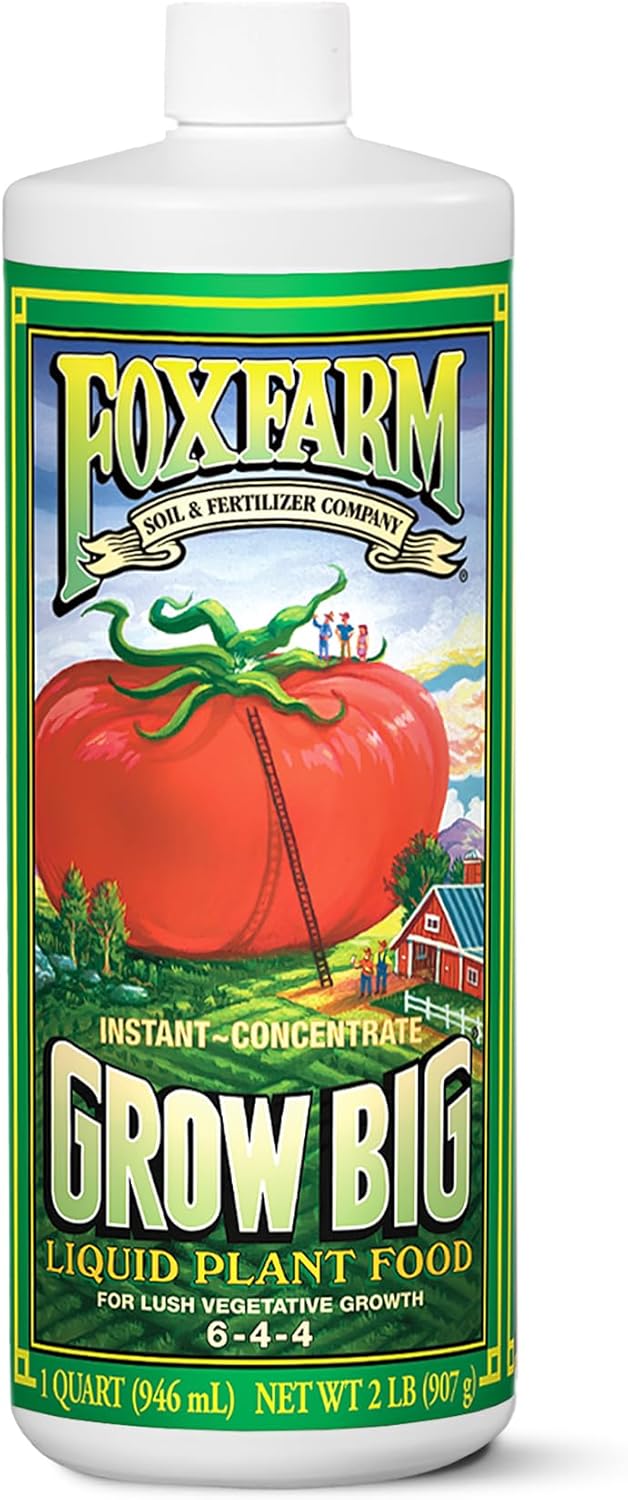
| N-P-K | 6-4-4 |
|---|---|
| Form | Liquid concentrate |
| Unit count | 32 Fluid Ounces |
| Mixing ratio | 2-3 teaspoons per gallon |
FoxFarm Grow Big is a water-soluble concentrate designed to boost vegetative growth and speed nutrient uptake in vegetable gardens and ornamentals. Mixed at 2 to 3 teaspoons per gallon, it can be applied through watering or foliar feeding to quickly deliver nitrogen-focused nutrition that supports larger plants and stronger stems. The low pH formula helps keep micronutrients stable so feedings remain effective, and the quart concentrate covers repeated applications for a small plot or a set of containers. Practical benefits include clear mixing instructions, versatility for both indoor and outdoor use, and a fast-acting effect when plants need a growth push. Limitations to note are the higher nitrogen emphasis, which favors leaf and stem growth over bloom or fruit set, and the presence of phosphorus in the formula that may be restricted in some local lawn rules. For gardeners who prioritize consistent, predictable feedings, this product is straightforward to measure and integrate into a regular watering schedule.
Best for: Gardeners who want a reliable, easy-to-dose liquid fertilizer to encourage rapid vegetative growth in vegetable beds, containers, and established plants and who value predictable results from each feeding.
Less Ideal for: Growers focused primarily on maximizing flowering or fruit set who need a bloom-boosting formula or those working under strict phosphorus-use restrictions in their area.
- Concentrated liquid formula for fast nutrient uptake and quick visible response
- Low pH formulation helps maintain micronutrient stability during storage and application
- Versatile application by watering or foliar feeding for indoor and outdoor use
- Clear mixing ratio (2–3 teaspoons per gallon) simplifies repeatable feedings
- Nutrient ratio (6-4-4) emphasizes vegetative growth rather than flowering or fruit production
- Contains phosphorus which may be restricted by local regulations for turf or non-agricultural use
Verdict: Choose this concentrate when you want a dependable, fast-acting liquid feed to promote vigorous leafy and structural growth in a vegetable garden.
Miracle-Gro Liquid All Purpose Plant Food Concentrate, 32 oz

| Item Form | Liquid |
|---|---|
| Specific Uses For Product | Plant Growth, Root Development |
| Application Method | Mix with water in a watering can |
| Mixing Ratio | 1:10 (concentrate to water, estimate) |
Miracle-Gro Liquid All Purpose is a water-soluble concentrate you mix into a watering can and apply every 1 to 2 weeks to container and in-ground plants. It is formulated for general plant growth and root development and is marketed for flowers, vegetables, shrubs and houseplants, so it works as a straightforward feed for flowering bulbs like calla lilies. The bottle’s mixing guidance (cap measures for garden application and 1 teaspoon per gallon for containers) makes it easy to dose for pots or small beds. Practical benefits include fast uptake through the soil when applied as directed and compatibility with routine watering schedules. Limitations to note are that it is an all-purpose formula rather than a bloom-focused or calcium-rich fertilizer tailored specifically to calla lilies, so growers seeking targeted bloom enhancement or specialty nutrition may want a supplement. Also, frequent use at higher-than-recommended strength can risk fertilizer burn, so follow the mixing directions and schedule.
Best for: Buyers who want an affordable, easy-to-use liquid fertilizer to keep calla lilies and other flowering plants regularly fed without fuss.
Less Ideal for: Growers seeking a specialist bloom-boost or a fertilizer formulated for specific micronutrient needs should consider a targeted or bloom-specific product instead.
- Concentrated liquid mixes easily with water for quick application
- Clear dosing instructions for both garden beds and container plants
- Suitable for a wide range of plant types including flowering bulbs and houseplants
- General all-purpose formula not specifically formulated for enhancing blooms of calla lilies
Verdict: A budget-friendly, easy-to-use liquid concentrate that reliably feeds calla lilies and other common garden plants on a regular schedule.
Choosing the Right Liquid Plant Food for Vegetable Gardens: Key Factors to Consider
Nutrient Ratio and Concentration
Vegetable crops need the right balance of nitrogen, phosphorus, and potassium at different growth stages. A liquid plant food with a higher nitrogen ratio benefits leafy greens, while higher phosphorus and potassium support flowering and fruiting in tomatoes, peppers, and beans. Concentration matters because highly concentrated formulas require careful dilution to avoid burning roots or foliage.
Look at both the N-P-K numbers and any secondary nutrients listed. Calcium and magnesium help prevent blossom end rot and support cell wall strength. Micronutrients like iron and zinc are useful when deficiency signs appear. Choose a product whose label provides clear N-P-K values and recommended dilutions for different vegetables.
Solubility and Mixing Ease
A liquid plant food should dissolve cleanly without leaving residues that can clog sprayers or drip lines. Water-soluble concentrates and ready-to-use liquids reduce mixing errors and speed application, which matters when you are feeding multiple beds or many containers.
Check whether a product needs pre-mixing, agitation, or warming to dissolve. Ease of mixing has a direct effect on consistent feeding rates across a garden and on the longevity of equipment when used with micro-irrigation systems.
Application Methods and Compatibility
Different gardens use different feeding methods. Some gardeners prefer foliar sprays for quick correction of deficiencies, others rely on root drenches or injection into drip lines. A good liquid plant food will be labeled for multiple application routes and indicate safe dilution rates for each method.
Compatibility with common irrigation components matters. If you plan to inject feed into drip systems, choose a formula that will not gum up filters or emitters. Also consider whether a product is safe for use on seedlings and transplants at lower concentrations.
Crop-Specific Safety and Residue
When feeding edible crops you must consider residue concerns and harvest intervals. Labels that provide clear guidance on timing of last application before harvest help prevent unintentional residues on produce. Some liquid feeds are organic-based and have different residue and safety profiles than synthetic concentrates.
Read instructions for pre-harvest intervals, any restrictions on leafy greens versus fruiting crops, and whether the product recommends rinsing produce after harvest. Safety guidance for children, pets, and pollinators in the garden is also relevant to backyard growers.
Speed of Plant Response
One reason gardeners choose liquid feeding is a faster visible response compared with granular options. How quickly plants green up, set flowers, or recover from deficiency will affect how often you feed and when you can expect results. Faster-acting feeds are useful when a rapid correction is needed during a critical growth window.
However, rapid response can also mean a shorter feeding interval and higher management. Consider whether you want quick fixes during the season or steadier nutrient release. Match the feed's action speed to your maintenance schedule and crop priorities.
When to Start Liquid Feeding in a Vegetable Garden
Begin liquid feeding after seedlings have developed their first true leaves and are established in the soil. For transplants, give them a couple of waterings to settle before the first diluted feed to avoid compounding transplant stress.
Adjust timing by crop. Leafy vegetables benefit from earlier, nitrogen-focused feeding, while fruiting crops respond most to balanced or bloom-support formulas later in the season.
- Feed seedlings with a quarter-strength solution to avoid burning delicate roots.
- Switch to a balanced or bloom formula as flowers form on tomatoes and peppers.
- Use foliar sprays for rapid correction of visible nutrient deficiencies.
Application Tips for Different Garden Setups
Containers, raised beds, and in-ground rows each have different watering and nutrient-holding characteristics. Containers dry and leach nutrients faster, so they often need more frequent, lighter liquid feeds. Raised beds with rich amendments may require less frequent feeding once organic matter buffers nutrients.
If you use drip irrigation, prepare a fresh, well-mixed solution and strain it if needed. For foliar application, spray in the morning or evening to minimize sun scorch and maximize uptake.
- Always follow dilution instructions for your chosen application method.
- Rotate application routes if a single method is not producing consistent results.
Organic Versus Synthetic Liquid Feeds
Organic liquid feeds are often lower in concentrated N-P-K numbers but provide organic matter and microbial food that can improve soil biology over time. They may act more slowly but contribute to long-term soil health. Synthetic concentrates deliver precise nutrient ratios rapidly and are useful for correcting deficiencies quickly.
Choose organic options if you prioritize soil-building and reduced chemical inputs. Synthetic formulas are practical when you need predictable short-term responses, such as during fruit set or to recover from a clear deficiency.
- Organic feeds can be gentler on seedlings and beneficial insects when used as directed.
- Synthetic feeds require careful measurement to avoid overfeeding and salt buildup.
How to Read Labels for Safe Edible Use
Label information matters for edible gardens. Look for explicit directions for vegetables, recommended dilutions by crop type, and any pre-harvest interval guidance. Ingredients should be listed so you can identify sources of nutrients and any additives.
Clear labeling that lists micronutrients and suggested frequency removes guesswork and helps you plan a feeding schedule that aligns with crop growth stages.
- Verify whether the product gives separate instructions for foliar versus soil application.
- Note any warnings about use on leafy crops close to harvest and follow safety instructions.
Troubleshooting Common Feeding Issues
Yellowing that does not improve after a feed often indicates wrong nutrient balance rather than insufficient feeding. Overfeeding can cause leaf burn, wilting, or excessive vegetative growth at the expense of fruiting.
If foliar sprays leave residue or scorch leaves, reduce concentration and spray during cooler parts of the day. For clogged emitters, filter solutions and increase dilution when necessary.
- If plants show no response after two feedings, reassess soil pH and drainage as these affect nutrient uptake.
- Keep records of feed strength and plant response to refine your routine season to season.
How We Chose the Best Liquid Plant Food for Vegetable Gardens
We selected products that suit real vegetable garden routines and edible-safety priorities. Our evaluation focused on nutrient formulation and concentration, to ensure each option supplies the primary elements vegetables need at the right ratios. We examined application flexibility, including compatibility with foliar feeding, soil drench, and drip irrigation, so gardeners can use the product with different setups. Solubility and ease of mixing were considered so gardeners face fewer clogs and inconsistent doses. We also weighed ingredient clarity and labeling for safe use on food crops and clear dilution instructions. Exclusions included products aimed solely at ornamental plants, slow-release granular blends that are not intended for liquid feeding, and any formulations lacking clear instructions for edible crops. We prioritized options that balance practicality for backyard and small-scale market gardeners with predictable nutrient delivery.
FAQ
How often should I apply liquid plant food to vegetables?
Frequency depends on concentration and crop. Many gardeners apply a diluted feed every 7 to 14 days during the active growing season. Containers often need more frequent feeding than in-ground beds.
Can I use the same liquid feed for seedlings and mature plants?
You can use the same formula at different dilutions, but seedlings require much weaker solutions. Follow label guidance for seedling-strength mixes to avoid root burn.
Is foliar feeding safe on fruiting crops?
Foliar feeding is safe when labels permit it and when you avoid spraying during hot midday sun. It is an effective way to correct micronutrient deficiencies quickly, but it should complement, not replace, root feeding.
Will liquid feeding build soil health over time?
Organic liquid feeds that contain microbial stimulants and organic matter can support soil biology. Synthetic liquids provide nutrients efficiently but do not add organic matter, so combine them with compost or amendments for long-term soil improvement.
Can I add liquid fertilizer to my drip irrigation system?
Yes, many liquid feeds can be injected into drip systems if they are fully soluble and free of particulates. Strain mixes and check compatibility with filters and emitters before routine use.
Final Verdict
Choosing the right liquid plant food for vegetable gardens means balancing nutrient needs, application method, and how quickly you want plants to respond. Prioritize clear label information, appropriate N-P-K ratios for your crop stage, and formulations that mix cleanly for your equipment. Consider whether you need organic soil-building benefits or fast, precise correction from a concentrated formula. With those tradeoffs in mind, pick the option that matches your garden setup and feeding rhythm to get predictable, healthy yields.
