

Note: This article contains affiliate links. If you click on these links and make a purchase, I may earn a small commission at no extra cost to you. This helps support my research and content. Read my full affiliate disclosure here.
A brushless pressure washer changes how you tackle outdoor cleaning by offering higher efficiency and longer motor life than traditional brushed units. If you need reliable power for decks, siding, driveways, or cars, choosing the right brushless model matters for performance, maintenance, and overall running cost. This guide shortlists the seven best brushless pressure washers for general home use. Each pick was evaluated for real-garden tasks like rinsing dirt from pavers, stripping mildew from siding, and washing vehicles. We also explain the key specs and tradeoffs to help you match a machine to the jobs you expect it to do.
Top Picks at a Glance
| Best Overall The best all-around choice for most situations | Greenworks Pro 2300 PSI 2.3 GPM Electric Pressure Washer |  |
| Best Quality Built to a higher standard if you want something more solid | Giraffe Tools Grandfalls Wall-Mount Pressure Washer Pro with 100 ft Retractable Hose |  |
| Best Value The sweet spot between price and what you get | Greenworks 2700 PSI Brushless Electric Pressure Washer (2.3 GPM Max) |  |
| Best Budget The cheapest option that still gets the job done reliably | MIMYTH Cordless Pressure Washer — Battery-Powered Portable 1650 PSI |  |
| Highest Rated A top-rated pick with lots of positive feedback | Greenworks 3000 PSI Brushless Electric Pressure Washer |  |
| Most Popular A crowd favorite that many people choose with confidence | Greenworks 3000 PSI Brushless Electric Pressure Washer (2.0 GPM) |  |
| Best Seller A high-volume bestseller chosen again and again | Westinghouse WPX3400e Electric Pressure Washer (3400 PSI, Brushless Motor) |  |
Greenworks Pro 2300 PSI 2.3 GPM Electric Pressure Washer

| Power Source | ac |
|---|---|
| Maximum Flow Rate | 2.3 gpm |
| Maximum Pressure | 2300 psi |
| Hose Length | 25 feet |
| Tank Volume | 2.3 gallons |
The Greenworks Pro 2300 PSI electric pressure washer is a corded cold-water unit aimed at homeowners who want a powerful, low-maintenance cleaning tool. It pairs a brushless motor and an axial cam pump to deliver up to 2300 PSI and 2.3 GPM, which is strong enough for patios, driveways, siding, decks, outdoor furniture, and vehicle washing. The unit includes a 25 foot high-pressure hose, five nozzles (15°, 25°, 40°, soap and turbo), a built-in detergent tank and quick-connect metal wand for swapping spray patterns on the fly. Large wheels and multiple grab points make it simple to move around the yard, and the total stop system reduces wear by shutting the motor off when the trigger is released. Practical limits are typical of corded electrics: it needs an outdoor outlet and is best for medium residential jobs rather than heavy commercial cleaning. Noise and maintenance are lower than gas machines, but reach is limited by hose and cord length. For an all-round homeowner wanting a reliable, brushless electric washer, this balances power, convenience, and ease of use well.
Best for: Homeowners who want a dependable, low-maintenance electric washer that handles a wide range of medium-duty outdoor cleaning tasks with minimal fuss.
Less Ideal for: Professional cleaners or users who need long uninterrupted runtime, very high pressure for industrial surfaces, or off-grid cordless operation.
- Brushless motor with 2300 PSI and 2.3 GPM provides strong cleaning power for most residential tasks
- Includes five nozzle options plus a turbo and built-in detergent tank for versatile spray patterns and soap application
- 25 ft high-pressure hose and large wheels improve mobility and make yard work easier to manage
- Total Stop System reduces motor wear by stopping the pump when the trigger is not engaged
- Corded design requires access to an outdoor outlet and limits working radius compared with gas or battery models
- Not intended for heavy commercial or industrial cleaning where higher pressure and longer continuous runtime are needed
Verdict: A reliable, brushless corded pressure washer that gives homeowners strong, versatile cleaning performance with low maintenance.
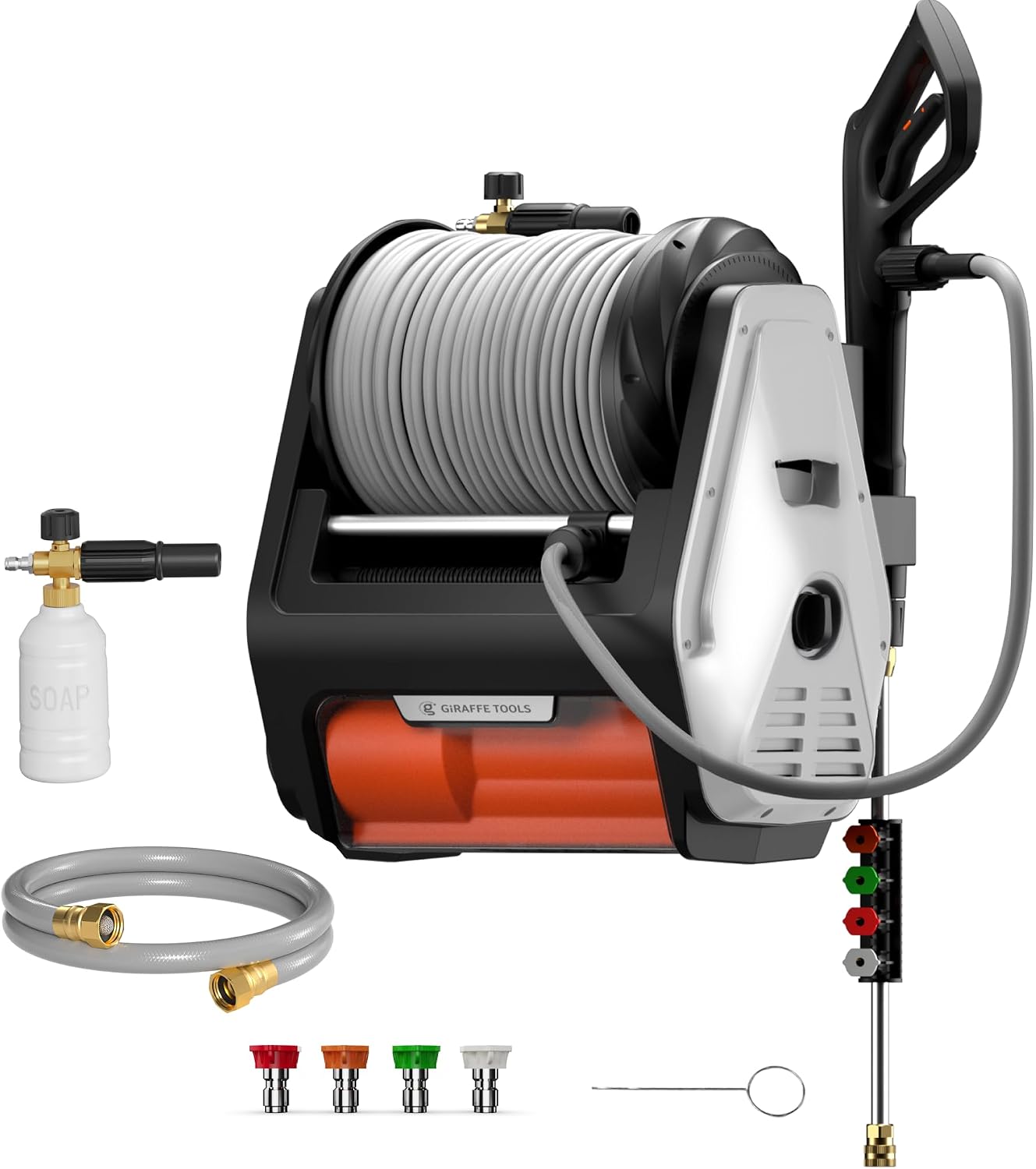
Giraffe Tools Grandfalls Wall-Mount Pressure Washer Pro with 100 ft Retractable Hose
| Power Source | Corded Electric |
|---|---|
| Maximum Pressure | 3700 psi |
| Maximum Flow Rate | 1.6 gpm |
| Hose Length | 100 feet |
The Giraffe Tools Grandfalls Pressure Washer Pro is a wall-mounted electric unit designed to store neatly while delivering high cleaning power for driveways, decks, and exterior surfaces. It mounts to a wall to free garage or shed floor space and includes a 100 foot retractable hose reel that locks at any length and auto-retracts to reduce tangles and storage clutter. The 1800W brushless motor and graphene cooling system are built for quieter, longer operation, and the unit advertises up to 3700 psi and 1.6 gpm for tackling oil stains, mildew, and heavy grime. Practical benefits include on-board accessory storage, a detachable hose section for quick replacement, and a design meant for extended runs without overheating. Important limitations are that claimed peak pressure and flow are usage-dependent and may not match continuous commercial output, and the unit’s heavy weight and wall installation mean it is less portable than freestanding models. Expect simpler maintenance with the detachable hose but plan for professional mount installation if you cannot lift or anchor heavy equipment.
Best for: Homeowners who want a space-saving, high-power wall-mounted pressure washer for regular exterior cleaning and value quiet, long-run performance and tidy storage.
Less Ideal for: Users who need a lightweight, portable pressure washer for occasional spot jobs or who cannot install a permanent wall unit.
- Wall-mount design saves floor space and keeps hose and accessories organized
- 100 ft retractable hose with triple-lock and auto-rewind reduces kinks and hassle
- 1800W brushless motor with graphene cooling for quieter, longer continuous operation
- Detachable hose sections allow quick replacement without swapping the entire hose
- Heavy unit that requires a solid wall and two-person install or professional mounting
- Advertised peak pressure and flow may not reflect continuous commercial-level performance
Verdict: Choose this model if you want a powerful, space-saving wall-mounted washer with a long retractable hose and quiet brushless motor for frequent heavy-duty home cleaning.
Greenworks 2700 PSI Brushless Electric Pressure Washer (2.3 GPM Max)

| Power Source | ac |
|---|---|
| Maximum Flow Rate | 2.3 gpm |
| Maximum Pressure | 2700 psi |
| Hose Length | 25 feet |
The Greenworks brushless electric pressure washer delivers strong residential cleaning performance without the maintenance of a gas engine. It uses a brushless motor and a high-efficiency pump to produce up to 2700 PSI and a variable flow up to 2.3 GPM, and comes with five quick-connect nozzles including a turbo and soap tip so you can switch from heavy-duty stain removal to gentle rinsing. The unit is designed for mobility with oversized wheels, multiple grip points, an integrated wand holder, a 25 foot tangle-resistant hose, and a 35 foot GFCI power cord for long reach without moving the machine. Practical features like a built-in detergent tank and push-button start simplify setup and reduce prep time. Expect electric-pressured convenience and quieter operation than gas, but keep in mind that performance depends on hookups to AC power and the unit’s maximum specs are achieved under test conditions; very large commercial jobs may still require a professional or gas unit. Follow safety guidance when using high-pressure settings near people or delicate surfaces.
Best for: Buyers who want a low-maintenance, high-power electric pressure washer for regular home and outdoor cleaning jobs and who prioritize convenience, quiet operation, and easy storage.
Less Ideal for: Users who need untethered cordless operation or who regularly perform large commercial or industrial cleaning projects that demand a heavy-duty gas-powered machine.
- High peak cleaning power up to 2700 PSI with variable flow up to 2.3 GPM for tackling concrete, siding, decks, and vehicles
- Brushless motor and efficient axial cam pump for better-than-gas performance with lower maintenance
- Five quick-connect nozzles plus a dedicated soap nozzle let you match spray pattern to the task
- Long reach with a 25 foot tangle-resistant hose and 35 foot GFCI power cord reduces repositioning
- Built-in detergent tank, wand holder, oversized wheels and multiple grips improve usability and transport
- Requires a standard AC outlet so it is limited by cord reach and available power
- Maximum pressure figures are achieved under controlled test conditions and will vary in typical use
Verdict: Choose this unit if you want a powerful, low-maintenance electric pressure washer that handles most residential cleaning tasks with convenient features for easy use.
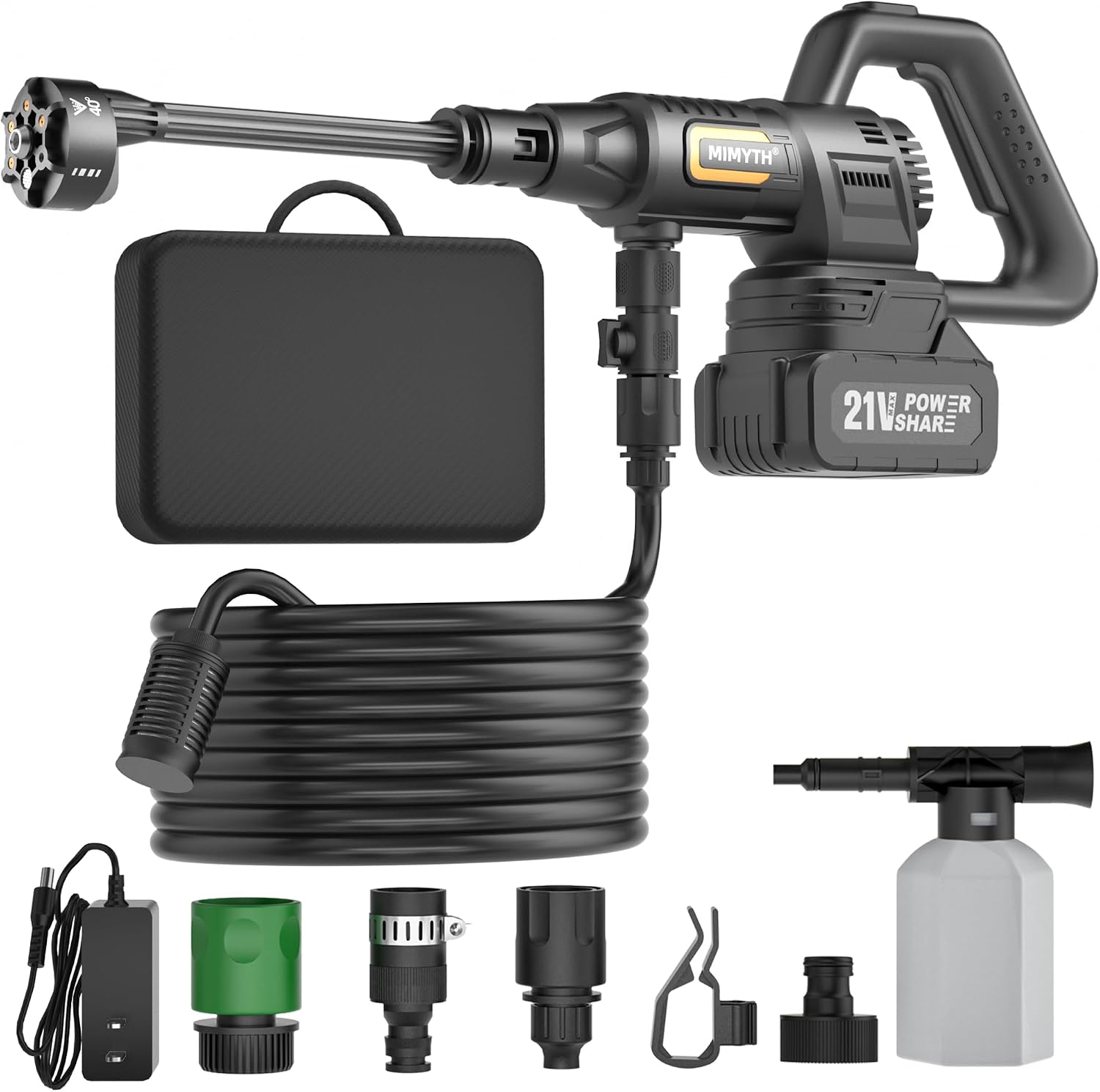
MIMYTH Cordless Pressure Washer — Battery-Powered Portable 1650 PSI
| Power Source | Battery Powered |
|---|---|
| Maximum Flow Rate | 3.7 gpm |
| Maximum Pressure | 1650 psi |
| Hose Length | 23 feet |
The MIMYTH cordless pressure washer is a lightweight, battery-powered unit built for quick, portable cleaning of cars, patios, walls, and other outdoor surfaces. It uses a brushless motor to produce up to 1650 psi and a 3.7 gpm flow rate, with an integrated LCD and three power modes so you can switch between gentle rinses and stronger cleaning without guesswork. The kit includes a reinforced 23-foot hose and a 6-in-1 nozzle plus a foam cannon for pre-soak, which makes washing vehicles and patios easier without moving your water source often. The unit draws water from taps, buckets, or pools through a weighted intake filter, expanding where you can use it. At under 4 pounds and with a soft storage case, it is easy to carry and stash in a trunk or shed. Expect run times of roughly 20 to 45 minutes per 21 V battery charge and about four hours to recharge, so larger continuous jobs may need a spare battery or staged breaks. Connectors and fittings are upgraded to reduce leaks, but this is not a replacement for a full-size gas or corded pressure washer on very heavy-duty commercial jobs.
Best for: Buyers who want a high-performing, portable pressure washer for regular vehicle and small-to-medium outdoor cleaning jobs and who value mobility and adjustable power over continuous runtime.
Less Ideal for: Professionals or users who need continuous high-volume cleaning for large commercial surfaces should consider a more powerful corded or gas model.
- Cordless brushless motor delivers up to 1650 psi for effective cleaning without cords
- Long 23-foot reinforced hose increases reach and reduces repositioning
- Adjustable power modes plus a 6-in-1 nozzle and foam cannon give versatile spray patterns and pre-soak capability
- Weighted intake and multiple water connections let you draw from buckets, pools, or faucets
- Lightweight and compact design with included soft case makes it easy to transport and store
- Battery run time is limited to about 20–45 minutes depending on mode which may interrupt longer jobs
- Not suitable as a replacement for high-capacity gas or corded pressure washers when continuous heavy-duty cleaning is required
Verdict: Great choice for performance-minded owners who need a portable, cordless unit that balances strong spray power with versatile attachments for car and patio cleaning.
Greenworks 3000 PSI Brushless Electric Pressure Washer

| Power Source | ac |
|---|---|
| Maximum Flow Rate | 2 gpm |
| Maximum Pressure | 3000 psi |
| Tank Volume | 1 gallons |
The Greenworks 3000 PSI brushless electric pressure washer is built for homeowners who need strong, reliable cleaning power without gas maintenance. It pairs a 14 Amp TruBrushless motor with JetFlow technology to deliver up to 3000 PSI and 2.0 GPM, which is capable of stripping grime from driveways, patios, siding and large outdoor surfaces. The unit is corded for continuous runtime and includes a 25 foot kink-resistant high-pressure hose, metal spray gun, five quick-connect nozzles (including turbo and soap) and a built-in detergent tank for faster degreasing. The steel-frame build, oversized wheels and multiple grip points make it easier to move around a property, while the 35 foot power cord increases reach from a standard outlet. Expect quieter operation than gas models and low maintenance from the electric brushless motor. Important limitations are that it is a corded unit so you need access to outlets or an extension solution and the maximum 2.0 GPM flow rate is balanced toward pressure rather than highest water volume for very large commercial jobs.
Best for: Homeowners who want a powerful, low-maintenance electric pressure washer to deep-clean driveways, patios and siding without dealing with gas engines, and who value portability and versatile spray options.
Less Ideal for: Contractors or users who need cordless freedom or very high continuous water flow for large commercial sites should consider professional gas or higher-GPM units instead.
- High peak cleaning power: up to 3000 PSI with a 2.0 GPM flow suitable for deep driveway and concrete cleaning
- Brushless motor with JetFlow tech for consistent power and lower maintenance
- Includes five quick-connect nozzles plus built-in detergent tank for flexible cleaning and faster stain removal
- Portable steel-frame design with oversized wheels and long power/hose reach for easy maneuvering
- Corded design requires access to a grounded outlet or extension for larger properties
- 2.0 GPM flow favors pressure over maximum water throughput for very large commercial jobs
Verdict: A high-pressure, low-maintenance electric washer that balances strong cleaning power and portability for homeowners tackling driveway and exterior grime.
Greenworks 3000 PSI Brushless Electric Pressure Washer (2.0 GPM)

| Power Source | AC |
|---|---|
| Maximum Flow Rate | 2 gpm |
| Maximum Pressure | 3000 psi |
| Hose Length | 25 feet |
| Tank Volume | 2 gallons |
The Greenworks 3000 PSI brushless electric pressure washer is built to tackle demanding exterior cleaning jobs without the fuss of gas maintenance. It produces up to 3000 PSI and 2.0 GPM from a 14 A TruBrushless motor and heavy‑duty cast aluminum axial cam pump, so it can remove stubborn grime from driveways, patios, siding, decks, and vehicles. Typical use involves plugging into a household outlet, attaching the 25 ft Uberflex hose and quick‑connect nozzles, and switching tips (15°, 25°, 40°, soap, and turbo) to match surface and pressure needs. Notable features include PWMA certification for the PSI/GPM claims, onboard nozzle storage, a metal spray gun, and compatibility with standard M22 fittings for accessories. Practical benefits are strong, near‑gas performance with simpler setup and lower noise, plus a robust pump designed for frequent heavy use. Important limitations are that it requires access to AC power and a water source, and the high pressure demands careful handling to avoid injury or surface damage when used improperly.
Best for: Homeowners who prioritize raw cleaning power and want near-gas performance from an electric unit for frequent heavy-duty outdoor cleaning tasks.
Less Ideal for: People who need cordless or off-grid mobility or those cleaning mostly delicate surfaces where lower pressure tools are preferable.
- Delivers up to 3000 PSI and 2.0 GPM for deep cleaning performance
- PWMA certified claims give independent verification of pressure and flow
- Includes rugged metal gun, 25 ft kink-resistant hose, and multiple quick-connect nozzles for versatility
- Cast aluminum axial cam pump and brushless motor provide durable, near-gas performance
- Requires a standard AC outlet so not suitable for off-grid use
- High-pressure output can damage delicate surfaces if nozzles and distance are not adjusted properly
Verdict: Buy this if you want a corded electric washer that delivers near-gas 3000 PSI cleaning power with durable components for regular heavy-duty use.
Westinghouse WPX3400e Electric Pressure Washer (3400 PSI, Brushless Motor)

| Power Source | ac |
|---|---|
| Maximum Flow Rate | 2 gpm |
| Maximum Pressure | 3400 psi |
| Hose Length | 25 feet |
| Tank Volume | 0.45 gallons |
The Westinghouse WPX3400e is an electric pressure washer built to handle demanding home projects like decks, driveways, siding and fences without the noise and maintenance of a gas unit. It delivers up to 3400 max PSI with a brushless AC motor and an axial cam pump that runs with an auto‑stop feature, and it includes a 0.45 gallon onboard soap tank plus five quick‑connect nozzle tips for flat fan, turbo, and soap applications. The 25 foot abrasion‑resistant hose, 10 inch never‑flat wheels and a long GFCI cord make it easy to move around a two‑story house and reach elevated work areas with an extension wand or compatible accessories. Practical benefits include good cleaning power for stubborn grime, lower upkeep compared with gas washers, and built‑in detergent delivery for siding and decks. Important limitations are that electric power restricts runtime to available outlets and extension reach, and the rated water flow drops from max PSI to a lower continuous flow for sustained cleaning, so very large jobs may take longer than with a commercial gas model.
Best for: Homeowners who want a powerful, low‑maintenance electric washer for thorough cleaning of siding, decks, driveways and periodic second‑story jobs and who value ease of use over commercial gas performance.
Less Ideal for: Users who need long continuous runtime, remote jobsite operation without power, or the fastest cleaning on very large paved areas should consider a gas or higher‑flow commercial unit instead.
- High peak pressure (3400 max PSI) suitable for heavy residential tasks
- Brushless AC motor and maintenance‑free axial cam pump for longer life
- Onboard 0.45 gallon soap tank and five quick‑connect nozzles for versatile cleaning
- Long hose and 35 ft GFCI power cord plus never‑flat wheels for easier mobility
- Requires an electrical outlet which limits placement and continuous runtime
- Lower rated flow (3000 PSI at 1.1 GPM) for sustained cleaning compared with peak spec
Verdict: A strong, low‑maintenance electric pressure washer that balances high cleaning power and user convenience for most two‑story home cleaning jobs.
Choosing the Right Brushless Pressure Washer: Key Factors to Consider
Cleaning Power and Flow
Cleaning power for outdoor surfaces depends on both pressure (PSI) and flow rate (GPM). High PSI helps remove stuck grime and mildew, while higher GPM rinses debris away faster. For hard surfaces like concrete or metal, look for machines with higher PSI and steady GPM. For delicate jobs such as vehicle or painted wood, lower pressure or adjustable nozzles prevent surface damage.
Performance numbers matter less than how they combine. A moderate PSI with strong flow can outperform a high-PSI, low-flow unit on large surfaces because it clears residue more quickly. Also consider how consistently the machine holds pressure under typical household water supply conditions.
Motor Type and Longevity
Brushless motors offer reduced internal friction, fewer wearing parts, and better heat management than brushed motors. That translates to longer service life and more consistent performance during extended cleaning sessions. Evaluate cooling features and whether the design protects the motor from water and dust exposure common in outdoor work.
Longer life reduces service interruptions and ownership cost. Pay attention to manufacturer guidance on duty cycle and cooling intervals for sustained tasks like rinsing a large driveway, and look for features that help shed heat during prolonged use.
Pump Construction and Repairability
The pump is the heart of a pressure washer and often determines both performance and lifespan. Ceramic or brass components resist wear better than plastic in high-pressure sections. Check whether the pump is axial or triplex-style since triplex pumps generally offer smoother flow and longer life for frequent heavy use.
Repairability matters for longevity. Machines with replaceable pump heads, accessible fittings, and standard hose couplings make routine service simpler. Consider how easy it will be to winterize or flush the pump to prevent freeze damage and mineral buildup.
Hose, Wand, and Accessory Design
A usable hose and wand set saves time and reduces fatigue. Hose length affects reach and repositioning needs; longer hoses reduce repositioning but can add storage bulk and may reduce effective pressure slightly. Wand ergonomics, trigger comfort, and nozzle interchangeability influence how long you can work comfortably and how precisely you can direct cleaning power.
Accessory choices such as surface cleaners, turbo nozzles, and adjustable spray tips expand capability. Check how accessories attach to the wand and whether quick-connect fittings are standard for faster swaps during multi-step jobs.
Portability and Storage
Weight, wheel design, and overall footprint determine how easily you move a pressure washer around a yard or up and down steps. Lighter units are easier to carry, but heavier designs with robust frames often survive rugged use better. Consider whether the machine has integrated hose reels, on-board accessory storage, or folding handles to minimize space when stored in a garage or shed.
Balance portability against durability. A compact unit that fits your storage space but lacks a stable base can be frustrating in windy or uneven outdoor conditions.
Matching Machine Size to Typical Jobs
Match the washer's capacity to the jobs you expect. For occasional car washes and light patio cleaning, a mid-range machine with moderate PSI and good flow will be easier to manage and more than adequate. For frequent heavy tasks like stripping moss from large driveways or preparing siding for painting, prioritize higher PSI and a pump designed for sustained use.
Think in terms of task duration and surface area. A more powerful unit will finish big jobs faster, but it may be heavier, louder, and require a sturdier water supply. Plan where you will store and power the unit so it is convenient when those larger jobs are needed.
- Short, frequent tasks benefit from lighter, more maneuverable models
- Large surfaces are handled faster by higher GPM machines
- Delicate surfaces need adjustable pressure or low-pressure modes
Water Supply and Hose Considerations
Your garden hose and tap pressure limit the machine's available flow. Long garden hoses or weak outdoor taps can reduce effective cleaning power. Use at least a 3/4-inch supply hose when possible and keep supply hoses as short as practical to maintain steady water flow.
Also consider inlet filters and quick-connect fittings. A clear inlet filter prevents grit and sediment from damaging the pump. Quick connects make swapping nozzles and accessories faster and reduce the chance of cross-threading that can cause leaks.
- Use a short, wide-diameter supply hose to preserve flow
- Check for inlet filtration to protect the pump
- Confirm compatibility with common accessory fittings
Noise, Power Source, and Local Use
Electric brushless models are generally quieter than gas engines and are preferable in suburban neighborhoods or on shared property. Consider the noise level if you will be working early in the morning or late in the evening. Corded electric machines need an electrical outlet nearby, while battery-powered brushless units offer mobility at the cost of limited run time.
Think about duty cycle and recharge logistics for battery machines, and verify cord length or generator needs for corded machines. Noise and exhaust considerations also affect where you can use the washer safely and considerately.
- Electric brushless units are quieter than gas models
- Battery models are portable but have run-time limits
- Plan for electricity access or generator use if needed
Maintenance and Winter Care
Regular maintenance extends the life of brushless pressure washers. Flush detergent lines after use, clean inlet screens, and inspect hoses and fittings for wear. Even though brushless motors reduce internal wear, seals and pump components still need attention to prevent leaks and loss of pressure.
Winterizing is essential in cold climates. Drain all water from the pump and hoses, and use pump protector or antifreeze where recommended to prevent freeze damage. Store the unit in a dry place off the ground if possible.
- Flush detergent and rinse the pump after each use
- Inspect and replace worn hose fittings promptly
- Drain and protect the pump before freezing temperatures
Accessory Uses That Increase Versatility
Accessories expand what a pressure washer can do. Surface cleaners cut time on flat surfaces by cleaning with a spinning sprinkler-style head that avoids streaking. Foam cannons or soap injectors make detergent application easier and more even for cars and siding. Turbo nozzles add focused cleaning power for stubborn stains but require care on delicate surfaces.
Consider which accessories you will actually use and whether the machine supports them without adapters. Integrated detergent tanks and adjustable pressure wands are handy features that make common chores faster and more repeatable.
- Surface cleaners speed up flat-surface cleaning
- Foam and detergent systems improve coverage on vehicles
- Turbo nozzles boost cleaning for tough stains but use cautiously
How We Chose the Best Brushless Pressure Washer
We prioritized real-world cleaning ability and long-term reliability when narrowing the field to seven brushless pressure washers. Key evaluation criteria included sustained water pressure and flow, since PSI and GPM together determine cleaning power; motor design and thermal management, because brushless motors should deliver longer service life with less heat buildup; and build quality, focusing on pump type and frame durability for outdoor use. We also weighed ease of use features like hose length, wand controls, accessory compatibility, and storage. Energy efficiency and noise were considered because brushless systems often run quieter and consume less electricity, which matters for regular home use. Warranty terms and serviceability were reviewed as indicators of expected lifespan. Units were excluded if they relied on brushed motors, lacked clear pump specifications, or were clearly designed only for light-duty indoor cleaning. We favored machines with measurable performance specs and practical features that matter in a yard, driveway, or garage.
FAQ
Are brushless pressure washers worth the extra cost for home use?
Often yes for frequent users. Brushless motors tend to last longer and run cooler, which reduces maintenance and downtime. For occasional light-duty cleaning, a basic machine can still be adequate.
Can I use a brushless pressure washer on a painted fence or siding?
It depends on PSI and nozzle selection. Use a low-pressure nozzle or step back to reduce force when cleaning paint or soft wood. Test a small inconspicuous area first to avoid damage.
How important is the pump type in a brushless pressure washer?
Very important. Pump construction affects flow consistency and longevity. Triplex pumps and metal components usually last longer under frequent heavy use compared with basic plastic pumps.
Do battery-powered brushless washers offer enough runtime for big jobs?
Battery models can handle small to moderate tasks well, but runtime depends on battery capacity and load. For extended jobs like large driveways, corded electric units or scheduled battery swaps are usually more practical.
What maintenance should I do after each use?
Rinse out detergent lines, clear the inlet filter, drain hoses, and store the unit where it will not freeze. Regularly inspect fittings and seals and address leaks promptly to prevent pump damage.
Final Verdict
Choose a brushless pressure washer by matching the machine to the tasks you do most. Prioritize cleaning power and pump construction for large or frequent jobs, and focus on motor cooling and build quality if you expect heavy use. For light, occasional cleaning, portability, and ease of storage can outweigh top-end specs. Balance PSI and GPM against portability and maintenance needs. Using the factors outlined here will help you pick a machine that lasts, handles your common chores efficiently, and fits your storage and power situation.
