

Note: This article contains affiliate links. If you click on these links and make a purchase, I may earn a small commission at no extra cost to you. This helps support my research and content. Read my full affiliate disclosure here.
Choosing the right humus rich soil matters because it directly affects water retention, nutrient availability, and the soil biology that supports plant health. Whether you are filling containers, topdressing raised beds, or rebuilding an in-ground vegetable patch, soil with a high humus content helps seedlings establish faster, improves moisture buffering during dry spells, and supports beneficial microbes. This guide looks at six shortlisted humus rich soils suited to different garden uses. We focus on measurable qualities gardeners care about, including texture, nutrient stability, and biological activity, to help you pick the right mix for your plot or pots.
Top Picks at a Glance
| Best Overall The best all-around choice for most situations | Wiggle Worm Pure Worm Castings Organic Fertilizer, 30 lb |  |
| Best Quality Built to a higher standard if you want something more solid | The Andersons HumiChar Organic Soil Amendment with Humic Acid and Biochar (12 lb) |  |
| Best Value The sweet spot between price and what you get | Rosy Soil Organic Houseplant Potting Mix, Peat-Free, 8 Quarts |  |
| Best Budget The cheapest option that still gets the job done reliably | Back to the Roots 3-in-1 Seed Starting Mix, 6 Quart, Organic Peat-Free |  |
| Highest Rated A top-rated pick with lots of positive feedback | Earth Science Premium Earthworm Castings, 3 lb |  |
| Best Seller A high-volume bestseller chosen again and again | Back to the Roots Organic Indoor Potting Mix, 6 Quart |  |
Wiggle Worm Pure Worm Castings Organic Fertilizer, 30 lb

| Item Form | Granules |
|---|---|
| Specific Uses For Product | Soil Conditioning |
| Application Method | Apply to soil |
| Unit Count | 480 Ounce |
Wiggle Worm Pure Worm Castings are a ready-to-use organic soil amendment made from concentrated earthworm castings. Gardeners typically mix a portion into potting mixes, top-dress established plants, work it into transplant holes, or brew it as a nutrient tea; the product page includes specific dosing for vegetables, containers, lawns, and roses. The castings are odorless, non-burning, and OMRI listed for organic use, so they supply water-soluble nutrients plus microbes that improve aeration, water retention, and root development without synthetic chemicals. Practical benefits include easy application, safe use on seedlings and mature plants, and versatility across raised beds, container gardens, and lawns. The main limitation is that this is a concentrated soil builder rather than an all-in-one fertilizer with NPK labels, so users seeking precise, fast-acting nutrient ratios may need to supplement for specific deficiencies; also a 30 lb bag is bulky to handle for small-space gardeners. For gardeners focused on long-term soil health and organic production, it functions as a low-risk, effective amendment.
Best for: Gardeners who prioritize building long-term soil health and want a safe, organic amendment for vegetables, ornamentals, and containers; buyers who value proven, low-risk inputs backed by strong user feedback.
Less Ideal for: Gardeners who need targeted, rapid nutrient correction based on precise NPK values or those who only want a lightweight product for very small balconies or indoor micro-gardens.
- OMRI listed organic and made from 100% worm castings
- Provides beneficial microbes that improve soil structure and water retention
- Odorless and non-burning so safe for seedlings and established plants
- Versatile dosing for containers, raised beds, lawns, and making worm casting tea
- No standard NPK nutrient label so not a precise standalone fertilizer for targeted feeding
- Large 30 lb bag can be heavy and awkward for gardeners with limited storage or mobility
Verdict: Choose this product when you want a proven, OMRI-listed worm casting that builds soil biology and improves plant health across beds and containers.
The Andersons HumiChar Organic Soil Amendment with Humic Acid and Biochar (12 lb)

| Unit Count | 192 Ounce |
|---|---|
| Volume | 12 liters |
| Ingredients | Humic Acid, Coconut Husk Biochar, Leonardite, Proprietary Binding Agent, Water |
| OMRI Listed | Environmentally friendly, OMRI listed |
HumiChar is a granular organic soil amendment designed to boost soil structure and long-term fertility by combining high-concentration humic acid with granulated biochar. It is applied to lawns and garden beds either alone or blended with fertilizer to increase nutrient availability, improve moisture retention, and build soil carbon over time. The product's dispersible granule technology reduces dust and helps the particles break down more predictably in the soil, making it easier to apply evenly with a spreader. Because it contains both quickly available humic acid and persistent biochar, you get both near-term benefits for turf vigor and a durable improvement in soil tilth that can reduce reliance on repeat fertilizer applications. Important limitations are its chemical-safety notes and handling precautions and that measurable soil changes require repeated or follow-up applications for larger areas; it is not a one-time quick fix for heavily depleted soils. Overall this is a practical option for homeowners and groundskeepers seeking a reliable, low-dust organic amendment to improve lawn soil health.
Best for: Homeowners or lawn caretakers who prioritize consistent, long-term soil improvement and want a low-dust, organic amendment that fits into a routine fertilizing program.
Less Ideal for: People needing an immediate, dramatic correction for compacted or nutrient-depleted turf who require fast-acting chemical treatments or structural soil replacement.
- Combines 30% humic acid with 43% granulated biochar for both immediate and long-term soil benefits
- Dispersible granule formulation reduces dust and spreads evenly with common spreaders
- OMRI-listed organic ingredient set suitable for organic lawn programs
- Can be blended with fertilizers or used alone for flexible application
- Not a one-time solution for severely degraded soils because measurable changes take time and repeat applications
Verdict: Choose HumiChar when you want a dependable organic amendment that delivers both quick humic benefits and long-term soil-building biochar for healthier lawns over time.
Rosy Soil Organic Houseplant Potting Mix, Peat-Free, 8 Quarts

| Item Highlight | Biochar and Worm Castings, for Monstera, Pothos, Tropical Indoor Plants, Peat Free |
|---|---|
| Unit Count | 256 Ounce |
| Item Type Name | Soil for House Plants |
| Manufacturer | Rosy Soil |
| Style Name | Houseplant |
Rosy Soil Houseplant Potting Mix is a peat-free, organic indoor soil designed for tropical houseplants such as peace lilies. The blend uses biochar, worm castings, compost, bark fines and mycorrhizal fungi to create a living medium that encourages stronger root growth and improved nutrient and water uptake. Its chunky, well-draining texture (bark fines and sand) helps prevent waterlogging and root rot, while biochar resists compaction so the mix stays aerated longer between repots. The included mycorrhizae and beneficial microbes make this particularly useful when repotting or refreshing containers because they establish around roots and can boost plant vigor from the start. Important limitations are the bag size and handling: an 8 quart bag fills several medium pots but may not be enough for multiple large repots, and the product produces fine dust so care is needed when pouring. Also there are no added synthetic fertilizers, so you may need to supplement feeding for fast-growing or nutrient-hungry plants.
Best for: Buyers who prioritize long-term plant performance and healthy root development for indoor tropicals and want a peat-free, biologically active soil when repotting peace lilies and similar plants.
Less Ideal for: People who need large volumes for many plants or immediate high-nutrient fertility without supplementing with fertilizer should consider bulk or fertilized alternatives.
- Peat-free organic formula with biochar and worm castings for long-term soil health
- Contains mycorrhizal fungi and beneficial microbes to improve root nutrient and water uptake
- Chunky, well-draining texture that helps prevent root rot and compaction
- Resealable bag preserves remaining soil between uses
- 8 quart volume may be small for multiple or large repots
- Can produce fine dust when pouring so protective measures are advisable
Verdict: Choose this peat-free, microbially active mix when you want a performance-oriented soil that improves root health and drains well for peace lily repotting.
Back to the Roots 3-in-1 Seed Starting Mix, 6 Quart, Organic Peat-Free

| Unit Count | 192 Fluid Ounces |
|---|---|
| Style Name | 3-in-1 Seed Starting Mix |
| Brand Name | Back to the Roots |
| UPC | 810667035822 |
This 6-quart Back to the Roots 3-in-1 Seed Starting Mix is a peat-free, organic blend aimed at making seed starting and early potting simple. You use it straight from the bag to fill trays, small pots, or starter cells; the mix includes coconut coir for water retention, dolomitic limestone to balance pH, mycorrhizae to support root uptake, and yucca extract for moisture control. Practically, that means fewer extra amendments for a new gardener and a more forgiving environment for delicate seedlings. The formula is designed to drain well while retaining enough moisture for even watering, and the included nutrients and worm castings can reduce early feeding. Limits to note are the small 6-quart volume, which is best for hobby-scale starting rather than large beds, and a lighter texture that may dry faster in very hot, exposed conditions. For budget growers who want an all-in-one starter mix without experimenting with multiple additives, this is a convenient choice.
Best for: Great for budget-minded home gardeners who want a single, ready-to-use seed starting mix that reduces extra amendments and simplifies starting herbs, vegetables, and flowers.
Less Ideal for: Not the best fit for landscapers or gardeners starting large numbers of plants or filling large containers where bulk bagged mixes would be more economical.
- Peat-free organic formula with coconut coir for moisture retention and aeration
- Includes mycorrhizae and worm castings to support early root development and nutrient uptake
- pH balancing with dolomitic limestone reduces the need for corrective amendments
- Ready-to-use blend suitable for seed trays, small pots, and indoor container starts
- Only 6 quarts per bag, so multiple bags are needed for larger projects
- Light, fast-draining texture can require more frequent watering in hot or windy conditions
Verdict: A convenient, peat-free all-in-one starter mix that saves time and extra purchases for home gardeners starting small batches of seeds.
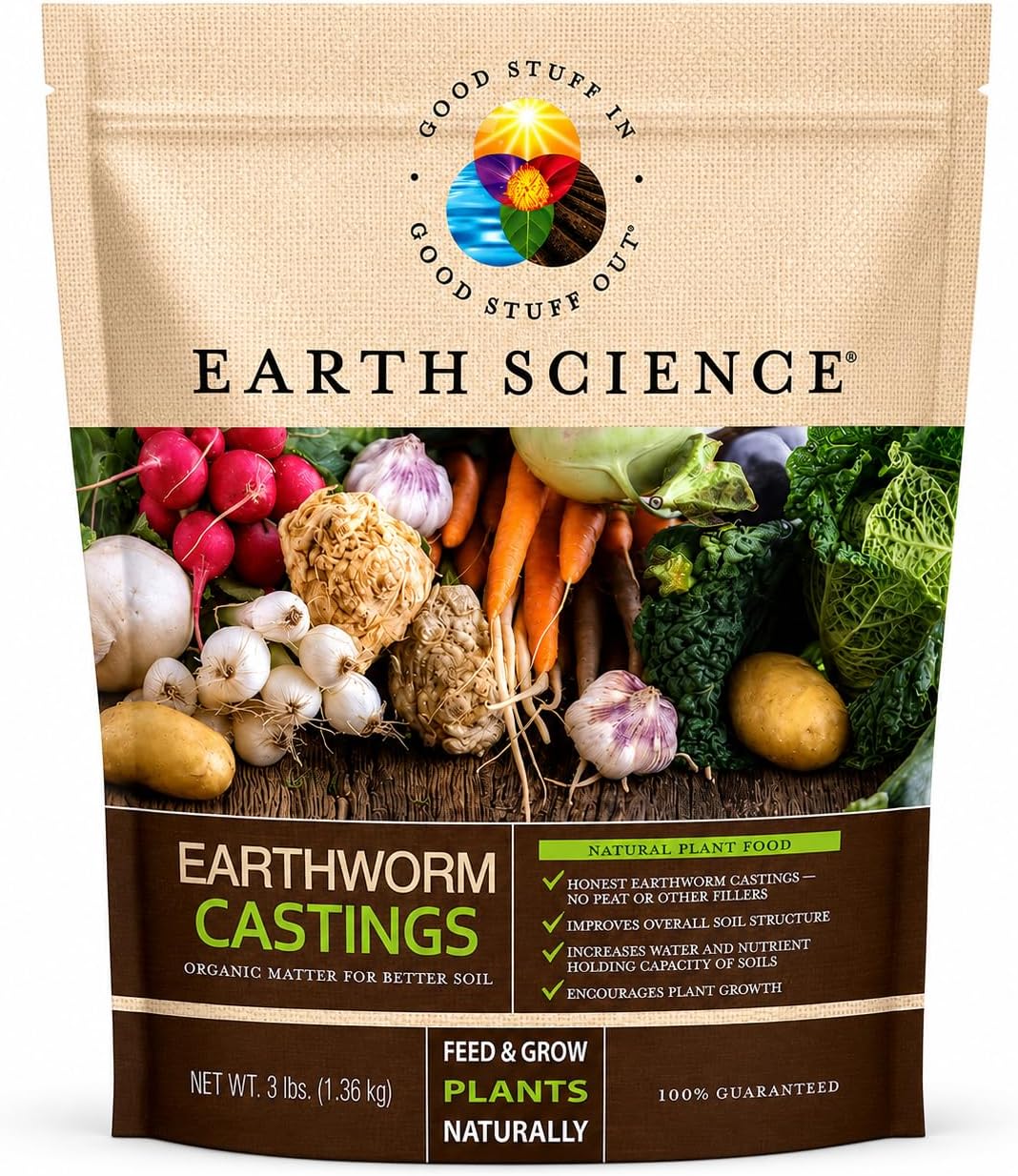
Earth Science Premium Earthworm Castings, 3 lb
| Item Form | Granules |
|---|---|
| Specific Uses For Product | Organic,Plant Food,Plant Growth |
| Coverage | Medium |
| Target Species | gardens, flower beds, fruits, trees, shrubs |
| Mixing Ratio | 1:4 |
Earth Science Premium Earthworm Castings are a pure vermicompost product intended to enrich garden and potting soils. Gardeners typically use it as a top dressing, mixed into potting mixes at about 1:4 castings to soil, or incorporated into garden beds at 1/4 to 1/2 inch and watered in; it can also be brewed as compost tea. The castings add organic matter that helps soil retain moisture, supports beneficial microbes, and can reduce compaction by improving aggregation. Practical benefits include a straightforward application for vegetables, flower beds, trees, and shrubs and the flexibility to use in pots, compost piles, or on lawns. The product is free of fillers and presented as a slow-release, natural fertilizer rather than a quick synthetic boost, so expect gradual improvements over weeks to months rather than immediate greening. Because this is a small, concentrated pouch, frequent reapplication during the growing season is recommended for larger beds or heavy-feeding crops.
Best for: Gardeners who prioritize dependable, natural soil improvement for organic vegetable beds and potted edibles and prefer steady, biology-driven results over quick chemical fixes.
Less Ideal for: Growers who need rapid, high-N fertilizer responses for a single fast-growing crop or who require large-volume amendments for extensive beds without frequent reapplication.
- 100% vermicompost with no peat or fillers
- Versatile uses: top dressing, potting mix amendment, compost tea, and compost layering
- Improves soil structure and water retention while feeding beneficial microbes
- Slow-acting nutrient release not suited for immediate greening or fast corrective feeding
Verdict: Use this pure earthworm castings product when you want a reliable, natural soil conditioner that builds long-term fertility for an organic vegetable garden.
Back to the Roots Organic Indoor Potting Mix, 6 Quart

| Unit Count | 192 Fluid Ounces |
|---|---|
| Item Type Name | Indoor Potting Mix 6qt |
| Item Highlight | Peat-free, 100% organic, made in the USA |
| Ingredients | Coconut Coir, Yucca, Mycorrhizae, Perlite, Horticultural Sand |
This Back to the Roots indoor potting mix is a ready-to-use, 6-quart blend designed for common houseplants such as pothos, monstera and ferns. It combines coconut coir, yucca extract, mycorrhizae, perlite and horticultural sand to improve moisture retention, drainage and root development without peat. In practice it feels light and friable, so it is easy to pot seedlings or repot mature plants and it reduces compaction that can suffocate roots. The added mycorrhizae helps young roots establish and take up nutrients more efficiently while yucca extract helps the mix hold water between waterings, which is convenient for forgetful or busy plant owners. Because it is peat-free and made in the USA, it is a more sustainable choice versus traditional peat-based mixes. Limitations are the small 6-quart size, which means frequent repurchasing for larger collections, and the bag does not include fertilizer so you will need to feed plants separately as they grow.
Best for: Buyers who prioritize low-risk, easy-care houseplant solutions and want an organic, ready-to-use potting mix that reduces watering hassles and supports healthy root growth.
Less Ideal for: Not ideal for gardeners who need large-volume soil for many pots or for those expecting a mix that includes built-in fertilizer for long-term feeding.
- Peat-free organic formula that reduces environmental impact
- Yucca extract improves moisture retention between waterings
- Contains mycorrhizae to support root development and nutrient uptake
- Light, well-draining texture suitable for repotting seedlings and houseplants
- Small 6-quart volume may require frequent repurchasing for larger plant collections
- Does not include fertilizer so additional feeding is necessary
Verdict: A compact, peat-free potting mix that simplifies indoor plant care by holding moisture and boosting root establishment.
Choosing the Right Humus Rich Soil: Key Factors to Consider
Organic Matter Percentage and Humus Quality
The percentage of organic matter and the quality of the humus determine how well a soil holds water and nutrients over time. Higher stable organic matter increases cation exchange capacity, which means nutrients remain available to roots rather than leaching away. Humus also improves aggregation, reducing crusting on the surface and encouraging earthworm activity.
Not all organic matter is equal. Fresh green waste or uncomposted yard debris provides short-term bulk but little humus benefit until it decomposes fully. Well-aged compost and decomposed leaf mold deliver more immediate humus benefits because the material is already stabilized and contributes to long-term soil structure.
Particle Size, Texture, and Drainage
Texture affects aeration, root penetration, and drainage. A humus rich soil that is too fine can compact and suffocate roots, while one that is too coarse may drain too quickly and fail to retain moisture. Balanced particle sizes provide both pore space for air and water-holding sites for plant use.
For containers, a slightly lighter texture with added coarse components can prevent waterlogging. For in-ground beds, finer particles are acceptable if paired with good humus levels to maintain structure and resist compaction under foot traffic.
Nutrient Profile and Release Pattern
Humus contributes to nutrient retention but does not always supply all required plant nutrients in the right proportions. Look for soils where the nutrient profile is based on stable organic inputs rather than a single-source amendment. Slow, steady release reduces the risk of nutrient burn in young roots and supports consistent growth through the season.
Consider whether the soil is intended as a planting medium or a topdress amendment. Planting mixes should have a balanced nutrient baseline, while topdress materials can focus more on organic matter and microbial support since the bed already holds baseline fertility.
Biological Activity and Soil Life
A living soil ecosystem improves nutrient cycling, disease suppression, and root growth. Soils with active microbial populations, earthworm activity, or mycorrhizal-friendly structure can give plants a measurable advantage. Biological activity also speeds the breakdown of organic residues into plant-available forms.
Be cautious with sterilized or heavily heat-treated products if your goal is to boost soil life. Those can be useful in pathogen-prone situations but will require reintroduction of beneficial organisms to restore a healthy ecosystem.
pH, Salt Levels, and Suitability for Plants
pH affects nutrient availability. Humus typically buffers pH swings, but initial soil pH and any added amendments determine whether the medium suits acid-loving or alkaline-preferring plants. Low salt levels are important, especially for seedlings and salt-sensitive crops.
Check product information for salt content or soluble salts warnings. High soluble salts can inhibit seed germination and stress young roots, so products intended for seed starting and sensitive plants should have verified low salt ratings.
Source Materials and Environmental Impact
Knowing what feedstocks were used to make a humus rich soil helps predict long-term behavior. Leaf mold, well-matured compost, and stable forest humus are generally desirable. Materials like uncomposted wood chips or fresh manures can create nitrogen draws or imbalances until fully decomposed.
Consider how the product was produced and packaged. Locally sourced, well-composted materials reduce transport footprint and often arrive more biologically active. Also weigh whether the soil contains recycled green waste that has been fully stabilized to avoid introducing pathogens or weed seeds.
Using Humus Rich Soil in Containers Versus In-Ground Beds
Container plantings and in-ground beds place different demands on humus rich soils. Containers require a mix that holds moisture and nutrients without becoming waterlogged; that usually means adding coarse drainage material or selecting a humus mix with open texture. In-ground applications can tolerate finer particles because the surrounding native soil helps with drainage and structure.
When moving humus rich soil into containers, consider blending with a coarser component for heavy feeders or plants in warm climates. For raised beds and vegetable patches, apply humus rich soil as a top layer or mix it into the top 6 to 12 inches to improve structure and fertility over the long term.
- Containers: prioritize aeration and steady moisture retention
- In-ground beds: focus on incorporation depth and long-term aggregation
- Topdressing: use humus rich material to rebuild surface structure
How to Incorporate Humus Into Existing Soil
Adding humus rich soil to an existing bed is most effective when you work it into the topsoil rather than burying it. Lightly fork or double-dig the top 6 to 12 inches and mix the humus evenly to avoid layering that could create a barrier to roots. For established lawns, a thin topdressing applied annually helps improve surface structure without disturbing established roots.
In heavy clay soils, gradually increase the proportion of humus over multiple seasons to avoid creating a perched water table. Mixing organic amendments with mineral matter and encouraging deep-rooted cover crops will help distribute benefits through the profile.
- Mix humus into top 6 to 12 inches for best root access
- Use thin annual topdressing for lawns and ornamental beds
- Improve clay soils gradually to avoid layering issues
Timing Applications Around Planting and Season
Apply humus rich soil during bed preparation in fall or early spring to give biological processes time to stabilize before heavy plant growth. Fall applications allow winter soil organisms to integrate organic matter and improve structure for spring planting. Spring additions are useful if you need an immediate boost but allow a few weeks for settling before planting sensitive seedlings.
For established perennials and shrubs, topdress with humus in late winter or early spring to supply slow-release nutrients and improve moisture buffering for the growing season.
- Fall: best for deep integration and seasonal microbial activity
- Early spring: useful for quick improvement before planting
- Late winter topdress: supports spring growth in established plantings
Seed Starting and Transplant Mix Considerations
Seed starting benefits from a light, well-aerated humus amended medium with low soluble salts. While high-humus mixes support moisture retention, they should be paired with fine aeration components to prevent damping-off. For transplanting seedlings into permanent soil, choose a humus rich mix that supports root spread without excessive nutrient spikes that can burn young roots.
When preparing a transplant hole in an established bed, work humus into the surrounding soil rather than filling the hole solely with rich material; this prevents the new root zone from sitting in a pocket that differs radically from the native soil.
- Seed starting: low salts, light texture, good aeration
- Transplants: blend humus with native soil for gradual transition
- Avoid raw manures or uncomposted feeds in seed mixes
Maintaining Soil Health After Application
Humus is not a one-time fix. Maintain soil health with regular organic additions, cover cropping, and minimal disturbance to preserve aggregation. Mulching helps retain the moisture benefits provided by humus and reduces erosion of the top layer.
Monitor soil pH and nutrient levels periodically, and adjust with lime or sulfur only when necessary. Encourage soil life by avoiding excessive fungicide or broad-spectrum biocide use that can knock back beneficial populations.
- Top up with small annual applications of humus-rich material
- Use mulches and cover crops to protect and build structure
- Test pH and adjust amendments conservatively
How We Chose the Best Humus Rich Soil
We selected humus rich soils using criteria that reflect how these products perform in real gardens. First, organic matter content and humus quality were weighted heavily because higher stable organic matter improves water holding, cation exchange capacity, and long-term nutrient buffering. Second, texture and drainage were evaluated so mixes suit both containers and in-ground beds without becoming compacted or waterlogged. Third, nutrient stability and slow-release nutrient availability were considered to favor soils that support steady growth rather than rapid short-lived flushes. Fourth, biological activity and the presence of beneficial microbes or mycorrhizal-friendly structure were used to judge how well the soil supports root development and disease suppression. We excluded mixes that are primarily inert substrates or that rely solely on synthetic granules for nutrition. Products were filtered out if they lacked clear labeling on organic matter percentage or if particle sizing would likely cause compaction. The final shortlist balances humus content, physical structure, nutrient dynamics, and biological support to reflect everyday gardener needs.
FAQ
Can I use humus rich soil straight from the bag for seedlings?
Often humus rich soils are beneficial for seedlings, but check for low soluble salts and a light texture. If the mix is heavy, blend in perlite or coarse sand for aeration and to reduce damping-off risk.
How much humus rich soil should I mix into my raised bed?
A good guideline is to incorporate humus material into the top 6 to 12 inches of the bed at rates of roughly 10 to 30 percent by volume, depending on initial soil condition. Very degraded soils may need larger proportions applied over multiple seasons.
Will humus rich soil change my garden pH?
Humus typically buffers pH and rarely causes drastic shifts on its own. However, the feedstocks used and any added amendments can affect pH, so test the soil if you grow pH-sensitive plants and adjust only if needed.
Is humus rich soil suitable for all plant types?
Humus benefits most plants by improving structure and nutrient retention, but acid-loving or calciphile species may require specific pH adjustments. Also, bulbs and drought-tolerant plants that prefer lean soils may need a lighter, lower-organic mix.
How often should I replenish humus in vegetable beds?
Annual light topdressing in early spring or fall works well for vegetable beds, with heavier incorporations every two to three years as needed. Continuous additions support soil life and steady fertility for successive crops.
Final Verdict
Prioritize humus content, texture, and biological activity when choosing a humus rich soil. Think about how you will use the material: containers need lighter mixes with good drainage, while in-ground beds benefit from deeper incorporation and gradual building of organic matter. Balance nutrient stability and low salt levels for seedlings and sensitive plants. Decide based on the primary constraint you face-improving structure, boosting water retention, or increasing biological life-and choose a humus rich soil that aligns with that goal. With the right tradeoffs considered, you can confidently pick a soil that improves plant establishment and long-term garden health.
