

Note: This article contains affiliate links. If you click on these links and make a purchase, I may earn a small commission at no extra cost to you. This helps support my research and content. Read my full affiliate disclosure here.
If you shape or maintain boxwoods, the right pruning shears make the work quicker and healthier for the plants. Boxwoods need clean, precise cuts to heal well and keep the dense rounded forms many gardeners want. The tools shortlisted here are chosen for their ability to make smooth cuts in small stems, reduce wrist and hand strain during repetitive shaping, and hold a sharp edge through frequent use. This guide covers five top options that suit regular shaping, corrective pruning, and seasonal maintenance. Below we explain the criteria used to evaluate each tool and what to watch for when you pick shears suited to boxwood care.
Top Picks at a Glance
| Best Overall The best all-around choice for most situations | FELCO F2 Pruning Shears — Swiss-Made Bypass Hand Pruner (F2) |  |
| Best Value The sweet spot between price and what you get | Haus & Garten ClassicPRO 8.5" Titanium-Coated Bypass Pruning Shears |  |
| Best Budget The cheapest option that still gets the job done reliably | Craft911 2-Pack Stainless Steel Pruning Shears and Snips |  |
| Highest Rated A top-rated pick with lots of positive feedback | BYANE 8.5" Bypass Pruning Shears with SK5 Titanium-Coated Blade |  |
| Best Seller A high-volume bestseller chosen again and again | Fiskars Bypass Pruning Shears with Nonstick Coating |  |
FELCO F2 Pruning Shears — Swiss-Made Bypass Hand Pruner (F2)

| Blade Length | 2 inches |
|---|---|
| Cutting width | 1 inches |
| Hand Orientation | Right |
| Blade Material | Metal,Steel |
| Handle Material | Metal,Rubber,Steel |
The FELCO F2 is a heavy-duty, precision pruning shear designed for regular use by serious gardeners and professionals. It delivers clean cuts up to about 1 inch thanks to a hardened steel cutting blade and anvil/bypass-style geometry that reduces crushing and promotes plant health. Forged aluminum handles keep the tool lightweight while providing strong, long-lasting support and a rubberized grip that helps reduce hand fatigue during extended sessions. Every part is replaceable which makes the F2 a tool you can service for years rather than replace. Practical benefits include very reliable cutting performance, comfortable ergonomics for right-handed users, and the ability to maintain sharpness and replace worn parts. The main limitations are that it is offered in a large size and right-hand orientation only, so it will not suit left-handed users or gardeners who need a smaller pruner for fine detail work.
Best for: Gardeners and landscapers who prioritize durable, professional cutting performance and want a serviceable tool they can rely on for frequent pruning.
Less Ideal for: Casual gardeners who need a budget or ambidextrous pruner or anyone who requires a small-size tool for fine trimming and delicate work.
- Hardened carbon steel blade produces clean, precise cuts up to 1 inch
- Forged aluminum handles offer strength with a lightweight feel
- Rubberized ergonomic grip reduces hand and wrist strain during long sessions
- All parts are replaceable so the tool can be maintained for decades
- Right-hand orientation and large size limit suitability for left-handed or small-handed users
- No blade coating or locking thumb catch on this model
Verdict: Buy the FELCO F2 if you want a professional, serviceable pruning shear that delivers precise, long-lasting cutting performance.
Haus & Garten ClassicPRO 8.5" Titanium-Coated Bypass Pruning Shears

| Blade Material | High Carbon Steel + Titanium Coating |
|---|---|
| Blade Type | Bypass |
| Hand Orientation | Ambidextrous |
| Cutting width | 1 inches |
| Handle Material | Aluminum |
The Haus & Garten ClassicPRO shears are built for frequent, performance-driven pruning. They use high-carbon steel blades with a titanium coating to stay sharp longer and resist corrosion, while the anodized forged-aluminum handles keep the tool lightweight for extended use. These bypass pruners are ambidextrous and cut up to about 1 inch, making them suitable for pruning woody stems, roses, and small branches. The ergonomic shape, non-slip grips, and shock-absorbing pads reduce hand fatigue during long sessions, and features like a replaceable blade and spring simplify maintenance. Expect clean, scissor-like cuts that help plants heal well when used correctly. Limitations: they are medium-large sized so users with very small hands may find the grip bulky, and the cutting capacity tops out at about 1 inch so larger limbs require loppers. Overall the ClassicPRO focuses on durability and precise cutting for gardeners who prioritize reliable, repeatable performance over ultra-compact or heavy-duty branch cutting.
Best for: Gardeners and landscape-minded users who want a durable, precise hand pruner for frequent pruning of shrubs, roses, and small branches and who prioritize clean cuts and long-term tool life.
Less Ideal for: People who need a compact pruner for very small hands or those who primarily cut thick limbs above 1 inch should choose a smaller snip or lopper instead.
- Titanium-coated high-carbon steel blade for longer edge retention and rust resistance
- Ergonomic anodized aluminum handle with non-slip grips and shock pads to reduce hand fatigue
- Ambidextrous bypass design produces clean cuts that promote plant health
- Replaceable blade and spring extend the tool’s service life
- Lightweight construction suited for extended pruning sessions
- Cutting capacity limited to about 1 inch so not suitable for larger branches
- Handle size is medium-large and may feel bulky for very small hands
Verdict: A durable, professional-grade bypass pruner that delivers sharp, rust-resistant cuts and built-in comfort for gardeners who prune often.
Craft911 2-Pack Stainless Steel Pruning Shears and Snips

| Blade Material | Stainless Steel |
|---|---|
| Blade Edge | Serrated, Straight |
| Blade Type | Bypass |
| Hand Orientation | Ambidextrous |
This Craft911 two-pack pairs a full-size bypass pruning shear with a smaller pruning snip so you can handle both thicker stems and delicate rose work with one set. The blades are stainless steel, with the snip carrying a titanium coating for extra edge life, and both tools lock closed for safe storage. They are ambidextrous and have non-slip, comfortable handles that reduce hand fatigue during longer sessions, which is useful when deadheading or shaping roses. The bypass blade and serrated options give clean cuts that help protect plant tissue and reduce tearing. Because the materials are rust resistant and the tools are easy to clean, they require minimal maintenance between uses. On the downside the handles are listed as plastic or metal without a specific ergonomic mechanism for heavy-duty leverage, so they are best for routine rose pruning and lighter branches rather than very thick woody canes. For gardeners who prefer straightforward, low-maintenance tools this combo covers most rose-care tasks effectively.
Best for: Gardeners who want dependable, low-maintenance tools for routine rose pruning, deadheading, and shaping and who prefer safe, easy-to-use gear.
Less Ideal for: Those who regularly cut very large or old woody rose canes and need heavy-duty loppers or pruners with superior leverage and anvil-style cutting.
- Includes both full-size bypass shears and a precision snip for versatile rose care
- Stainless steel blades with a titanium-coated snip edge for lasting sharpness
- Ambidextrous design and non-slip handles that reduce hand fatigue
- Built-in safety locks keep blades closed for safe storage and transport
- Handles are basic plastic or metal without advanced leverage for very thick canes
- Not intended for heavy woody pruning of large rose canes
Verdict: A safe, low-maintenance pruning combo that handles most rose grooming tasks well with sharp stainless blades and easy-to-use locks.
BYANE 8.5" Bypass Pruning Shears with SK5 Titanium-Coated Blade

| Blade Type | Bypass |
|---|---|
| Blade Material | SK5 high-carbon steel, titanium-coated |
| Hand Orientation | Ambidextrous |
| Included Components | Spare spring and safety lock |
These BYANE 8.5-inch bypass pruning shears are built for regular garden work where clean cuts and low hand effort matter. The SK5 high-carbon blade is nano-polished and finished with a three-layer titanium coat to resist corrosion and slice through live stems; the bypass action favors precise cuts on roses, herbs, and light branches. An optimized lever-assist mechanism multiplies user force so you can tackle stems up to about 3/4 inch without excessive hand strain, and the included spare spring and one-handed safety lock simplify upkeep and storage. Handles are anodized aluminum with rubber cushioning that gives a secure, comfortable grip and supports both left- and right-handed use. Practical limitations are its intended cutting capacity — very hard or thick wood will exceed its 3/4-inch guideline — and the compact size may not be the best choice for heavy woody pruning. For routine trimming, deadheading, harvesting, and bonsai shaping these shears deliver dependable performance and easy maintenance.
Best for: Gardeners who prioritize consistent, low-effort cutting for routine tasks like deadheading, herb and vegetable harvesting, and shaping shrubs or bonsai, and who want a tool that stays reliable with basic maintenance.
Less Ideal for: Landscapers or homeowners needing a shear for heavy woody pruning or larger branches should choose a larger anvil or lopper instead.
- Durable SK5 high-carbon steel blade with three-layer titanium coating for smooth cuts and improved corrosion resistance
- Lever-assisted mechanism reduces hand effort when cutting stems up to 3/4 inch
- Ambidextrous, cushioned non-slip grips on lightweight aluminum handles for comfortable repeated use
- Includes spare spring and one-handed safety lock for easier maintenance and safe storage
- Not intended for heavy woody branches or large-diameter pruning beyond the stated 3/4-inch capacity
Verdict: If you want a reliable, low-effort hand pruner for everyday trimming and precise cuts on flowers, herbs, and small branches, these shears are a solid choice.
Fiskars Bypass Pruning Shears with Nonstick Coating
| Cutting width | 0.63 inches |
|---|---|
| Blade Edge | Serrated |
| Blade Material | Alloy Steel |
| Hand Orientation | Ambidextrous |
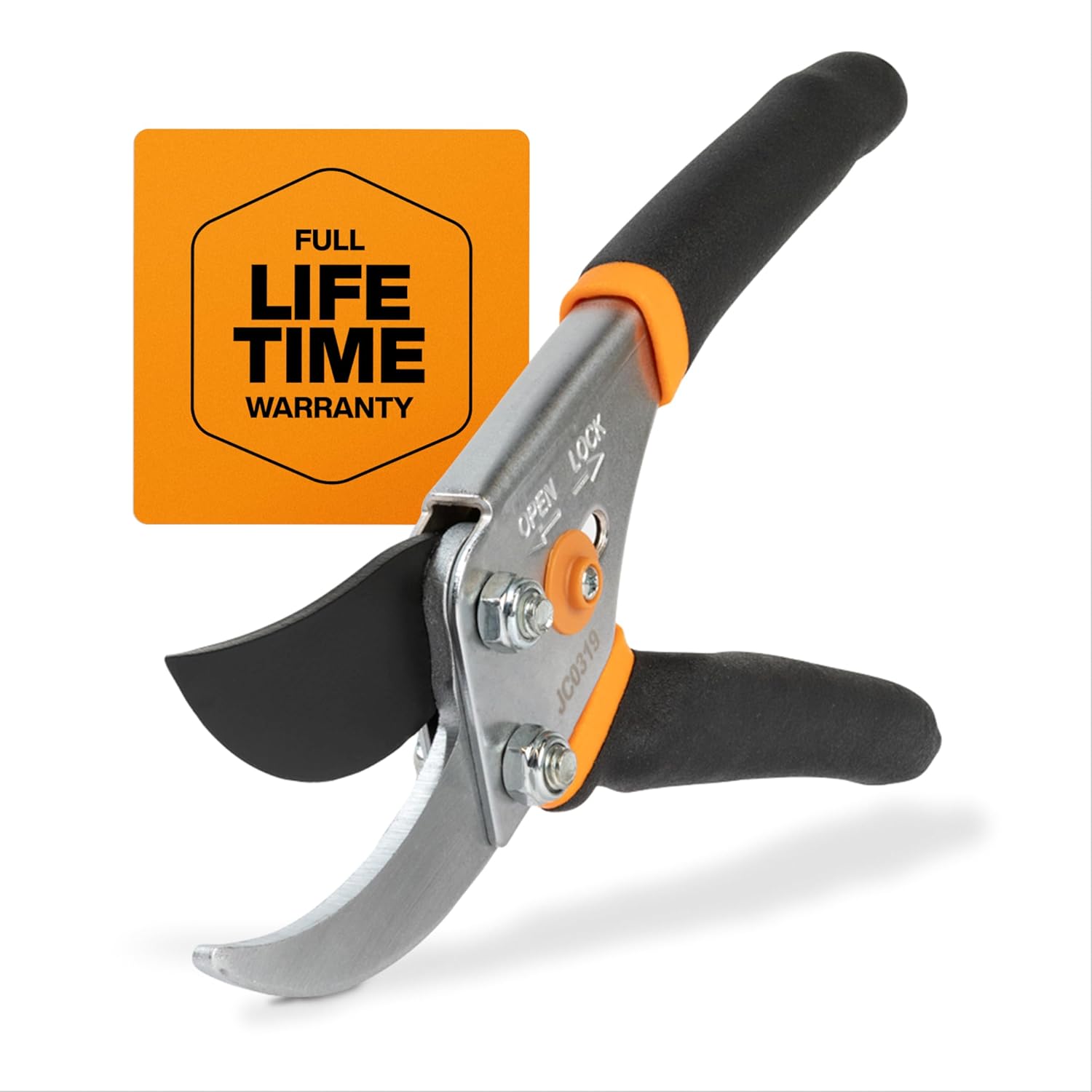
These Fiskars bypass pruning shears are a straightforward, reliable tool for everyday garden pruning. They use a bypass cutting action with precision-ground alloy steel blades and a low-friction coating so stems and green growth are sheared cleanly without crushing, which is helpful for flowers, shrubs, and small woody shoots up to about 5/8 inch. The pruners include a sap groove and nonstick finish to reduce sticking and rust, and an ergonomic non-slip handle that makes repeated trimming more comfortable. Because they are all-steel construction they feel solid and hold an edge through routine use, and the safety lock keeps the blades closed for storage. The main limitations are the modest cutting capacity, which is not suited for thick branches, and the simpler design lacks compound leverage for heavy cutting, so they work best for regular maintenance rather than heavy-duty pruning. For gardeners who want a durable, easy-to-maintain daily pruner, these are a dependable choice.
Best for: Home gardeners who want a dependable, low-maintenance pruner for routine trimming, deadheading, and shaping of flowers and small shrubs and who value proven, widely used tools.
Less Ideal for: People who need a pruner for larger woody branches or frequent heavy-duty cutting should choose a lopper or powered/pruning tool instead.
- Bypass blades and precision-ground steel deliver clean cuts on live stems
- Low-friction blade coating and sap groove reduce sticking and resist rust
- Ergonomic non-slip handle improves control and reduces hand fatigue
- All-steel construction offers durable, long-lasting performance
- Cut capacity limited to about 5/8 inch so not suitable for thicker branches
- No compound leverage mechanism, making heavy or woody cuts harder
Verdict: A tough, no-nonsense pruner that provides clean cuts and low-maintenance blades for everyday garden grooming.
Choosing the Right Pruning Shears for Boxwoods: Key Factors to Consider
Blade Sharpness and Edge Geometry
Boxwoods respond best to clean, even cuts because ragged wounds or crushed tissue increase the risk of disease and slow healing. Look for blades with a fine edge and a slicing geometry rather than a blunt anvil-style contact. A sharp bevel and consistent factory grind make the first cuts noticeably smoother. Over time the blade will dull, so the initial edge geometry should be one that is straightforward to resharpen with common sharpening stones or a diamond hone.
Edge geometry also affects how the shears slice through those small, often twiggy stems typical of boxwoods. A narrower bevel angle slices more cleanly but may require more frequent touch-ups. Consider how often you will prune and whether you are comfortable maintaining a finer edge.
Ergonomic Comfort and Handle Design
Boxwoods are usually clipped in repeated short sessions, so handle shape and grip material matter for reducing hand and wrist fatigue. Ergonomic handles that follow the natural curve of your hand, plus a comfortable grip material, distribute pressure more evenly and minimize hotspots. Look for shears with spring action that returns the blades gently; a too-strong spring increases strain when using the tool for extended shaping.
Also consider handle length and clearance. If you wear gloves, make sure the handles leave enough room for a secure grip without forcing your hand into an awkward position. Some designs include shock-absorbing bumps or soft inserts to reduce jarring when cutting thicker stems.
Cutting Capacity and Jaw Fit
Boxwood stems are usually small to medium in diameter, but occasional thicker shoots do appear. Choose shears with a cutting capacity that covers the typical range you encounter, often up to about 3/4 inch for heavier growth, while maintaining precise blade alignment for small diameters. Jaw fit and blade overlap determine whether the cut slices cleanly or leaves a split end.
Well-matched jaws hold the stem steady and center it along the blade edge. If the jaw geometry is poorly matched, the cut can slip or compress the stem instead of slicing, which is especially harmful on dense boxwood branches where airflow and wound sealing are important.
Corrosion Resistance and Material Choices
Boxwoods grow in many climates and often in humid conditions where metal tools will face moisture exposure. Stainless steels or blades with effective rust-resistant treatments extend the life of the tool and keep edges performing consistently. Pay attention to coatings and the overall finish; a quality finish prevents pitting and reduces the need for frequent replacement.
Beyond blades, pivot bolts, springs, and fasteners should also be corrosion-resistant. A single rusty pivot can seize a pair of shears, so full-tool resistance is more valuable than blade-only protection.
Maintenance, Sharpening, and Serviceability
Regular maintenance keeps shears cutting well and prevents accidental damage to boxwoods. Simple, serviceable designs with accessible pivot nuts, replaceable springs, and blades that detach easily make cleaning, sharpening, and part replacement straightforward. Avoid sealed or permanently bonded assemblies that hide the pivot or prevent proper degreasing.
Also consider how easy the blade is to sharpen at home. Blades with complex serrations or unusual profiles can be difficult to recondition without specialized tools. Models that accept common sharpening stones or files make it simpler to maintain a razor edge between seasonal professional services.
When to Use Hand Shears Versus Small Pruners
Hand shears and small pruners overlap in function but have different strengths for boxwood work. Use hand shears when you need to shape large areas of formal hedging quickly; their longer blades create uniform lines with fewer cuts. Small pruners are better for targeted snips, detail shaping, and removing individual reisdual shoots.
Think about the typical task in your garden. If you often do light trimming and shaping across broad contours, a comfortable pair of hand shears reduces the number of cuts needed. For precision topiary points or close-in cleanup, a compact pruner keeps cuts controlled and reduces accidental over-trimming.
- Hand shears: faster for long straight or rounded cuts
- Small pruners: better for precise cuts and thicker single stems
- Mixing both tool types often gives the best control for shaped boxwoods
Sharpening Routine That Protects Boxwood Health
A short sharpening routine before the main pruning season keeps shears slicing cleanly. Remove sap and residue, check the pivot, and hone the blade edge with a fine stone until it slices a piece of paper cleanly. A quick stropping pass can polish the edge and reduce microscopic burrs that cause crushing.
Regular light maintenance means you do not need aggressive reshaping later, which risks removing too much metal and changing the blade geometry. Keep sharpening stones and a small file in your garden shed so touch-ups are quick between pruning sessions.
- Clean blades with household solvent or soapy water before sharpening
- Hone at the original bevel angle for best results
- Lubricate the pivot after cleaning to maintain smooth opening and closing
Glove Choices and Cutting Technique
Gloves protect your hands but also change how you feel the tool. Thin leather or nitrile-coated gloves offer tactile feedback while guarding against minor scratches. Bulkier gloves can reduce precision; if you need thick protection, practice a few trimming strokes to find a comfortable grip.
Technique matters as much as the tool. Hold the shears so the blade passes cleanly across the stem, and make decisive cuts instead of sawing motions. For shaping, step back periodically to check overall form rather than relying on close-up detail alone.
- Use thinner gloves for shaping sessions to preserve dexterity
- Make single, decisive cuts to minimize tissue damage
- Step back frequently to assess symmetry and avoid over-pruning
Storing Shears to Prevent Rust and Damage
After every use, wipe blades clean of sap and moisture before storing. A light film of oil on the blades and pivot protects against humidity and airborne salts. Store shears in a dry, ventilated place rather than a damp shed corner where condensation forms.
Consider a simple blade cover or a hanging pegboard spot to keep blades from rubbing against other tools. Preventing nicks and dents is easier than repairing them, and a well-stored pair of shears will hold its edge much longer.
- Wipe blades dry and apply light oil before storage
- Keep shears away from direct soil contact or damp surfaces
- Use a blade sheath or dedicated hanging hook to avoid incidental damage
Sustainable Disposal and Parts Replacement
High-quality shears are repairable, which is more sustainable than full replacement. Look for tools with replaceable blades, springs, and pivot hardware so you can extend the life of a favorite pair. When parts are no longer available, recycle metal components if local services accept small tools.
If you do replace tools, choose durable materials and maintain them to maximize longevity. Regular maintenance reduces the frequency of disposal and helps avoid unnecessary waste.
- Prefer repairable designs with replaceable parts
- Keep spare parts like springs and pivot nuts on hand if you prune frequently
- Recycle metal components responsibly when disposal is necessary
How We Chose the Best Pruning Shears for Boxwoods
We focused on the attributes that matter when trimming boxwoods: blade sharpness and edge retention to ensure clean, non-crushing cuts; ergonomic design and handle shape to reduce hand and wrist fatigue during repetitive shaping; cutting capacity and jaw geometry so shears can handle typical boxwood branch diameters without forcing or tearing; corrosion resistance and material quality because boxwoods often grow in moist environments and tools must stay reliable; and maintenance ease, meaning blades that are simple to sharpen and pivot points that are easy to clean and lubricate. Products were excluded if they were designed only for heavy woody pruning, because the list targets shears optimized for frequent, precise shaping rather than large limb removal. We also excluded models lacking corrosion protection or those without any ergonomic consideration, since repeated boxwood clipping amplifies fatigue issues. In short, shortlisted shears scored well on cutting cleanliness, user comfort, appropriate cutting range for boxwood stems, rust resistance, and straightforward upkeep. These evaluation dimensions map directly to the scoring labels used in our product scorecards.
FAQ
What blade style is best for boxwood shaping?
Bypass-style blades are usually best because they produce clean slicing cuts ideal for boxwood stems. Anvil blades can crush softer stems and are less suited to delicate shaping.
How often should I sharpen shears used on boxwoods?
Frequency depends on use, but many gardeners find a light hone before major shaping seasons and touch-ups during long sessions keeps performance consistent. Heavy daily use may require more frequent sharpening.
Are coated blades worth it for humid climates?
Corrosion-resistant coatings or stainless steel blades help prevent rust in humid conditions. Coatings can wear over time, so also focus on good cleaning and oiling habits to preserve blade life.
Can I use bypass pruners for all boxwood work?
Bypass pruners handle most boxwood tasks, especially fine shaping. For occasional thicker growth, a larger pruning tool may be needed, but bypass pruners cover daily shaping and small corrective cuts.
Should I choose lighter or heavier shears for extended shaping sessions?
Lighter shears reduce fatigue during long shaping sessions, but they must still feel sturdy and have a reliable cutting action. Balance weight with ergonomics rather than choosing the lightest tool by default.
Final Verdict
Prioritize clean-cutting blades and comfortable ergonomics when choosing pruning shears for boxwoods. The right edge geometry, paired with corrosion resistance and a serviceable pivot, keeps cuts healthy and tools dependable for seasons of shaping. Balance cutting capacity with lightweight handling and plan a maintenance routine that includes regular honing and lubrication. With those priorities, you can select shears that deliver precise results and long service.
