

Note: This article contains affiliate links. If you click on these links and make a purchase, I may earn a small commission at no extra cost to you. This helps support my research and content. Read my full affiliate disclosure here.
A plastic raised garden bed can simplify planting, reduce weeding, and extend your growing season without heavy construction. For small-space vegetable gardening, the right plastic bed keeps soil contained, warms faster in spring, and resists rot and insect damage compared with some organic materials. This guide focuses on the top shortlisted options for durable, low-maintenance plastic raised beds. We evaluated each on structural strength, water management, and ease of use so you can pick the best fit for your yard, balcony, or community plot. Read on to see what mattered in our selection and find the features that match your planting goals.
Top Picks at a Glance
| Best Overall The best all-around choice for most situations | LIFETIME 4 x 4 ft Raised Garden Bed Kit (3-Pack) |  |
| Best Quality Built to a higher standard if you want something more solid | Kdgarden 4'x4' Vinyl Raised Garden Bed Kit with Grow Grid |  |
| Best Value The sweet spot between price and what you get | EFU Raised Garden Bed with Wheels and Lower Storage Shelf |  |
| Best Budget The cheapest option that still gets the job done reliably | Tigerden 4.3 × 3 × 1 ft Plastic Raised Garden Bed Kit |  |
| Highest Rated A top-rated pick with lots of positive feedback | Megawodar 4-Piece Self-Watering Elevated Raised Garden Bed |  |
| Most Popular A crowd favorite that many people choose with confidence | Keter Urban Bloomer 12.7 Gallon Elevated Raised Garden Bed |  |
LIFETIME 4 x 4 ft Raised Garden Bed Kit (3-Pack)

| Material Type | Polyethylene (PE) |
|---|---|
| Capacity | 30.93 cubic feet |
| Unit Count | 3 Count |
| Indoor Outdoor Usage | Outdoor |
The LIFETIME 4 x 4 ft Raised Garden Bed Kit is a durable plastic bed system meant to give you a tidy, low-maintenance planting area quickly. Each kit includes three interlocking 4 x 4 boxes with 9 inch walls that assemble without tools, so installation is straightforward for weekend DIYers and first-time raised-bed gardeners. The HDPE panels are UV protected and simulated wood textured to resist rot, cracking, and peeling, which makes them suitable for season-to-season outdoor exposure. You can use single boxes for shallow-rooted vegetables and flowers or stack beds to increase depth for root crops. Practical benefits include minimal upkeep compared with wood, easy repositioning, and the included tools and instructions to speed setup. The main limitations are the relatively shallow single-wall depth for deep-rooted plants unless stacked and the plastic aesthetic that will not age like natural wood, which may matter if you prefer a traditional look. Still, this kit delivers quick assembly and weather resistance for most home vegetable and flower gardens.
Best for: Gardeners who want a low-maintenance, easy-to-assemble raised bed that performs reliably season after season and who value convenience over a traditional wood aesthetic.
Less Ideal for: Buyers seeking a decorative, natural-wood look or those who need deep beds for large root crops without stacking multiple units.
- Tool-free interlocking assembly for fast, straightforward setup
- UV-protected high-density polyethylene resists rot, cracking, and fading
- Modular design allows stacking to increase planting depth
- Includes tools and instruction manual for easier installation
- Single-wall height is shallow for deep-rooted vegetables unless beds are stacked
- Plastic appearance may not suit gardens seeking a natural wood look
Verdict: Choose this kit if you want a weather-resistant, easy-to-assemble plastic raised bed that gets a vegetable or flower garden established quickly.
Kdgarden 4'x4' Vinyl Raised Garden Bed Kit with Grow Grid

| Material Type | Vinyl |
|---|---|
| Capacity | 8 cubic feet |
| Included Components | Instruction manual, Tools |
| Indoor Outdoor Usage | Outdoor |
This Kdgarden 4'x4' vinyl raised garden bed kit is a sturdy, low-maintenance container for growing vegetables, herbs, and flowers in a compact footprint. Made from high-grade vinyl, the box is built to resist yellowing, fading, rot, and UV exposure so it can sit outdoors year-round with minimal upkeep. The kit arrives with connectors, a grow grid and basic tools and assembles quickly without special equipment. The open-bottom design promotes drainage and lets roots access deeper soil, while the included grid helps organize planting and can boost yields by encouraging orderly spacing. Practical benefits include easy cleaning with a hose, no painting or sealing, and the option to stack two beds with the supplied connectors for extra depth. Limitations to consider are the relatively shallow 13.3 inch height, which restricts very deep-rooted crops, and the vinyl construction which provides less thermal mass than wood or metal so soil temperature can fluctuate more rapidly. The bed is best when used with good-quality potting mix and regular watering for consistent growth.
Best for: Gardeners who want a durable, low-maintenance plastic raised bed that maximizes productive space in a small backyard or patio and values straightforward setup and upkeep.
Less Ideal for: Growers who need deeper beds for large root crops or who prefer the insulation and rigidity of wood or metal raised beds.
- Weather-resistant vinyl resists yellowing, fading and rot for long outdoor life
- Open-bottom design improves drainage and root access to native soil
- Includes grow grid for organized planting and potentially higher yields
- Quick, tool-free assembly and simple hose-clean maintenance
- Shallow depth (13.3 inches) limits very deep-rooted plants
- Vinyl has less thermal mass than wood or metal, so soil can heat and cool faster
Verdict: A low-maintenance, weather-resistant vinyl raised bed that delivers quick assembly and organized planting for productive small-space vegetable and herb gardens.
EFU Raised Garden Bed with Wheels and Lower Storage Shelf
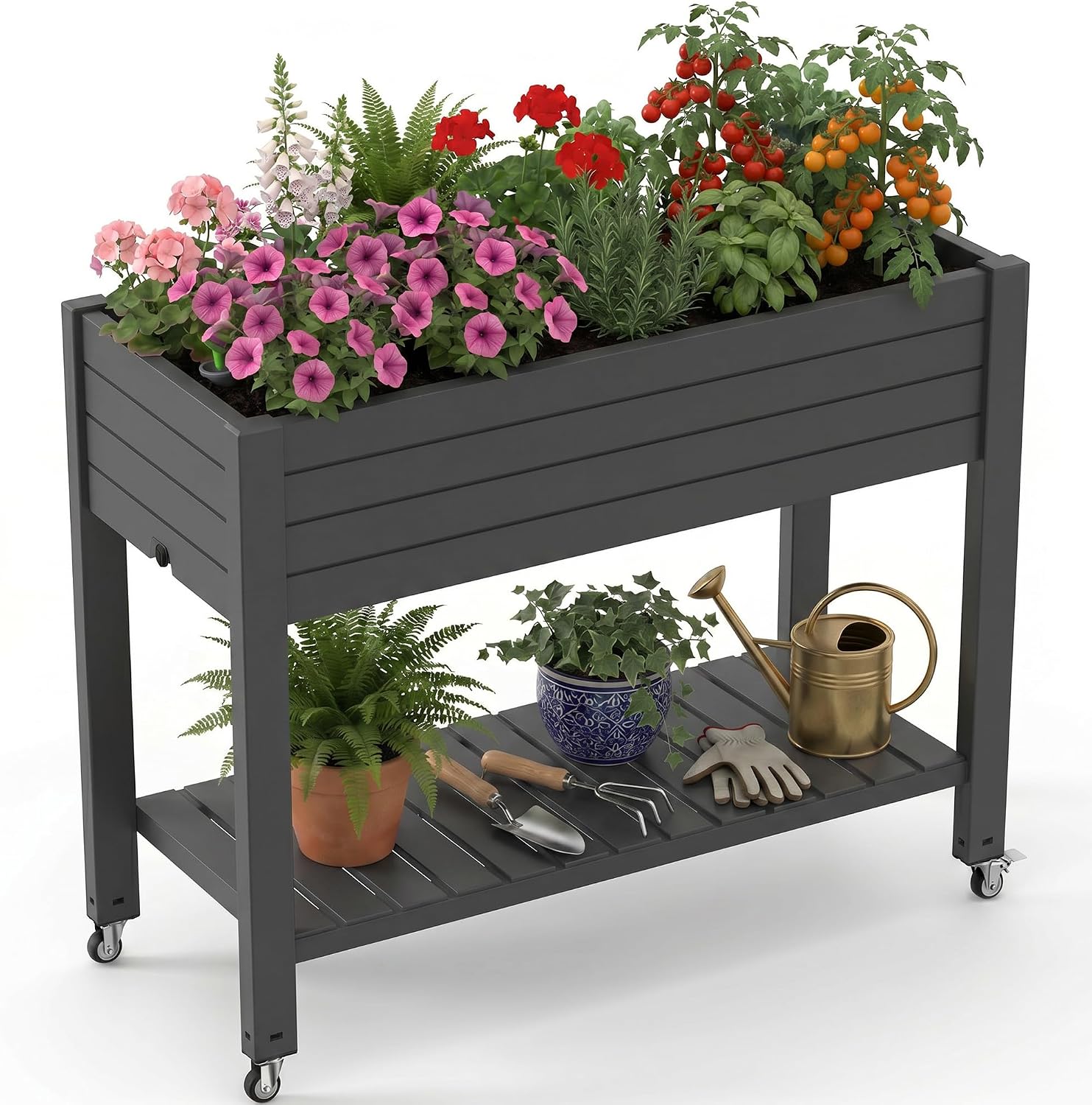
| Capacity | 21 gallons |
|---|---|
| Number of Levels | 4 |
| Other Special Features of the Product | Drainage Hole |
| Mounting Type | Floor Standing |
This EFU elevated raised bed is a practical option for home gardeners who want a compact, waist-high planting station that moves. It provides four separate planting zones and about 21 gallons of soil capacity, so you can keep herbs, lettuces, or small tomato varieties organized without spreading into the ground. The high-density resin construction and four reinforced support rods resist cracking and fading outdoors, while the built-in drainage holes and water-level monitor help prevent overwatering and root problems. Lockable casters make it easy to reposition the planter to follow sun or protect plants from bad weather, and the lower shelf stores small tools and pots to keep work tidy. Assembly is straightforward and should take about 20 to 25 minutes with the included manual. Limitations to note are the modest soil volume compared with full-size raised beds and the plastic construction, which may feel less substantial than metal or wood options to some buyers.
Best for: Buyers who want a low-effort, elevated planter for balconies, patios, or small yards and prefer a movable, easy-to-manage setup that reduces bending and soil mess.
Less Ideal for: Gardeners needing large soil volumes for deep-rooted vegetables or those who prefer traditional wood or metal raised beds for a heavier, permanent installation.
- Four separate planting zones for organized small-space gardening
- Lockable casters for easy mobility and placement adjustment
- Built-in drainage holes and water-level monitor to reduce overwatering risk
- Durable high-density resin construction with reinforced support rods
- Lower storage shelf keeps tools and pots close at hand
- 21-gallon capacity limits how large root crops or large tomato plants can grow
- Resin construction may not feel as heavy-duty as metal or thick cedar for long-term aesthetics
Verdict: This elevated, wheeled resin planter is the best pick for risk-averse gardeners who want a sturdy, low-maintenance, movable raised bed for compact vegetable and herb growing.
Tigerden 4.3 × 3 × 1 ft Plastic Raised Garden Bed Kit

| Material Type | Polypropylene (PP) |
|---|---|
| Capacity | 96.5 gallons |
| Included Components | Steel cables and panel sheets |
| Indoor Outdoor Usage | Outdoor |
| Other Special Features | Fade Resistant, Rust Resistant, Weather Resistant |
This Tigerden raised garden bed kit is a straightforward plastic planter designed for quick, tool-free setup and basic seasonal gardening. Panels snap together in minutes, so you can place it on a patio, balcony, or backyard and fill it with soil without needing screws or extra hardware. Built from UV-resistant polypropylene and supported with steel cables, the box resists rust and holds its shape better than simple plastic sheets, while the open-base design improves drainage and reduces risk of waterlogged roots. It is lightweight and easy to move or combine with additional kits to make a larger planting area. The main limitations are that it lacks a bottom panel — so it must sit on soil or a prepared surface — and the plastic construction will not insulate soil as well as thicker wooden beds. For short-term use, seasonal vegetables, herbs, and flowers it offers good value, but heavy permanent installations or deep-rooted crops may require sturdier materials.
Best for: Buyers looking for an inexpensive, easy-to-assemble raised bed to start seasonal vegetable or herb planting on a patio, balcony, or small yard.
Less Ideal for: Gardeners planning permanent heavy-duty beds, deep-rooted crops, or those who need integrated bottoms or thick insulating walls should consider sturdier materials.
- Tool-free snap-together assembly that can be completed in about 10 minutes
- UV-resistant polypropylene construction resists rust and weathering
- Steel cable reinforcement helps the panels keep shape under soil load
- Open-base design improves drainage and reduces risk of waterlogging
- No bottom panel included so it must be placed on soil or a prepared surface
- Thin plastic panels offer less insulation and long-term rigidity than wood or metal
Verdict: A budget-friendly, rustproof plastic raised bed that installs in minutes and is ideal for starting seasonal vegetable and herb gardens on small outdoor spaces.
Megawodar 4-Piece Self-Watering Elevated Raised Garden Bed

| Material Type | Plastic |
|---|---|
| Other Special Features of the Product | Self Watering |
| Mounting Type | Floor Standing |
| Indoor Outdoor Usage | Indoor, Outdoor |
This Megawodar elevated raised garden bed is a plastic, floor-standing planter that combines a built-in water reservoir and float gauge with a drainage control to simplify container gardening. Typical use is for herbs, small vegetables, and flowers on balconies, patios, or indoor sunrooms where regular watering is inconvenient. The self-watering reservoir and visible water gauge let you top up and then leave plants for up to a few weeks depending on crop needs, and the openable drainage gives you control to avoid oversaturation. Made from polypropylene, the panels snap together for straightforward assembly and the elevated design reduces bending and pest access. Limitations are the plastic construction, which is lighter and less insulating than wood or metal, and the overall planting volume is suited to compact beds rather than large-scale vegetable production. Expect reliable low-maintenance watering for small to medium container gardens but plan on seasonal placement and occasional checks to prevent algae or clogged vents.
Best for: Gardeners who value dependable, low-maintenance watering for herbs, small vegetables, or flowers in compact outdoor or balcony spaces and prefer a reliable planter that reduces day-to-day watering chores.
Less Ideal for: People needing very large planting volumes or those who prefer natural materials and the thermal benefits of wood for long-season vegetable production.
- Integrated self-watering reservoir with float gauge for hands-off watering
- Drainage control lets you open or close the water flow to suit plant needs
- Elevated, floor-standing design reduces bending and deters some ground pests
- Durable polypropylene construction resists rot and is easy to wipe clean
- Plastic walls provide less insulation and rigidity than wood or metal raised beds
- Planting volume is limited for larger vegetables or deep-rooted crops
Verdict: Choose this self-watering elevated plastic bed when you want a reliable, low-maintenance planter that keeps herbs and small vegetables watered for weeks with minimal oversight.
Keter Urban Bloomer 12.7 Gallon Elevated Raised Garden Bed

| Capacity | 22.4 gallons |
|---|---|
| Material Type | Resin |
| Other Special Features | Fade Resistant |
| Mounting Type | Floor Standing |
| Indoor Outdoor Usage | Outdoor |
The Keter Urban Bloomer is an elevated raised garden bed built for simple, low-maintenance herb and small-vegetable gardening on patios, balconies, or decks. It uses a built-in reservoir and water gauge to reduce watering frequency and help prevent overwatering and root rot, while a manual drainage tap allows you to empty the reservoir for indoor moves or heavy rain. The included seed sprouting tray makes starting seedlings neater, and the resin, wood-look finish is UV protected so it resists fading and rot better than real wood. Assembly is straightforward and the rectangular, floor-standing form fits alongside outdoor furniture. Because it is a single-piece plastic/resin planter, it is lightweight and weatherproof but will not provide the insulating or aesthetic qualities of natural wood or heavier materials. Capacity is limited compared with large raised beds, so it is best for herbs, salad greens, and a few compact vegetables rather than large crops.
Best for: Gardeners who want a practical, low-effort elevated planter for growing herbs and small salad greens on a balcony or patio and who prioritize easy watering management and low maintenance.
Less Ideal for: People planning to grow large vegetables, heavy production beds, or who want the look and thermal benefits of natural wood or metal raised beds.
- Self-watering reservoir with visible water gauge helps maintain consistent moisture and prevents overwatering
- Manual drainage tap makes it easy to drain excess water and move the planter indoors without leaks
- UV-protected resin construction resists fading, rot, and rust for low outdoor maintenance
- Included seed sprouting tray simplifies starting seedlings and transplanting into the bed
- Relatively small soil capacity limits the number and size of plants compared with full-size raised beds
- Resin construction lacks the natural insulation and aesthetic of wood or heavier materials
Verdict: If you want a compact, low-maintenance elevated planter that simplifies watering and seed starting for herbs and small veggies, this is a practical choice.
Choosing the Right Plastic Raised Garden Bed: Key Factors to Consider
Material Durability and UV Resistance
Plastic formulation and thickness determine how a raised bed holds up through sun, frost, and everyday use. UV-stabilized polymers resist becoming brittle and cracking after repeated summer sunlight. Thicker panels or reinforced edges reduce the risk of warping under the weight of wet soil.
Longer-lasting plastic also eases storage and reuse plans. If you expect to leave a bed outdoors year-round, choose materials specified for outdoor exposure rather than thin, non-stabilized plastic that degrades quickly.
Structural Stability and Connection System
The way panels join at corners and along edges dictates whether the bed will bow or collapse when filled. Robust corner posts or interlocking joint systems keep walls straight and maintain the intended soil volume. Internal bracing or ribbed panel designs add strength without increasing weight.
Consider how the bed behaves when placed on uneven ground. Some connection systems tolerate minor ground irregularities better, while others require a leveled base to avoid stress on the joints.
Drainage and Water Management
Proper drainage is essential for most vegetables to avoid root rot and nutrient leaching. Some plastic raised beds include pre-formed drainage holes or recommend substrate layering to promote flow. Others rely entirely on bottom permeability or placed-in-ground setups to manage excess water.
Think about your local rainfall and irrigation habits. In heavy-rain climates or with frequent overhead watering, choose a bed design that encourages quick drainage or plan to add gravel or a drainage layer beneath the planting mix.
Soil Depth and Planting Needs
Different crops need different root space, and plastic beds vary in internal depth. Shallow beds work for lettuce, herbs, and annuals, while deeper vegetables like carrots and tomatoes require more soil volume. Verify the usable planting depth rather than just external wall height, since frames or connection overlaps can reduce actual soil depth.
Also consider future cropping plans. If you rotate heavy feeders or plan to grow root crops, opt for greater depth to avoid frequent soil replacement.
Assembly, Portability, and Site Access
Ease of assembly matters if you plan to move beds seasonally or install them without specialized tools. Snap-together systems and lightweight panels speed setup for one-person jobs. Heavier, more rigid panels improve longevity but can make relocation difficult once filled.
Think about how you'll access the bed for planting, weeding, and harvest. Beds intended for balconies or raised access should balance depth with manageable weight and height for comfortable work.
Maintenance, Cleaning, and Pest Resistance
Plastic is naturally resistant to rot and many pests, but insects and slugs still exploit exposed soil. Smooth, non-porous surfaces are easier to clean between seasons and reduce pathogen carryover. Check whether corners and joints trap soil or moisture that can encourage mold or pests.
Also consider how the material responds to common cleaning methods. Some plastics tolerate pressure washing or diluted bleach, while others may discolor or weaken with harsh chemicals.
Sizing for Small Yards and Balconies
In tight spaces choose beds that maximize usable soil while fitting access routes and sunlight patterns. Rectangular or modular designs can be combined to form longer runs without taking more width. For balconies, confirm load limits and select shallower beds that still provide enough planting depth for intended crops.
Modular kits help gardeners scale planting area over time. If you need mobility, look for lighter panels that assemble without permanent fasteners so you can empty and move beds between seasons.
- Measure available footprint and overhead clearance before ordering
- Prefer modular lengths to avoid awkward long pieces on small balconies
- Check balcony weight capacity if planting heavy, moisture-laden soil
Preparing the Ground and Base Options
Decide whether to place the bed directly on soil, gravel, or a hard surface. Direct-ground placement improves drainage and encourages earthworms but may allow weed roots to invade. A weed barrier or bottom screen reduces invasion while still permitting drainage.
On hard surfaces use a drainage layer and ensure water can escape rather than pooling under the bed. Proper leveling simplifies assembly and reduces joint stress.
- Direct-ground: best for long-term beds and improved drainage
- Hard-surface: use a raised base or slotted feet to allow runoff
- Add a coarse layer under the soil for extra drainage in heavy-soil regions
Adapting Plastic Beds for Better Soil Health
Plastic beds work well with layered soil builds: a base of coarse material for drainage, a middle layer of compost-amended topsoil, and a top mulch to reduce evaporation. Regularly top up organic matter to maintain fertility and structure since confined beds can exhaust nutrients faster than in-ground plots.
Rotate plant families and periodically replace or rejuvenate the soil to prevent disease buildup. Using good-quality compost and occasional soil testing keeps nutrient balance steady in a contained bed.
- Layer for drainage, fertility, and easier maintenance
- Top-dress annually with compost rather than replacing all soil
- Test soil every 2 to 3 years if growing heavy-feeding vegetables
Winter Care and Off-Season Storage
In colder climates consider leaving beds in place and protecting soil with mulch or cover crops to prevent erosion and nutrient loss. For portable plastic beds, emptying and stacking panels for off-season storage reduces UV wear and frees space for other uses.
If leaving assembled beds outdoors, inspect joints each spring for loosening or frost-related shifts and tighten or reset panels as needed to preserve structural integrity.
- Mulch or cover crop to protect soil in winter
- Store lightweight panels inside to extend life
- Check and reseat connections after freeze-thaw cycles
Customization and Accessories
Plastic beds accept accessories like trellis attachments, internal dividers, and irrigation fittings. Look for designs with compatible attachment points if you plan vertical gardening or drip irrigation. Some kits include optional lids or cold frames to extend the season for early seedlings.
Adding simple shade cloth or row covers can protect young plants from intense sun or pests without altering the bed structure.
- Plan trellis points for vining crops
- Use drip irrigation for consistent moisture in confined soil
- Consider modular add-ons to expand without replacing the bed
How We Chose the Best Plastic Raised Garden Bed
We concentrated on characteristics that matter for plastic raised garden beds in active vegetable and herb gardens. Primary evaluation criteria included material durability, structural stability, drainage performance, ease of assembly and handling, and maintenance requirements. Material durability covered UV resistance, impact toughness, and long-term shape retention under sun and frost exposure. Structural stability assessed panel thickness, connection systems, and how well beds resist bowing or collapse when filled with soil. Drainage performance looked at how easily excess water leaves the bed and whether included features or recommended modifications reduce waterlogging. Ease of assembly and handling considered tool-free connection options, the simplicity of corner joints, and how straightforward it is to move or reconfigure a bed once assembled. Maintenance requirements covered cleaning, pest resistance, and how the material ages over multiple seasons. We excluded wooden, metal, and fabric planters, as well as garden beds intended only for decorative use without adequate soil depth for vegetables. We also filtered out products lacking clear durability specs or that require complex permanent installation. The final shortlist includes beds that meet practical gardener needs for seasonal vegetable production and small-space growing.
FAQ
Will a plastic raised garden bed overheat plant roots in hot climates?
Plastic can absorb and hold heat, especially darker colors in full sun. Lighter-colored beds and shading techniques reduce heat transfer. Using a layer of mulch and adequate soil depth buffers roots from temperature swings.
Can I place a plastic raised bed directly on concrete or decking?
Yes, but provide drainage so water can escape and avoid trapping moisture under the bed. Use feet, a drainage mat, or a coarse base layer to prevent water pooling and protect the surface beneath.
How deep should a plastic raised bed be for vegetables?
Depth depends on crops. Many leafy greens and herbs do fine in 6 to 8 inches of soil, while tomatoes, peppers, and root vegetables benefit from 10 to 18 inches. Check usable internal depth rather than just wall height.
Are plastic raised beds safe for organic gardening?
Most modern garden-grade plastics are safe for organic vegetable production if they are labeled for outdoor use and do not leach odors. Rinse new components and avoid beds that show signs of factory residues before planting.
How do I prevent weeds and pests from getting into a plastic raised bed?
Install a barrier under the bed, such as landscape fabric or a bottom screen, to block perennial weeds. Keep edges tight and clean up spilled soil that can bridge the gap. For slugs and ground pests, use traps or copper barriers around the bed perimeter.
Can I reuse the soil from a plastic raised bed year after year?
Yes, you can, but confined soils need periodic replenishment of organic matter and nutrients. Top-dress with compost each season and consider partial replacement or restorative amendments every few years to avoid compaction and nutrient depletion.
Final Verdict
When choosing a plastic raised garden bed prioritize the combination of material durability, solid connections, and appropriate planting depth for your crops. Balance portability and assembly ease with the structural strength needed to hold wet soil and support plantings over multiple seasons. Tradeoffs include heavier, more durable panels that are harder to move versus lightweight kits that may need replacement sooner. Pick the design that fits your site, intended crops, and how much seasonal maintenance you want to do, and you will have a low-maintenance container that simplifies planting and extends your growing season.
