

Note: This article contains affiliate links. If you click on these links and make a purchase, I may earn a small commission at no extra cost to you. This helps support my research and content. Read my full affiliate disclosure here.
Picking the right spring weed and feed for zoysia grass matters because zoysia has specific growth timing and weed sensitivities. Apply too much nitrogen or the wrong herbicide at the wrong time and you can stress the turf rather than encourage a healthy spring green-up. Zoysia emerges later in spring than many cool-season grasses, so its fertilizer and weed-control needs differ. This guide covers seven carefully shortlisted spring weed and feed options appropriate for zoysia lawns. We evaluated products for safety to zoysia, timing of application, and nutrient balance so you can choose the approach that matches your lawn care plan and seasonal window.
Top Picks at a Glance
| Best Overall The best all-around choice for most situations | Scotts Turf Builder Triple Action 3-in-1 Lawn Fertilizer and Weed Control, 33.94 lb |  |
| Best Quality Built to a higher standard if you want something more solid | GreenView Premium Formula Spring Weed & Feed and Crabgrass Preventer, 14.4 lb |  |
| Best Value The sweet spot between price and what you get | The Andersons Premium Weed and Feed 24-0-16 (18 lb) |  |
| Best Budget The cheapest option that still gets the job done reliably | Scotts Turf Builder Liquid Lawn Food Plus Weed Control Refill, 32 fl. oz. |  |
| Highest Rated A top-rated pick with lots of positive feedback | Scotts Turf Builder Weed & Feed for Texas Lawns, 22.4 lb |  |
| Most Popular A crowd favorite that many people choose with confidence | BioAdvanced 5-in-1 Weed and Feed Granules (9.6 lb) |  |
| Best Seller A high-volume bestseller chosen again and again | Scotts Turf Builder Halts Crabgrass Preventer with Lawn Food (covers 5,000 sq. ft.) |  |
Scotts Turf Builder Triple Action 3-in-1 Lawn Fertilizer and Weed Control, 33.94 lb

| Item Form | Granule |
|---|---|
| Coverage | All-purpose |
| Active Ingredients | Pendimethalin, 2,4-D, Dicamba |
| Unit Count | 543.04 Ounce |
Scotts Turf Builder Triple Action combines weed control, crabgrass prevention, and fertilizer into one granular product aimed at simplifying spring lawn care. You apply it with a broadcast spreader to a wet lawn when broadleaf weeds like dandelions are actively growing, let the granules settle for 24 hours, then water to activate the pre-emergent layer that blocks crabgrass germination. The formula contains pendimethalin plus 2,4-D and dicamba to target a broad list of lawn weeds while providing nutrients to strengthen turf. Its main benefits are convenience and broad coverage — one 33.94 lb bag treats about 12,000 sq ft — and it works on most common turf species. Important limitations to note are safety and timing: active ingredients require care around children and pets until dusts settle, it will not kill established crabgrass, and correct application timing and watering are essential for prevention to work. For best results use a calibrated spreader and follow label directions for temperature and grass type compatibility.
Best for: Buyers who prioritize measurable lawn performance and want a single product to reduce steps in spring lawn care, particularly homeowners managing medium to large cool- or warm-season lawns.
Less Ideal for: Those who need a solution for existing crabgrass patches, have very small decorative turf areas, or prefer organic-only products should consider alternative targeted treatments.
- Three functions in one bag: fertilizer, broadleaf weed killer, and crabgrass pre-emergent
- Large coverage per bag suitable for medium to large lawns (up to 12,000 sq ft)
- Granular form works with standard broadcast spreaders for even application
- Contains multiple active ingredients for control of a wide range of listed weeds
- Instructions and recommended use timing are provided to optimize performance
- Does not control existing crabgrass since pre-emergent only prevents germination
- Contains herbicides that require keeping people and pets off treated area until granules settle
- Effectiveness depends on correct timing, watering, and spreader calibration
Verdict: Choose this if you want a performance-focused, all-in-one granular treatment that feeds turf while preventing crabgrass and controlling common broadleaf weeds.
GreenView Premium Formula Spring Weed & Feed and Crabgrass Preventer, 14.4 lb

| NPK | 24-0-6 |
|---|---|
| Form | Granules |
| Coverage | Up to 4,000 sq. ft. |
| Includes | Weed and Feed, Crabgrass Preventer |
The GreenView Premium Formula Spring Weed & Feed is a granular, all-in-one lawn treatment designed to feed turf and prevent crabgrass in a single application. It is typically broadcast over established lawns in spring and targets common broadleaf weeds while laying down a Dimension pre-emergent barrier to prevent crabgrass germination for up to 120 days. Notable features include a 24-0-6 NPK analysis with slow-release nitrogen for extended feeding, coverage of up to 4,000 sq ft from the 14.4 lb bag, and claims of controlling over 200 broadleaf weeds. For performance-minded users this product gives a strong growth response and reduced need for repeat feeding through the season, and the pre-emergent helps protect high-value warm-season grasses like zoysia during critical germination windows. Limitations: it must be applied only to established turf and is not suitable for certain species such as bentgrass or newly seeded areas, and combining fertilization with weed control means timing is important because the herbicide component can affect overseeding or newly sprigged lawns.
Best for: Homeowners with established zoysia lawns who prioritize season-long turf performance and want a single spring application that feeds and prevents crabgrass while reducing follow-up treatments.
Less Ideal for: People establishing new lawns, overseeding, or managing grass types listed as incompatible such as bentgrass or seedling buffalograss should choose a no-herbicide starter fertilizer instead.
- Combines slow-release 24-0-6 fertilizer with a Dimension pre-emergent for up to 120 days of crabgrass prevention
- Covers up to 4,000 sq ft from a single 14.4 lb bag for one-step spring treatment
- Granular formula delivers sustained nitrogen release to promote steady green-up without surge growth
- Claims control of over 200 broadleaf weeds, reducing the need for separate spot treatments
- Not safe for newly seeded or sprigged lawns and must be used only on established turf
- Contains herbicide activity that can limit overseeding windows and requires careful timing
Verdict: If you need a strong single-step spring treatment for established zoysia that feeds turf and prevents crabgrass for months, this product delivers reliable season-long performance.
The Andersons Premium Weed and Feed 24-0-16 (18 lb)

| Item Form | Granule |
|---|---|
| Coverage | 5,000 sq ft |
| Unit Count | 288 Ounce |
| Active Ingredients | Herbicide, Iron, Nitrogen, Sulfur |
The Andersons Premium Weed and Feed 24-0-16 is a granular lawn product designed to kill broadleaf weeds while feeding turf with a mix of quick- and slow-release nitrogen plus iron for deeper greening. You apply it with a rotary or drop spreader to a dry lawn, following the label spreader settings and the two-step application schedule for best control. It targets over 250 broadleaf weeds and lists compatibility with St. Augustine and other common warm- and cool-season grasses, making it useful for seasonal lawn program maintenance. Practical benefits include combined weed control and extended feeding in one pass and improved lawn color from added iron. Important limitations are geographic restrictions and the need to follow the two-application procedure and post-application watering to activate herbicide; it is also not suitable for dichondra or carpet grass. For performance-focused users, correct spreader calibration and adherence to timing will determine results more than the product alone.
Best for: Homeowners who prioritize visible lawn performance and want a combined weed-control plus feeding product for regular seasonal maintenance of St. Augustine and similar grasses.
Less Ideal for: People managing sensitive or restricted lawns such as dichondra or carpet grass or those located in states where this product is not approved.
- Combines herbicide and fertilizer so you kill weeds while feeding grass in one application
- Includes both quick- and slow-release nitrogen for immediate green-up and longer-lasting feeding
- Contains iron for deeper, faster greening of turf
- Covers up to 5,000 sq ft per bag, suitable for medium-sized yards
- Not approved for sale or use in some states which limits availability
- Requires specific spreader settings and a two-step application schedule for full effectiveness
Verdict: Choose this product if you want a single granular treatment that controls broadleaf weeds and delivers both quick and extended feeding for a noticeably greener St. Augustine lawn.
Scotts Turf Builder Liquid Lawn Food Plus Weed Control Refill, 32 fl. oz.

| Unit Count | 32 Fluid Ounces |
|---|---|
| Item Form | Liquid |
| Coverage | 2000 square foot |
| NPK | 29-0-0 |
This Scotts Turf Builder liquid refill combines a high‑nitrogen fertilizer with a contact weed‑control ingredient so you can spray and treat a small lawn in roughly 10 minutes. You attach a reusable hose‑end applicator to the translucent refill bottle, connect your garden hose, and spray evenly; the bottle’s translucence helps avoid overapplication. It is labeled for common cool‑ and warm‑season grasses and starts to curl listed weeds within days, with repeat treatment recommended for stubborn species. Practical benefits include quick coverage, dual action that thickens turf while reducing visible clover and dandelions, and a refill format that reduces disposable sprayer waste. Important limitations are its labeled grass list and timing restrictions: it is not for use on edible beds, you must apply only when listed grasses are actively growing, avoid watering for 48 hours after treatment, and it may cause temporary injury on some bermudagrass varieties. Also it is a small refill sized for about 2,000 sq ft, so larger lawns will need multiple bottles or a different coverage option.
Best for: Homeowners who want a quick, low‑effort way to feed and spot‑treat weeds on a small to medium lawn and prefer simple hose‑on application and lower ongoing cost per use.
Less Ideal for: People with large lawns who need high‑coverage products or gardeners who require a weed control labeled specifically for St. Augustine grass should consider alternatives.
- Fast application with hose‑end attachment covers 2,000 sq ft in about 10 minutes
- 2‑in‑1 formula feeds turf while controlling many listed broadleaf weeds
- Translucent refill bottle helps monitor application and reduce guesswork
- Refill format lets you reuse a spray applicator to cut down on plastic waste
- Not labeled for use on edible gardens or all grass types, limiting where it can be applied
- Small 32 fl. oz. volume means multiple bottles are required for larger lawns
Verdict: If you want a fast, low‑effort liquid refill that feeds turf and knocks back common broadleaf weeds on a ~2,000 sq ft lawn, this is a budget‑friendly, practical choice.
Scotts Turf Builder Weed & Feed for Texas Lawns, 22.4 lb

| Item Form | Granule |
|---|---|
| Coverage | 8000 square foot |
| Active Ingredients | 2,4-D, 2-ethylhexyl ester; Mecoprop-p acid; Dicamba acid |
| Unit Count | 358.4 Ounce |
This Scotts Turf Builder Weed & Feed for Texas Lawns combines a broadleaf weed killer with lawn fertilizer in an easy-to-spread granular form intended to cover up to 8,000 sq. ft. It controls more than 80 listed weeds, including dandelion, clover, chickweed and certain woody weeds, while the fertilizer component greens grass within about 72 hours and encourages thicker growth. Typical use is a spring or early-fall application to a moist lawn when weeds are actively growing, using a broadcast spreader and following label timings to avoid newly seeded areas and specific grass exclusions. Notable features are the targeted active ingredients for broadleaf control and a formulation matched to many common turf types found in the region. Practical benefits include one-pass weed control plus feeding and broad coverage from a single bag. Important limitations are the grass restrictions—do not use on Floratam St. Augustine or other listed turf types—and the need to avoid rain within 24 hours and to follow protective handling guidance due to the active herbicides.
Best for: Homeowners who want a dependable, single-product solution to both remove broadleaf weeds and feed established lawns across large areas in spring or early fall.
Less Ideal for: People establishing new seedings, owners of excluded grass varieties, or gardeners who prefer non-chemical or spot-treatment weed control approaches.
- Controls over 80 listed broadleaf weeds common in lawns
- Includes fertilizer that greens turf quickly and promotes thicker growth
- Granular formula for use with a spreader and coverage up to 8,000 sq. ft.
- Formulated for a range of warm- and cool-season grasses common in Texas lawns
- Contains herbicide actives that require protective handling and caution around children and pets
- Not safe for certain turf types such as Floratam St. Augustine and other listed grasses
Verdict: Use this product when you want a reliable, one-step granular treatment that kills common broadleaf weeds and feeds an established lawn across a large area.
BioAdvanced 5-in-1 Weed and Feed Granules (9.6 lb)

| Item Form | Granule |
|---|---|
| Coverage | 4000 square_feet |
| Active Ingredients | Dicamba, Quinclorac |
BioAdvanced 5-in-1 Weed and Feed is a granular lawn treatment that combines multiple herbicides with fertilizer so you can kill existing weeds and feed turf in a single application. You apply it with a broadcast or drop spreader to an established, dry lawn, then water in and avoid mowing for at least a day. The formula targets over 200 broadleaf weeds and large crabgrass and creates a soil barrier that helps prevent new listed weeds for up to six months while feeding and greening the lawn for about three months. Practical features include granular form for easy even coverage and instructions for follow-up watering and safety precautions. Important limitations are usual for combined herbicide-fertilizers: it is intended for established turf rather than newly seeded lawns, and precautions are needed around children, pets, and windy applications. It is not labeled for sale in all states and requires following label directions closely for best results.
Best for: Homeowners who want a low-effort, maintenance-friendly product to reduce separate purchases and applications and keep an established lawn greener while controlling common weeds.
Less Ideal for: People establishing a new lawn from seed, managing sensitive ornamentals near turf, or those who prefer non-chemical weed control methods.
- Combines weed control and fertilizer in one application for convenience
- Controls both broadleaf weeds and large crabgrass and helps prevent new weeds for up to six months
- Granular formula spreads evenly with a broadcast or drop spreader for uniform coverage
- Feeds and greens turf for up to three months after application
- Not suitable for newly seeded or delicate lawns where herbicides can inhibit germination
- Requires careful handling and exclusion of children and pets until treated areas are dry
Verdict: Use this product when you want one granular application to both kill common and crabgrass weeds and feed an established lawn for months of reduced maintenance.
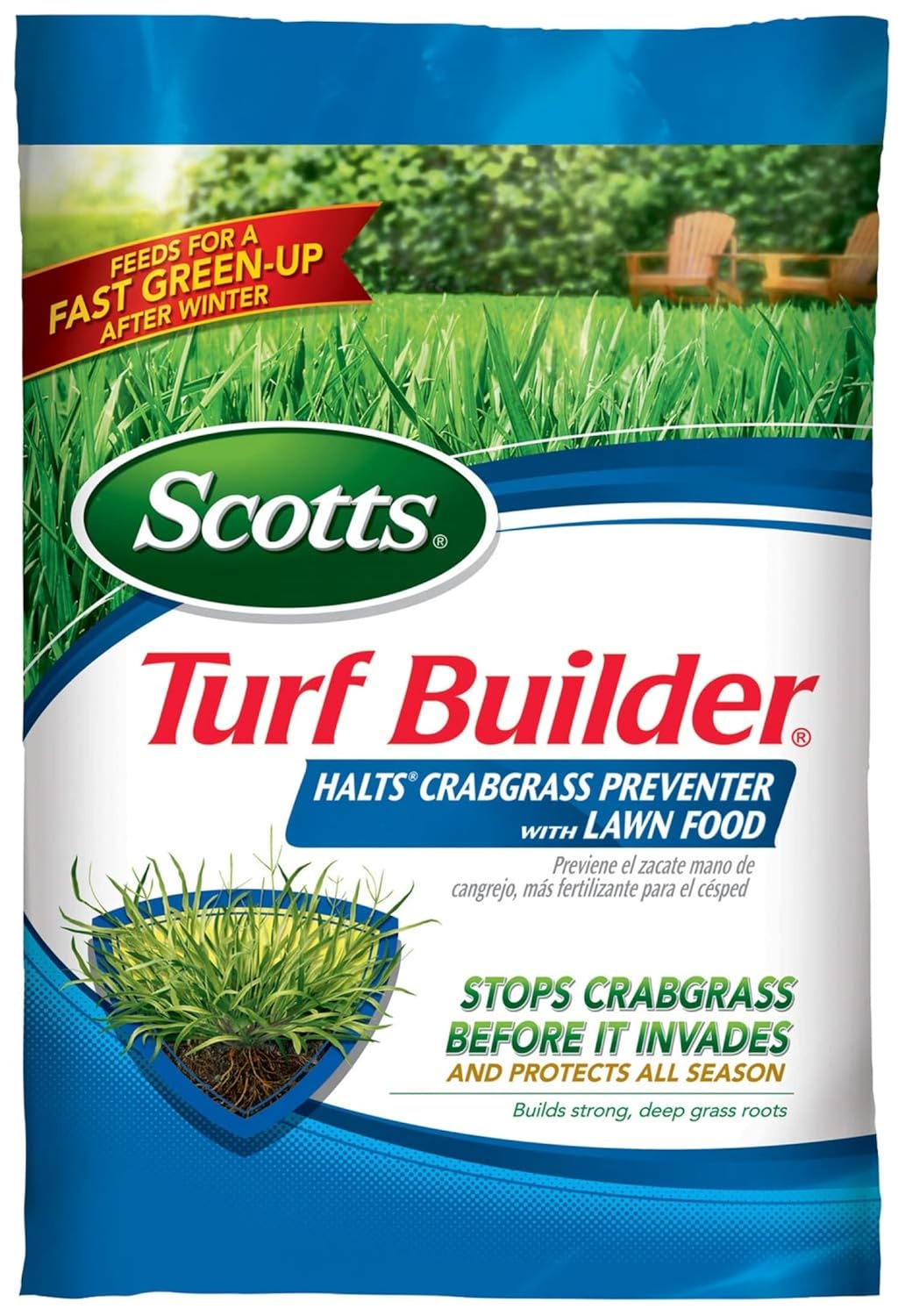
Scotts Turf Builder Halts Crabgrass Preventer with Lawn Food (covers 5,000 sq. ft.)
| Item Form | Granule |
|---|---|
| Coverage | 5000 square feet |
| Unit Count | 213.6 Ounce |
| Fertilizer analysis | 30-0-4 |
Scotts Turf Builder Halts combines a pre-emergent crabgrass preventer with a granular lawn fertilizer to protect and feed an established lawn through the spring. You apply it once in early spring to a dry lawn before regular hot weather, using a broadcast or drop spreader and then water the lawn lightly within 2 to 3 days so the active ingredient forms a barrier in the soil. The product covers 5,000 sq. ft. per bag and is formulated to prevent several grassy and broadleaf weeds while the 30-0-4 fertilizer helps grass green up quickly and build deeper roots. Practical benefits include season-long prevention of new crabgrass and simultaneous feeding, which reduces extra steps in spring lawn care. Limitations are that it will not kill mature crabgrass or existing weeds and it is not suitable for certain turf types like dichondra or bentgrass. Also, correct spreader settings and post-application watering are important for reliable performance, so casual or inexperienced applicators should follow directions closely.
Best for: Homeowners who prioritize reliable, season-long prevention and want a simple spring treatment that both blocks new crabgrass and feeds the lawn.
Less Ideal for: People needing a post-emergent weed killer for existing crabgrass or those managing dichondra or bentgrass turf should choose a different product.
- Pre-emergent formula prevents crabgrass and several other grassy weeds when applied correctly
- Includes fertilizer (30-0-4) for fast green-up and stronger root development
- Single-application coverage for 5,000 sq. ft. reduces repeat treatments in spring
- Granular form works with common broadcast and drop spreaders for even application
- Does not control established or mature crabgrass or existing weeds
- Not safe for use on dichondra and bentgrass lawns
Verdict: Choose this product if you want a dependable one-time early-spring treatment that prevents new crabgrass while feeding and strengthening your lawn.
Choosing the Right Spring Weed and Feed for Zoysia Grass: Key Factors to Consider
Herbicide Selectivity and Warm-Season Safety
Herbicide selectivity matters because some weed killers that are safe on cool-season grasses will injure or discolor warm-season species like zoysia. Look for active ingredients and label language that explicitly state safety for warm-season turf or specifically mention zoysia. When a label lists warm-season grasses or provides a zoysia caution, it gives you confidence the product was formulated or tested with similar turf.
Incorrect herbicide choice can cause thinning, brown patches, or delayed green-up. Also consider the range of weeds controlled. Some selective herbicides target only broadleaf weeds while others add suppression of winter annual grasses. Knowing which weeds dominate your lawn in spring will help match selectivity to need.
Nitrogen Formulation and Release Schedule
Zoysia transitions from dormancy to active growth later than many cool-season grasses, so nitrogen timing and form are important. Slow-release nitrogen provides steady feeding and reduces the chance of a rapid growth surge that stresses the plant. A mix of quick-release and slow-release nitrogen can promote an initial green-up while sustaining growth over several weeks.
Avoid high water-soluble nitrogen rates in early spring when soil temperatures are still low. Check the guaranteed analysis for percent slow-release nitrogen and the product notes about ideal soil temperatures or growth stages to apply. A product that times nitrogen availability to zoysia's spring curve will produce a more even, resilient lawn.
Application Window and Timing Flexibility
The ideal application window for spring weed and feed should match zoysia's green-up period. Products that require application at a specific narrow soil temperature or growth stage can be harder to time correctly. Choose options that allow application once zoysia is actively greening but before warm-season weeds get strongly established.
Timing flexibility also matters for weather variability. A product that tolerates a broader temperature range or can be applied a bit earlier or later without damage reduces the risk of misapplication. Read label guidance about rainfall windows after application to plan watering or expect natural precipitation impacts.
Granule Quality and Application Consistency
Even coverage is critical because uneven spreading causes patchy feeding and variable weed control. Granule size, flowability, and how a product behaves in a broadcast spreader affect application consistency. Look for products with a uniform granule size and those that provide spreader settings on the label.
If you prefer liquid tank mixes, consider whether the product is available in a soluble form or requires specialized mixing. Inconsistent application can create localized burn or leave weeds untreated, so application characteristics should match your equipment and lawn size.
Residual Control and Spectrum of Weeds
Residual weed control determines how long the herbicide will suppress reemergence of common spring weeds. Some formulations provide short-term knockdown only, while others include residual activity that reduces reinfestation for weeks. Choose based on the weed pressure in your lawn and whether you want to reduce follow-up treatments.
Consider the spectrum of weeds controlled, such as chickweed, dandelion, clover, and annual bluegrass. Products that address the specific weeds you see will reduce the need for spot treatments. Also factor in how residual herbicides interact with planned overseeding or lawn repair work.
Environmental and Lawn Care Compatibility
Environmental considerations include runoff risk, proximity to garden beds, and restrictions near water sources. Some herbicides have stricter buffer recommendations or longer re-entry intervals. Read label precautions for application near ornamental plantings or vegetable gardens.
Compatibility with other lawn practices matters too. If you plan to dethatch, aerate, or overseed in spring, choose a product whose label permits those practices within your planned schedule. Also consider pet and child re-entry intervals and follow any watering restrictions after application.
When To Apply On Zoysia
Timing is critical for zoysia. Wait until the turf shows consistent signs of green-up rather than applying at a fixed calendar date. Soil temperatures and local microclimates influence when zoysia resumes active growth, so check for new green shoots across several lawn areas before treatment.
Apply a spring weed and feed once zoysia is actively growing and before broadleaf weeds set seed. If you apply too early while zoysia is still dormant, the turf may not metabolize fertilizer or herbicide properly, risking phytotoxicity or poor control.
- Look for consistent day and night temperatures above the label's recommended soil temperature
- Avoid treating immediately after frost events or during drought stress
- If rain is expected within 24 hours, confirm the product's rainfast window to avoid wash-off
How To Measure and Calibrate Your Spreader
Accurate spreading prevents uneven appearance and ensures correct herbicide and nutrient rates. Use the label's suggested spreader settings as a starting point, then perform a test pass to measure actual coverage. Divide your lawn into test swaths and weigh or count granules collected over a set distance if you want precision.
Adjust rate and overlap to achieve uniform coverage. Walk at a steady pace and avoid stopping mid-pass. If your lawn has narrow strips or irregular shapes, consider spot-applying with a hand spreader or a targeted liquid treatment for those areas.
- Follow the spreader setting chart on the product label
- Test on a small area before treating the entire lawn
- Clean spreader after use to prevent cross-contamination
Watering and Post-Application Care
Watering after application affects both herbicide activation and fertilizer uptake. Many products require light irrigation to move granules into the thatch and soil, but excessive watering shortly after application can wash away active ingredients. Read the product label for the recommended rainfast period and irrigation amount.
Avoid mowing for a couple of days before and after application to reduce turf stress and to allow herbicide contact with target weeds. Monitor the lawn for areas of discoloration and follow label directions for re-entry, pet access, and any spot treatments that may be needed later.
- Follow label directions on irrigation timing and amounts
- Delay mowing as recommended to maximize efficacy
- Inspect treated areas weekly and address any damaged spots with appropriate lawn care measures
Managing Expectations: What Results Look Like
Broadleaf weeds often show decline within 7 to 21 days, though full control and lawn green-up may take longer depending on weather and turf vigor. Expect gradual improvement rather than instant results, especially if weeds are mature or soil temperatures are cool.
Some temporary discoloration or slowed growth can occur as herbicides act on weeds, but widespread turf injury indicates a timing or product mismatch. If you see significant damage, follow label recommendations for recovery and avoid reapplication until the lawn has recovered.
- Track weed decline over several weeks before assuming treatment failed
- Plan follow-up spot treatments for persistent weeds rather than reapplying broad treatments immediately
- Record application dates and weather conditions to refine timing in future seasons
Alternatives and Complementary Practices
Weed and feed products are one tool in a broader lawn care plan. Cultural practices such as proper mowing height, regular aeration, timely overseeding, and balanced fertility reduce weed pressure over the long term. Integrating these practices can reduce reliance on chemical controls.
For small or irregular lawns, targeted spot treatments or hand-pulling can be safer and more precise. In areas near sensitive plantings or water, non-chemical weed control and improving turf density through cultural care are practical alternatives.
- Mow zoysia at the recommended height to promote density
- Aerate compacted soils to improve root growth and nutrient uptake
- Use selective spot treatments on isolated weed patches to limit herbicide use
How We Chose the Best Spring Weed and Feed for Zoysia Grass
We focused on attributes that directly affect zoysia performance in spring. Primary evaluation criteria included herbicide selectivity and safety for warm-season turf, nitrogen formulation and release timing, timing window and application flexibility for zoysia dormancy-to-green-up transition, and granule consistency or application method to ensure even coverage. We also assessed residual weed control duration and compatibility with overseeding or lawn repairs often done in spring. Products that required unlikely application conditions or that contained herbicides known to damage warm-season grasses were excluded. We avoided formulations that deliver a heavy early-season nitrogen spike that can burn or overstimulate zoysia before it is ready. Excluded items included products designed only for cool-season lawns, broad-spectrum herbicides harmful to warm-season turf, and formulations that demand specialized equipment few home gardeners have. The final shortlist balances safety for zoysia, predictable green-up response, and practical application needs in typical home lawn routines.
FAQ
Can I apply a spring weed and feed to zoysia as soon as temperatures reach 50 degrees?
It often depends on soil temperature and visible turf activity. Rather than a fixed temperature, wait until zoysia shows consistent green-up across the lawn. Labels may reference soil temperature thresholds, but visible growth is a more practical indicator for timing.
Will a spring weed and feed prevent crabgrass in my zoysia lawn?
Many spring weed and feed products target broadleaf weeds and do not provide full preemergent control for grassy weeds like crabgrass. If crabgrass is your main concern, choose a product that includes a preemergent ingredient or plan a separate preemergent application timed for your region.
How long should I wait to overseed or repair bare spots after application?
Wait until label-specified intervals have passed. Some herbicides with residual activity restrict overseeding for several weeks. If you plan repairs, choose a product whose label permits seeding within your intended timeline or delay application until after establishing new grass.
Is spot treatment safer than a full lawn application for small zoysia yards?
Spot treatment can be a good option for small areas or isolated weed patches because it reduces the amount of herbicide applied and lowers the risk of turf injury. For widespread weed pressure, a full lawn application timed properly may be more efficient.
Can I use a spring weed and feed if my lawn is under drought stress?
It usually depends on severity. Avoid applying when the lawn is visibly drought-stressed because herbicides and fertilizers can increase stress. Water the lawn to relieve stress and wait until turf shows recovery before treating.
Are there special precautions for pets and children after applying a weed and feed?
Follow the product label for re-entry intervals and watering recommendations. Most products advise keeping pets and children off the treated area until granules are watered in and the surface is dry. Use label guidance to determine specific timing.
How often should I expect to reapply a spring weed and feed?
Frequency depends on product residual activity and your weed pressure. Many gardeners apply a single spring application and rely on cultural practices and occasional spot treatments thereafter. Read label intervals for minimum reapplication timing and avoid overlapping treatments.
Final Verdict
Choose a spring weed and feed for zoysia by prioritizing herbicide selectivity and a nitrogen release profile that matches zoysia's later spring green-up. Also consider application timing flexibility and granule consistency to ensure even coverage and predictable results. Balance residual weed control needs against overseeding or repair plans and follow label environmental and safety guidelines. Focusing on turf-safe ingredients and appropriate timing will produce the best tradeoff between healthy green-up and effective weed suppression.
