

Note: This article contains affiliate links. If you click on these links and make a purchase, I may earn a small commission at no extra cost to you. This helps support my research and content. Read my full affiliate disclosure here.
When you install new sod, the wrong fertilizer-plus-herbicide mix can slow establishment or stress tender grass. Choosing a weed and feed formulated for sod matters because young turf needs nutrients timed for root growth and herbicides that will not injure recently laid grass. This guide covers six top-rated weed and feed options suitable for sod, shortlisted for their application timing, turf safety, and nutrient balance. We evaluate each product on how it affects sod establishment, ease of use, and long-term turf health so you can pick a treatment that speeds green-up without risking burn. Read on to see how the contenders stack up against the key decision factors gardeners care about.
Top Picks at a Glance
| Best Overall The best all-around choice for most situations | Scotts Turf Builder Bonus S Southern Weed & Feed, 17.24 lb (covers 5,000 sq ft) |  |
| Best Quality Built to a higher standard if you want something more solid | The Andersons Premium Weed and Feed 24-0-16 (18 lb) |  |
| Best Value The sweet spot between price and what you get | The Andersons Surge Weed & Feed 16-0-9 Granular Lawn Fertilizer (40 lb) |  |
| Best Budget The cheapest option that still gets the job done reliably | Scotts Turf Builder Liquid Lawn Food Plus Weed Control Refill, 32 fl. oz. |  |
| Most Popular A crowd favorite that many people choose with confidence | Scotts Turf Builder Weed & Feed5 Granular Lawn Fertilizer (33.95 lb) |  |
| Best Seller A high-volume bestseller chosen again and again | Scotts Turf Builder WinterGuard Fall Weed & Feed (33.84 lb) |  |
Scotts Turf Builder Bonus S Southern Weed & Feed, 17.24 lb (covers 5,000 sq ft)

| Item Form | Granule |
|---|---|
| Coverage | 5000 square feet |
| Active Ingredients | Atrazine |
| Guaranteed Analysis (N-P-K) | 29-0-10 |
Scotts Turf Builder Bonus S Southern Weed & Feed is a dual-action granular product designed for southern lawns such as St. Augustine, centipede, zoysia, and carpetgrass. You apply it with a broadcast or drop spreader to a dry, actively growing lawn and then water it in immediately; one 17.24 lb bag covers about 5,000 sq ft and the label gives spreader-settings to simplify application. The fertilizer portion (29-0-10 with slowly available nitrogen) feeds the turf to encourage deeper roots and greener color, while the active herbicide atrazine targets more than 25 common southern weeds including dollarweed and clover. Practical benefits include simplified two-in-one treatment and clear timing guidance for late spring or when soil temperatures reach 60 to 85°F. Important limitations: it is not labeled for bermudagrass and must be used only on the specified southern species, and it requires careful handling and watering-in to work as intended. Also, atrazine is a persistent herbicide so follow local regulations and label safety precautions when using near water or sensitive areas.
Best for: Homeowners with St. Augustine, centipede, zoysia, or carpetgrass lawns who want a straightforward, proven two-in-one treatment to reduce broadleaf weeds while feeding turf and who prefer products with broad user feedback.
Less Ideal for: Owners of bermudagrass lawns or gardeners who need an herbicide-free or organic approach should look for alternative products.
- Two-in-one formula that controls listed southern broadleaf weeds while feeding turf.
- Clear application instructions with spreader settings and a coverage figure of 5,000 sq ft.
- Slow-release nitrogen in the fertilizer promotes sustained greening and stronger roots.
- Targets 25+ weeds common to warm, humid southern lawns including dollarweed and clover.
- Not safe for bermudagrass and limited to specific southern grass types.
- Contains atrazine which requires careful handling and attention to local environmental restrictions.
- Requires watering in immediately after application for effectiveness and safety precautions during windy conditions.
Verdict: Choose this if you have a listed southern grass and want a single granular product that reliably kills common southern broadleaf weeds while feeding your lawn.
The Andersons Premium Weed and Feed 24-0-16 (18 lb)

| Item Form | Granule |
|---|---|
| Coverage | 5,000 sq ft |
| Unit Count | 288 Ounce |
| Active Ingredients | Herbicide, Iron, Nitrogen, Sulfur |
The Andersons Premium Weed and Feed 24-0-16 is a granular lawn product designed to kill broadleaf weeds while feeding turf with a mix of quick- and slow-release nitrogen plus iron for deeper greening. You apply it with a rotary or drop spreader to a dry lawn, following the label spreader settings and the two-step application schedule for best control. It targets over 250 broadleaf weeds and lists compatibility with St. Augustine and other common warm- and cool-season grasses, making it useful for seasonal lawn program maintenance. Practical benefits include combined weed control and extended feeding in one pass and improved lawn color from added iron. Important limitations are geographic restrictions and the need to follow the two-application procedure and post-application watering to activate herbicide; it is also not suitable for dichondra or carpet grass. For performance-focused users, correct spreader calibration and adherence to timing will determine results more than the product alone.
Best for: Homeowners who prioritize visible lawn performance and want a combined weed-control plus feeding product for regular seasonal maintenance of St. Augustine and similar grasses.
Less Ideal for: People managing sensitive or restricted lawns such as dichondra or carpet grass or those located in states where this product is not approved.
- Combines herbicide and fertilizer so you kill weeds while feeding grass in one application
- Includes both quick- and slow-release nitrogen for immediate green-up and longer-lasting feeding
- Contains iron for deeper, faster greening of turf
- Covers up to 5,000 sq ft per bag, suitable for medium-sized yards
- Not approved for sale or use in some states which limits availability
- Requires specific spreader settings and a two-step application schedule for full effectiveness
Verdict: Choose this product if you want a single granular treatment that controls broadleaf weeds and delivers both quick and extended feeding for a noticeably greener St. Augustine lawn.
The Andersons Surge Weed & Feed 16-0-9 Granular Lawn Fertilizer (40 lb)

| Item Form | Granule |
|---|---|
| Coverage | 16000 square_feet |
| Unit Count | 640 Ounce |
| Active Ingredients | Herbicide |
The Andersons Surge Weed and Feed is a professional four‑way granular treatment that combines herbicide action with a 16-0-9 fertilizer to feed lawns while eliminating broadleaf weeds. It is applied with a broadcast spreader to established turf when broadleaf weeds are actively growing; best results come from mowing 1–2 days before application, applying to a damp lawn so granules adhere, and avoiding irrigation for at least 24 hours afterward. The product claims control of more than 250 common weeds and uses relatively small granules for wider coverage per square inch. In practice this means you can treat a large yard quickly and expect both greening and weed suppression over the season, including cooler spring and fall windows. Important limitations are that it is not suitable for certain turf types such as Floratam St. Augustine, dichondra, carpetgrass, creeping bentgrass, or lawns with desirable clovers, and you must follow timing and watering instructions to avoid reduced effectiveness or damage to new grass. For a homeowner focused on strong seasonal performance, this delivers broad control and fertilizer in one application.
Best for: Buyers who prioritize strong, season‑long weed control and want a professional‑grade product that also feeds established lawns and can treat a large area efficiently.
Less Ideal for: People with sensitive or excluded turf species, newly seeded/sodded lawns, or those who prefer spot treatments rather than whole‑lawn broadcast applications.
- Combines broadleaf weed control with fertilizer (16-0-9) for two functions in one application
- Covers up to 16,000 square feet, suitable for medium to large lawns
- Small granule size increases coverage per square inch for more uniform application
- Formulated to work through a wide part of the growing season, including cooler spring and fall conditions
- Not safe for specific turf types including Floratam St. Augustine, dichondra, carpetgrass, and creeping bentgrass
- Requires careful timing and withholding irrigation for at least 24 hours to be effective
- Not recommended for newly seeded or recently sodded lawns without reduced rates and waiting periods
Verdict: Choose this if you want a professional, large‑area weed‑and‑feed that delivers broadleaf control plus fertilizer in a single application.
Scotts Turf Builder Liquid Lawn Food Plus Weed Control Refill, 32 fl. oz.

| Unit Count | 32 Fluid Ounces |
|---|---|
| Item Form | Liquid |
| Coverage | 2000 square foot |
| NPK | 29-0-0 |
This Scotts Turf Builder liquid refill combines a high‑nitrogen fertilizer with a contact weed‑control ingredient so you can spray and treat a small lawn in roughly 10 minutes. You attach a reusable hose‑end applicator to the translucent refill bottle, connect your garden hose, and spray evenly; the bottle’s translucence helps avoid overapplication. It is labeled for common cool‑ and warm‑season grasses and starts to curl listed weeds within days, with repeat treatment recommended for stubborn species. Practical benefits include quick coverage, dual action that thickens turf while reducing visible clover and dandelions, and a refill format that reduces disposable sprayer waste. Important limitations are its labeled grass list and timing restrictions: it is not for use on edible beds, you must apply only when listed grasses are actively growing, avoid watering for 48 hours after treatment, and it may cause temporary injury on some bermudagrass varieties. Also it is a small refill sized for about 2,000 sq ft, so larger lawns will need multiple bottles or a different coverage option.
Best for: Homeowners who want a quick, low‑effort way to feed and spot‑treat weeds on a small to medium lawn and prefer simple hose‑on application and lower ongoing cost per use.
Less Ideal for: People with large lawns who need high‑coverage products or gardeners who require a weed control labeled specifically for St. Augustine grass should consider alternatives.
- Fast application with hose‑end attachment covers 2,000 sq ft in about 10 minutes
- 2‑in‑1 formula feeds turf while controlling many listed broadleaf weeds
- Translucent refill bottle helps monitor application and reduce guesswork
- Refill format lets you reuse a spray applicator to cut down on plastic waste
- Not labeled for use on edible gardens or all grass types, limiting where it can be applied
- Small 32 fl. oz. volume means multiple bottles are required for larger lawns
Verdict: If you want a fast, low‑effort liquid refill that feeds turf and knocks back common broadleaf weeds on a ~2,000 sq ft lawn, this is a budget‑friendly, practical choice.
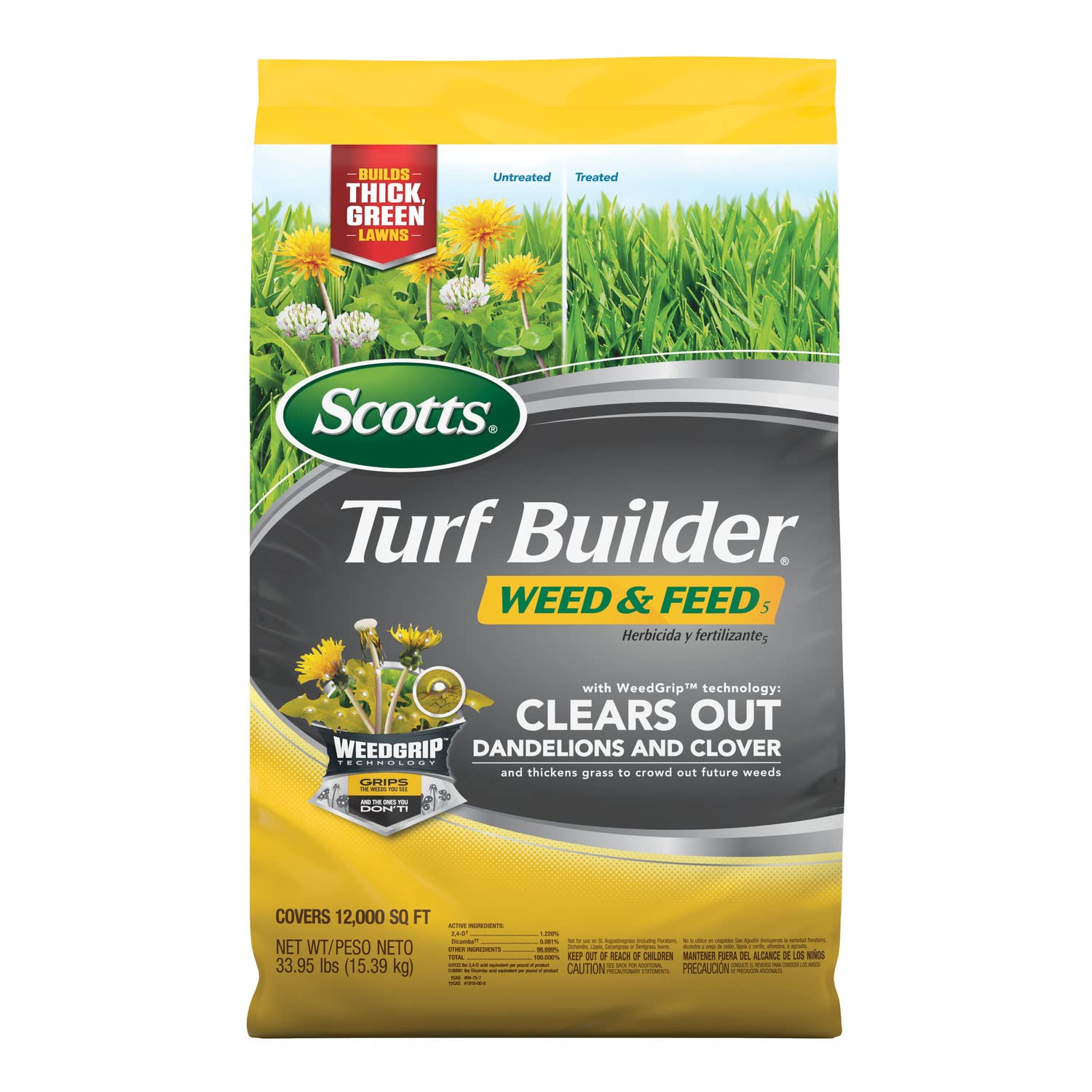
Scotts Turf Builder Weed & Feed5 Granular Lawn Fertilizer (33.95 lb)
| Item Form | Granule |
|---|---|
| Coverage | 12000 square feet |
| Active Ingredients | 2.4‑D and Dicamba |
| Unit Count | 1 Count |
Scotts Turf Builder Weed & Feed5 is a combined granular weed killer and lawn fertilizer intended for use when broadleaf weeds are actively growing and daytime temperatures are between 60°F and 90°F. You apply it to a wet lawn with a broadcast, drop, or hand spreader (Scotts publishes spreader settings) and then avoid watering for 24 hours to let granules stick to weed leaves. The formula uses WeedGrip technology and active ingredients 2,4‑D and dicamba to target common lawn weeds such as clover and dandelion while the fertilizer portion delivers nitrogen and potassium to thicken turf. A single 33.95 lb. bag is sized to cover about 12,000 square feet, making it convenient for medium to large yards. Important limits: do not use on St. Augustine, bentgrass, dichondra, carpetgrass, or lippia and do not apply if rain is expected within 24 hours; the product can also require keeping people and pets off treated turf until dust settles. For homeowners seeking a combined weed control plus feeding step, this simplifies late‑spring applications, but those with excluded grass types or who need precise spot treatments should consider alternatives.
Best for: Homeowners with warm‑season Bahia and other listed grass types who want a single late‑spring application to control broadleaf weeds while feeding the lawn and prefer products with established brand usage guidance.
Less Ideal for: Anyone growing St. Augustine, bentgrass, dichondra, carpetgrass, or lippia or gardeners who need spot treatments, organic options, or year‑round fertilization plans.
- Kills a wide range of listed broadleaf lawn weeds including clover and dandelion using WeedGrip technology
- Feeds lawn while treating weeds so it both reduces weeds and promotes thicker turf
- Large 33.95 lb. bag covers up to 12,000 sq ft, suitable for medium to large lawns
- Published application guidance and spreader settings make it straightforward to apply evenly
- Not safe for use on several turf types including St. Augustine and bentgrass
- Requires dry window after application and restriction on people and pets until dust settles
- Contains synthetic herbicides that require careful handling and label compliance
Verdict: A convenient, proven weed‑and‑feed option for Bahia and other compatible lawns that combines broadleaf weed control with feeding in one late‑spring application.
Scotts Turf Builder WinterGuard Fall Weed & Feed (33.84 lb)

| Item Form | Granule |
|---|---|
| Coverage | 12000 sq ft |
| Unit Count | 541.44 Ounce |
Scotts Turf Builder WinterGuard Fall Weed & Feed is a granular all-in-one product for fall lawn care that combines weed control and fertilizer to strengthen turf before winter. It is applied with a broadcast or drop spreader to a wet lawn on calm days when weeds are actively growing and temperatures are between 60°F and 90°F. The formulation claims control of over 50 listed weeds such as dandelion and clover while delivering nutrients to build stronger roots and help turf recover from summer stress. Practical benefits include wide coverage from a single 33.84 lb. bag, straightforward spreader settings provided by the manufacturer, and timing guidance that helps maximize efficacy. Important limitations are that it is season-specific for fall application and requires following precise conditions around moisture, temperature, and no rain for 24 hours after application to work correctly. Also it is a conventional chemical treatment so users should follow safety instructions to avoid exposure to children, pets, and non-target plants.
Best for: Homeowners who prioritize a dependable, single-step fall treatment to reduce weeds and strengthen lawns for spring and who follow label directions and application timing carefully.
Less Ideal for: People seeking an all-season weed control plan or organic/chemical-free alternatives should consider different products or integrated approaches.
- Combines weed control and fertilizer in one fall application to simplify lawn care
- Manufacturer provides specific spreader settings for accurate application
- Covers up to 12,000 sq ft from a single bag for broad yard coverage
- Targets over 50 common lawn weeds while promoting stronger root development
- Formulated for fall use only and not suitable as a general year-round weed solution
- Requires specific weather and moisture conditions and a 24-hour rain-free window for best results
Verdict: A reliable fall-focused weed-and-feed that simplifies prep for a healthier lawn next spring by combining broad weed control with fertilizer in one application.
Choosing the Right Weed and Feed for Sod: Key Factors to Consider
Turf Safety on New Sod
Newly installed sod is more vulnerable to herbicide and high-salt fertilizers than established turf. Products vary in how soon they can be applied after laying sod and in the gentleness of their herbicide chemistry. Look for weed and feed options that specify use on new sod or provide a clear waiting period. A product labeled safe for sod typically uses herbicides and fertilizer carriers that limit leaf scorch and root uptake stress.
Applying a product not rated for new sod can cause yellowing, stunting, or patchy establishment, which delays a uniform lawn. If the label requires waiting several weeks, plan fertility and weed control around that window to avoid setbacks.
Fertilizer Analysis and Release Type
The nutrient ratio and release mechanism affect root development and topgrowth of new turf. A balanced starter-style analysis with slightly higher phosphorus can support root establishment, while controlled-release nitrogen provides steady growth without a sudden flush that increases water demand. Granular slow-release formulations reduce burn risk on young sod and extend feeding over weeks.
Conversely, high rates of quick-release nitrogen will spike topgrowth and can tax roots, requiring more frequent watering and increasing stress. Match the fertilizer analysis to the growth stage: early root-building benefits from steady, moderate nitrogen and available phosphorus.
Herbicide Spectrum and Mode of Action
Weed and feed products combine fertilizer with herbicide active ingredients that target broadleaf weeds, grassy weeds, or both. For new sod, the herbicide spectrum matters because some actives can injure certain turf species or be too aggressive on seedlings. Prefer formulations with selective herbicides labeled safe for the turf species in your sod and that target the common weeds in your region.
Understanding mode of action helps with long-term weed control planning. Using products with different modes across seasons reduces the chance of resistance and improves control of recurring weeds.
Timing and Application Window
Correct timing is critical when treating sod. Labels will state the minimum number of days to wait after installation before applying the product, and whether treatment is appropriate before or after the first mowing. Applying at the wrong time risks phytotoxicity or reduced herbicide effectiveness. Ideal timing aligns fertilizer release with root growth and applies herbicide when target weeds are actively growing.
Also consider seasonal timing: some herbicides work best in cool-season windows for broadleaf control while others target warm-season weeds in summer. Plan applications around local climate and sod species to maximize benefit and minimize harm.
Application Method and Ease
Different weed and feed formats require different applicators and techniques. Granular spreader-applied products offer quick coverage for larger lawns, while liquid concentrates can provide more uniform application for irregular areas. Ease of calibration, clear spreader settings or dilution ratios, and labeled coverage rates are important to avoid over- or under-application.
Consider whether you have the right equipment and confidence to apply the product uniformly. Poor application can create streaks, missed spots, or burned edges that compromise newly installed sod.
Environmental and Safety Considerations
Herbicides and fertilizers can affect pollinators, waterways, and soil life. Choose formulations with lower runoff risk and follow label instructions to prevent drift and pond contamination. Many labels include buffer zone guidance and specific pre- and post-application irrigation recommendations to reduce environmental impact.
Personal safety matters too. Look for products with clear PPE requirements, re-entry intervals, and pet-safety instructions so you can plan timing relative to household use of the lawn.
When to Wait Before Applying Weed and Feed
Labels often specify a waiting period after sod installation. That interval reflects how long the turf needs to knit to the soil and develop roots that can tolerate herbicidal activity. Waiting the recommended number of days reduces the chance of scorch and ensures nutrients are taken up by roots rather than stressing foliage.
If you are unsure, err on the side of waiting an extra week and focus initially on proper watering and the first two mowings. Postpone broad-spectrum treatments until the turf shows steady rooting and normal growth patterns.
- Check label for minimum days after installation before application
- Avoid herbicide application right after heavy irrigation or drought stress
- Time treatments to active weed growth for better control
How to Match Feeding to Sod Species
Different grass species have different nutrient needs and seasonal growth rhythms. Cool-season grasses establish best with moderate nitrogen in early fall or spring, while warm-season grasses respond to feeding in late spring through summer. Choose a weed and feed whose fertilizer analysis aligns with your sod species and planting time.
If the product does not align with your grass type, consider a dedicated starter fertilizer now and delay herbicide-containing products until the turf is more established and the label permits.
- Know whether your sod is cool-season or warm-season
- Match feeding schedule to species growth peaks
- Consider separate starter fertilizer if timing or composition is off
Application Tips to Protect New Sod
Calibrate your spreader or measure liquid mixes carefully to apply a uniform rate. Uneven application can cause burn or inconsistent weed control. Apply on calm, dry days to prevent drift and wash-in, and avoid watering for the interval specified on the label so herbicides can be absorbed by target weeds.
After application, follow any re-entry and irrigation instructions. For granular products, light grooming of piles and a gentle watering schedule may help prevent surface salt buildup and aid nutrient movement to roots.
- Use proper spreader settings and walk at a steady pace
- Avoid treating under extreme heat or drought
- Follow label irrigation timing to reduce runoff and tissue injury
Combining Treatments with Overseeding or Repairs
If you plan to overseed or patch bare spots after laying sod, be cautious with weed-and-feed timing. Herbicides can inhibit new seed germination depending on active ingredient and persistence. Coordinate repairs and seeding windows so that herbicidal residuals have declined before establishing new seed.
For isolated spot repairs, consider using non-herbicidal starter fertilizers, hand-weeding, or targeted spot treatments until the sod is fully established and broad applications are safe.
- Delay seeding until herbicide residuals are low
- Use starter fertilizer for seed germination instead of broad herbicides
- Perform spot treatments rather than blanket applications when repairing
Environmental Best Practices
Minimize runoff by avoiding application before heavy rain and by following label irrigation guidance. Maintain buffer zones near streams, ponds, and storm drains. Use only the labeled rate and avoid overlapping passes when spreading granules to reduce cumulative loading.
Store and dispose of unused product according to label instructions. Consider integrated pest management steps such as hand-weeding, mowing at the correct height, and improving soil health to reduce reliance on chemical controls over time.
- Do not apply before forecasted heavy rain
- Keep products away from water features and drains
- Adopt cultural practices to reduce future weed pressure
How We Chose the Best Weed and Feed for Sod
We focused on products that explicitly address use on recently installed or establishing sod. Our editorial filters prioritized labeled turf safety for new sod, fertilizer analysis suited to root development, and herbicide activity targeting common grassy and broadleaf weeds without harming young turf. We also considered application flexibility, including spreader vs liquid use, and clarity of timing instructions to avoid early application that can stress sod. Concrete evaluation criteria included active ingredient profiles and labeled sod safety, N-P-K balance and release characteristics, herbicide spectrum and residual activity, and ease of application and timing guidance. We excluded products labeled only for established turf, overseeding-only formulas, and formulations with unclear usage windows for new sod. Finally, we looked for clear label instructions and safety margins that help gardeners time treatment to support healthy sod establishment.
FAQ
Can I apply weed and feed immediately after laying sod?
Usually you must wait. Many products require a waiting period after installation to avoid turf injury. Check the label for the minimum days to wait and observe the sod for signs of rooting before treating.
Will a weed and feed harm my new sod if I water right after application?
It depends on the product. Some labels require a delay before irrigation to allow herbicide uptake by weeds, while others recommend light watering to move fertilizer into the root zone. Follow the product instructions to avoid reduced effectiveness or increased burn risk.
Should I use a starter fertilizer instead of a weed and feed for new sod?
Often a starter fertilizer is a safer early-season choice because it supplies nutrients without herbicides that may stress young turf. Use a weed-and-feed only when the label permits treatment on new sod and when weed pressure justifies combined action.
How do I know if my sod is ready for herbicide-containing treatments?
Look for consistent rooting across the sod pieces, steady growth after several mowings, and no signs of transplant stress. Labels also give specific timeframes; use those together with visual cues to decide.
Can herbicide residues affect future overseeding or repairs?
Yes. Some herbicides have residual activity that inhibits seed germination for weeks to months. Check the product residual statement and avoid overseeding until the label indicates it is safe.
Are granular or liquid weed and feed products better for new sod?
Granular slow-release fertilizers reduce burn risk and are easy to apply over large areas, while liquid concentrates can offer more uniform coverage for irregular lawns. The best choice depends on lawn size, applicator availability, and the product label's guidance for sod.
Final Verdict
Prioritize turf-safe formulations and clear timing when choosing a weed and feed for sod. Focus on products with fertilizer analyses that support root establishment, herbicide labels that specifically permit use on new sod, and application methods you can execute accurately. Expect tradeoffs between quick weed control and the caution required during establishment; when in doubt, favor gentler fertility now and delay aggressive weed control until the turf is firmly rooted. Use the evaluation criteria above to weigh options and pick a treatment that balances green-up, weed control, and long-term turf health for your sod installation.
