

Note: This article contains affiliate links. If you click on these links and make a purchase, I may earn a small commission at no extra cost to you. This helps support my research and content. Read my full affiliate disclosure here.
Sandy soil drains quickly and holds nutrients poorly, so a standard lawn treatment often washes away or gives uneven results. Picking a weed-and-feed formulated for sandy soil helps you control common broadleaf weeds while delivering fertilizer that stays active long enough to benefit grass roots. This guide covers the top shortlisted options for sandy conditions and explains the practical differences that matter in real yards and coastal properties. You will see how we evaluated spread pattern, fertilizer release, weed-killing spectrum, and salt or nutrient loading so you can choose a product that matches your turf type and maintenance routine.
Top Picks at a Glance
| Best Overall The best all-around choice for most situations | BioAdvanced 5-in-1 Weed and Feed Granules (9.6 lb) |  |
| Best Quality Built to a higher standard if you want something more solid | Jonathan Green Veri-Green Southern Weed & Feed Fertilizer (5,000 sq ft) |  |
| Best Value The sweet spot between price and what you get | GreenView Weed & Feed Lawn Fertilizer, 13 lb Bag |  |
| Best Budget The cheapest option that still gets the job done reliably | Bonide Liquid Weed & Feed 20-0-0 Ready-to-Spray, 32 oz |  |
| Most Popular A crowd favorite that many people choose with confidence | Scotts Turf Builder Weed & Feed5 Granular Lawn Fertilizer (33.95 lb) |  |
| Best Seller A high-volume bestseller chosen again and again | Scotts Turf Builder Halts Crabgrass Preventer with Lawn Food (covers 5,000 sq. ft.) |  |
BioAdvanced 5-in-1 Weed and Feed Granules (9.6 lb)

| Item Form | Granule |
|---|---|
| Coverage | 4000 square_feet |
| Active Ingredients | Dicamba, Quinclorac |
BioAdvanced 5-in-1 Weed and Feed is a granular lawn treatment that combines multiple herbicides with fertilizer so you can kill existing weeds and feed turf in a single application. You apply it with a broadcast or drop spreader to an established, dry lawn, then water in and avoid mowing for at least a day. The formula targets over 200 broadleaf weeds and large crabgrass and creates a soil barrier that helps prevent new listed weeds for up to six months while feeding and greening the lawn for about three months. Practical features include granular form for easy even coverage and instructions for follow-up watering and safety precautions. Important limitations are usual for combined herbicide-fertilizers: it is intended for established turf rather than newly seeded lawns, and precautions are needed around children, pets, and windy applications. It is not labeled for sale in all states and requires following label directions closely for best results.
Best for: Homeowners who want a low-effort, maintenance-friendly product to reduce separate purchases and applications and keep an established lawn greener while controlling common weeds.
Less Ideal for: People establishing a new lawn from seed, managing sensitive ornamentals near turf, or those who prefer non-chemical weed control methods.
- Combines weed control and fertilizer in one application for convenience
- Controls both broadleaf weeds and large crabgrass and helps prevent new weeds for up to six months
- Granular formula spreads evenly with a broadcast or drop spreader for uniform coverage
- Feeds and greens turf for up to three months after application
- Not suitable for newly seeded or delicate lawns where herbicides can inhibit germination
- Requires careful handling and exclusion of children and pets until treated areas are dry
Verdict: Use this product when you want one granular application to both kill common and crabgrass weeds and feed an established lawn for months of reduced maintenance.
Jonathan Green Veri-Green Southern Weed & Feed Fertilizer (5,000 sq ft)

| Item Form | Granule |
|---|---|
| Coverage | 5000 square foot |
| Unit Count | 184 Ounce |
| N-P-K Ratio | 30-0-3 |
Jonathan Green Veri-Green Southern Weed & Feed combines a 30-0-3 fertilizer with a post-emergent broadleaf weed control designed for warm-season turf. You spread the granules across an established St. Augustine lawn (or other southern grasses) to feed the turf and actively kill more than 40 common weeds such as dollarweed and dandelions. The product is intended for spring or fall application and is most effective when applied to actively growing weeds and watered in or applied to dew-covered grass so granules adhere. The high-nitrogen formula promotes quick greening and denser growth while helping the lawn better withstand heat. Because it is a granular, coverage is easy to measure and the single bag treats up to 5,000 sq ft. Limitations to note are that it is not labeled for cool-season grasses and it is a combined weed-and-feed approach, so you cannot target weeds without also applying fertilizer; follow label directions to avoid overapplication or use on newly seeded areas until safe per instructions.
Best for: Homeowners with established St. Augustine or other southern warm-season lawns who want a single, practical product to both feed turf and reduce broadleaf weeds without complex scheduling.
Less Ideal for: People maintaining cool-season lawns, those seeding new turf where selective fertilization is required, or gardeners who prefer spot-treating weeds rather than treating the entire lawn.
- Formulated specifically for southern warm-season grasses including St. Augustine
- 30-0-3 NPK promotes rapid greening and denser turf
- Controls over 40 common broadleaf weeds
- Granular formula covers up to 5,000 sq ft for straightforward application
- Not suitable for cool-season lawns or where selective weed-only treatment is preferred
Verdict: A convenient, purpose-built weed-and-feed for St. Augustine and other southern warm-season lawns that feeds turf while controlling a wide range of broadleaf weeds across 5,000 sq ft.
GreenView Weed & Feed Lawn Fertilizer, 13 lb Bag

| NPK | 27-0-4 |
|---|---|
| Form | Granule |
| Coverage | 5000 square_feet |
| Active ingredient | Nitrogen |
GreenView Weed & Feed is a combined granular fertilizer and selective herbicide designed to feed established turf while controlling broadleaf weeds. You apply it to a dry, established lawn when weeds are actively growing, then water to activate the product and avoid mowing for two days. It uses a controlled-release nitrogen formulation to deliver steady feeding for up to eight weeks, which helps green-up without pushing surge growth and supports deeper roots for better drought tolerance. The herbicide component targets more than 250 common lawn weeds such as dandelion, clover, and plantain, so one application handles both nutrition and weed pressure across many cool- and warm-season grasses. Practical benefits include long feeding duration, wide weed control, and coverage suitable for medium to large yards. Important limitations are that it is for established turf only, it can damage certain grasses like St. Augustine (in Florida), dichondra, and carpetgrass, and timing matters because weeds must be actively growing for best control.
Best for: Homeowners who want a single, budget-friendly product to both feed and reduce broadleaf weeds on established lawns and prefer less frequent applications over the season.
Less Ideal for: Gardeners establishing new turf, owners of sensitive or excluded grass types, or those seeking an organic or granular fertilizer without herbicide.
- Controlled-release nitrogen feeds lawns for up to eight weeks, reducing the need for frequent applications
- Provides selective control of over 250 broadleaf weeds alongside fertilization
- Covers approximately 5,000 square feet from a single 13 lb bag, suitable for medium to large yards
- Zero phosphate formulation to reduce risk of waterway runoff
- Not safe for certain turf types such as St. Augustine in Florida, dichondra, and carpetgrass
- Requires correct timing and watering after application for effective weed control
- Intended only for established lawns and can harm seedlings or sensitive grasses
Verdict: A cost-effective all-in-one weed-and-feed that delivers eight weeks of controlled-release nitrogen while knocking back a wide range of common broadleaf weeds.
Bonide Liquid Weed & Feed 20-0-0 Ready-to-Spray, 32 oz

| Liquid Volume | 32 fluid ounces |
|---|---|
| Coverage | 2,500 square feet |
| Item Form | Spray |
| Active Ingredients | Nitrogen |
This Bonide Liquid Weed & Feed is a straightforward lawn treatment that mixes fertilizer with broadleaf weed control in a hose-end ready bottle. You connect your garden hose to the attached sprayer, flip the on/off switch and apply without measuring or mixing. The formula delivers 20% nitrogen for quick green-up while including 2,4-D and 2,4-DP to target common broadleaf weeds like dandelion, clover, and plantain. A single 32 oz bottle covers about 2,500 square feet, which makes it useful for small to medium yards or spot treating larger lawns. Notable perks are the convenience of the integrated sprayer and the dual-action fertilizer plus herbicide in one pass. Important limitations: it is selective for turf but still requires care around desirable ornamentals and water, and safety precautions are needed for pets and children. Also it contains standard phenoxy herbicides, so it is not suitable where those active ingredients are restricted. For budget-focused buyers it is easy to use and can reduce time compared with separate products, but you should follow label directions closely to avoid off-target damage.
Best for: Budget-minded homeowners who want a quick, no-mix solution to green up St. Augustine lawns while knocking back common broadleaf weeds with a single application.
Less Ideal for: Specialty lawn stewards who need herbicide-free or organic options, or properties with sensitive ornamentals and water features where phenoxy herbicides are prohibited.
- Ready-to-spray bottle with attached hose-end sprayer for no-mix application
- Combines 20-0-0 nitrogen fertilizer and broadleaf herbicides in one treatment
- One quart treats up to 2,500 square feet, useful for small to medium lawns
- Targets a wide list of common broadleaf weeds found in turf
- Contains 2,4-D and 2,4-DP which can harm nearby ornamentals and is not appropriate near water sources
- Not formulated for non-target plants and requires protective gear and careful application
Verdict: A convenient, low-cost ready-to-spray weed-and-feed that treats up to 2,500 sq ft and simplifies broadleaf control and nitrogen feeding in one step.
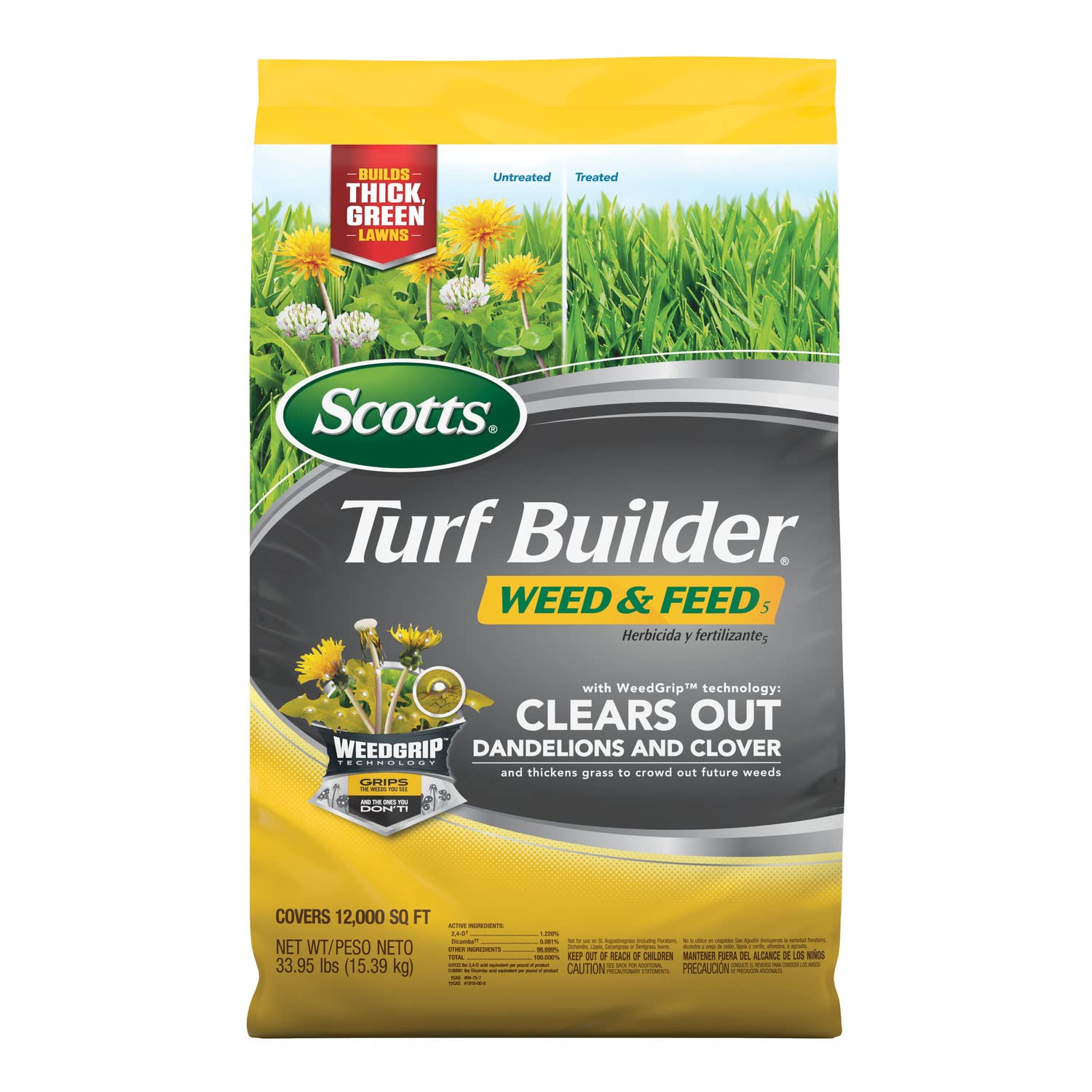
Scotts Turf Builder Weed & Feed5 Granular Lawn Fertilizer (33.95 lb)
| Item Form | Granule |
|---|---|
| Coverage | 12000 square feet |
| Active Ingredients | 2.4‑D and Dicamba |
| Unit Count | 1 Count |
Scotts Turf Builder Weed & Feed5 is a combined granular weed killer and lawn fertilizer intended for use when broadleaf weeds are actively growing and daytime temperatures are between 60°F and 90°F. You apply it to a wet lawn with a broadcast, drop, or hand spreader (Scotts publishes spreader settings) and then avoid watering for 24 hours to let granules stick to weed leaves. The formula uses WeedGrip technology and active ingredients 2,4‑D and dicamba to target common lawn weeds such as clover and dandelion while the fertilizer portion delivers nitrogen and potassium to thicken turf. A single 33.95 lb. bag is sized to cover about 12,000 square feet, making it convenient for medium to large yards. Important limits: do not use on St. Augustine, bentgrass, dichondra, carpetgrass, or lippia and do not apply if rain is expected within 24 hours; the product can also require keeping people and pets off treated turf until dust settles. For homeowners seeking a combined weed control plus feeding step, this simplifies late‑spring applications, but those with excluded grass types or who need precise spot treatments should consider alternatives.
Best for: Homeowners with warm‑season Bahia and other listed grass types who want a single late‑spring application to control broadleaf weeds while feeding the lawn and prefer products with established brand usage guidance.
Less Ideal for: Anyone growing St. Augustine, bentgrass, dichondra, carpetgrass, or lippia or gardeners who need spot treatments, organic options, or year‑round fertilization plans.
- Kills a wide range of listed broadleaf lawn weeds including clover and dandelion using WeedGrip technology
- Feeds lawn while treating weeds so it both reduces weeds and promotes thicker turf
- Large 33.95 lb. bag covers up to 12,000 sq ft, suitable for medium to large lawns
- Published application guidance and spreader settings make it straightforward to apply evenly
- Not safe for use on several turf types including St. Augustine and bentgrass
- Requires dry window after application and restriction on people and pets until dust settles
- Contains synthetic herbicides that require careful handling and label compliance
Verdict: A convenient, proven weed‑and‑feed option for Bahia and other compatible lawns that combines broadleaf weed control with feeding in one late‑spring application.
Scotts Turf Builder Halts Crabgrass Preventer with Lawn Food (covers 5,000 sq. ft.)

| Item Form | Granule |
|---|---|
| Coverage | 5000 square feet |
| Unit Count | 213.6 Ounce |
| Fertilizer analysis | 30-0-4 |
Scotts Turf Builder Halts combines a pre-emergent crabgrass preventer with a granular lawn fertilizer to protect and feed an established lawn through the spring. You apply it once in early spring to a dry lawn before regular hot weather, using a broadcast or drop spreader and then water the lawn lightly within 2 to 3 days so the active ingredient forms a barrier in the soil. The product covers 5,000 sq. ft. per bag and is formulated to prevent several grassy and broadleaf weeds while the 30-0-4 fertilizer helps grass green up quickly and build deeper roots. Practical benefits include season-long prevention of new crabgrass and simultaneous feeding, which reduces extra steps in spring lawn care. Limitations are that it will not kill mature crabgrass or existing weeds and it is not suitable for certain turf types like dichondra or bentgrass. Also, correct spreader settings and post-application watering are important for reliable performance, so casual or inexperienced applicators should follow directions closely.
Best for: Homeowners who prioritize reliable, season-long prevention and want a simple spring treatment that both blocks new crabgrass and feeds the lawn.
Less Ideal for: People needing a post-emergent weed killer for existing crabgrass or those managing dichondra or bentgrass turf should choose a different product.
- Pre-emergent formula prevents crabgrass and several other grassy weeds when applied correctly
- Includes fertilizer (30-0-4) for fast green-up and stronger root development
- Single-application coverage for 5,000 sq. ft. reduces repeat treatments in spring
- Granular form works with common broadcast and drop spreaders for even application
- Does not control established or mature crabgrass or existing weeds
- Not safe for use on dichondra and bentgrass lawns
Verdict: Choose this product if you want a dependable one-time early-spring treatment that prevents new crabgrass while feeding and strengthening your lawn.
Choosing the Right Weed and Feed for Sandy Soil: Key Factors to Consider
Nutrient Release and Leaching Risk
Sandy soils drain quickly, making leaching the primary concern when choosing a weed-and-feed. Products with controlled-release nitrogen or coatings that slow nutrient dissolution give plants a longer window to take up nutrients instead of losing them below the root zone. Matching the release profile to your irrigation schedule reduces wasted fertilizer and lowers the chance of salt buildup in the root zone.
Consider formulations with a mix of fast-acting and slow-release nitrogen so you get an initial green-up plus sustained feeding. Avoid high concentrations of readily soluble salts unless you can limit irrigation immediately after application.
Herbicide Spectrum for Common Sandy-Soil Weeds
Different herbicides target different groups of broadleaf weeds and grassy invaders. In sandy sites, weeds can germinate rapidly after rainfall, so choose a product whose active ingredients control the species that appear in your lawn profile-dandelions, clover, plantain, and others. Contact-only herbicides may need more frequent applications, while systemic options can provide longer control but require careful timing relative to turf growth and irrigation.
Also look for label guidance about effectiveness on newly emerged versus established weeds, and whether the product is safe for overseeding or repair work soon after application.
Application Form and Spread Pattern
Granule size, shape, and density affect how evenly a weed-and-feed distributes over sparse or uneven turf often found in sandy yards. Lightweight, irregular granules can bounce off blades and end up in drifts, producing patchy results. Products with uniform, coated granules tend to spread more predictably and help match nutrient and herbicide coverage across the lawn.
Think about the type of spreader you will use and calibrate it. Some products include spreader settings on the label; following those recommendations reduces streaking and ensures a consistent application rate.
Turf Safety and Salt Concerns
Sandy soils can concentrate salts near the surface when irrigation evaporates, so any weed-and-feed with high soluble salt content raises the risk of leaf burn or root stress. Choose formulations with lower salt indexes and slower nutrient release to protect young or thin turf. Also consider the turf species tolerance-some grasses handle certain herbicides or fertilizer blends better than others.
Timing applications when grass is actively growing and not under heat or drought stress reduces the chance of injury. If salinity is already an issue, opt for gentler nutrient blends and increase irrigation after the recommended wait period to help move salts away from roots.
Timing, Watering, and Maintenance Compatibility
How soon you plan to water, mow, or overseed affects product choice. Some weed-control ingredients require a dry period after application to be absorbed by weeds, while fertilizers may need irrigation to move into the root zone. On sandy soil, the balance is delicate: too much water too soon increases leaching, but too little reduces uptake.
Read label instructions closely for post-application watering windows and mowing restrictions. Also consider seasonal timing-apply when weeds are actively growing and turf is receptive to nutrient uptake for best results.
Environmental and Local Regulations
Products containing certain herbicides or higher concentrations of phosphorus may be restricted in some municipalities or during particular seasons. Sandy soils near waterways or with rapid drainage present a higher risk of nutrient runoff, so choose products and application rates that comply with local guidelines.
Check local extension recommendations and follow label limits to reduce environmental impact. Buffer zones and timing restrictions are common in coastal or watershed-protection areas.
Preparing Sandy Soil Before Application
Before applying any weed-and-feed, prepare the lawn so the product can work effectively. Remove debris and mow to the recommended height; cutting too short exposes soil and increases the chance that granules will reach bare sand rather than grass blades. Water deeply a day or two before application only if the turf is drought-stressed-moist root zones take up nutrients and herbicides more readily than bone-dry turf.
If the lawn has large bare patches, consider seeding or repair after you allow the weed-control window to pass. Spreading product onto very thin turf produces uneven results and can harm seedlings if you plan to overseed soon.
- Mow at normal height and collect clippings if recommended by the label
- Avoid applying to waterlogged or saturated ground
- Mark irrigation heads and adjust run times after application
Adjusting Application Rates for Patchy Coverage
Sandy yards often have areas of thin turf and exposed soil. Instead of blanket applications at full rate that risk overfeeding some spots, consider using targeted spreader passes or blending with a lower-rate product to even out coverage. Calibrate your spreader and walk at a steady pace to avoid streaks.
For small problem areas, spot-treating with a compatible herbicide and using a turf fertilizer on the rest of the lawn can be an effective approach. That prevents excessive chemical exposure to stressed grass in thin patches.
- Calibrate spreader using a test strip to confirm output
- Overlap passes by 30 percent for uniform coverage
- Avoid double-applying over the same area
Post-Application Care in Fast-Draining Lawns
After applying a weed-and-feed suited to sandy soils, follow label guidance for watering. Many formulations recommend a light irrigation to move fertilizer into the root zone but warn against heavy early watering that increases leaching. In sandy soil, split the recommended irrigation into shorter cycles to give roots a chance to absorb nutrients between soakings.
Monitor the lawn for stress signs in the week after application. If hot, windy weather follows, shade and supplemental watering may be necessary to prevent turf browning while the herbicide acts on target weeds.
- Use short irrigation cycles spaced across several hours
- Avoid mowing for the interval recommended by the label
- Watch for uneven green-up as a sign of application gaps
Dealing with Low Organic Matter
Sandy soils usually lack organic matter, which reduces nutrient-holding capacity and microbial activity that helps break down some herbicides. Incorporating organic matter through topdressing or regular applications of compost can improve long-term nutrient retention and reduce dependence on repeat chemical applications.
While adding organics is a longer-term fix, it also supports root growth and helps the lawn tolerate treatments. Pairing a structured soil-improvement plan with a suitable weed-and-feed schedule yields more consistent results season to season.
- Topdress thin areas with a thin layer of compost or loam
- Consider soil tests to guide amendments
- Aim to gradually increase organic matter over several seasons
How We Chose the Best Weed and Feed for Sandy Soil
We focused on products that are specifically suitable for sandy soils or that include features that mitigate high drainage and low nutrient retention. Our selection filters favored formulations with slower nutrient release or starter blends that reduce leaching, weed-control chemistries effective on common broadleaf species in loose soil, and application forms that promote even distribution on low-organic ground. We also considered granule size and coating technologies because they affect how long nutrients remain available in coarse-textured profiles. Exclusions included specialty herbicides meant only for spot treatment, fertilizer-only products without a weed-control component, and formulations labeled exclusively for ornamental beds rather than turf. We prioritized options with clear application windows and label guidance for sandy sites, plus products that balance nitrogen source and persistence to avoid burning or wastage. Practical factors such as ease of spreading, watering timing, and compatibility with irrigation systems were used as well, since they determine real-world performance in sandy lawns.
FAQ
Can I apply weed-and-feed on newly seeded areas in sandy soil?
Usually you should avoid applying weed-and-feed to newly seeded lawns until seedlings are well established. Many products can damage young grass. Check the label for the recommended wait period after seeding; in sandy soil, young roots are especially vulnerable.
How soon should I water after applying weed-and-feed on sandy soil?
Timing depends on the formulation. Some products ask for light irrigation within 24 hours to move fertilizer into the root zone, while herbicide uptake may prefer a dry window. On sandy soil, use short, staged irrigations to reduce leaching while still activating nutrient uptake.
Will sandy soil reduce herbicide effectiveness?
Sandy soil can affect contact and persistence but does not inherently make herbicides ineffective. Rapid drainage and low organic matter can reduce residual activity, so choose formulations and application timing that compensate for quick turnover.
Is it better to spot-treat weeds in patchy sandy lawns?
Often yes. Spot-treating dense weed patches while using a lighter fertilizer program for the rest of the lawn reduces chemical load on stressed turf and prevents over-application in thin areas.
Should I change my spreader settings for sandy soil?
Adjust settings based on the product label and perform a test pass. Sandy-site turf can be patchy, so maintain a steady walking speed and overlap passes slightly to ensure even distribution and avoid streaking.
Final Verdict
For sandy soil, prioritize formulations that limit leaching and provide even herbicide coverage while being gentle on thin or drought-prone turf. Balance controlled-release nutrient profiles with an herbicide spectrum that matches the weeds you commonly see, and pay attention to granule consistency and spreader calibration. With careful timing and modest post-application irrigation, you can control weeds and support healthier grass without wasting fertilizer or stressing the lawn.
