

Note: This article contains affiliate links. If you click on these links and make a purchase, I may earn a small commission at no extra cost to you. This helps support my research and content. Read my full affiliate disclosure here.
Red spider mites can strip leaves, stunt growth, and spread rapidly across houseplants, vegetable gardens, and ornamentals. Picking the right red spider mite killer matters because treatments vary in how quickly they reduce mite populations, how gentle they are on foliage and beneficial insects, and how much residue they leave behind. This guide covers seven shortlisted options that represent effective approaches for home gardeners. We explain the practical tradeoffs you should expect in the garden and outline the evaluation criteria used so you can choose the best fit for your situation. Read on for concise, gardener-focused guidance before the product details.
Top Picks at a Glance
| Best Overall The best all-around choice for most situations | EcoVenger Mite Killer Spray 16 oz by EcoRaider |  |
| Best Quality Built to a higher standard if you want something more solid | BioAdvanced 3-in-1 Insect, Disease & Mite Control Concentrate, 32 oz |  |
| Best Value The sweet spot between price and what you get | Grower's Ally Crop Defender 3 Concentrate, 24 oz |  |
| Best Budget The cheapest option that still gets the job done reliably | Bonide Insecticidal Soap Ready-to-Use Spray, 32 oz |  |
| Highest Rated A top-rated pick with lots of positive feedback | NatureStop Spider Mite Killer for Plants, 16 oz |  |
| Most Popular A crowd favorite that many people choose with confidence | Bonide Captain Jack's Ready-to-Use Neem Oil Spray, 32 oz |  |
| Best Seller A high-volume bestseller chosen again and again | Atticus Talak 7.9% Bifenthrin Indoor/Outdoor Insecticide Concentrate, 32 oz |  |
EcoVenger Mite Killer Spray 16 oz by EcoRaider

| Net volume | 16 oz |
|---|---|
| Active ingredients | Geraniol, Lemongrass Oil, Sodium Lauryl Sulfate |
| Formulation | Ready-to-use water-based spray |
| Intended uses | Plants, bedding, upholstery, pets, poultry |
EcoVenger Mite Killer is a botanical, ready-to-use spray formulated to eliminate spider mites and other mite species at eggs, larval and adult stages. Typical use is simple: shake and apply a light, even mist to infested leaves, stems, or indoor plants; it can also be sprayed on bedding, carpets, upholstery, and pet areas, then allowed to air dry. The formula lists geraniol and lemongrass oil as active ingredients and is water-based and non-staining, so it leaves little visible residue and a mild natural scent instead of strong chemical fumes. For gardeners facing red spider mite outbreaks, the product’s ovicidal claim and multi-stage efficacy make it useful for breaking the breeding cycle. Limitations include reliance on botanical actives that may require thorough coverage and repeat applications for heavy infestations, and the nozzle contains delicate parts that can be damaged if mishandled. Follow label directions and keep spray away from eyes and children.
Best for: Gardeners and houseplant owners who want a safer, plant-compatible option to control red spider mites and prefer botanical solutions over conventional pesticides.
Less Ideal for: Commercial growers or users facing very large or heavily established infestations who need fast-acting synthetic miticides or systemic controls.
- Kills multiple mite species and targets all life stages including eggs according to the label
- Plant-based, water-based formula designed to be non-staining with a mild natural scent
- Safe for use on indoor and outdoor plants as well as fabrics and pet areas when used as directed
- Botanical actives may need repeat treatments and careful coverage for severe or established infestations
- Spray nozzle is noted as delicate and can be damaged if mishandled
Verdict: A plant-powered, ready-to-use spray that effectively targets red spider mites at all life stages while being safe for use on plants and around the home.
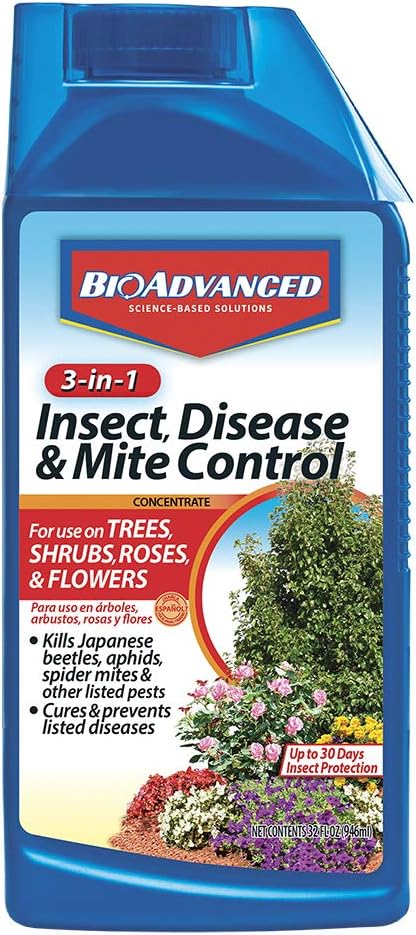
BioAdvanced 3-in-1 Insect, Disease & Mite Control Concentrate, 32 oz
| Unit Count | 32 Fluid Ounces |
|---|---|
| Item Type Name | Concentrate |
| Liquid Volume | 32 fluid ounces |
| Active Ingredients | Imidacloprid, Tau-fluvalinate, Tebuconazole |
| Specification Met | EPA |
This BioAdvanced concentrate is designed as an all-purpose plant treatment that kills listed insects on contact, controls common fungal diseases, and suppresses spider mites in one product. You mix the concentrate with water to make spray solution (it yields up to about 12 gallons), then apply to roses, flowers, shrubs, trees, and other ornamentals. Key active ingredients—imidacloprid, tau-fluvalinate, and tebuconazole—deliver systemic, rainproof protection that the label says can last up to 30 days. For mite control specifically, the miticide component gives both suppression and residual activity, so it is useful for follow-up sprays during an outbreak. Practical benefits include fewer separate products to buy and the convenience of treating multiple problems with one application. Important limitations are regulatory restrictions that make it unavailable in several states and the need to follow label safety precautions because it contains systemic insecticide active ingredients that can affect non-target insects if misused.
Best for: Gardeners who want a single, practical product to manage insect pests, fungal diseases, and spider mites on roses and ornamentals and who prefer a preventive residual treatment.
Less Ideal for: Organic gardeners or those managing pollinator-attractive plantings who avoid systemic insecticides should choose non-systemic or organic miticide and fungicide options instead.
- Combines insecticide, fungicide, and miticide in one concentrate for fewer products to store and apply
- Systemic formulation with rainproof protection that can last up to 30 days after application
- Makes up to 12 gallons of spray from a 32 fl oz bottle, suitable for treating multiple plants or repeat applications
- Active ingredients target a broad list of pests including aphids, spider mites, Japanese beetles and common foliar diseases
- Not available for sale in several U.S. states, limiting where it can be used
- Contains systemic insecticides that require careful adherence to label directions to avoid harming beneficial insects
Verdict: If you want one dependable product to both kill spider mites and prevent common foliar diseases across roses and ornamentals, this 3-in-1 concentrate simplifies treatment with a month-long systemic residual.
Grower's Ally Crop Defender 3 Concentrate, 24 oz

| Item Form | Liquid |
|---|---|
| Target Species | Insects, Plant Pathogens, Fungus |
| Specification Met | OMRI |
| Active Ingredients | Thyme Oil, Rosemary Oil, Clove Oil, Peppermint Oil |
Crop Defender 3 is a triple-action, botanical concentrate designed for weekly use to knock down spider mites, powdery mildew and other soft-bodied insects on contact. The formula combines thyme, rosemary, clove and peppermint oils with a built-in surfactant so it spreads and sticks to leaves, making it suitable for foliar sprays in outdoor gardens, greenhouses, and indoor grows. It is OMRI listed and FIFRA 25(b) exempt, which means it is intended for organic programs and leaves no synthetic residues. Practical advantages include minimal required PPE, no re-entry interval, and label guidance that allows application through flowering and up to harvest for many crops. Expect fast contact control but plan for repeat applications on heavy infestations and thorough coverage to reach mites hiding on undersides of leaves. This is not a systemic product, so it will not protect new growth after application. For growers focused on an eco-friendlier, IPM-compatible miticide that can be used through bloom, Crop Defender 3 is a reliable topical option, but severe outbreaks may still need integrated cultural or mechanical controls alongside sprays.
Best for: Growers who prioritize practical, eco-compatible pest control and want a single topical product to manage spider mites, powdery mildew and other soft-bodied pests within an IPM approach.
Less Ideal for: Gardeners seeking a systemic or long-lasting residual miticide for severe, persistent infestations should consider alternative chemistries or combine this product with cultural controls.
- Triple-action formula targets mites, insects and fungal pathogens in one product
- OMRI listed and FIFRA 25(b) exempt for use in organic and IPM programs
- Built-in surfactant improves leaf coverage and sticking for foliar applications
- Safe to apply through flowering and up to harvest for many crops with minimal PPE
- Contact-only action so it does not provide systemic protection for new growth
- May require frequent reapplication and thorough coverage for heavy infestations
Verdict: A practical, organic-friendly topical miticide and fungicide that gives growers a safe, IPM-compatible option for knocking down red spider mites and powdery mildew when used with good coverage and repeat applications.
Bonide Insecticidal Soap Ready-to-Use Spray, 32 oz

| Unit Count | 32 Ounce |
|---|---|
| Item Form | Spray |
| Target Species | Insects |
| Active Ingredients | Potassium salt of fatty acids |
This ready-to-use insecticidal soap spray kills soft-bodied insects on contact using potassium salts of fatty acids derived from plants, making it suitable for organic vegetable beds and container vegetables. It is applied with the built-in spray nozzle directly to affected foliage to control aphids, mites, caterpillars, whiteflies and other listed pests; the label allows use up to the day of harvest on many food crops. Practical benefits include an easy spray application with no mixing, low residual toxicity compared with conventional insecticides, and a broad list of target species for small-scale home gardens and greenhouses. Important limitations are that it works by contact so complete coverage is required and it will not control pests hidden inside fruit or stems; repeated applications may be necessary for heavy infestations. Users should follow label safety directions and test on a few plants first since some sensitive foliage can show damage under hot conditions.
Best for: Gardeners who prioritize simple, low-residue organic solutions for vegetables and want a no-mix spray they can use quickly on affected plants.
Less Ideal for: Large-scale growers who need systemic or long‑residual control or anyone needing a product to reach pests hidden inside fruit or stems.
- Ready-to-use spray with an easy nozzle for immediate application
- Active ingredient is a plant-derived potassium salt suitable for organic gardening
- Labeled for use on a wide range of vegetables, herbs, ornamentals and houseplants
- Low residual toxicity compared with synthetic insecticides
- Kills only on contact so full coverage and repeat treatments are often required
- May cause phytotoxicity on some sensitive plants or under high heat if not spot-tested
Verdict: A convenient, ready-to-use organic spray that gives practical contact control of common vegetable garden pests with minimal residual impact.
NatureStop Spider Mite Killer for Plants, 16 oz

| Item Form | Spray |
|---|---|
| Target Species | Spider |
| Unit Count | 16 Fluid Ounces |
NatureStop Spider Mite Killer is a ready-to-use spray intended to reduce spider mite populations on both indoor and outdoor plants by coating leaves and stems with a plant-friendly, oil-based formula. It is applied directly to affected surfaces using the bottle sprayer, making it suitable for spot treatments and routine maintenance on ornamentals, houseplants, and container-grown vegetables. The formula emphasizes natural oils rather than harsh synthetic pesticides, which can make it calmer to use around families and pets when directions are followed. Practical benefits include simple spray application, a clear focus on spider mites as the target species, and a 16-ounce volume that supports multiple treatments for small to medium collections of plants. Limitations to consider are that oil-based contact sprays work best when they directly reach the pests and their webs, so thorough coverage is required and repeat applications are often necessary to catch newly hatched mites. This product does not replace integrated pest management practices such as monitoring, cleaning infested leaves, and encouraging beneficial predators.
Best for: Gardeners who prioritize safe, reliable mite suppression and want an easy-to-use spray they can apply themselves as part of regular plant care.
Less Ideal for: People needing a single heavy-duty knockdown treatment for widespread infestations or those looking for a broad-spectrum insecticide that targets many pest types.
- Plant-friendly oil-based formula designed as an alternative to harsh chemical treatments
- Ready-to-use spray for direct application to leaves, stems, and affected surfaces
- Formulated specifically to target spider mites
- Suitable for both indoor and outdoor plant use
- Requires thorough coverage and repeated applications to manage eggs and new hatchlings
- May not control pests not reached by direct spray contact
Verdict: A pet- and family-friendly, ready-to-use spray that provides dependable, plant-safe control of spider mites when applied thoroughly and regularly.
Bonide Captain Jack's Ready-to-Use Neem Oil Spray, 32 oz

| Item Form | Liquid |
|---|---|
| Target Species | Insects |
| Liquid Volume | 32 fluid ounces |
| Active Ingredients | Clarified Hydrophobic Extract of Neem Oil |
This ready-to-use neem oil spray is a multipurpose garden treatment that kills insects at all life stages while also serving as a miticide and preventative fungicide. Packaged in a 32-ounce trigger bottle, it is applied by shaking and thoroughly spraying plant surfaces, including leaf undersides, at the first sign of pests or disease and reapplying every 7 to 14 days as needed. The active ingredient is a clarified hydrophobic extract of neem oil, which is approved for organic gardening and labeled safe to use on vegetables up to the day of harvest. Practical benefits include broad pest coverage (aphids, whiteflies, spider mites and others), disease suppression such as powdery mildew, and convenience from a ready-to-use sprayer. Important limitations are that results are slower than synthetic contact insecticides and application timing matters to avoid leaf burn in full sun; repeated applications may be needed for heavy infestations. Follow label safety directions and keep the product away from children and pets.
Best for: Gardeners who want a single, organic-approved product to manage common vegetable garden pests and fungal problems and who prefer products with strong user feedback.
Less Ideal for: Growers needing rapid knockdown of severe infestations or commercial producers who require fast-acting, high-throughput treatments.
- Kills multiple pest stages including eggs, larvae and adults for more complete control.
- Also acts as a fungicide and miticide so one product covers pests and common fungal issues.
- Ready-to-use trigger bottle requires no mixing and is easy to apply to leaves and undersides.
- Approved for organic gardening and can be used on vegetables up to day of harvest.
- Slower-acting than many synthetic contact insecticides, so it may take several applications to see control.
- Must avoid spraying in peak sunlight to reduce risk of leaf burn.
Verdict: A convenient, organic-approved all-in-one neem spray that controls common vegetable garden pests and fungal issues with minimal fuss.
Atticus Talak 7.9% Bifenthrin Indoor/Outdoor Insecticide Concentrate, 32 oz

| Active Ingredient | Bifenthrin |
|---|---|
| Formulation | Suspension Concentrate |
| Liquid Volume | 32 fluid ounces |
| Length of Control | Up to three months |
| Target Species | Insects |
Talak 7.9% is a liquid concentrate for treating lawns, landscaping, outdoor living areas and indoor perimeter spots like baseboards and cabinets. You dilute the concentrate with water to create a spray for barrier treatments, spot applications or lawn mixes; label rates explain how much to mix per gallon depending on the use. The product uses bifenthrin, a proven broad-spectrum active ingredient, and the manufacturer states it controls over 75 species and can give residual control for as long as three months. Its water-based formula dries clear, leaves no odor or visible residue, and is not phytotoxic on plants when used per label. Practical benefits include flexible indoor and outdoor use, clear drying, and a bottle designed for easier pouring. Important limitations are that solutions should be mixed only for same-day use, it is not registered for sale in a few states, and it is not approved for fogger application, so professional-style misting methods are not appropriate.
Best for: Buyers who want a single, reliable product to protect yards, patios and building perimeters from a wide range of common pests and prefer conservative, label-driven application practices.
Less Ideal for: People seeking ready-to-use sprays or fogger-compatible products or those in states where this formulation is not registered should look at alternatives.
- Broad-spectrum control listed for 75+ indoor and outdoor pest species
- Water-based formula that dries clear and leaves no odor or residue
- Flexible label directions for lawns, landscapes, hardscapes and indoor perimeter treatments
- Long residual activity up to three months when applied at recommended rates
- Mixed spray solutions cannot be stored and must be used the same day
- Not approved for fogger application and not available for sale in some states
Verdict: A versatile, water-based bifenthrin concentrate that delivers long-lasting, broad-spectrum outdoor (and perimeter indoor) control when used according to the label.
Choosing the Right Red Spider Mite Killer: Key Factors to Consider
Knockdown Speed and Initial Efficacy
How quickly a treatment reduces visible mite numbers matters when infestations are advanced. Rapid knockdown helps stop damage progression and reduces the chance mites disperse to nearby plants.
Treatments vary from contact miticides that kill on contact to systemic options that affect feeding. Contact products often show visible results within a day or two but may require thorough coverage. Systemic or translaminar materials can continue to control mites after application but may take longer to show obvious population declines.
Plant Safety and Phytotoxicity Risk
Some miticides and oils can cause leaf burn or discoloration, especially on stressed plants, young tender foliage, or under hot sun. Assess how sensitive your plant species are and whether treatment will be applied during warm or bright conditions.
Look for labels that specify safe temperatures and dilution rates. When in doubt, test a small area or spray early morning or evening to reduce risk. Organic oils and soaps are generally gentler but still can harm some cultivars if overapplied.
Compatibility With Beneficials and Pollinators
Many home gardens rely partly on predatory mites, lady beetles, or lacewings to suppress pest populations. Broad-spectrum insecticides can kill these allies and lead to mite resurgences.
Choose materials and application methods that minimize impact on beneficial insects. Targeted sprays, spot treatments, or products labeled as selective for spider mites help preserve beneficial populations. Also consider timing applications to avoid direct exposure to pollinators during bloom.
Residual Activity and Need for Repeat Treatments
Residual control determines how long a single application continues to suppress mite populations. Short-residual contact options may require frequent reapplication until the infestation is under control, while longer-residual products reduce application frequency.
Frequent treatments increase labor and potential plant stress, so balance the convenience of a longer-lasting product against any drawbacks like increased phytotoxicity or restrictions on edible crops.
Mode of Action and Resistance Management
Spider mites can develop resistance to repeated use of a single chemical mode of action. Using products with different modes of action in rotation or combining cultural controls reduces this risk.
Understand label guidance on rotation and avoid overreliance on one type of miticide. Integrating nonchemical measures such as water sprays, improved humidity, and removal of heavily infested leaves also helps slow resistance buildup.
Practical Application and Garden Logistics
Consider how easy a treatment is to apply given your garden size, plant types, and available equipment. Some options require only a spray bottle or hose-end applicator, while others may need hand sprayers or protective gear.
Also factor in coverage needs for dense canopies and undersides of leaves where mites hide. Ease of mixing, clear label directions, and flexibility for spot vs broad applications make a solution more usable in everyday gardening.
When to Treat: Timing and Thresholds
Early detection reduces the need for aggressive measures. Check undersides of older leaves and new growth weekly during warm, dry seasons when mites multiply fastest. Look for fine webbing, stippled or bronzed leaves, and slow plant vigor as signs of rising populations.
Treat if you see consistent webbing or more than a few active mites per leaf in high-value plants. For low-value landscape plants you may tolerate minor populations while encouraging predators. In production or edible plantings, act sooner to avoid yield impacts.
- Inspect plants during morning hours when mites are less active
- Prioritize high-value or stressed plants for early treatment
- Increase inspection frequency in hot, dry weather
Cultural Controls That Reduce Mite Pressure
Simple cultural changes often make miticide choices more effective. Spider mites thrive in hot, dry conditions, so increasing humidity, mulching to conserve soil moisture, and avoiding plant drought stress reduce their reproductive rate.
Regularly hose down plants to physically remove mites and disrupt webs. Prune excessively dense growth to improve airflow and make sprays reach leaf undersides more easily. Removing severely infested foliage lowers population pressure and improves treatment success.
- Increase humidity around susceptible houseplants with grouping or trays
- Use targeted pruning to open canopies
- Rinse foliage with a strong stream before chemical or oil applications
Organic Vs Conventional Approaches
Organic options like horticultural oils, insecticidal soaps, and certain botanical extracts can provide effective contact control when coverage is thorough. They tend to break down quickly and are less disruptive to many beneficials but may need repeated applications.
Conventional miticides can offer longer residual control and different modes of action useful in severe outbreaks, but they require careful attention to label directions and resistance management. For many home gardens, starting with gentler options and escalating only if needed balances control with ecosystem health.
- Organic: gentler, shorter residual, repeat as needed
- Conventional: longer residual, check mode-of-action for resistance
Application Tips to Maximize Effectiveness
Coverage is the most common reason treatments fail. Focus sprays on the undersides of leaves, leaf axils, and inner canopy where mites concentrate. Use fine droplet settings to reach hidden mites but avoid heavy runoff.
Apply treatments in the cooler parts of the day and avoid direct midday sun to reduce phytotoxic risk. Follow label intervals for repeat applications and rotate modes of action when managing persistent outbreaks.
- Test spray on a small area if plants are stressed
- Use protective equipment when label requires it
- Keep treated plants out of direct sun until residues dry
Integrated Pest Management Steps
An IPM approach combines monitoring, cultural controls, biological allies, and targeted chemical use. Start with inspection and cultural adjustments, use physical removal or water sprays for light infestations, and reserve miticides for persistent or large outbreaks.
Maintain records of treatments, dates, and observed efficacy to guide future rotations and avoid resistance. Encourage beneficial predators by reducing broad-spectrum insecticide use and providing habitat like groundcover or companion plantings.
- Monitor regularly and record observations
- Use spot treatments when possible to preserve beneficials
- Rotate products by mode of action each season
How We Chose the Best Red Spider Mite Killer
We prioritized products and approaches that deliver reliable miticidal action while protecting plants and integrated garden life. Our selection filters favored methods with documented efficacy against two-spotted and other common spider mites, broad applicability across container and in-ground plantings, and reasonable safety for ornamental and edible plants when used as directed. Evaluation criteria included speed of mite knockdown, residual activity on plant surfaces, phytotoxicity risk on tender foliage, and compatibility with common biological controls and pollinators. We also considered ease of application for typical gardeners and material availability for repeat treatments during seasonal outbreaks. Products that required specialized equipment, had high risk of burning foliage under normal use, or lacked clear usage directions were excluded. The result is a practical list focused on fast, safe, and usable mite control in home garden settings.
FAQ
How long does it take to see results after treating for red spider mites?
Results vary by method. Contact treatments often show visible reductions within one to three days when coverage is good. Treatments with residual or systemic activity may continue to reduce populations over a week or more.
Can I use miticides on edible plants like vegetables and herbs?
Many miticides and oils are labeled for use on edible crops but differ in preharvest intervals and application limits. Choose products with explicit edible-plant directions and follow label timing to avoid unacceptable residues.
Will horticultural oil and insecticidal soap harm beneficial insects?
Horticultural oils and soaps are less persistent than many conventional insecticides and tend to have lower long-term impacts, but they can still affect soft-bodied beneficials if directly contacted. Apply selectively and avoid spraying during active pollination.
How often should I reapply treatments to control an outbreak?
Reapplication intervals depend on the product and infestation severity. Many contact treatments require repeat applications every 7 to 10 days until the population is controlled, while longer-residual materials may allow wider intervals. Always follow label instructions.
What nonchemical steps can I take to prevent reinfestation?
Maintain adequate plant watering and humidity, remove heavily infested leaves, encourage predators, and isolate new or infected plants until clear. Regular inspections and quick spot treatments prevent small pockets from becoming large outbreaks.
Final Verdict
Focus on solving your immediate problem while protecting plant health and garden ecology. Prioritize treatments that give fast knockdown if damage is severe, but balance that with plant safety and the need to preserve beneficial insects. Use good coverage, rotate modes of action when using chemical controls, and combine treatments with cultural steps to prevent recurrence. By matching control speed, residual needs, and application practicality to your garden situation, you can choose a red spider mite control strategy that brings plants back to health with the fewest tradeoffs.
