

Note: This article contains affiliate links. If you click on these links and make a purchase, I may earn a small commission at no extra cost to you. This helps support my research and content. Read my full affiliate disclosure here.
Choosing the right fertilizer for a crepe myrtle tree changes how it flowers, grows, and resists stress. The wrong feed can encourage weak growth or reduce bloom counts, while the right nutrient mix supports abundant summer flowers, strong bark development, and long-term vigor. This guide covers seven shortlisted fertilizer options suitable for crepe myrtle trees in gardens, yards, and patios, with straightforward notes on nutrient ratios, release types, and ease of application. We evaluated factors that matter in everyday gardening, such as nitrogen management for balanced growth and phosphorus for blooms. Read on to find the feeding approach that fits your soil, time, and flowering goals.
Top Picks at a Glance
| Best Overall The best all-around choice for most situations | Espoma Tree‑Tone Organic 6-3-2 Tree Fertilizer, 4 lb |  |
| Best Quality Built to a higher standard if you want something more solid | Miracle-Gro Shake 'N Feed Flowering Trees & Shrubs Plant Food, 8 lb |  |
| Best Value The sweet spot between price and what you get | Jobe's Organics Granular All-Purpose Fertilizer, 4 lb |  |
| Best Budget The cheapest option that still gets the job done reliably | TPS Nutrients Crepe Myrtle Liquid Fertilizer, 8 oz |  |
| Highest Rated A top-rated pick with lots of positive feedback | Carl Pool Crepe Myrtle Plant Food 8-55-7, Water-Soluble 24 oz |  |
| Most Popular A crowd favorite that many people choose with confidence | Jobe's Slow Release Tree and Shrub Fertilizer Spikes, 15 Count |  |
| Best Seller A high-volume bestseller chosen again and again | Nelson NutriStar Granular Fertilizer for Crape Myrtle & Flowering Trees 10-15-9 (2 lb) |  |
Espoma Tree‑Tone Organic 6-3-2 Tree Fertilizer, 4 lb

| Item Form | Granules |
|---|---|
| Specific Uses For Product | Organic Plant Food – fertilizer |
| Application Method | Ready to use |
| Target Species | All shade, fruit and ornamental trees including apple and peach trees |
Espoma Tree‑Tone is a granular, ready-to-use organic fertilizer designed for trees and large shrubs. You spread it around the root zone in spring and fall to supply a steady dose of nitrogen, phosphorus, potassium and 5% calcium from natural sources. Its key practical benefits are ease of use since no mixing is required, suitability for organic gardens because it is an approved organic input, and a formulation aimed at improving general tree vigor and fruiting for species like crepe myrtle. The product ships in a small 4 lb bag that covers a medium area, so it is convenient for one or two specimen trees but not for larger plantings. Because it is an organic granular formula, nutrient release is slower and depends on soil biology and moisture, so results appear over weeks rather than immediately. If you need fast greening or have many trees to feed, plan on larger quantities or supplemental fast-release products.
Best for: Gardeners who want a simple, organic fertilizer to maintain or boost the health of one to a few ornamental trees such as crepe myrtles and prefer low-effort, seasonal applications.
Less Ideal for: Large properties or commercial plantings that need rapid nutrient correction or frequent feeding should choose bulk or fast-release fertilizers instead.
- Ready-to-use granules require no mixing or complicated application
- Formulated for trees including shade, fruit and ornamental species
- Approved for organic gardening and made from natural ingredients
- Contains 5% calcium which supports fruiting and cell strength
- 4 lb bag provides limited coverage for multiple trees or large landscapes
- Organic formula releases nutrients slowly so effects are not immediate
Verdict: A straightforward, organic granular fertilizer that makes seasonal feeding of crepe myrtles and other ornamental trees easy and low-effort.
Miracle-Gro Shake 'N Feed Flowering Trees & Shrubs Plant Food, 8 lb

| Item Form | Granules |
|---|---|
| Application Method | shake evenly onto the soil |
| Coverage | Medium |
| Target Species | flowering trees, shrubs and other acid-loving plants |
| Mixing Ratio | 18:6:12 |
This Shake 'N Feed formula is a granular, continuous-release plant food made specifically for flowering trees, shrubs and other acid-loving plants. You apply it by shaking the granules onto soil beneath the branch spread or working it into container soil at planting, then watering to start the feed. The 18-6-12 NPK ratio plus organic inputs such as kelp, feather meal, bone meal and earthworm castings supports foliage, blooms and root health while also feeding soil microbes. The main practical benefit is low maintenance feeding that lasts about three months, so established crepe myrtles get regular nutrition without frequent attention. Coverage is described as medium for landscape beds, and the granule form makes application quick and measurable. Limitations are that it is a general-purpose, acid-loving formulation rather than a crepe-myrtle-specific booster, and users wanting rapid corrective feeding or exact micronutrient targeting will need supplemental products or a water-soluble feed for quicker results.
Best for: Gardeners who want dependable, low-maintenance feeding for established flowering trees and shrubs and prioritize sustained growth and bloom through the season.
Less Ideal for: Growers needing rapid corrective feeding, precise nutrient formulations, or who prefer liquid feeds for immediate uptake.
- Continuous-release granules feed plants for up to three months reducing application frequency
- Formulated for flowering trees and acid-loving shrubs, supporting blooms and foliage
- Contains organic amendments (kelp, feather meal, bone meal, earthworm castings) that support soil microbes and root health
- Simple shake-on application works for in-ground and container plants
- Not a fast-acting water-soluble fertilizer for immediate nutrient correction
- Nutrient profile is broad rather than tailored to crepe myrtle micronutrient needs
Verdict: Use this to give crepe myrtles reliable three-month, low-maintenance feeding that supports lush foliage and seasonal blooms.
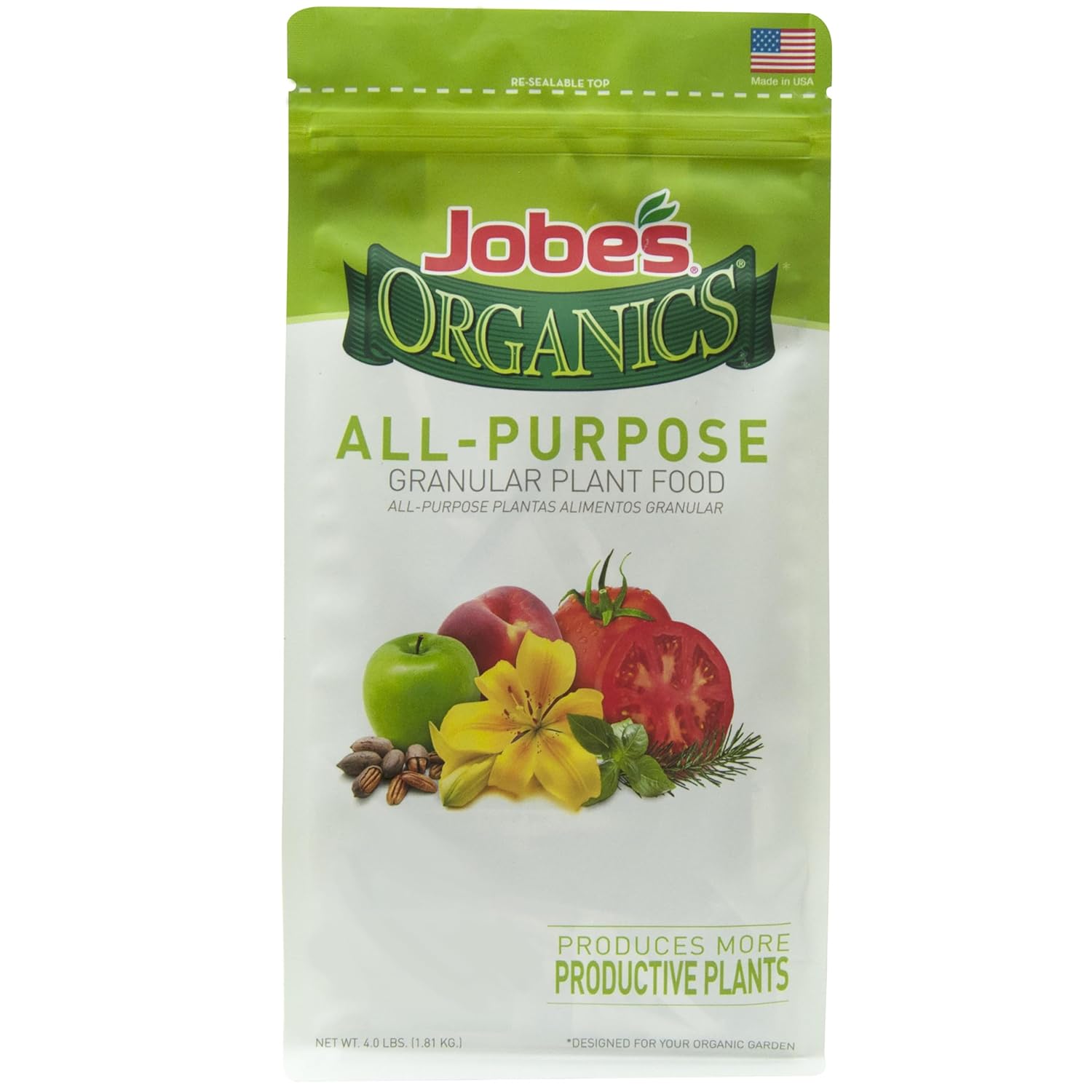
Jobe's Organics Granular All-Purpose Fertilizer, 4 lb
| Item Form | Granules |
|---|---|
| Specific Uses For Product | Gardening |
| Coverage | Resealable |
| Mixing Ratio | 4-4-4 |
Jobe’s Organics Granular All-Purpose Fertilizer is a slow-release, OMRI-listed granular fertilizer designed to feed roots over time with a balanced 4-4-4 NPK plus calcium, magnesium, and sulfur. You apply measured granules around the base of established plants and water in; the manufacturer recommends reapplying every 2 to 3 weeks during the growing season. The formula is derived from feather meal, bone meal, and processed poultry manure, so it supplies organic nutrients while boosting soil microbial activity for healthier, living soils. Its resealable 4 lb bag is convenient for small yards or individual trees and the nutrient balance supports both foliage and flowering without heavy nitrogen spikes. Limitations are that the NPK is modest compared with targeted tree fertilizers and results are slower than synthetic feeds, so you may need consistent feeding through the season for larger or nutrient-hungry specimens. For crepe myrtle, this product offers steady, organic nutrition best suited to owners who prefer gentle, repeat applications rather than one-time high-analysis treatments.
Best for: Gardeners who prefer organic, incremental feeding and want a simple, easy-to-measure fertilizer for established ornamental trees and surrounding plantings.
Less Ideal for: People needing a high-analysis, single-application fertilizer to rapidly correct severe nutrient deficiencies or to feed large mature trees on a tight schedule.
- OMRI-listed organic granular formula suitable for organic gardens
- Balanced 4-4-4 NPK feeds foliage, blooms, and roots without heavy nitrogen rush
- Contains calcium and micronutrients that support soil health and long-term vigor
- Resealable 4 lb bag is convenient for small gardens or single-tree maintenance
- Lower NPK concentration than specialized tree fertilizers so may require more frequent applications for larger trees
- Granular organic sources release nutrients more slowly than synthetic fertilizers, so outcomes take longer to appear
Verdict: A practical organic choice for steady, root-focused feeding of crepe myrtles and nearby ornamentals when you prefer gentle, repeatable applications.
TPS Nutrients Crepe Myrtle Liquid Fertilizer, 8 oz

| Item Form | Liquid |
|---|---|
| Application Method | Liquid |
| Coverage | Crepe Myrtle trees |
| Target Species | Crepe Myrtle |
| Unit Count | 8 Fluid Ounces |
This 8 oz liquid fertilizer from TPS Nutrients is designed for crepe myrtle trees and is mixed into water for routine feedings. It emphasizes a high-potassium formula to promote heavier flowering and supports foliage, stems, and root development so trees look fuller and produce more blooms. Typical use is straightforward: dilute per label instructions and apply during the growing season to potted or in-ground crepe myrtles. The liquid form makes it easy to measure and apply evenly compared with granular products, and the targeted label reduces guesswork about suitability for crepe myrtles. Because the bottle is small it is convenient for homeowners trying the product on a few trees or for seasonal spot treatments, but frequent users with larger landscapes may find the volume requires buying multiple bottles. It does not list an N-P-K ratio on the provided details so users who prefer precise nutrient breakdowns may need to contact the manufacturer or compare labels. Overall the product is a simple, plant-specific option for improving blooms and basic vigor on crepe myrtles.
Best for: Home gardeners who want a simple, labeled solution to boost crepe myrtle blooms without complex mixing or specialty products and who are managing one to a few trees.
Less Ideal for: Large properties or professional landscapers who need bulk quantities or detailed nutrient specifications for custom fertilization plans.
- Liquid formula mixes easily for even application
- Formulated specifically for crepe myrtle trees to encourage heavier flowering
- Supports foliage and root development as well as blooms
- Small 8 oz volume may require multiple purchases for larger gardens
- No N-P-K ratio or full nutrient breakdown provided in the listed details
Verdict: A convenient, plant-specific liquid fertilizer for homeowners who want an easy way to increase crepe myrtle blooms.
Carl Pool Crepe Myrtle Plant Food 8-55-7, Water-Soluble 24 oz

| Item Form | Granules |
|---|---|
| Application Method | Water |
| Coverage | Medium |
| Target Species | Crepe Myrtle |
| Unit Count | 24 Ounce |
This Carl Pool Crepe Myrtle Plant Food is a water-applied, granule concentrate designed to promote flowering and overall growth in crepe myrtle. With an 8-55-7 N-P-K, it supplies a high phosphorus boost to encourage more abundant blooms while delivering micronutrients through root and foliar feeding when mixed into water. Typical use is dissolving the measured granules according to the mixing guide and applying during the active growing season to medium coverage areas around individual trees. Practical benefits include targeted formulation for crepe myrtle, easy water-based application, and a compact 24 ounce package that stores easily. Limitations to note are the concentrated phosphorus ratio, which is excellent for bloom but not balanced for leafy growth or long-term maintenance if used alone, and the need to follow mixing instructions carefully to avoid overapplication. It is best used as part of a seasonal feeding plan alongside a general maintenance fertilizer for balanced nutrition.
Best for: Buyers who prioritize a dependable, species-specific bloom booster for crepe myrtles and want a straightforward water-soluble feed to use seasonally.
Less Ideal for: Gardeners seeking an all-purpose or long-term balanced fertilizer for general leafy growth or mixed-plant beds should consider more balanced formulations.
- High phosphorus formula (8-55-7) targets bloom development in crepe myrtle
- Water-soluble granules allow foliar or soil drench application for flexible feeding
- Compact 24 oz unit is easy to store and measure for small to medium plantings
- Formulated specifically for crepe myrtle, simplifying product choice for that species
- High phosphorus ratio may not provide balanced nutrition if used as the sole fertilizer
- Requires correct mixing and application frequency to avoid nutrient imbalance
Verdict: Choose this product when you want a reliable, water-soluble bloom booster formulated specifically to increase flowering on crepe myrtle trees.
Jobe's Slow Release Tree and Shrub Fertilizer Spikes, 15 Count

| NPK | 16-4-4 |
|---|---|
| Application method | Insert spikes into soil |
| Coverage | 15 fertilizer spikes |
| Target species | Tree and Shrub |
Jobe's Slow Release Tree and Shrub Fertilizer Spikes deliver timed nutrition directly to the root zone using 15 pre-measured spikes formulated with NPK 16-4-4. You insert the sticks around a tree's dripline twice a year in early spring and late fall; the slow-release formula supplies nutrients through the growing season while minimizing runoff and surface mess. Practical benefits include easy, no-mess installation, reduced risk of overfertilizing because each spike is measured, and targeted feeding that is useful for acid-loving ornamental trees and shrubs. The product is convenient for homeowners who prefer low-effort seasonal care rather than frequent granular feeding. Limitations are that spikes deliver a fixed nutrient ratio and application spacing, so fine-tuning for a specific species such as crepe myrtle or for unusual soil tests is not possible, and spikes do not replace corrective soil amendments or pH adjustments that some trees require. For larger or heavily nutrient-depleted trees you may need more spikes or supplemental feeding methods.
Best for: Homeowners who want a low-effort, low-mess way to feed ornamental trees and shrubs seasonally and who value clear product performance and peer validation when choosing garden products.
Less Ideal for: Gardeners who need species-specific fertilization plans, have trees with known soil nutrient deficiencies, or who prefer customizable granular or liquid feeding regimens.
- Pre-measured slow-release formula reduces risk of overfertilizing
- Targets nutrients to the root zone to limit runoff and surface mess
- Easy twice-yearly application requires minimal time or skill
- Suitable for many ornamental trees and shrubs including acid-loving species
- Fixed NPK ratio (16-4-4) cannot be adjusted for specific deficiencies
- May be insufficient alone for large or nutrient-depleted trees that need heavier feeding or soil amendments
Verdict: An easy, low-risk seasonal option to feed crepe myrtles and other ornamental trees with targeted, pre-measured slow-release nutrition.
Nelson NutriStar Granular Fertilizer for Crape Myrtle & Flowering Trees 10-15-9 (2 lb)

| Item Form | Granules |
|---|---|
| Specific Uses For Product | Plant Food |
| Target Species | Crape Myrtle, Desert Willow, Mimosa, Orchid Tree |
| Mixing Ratio | 10-15-9 |
This NutriStar granular formula is designed specifically for crape myrtles and similar flowering trees and delivers a blend of five nitrogen sources plus phosphorus, potassium, sulfur, and micronutrients to encourage bigger, more frequent blooms. Typically applied as a top-dress in spring at the full rate and then every 60 days at half rate, the slow-release chemistry provides an initial nutrient boost followed by longer-term feeding that supports regrowth after pruning and overall plant health. The inclusion of sulfur helps slightly acidify the root zone and the micronutrients target bloom color and vigor, which is useful for established trees or container-grown specimens. Because it is a granular, easy-to-measure product, it is straightforward for a cautious gardener to apply without specialized equipment. Limitations are that the package is small relative to landscape needs and repeated applications are required through the season for continuing effects, so larger plantings will need multiple purchases or a bulk alternative.
Best for: A cautious homeowner who wants a purpose-built, easy-to-apply fertilizer for established or container crape myrtles and other flowering trees and prefers predictable, slow-release nutrition.
Less Ideal for: People managing large beds or commercial plantings who need bulk fertilizer or a single application that covers many trees across a property.
- Formulated specifically for crape myrtles and flowering trees with an NPK of 10-15-9
- Slow-release mix of multiple nitrogen sources provides both immediate and sustained feeding
- Contains micronutrients and sulfur to improve bloom color and support plant health
- Easy-to-apply granules work for in-ground and container-grown trees
- Small 2 lb. unit is not economical for large landscapes
- Requires repeat applications every 60 days to maintain results
Verdict: Choose this product if you want a gardener-friendly, slow-release fertilizer specifically tuned to boost blooms on crape myrtles and other flowering trees.
Choosing the Right Fertilizer for Crepe Myrtle Tree: Key Factors to Consider
Nutrient Ratio and Bloom Support
The proportions of nitrogen, phosphorus, and potassium directly affect crepe myrtle growth and flowering. Higher phosphorus levels help set and sustain blooms, while too much nitrogen can push vigorous leafy growth at the expense of flowers. Look for balanced formulas that supply a modest amount of nitrogen with adequate phosphorus and potassium to support bud formation and stress tolerance.
Assessment of the N-P-K ratio is not just about numbers. Consider how the fertilizing schedule interacts with the tree's growth cycle: lower nitrogen in late summer protects winter hardiness, while a modest boost in spring can help establish new growth without compromising bloom density.
Release Type and Timing
How quickly nutrients become available matters for gardeners with different maintenance rhythms. Fast-release fertilizers deliver an immediate nutrient boost but can cause a rapid flush of foliage and require more frequent applications. Controlled-release or slow-release products provide steady feeding over several months, which helps maintain consistent bloom production and reduces the chance of nutrient spikes that stress roots.
Match release type to your schedule and climate. In hot regions a slow-release option reduces the risk of salt accumulation and over-stimulation, while in cooler climates a soluble feed in early spring can kick-start bud development after dormancy.
Application Method and Ease
Fertilizers come as granules, spikes, liquids, or water-soluble powders, and each format affects how you apply them around a crepe myrtle. Granular spreads are easy to broadcast around the dripline and can be worked into the soil, while spikes simplify single-point placement but may not evenly feed large root zones. Liquid and soluble feeds let you target roots and are good for quick fixes or for use with irrigation systems.
Consider physical effort, garden layout, and frequency of feeding. If you prefer low-maintenance care, a long-duration granular or slow-release option minimizes repeat applications. For precise adjustments based on soil test results, soluble feeds give more control over dosing.
Root Safety and Salt Index
Crepe myrtles tolerate a range of soils but are vulnerable to root stress from high salt fertilizers or heavy applications. Products with a high salt index increase the risk of root burn and reduced water uptake, especially in dry periods. Choosing formulas labeled as low-salt or using controlled-release nitrogen sources reduces this risk.
Also practice correct placement to avoid direct contact with the trunk bark. Distribute fertilizer across the root zone rather than piling it at the base, and water in after application to move nutrients into the soil and away from surface roots.
Soil Type and pH Compatibility
Soil texture and pH influence nutrient availability and the effectiveness of a fertilizer program. In heavy clay soils nutrients can bind and become less available, so organic amendments or chelated micronutrients help improve uptake. Sandy soils leach nutrients quickly and often benefit from slow-release formulations and organic matter additions to retain fertility.
Test soil pH before choosing a product. Crepe myrtles are adaptable to a moderately wide pH range, but extreme acidity or alkalinity can lock up phosphorus or micronutrients. Tailor your fertilizer choice to correct any nutrient deficiencies indicated by a soil test rather than relying solely on high-analysis general-purpose feeds.
Seasonal Feeding and Pruning Considerations
Timing fertilizer applications around the tree's growth and pruning cycle affects results. Feeding too late in the season can stimulate tender growth that is vulnerable to frost, while well-timed spring feeding supports bud set and summer flowering. If you prune heavily, delay significant fertilization until after new shoots have developed so nutrients support healthy branch regrowth.
Plan a feeding calendar that aligns with bloom and dormant periods. For most gardens a light spring application followed by a controlled-release maintenance dose is a prudent strategy that balances bloom support and winter preparedness.
When to Feed Crepe Myrtle Trees
The ideal feeding window depends on your climate and the tree's growth cycle. In temperate regions, a modest application in early spring as new growth begins helps support bud formation. Avoid heavy late-summer or fall feedings that encourage vulnerable late-season growth.
If your tree blooms multiple times or you manage it in a warm climate, a maintenance dose midseason from a slow-release product can sustain flower production without causing a late flush of tender shoots.
- Early spring: support bud set with balanced nutrients
- Midseason: optional slow-release maintenance to sustain blooms
- Avoid heavy feeding late summer or fall
Organic Versus Synthetic Options
Organic fertilizers release nutrients more slowly and improve soil structure over time. They are forgiving and reduce burn risk, making them a good choice for long-term soil health and gardeners who prefer natural amendments.
Synthetic or mineral fertilizers provide predictable nutrient ratios and quicker corrections of deficiencies. They are useful when you need to adjust a specific nutrient level rapidly, but they require correct dosing and attention to salt buildup.
- Organics improve soil biology and moisture retention
- Synthetics give precise, fast nutrient delivery
Using Soil Tests to Guide Feeding
A simple soil test reveals pH and nutrient levels so you can choose a fertilizer that addresses actual deficiencies rather than guessing. Tests are particularly useful if blooms are poor, leaves show nutrient symptoms, or the site has a history of heavy amendments.
Adjust fertilizer type and rate based on test results. For example, low phosphorus suggests a formula with more bloom-supporting phosphorus, while adequate phosphorus but low micronutrients points toward a supplemental trace element mix.
- Test every few years or when problems appear
- Match fertilizer to reported deficiencies
Applying Fertilizer Around the Root Zone
Spread fertilizer evenly across the root zone rather than concentring it at the trunk. Crepe myrtle roots extend roughly to the dripline and beyond, so distribute feed where fine absorbing roots occur. Water after application to move nutrients into the soil and reduce the chance of surface burn.
For liquid or soluble feeds, drench evenly under the canopy. For spikes or granular products, follow label spacing recommendations and avoid piling material against the trunk flare.
- Target the area under the canopy and up to the dripline
- Water in to incorporate nutrients and avoid root burn
Adjusting Care for Container-Grown Crepe Myrtles
Potted crepe myrtles need more frequent feedings because containers limit root volume and nutrients leach faster. Use a balanced, water-soluble feed on a regular schedule or a slow-release formula formulated for containers. Monitor salt buildup and periodically flush the container with clear water.
Repot or refresh potting mix every few years to restore organic matter and avoid compounding nutrient imbalances.
- Use water-soluble or slow-release container formulas
- Flush pots periodically to prevent salt accumulation
How We Chose the Best Fertilizer for Crepe Myrtle Tree
We focused on practical, garden-tested criteria that affect crepe myrtles in real landscapes. First, nutrient ratio and bloom support were essential; we favored products with phosphorus and potassium levels that promote flowering without excessive early-season nitrogen. Second, release type mattered because fast-release feeds produce quick leaf growth while slow-release or controlled-release formulations sustain blooms and reduce re-feeding frequency. Third, application method and ease were assessed, including granular, spike, and water-soluble options so gardeners can match a product to their watering and maintenance routines. Fourth, safety for established trunks and roots was considered, preferring formulations that minimize salt buildup and burn risk. Finally, soil compatibility and amendment needs were checked to ensure products can be used on a range of soils, including clay and sandy gardens. We excluded specialty fertilizers intended only for seedlings, indoor houseplants, or lawn-only formulas that do not match tree nutrient needs. Products were scored by the concrete evaluation dimensions above: nutrient balance for bloom, release type predictability, application convenience, root and trunk safety, and soil adaptability.
FAQ
How often should I fertilize a crepe myrtle tree?
Often a light feeding in early spring and an optional slow-release maintenance application midseason is sufficient. Frequency depends on soil fertility, fertilizer type, and whether the tree is container-grown or in the ground.
Will too much nitrogen reduce flowers on my crepe myrtle?
Yes, excessive nitrogen tends to promote leafy growth at the expense of bloom production. Choose a formula with balanced nitrogen and adequate phosphorus to support flowers.
Can I use an all-purpose lawn fertilizer on crepe myrtles?
Sometimes lawn formulas can be used if the nutrient ratio suits trees, but many lawn feeds contain higher nitrogen levels designed for grass. It is better to select a product formulated for shrubs and trees or adjust the application rate accordingly.
Is organic fertilizer good enough for crepe myrtles?
Organic fertilizers work well and improve soil health over time, but they release nutrients more slowly. They are a good choice for steady long-term feeding or when soil biology improvement is a priority.
How should I apply fertilizer to avoid damaging roots or trunk?
Distribute fertilizer across the root zone rather than placing it against the trunk. Water after applying to move nutrients into the soil and follow label rates to avoid over-application and potential root burn.
Final Verdict
Prioritize a fertilizer that balances bloom-supporting phosphorus with moderate nitrogen and a release type that fits your maintenance routine. Slow-release or controlled formulas reduce the risk of late-season flushes and salt stress, while soluble feeds are useful for targeted corrections based on soil tests. Decide by matching your soil conditions, feeding schedule, and whether the tree is in ground or in a container. Focus on nutrient balance, root safety, and timing to get reliable flowering and long-term tree health.
