

Note: This article contains affiliate links. If you click on these links and make a purchase, I may earn a small commission at no extra cost to you. This helps support my research and content. Read my full affiliate disclosure here.
Tomato hornworms can strip plants overnight, reduce fruit set, and turn a productive tomato patch into a ragged mess. Choosing the right insecticide for tomato hornworm matters because you need something that reliably reduces large caterpillars without harming fruit, pollinators, or the beneficial insects that help keep other pests down. This guide presents seven top insecticides selected for use against tomato hornworm in home gardens and small plots. We shortlisted products based on how quickly they knock down hornworms, safety around edible plants, application ease, and impact on non-target insects. Read on to see the properties we evaluated and how to match a solution to your garden situation before the review blocks below.
Top Picks at a Glance
| Best Overall The best all-around choice for most situations | Bonide Thuricide BT Concentrate, 16 oz Ready-to-Mix |  |
| Best Quality Built to a higher standard if you want something more solid | Southern Ag Thuricide BT Caterpillar Control, 16 oz |  |
| Best Value The sweet spot between price and what you get | Garden Safe Houseplant & Garden Insect Killer, Ready-to-Use, 32 oz |  |
| Best Budget The cheapest option that still gets the job done reliably | GardenTech Sevin Insect Killer Dust, 1 lb |  |
| Highest Rated A top-rated pick with lots of positive feedback | ferti-lome Spinosad Insecticide Concentrate (16 fl. oz.) |  |
| Most Popular A crowd favorite that many people choose with confidence | Bonide Captain Jack's Bt Thuricide Ready-to-Use Spray, 32 oz |  |
| Best Seller A high-volume bestseller chosen again and again | Bonide Captain Jack's Deadbug Brew 16 oz Concentrate |  |
Bonide Thuricide BT Concentrate, 16 oz Ready-to-Mix

| Unit Count | 16 Ounce |
|---|---|
| Item Form | Spray |
| Target Species | Worm & Caterpillar |
| Active Ingredients | Bacillus thuringiensis |
Bonide Thuricide is a BT-based liquid concentrate intended for spot and broadcast spraying to control caterpillars, cutworms, and other worm pests on vegetables, ornamentals, and fruiting plants. You mix the concentrate with water in a garden sprayer (label suggests 1 to 4 teaspoons per gallon) and apply to foliage when larvae are actively feeding, making sure to coat leaf undersides. Because it is Bacillus thuringiensis it works by ingestion, so treated insects stop feeding and die over a few days rather than immediately. The product is approved for organic gardening and is described as harmless to birds, earthworms, and many beneficial insects when used as directed. Practical benefits include suitability for use up to the day of harvest on many vegetables and a familiar, well-established active ingredient gardeners trust. Limitations are that control requires thorough coverage and correctly timed applications, and results are slower than fast-acting contact insecticides so repeated applications may be needed for heavy infestations.
Best for: Gardeners who want an organic-approved, targeted way to manage cutworms and caterpillars on vegetables and ornamentals and who are willing to apply treatments carefully and on schedule.
Less Ideal for: Users seeking immediate knockdown of heavy infestations or a single-application cure; those who prefer broad-spectrum contact insecticides for instant results should consider other options.
- Contains Bacillus thuringiensis, an organic-approved active ingredient effective against caterpillars and worms
- Ready-to-mix liquid concentrate lets you adjust dilution rate for spot treatments or larger areas
- Safe for use up to the day of harvest on many vegetables when label directions are followed
- Low impact on birds, earthworms, and many beneficial insects when applied correctly
- Requires ingestion by pests so control is slower and depends on larvae actively feeding
- Needs thorough coverage and potentially multiple applications for heavy infestations
Verdict: A trusted BT concentrate for gardeners who want an organic, low-impact way to control cutworms and caterpillars with correctly timed, thorough applications.
Southern Ag Thuricide BT Caterpillar Control, 16 oz
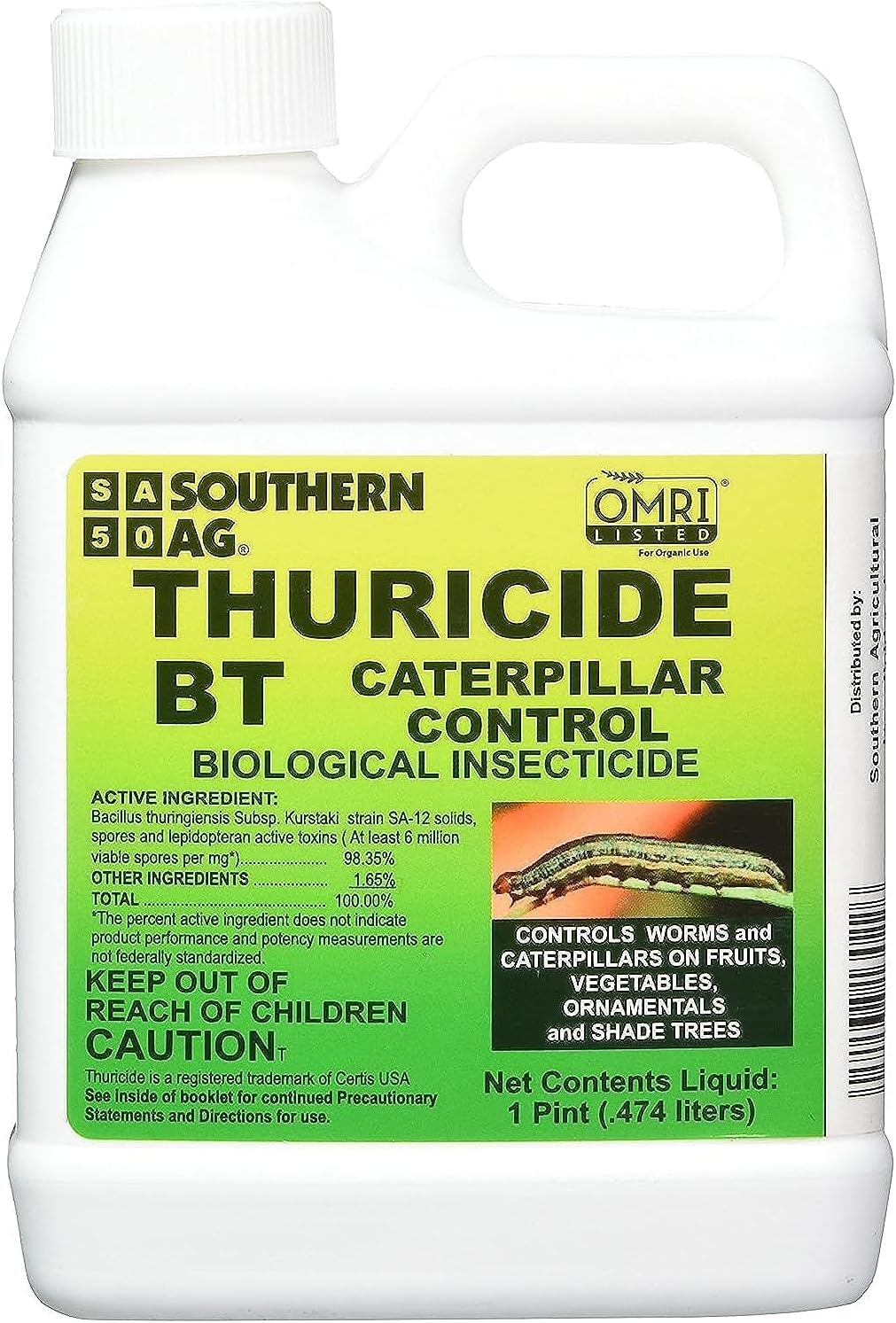
| Item Form | Liquid |
|---|---|
| Target Species | Caterpillar |
| Liquid Volume | 16 fluid ounces |
| Specification Met | OMRI |
| Active Ingredients | Bacillus Thuringiensis Kurstaki |
Thuricide BT is a concentrated liquid formulation of Bacillus thuringiensis kurstaki designed to target lepidopteran larvae such as tomato hornworm and other caterpillars. You dilute 2 to 4 teaspoons per gallon, add a spreader-sticker if desired, and spray for thorough coverage on leaves where caterpillars feed. Its OMRI listing and very low toxicity to people and pets make it suitable for use on vegetables, fruit trees, shrubs and ornamentals in organic gardens. In practice it works best when applied early to small larvae; chewing stops after ingestion as the bacterial toxins disrupt the caterpillar gut. Expect selective control of caterpillars rather than broad-spectrum knockdown of other pests. Because it requires ingestion and proper coverage, repeat applications and careful timing are necessary, and heavy infestations may require multiple treatments or complementary controls. The concentrate format keeps storage and application flexible for backyard growers and small-acre organic operations.
Best for: Gardeners and small-scale growers who prioritize targeted, low-toxicity control of caterpillars on tomatoes and other edible plants and who will apply treatments promptly and thoroughly.
Less Ideal for: Users seeking an immediate broad-spectrum contact insecticide or a single-application fix for heavy, established infestations should consider faster-acting alternatives.
- Contains Bt kurstaki effective specifically against lepidopteran larvae including tomato hornworm
- OMRI listed and low toxicity to humans and pets suitable for organic vegetable use
- Concentrated liquid allows economical dilution and flexible application rates
- Safe for use on edible crops, ornamentals, trees and shrubs when used as directed
- Must be eaten by larvae to be effective so it does not provide contact kill
- Performance depends on timing and coverage so multiple applications may be needed
- Less effective on large, mature caterpillars compared with small larvae
Verdict: Choose this OMRI-listed Bt concentrate when you want a reliable, low-toxicity solution for controlling tomato hornworm by targeting larvae early.
Garden Safe Houseplant & Garden Insect Killer, Ready-to-Use, 32 oz

| Item Form | Spray |
|---|---|
| Target Species | Insects |
| Liquid Volume | 32 fluid ounces |
This ready-to-use Garden Safe spray is a contact insect killer formulated for use on houseplants, ornamentals and edible garden crops. You apply it by spraying the upper and lower leaf surfaces weekly or as needed; the label allows use up to the day of harvest, which makes it practical for vegetable and herb growers. It claims to kill more than 100 listed pests on contact, so it can quickly reduce visible populations of common houseplant pests including spider mites when sprayed thoroughly. Important features include a convenient trigger-spray bottle and instructions for repeated applications up to ten times per season. Be mindful that it is a pesticide with safety precautions: avoid applying in hot weather above 90 F, keep it away from water and bees, and follow first-aid guidance for accidental exposure. For someone who wants an effective, easy-to-use spray to manage outbreaks, this product is a straightforward option, but it requires careful application to protect beneficial insects and aquatic life.
Best for: For practical plant owners who want a simple, grab-and-spray solution to bring down visible pest outbreaks on houseplants and small garden plots without mixing concentrates.
Less Ideal for: Not a good fit for people wanting organically certified or strictly pollinator-safe solutions for flowering plants visited by bees.
- Ready-to-use spray bottle is convenient for spot treatments on houseplants
- Label lists use on edible crops up to day of harvest for flexible garden use
- Fast-acting contact formula that targets over 100 listed insect pests
- Directions support repeat applications (weekly, up to 10 times per season)
- Toxic to aquatic life and bees when directly applied to blooming plants
- Not recommended for use when temperatures exceed 90 degrees Fahrenheit
Verdict: A convenient, ready-to-use spray that quickly reduces common houseplant and garden insect pests and is practical for repeat spot treatments.
GardenTech Sevin Insect Killer Dust, 1 lb

| Item Form | Dust |
|---|---|
| Target Species | Insects |
| Active Ingredients | Bifenthrin |
| Unit Count | 1 Count |
Sevin Insect Killer Dust is a handheld dust formulation of bifenthrin for spot and perimeter treatment of garden pests, including Japanese beetles. You apply it by shaking a thin, uniform layer onto leaves, stems and around plants as a preventative or when you first see damage. The product kills by contact and lists more than 150 target insects, so it works across vegetables, fruit, ornamentals and turf. Practical features include a flip-open cap for easy dispensing and a 1 pound container sized for small-to-medium beds; the manufacturer states one pound treats about 2,000 sq. ft. The dust does not require mixing and settles quickly so treated areas can be reoccupied after it dries. Important limitations are typical for contact insecticides: it should not be applied to open blooms to protect pollinators and it provides little residual control if plants are watered or receive heavy rain within 24 hours of application. Users must follow label safety steps like avoiding the eyes and washing hands after use.
Best for: Gardeners who want a straightforward, no-mix contact treatment to quickly reduce visible beetle and chewing insect pressure in mixed vegetable, fruit and ornamental plantings.
Less Ideal for: People prioritizing pollinator-safe or long-residual biological controls should choose targeted or non-chemical methods instead.
- Kills by contact a wide range of garden pests including Japanese beetles and aphids
- Ready-to-use dust needs no mixing and is simple to apply with a flip-open cap
- Label lists use on vegetables, fruits, ornamentals and lawns so it fits mixed garden beds
- Contains bifenthrin which can harm beneficial insects if applied to open blooms or overused
Verdict: If you need a simple, ready-to-use contact treatment to quickly knock down Japanese beetles and other common garden pests, Sevin dust delivers fast, broad-spectrum control.
ferti-lome Spinosad Insecticide Concentrate (16 fl. oz.)

| Unit Count | 16 Fluid Ounces |
|---|---|
| Item Form | Oil |
| Target Species | Foliage feeding worms, thrips and other listed pests |
| Specification Met | OMRI |
| Active Ingredients | Spinosad |
This ferti-lome spinosad concentrate is a water-soluble, OMRI-listed insecticide formulated to control bagworms, tent caterpillars, armyworms and a wide range of foliage-feeding pests on vegetables, trees, shrubs, flowers and fruit. You dilute the concentrate (label recommends about 4 tablespoons per gallon) and apply it as a spray to affected foliage, which makes it convenient for spot treatments or whole-plant coverage. The active ingredient spinosad is effective against chewing insects while being approved for organic gardening, so it fits into integrated pest management plans. Practical benefits include broad-spectrum control of caterpillars and similar pests, compatibility with many outdoor uses, and a concentrate format that stretches farther than ready-to-spray alternatives. Important limitations are that it targets primarily chewing and foliage-feeding insects rather than sap-sucking pests, and label directions and safety precautions must be followed for timing and application to protect pollinators and beneficial insects.
Best for: Gardeners who prioritize practical, cost-effective pest control for outdoor plants and want an organic-approved concentrate to treat bagworms and other caterpillars across trees, shrubs and edibles.
Less Ideal for: People seeking an all-in-one product for sucking pests or those who want a pre-mixed spray with no measuring and mixing steps.
- OMRI listed so suitable for organic gardening and certified operations
- Concentrate form lets you dilute for multiple applications and spot treatments
- Effective against bagworms, tent caterpillars and a broad range of chewing foliage pests
- Water-soluble formulation is easy to mix into spray equipment
- Targets primarily chewing insects and is not intended for sap-sucking pests like aphids
- Requires mixing and correct dilution which adds preparation time compared with ready-to-spray products
Verdict: A concentrated, OMRI-listed spinosad solution that gives practical, organic-approved control of bagworms and other chewing caterpillars across outdoor plants.
Bonide Captain Jack's Bt Thuricide Ready-to-Use Spray, 32 oz

| Unit Count | 32 Ounce |
|---|---|
| Item Form | Spray |
| Target Species | Insects |
| Active Ingredients | Bacillus Thuringiensi,Lapidapteran Active Toxins |
Bonide Captain Jack's Bt Thuricide is a ready-to-use biological spray that delivers Bacillus thuringiensis (Bt) to control caterpillars and worm-stage insects. You apply it with the trigger sprayer directly to the tops and undersides of leaves when you first see feeding damage; it is labeled for use on vegetables, fruit, shade trees and ornamentals and can be used up to the day of harvest on edibles. Because it kills by ingestion, treated pests stop feeding within a couple of days while birds, earthworms and many beneficial insects are largely unharmed. The product is convenient for small-to-medium infestations since it needs thorough coverage and repeat applications for new larvae. It is approved for organic gardening and comes in a 32-ounce bottle that is easier to use than concentrates for spot treatments, but using a ready-to-use bottle across a large property can become time consuming compared with hose-end or pressurized sprayers.
Best for: Gardeners who prioritize proven, low-risk biological control and want an easy spray for spot treating caterpillars on edible and ornamental plants; ideal for those who value safety around beneficials and pets.
Less Ideal for: People needing fast-contact knockdown for a large-scale outbreak or who must treat many acres quickly should consider concentrates or professional application methods instead.
- Targets caterpillars and worm-stage pests with a proven Bt active ingredient
- Safe for use on edible plants up to day of harvest when label directions are followed
- Ready-to-use trigger bottle requires no mixing for quick spot treatments
- Labeled for a wide range of plants including vegetables, ornamentals and shade trees
- Requires insects to ingest product so results are not immediate and depend on good spray coverage
- Ready-to-use bottle is less efficient for treating large areas compared with concentrates or hose-end applicators
Verdict: A convenient, organic-ready Bt spray that reliably controls caterpillars and worm pests while protecting beneficials, ideal for careful gardeners treating spot infestations.
Bonide Captain Jack's Deadbug Brew 16 oz Concentrate

| Unit Count | 16 Ounce |
|---|---|
| Item Form | Spray |
| Target Species | Insects |
| Active Ingredients | Spinosad (Mixture of Spinosyn A and Spinosad D) |
Bonide Captain Jack's Deadbug Brew is a concentrated spinosad insecticide designed for use on vegetables, fruits, ornamentals, and other garden plants. You mix the 16 fl oz concentrate with water and apply it with a trigger, hand-held, backpack, or hose-end sprayer to target caterpillars, beetles, borers, leaf miners, and similar chewing pests. Because the active ingredient is spinosad, the product is approved for organic gardening and is selective enough that it does not significantly impact many predatory beneficial insects and mites when used as directed. In practical use it provides quick knockdown of listed pests and is suitable for protecting squash and other cucurbits from feeding damage. The main limitations are that it must be mixed and applied correctly following label rates and safety instructions and that repeated broad use can still affect non-target insects if timing and coverage are not careful. For gardeners focused on protecting food crops, it is a straightforward, effective option when integrated with scouting and spot treatments.
Best for: Gardeners who prioritize practical, effective pest control for edible gardens and want an organic-approved concentrate they can mix and apply themselves to protect squash and other crops.
Less Ideal for: Gardeners seeking a ready-to-use spray or those unwilling to follow label mixing and safety instructions should consider alternative formats or professional application.
- Contains spinosad, an active ingredient approved for organic gardening and effective against caterpillars and beetles
- Concentrate mixes with water for use with trigger, backpack, hand-held, or hose‑end sprayers
- Labeled for use on a wide range of vegetables, fruits, and ornamentals including cucurbits
- Designed to minimize impact on many predatory beneficial insects and mites when used as directed
- Requires careful mixing and application per label to avoid harming non-target insects
- Not a residual solution for all pests so repeat applications or scouting are often necessary
Verdict: A practical, organic-approved spinosad concentrate that reliably controls chewing pests on squash and other garden crops when mixed and applied correctly.
Choosing the Right Insecticide for Tomato Hornworm: Key Factors to Consider
Caterpillar Knockdown Vs Slow-Acting Controls
Hornworms are large chewing caterpillars that can consume foliage quickly. Some insecticides provide immediate contact knockdown, paralyzing or killing caterpillars within hours. Others work by ingestion and may take a day or more to stop feeding. Faster knockdown limits immediate defoliation but often depends on thorough spray coverage; slower systemic or stomach poisons can control caterpillars that feed after application. Consider how quickly you need visible control and whether you can achieve full coverage on large plants before choosing between contact and slower-acting options.
Safety for Tomatoes and Harvest Timing
Products differ in labeled use on tomatoes and in pre-harvest intervals. For edible crops you will harvest soon after treatment, choose insecticides with short or zero-day pre-harvest intervals and clear instructions for washing fruit. Residue persistence on leaves and fruit is also important if you have children or pets in the garden. Always follow label directions on when it is safe to harvest following treatment. A more conservative choice may reduce risk but could require repeated applications to maintain control.
Impact on Pollinators and Beneficial Insects
Tomato plants can attract pollinators and are often grown near flowers that support predatory insects. Broad-spectrum sprays can kill bees, lacewings, lady beetles, and parasitic wasps that help suppress other pests. Consider targeted application techniques such as spot spraying at dusk, choosing products with lower toxicity to bees, or using biological options that spare beneficials. Reducing non-target impact helps maintain longer-term pest balance in your garden and can reduce the need for repeated chemical treatments.
Application Method and Equipment Needs
Different formulations require different equipment and techniques. Ready-to-use sprays are convenient for spot treatment, hose-end sprayers speed coverage on larger plantings, and concentrated liquids or dusts may need mixing and careful calibration. Systemic drenches require root uptake time and may not be appropriate if quick knockdown is needed. Match the formulation to your garden size, access to sprayers, and comfort level with mixing concentrated products to get reliable coverage without waste or drift.
Residual Control and Reapplication Frequency
Residual activity determines how often you need to reapply. Some products leave little residue and only protect plants briefly, requiring more frequent treatments during peak hornworm activity. Others provide longer residual control but may pose greater risk to non-targets or leave higher residues on foliage. Think about how often you can monitor plants and reapply treatments, and balance longevity with safety for harvest and beneficial insects.
Integration With Cultural and Mechanical Controls
Insecticides work best as part of an integrated approach. Handpicking large hornworms, removing infested foliage, using row covers early in the season, and timing plantings to avoid peak moth flights all reduce pressure on chemical controls. Choosing an insecticide that complements these tactics allows you to use lower rates or spot treatments rather than broad applications, which conserves beneficials and reduces overall chemical load in the garden.
When to Treat Vs When to Handpick
Large hornworms are conspicuous and often easy to remove by hand if you can inspect plants daily. Handpicking is highly effective for small infestations and eliminates the need for chemical controls, but it demands time and vigilance.
Treat with insecticide when infestation levels exceed what you can reasonably monitor, when caterpillars are hidden in dense foliage, or when rapid control is needed to protect developing fruit. Use spot treatments first and reserve broader sprays for heavy, widespread infestations.
- Inspect plants at dusk and dawn when hornworms are most active.
- Look for chewed foliage, frass, and missing leaves as early indicators.
- Combine hand removal with targeted insecticide spots for large caterpillars you cannot reach.
Timing Applications for Best Results
Apply contact sprays when caterpillars are active and coverage reaches all leaf surfaces. For systemic options, apply according to label timing so active ingredients move into plant tissue before heavy feeding starts.
Evening applications often reduce risk to pollinators. Avoid spraying flowering companion plants and follow label guidance about temperature and wind to minimize drift and maximize uptake.
- Target lower and inner foliage where hornworms hide.
- Retreat according to residual claims and scout regularly to catch reinfestation early.
Minimizing Harm to Beneficial Insects
Choose products and application patterns that reduce exposure to bees and predatory insects. Spot treatments, short-residual products, and timing sprays for evening all lower non-target impact.
If you rely on biological control agents, avoid broad-spectrum products during their active periods and prioritize selective options compatible with integrated pest management.
- Avoid spraying open flowers and nearby pollinator plantings.
- Consider biological insecticides that target caterpillars specifically when conservation of beneficials is a priority.
Mixing and Applying Safely in Food Gardens
Follow label mixing instructions carefully and measure concentrates precisely. Wear appropriate personal protective equipment when preparing and applying solutions to prevent exposure.
Rinse sprayers and dispose of leftover mixes according to guidance. Keep pets and children out of treated areas until the label permits re-entry, and wash harvested fruit as recommended before eating.
- Label directions govern safe mixing ratios and PPE requirements.
- Store unused concentrates securely and out of reach of children and animals.
Organic and Biological Options
Biological insecticides and botanical products can deliver effective control while posing lower risk to beneficial insects when used correctly. Products that rely on a bacterial toxin or naturally derived compounds are often labeled for organic gardens and can be applied repeatedly with minimal residue concerns.
Understand that biologicals may require more frequent applications and precise coverage because they act through ingestion. For heavy infestations, combine biologicals with mechanical removal to reduce caterpillar numbers quickly.
- Apply biologicals thoroughly to foliage so caterpillars ingest the active ingredient.
- Expect slower visible mortality compared with strong contact neurotoxic sprays.
How We Chose the Best Insecticide for Tomato Hornworm
We prioritized products that combine proven control of caterpillars with minimal risk to fruit safety and beneficial insects. Selection criteria included documented activity against large chewing caterpillars, labeled use on tomatoes, and realistic application methods for home gardeners. We also looked for options with short pre-harvest intervals or low residuals to reduce concerns about edible harvests, and formulations that allow targeted sprays rather than broadcast coverage. We excluded products that do not list tomatoes on the label or that are only intended for professional agricultural use. Products lacking clear guidance for backyard application or that rely on unverified anecdotal claims were not considered. Final choices reflect a balance of contact knockdown, systemic uptake where appropriate, and products that integrate into IPM strategies without wiping out beneficial insects when used as directed. Editorial filters focused on four to six measurable dimensions: efficacy against caterpillars, safety for edible plants, non-target impact, and ease of application. These are the same dimensions we used to score each insecticide in product blocks.
FAQ
Can I use insecticides on tomatoes that are about to be harvested?
It depends on the product. Many insecticides have a labeled pre-harvest interval; some are cleared for use up to the day of harvest while others require several days. Always read and follow the label to protect edible harvests and stay within safety guidelines.
Will treating for hornworms kill beneficial insects in my tomato patch?
Some treatments can harm beneficials, especially broad-spectrum contact sprays. You can reduce impact by spot treating, timing sprays for evening, avoiding flowering plants, or choosing biological options that are selective for caterpillars.
How often should I reapply insecticide for sustained hornworm control?
Reapplication frequency depends on the product residual and infestation pressure. Short-residual options may need reapplication every few days during heavy feeding, while longer-lasting products might protect plants for a week or more. Scout regularly and follow label reapplication intervals.
Are organic insecticides effective against large hornworms?
Organic options can be effective, but they often rely on ingestion and may act more slowly. For large, actively feeding hornworms, combine organic sprays with handpicking to reduce the population quickly while using biologicals to catch stragglers.
Can I apply systemic products to container-grown tomatoes?
Systemic drenches or soil-applied options can work in containers if you follow label rates and account for smaller soil volume. Overapplication can harm plants, so adjust dosages to container size and monitor plant response carefully.
Final Verdict
Choose an insecticide for tomato hornworm based on how fast you need control, how close plants are to harvest, and how much you want to protect beneficial insects. Quick-contact sprays give rapid relief but may carry greater non-target risk, while biologicals and systemics offer alternative tradeoffs in speed, residue, and application style. Prioritize products that are labeled for tomatoes, fit your application equipment, and integrate with handpicking and cultural controls to reduce overall chemical use. That approach keeps plants productive while limiting harm to pollinators and the wider garden ecosystem.
