

Note: This article contains affiliate links. If you click on these links and make a purchase, I may earn a small commission at no extra cost to you. This helps support my research and content. Read my full affiliate disclosure here.
Picking the right soil for a Japanese maple bonsai matters more than many beginners expect. These trees need a mix that drains well to prevent root rot while holding enough moisture for delicate feeder roots and supplying steady nutrients through the growing season. Poor soil choice shows up quickly as leaf drop, slowed growth, or winter stress. This guide covers seven shortlisted soils that suit Japanese maple bonsai and explains the practical tradeoffs you will face. We evaluate mixes on drainage, moisture retention, nutrient-holding capacity, and ease of repotting so you can match a mix to your watering habits and climate. Read on to see which characteristics make sense for your tree and pot setup.
Top Picks at a Glance
| Best Overall The best all-around choice for most situations | Bonsai Outlet Deciduous Bonsai Soil Blend (2 Quarts) |  |
| Best Quality Built to a higher standard if you want something more solid | Tinyroots Akadama Bonsai Soil, Sifted Fine Grain (5mm), 2.25 qt |  |
| Best Value The sweet spot between price and what you get | Agra Life Bonsai Soil Mix, Premium Organic 4-Quart |  |
| Best Budget The cheapest option that still gets the job done reliably | Doter Premium Bonsai Soil Mix (1 qt) |  |
| Highest Rated A top-rated pick with lots of positive feedback | ZzbTwinkle Yamano Kusa Japanese Succulent & Bonsai Soil Mix (10L) |  |
| Most Popular A crowd favorite that many people choose with confidence | The Bonsai Supply Fast-Draining Bonsai Soil Mix (2 Quart) |  |
| Best Seller A high-volume bestseller chosen again and again | Bonsai Jack Universal Organic Bonsai Soil Mix (2 Quart) |  |
Bonsai Outlet Deciduous Bonsai Soil Blend (2 Quarts)
| Volume | 2 quarts |
|---|---|
| Style Name | Deciduous Blend |
| Unit Count | 74.5 Ounce |
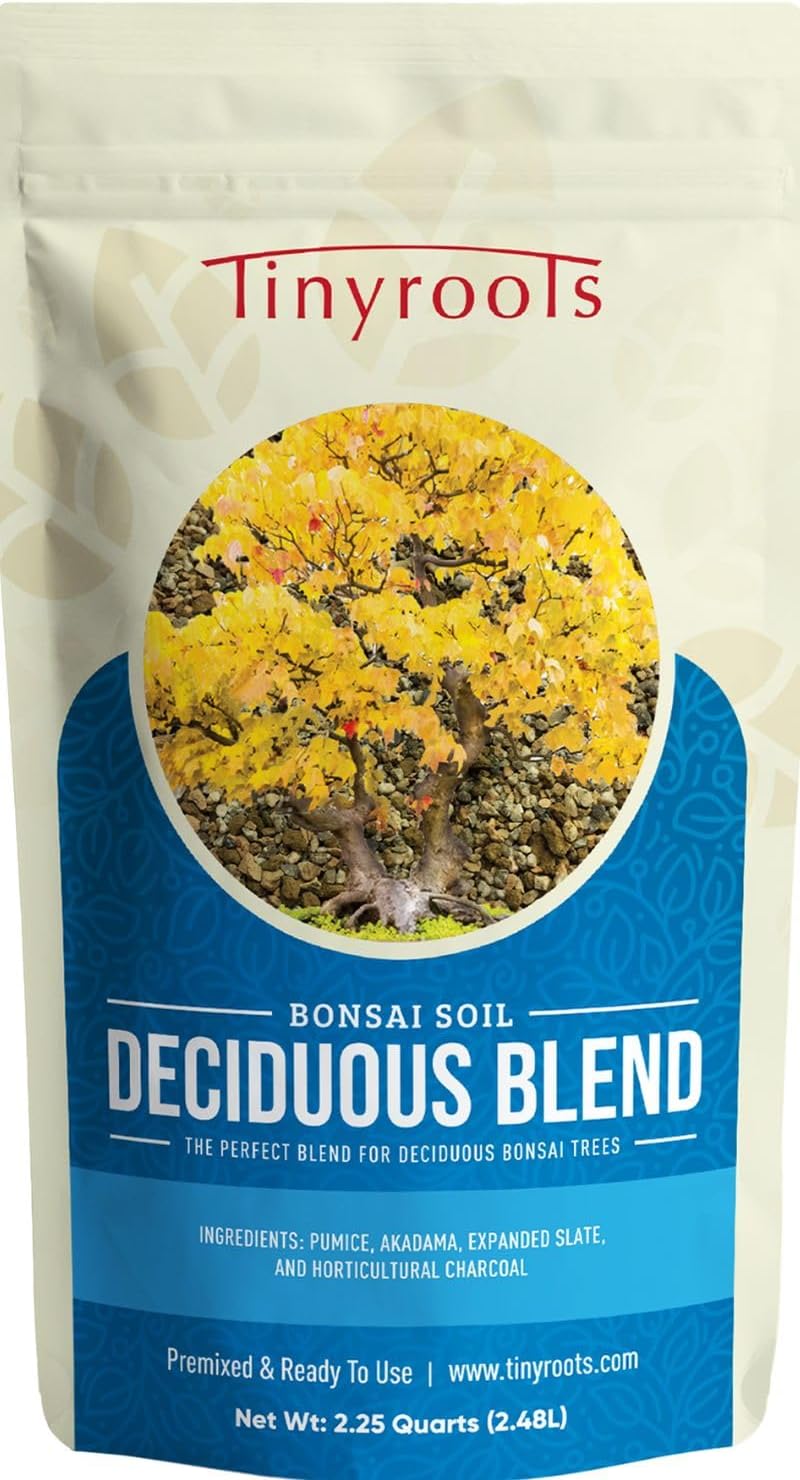
This two-quart bonsai soil is a ready-to-use, pre-sifted substrate designed for deciduous bonsai such as Japanese maple, hornbeam, and elm. The mix uses akadama, pumice, expanded slate, and horticultural charcoal to create a coarse, fast-draining medium that supports healthy root development and reduces water retention issues common with garden soils. Because it is pre-mixed and pre-sifted, it saves time for growers who prefer not to source and screen individual components. Practical benefits include improved aeration, clearer drainage paths, and a stable particle structure that helps prevent compaction during watering. The small two-quart volume is convenient for repotting a single tree or topping up soil in a finished bonsai but means multiple bags are needed for larger projects or several trees. Buyers should also expect an inorganic-dominant texture that requires regular fertilization for nutrient needs because it does not hold much organic matter. For someone managing Japanese maples, this blend provides a reliable, hobbyist-friendly substrate that streamlines routine repotting and care.
Best for: Gardeners who want a ready-made, high-drainage substrate for repotting or maintaining Japanese maples and other deciduous bonsai without mixing components themselves.
Less Ideal for: People who prefer an all-organic, moisture-retentive potting mix or who need large quantities for many trees should consider other substrates or bulk blends.
- Pre-sifted mix saves time and avoids dust and fines
- Coarse particle blend promotes fast drainage and good aeration
- Formulated specifically for deciduous bonsai species including Japanese maple
- Contains horticultural charcoal which can help with soil freshness and root health
- Small 2-quart bag may require multiple purchases for several trees
- Low organic content means you must fertilize regularly for nutrients
Verdict: A convenient pre-sifted bonsai soil that delivers the fast drainage and structure Japanese maples need, without the hassle of mixing components yourself.
Tinyroots Akadama Bonsai Soil, Sifted Fine Grain (5mm), 2.25 qt

| Unit Count | 83.8 Ounce |
|---|---|
| Item Type Name | 5MM |
| Manufacturer | New England Bonsai Gardens |
| Volume | 2 quarts |
Tinyroots Akadama is a fine-grain volcanic bonsai substrate intended for growers who prioritize root health and reliable drainage. The product is pre-sifted through 1/8 then 1/16 inch mesh to remove dust and fines, producing a uniform 5mm particle size that promotes aeration and prevents compaction around delicate roots. Use it as a standalone medium for conifers, deciduous bonsai, or as a top layer for potted succulents and cacti; the soil darkens when wet so you can judge watering needs visually. Practical benefits include steady moisture regulation, improved oxygen flow to roots, and a clean, consistent texture that makes repotting and root work easier. Limitations are the small bag size and light weight, so it is best for individual trees or small batches rather than large-scale reuse, and pure Akadama may require blending with pumice or lava for long-term use in very wet climates. For growers focused on performance and predictable root conditions, this sifted Akadama delivers professional-style results in a compact package.
Best for: Serious bonsai growers and hobbyists who want a performance-oriented, well drained substrate for individual trees and precise watering control.
Less Ideal for: Gardeners who need large volumes of potting mix for many plants or those seeking an all-in-one, low-maintenance commercial potting soil.
- Uniform 5mm particle size from double sifting reduces dust and prevents compaction
- Good drainage and aeration that support healthy root development
- Darkens when wet to provide a simple visual watering indicator
- Suitable for bonsai, succulents, and cacti as a performance-focused substrate
- Small 2.25 quart / 2 pound bag limits quantity for multiple trees or large pots
- Pure Akadama can break down over time and may need mixing with harder aggregates in wet conditions
Verdict: Choose this sifted Akadama when you want a predictable, high-performance bonsai substrate that improves drainage and helps you water with confidence.
Agra Life Bonsai Soil Mix, Premium Organic 4-Quart

| Brand Name | Agra Life |
|---|---|
| Item Highlight | Fast drainage. Healthy roots. Premium organic soil balances moisture and airflow. |
| Volume | 4 quarts |
| Style Name | Bonsai Plant Soil Mix |
This Agra Life Bonsai Soil Mix is a pre-blended organic potting medium designed to give bonsai seedlings the drainage and airflow they need while retaining enough moisture for young roots. Typical use is simple: fill small bonsai pots or seedling trays, plant seedlings or cuttings, and monitor water — the mix helps prevent waterlogging that can rot fragile roots. Notable features are the focus on fast drainage and balanced moisture, organic ingredients, and a 4-quart volume that suits a few small pots or successive repottings. Practical benefits include easier watering control for beginners and reduced risk of root disease thanks to improved aeration. Limitations are the modest 4-quart volume, which means you may need multiple bags for several seedlings or larger repots, and the product description does not list exact ingredient proportions or particle sizes, so experienced growers seeking specific grit ratios may find it less detailed than custom mixes. It is packaged and formulated in the United States for consistent quality.
Best for: Gardeners starting bonsai seedlings who want a simple, ready-made organic mix that improves drainage and reduces root problems without custom blending.
Less Ideal for: Advanced growers who need precise grit ratios or large-scale bonsai production where bulk quantities are required.
- Formulated for fast drainage and good aeration to protect delicate bonsai roots
- Organic ingredients suitable for indoor seedlings and chemical-free growing
- Ready-to-use mix that simplifies potting for beginners
- 4-quart size convenient for small collections or multiple repottings
- Small bag size may require buying multiple units for collections or larger pots
- Does not specify particle size distribution or exact component percentages for precision mixing
Verdict: Buy this if you want a convenient, organic ready-made bonsai soil that improves drainage and makes seedling care easier.
Doter Premium Bonsai Soil Mix (1 qt)

| Brand Name | Doter |
|---|---|
| Unit Count | 32 Ounce |
| Style Name | Japanese |
| Volume | 1 quarts |
This Doter bonsai soil is a ready-to-use blend aimed at keeping bonsai roots healthy by balancing fast drainage with moisture retention. The mix pairs volcanic rock, pumice and perlite for open structure and aeration while akadama and coconut coir help hold enough moisture for steady root uptake; pine bark adds slow-release organic matter. You would typically use it for repotting or top-dressing indoor and outdoor bonsai species such as juniper, pine and ficus where preventing waterlogged roots is a priority. Its coarse components make it easy to work with in small bonsai pots and reduce the need for additional amendments. Expect consistent drainage and a lower risk of root rot, though the 1 quart bag is best for single trees or small projects rather than multiple repots. Buyers who want a completely inorganic, long-lasting professional akadama-only mix may prefer a different product, and the blend will gradually break down over time like other organic-containing soils.
Best for: Budget-minded bonsai owners looking for a versatile, ready-made mix to repot one or a few trees and reduce fiddly mixing of components.
Less Ideal for: Collectors who need large volumes for multiple trees or growers who prefer a fully inorganic, long-lasting akadama-only medium.
- Engineered for drainage and aeration with pumice, volcanic rock and perlite
- Includes akadama and coconut coir to retain balanced moisture without compaction
- Ready to use straight from the bag for repotting or top-dressing
- Suitable for a wide range of common bonsai species
- Small 1 quart volume limits how many trees you can repot per bag
- Contains organic components that will slowly break down and may require periodic refresh
Verdict: A compact, ready-to-use bonsai soil blend that delivers reliable drainage and moisture balance for single-tree repots or small projects.
ZzbTwinkle Yamano Kusa Japanese Succulent & Bonsai Soil Mix (10L)

| Volume | 10 liters |
|---|---|
| Style Name | Japanese |
This Yamano Kusa blend is a ready-to-use, Japanese-style soil aimed at bonsai and drought-tolerant plants. It mixes baked akadama and kanuma with porous pumice and ezo sand to provide quick drainage while still retaining modest moisture where roots need it. In practice the akadama holds structure longer than ordinary potting mixes, so roots stay aerated and you avoid compaction that leads to root rot. The pumice and sand make it easy to water thoroughly and let excess run through, which suits species that require dry intervals between waterings. Because it is pre-formulated for alpine plants, succulents, cacti and bonsai, you can pot without amending for those uses and expect consistent performance. Limitations are that this is a specialty medium not formulated for heavy-feeding or long-term nutrient supply, so regular fertilizing is necessary for actively growing trees, and it may not suit plants that prefer high organic matter.
Best for: Buyers who prioritize a dependable, long-lasting growing medium for bonsai and drought-tolerant plants and want a consistent, ready-made mix that preserves root aeration.
Less Ideal for: Gardeners seeking an all-purpose potting soil or a high-organic feeding medium for heavy-feeding ornamentals should consider alternatives formulated for nutrient retention.
- Fast-draining mix reduces risk of root rot for bonsai and succulents
- Baked akadama maintains structure to prevent compaction over time
- Contains pumice and ezo sand for improved aeration at the root zone
- Pre-mixed and ready to use straight from the bag for convenience
- Low inherent nutrient content so regular fertilization is required
- Specialty composition may not suit plants that need richer, organic soils
Verdict: Choose this Japanese-style mix when you want a reliable, fast-draining soil that preserves aeration and structure for bonsai and succulents.
The Bonsai Supply Fast-Draining Bonsai Soil Mix (2 Quart)

| Volume | 2 quarts |
|---|---|
| Unit Count | 64 Ounce |
| Style Name | Bonsai-specific, fast-draining, nutrient-rich potting mix |
| Ingredients | Pumice, Calcined Clay, Pine Bark Fines, Black Lava |
This 2-quart pre-mixed bonsai soil is formulated to give container-grown plants the drainage and aeration they need without extra mixing. It combines pumice, calcined clay, pine bark fines, and black lava to create a chunky, free-draining medium that helps prevent root rot and improves oxygen flow to roots. The bag arrives sifted and ready to use, so it is convenient for repotting Japanese maples into smaller containers or for top dressing. Practical benefits include improved moisture control compared with standard potting soil and good long-term stability so the mix does not compact quickly. Limitations to note are the small pack size for larger trees or multiple repots and that the fixed blend leaves no room to adjust particle size or organic content for very specific cultivars or microclimates. For gardeners who prefer a ready-made, consistent bonsai substrate this mix reduces prep time and uncertainty, but those wanting custom proportions will need to amend or combine it with coarser or finer components.
Best for: Gardeners who want a reliable, out-of-the-bag bonsai substrate to repot or top-dress Japanese maples and other container-grown trees without mixing components themselves.
Less Ideal for: Specialist growers who prefer to custom-blend particle sizes and organic content for particular cultivars or landscapes with unusual moisture regimes.
- Ready-to-use pre-mix saves time when repotting bonsai or container trees
- Fast-draining aggregate blend reduces risk of waterlogged roots
- Contains pumice, calcined clay and lava for stable, long-lasting structure
- Sifted texture makes it easy to fill pots and position roots neatly
- Small 2-quart volume is insufficient for large trees or multiple repots
- Fixed particle mix limits ability to fine-tune substrate for very specific soil preferences
Verdict: Buy this if you want a consistent, ready-made fast-draining bonsai soil that simplifies repotting Japanese maples.
Bonsai Jack Universal Organic Bonsai Soil Mix (2 Quart)

| Volume | 2 quarts |
|---|---|
| Ingredients | 40% Bonsai Block, 40% Lava, 20% Pine Bark Fines |
| Particle size | Screened to ~1/4 inch average |
| pH | Optimized around 6.4 |
Bonsai Jack Universal Organic Bonsai Soil Mix #221 is a ready-to-use gritty blend designed for bonsai repotting and ongoing culture. The mix combines bonsai block, lava, and pine bark fines in roughly a 40/40/20 ratio and is screened to an average particle size around a quarter inch so roots push outward quickly instead of circling. It arrives pre-washed with an optimized pH around 6.4 and is intended for use as-is on the majority of bonsai, including tropicals, or mixed with other ingredients for specific needs. Practical benefits include consistent drainage and fast drying compared with standard potting soils, plus reduced compaction that helps maintain oxygen around the root zone. Limitations are that it is a small 2 quart bag suited to individual repots or top dressing rather than filling multiple pots, and the coarse texture means it is not intended for regular houseplants or species that prefer finer media. The product also recommends staged conversion when moving trees from nursery soil to avoid transplant shock.
Best for: Buyers who prioritize reliable, ready-to-use bonsai substrate for repotting and want a coarse, fast-draining mix that encourages healthy root structure.
Less Ideal for: Growers who need large volumes of soil for many pots or who care for plants that require fine, moisture-retentive potting mixes should look elsewhere.
- Balanced gritty mix (bonsai block, lava, pine bark) promotes root ramification and good drainage
- Screened and pre-washed with an optimized pH around 6.4 for immediate use
- Consistent particle sizing reduces compaction and helps oxygenate the root zone
- Suitable for the majority of bonsai species including tropicals and usable as-is or as a base mix
- Small 2 quart bag size limits usefulness to single repots or top dressing
- Coarse blend is not suitable for standard houseplants or species needing fine-textured media
Verdict: A small, professionally blended gritty mix that gives bonsai owners a convenient, fast-draining substrate to promote strong root development.
Choosing the Right Soil for Japanese Maple Bonsai: Key Factors to Consider
Particle Size and Aeration
Particle size determines how freely water moves through the pot and how much air reaches feeder roots. Japanese maple bonsai prefer mixes with a range of particle sizes that create clear macropores for drainage and micropores for moisture. A mix dominated by very fine particles will retain too much water and reduce oxygen, increasing the risk of root rot.
Aim for components that keep spaces open after repeated wetting and drying cycles. In practice, that means blending mineral elements like grit or pumice with finer organics so the root ball stays airy but not bone dry.
Water-Holding Capacity
Japanese maples need steady moisture without waterlogging, so the soil must hold enough water between waterings while still draining excess. Water-holding capacity is influenced by the proportion of porous organic matter and small mineral particles.
If you water frequently, choose a mix with slightly higher drainage; if you have longer gaps between watering, lean toward mixes that retain more moisture. Consider local climate: hot, windy sites speed evaporation and favor a mix with greater water-holding ability.
Nutrient Retention and Release
Soil components both hold and release nutrients to feeder roots. Mineral elements provide stable structure but little nutrition, while organic components and certain amendments buffer nutrients so they are available over time.
Look for mixes that balance inert minerals with modest organic content or added slow-release amendments. Too much organic matter can burn off quickly and change the mix texture, while too little leaves the tree dependent solely on external fertilizing.
Repotting Ease and Root Health
Repotting frequency for bonsai is a reality, and the soil should allow roots to be teased and pruned without clumping or sticking. A mix that holds its structure but is easy to remove from roots speeds repotting and reduces root damage.
Stable components like pumice or sintered clay tend to hold form; avoid mixes that turn into a sticky mass when wet. Good repotting behavior also correlates with long-term aeration and root vigor.
pH Stability and Component Interaction
Japanese maples prefer slightly acidic to neutral conditions, so the soil should not shift pH dramatically as it ages. The mix components and any fertilizers used will influence pH over time.
Choose materials that do not leach alkalinity or acidity rapidly. Also consider how different components interact: some organics can acidify while crushed shell or lime-containing gravels will raise pH. Stable pH supports nutrient uptake and overall tree health.
Durability and Long-Term Structure
Over multiple seasons a good bonsai soil retains its particle distribution and porosity. Materials that break down quickly will increase fines and reduce drainage, forcing earlier repotting and more root disturbance.
Evaluate how long components hold up in outdoor conditions and after repeated wetting. Durable mixes reduce maintenance and keep roots healthy by preserving pore space and aeration.
Adapting Soil Mix to Your Watering Routine
Your watering frequency should drive the final mix choice. If you water daily or live in a humid climate, prioritize mixes with faster drainage and larger aggregate. That prevents constant saturation and encourages a shallow, fibrous root system.
If you water less often or your bonsai sit in bright, drying locations, choose mixes with a bit more moisture-holding capacity. You can also topdress with a finer organic layer to increase short-term moisture without sacrificing base drainage.
- Faster drainage suits frequent watering and cooler climates.
- Higher moisture retention helps in hot, dry, or windy spots.
- Adjust top layer texture to fine-tune water availability between waterings.
Repotting Schedule and Soil Longevity
Plan repotting based on root development and mix breakdown, not strictly by calendar. Bonsai soils that maintain structure for several years need less frequent disturbance and support consistent growth.
When soil becomes compacted or contains many fines, repot into a refreshed mix. Use this time to prune roots and correct any drainage issues revealed during root inspection.
- Inspect roots annually for young trees and every 2-3 years for established specimens.
- Replace soils that collapse into a paste when wet.
- Keep a spare bag of your chosen base components to reproduce a familiar mix.
Seasonal Considerations for Japanese Maple
Japanese maples change water needs through the year. In spring and early summer they use more water and nutrients, while in late autumn and winter uptake slows. A soil that balances drainage and retention helps avoid overwatering in dormancy and under-watering in growth periods.
In colder climates, good drainage prevents ice-damaged roots and crown-sitting water. In warmer regions, soils that keep a little more moisture reduce midday stress.
- Increase watering slightly during active growth.
- Reduce frequency but not volume during dormancy if potting media stays damp.
- Monitor soil moisture more often in extreme weather.
Adjusting Mixes for Container Size and Shape
Shallow bonsai pots dry faster than deep containers, so the same mix will behave differently depending on pot dimensions. For shallow pots, include more water-retentive elements or a finer top layer to extend dryness intervals.
Conversely, deep pots can be made more free-draining with larger aggregate at the base and a slightly coarser overall texture to prevent waterlogging at the bottom.
- Shallow pots: increase moisture-retentive fraction.
- Deep pots: add coarser materials to avoid perched water.
- Match particle size to pot depth for consistent moisture profiles.
Using Amendments and Organic Additives
Small amounts of slow-release organic matter can support nutrient needs without collapsing the mix. Choose well-aged, stable organics and use them sparingly. Compost fines or leaf mold are common choices but should be mixed with robust mineral components.
Mineral amendments like pumice, lava rock, or sintered clay improve aeration and durability. Avoid adding materials that break down quickly or swell excessively when wet.
- Limit organic fraction to prevent rapid breakdown.
- Prioritize inert, porous minerals for long-term structure.
- Introduce amendments gradually and observe how they change moisture behavior.
How We Chose the Best Soil for Japanese Maple Bonsai
We selected mixes that demonstrate a balance of drainage and moisture retention appropriate for Japanese maple bonsai. Our filters prioritized particle size distribution, stable aeration after watering, and the presence of components that supply or hold nutrients without compacting. We also considered how mixes behave during repotting, including root teaseability and how easily old soil shakes away. Concrete evaluation dimensions were particle drainage rate, water-holding capacity, nutrient buffering, root friendliness during repot, and long-term structural stability. We excluded blends designed solely for large landscape planting or for species with vastly different root habits, such as tropical bonsai or succulents. Also excluded were mixes that rely heavily on peat alone and those that compact severely when wet. The result is a list focused on practical performance for Japanese maple bonsai across temperate growing conditions.
FAQ
How often should I repot a Japanese maple bonsai?
Repotting frequency depends on root growth and soil breakdown. Young trees often need attention every 1 to 2 years, while mature specimens can go 2 to 4 years if the soil maintains structure and drains well.
Can I use regular potting soil for a Japanese maple bonsai?
Regular potting soil is usually too fine and holds too much water for bonsai. It can compact and limit root oxygen. If used, it should be heavily amended with coarse minerals to improve drainage and aeration.
What particle sizes work best in a bonsai mix?
A mix of coarse aggregates and finer particles gives the right balance. Typical useful ranges include visible grit or pumice for macropores and small organic or mineral fines for moisture-holding micropores. Exact sizes depend on pot depth and watering routine.
Should I change soil composition seasonally?
Seasonal changes are better managed by adjusting watering rather than frequently swapping soil. However, you can topdress with a slightly coarser or finer layer to tweak short-term moisture availability between repottings.
How do I test if my bonsai soil drains well enough?
Saturate the pot and observe how quickly excess water flows through and how the surface drains. Good bonsai soil should pass water freely without staying soggy for long. If water pools or the mix becomes sticky, drainage is inadequate.
Does soil pH matter for Japanese maples in containers?
Yes. Japanese maples prefer slightly acidic to neutral conditions. Choose mix components and amendments that do not dramatically alter pH over time, and test periodically if you notice nutrient symptoms.
Final Verdict
Choosing soil for a Japanese maple bonsai is a balance between drainage and moisture retention. Prioritize mixes that keep pore space open, hold modest moisture, and allow healthy root handling during repotting. Match the final mix to your pot size, local climate, and how often you water. Tradeoffs are inevitable: more drainage reduces overwatering risk but may require more frequent watering, while higher moisture retention eases drought stress but can risk low oxygen at the roots. Use the evaluation criteria above to pick a mix that fits your routine and the tree will reward you with steadier growth.
