

Note: This article contains affiliate links. If you click on these links and make a purchase, I may earn a small commission at no extra cost to you. This helps support my research and content. Read my full affiliate disclosure here.
A moss terrarium depends more on substrate behavior than on flashy fertilizers. The right soil balances steady moisture, gentle aeration, and minimal nutrients so moss can spread without being outcompeted by fast-growing plants or algae. This guide compares six shortlisted soils tailored for moss terrarium setups, explaining how each type performs in small, enclosed microclimates. We evaluate mixes for water retention, drainage, aeration, pH tendencies, and how they influence long-term maintenance. Use this guide to match a soil style to your terrarium size, humidity level, and the moss species you want to cultivate.
Top Picks at a Glance
| Best Overall The best all-around choice for most situations | Soil Sunrise Terrarium Potting Soil Mix (4 Quart) |  |
| Best Value The sweet spot between price and what you get | DUSPRO 6-in-1 Terrarium Soil Mix, Ready-to-Use (8 qt) |  |
| Best Budget The cheapest option that still gets the job done reliably | Zoo Med Creatures Creature Soil Bag, 1 Quart (Peat Moss Blend) |  |
| Highest Rated A top-rated pick with lots of positive feedback | TerraVerse Rainforest Terrarium Substrate Mix (4 Quart) — Bioactive, Limestone Calcium Infused |  |
| Most Popular A crowd favorite that many people choose with confidence | Josh's Frogs ABG Mix Bioactive Terrarium Substrate (4 qt) |  |
| Best Seller A high-volume bestseller chosen again and again | Back to the Roots Organic Expanding Coco Coir Potting Soil Brick (10 lb) |  |
Soil Sunrise Terrarium Potting Soil Mix (4 Quart)

| Volume | 4 quarts |
|---|---|
| Ingredients | Coco coir, horticultural charcoal, pumice |
| Unit Count | 1 Count |
| Style Name | Compact |
This 4‑quart Soil Sunrise terrarium mix is designed specifically for closed and open terrarium displays. The blend of coco coir, pumice, and horticultural charcoal creates a lightweight, soilless medium that holds moisture without becoming waterlogged while allowing airflow around roots. In practice it is used as the primary growing medium for ferns, mosses, African violets and other small, humidity‑loving plants in glass containers. Notable features include built‑in charcoal for toxin absorption and pumice for improved drainage and aeration, so you can avoid frequent repotting or root rot in sealed environments. The bagged 4‑quart size is sized for a few small containers and is easy to scoop into layered terrarium builds. Limitations are the small volume if you want to fill several or larger closed terrariums and the lack of added slow‑release fertilizer, so plan to supplement nutrients for long‑term plantings. Overall it is a focused, low‑maintenance substrate for hobbyists building compact, high‑humidity displays.
Best for: Buyers who want a ready‑to‑use, low‑maintenance substrate for building or refreshing small closed terrariums and fairy gardens and who prioritize proper moisture control over added fertilizers.
Less Ideal for: Gardeners planning to plant many or larger terrariums, or those who want an all‑in‑one potting mix with preloaded long‑term fertilizer.
- Formulated blend of coco coir, pumice, and horticultural charcoal for moisture balance and drainage
- Charcoal helps absorb impurities and supports healthy microenvironments in closed terrariums
- Lightweight, soilless mix that promotes airflow to roots and reduces risk of root rot
- Appropriate texture for small, humidity‑loving plants like ferns, mosses, and violets
- Only 4 quarts per bag, so multiple bags are needed to fill larger or several terrariums
- No built‑in fertilizer so periodic nutrient supplementation is required
Verdict: A purpose‑built, low‑maintenance terrarium mix that keeps closed displays moist but not soggy, ideal for building healthy small terrariums.
DUSPRO 6-in-1 Terrarium Soil Mix, Ready-to-Use (8 qt)

| Included Components | Coco Coir, Peat Moss, Pine Bark, Perlite, Pumice & Zeolite |
|---|---|
| Tank Volume | 8 quarts |
| Specific Uses For Product | Indoor |
| Vivarium Type | Terrarium |
This ready-to-use 6-in-1 terrarium soil is designed for building closed and semi-closed moss terrariums and small planted displays. The blend pairs moisture-holding components (coco coir and peat moss) with mineral materials (perlite, pumice and pine bark) so the mix stays loose rather than compacting under humidity. Zeolite is included to help keep the soil structure stable over time and reduce settling in layered terrarium builds. Typical use is simple: pour a drainage layer if needed, add this substrate to create the planting layer, position moss and small foliage, then mist for humidity control. For moss-focused terrariums the mix supports consistent moisture without turning waterlogged, and the lightweight mineral bits make planting and surface maintenance easier. Limitations: it is a general terrarium mix rather than a pure sphagnum moss product, so for mosses that need near-pure sphagnum you may want to topdress or add extra sphagnum; the bag does not include decorative items or containers. Overall it is a time-saving choice when you want a balanced, low-maintenance substrate for moss and small moisture-loving plants.
Best for: Buyers who want a practical, time-saving substrate for building moss or mixed-plant terrariums and prefer a reliable, balanced medium that minimizes repotting and settling.
Less Ideal for: Not the best choice for growers who need a nearly pure sphagnum-only medium or who require custom-mixed specialty mixes for rare moss species.
- Pre-mixed 6-in-1 formula ready to use out of the bag for quick terrarium setup
- Balanced moisture retention and airflow from combination of organic and mineral components
- Zeolite and mineral pieces reduce compaction and help maintain stable soil structure
- Suitable for closed, semi-closed and open terrariums with moisture-loving small plants
- Not a pure sphagnum moss substrate so may require added sphagnum or topdressing for mosses that demand it
- Only sold as substrate; container, decorative moss and plants are not included
Verdict: A convenient pre-mixed substrate that saves prep time and provides balanced moisture and airflow for moss-focused terrariums.
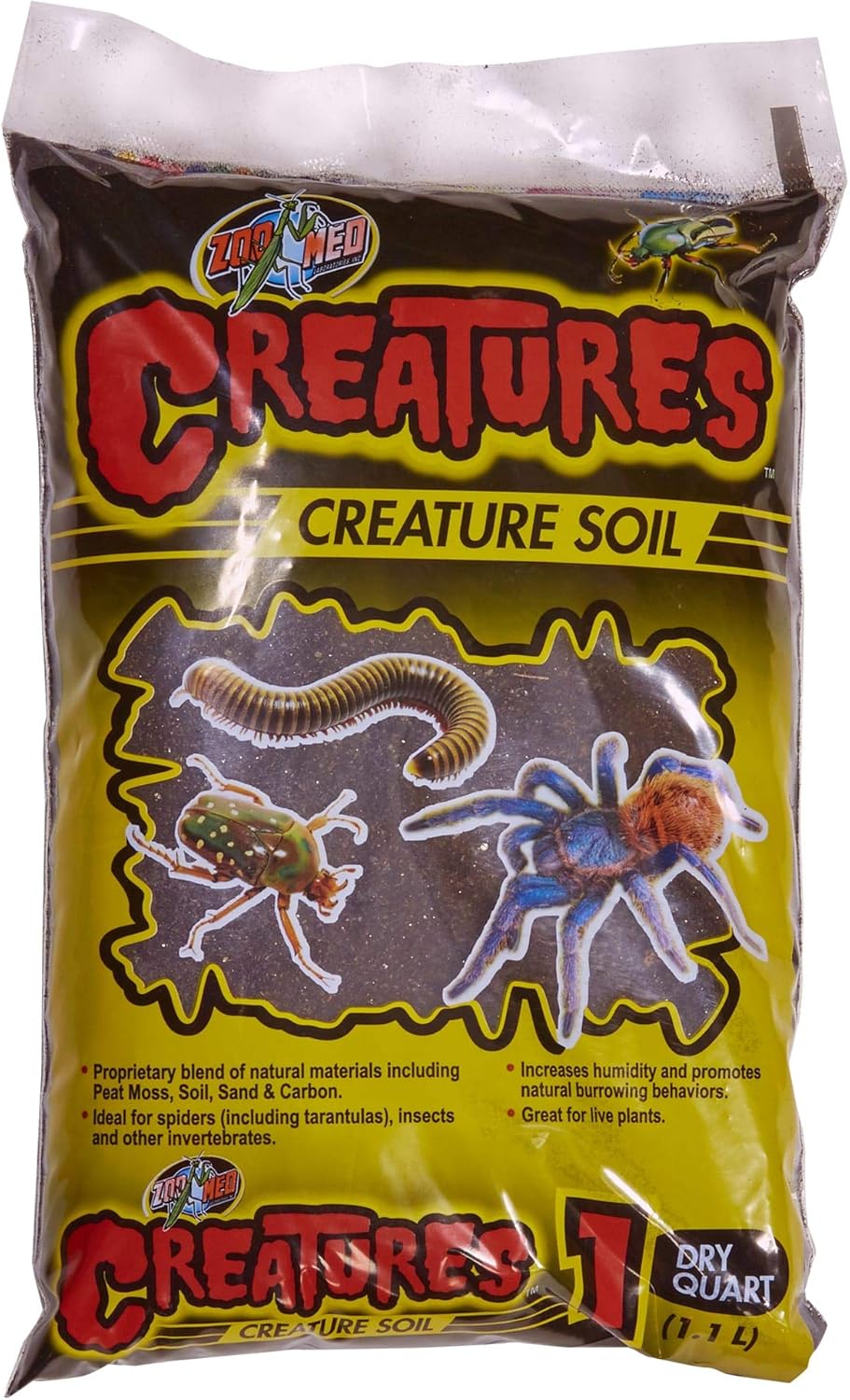
Zoo Med Creatures Creature Soil Bag, 1 Quart (Peat Moss Blend)
| Unit Count | 32 Ounce |
|---|---|
| Number of Packs | 1 |
| Style Name | Peat Moss |
| Volume | 2 liters |
Zoo Med Creature Soil is a small, pre-mixed substrate aimed at terrariums that house spiders, insects, and other invertebrates. The bag combines peat moss with soil, sand, and carbon to retain humidity, encourage burrowing, and support live plants in smaller enclosures. It comes in a one quart (2 liter) bag that is easy to portion into starter setups or to top-dress existing substrates. The mix is practical for hobbyists who want a natural-feeling substrate without mixing components separately, and the peat content helps keep humidity stable for species that need moisture. Important limitations are the small volume for larger terrariums and the inhalation/irritation warning for peat moss, so handle it with a mask and avoid dusty clouds when filling a tank. For long-term use in active burrowing species you may want deeper quantities or periodic replacement but for planting, humidity control, and temporary setups this is a convenient, low-effort option.
Best for: A thrifty hobbyist setting up small terrariums for spiders, insects, or planted displays who prefers a ready-made substrate to save time and effort.
Less Ideal for: Not a good fit for builders of large or deep burrowing systems who need bulk substrate or for users seeking peat-free or sterile commercial mixes.
- Pre-mixed blend saves time compared with assembling peat, sand, and soil separately
- Peat moss base holds moisture well to support humidity-loving invertebrates and live plants
- Small 1 quart bag is easy to portion for starter tanks or to use as top-dressing
- Quantity is limited so multiple bags are needed for medium or large terrariums
- Contains peat moss which can produce dust and may irritate respiratory systems if not handled carefully
Verdict: A compact, ready-to-use peat-based substrate that delivers good humidity and burrowing performance for small terrariums on a tight budget.
TerraVerse Rainforest Terrarium Substrate Mix (4 Quart) — Bioactive, Limestone Calcium Infused

| Unit Count | 25 Grams |
|---|---|
| Tank Volume | 4 quarts |
| Specific Uses For Product | Indoor |
| Vivarium Type | Terrarium |
| Additional Features | Bioactive |
This 4-quart TerraVerse Rainforest Terrarium Substrate Mix is designed for keepers building bioactive rainforest setups. The ready-to-use mix combines sphagnum peat and other natural components to hold humidity, encourage plant growth, and support a cleanup crew by aiding organic waste breakdown. The limestone calcium infusion is a practical feature for maintainers of frogs, geckos, and other small reptiles because it helps supply available calcium in the substrate. Typical use is straightforward: spread 2 to 3 inches in the enclosure, lightly moisten, add plants and decor, then introduce animals once stabilized. For hobbyists focused on reliability, the mix reduces early tinkering by providing consistent moisture retention and nutrient support out of the bag. Limitations to note are the small 4 quart volume, which is best for small to medium enclosures, and that live-arrival handling instructions suggest users must monitor delivery closely for live cleanup crew purchases when bundled. The product is best paired with a monitored watering routine and appropriate microfauna to complete a self-sustaining bioactive system.
Best for: Keepers who prioritize a low-maintenance, dependable substrate for small to medium rainforest terrariums and want a ready-made bioactive base that supports plants and microfauna.
Less Ideal for: People setting up large or deep-substrate vivaria or those who prefer to custom-blend inert substrates for precise drainage and layering.
- Formulated for bioactive setups to support beneficial microorganisms and invertebrates
- Infused with limestone calcium to provide an additional calcium source for reptiles and amphibians
- Good moisture retention from sphagnum and peat for maintaining rainforest humidity
- Ready to use straight from the bag with clear setup instructions
- 4 quart volume is limited and may not be enough for larger or deep-layered terrariums
- Contains peat which may compact over time and require occasional refreshing or mixing
Verdict: Buy this if you want an off-the-shelf, moisture-retaining bioactive substrate that simplifies reliable rainforest terrarium setup for small to medium enclosures.
Josh's Frogs ABG Mix Bioactive Terrarium Substrate (4 qt)

| Brand Name | Josh's Frogs |
|---|---|
| Item Type Name | Terrarium Substrate |
| Unit Count | 128 Ounce |
| Style Name | Tropical |
Josh's Frogs ABG Mix is a ready-to-use terrarium substrate formulated from the original Atlanta Botanical Garden recipe to support tropical plants and bioactive setups. It combines charcoal, milled sphagnum moss, pine bark, tree fern, and peat to create a moisture-retentive yet well-draining layer that breaks down slowly, so you do not need frequent replacement in long-term displays. The mix is vivarium-ready and works well for cultivating springtails and isopods that help control mold and waste, which simplifies maintenance. Preparation is straightforward: remix the bag and moisten with distilled or RO water to reduce dust and ease handling. Important practical limits are its plant-only guidance and a caution against saturation in setups that can trap excess water, so it needs proper drainage design or a drainage layer underneath. The 4 quart volume is suitable for small to medium enclosures but may require multiple bags for larger terraria.
Best for: Buyers who prioritize reliable, proven performance for tropical or bioactive terrariums and want a substrate that promotes plant health and a self-sustaining microfauna community.
Less Ideal for: People setting up large enclosures who need bulk substrate quantities in one purchase or keep animals explicitly listed as incompatible should consider other options.
- Formulated from the original ABG recipe trusted for tropical plant growth
- Balanced blend of charcoal, sphagnum moss, bark, tree fern, and peat for moisture retention and drainage
- Supports culturing of springtails and isopods for low-maintenance bioactive cleanup
- Breaks down slowly for longer service life in established terrariums
- Pre-mixed and vivarium-ready for simple setup after moistening
- Supplied volume (4 quarts) is limited for larger terraria and may require multiple bags
- Not recommended for use with hermit crabs or pac-man frogs and requires care to avoid saturation
Verdict: Choose this ABG mix when you want a proven, plant-focused substrate that supports a low-maintenance bioactive terrarium.
Back to the Roots Organic Expanding Coco Coir Potting Soil Brick (10 lb)

| Item Highlight | 10 lb compressed coco coir brick; peat-free; OMRI Listed |
|---|---|
| Item Type Name | Coconut Coir |
| Volume | 2 cubic feet |
| Ingredients | Coconut Coir |
| Style Name | Expanding Potting Soil |
This compressed coco coir brick provides a lightweight, peat-free potting medium that expands when you add water to create loose, airy substrate for containers and seed flats. It is typically used by hydrating the 10 lb block to about 2 cubic feet of coir and then using it alone for potted plants, mixing it into garden soil to improve drainage and aeration, or blending with compost for starting seeds. Notable features include OMRI listing for organic use, a balanced pH suited to a wide range of plants, and compact storage before expansion which saves space. Practical benefits are improved root aeration and water retention compared with heavy garden loam, easier handling than bulky bags, and versatility across vegetables, herbs, and ornamentals. Important limitations are that coco coir is a soilless substrate and does not supply significant nutrients on its own so you will need to add fertilizer or compost for long-term potted herbs like rosemary, and the product requires time and a water source to expand before use.
Best for: Buyers who prioritize low-risk, easy-to-handle, organic potting media and want a versatile base for container herbs and seed starting without dealing with heavy bags.
Less Ideal for: Gardeners who want a ready-to-plant, nutrient-rich potting mix out of the box or those who prefer soil with built-in slow-release fertilizer.
- Peat-free OMRI listed organic coco coir suitable for organic growing
- Expands from a compact brick to about 2 cubic feet for easy storage and transport
- pH balanced and airy texture that improves drainage and root aeration
- Versatile use: can be used alone, for seed starting, or mixed into existing soil
- Provides little inherent fertility so supplemental feeding or compost is needed for nutrient-hungry plants
Verdict: A compact, peat-free coco coir brick that expands into an airy, pH-balanced base ideal for low-risk organic container gardening and seed starting when paired with fertilizer or compost.
Choosing the Right Soil for Moss Terrarium: Key Factors to Consider
Moisture Retention Versus Saturation
Moss needs constant surface moisture but cannot tolerate roots buried in standing water. A good terrarium soil holds thin films of water and releases them slowly through evaporation. If the substrate retains too much free water, oxygen levels drop and moss turns yellow or sloughs off.
Look for materials with internal porosity like fine peat or sphagnum fibers mixed with coarser particles. Those retain moisture at the micro level while leaving enough macropores for gas exchange. In practice, you will water less frequently with a moisture-retentive mix, but you must avoid sealed saturation by providing slight drainage or an absorbent lower layer.
Aeration and Gas Exchange
Moss respirates through its tissues and relies on gas exchange at the surface and within shallow substrate pores. Compact, silt-heavy soils reduce oxygen diffusion and create anaerobic pockets that promote rot and odours. A terrarium substrate should therefore combine small-scale moisture retention with visible pore space.
Including coarse mineral particles or inert chunky components helps preserve channels for air movement. Those channels also let excess water escape into a lower reservoir or evaporate more evenly, keeping surface conditions hospitable for moss growth.
Low Nutrient Profile
Unlike most vascular plants, many moss species thrive in lean, low-nutrient conditions. A substrate high in available nitrogen or phosphorus encourages algae, liverworts, and fast-growing weeds that outcompete moss for light and space. Choosing an inherently low-nutrient mix reduces the need for chemical interventions.
Avoid fresh garden loam or rich potting soils that contain composted organic matter or fertilizer. Instead, favor inert or lightly decomposed organics that provide structure and moisture control without supplying a flush of soluble nutrients.
Particle Size and Texture
Particle size affects how the soil compacts, how it holds moisture, and how easy it is to plant or layer the terrarium. Very fine powders and dust will compact under their own weight or after repeated wetting and drying cycles, choking moss attachment points. Very coarse gravel will not hold enough moisture at the surface for moss rhizoids to access.
Aim for a graded texture: small fibrous pieces or fine grit mixed with some coarse grains. That combination supports attachment, resists compaction, and creates a stable surface for moss to creep across.
pH and Chemical Stability
Different moss species prefer slightly different pH ranges, but many common terrarium mosses do well in slightly acidic to neutral substrates. Sudden pH shifts during wetting cycles can stress moss and encourage unwanted organisms. Materials that leach alkalinity or acidity when wet should be avoided unless you are prepared to buffer them.
Choose components known for stable behavior in moist, closed environments. If you plan to keep sensitive moss species, test the substrate pH in a soak test before planting and adjust by swapping components rather than by adding chemicals.
Cleanliness and Longevity
Terrarium substrates are in a confined space where decomposition products accumulate. Materials that break down quickly will change water retention and nutrient release over months, often requiring substrate replacement. Clean, slowly decomposing components keep environmental conditions stable.
Pre-washed mineral components and well-aged organics reduce dust and avoid sudden nutrient spikes. When possible, sterilize or rinse materials to remove weed seeds and microbial loads that could destabilize the closed system.
Common Substrate Types and How They Behave
Understand the basic categories: fibrous organics, mineral grits, and inert bases. Fibrous organics like sphagnum and peat hold moisture at the micro level but can vary in nutrient content depending on age. Mineral grits such as fine sand, crushed lava rock, or poultry grit stabilize surfaces and preserve pore space. Inert bases like coarse horticultural sand or perlite help drainage but do not hold much water on their own.
Mixing these types lets you tune the substrate to your terrarium's humidity regime. A closed, high-humidity jar benefits from more mineral fraction to prevent saturation, while an open-top display in a bright room may need a more moisture-retentive organic component to avoid drying.
- Fibrous organics: retain moisture and provide a soft bed for moss attachment
- Mineral grits: maintain air channels and prevent compaction
- Inert bases: improve drainage but need pairing with water-holding components
Preparing Soil and Layering for a Moss-Only Terrarium
Layering solves the persistent problem of standing water in closed environments. A thin drainage layer of larger grit or charcoal at the bottom collects excess water while preventing direct saturation of the moss surface. Above that, a transition layer of coarser substrate keeps fine organics from washing down.
Top-off with a thin surface layer tailored for moss establishment: a mix that feels slightly spongy and holds moisture at the surface without caking. Keep layers shallow in small jars to keep the moss near light sources and to minimize oxygen gradients.
- Bottom: coarse drainage media or activated charcoal
- Middle: transition aggregate to stabilize layers
- Top: fine fibrous or gritty mix for moss anchorage
Maintaining Moisture and Preventing Algae
Avoid overwatering and allow micro-evaporation to cycle moisture rather than adding water frequently. In closed terrariums, misting once the surface shows dullness is often enough. Overly rich substrates are the most common cause of algae blooms because they supply soluble nutrients every time water moves through the soil.
If algae appear, reduce watering, increase airflow briefly by opening the container, and assess the substrate for nutrient-rich components. Where necessary, replace or amend the top layer with a cleaner, lower-nutrient mix.
- Use minimal, targeted misting
- Increase short-term ventilation to clear algae spores
- Replace decomposed top layers to reset nutrient levels
Choosing Soil for Different Moss Species and Styles
Some mosses prefer wetter, slightly acidic conditions while others tolerate drier surfaces and more neutral pH. For cushion or carpet-forming mosses used in tabletop pieces, lean toward a more water-retentive top layer so the moss can draw on a thin film of water. For trailing or epiphytic species used in open displays, favor a grittier, faster-draining surface.
Match the substrate to both the moss habit and the display environment. Consider light levels, ventilation frequency, and how often you are willing to intervene for maintenance when selecting the soil mix.
- Dense carpets: more fibrous, moisture-holding surface mix
- Trailing species: grittier, faster-drying substrate
- High-light displays: ensure good aeration to avoid scorching and algae
Long-Term Care and When to Refresh Substrate
Expect changes over months as organic components compact and release small amounts of nutrients. Monitor surface texture and moisture behavior rather than a fixed schedule. If the substrate compacts, fosters algae, or holds too much moisture, plan a partial top-layer refresh to restore surface porosity.
When you refresh, lift the moss gently, replace or amend only the top 1 to 2 inches where feasible, and avoid disturbing established colonies more than necessary. Regular, light maintenance keeps the ecosystem stable and preserves the look of mature moss.
- Inspect substrate texture quarterly in stable setups
- Partial top-layer refreshes are less disruptive than full replacements
- Replace only when compaction or biological issues appear
How We Chose the Best Soil for Moss Terrarium
We focused on attributes that directly affect moss health in closed or open terrarium environments. Editors prioritized substrates that maintain consistent moisture without becoming waterlogged, materials that provide enough pore space for oxygen exchange, and mixes that are low in available nutrients to discourage algae and vascular weed growth. We also considered particle size distribution because very fine silt compacts and suffocates moss rhizoids, while very coarse substrates fail to hold the thin films of water moss needs. Practical durability and cleanliness were part of the filter: components that resist rapid decomposition help avoid sudden changes in chemistry and nutrient release. pH behavior under moist, slightly acidic to neutral conditions was checked, since many mosses prefer pH in that range. Pet safety and non-toxicity were considered where relevant. We excluded heavy garden soils, fresh high-nutrient potting mixes, and components that require active fertilization, because those encourage algae and fast-growing plants that overwhelm moss. The final list focuses on substrate types and blends that reliably support moss growth with minimal intervention.
FAQ
Can I use regular potting soil for a moss terrarium?
Regular potting soil is usually too nutrient-rich and may contain composted materials that fuel algae and weeds. It can be used only after heavy dilution with inert materials and thorough rinsing to reduce soluble nutrients.
How often should I water a closed moss terrarium?
Closed terrariums typically need watering far less often than open pots. Many setups require only occasional misting every few weeks depending on light and temperature. Rely on surface appearance and condensation patterns rather than a fixed schedule.
Do I need to sterilize substrate before planting moss?
Sterilizing can reduce unwanted seeds and microbial loads, but it is not always necessary if components are clean and well-aged. Rinsing mineral components and using well-aged fibrous organics lowers the chance of contaminants without aggressive sterilization.
What is the ideal pH for most terrarium mosses?
Many common mosses prefer slightly acidic to neutral conditions, often around pH 5.0 to 7.0. Tolerance varies by species, so if you keep sensitive varieties, test substrate pH beforehand and choose stable components that do not shift pH when wet.
How deep should the soil be for a moss-only terrarium?
Mosses do not need deep substrate; a shallow top layer of an inch or two is often sufficient in small jars. Depth depends on moss type and container size, but keeping the moss near light and air exchange is more important than deep soil.
Will adding activated charcoal help my moss terrarium?
A thin charcoal layer in the bottom can reduce odors and help filter water, but it does not replace the need for proper drainage and a balanced top mix. Use charcoal sparingly and in conjunction with a transition layer to prevent fine particles from migrating upward.
Final Verdict
Choosing soil for a moss terrarium means prioritizing moisture at the surface, stable aeration, and minimal nutrient availability. Focus on mixes that combine fibrous organics with mineral grit to hold thin water films while preserving pore space and resisting compaction. Balance tradeoffs based on your moss species and display type: denser, moisture-retaining surfaces support carpeting mosses, while grittier mixes favor trailing species and brighter displays. When in doubt, pick a cleaner, slowly decomposing substrate and refresh the top layer as needed for long-term stability.
