

Note: This article contains affiliate links. If you click on these links and make a purchase, I may earn a small commission at no extra cost to you. This helps support my research and content. Read my full affiliate disclosure here.
Getting cuttings to root reliably depends more on the medium than many gardeners realize. A purpose-built soil mix for cuttings provides the right balance of air, moisture, and stability to encourage root formation while limiting fungal risks. This guide looks at seven shortlisted mixes chosen for their balance of drainage, water retention, and sanitary components so you can pick one suited to your propagation set-up. We'll explain the practical differences between mixes and the evaluation criteria used to judge them, then walk through pros and cons to help you match a mix to your space and plant types.
Top Picks at a Glance
| Best Overall The best all-around choice for most situations | Miracle-Gro Indoor Potting Mix for Seed Starting, 8 qt. (2-Pack) |  |
| Best Quality Built to a higher standard if you want something more solid | Old Potters Germination Mix (24 qt) — Peat Moss with Fine Perlite & Vermiculite |  |
| Best Value The sweet spot between price and what you get | Midwest Hearth Seed Starter Potting Soil Mix, 4 Dry Quarts |  |
| Best Budget The cheapest option that still gets the job done reliably | Doter Plant Propagation Potting Mix (1 qt) |  |
| Highest Rated A top-rated pick with lots of positive feedback | Sol Soils Seedling & Propagation Mix (1 gal) |  |
| Most Popular A crowd favorite that many people choose with confidence | SunGro Horticulture Organic Seedling Mix (8 Quart) |  |
| Best Seller A high-volume bestseller chosen again and again | Back to the Roots Organic Indoor Potting Mix, 6 Quart |  |
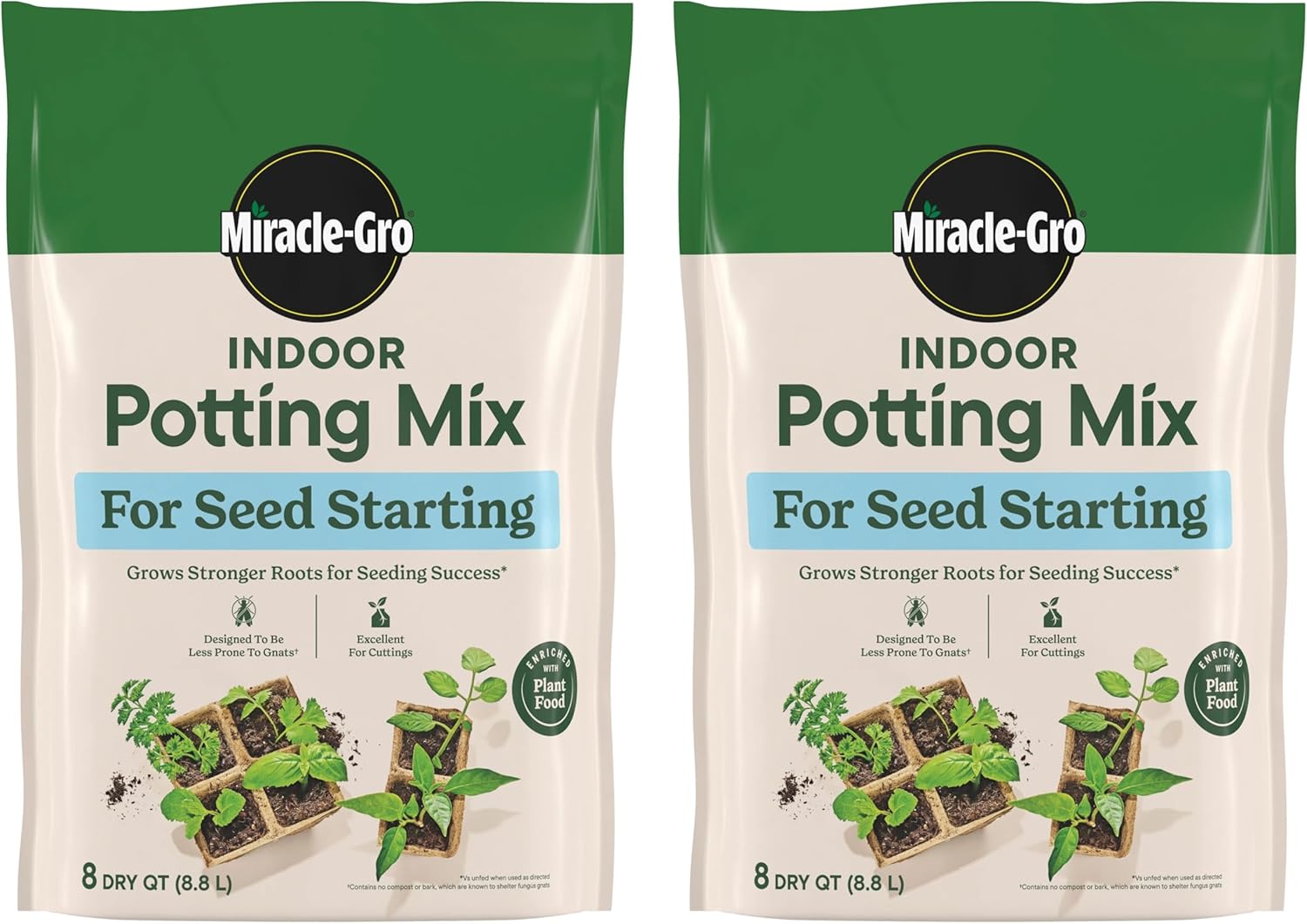
Miracle-Gro Indoor Potting Mix for Seed Starting, 8 qt. (2-Pack)
| Brand Name | Miracle-Gro |
|---|---|
| Item Type Name | Potting Mix |
| Number of Packs | 2 |
| Volume | 8 quarts |
This two-pack of Miracle-Gro Indoor Potting Mix is designed specifically for starting seeds and rooting cuttings indoors. The blend is lightweight and pre-enriched with plant food so seedlings get a nutrient boost during early root development, and the manufacturer says it yields stronger roots compared with unfed mixes when used as directed. It is intended for vegetables, flowers, and herbs and works well in cell trays and small containers; one 8 qt. bag will fill roughly three 72-cell trays. Notably, the formula omits compost and bark, which helps lower the chance of fungus gnat infestations in damp seed-starting setups. Use it by filling trays or pots, keeping the mix evenly moist, and shielding newly sown seeds from direct sun until germination. Important limitations are standard for enriched mixes: it contains fertilizer (so handle carefully) and it is a seed-starting medium rather than an all-purpose potting soil for mature plants, so you will likely transplant seedlings into a different mix or amend soil later.
Best for: Buyers who want a low-effort, indoor seed-starting medium that supports faster root development and reduces common pest risks while following proven seed-starting practices.
Less Ideal for: Gardeners who need a permanent potting soil for mature container plants or who prefer fully organic, compost-rich mixes should consider alternatives.
- Lightweight, ready-to-use formula tailored for seed germination and cuttings
- Pre-enriched with plant food to support early root and seedling growth
- Excludes compost and bark to reduce habitat for fungus gnats
- Comes as a two-pack so you have enough mix for multiple trays
- Contains fertilizer which requires careful handling and storage
- Intended for seed starting so not formulated as long-term potting soil for mature plants
Verdict: A practical, low-risk seed-starting mix that boosts early root growth and reduces fungus gnat risk, making it a reliable choice for indoor vegetable seedlings.
Old Potters Germination Mix (24 qt) — Peat Moss with Fine Perlite & Vermiculite

| Volume | 24 quarts |
|---|---|
| Unit Count | 768 Fluid Ounces |
| pH range | 5.4 – 6.3 |
| Electrical conductivity | 1.0 – 1.5 mmhos/cm |
This germination mix is built for starting seeds and propagating cuttings with consistent results. Its formula is 80–90% finely milled Canadian sphagnum peat moss combined with fine horticultural perlite and vermiculite to provide a balance of moisture retention and aeration that promotes uniform root development. Calcitic and dolomitic limestone are added to hold the pH in the 5.4–6.3 range and a wetting agent helps the medium rehydrate evenly so you avoid dry pockets in small cells or trays. A mild starter nutrient charge and a modest EC (1.0–1.5 mmhos/cm) give seedlings a gentle early feed without burning young roots. The fine texture makes it well suited to both sub-irrigation and overhead watering systems and to use in seed flats, plug trays, and small pots. Be aware the mix is peat-based, so it will compress over time and may hold more water than soilless mixes with higher perlite content, requiring attention to drainage for long-term potting. For reliable, repeatable seed starts this is a practical, no-nonsense choice.
Best for: Gardeners who prioritize consistent, predictable seed starts and propagation results and want a ready-to-use medium that performs across trays and small pots.
Less Ideal for: Growers looking for an entirely peat-free or very fast-draining mix for succulents or long-term container culture should consider alternatives.
- High peat content for even moisture retention and fine texture ideal for seeds and cuttings
- Added fine perlite and vermiculite improve aeration and uniform water holding in trays
- pH balanced with calcitic and dolomitic limestone for consistent nutrient availability
- Wetting agent promotes quick, even rehydration to reduce dry spots in small cells
- Peat-based formulation can compress and retain more water over time compared with higher-drainage mixes
- Contains a light starter charge but not a complete fertilizer for longer-term growth
Verdict: Choose this germination mix when you need a dependable, fine-textured medium that gives repeatable, uniform seed and cutting starts.
Midwest Hearth Seed Starter Potting Soil Mix, 4 Dry Quarts

| Brand | Midwest Hearth |
|---|---|
| Unit Count | 128 Ounce |
| Item Type | Potting Soil |
| Key Ingredients | Peat moss, perlite, vermiculite |
This Midwest Hearth seed starter is a simple, no-mix potting medium designed for starting seeds and raising young seedlings. The blend of organic peat moss with perlite and vermiculite gives a light, well-aerated texture that holds moisture without becoming waterlogged, which helps consistent germination and reduces damping-off risk when used with proper hygiene. It is pH-balanced for a wide range of plants and arrives ready to use, so you can fill flats or small pots and sow seeds immediately rather than measuring amendments. Practical features include a color/weight change cue to help time watering and safety guidance about dust and skin/eye contact. Limitations are that the bag is a small 4 quart volume suited to modest starting needs and it does not contain added fertilizer for longer-term growth, so seedlings will need transplanting into richer potting mix or feeding after true leaves develop.
Best for: Gardeners who want a straightforward, ready-made seed starting mix to get reliable germination with minimal prep and predictable watering cues.
Less Ideal for: Growers starting large numbers of seeds, or those who prefer a pre-fertilized or extended-growth potting medium for longer container culture.
- Ready-to-use formulation with peat moss, perlite, and vermiculite for good aeration and moisture retention
- pH-balanced to suit a broad range of seed types and young plants
- Lightweight, loose texture that promotes healthy root development and consistent germination
- Visual color/weight change cue helps time watering for seedlings
- Small 4 quart bag provides limited volume for larger seed-starting batches
- No added nutrients for extended growth so seedlings will require feeding or transplanting
Verdict: A convenient, pH-balanced seed starter mix that simplifies germination for small-scale seed starting and quick setup.
Doter Plant Propagation Potting Mix (1 qt)

| Brand Name | Doter |
|---|---|
| Unit Count | 32 Ounce |
| Item Type Name | Garden soil |
| Volume | 1 quarts |
This 1 quart Doter propagation mix is built for starting cuttings and seedlings. It blends perlite and vermiculite to create a loose, sterile medium that holds moisture without staying waterlogged, which helps roots form quickly while reducing the risk of rot. The mix is very lightweight and easy to handle in small trays or individual pots, and its clean composition makes it convenient for indoor work where disease-free media matters. Typical use is filling small propagation pots, inserting cuttings to about one-third their length, and keeping the substrate slightly moist until roots appear. Practical benefits include improved oxygen around developing roots and simpler handling compared with heavier potting soils. Limitations are the small 1 qt volume, which means frequent repurchasing for larger projects, and the product may require added nutrients once cuttings are rooted and moved to longer-term pots.
Best for: Home gardeners who want an affordable, ready-to-use propagation medium for small batches of cuttings and who prioritize a clean, easy-to-handle mix over bulk quantity.
Less Ideal for: Gardeners propagating large numbers of cuttings, nurseries, or projects that need nutrient-rich potting soil for long-term growth should consider larger or richer mixes.
- Formulated with perlite and vermiculite for balanced drainage and moisture retention
- Lightweight and loose texture makes inserting cuttings and checking roots easy
- Sterile, clean medium reduces risk of soil-borne contaminants during propagation
- Suitable for a wide range of plants including flowers, herbs, and vegetables
- Only 1 quart per package so not cost-effective for large batches of cuttings
- No built-in nutrients so cuttings need feeding after rooting
Verdict: A compact, inexpensive propagation mix that gives beginner and budget-focused gardeners a reliable, sterile medium for rooting cuttings.
Sol Soils Seedling & Propagation Mix (1 gal)

| Brand Name | sol soils |
|---|---|
| Style Name | Seedling & Propagation Mix |
| Unit Count | 128 Ounce |
| Volume | 1 gallons |
This Seedling & Propagation Mix is designed specifically for starting seeds and rooting cuttings. It combines calcined clay for moisture buffering and aeration, hardwood biochar to improve structure and microbial activity, coconut husk as a peat-free moisture-retentive medium, and earthworm castings to supply gentle nutrients. In practice the mix is fine-textured and holds water without becoming soggy, which helps delicate roots establish while reducing the risk of damping-off. It is sterile out of the bag and compatible with most plant types, so you can use it in trays, small pots, or plug cells for both indoor seed starting and greenhouse propagation. Bags are hand-mixed in small batches so texture varies slightly between bags, but the ingredients are chosen to extend time between waterings and resist compaction over a single growing cycle. Important limitations: the bag is one gallon so larger or repeated projects will require multiple bags, and users should soak coconut husk as recommended to remove tannins before heavy use.
Best for: Buyers who prioritize reliable, low-maintenance seed starting want a consistent, sterile medium that reduces overwatering risk and helps fragile roots establish. Ideal for hobbyists and small greenhouse growers focused on dependable results.
Less Ideal for: Not a good fit for growers who need large volumes for broadscale sowing or those who prefer DIY mixes tailored to specific crop nutrient profiles.
- Blend formulated for seedlings with calcined clay for moisture consistency and aeration
- Hardwood biochar and castings support beneficial microbes and gentle nutrient supply
- Peat-free coconut husk improves moisture retention while providing aeration
- Fine texture and sterile mix suitable for trays, small pots, and cuttings
- Small 1 gallon volume may be insufficient for larger seed-starting projects
- Batch-to-batch texture variability due to small-batch mixing
Verdict: A dependable, fine-textured peat-free propagation mix that helps seedlings and cuttings establish with less risk of overwatering.
SunGro Horticulture Organic Seedling Mix (8 Quart)

| Brand Name | SUN GRO |
|---|---|
| Style Name | Peat Moss |
| Volume | 8 quarts |
SunGro Horticulture Seedling Mix is a fine-textured, peat-based starting mix formulated to germinate seeds in flats, pots, and plug trays. It contains sphagnum peat moss, perlite for lightness and drainage, and an organic wetting agent to promote even water absorption, which helps maintain consistent moisture for small seeds. The mix also includes a silicon-enriched additive called RESiLIENCE intended to support stronger seedlings and reduce wilting during establishment. Typical use is filling trays or small pots, keeping the medium evenly moist but not waterlogged, then transplanting seedlings once roots are established. Practical benefits include predictable moisture retention, a clean fine texture that allows delicate roots to develop, and OMRI listing for organic onion transplants and other edible starts. Limitations are its small 8 quart volume for larger onion seed programs and that peat-based mixes dry out faster than heavier soils, so frequent monitoring is required; it also provides limited long-term nutrients so potting up into a richer mix or fertilizing before transplant is necessary.
Best for: Gardeners who want an organic, predictable seed starting medium for small to medium onion seed batches and who prioritize reliable germination over bulk volume.
Less Ideal for: Commercial growers or anyone starting very large quantities of onion seedlings should choose larger-volume or more nutrient-dense starting media.
- Fine, light texture suitable for delicate seed germination
- Organic wetting agent promotes uniform water absorption
- OMRI listed so safe for organic edible starts
- Contains perlite for improved drainage and root aeration
- Small 8 quart bag may not be cost-effective for starting large onion batches
- Peat-based mix has low long-term nutrient content and needs fertilizing before transplant
Verdict: A reliable OMRI-listed seed starting mix that delivers even moisture and a fine texture ideal for producing healthy onion seedlings in small home gardens.
Back to the Roots Organic Indoor Potting Mix, 6 Quart

| Unit Count | 192 Fluid Ounces |
|---|---|
| Item Type Name | Indoor Potting Mix 6qt |
| Item Highlight | Peat-free, 100% organic, made in the USA |
| Ingredients | Coconut Coir, Yucca, Mycorrhizae, Perlite, Horticultural Sand |
This Back to the Roots indoor potting mix is a ready-to-use, 6-quart blend designed for common houseplants such as pothos, monstera and ferns. It combines coconut coir, yucca extract, mycorrhizae, perlite and horticultural sand to improve moisture retention, drainage and root development without peat. In practice it feels light and friable, so it is easy to pot seedlings or repot mature plants and it reduces compaction that can suffocate roots. The added mycorrhizae helps young roots establish and take up nutrients more efficiently while yucca extract helps the mix hold water between waterings, which is convenient for forgetful or busy plant owners. Because it is peat-free and made in the USA, it is a more sustainable choice versus traditional peat-based mixes. Limitations are the small 6-quart size, which means frequent repurchasing for larger collections, and the bag does not include fertilizer so you will need to feed plants separately as they grow.
Best for: Buyers who prioritize low-risk, easy-care houseplant solutions and want an organic, ready-to-use potting mix that reduces watering hassles and supports healthy root growth.
Less Ideal for: Not ideal for gardeners who need large-volume soil for many pots or for those expecting a mix that includes built-in fertilizer for long-term feeding.
- Peat-free organic formula that reduces environmental impact
- Yucca extract improves moisture retention between waterings
- Contains mycorrhizae to support root development and nutrient uptake
- Light, well-draining texture suitable for repotting seedlings and houseplants
- Small 6-quart volume may require frequent repurchasing for larger plant collections
- Does not include fertilizer so additional feeding is necessary
Verdict: A compact, peat-free potting mix that simplifies indoor plant care by holding moisture and boosting root establishment.
Choosing the Right Soil Mix for Cuttings: Key Factors to Consider
Particle Size and Structure
Particle size controls how freely air moves through the medium and how water distributes around a cutting stem. A mix with a range of particle sizes creates pore space that feeds oxygen to forming roots and prevents soggy pockets that cause rot. Coarse components like perlite, pumice, or coarse sand increase macroporosity, while finer materials hold water near the stem without sealing off the larger pores.
For cuttings you want structure that supports the stem upright without compacting when watered. Very fine-textured materials compact easily and reduce oxygen availability. Look for mixes that specifically list coarse elements and indicate whether they are washed or graded to avoid dust and inconsistency.
Moisture Retention Balance
Successful rooting requires steady moisture around the cutting base but not saturation. Materials such as coco coir or finely aged peat provide gentle water retention that keeps stems hydrated between misting or watering cycles. Too little retention leads to desiccation, especially under propagation lights, while too much retention invites fungal attack.
Consider your propagation environment when assessing retention. In a humid, low-evaporation space you can use a faster-draining mix. Under grow lights or heated mats, pick a mix with more water-holding capacity to limit frequent watering and disturbance of delicate new roots.
Sterility and Disease Management
Cuttings have exposed tissue that is highly vulnerable to soilborne pathogens. A propagation mix should minimize organic, microbe-rich fines that harbor fungi and bacteria. Sterile or inert components such as perlite, pumice, coarse sand, or washed bark reduce pathogen load compared with raw garden soil or fresh compost.
Some mixes are heat-treated or pasteurized during production and will state reduced microbial counts. Even so, good hygiene practices such as clean tools, fresh pots, and avoiding overwatering remain essential to prevent damping-off and other common issues.
pH and Nutrient Considerations
Most cuttings do not need substantial nutrients until roots form. A neutral to slightly acidic pH is acceptable for a broad range of species and supports consistent nutrient uptake once roots develop. Extremely nutrient-rich mixes can encourage rot or callus formation without stimulating healthy roots.
Evaluate whether a mix is intentionally low in fertilizer for rooting, or if it contains long-release amendments that could alter early development. For sensitive or rare cuttings you may prefer minimal nutrient content and then pot up into richer mix once roots are established.
Consistency and Ingredient Transparency
A predictable mix composition makes propagation outcomes repeatable. Manufacturers or DIY recipes that list component proportions let you anticipate drainage and retention characteristics. Variable bag-to-bag texture or vague ingredient lists make it harder to diagnose issues when cuttings fail to root.
For DIY mixing, stick to simple, reproducible ratios. For pre-mixed products, favor those that list percentages or clear ingredient weights so you can compare performance between batches and suppliers.
Ease of Handling and Potting Workflow
Propagation often happens in small cells, tubes, or trays, so the physical behavior of the mix matters. Lightweight, free-draining mixes are easier to fill into small pots and to insert cuttings without crushing. Dusty mixes or those with a lot of fine material can clog misting nozzles and make cleanup harder.
Consider how the mix responds when you water from the top versus bottom-watering, whether it compacts over time, and how easy it is to remove rooted cuttings for repotting without damaging fragile young roots.
Propagation Techniques That Complement the Right Mix
The best soil mix for cuttings works together with your propagation routine. For softwood and herbaceous cuttings, gentle bottom heat and a higher-humidity dome reduce transpiration and let a slightly coarser, faster-draining mix perform well. Semi-ripe or hardwood cuttings tolerate lower humidity but benefit from mixes that hold a little more moisture while still offering good aeration.
Use propagation domes, trays with drainage holes, or clear plastic covers to moderate humidity without trapping water directly on stems. Periodic air exchange reduces fungal pressure and helps callus formation before roots appear.
- Bottom heat can speed rooting but increases evaporation; choose a mix with more retention if you use heat.
- Frequent misting pairs well with quick-draining mixes to maintain surface moisture without saturating the root zone.
- For woody cuttings, allow longer callusing periods and avoid mixes that stay wet for prolonged periods.
Mixing Your Own Propagation Medium
DIY mixes give you control over particle size and retention characteristics. A common starting point is equal parts of a stable, inert drainage component and a fine moisture-retaining component, then adjust for local climate and plant type. For example, increase coarse grit in humid climates and add more coir or fine bark in hot, dry rooms.
When blending, sift components to remove dust and fine particulates that can compact. Pre-wetting coir and washing sand or perlite removes soluble salts and reduces initial dust that can interfere with rooting.
- Test small batches before committing all your cuttings to a new recipe.
- Record ratios and results so you can refine the mix over successive propagation cycles.
Special Considerations for Difficult-to-Root Species
Some plants are notoriously slow or finicky when propagating. For these species, lean toward mixes with excellent aeration and low organic load to reduce microbial competition. Very coarse, sterile blends often give the highest success by forcing roots to grow through the grain boundaries in search of moisture.
Combine that medium choice with patient technique: extended callusing, intermittent bottom heat at low settings, and careful monitoring of moisture without overwatering. Often success comes from matching a conservative moisture strategy with a reliably clean substratum.
- For plants sensitive to root rot, favor washed, inert components and avoid composted materials.
- Use a sterile cutting surface and clean tools to reduce introduction of pathogens.
Reusing and Refreshing Propagation Mix
Reusing propagation mix is possible but requires attention to hygiene and structure. Over time fine particles and root debris accumulate, reducing drainage and increasing disease risk. Sifting and refreshing the coarse components can restore porosity, but if the mix shows signs of foul odor, mold, or sticky compaction, replace it.
When reusing, remove old root fragments, sun-sterilize small batches when possible, and blend in fresh coarse material to restore performance. Keep a rotation so mixes used for actively rooting vulnerable cuttings are always fresh.
- Inspect reused mix for decomposition and off smells before reuse.
- Top up the coarse fraction rather than adding more fine material when structure has been lost.
Adapting Mix Choice to Your Propagation Setup
A home windowsill propagator and a heated greenhouse demand different mixes. In low-light, low-evaporation environments, a mix with higher retention prevents dehydration. Under bright lights and heat mats, a faster-draining, more aerated mix reduces rot risk. Think about how you water, how often you can monitor trays, and how long cuttings typically take to root for your species list.
Also consider container size. Small cells dry out faster, so they often pair better with mixes that hold slightly more moisture without sacrificing aeration. Larger pots buffer moisture but need good drainage to avoid anaerobic zones around the stem base.
- Match the mix to your routine: less frequent watering needs more retention.
- Adjust particle size when moving from trays to larger pots during potting-on.
How We Chose the Best Soil Mix for Cuttings
We focused on practical, propagation-centered attributes that actually affect rooting success and ongoing hygiene. Candidate mixes had to provide a balance of particle size for aeration, proven water retention without waterlogging, low pathogen risk through clean or inert components, and enough structure to support cuttings until roots develop. We checked formulation transparency so gardeners understand ingredients, and we prioritized mixes that performed well across indoor and sheltered outdoor setups. Excluded items included generic garden soils, unamended composts, and mixes formulated primarily for established container plants rather than propagation. Our evaluation criteria emphasized drainage and aeration, moisture-holding capacity, disease resistance and sterility, ingredient transparency and consistency, and ease of handling at small volumes. These filters ensured each shortlisted mix supports healthy root initiation and reduces common propagation failures.
FAQ
Can I use regular potting soil for cuttings?
Regular potting soil often contains fine organic matter and fertilizers that retain moisture and harbor microbes. That can lead to rot in unrooted cuttings. For best results, use a lighter, cleaner propagation mix that prioritizes aeration and low pathogen load.
How wet should the soil mix be when I insert a cutting?
Aim for evenly moist but not saturated mix. It should hold together lightly when squeezed but release no free water. Excess surface wetness invites fungal problems, while a slightly damp environment supports callusing and early root growth.
Should I add rooting hormone if I use a propagation mix?
Rooting hormone often increases the speed and uniformity of rooting, especially for woody or difficult cuttings. A clean, well-structured propagation mix complements hormone use by providing oxygen and consistent moisture for developing roots.
Can I sterilize used mix at home?
Small batches can be sterilized by baking at low temperature or solarizing in sealed bags, but these methods may alter structure and reduce aeration. For propagation of vulnerable cuttings, fresh or professionally pasteurized mixes are usually a safer option.
When should I pot on rooted cuttings into a richer mix?
Wait until you see a healthy root ball that holds soil together when lifted. Once roots are established, gradually transition to a richer or more stable potting mix to support shoot growth. Avoid sudden over-fertilization immediately after potting on.
Final Verdict
Choose a propagation mix that prioritizes pore space and predictable moisture holding over immediate fertility. The right balance of coarse drainage elements and gentle water-retaining components reduces rot and encourages steady root development. Match your mix choice to your local environment, container size, and the specific needs of the plants you propagate so you can root cuttings reliably and move them on to fuller potting mixes with confidence.
