

Note: This article contains affiliate links. If you click on these links and make a purchase, I may earn a small commission at no extra cost to you. This helps support my research and content. Read my full affiliate disclosure here.
Growing microgreens successfully starts with the right growing medium. The wrong soil can lead to slow sprouts, mold issues, or uneven growth across trays. This guide focuses on soil mixes for microgreens, explaining how different textures, moisture retention, and nutrient content affect germination speed and stand uniformity. We shortlisted seven top soil mixes chosen for consistent sprouting and tray-to-tray reliability. Below you will find practical notes about what each mix does in a real grow setup and the evaluation criteria used to compare them, including texture, drainage, and ease of use.
Top Picks at a Glance
| Best Overall The best all-around choice for most situations | Espoma Organic Seed Starter Premium Potting Mix, 16 qt |  |
| Best Quality Built to a higher standard if you want something more solid | BIOGREENS Microgreens Growing Media, 1.5 cu ft |  |
| Best Value The sweet spot between price and what you get | Miracle-Gro Indoor Potting Mix for All Plants, 6 qt., 2-Pack |  |
| Best Budget The cheapest option that still gets the job done reliably | SunGro Horticulture Organic Seedling Mix (8 Quart) |  |
| Highest Rated A top-rated pick with lots of positive feedback | Sol Soils Seedling & Propagation Mix (1 gal) |  |
| Most Popular A crowd favorite that many people choose with confidence | Miracle-Gro Indoor Potting Mix for Seed Starting, 8 qt. (2-Pack) |  |
| Best Seller A high-volume bestseller chosen again and again | Back to the Roots 3-in-1 Seed Starting Mix, 6 Quart, Organic Peat-Free |  |
Espoma Organic Seed Starter Premium Potting Mix, 16 qt

| Brand Name | Espoma |
|---|---|
| Volume | 16 quarts |
| Unit Count | 598.4 Ounce |
| Model Number | SS16 |
Espoma Organic Seed Starter is a peat-based, lightweight potting mix designed specifically for germinating seeds and rooting cuttings. The blend of sphagnum peat moss and perlite gives good aeration and drainage while the formula includes yucca extract to improve wetting and lime to balance pH. It also contains Myco-tone mycorrhizae to help early root establishment and improve nutrient access during the seedling stage. Typical use is filling trays, cells, or small pots for seeds and softwood cuttings; its fine texture and moisture retention reduce damping-off risk when used with proper sanitation and watering. Because it contains no synthetic fertilizers, it is appropriate for organic growing but you will need to begin light feeding once true leaves form or when transplanting. The bag size covers routine home-seed-starting needs, and the product is straightforward to handle and mix for small-scale propagation projects.
Best for: Gardeners focused on reliable seed germination and strong early root development who want an organic, ready-to-use mix for trays and small pots.
Less Ideal for: Growers wanting a peat-free or pre-fertilized seed mix or those starting very large volumes commercially should consider alternatives tailored to those needs.
- Formulated for seedlings with peat and perlite for balanced aeration and moisture retention
- Includes Myco-tone mycorrhizae to support early root development
- Organic ingredients with no synthetic fertilizers, suitable for organic growing
- Contains yucca extract to improve wetting and lime to help stabilize pH
- No starter nutrients included so plants need feeding after true leaves appear
- Peat-based mix is not the most sustainable choice for gardeners preferring peat-free media
Verdict: Choose this organic seed starter when you want a ready-to-use mix that promotes rapid root development and reliable germination for home seedlings and cuttings.
BIOGREENS Microgreens Growing Media, 1.5 cu ft

| Volume | 1.5 cubic feet |
|---|---|
| Item Highlight | Nutrient-rich microgreens mix with fine peat, coco, perlite, biochar & beneficial biology for germination through harvest |
| Style Name | Organic |
| Item Weight | 25 pounds |
| N-P-K | 0.45-0.18-0.40 |
BIOGREENS is a purpose-built growing media for microgreens and other short-cycle leafy crops, sold ready to use straight from the bag. It combines fine sphagnum peat, coconut coir and perlite with 7% softwood biochar and an N-P-K of 0.45-0.18-0.40 to deliver bioavailable nutrients through germination and harvest. The fine texture improves seed-to-media contact for uniform stands while the high-porosity blend helps balance moisture and oxygen around fragile microgreen roots. Because it is uncompressed and OMRI listed, you can fill flats or propagation trays quickly without pre-soaking, and the indoor manufacturing and quality checks aim to reduce contamination risk. Expect vigorous green growth without needing frequent supplemental feeding for the first crop cycles. Limitations are that the mix is formulated for short-cycle greens rather than long-term potting for large plants, and its peat-rich base may be a concern for growers avoiding peat in mixes.
Best for: Growers who prioritize reliable, high-performance results for microgreens and leafy greens and want a ready-to-use substrate that reduces setup time and early feeding needs.
Less Ideal for: Growers seeking a long-term potting mix for large vegetables or ornamentals or those who strictly avoid peat-based products should consider alternatives.
- Formulated specifically for microgreens and leafy greens for consistent germination and harvest
- Fine-textured blend improves seed-to-media contact for even stands
- Includes biochar and a defined nutrient analysis to support early vigorous growth
- High-porosity mix balances moisture and aeration to protect delicate roots
- OMRI listed and sold ready to use straight from the bag, no compression prep required
- Designed for short-cycle crops so it is not optimized for long-term container-grown plants
- Contains peat which some growers avoid for sustainability reasons
Verdict: If you want a ready-to-use, high-performance substrate that promotes uniform germination and vigorous microgreen growth, this mix is built for that purpose.
Miracle-Gro Indoor Potting Mix for All Plants, 6 qt., 2-Pack

| Number of Packs | 2 |
|---|---|
| Unit Count | 400.58 Ounce |
| Item Highlight | Feeds for up to 6 Months |
| Ingredients | Sphagnum Peat Moss, Coir, Perlite, Fertilizer, Wetting Agent |
This Miracle-Gro indoor potting mix is formulated as an all-purpose soil for indoor container plants and is sold in a two-pack of 6‑quart bags. It combines sphagnum peat moss, coconut coir, and perlite to create a lightweight, well-draining mix that holds moisture yet releases it to roots, which helps tropical houseplants like a Dragon Tree avoid waterlogged roots. The bagged mix includes a slow-release fertilizer meant to feed plants for up to six months so you do not need to amend immediately after potting. Notably the formula excludes bark and compost, which can reduce habitats for fungus gnats — useful when repotting indoor specimens. Use is straightforward: fill a pot with drainage, set the plant, backfill with mix, and water. Limitations are that the fertilizer schedule is fixed to the included feed and heavy feeders may need additional fertilizing after several months, and serious growers who want a custom cactus or orchid-style mix will find the texture too fine. For routine repotting of Dragon Trees and similar tropical houseplants this mix is convenient and consistent.
Best for: Buyers who want a reliable, low-effort potting mix for repotting tropical houseplants like Dragon Trees and prefer a product with built-in feeding and pest-reduction features.
Less Ideal for: Specialist growers who need custom texture blends for succulents, orchids, or aggressive feeders should choose purpose-formulated mixes or amend this product accordingly.
- Balanced blend of peat moss, coir, and perlite for good moisture retention and drainage
- Includes slow-release fertilizer that feeds up to six months for low-maintenance care
- Bark- and compost-free formula reduces places for fungus gnats to breed
- Ready-to-use bag makes repotting quick with no mixing required
- Fertilizer is fixed for about six months so additional feeding may be necessary for heavy feeders
- Texture may be too fine for plants that prefer very fast-draining or chunky mixes
Verdict: A convenient, low-maintenance indoor potting mix that keeps Dragon Trees healthy with good drainage and up to six months of built-in feeding.
SunGro Horticulture Organic Seedling Mix (8 Quart)

| Brand Name | SUN GRO |
|---|---|
| Style Name | Peat Moss |
| Volume | 8 quarts |
SunGro Horticulture Seedling Mix is a fine-textured, peat-based starting mix formulated to germinate seeds in flats, pots, and plug trays. It contains sphagnum peat moss, perlite for lightness and drainage, and an organic wetting agent to promote even water absorption, which helps maintain consistent moisture for small seeds. The mix also includes a silicon-enriched additive called RESiLIENCE intended to support stronger seedlings and reduce wilting during establishment. Typical use is filling trays or small pots, keeping the medium evenly moist but not waterlogged, then transplanting seedlings once roots are established. Practical benefits include predictable moisture retention, a clean fine texture that allows delicate roots to develop, and OMRI listing for organic onion transplants and other edible starts. Limitations are its small 8 quart volume for larger onion seed programs and that peat-based mixes dry out faster than heavier soils, so frequent monitoring is required; it also provides limited long-term nutrients so potting up into a richer mix or fertilizing before transplant is necessary.
Best for: Gardeners who want an organic, predictable seed starting medium for small to medium onion seed batches and who prioritize reliable germination over bulk volume.
Less Ideal for: Commercial growers or anyone starting very large quantities of onion seedlings should choose larger-volume or more nutrient-dense starting media.
- Fine, light texture suitable for delicate seed germination
- Organic wetting agent promotes uniform water absorption
- OMRI listed so safe for organic edible starts
- Contains perlite for improved drainage and root aeration
- Small 8 quart bag may not be cost-effective for starting large onion batches
- Peat-based mix has low long-term nutrient content and needs fertilizing before transplant
Verdict: A reliable OMRI-listed seed starting mix that delivers even moisture and a fine texture ideal for producing healthy onion seedlings in small home gardens.
Sol Soils Seedling & Propagation Mix (1 gal)

| Brand Name | sol soils |
|---|---|
| Style Name | Seedling & Propagation Mix |
| Unit Count | 128 Ounce |
| Volume | 1 gallons |
This Seedling & Propagation Mix is designed specifically for starting seeds and rooting cuttings. It combines calcined clay for moisture buffering and aeration, hardwood biochar to improve structure and microbial activity, coconut husk as a peat-free moisture-retentive medium, and earthworm castings to supply gentle nutrients. In practice the mix is fine-textured and holds water without becoming soggy, which helps delicate roots establish while reducing the risk of damping-off. It is sterile out of the bag and compatible with most plant types, so you can use it in trays, small pots, or plug cells for both indoor seed starting and greenhouse propagation. Bags are hand-mixed in small batches so texture varies slightly between bags, but the ingredients are chosen to extend time between waterings and resist compaction over a single growing cycle. Important limitations: the bag is one gallon so larger or repeated projects will require multiple bags, and users should soak coconut husk as recommended to remove tannins before heavy use.
Best for: Buyers who prioritize reliable, low-maintenance seed starting want a consistent, sterile medium that reduces overwatering risk and helps fragile roots establish. Ideal for hobbyists and small greenhouse growers focused on dependable results.
Less Ideal for: Not a good fit for growers who need large volumes for broadscale sowing or those who prefer DIY mixes tailored to specific crop nutrient profiles.
- Blend formulated for seedlings with calcined clay for moisture consistency and aeration
- Hardwood biochar and castings support beneficial microbes and gentle nutrient supply
- Peat-free coconut husk improves moisture retention while providing aeration
- Fine texture and sterile mix suitable for trays, small pots, and cuttings
- Small 1 gallon volume may be insufficient for larger seed-starting projects
- Batch-to-batch texture variability due to small-batch mixing
Verdict: A dependable, fine-textured peat-free propagation mix that helps seedlings and cuttings establish with less risk of overwatering.
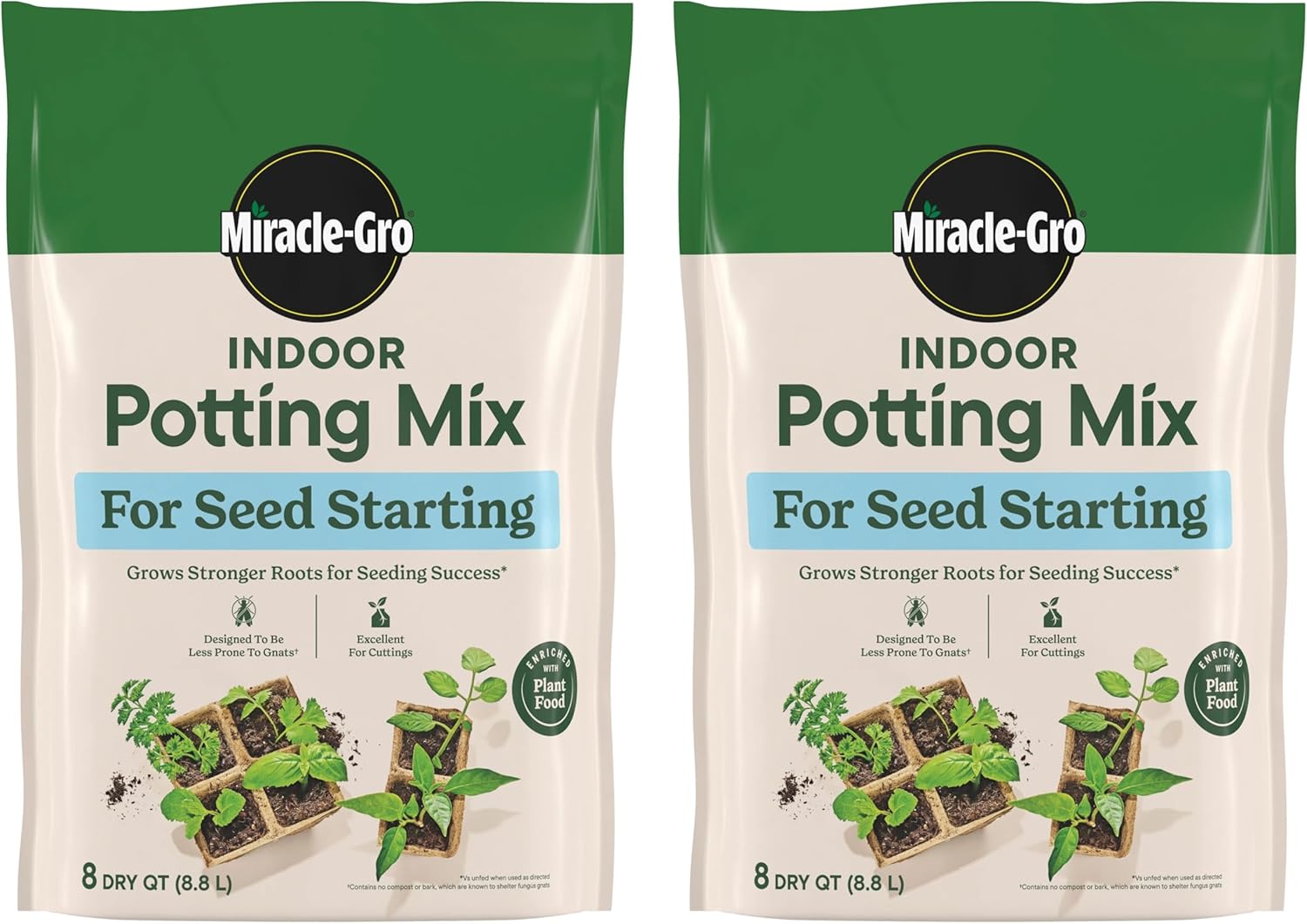
Miracle-Gro Indoor Potting Mix for Seed Starting, 8 qt. (2-Pack)
| Brand Name | Miracle-Gro |
|---|---|
| Item Type Name | Potting Mix |
| Number of Packs | 2 |
| Volume | 8 quarts |
This two-pack of Miracle-Gro Indoor Potting Mix is designed specifically for starting seeds and rooting cuttings indoors. The blend is lightweight and pre-enriched with plant food so seedlings get a nutrient boost during early root development, and the manufacturer says it yields stronger roots compared with unfed mixes when used as directed. It is intended for vegetables, flowers, and herbs and works well in cell trays and small containers; one 8 qt. bag will fill roughly three 72-cell trays. Notably, the formula omits compost and bark, which helps lower the chance of fungus gnat infestations in damp seed-starting setups. Use it by filling trays or pots, keeping the mix evenly moist, and shielding newly sown seeds from direct sun until germination. Important limitations are standard for enriched mixes: it contains fertilizer (so handle carefully) and it is a seed-starting medium rather than an all-purpose potting soil for mature plants, so you will likely transplant seedlings into a different mix or amend soil later.
Best for: Buyers who want a low-effort, indoor seed-starting medium that supports faster root development and reduces common pest risks while following proven seed-starting practices.
Less Ideal for: Gardeners who need a permanent potting soil for mature container plants or who prefer fully organic, compost-rich mixes should consider alternatives.
- Lightweight, ready-to-use formula tailored for seed germination and cuttings
- Pre-enriched with plant food to support early root and seedling growth
- Excludes compost and bark to reduce habitat for fungus gnats
- Comes as a two-pack so you have enough mix for multiple trays
- Contains fertilizer which requires careful handling and storage
- Intended for seed starting so not formulated as long-term potting soil for mature plants
Verdict: A practical, low-risk seed-starting mix that boosts early root growth and reduces fungus gnat risk, making it a reliable choice for indoor vegetable seedlings.
Back to the Roots 3-in-1 Seed Starting Mix, 6 Quart, Organic Peat-Free

| Unit Count | 192 Fluid Ounces |
|---|---|
| Style Name | 3-in-1 Seed Starting Mix |
| Brand Name | Back to the Roots |
| UPC | 810667035822 |
This 6-quart Back to the Roots 3-in-1 Seed Starting Mix is a peat-free, organic blend aimed at making seed starting and early potting simple. You use it straight from the bag to fill trays, small pots, or starter cells; the mix includes coconut coir for water retention, dolomitic limestone to balance pH, mycorrhizae to support root uptake, and yucca extract for moisture control. Practically, that means fewer extra amendments for a new gardener and a more forgiving environment for delicate seedlings. The formula is designed to drain well while retaining enough moisture for even watering, and the included nutrients and worm castings can reduce early feeding. Limits to note are the small 6-quart volume, which is best for hobby-scale starting rather than large beds, and a lighter texture that may dry faster in very hot, exposed conditions. For budget growers who want an all-in-one starter mix without experimenting with multiple additives, this is a convenient choice.
Best for: Great for budget-minded home gardeners who want a single, ready-to-use seed starting mix that reduces extra amendments and simplifies starting herbs, vegetables, and flowers.
Less Ideal for: Not the best fit for landscapers or gardeners starting large numbers of plants or filling large containers where bulk bagged mixes would be more economical.
- Peat-free organic formula with coconut coir for moisture retention and aeration
- Includes mycorrhizae and worm castings to support early root development and nutrient uptake
- pH balancing with dolomitic limestone reduces the need for corrective amendments
- Ready-to-use blend suitable for seed trays, small pots, and indoor container starts
- Only 6 quarts per bag, so multiple bags are needed for larger projects
- Light, fast-draining texture can require more frequent watering in hot or windy conditions
Verdict: A convenient, peat-free all-in-one starter mix that saves time and extra purchases for home gardeners starting small batches of seeds.
Choosing the Right Soil Mix for Microgreens: Key Factors to Consider
Texture and Seed Contact
Microgreen seeds need firm, consistent contact with the growing medium for reliable germination. A mix with a fine but not powdery texture lets small seeds sit on the surface without sinking while still allowing roots to penetrate. If the media is too coarse, small seeds will sit on top and dry out; if it is too fine, it can compact and reduce oxygen to the emerging radicles.
When choosing a mix, look for consistent particle size across the bag. Slightly gritty or sandy components mixed with finer organic matter often give the best balance of contact and root penetration for the variety of seed sizes used in microgreens.
Moisture Retention and Watering Window
Microgreens require steady moisture for the first several days of germination but also need the surface to dry slightly between harvests to limit mold. The ideal mix holds enough water to keep seeds moist without staying soggy. Components like coco coir and peat increase water retention, while perlite and sand reduce it.
Consider your watering routine and ambient humidity. If you grow in a dry room, choose a mix with higher retention. If you struggle with overwatering or have poor ventilation, prioritize mixes with faster drying profiles to reduce disease risk.
Drainage and Aeration
Roots need oxygen as much as they need water. A mix that drains well and resists compaction prevents the shallow root systems of microgreens from becoming waterlogged. Good drainage also helps avoid root rot and fungal growth during the longer microgreen cycles.
Look for mixes that include light mineral components or coarse organic particles to keep pore space open. Avoid dense, heavy potting mixes formulated for large containers that can retain too much water in small shallow trays.
Nutrient Content and Feeding Needs
Some growers prefer inert mixes and feed with weak nutrient solutions after the cotyledons open. Others choose mixes with a low, balanced nutrient reserve that supports crops to harvest without supplemental feeding. Consider whether you want to water with plain water or add fertilizer during the short growth window.
A modest nutrient presence can help denser, healthier leaves, but too much fertilizer can harm tiny seedlings. Choose a mix appropriate to your feeding plan and the variety of microgreens you plan to grow.
Contamination Risk and Cleanliness
Microgreens are grown densely and harvested young, which creates conditions where mold and bacterial issues can quickly spread. Media that is hygienically processed, free of weed seeds, and low in high-carbon residues reduces contamination risk. Pre-sterilized or heat-treated mixes offer an extra margin of safety for hobby and commercial growers alike.
Also consider how easy the mix is to remove from trays between crops. Lightweight, dusty mixes can cling to tray edges and require more cleaning to avoid cross-contamination between successive plantings.
pH Stability and Consistency
Seedlings are sensitive to pH extremes. A stable, near-neutral pH helps nutrient uptake and predictable growth. Some organic components shift pH over time, so mixes formulated and tested for seedlings reduce surprises. Consistent batch quality matters because fluctuations in particle size, nutrient level, or pH between bags will change germination and growth outcomes.
For growers aiming for repeatable harvests, choose mixes with documented pH ranges or those blended specifically for seed starting and microgreens rather than generic garden soils.
How Mix Components Affect Microgreen Varieties
Different microgreen species respond to media textures and nutrient levels in distinct ways. Brassicas and mustards often germinate and grow densely with minimal nutrients, while herbs and amaranth may appreciate a bit more available nitrogen for leaf color and size. Adjust the mix choice to the types you plant most frequently.
If you plan a mixed tray with several species, choose a neutral mix that performs reasonably well across seed sizes and nutrient needs rather than optimizing for one variety and risking poor results for others.
- Fine-seeded crops benefit from smooth, even surfaces and light compaction.
- Larger-seeded crops tolerate coarser textures and may need deeper media for root anchorage.
- Heavier feeders will show stronger growth with a slightly richer mix or light feeding.
Tray Preparation and Layering Techniques
How you fill and level the tray affects germination uniformity. Use a shallow, even layer of mix and firm it lightly to improve seed contact without compacting. Some growers use a very thin bottom layer of coarser material to enhance drainage and then top with the fine seed-starting mix.
Wetting the mix before sowing and allowing excess water to drain ensures that seeds start in consistently moist conditions. Avoid oversaturating the tray as excess water trapped under a compacted surface invites mold.
- Pre-wet media until it holds together when squeezed but does not drip.
- Level the surface with a straight edge for even seeding depth and contact.
- Consider a drainage layer or micro-holes in trays if your setup tends to retain water.
Managing Mold and Fungal Issues in Dense Trays
High humidity, cool temperatures, and stagnant air encourage mold on microgreen surfaces. Media choice helps but environmental controls are equally important. Improve airflow above trays, maintain moderate temperatures, and water from below or mist lightly to reduce surface saturation.
If mold appears, remove affected trays promptly and adjust humidity and ventilation. Choosing a cleaner, less dusty mix and practicing good sanitation between crops reduces outbreak frequency.
- Use a fan for gentle air movement above seed trays.
- Water from the bottom to limit surface wetting when appropriate.
- Sanitize trays and tools between plantings to prevent carryover.
Scaling From Hobby To Small Commercial Runs
As you scale, consistency and batch-to-batch reliability of your chosen mix become more important than minor cost differences. Larger operations often prefer mixes that are easy to hydrate at scale and that stay uniform when mixed in batches.
Consider storage stability, how quickly the mix compacts under repeated handling, and whether the supplier provides batch data on pH and particle size. These factors save time and reduce crop variability when producing many trays.
- Test a new mix with several small trays before ordering larger quantities.
- Store mixes in cool, dry conditions to preserve consistency.
- Set up a standard hydration and filling routine to minimize variation.
Sustainable and Organic Considerations
If organic certification or sustainability matters, check the component sourcing and whether the mix uses renewable ingredients. Coco coir, composted bark, and certified organic composts are common sustainable options, but they vary in salt content and consistency.
Remember that some organic materials can increase contamination risk if not properly processed. Look for mixes produced under controlled conditions and matched to indoor seed-starting uses to balance sustainability with hygiene.
- Choose certified organic blends when organic labeling is required.
- Watch for salts in some coir or compost products that can affect seedlings.
- Prefer materials produced with traceable sourcing for predictable results.
How We Chose the Best Soil Mix for Microgreens
Our shortlist reflects how these mixes behave in real microgreen setups rather than marketing claims. We prioritized mixes that support quick, even germination and produce dense, uniform stands under common indoor conditions. Key evaluation criteria included particle texture and aeration, moisture retention and drainage balance, nutrient profile and feeding needs, contamination resistance and mold risk, and ease of handling when filling trays and cleaning between crops. We also considered pH stability and consistency between batches, since variability makes repeatable results difficult for growers. We excluded blends designed for outdoor beds, heavy container soils with large bark content, and mixes that require extensive on-site amendment before use. Single-ingredient media like pure vermiculite or peat alone were not included unless sold as formulated mixes meant for microgreens. The final picks focus on ready-to-use mixes that perform reliably in small trays and under typical indoor light and humidity conditions.
FAQ
Can I use regular potting soil for microgreens?
Regular potting soil is often formulated for larger container plants and can be too heavy or nutrient-rich for microgreens. It may retain too much water and compact in shallow trays, raising the risk of mold. A lighter seed-starting or microgreen-specific mix usually gives more consistent results.
Should I sterilize my soil mix before sowing microgreens?
Sterilization reduces contamination risk and can be helpful if you have had mold issues. Many commercial mixes are processed to be low in pathogens, so additional sterilization is not always necessary. If you do sterilize at home, avoid overheating which can damage structure and beneficial properties.
How deep should the soil mix be in microgreen trays?
Most microgreens perform well in a shallow layer, typically 1 to 1.5 inches of media. This depth supports the shallow root systems while keeping trays light and easy to water. Some larger varieties may benefit from slightly deeper media, but excessive depth can increase water retention and disease risk.
Can I reuse soil mix for multiple microgreen crops?
Reusing mix is possible but carries higher contamination risk and often reduced structure. Between crops, remove old roots and compost them, then refresh the media with amendments or top up with fresh mix. For reliable, disease-free harvests, many growers replace or heavily refresh the mix between cycles.
Is coco coir better than peat for microgreens?
Coco coir and peat both retain water well, but coir tends to have better aeration and is considered more sustainable. Coir may contain salts depending on processing, so rinsing or choosing pre-washed coir helps. Peat holds moisture strongly but can compact over time, so blends that include a coarse component often perform better.
Final Verdict
Choose a soil mix that balances seed contact, moisture retention, and drainage for the types of microgreens you grow most often. Expect some tradeoffs: mixes that hold more moisture reduce watering frequency but raise mold risk without good airflow, while faster-draining mixes need closer monitoring in dry environments. Prioritize consistent particle size, low contamination risk, and a nutrient profile that fits your feeding plan to get repeatable, dense trays.
