

Note: This article contains affiliate links. If you click on these links and make a purchase, I may earn a small commission at no extra cost to you. This helps support my research and content. Read my full affiliate disclosure here.
Choosing the right fish pond filter matters for water clarity, fish health, and algae control in any backyard pond. The wrong filter can leave you chasing cloudy water, while the right one balances mechanical and biological filtration to reduce maintenance and support stable water chemistry. This guide looks at seven top shortlisted Fish Pond Filters suited to typical garden ponds, focusing on flow capacity, media performance, and ease of upkeep. Read on to understand the tradeoffs between filtration power, installation complexity, and seasonal maintenance before you pick a unit for your pond.
Top Picks at a Glance
| Best Overall The best all-around choice for most situations | VIVOHOME VH515 Pressurized Biological Pond Filter with 13W UV Light |  |
| Best Quality Built to a higher standard if you want something more solid | Aquascape UltraKlean 2000 Biological Pressure Pond Filter with 14W UV Clarifier |  |
| Best Value The sweet spot between price and what you get | POPOSOAP 660 GPH Pond Pump and Filter Kit with Fountain Attachments |  |
| Best Budget The cheapest option that still gets the job done reliably | VCRAZE CFP-1500 25W Pond Filter Pump with 4-Stage Filtration |  |
| Highest Rated A top-rated pick with lots of positive feedback | IRONMAX 2630 GPH Bio Pressure Pond Filter with 13W UV Light and Backflush |  |
| Most Popular A crowd favorite that many people choose with confidence | VIVOHOME VH556 530 GPH All-in-One Submersible Pond Filter Pump with Fountain |  |
| Best Seller A high-volume bestseller chosen again and again | TotalPond Complete Pressurized Pond Filter with 9W UV Clarifier |  |
VIVOHOME VH515 Pressurized Biological Pond Filter with 13W UV Light
| Power Source | Electric |
|---|---|
| Voltage | 110 volts |
| Horsepower | 13 watts |
| Material Type | Acrylonitrile Butadiene Styrene (ABS) |
| Included Components | Filter, UV sterilizer light (13W) |
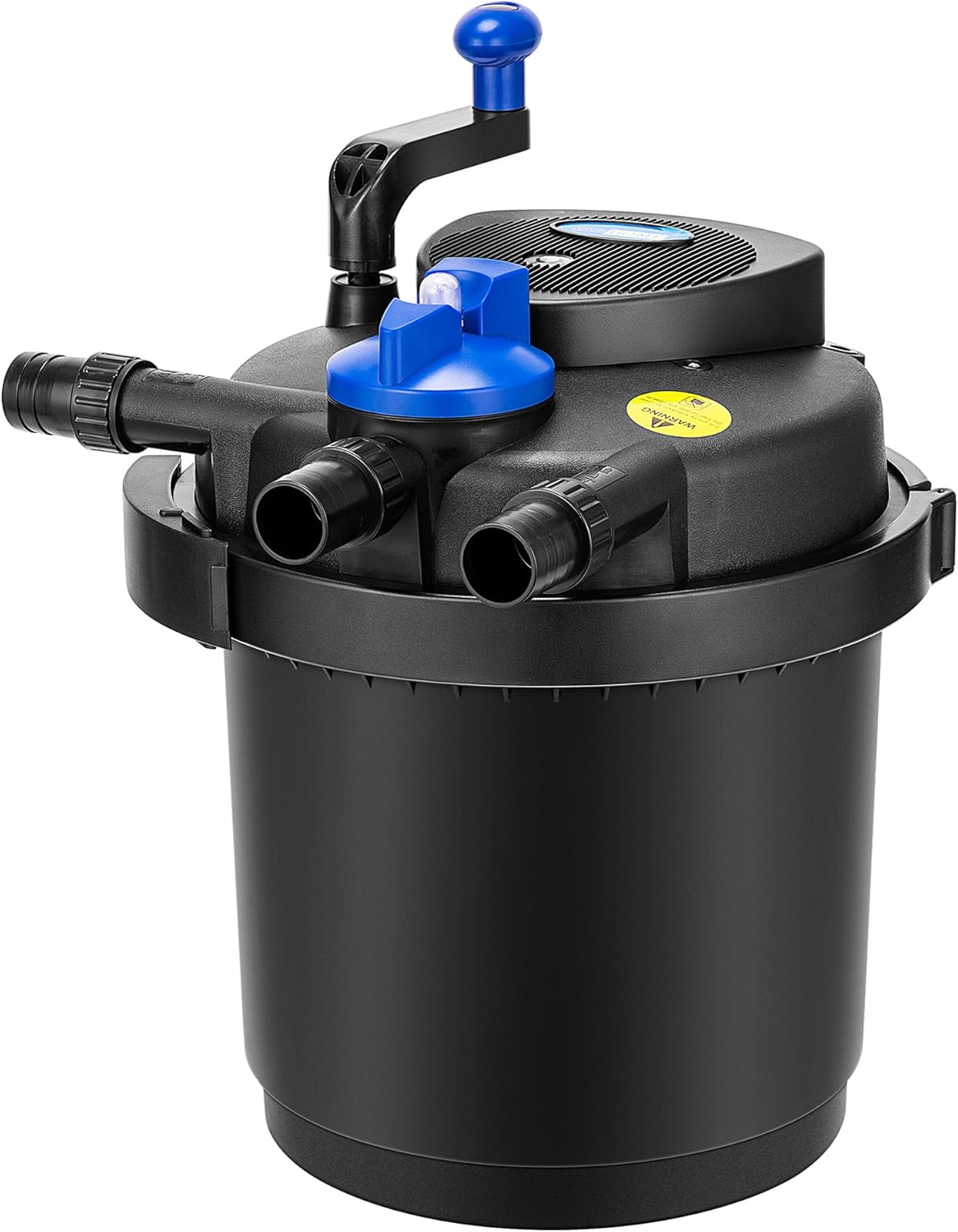
The VIVOHOME VH515 is a pressurized biological filter intended to keep koi and decorative ponds clear by combining mechanical sponge filtration with a 13W UV clarifying lamp. It is installed inline with a separate water pump and connects via the included multi-size hose adapters. Water passes through coarse and fine reusable sponges that trap debris while the lamp reduces free-floating algae, and a simple handle-driven backwash lets you switch to Clean mode and flush accumulated muck without disassembling the unit. The ABS, weather-resistant housing and clear inlet/outlet labels make outdoor siting straightforward and reduce installation guesswork. Practical benefits include low ongoing consumable cost because sponges are reusable, simple routine maintenance signaled by a red float, and compatibility with ponds up to about 1,600 gallons (ornamental) or 800 gallons with fish. Important limits are that the unit requires a separate pump and the UV bulb has a finite lifespan and must be replaced if water breaches the lamp seal; performance also depends on matching pump flow and hose size for steady filtration.
Best for: Buyers who want a low-maintenance, reliable filter for a small to mid-size koi or ornamental pond and prioritize simple installation and predictable upkeep.
Less Ideal for: Not the best choice for very large or heavily stocked ponds where industrial-scale filtration or integrated pumping is needed; pond owners who prefer fully submersible combo units should look elsewhere.
- Combined mechanical and UV clarification reduces both debris and free-floating algae
- Reusable coarse and fine sponge media lowers ongoing replacement costs
- Handle-driven backwash makes routine cleaning quick and tool-free
- Includes multiple hose adapters and clear inlet/outlet labeling for easier installation
- Weather-resistant ABS housing suited for year-round outdoor use
- Requires a separate water pump so total system cost and compatibility must be planned
- UV lamp has limited life and can fail if the lamp compartment seal is compromised
Verdict: A straightforward, low-maintenance pressurized biofilter that pairs with your pump to deliver clear water and easy weekly backflushing for small to mid-size koi and ornamental ponds.
Aquascape UltraKlean 2000 Biological Pressure Pond Filter with 14W UV Clarifier

| Capacity | 2000 gallons |
|---|---|
| UV Clarifier | 14-Watt |
| Maximum Flow Rate | 2700 gpm |
| Filter Life Cycle | 3 years |
| Installation Type | Freestanding |
The Aquascape UltraKlean 2000 is a compact, freestanding pressure filter designed to deliver mechanical and biological filtration plus a 14-watt UV clarifier for clearer water in ponds up to about 2,000 gallons. Water enters the unit and is distributed through packed BioBalls that trap debris and provide high surface area for nitrifying bacteria, while an internal UV chamber reduces single-cell algae. The unit includes a built-in backwash function that lets you clean the filter in under five minutes without disassembly, and the design avoids sponge media so clogging is less of a problem. It runs on AC power and includes the fittings needed for installation. Practical benefits for a koi keeper include strong biological capacity, easy maintenance, and an integrated UV to cut green water between seasonal cleanings. Limitations are typical for pressure filters: it relies on an external pump sized to handle up to the listed max flow, the plastic housing is lightweight compared with heavy-duty commercial units, and the 14W UV is aimed at suspended algae rather than eliminating all algae types or pathogens.
Best for: For koi pond owners who prioritize reliable water clarity and biological filtration with low-maintenance servicing and straightforward installation.
Less Ideal for: Not the best choice for very large ponds, commercial installations, or users who need heavy-duty metal housings and industrial-scale flow rates.
- Three-in-one filtration: mechanical screening, biological BioBalls, plus a 14W UV clarifier in one compact unit
- Backwash self-cleaning feature that flushes debris in under five minutes without disassembly
- High-surface-area BioBalls provide robust biological filtration for beneficial bacteria colonization
- Requires a suitably sized external pump to reach the unit's maximum flow and proper circulation
- Plastic construction is lighter duty than some metal or commercial-grade housings
Verdict: Choose the UltraKlean 2000 if you want an all-in-one, low-maintenance filter that combines strong biological media with a built-in UV clarifier for clearer koi pond water.
POPOSOAP 660 GPH Pond Pump and Filter Kit with Fountain Attachments

| Power Source | Corded Electric |
|---|---|
| Flow Rate | 2500 liters per hour |
| Maximum Lifting Height | 8.2 feet |
| Voltage | 110 volts |
| Horsepower | 40 watts |
This POPOSOAP kit combines a 660 GPH corded pump with an integrated filter box and a small fountain kit to keep pond water circulating and clearer with minimal setup. It is typically used in backyard koi ponds, water gardens, or decorative courtyard waterfalls where a single unit that handles mechanical and biological filtration plus a fountain display is preferred. The kit includes two filter pads, filter balls, bio-ceramic rings and multiple nozzle heads with a diverter so you can run a fountain, a secondary outlet, or both while adjusting flow. Practical benefits include straightforward installation and easy maintenance thanks to the clip-access lid and replaceable media, plus the pump’s adjustable flow for matching different water features. Important limitations are that the unit is a compact, plastic-bodied system intended for ponds up to the stated capacity so larger or heavily stocked koi ponds may need a dedicated external filter and higher-capacity pump for heavy waste loads. The included components cover basic filtration and aeration but advanced multi-stage filtration or UV sterilization are not part of this single-unit kit.
Best for: Buyers who want a compact, easy-to-install solution that combines filtration, circulation, and a decorative fountain for small to medium backyard ponds and who prioritize convenience and low-maintenance operation.
Less Ideal for: Owners of large, heavily stocked koi ponds or hobbyists seeking advanced multi-stage filtration and professional-grade, long-term durability should consider separate high-capacity pumps and external filters.
- Integrated pump and filter simplifies installation and reduces plumbing work
- 660 GPH pump provides strong circulation suitable for small to mid-size ponds (manufacturer-rated up to 1,180 gallons)
- Includes multiple filter media (pads, balls, bio-ceramic rings) for mechanical and biological filtration
- Fountain kit with three nozzles and diverter enables different water displays and adjustable flow
- Easy-access lid and simple clips make routine cleaning and media replacement straightforward
- Plastic construction may be less durable than heavier-duty external filters over many years
- Not a substitute for large-capacity, multi-stage filtration in heavily stocked or very large koi ponds
Verdict: A convenient, all-in-one pump and filter kit that delivers strong circulation and basic mechanical and biological filtration plus fountain options for small to mid-size koi ponds.
VCRAZE CFP-1500 25W Pond Filter Pump with 4-Stage Filtration

| Power Source | Corded Electric |
|---|---|
| Flow Rate | 1500 liters per hour |
| Maximum Lifting Height | 6 feet |
| Horsepower | 25 watts |
The VCRAZE CFP-1500 pairs a modest 25W submersible pump with an integrated 4-stage filter box to handle mechanical and biological filtration for small backyard ponds. You set the unit in the pond or attach it as a prefilter for a fountain or waterfall and the housing channels water through coarse and fine sponges, ceramic rings, and bio-balls for debris removal, bacterial toxin processing, and improved oxygenation. The enclosed filter box protects fish and keeps leaves away from the impeller, while the removable media make routine cleaning straightforward. With a 400 GPH (approx.) flow and 6 ft maximum head it is sized for ponds around 200–350 gallons, so it will cycle water quickly in that range without excess electricity use. Expect occasional media cleaning every couple of weeks during heavy debris seasons and plan to source hoses or fittings separately for fountain hookups. The materials and design aim for season-long outdoor use but buyers wanting higher flow or taller heads should choose a larger model instead.
Best for: A practical buyer who needs an affordable, all-in-one pump and filter for a small to mid-size backyard pond or water feature and values easy maintenance and low running cost.
Less Ideal for: Owners of larger ponds, high-head waterfall installations, or those who need a heavy-duty commercial system should look at higher-flow, higher-head models.
- Integrated 4-stage filtration (coarse sponge, fine sponge, ceramic rings, bio-balls) for mechanical and biological cleaning
- Enclosed filter box protects fish and keeps debris away from the impeller
- Low power draw (25W) suitable for continuous operation on small ponds
- Removable, reusable filter media make cleaning simple and reduce replacement waste
- Designed for ponds up to about 200–350 gallons so it is undersized for larger ponds
- Hoses and fittings for fountain or waterfall connections are not included
- Requires regular cleaning in leafy or heavily stocked ponds to maintain flow
Verdict: Buy this if you want a budget-friendly, low-energy pump with built-in 4-stage filtration that keeps small ponds and fountains clear with minimal fuss.
IRONMAX 2630 GPH Bio Pressure Pond Filter with 13W UV Light and Backflush

| Maximum flow | 2630 GPH (10,000 L/H) |
|---|---|
| UV lamp | 13W |
| Recommended pond size | Decorative ponds 2000-2600 gallons; fish ponds 1000-1300 gallons |
| Material | ABS |
This IRONMAX bio pressure filter combines mechanical and biological filtration with a 13W ultraviolet lamp and a convenient backflush function to keep pond water clear with less hands-on maintenance. It is used inline with a pump to pull water through layered sponges that trap debris while providing surface for beneficial bacteria, and the UV lamp helps control free-floating algae. Notable features include four interchangeable hose adapters for common pipe sizes, a transparent flow adapter to monitor water speed, and a float turbidity indicator that signals when backflushing is needed. The backflush knob allows cleaning the internals without disassembling the unit, which speeds routine upkeep. Constructed from ABS plastic, the unit is built for outdoor exposure and the sponge elements and lamp tube are replaceable to extend service life. Important limitations are that it requires a compatible pump sized for up to 2,630 GPH and replacement UV bulbs and sponges over time, so expect occasional parts maintenance and proper electrical protection for outdoor installation.
Best for: Buyers who prioritize a dependable, low-maintenance filtration system for a medium to large koi or decorative pond and want built-in UV clarification and easy cleaning features.
Less Ideal for: Small pond owners with low flow pumps or people who prefer simple gravity or DIY biofilters without electrical components should consider other options.
- Integrated 13W UV lamp reduces free-floating algae and helps clarify water
- Backflush valve lets you clean the filter interior without opening the unit
- Replaceable sponges and lamp tube extend usable life and simplify maintenance
- Includes four hose adapters plus a transparent flow adapter for easy plumbing
- Requires a pump capable of handling up to 2,630 GPH to reach rated flow
- UV bulb and sponges are consumables that must be replaced periodically
Verdict: A reliable, maintenance-friendly pressure filter with built-in UV clarification and backflush cleaning that suits medium to large koi ponds needing consistent water clarity.
VIVOHOME VH556 530 GPH All-in-One Submersible Pond Filter Pump with Fountain

| Power Source | Corded Electric |
|---|---|
| Flow Rate | 2000 liters per hour |
| Maximum Lifting Height | 6.5 feet |
| Horsepower | 42 watts |
| Material Type | PP+ Copper |
The VIVOHOME VH556 is an all-in-one submersible filter pump designed to clean and circulate water while creating a decorative fountain. It houses a 42 W pump that moves up to 530 GPH (about 2000 L/h) through an internal sponge and bio-ball filter before returning water through one of three fountain nozzles. Typical use is simple: set the unit submerged in a backyard pond or water feature, choose a nozzle pattern, and plug in the long 33 ft cord. Notable features include multi-stage filtration to reduce debris and improve clarity, an integrated 9 W LED for nighttime display, and an IPX8 sealed design for weather resistance. Practical benefits are easy setup, reduced maintenance compared with separate pump and filter components, and added aeration from the fountain that helps pond health. Limitations are that it is sized for small to medium ponds and may need occasional cleaning of sponges and bio-balls; the unit is not intended for very large water gardens or heavily silted installations where a larger external filter would be better.
Best for: Buyers who want a low-hassle, single-unit solution to keep a small to medium garden pond clear and attractive with minimal installation and routine maintenance.
Less Ideal for: Gardeners with large water gardens, heavy fish loads, or ponds with substantial sediment buildup should consider a higher-capacity external filter and pump system instead.
- Integrated pump and multi-stage filtration simplifies setup and reduces equipment clutter
- 530 GPH (2000 L/h) flow rate suitable for aeration and circulation in small to medium ponds
- Three interchangeable nozzles let you change fountain patterns for decoration
- IPX8 sealed construction and a 33 ft UL-certified power cord for safe outdoor use
- Built-in LED light adds nighttime visual interest and shows when the light is functioning
- Not designed for very large ponds or heavy sediment where an external canister filter is preferable
- Requires periodic cleaning of sponge and bio-balls to maintain flow and filtration performance
Verdict: A convenient all-in-one pump and filter that adds aeration and a decorative fountain while keeping small to medium ponds cleaner with minimal fuss.
TotalPond Complete Pressurized Pond Filter with 9W UV Clarifier

| Capacity | 1200 gallons |
|---|---|
| Other Special Features of the Product | UV Clarification |
| Purification Method | Ultraviolet |
| Power Source | Ac/DC |
| Included Components | Filter body, 9W UV Clarifier, 2 filter pads, 12 bio-balls |
The TotalPond Complete Pressurized Pond Filter combines mechanical pads, bio-balls and a 9W ultraviolet clarifier into a single freestanding unit for ponds and waterfalls up to 1200 gallons. You install your own pump and route water through the inlet so it passes the UV chamber, then two filter pads and the bio-ball chamber where beneficial bacteria establish. The enclosed, pressurized design keeps water moving and reduces clogging compared with open-media boxes, and the included stepped adapters accept 3/4 or 1 inch ID tubing for common pond setups. Practical benefits include simpler maintenance from the removable lid and preloaded media, plus UV-treated flow that helps clear green water and controls single-cell algae. Limitations are that the unit requires a separate pump sized to your pond and the 9W UV is modest for very high sunlight or larger koi ponds, so heavy algae pressure may need a stronger clarifier or supplemental filtration. The plastic housing is lightweight and easy to hide but not as rugged as heavy-duty commercial filters.
Best for: Buyers who want a single, compact filter that simplifies startup and maintenance while improving water clarity for backyard koi or decorative ponds and who prefer choices supported by established product reviews.
Less Ideal for: Large commercial koi collections, very high-biomass ponds, or owners who want an all-in-one pump-plus-filter solution without adding a pump.
- Integrated 9W UV clarifier to reduce green water and microscopic algae
- Pressurized design promotes steady flow and helps prevent debris settling
- Includes mechanical filter pads and bio-balls for combined mechanical and biological filtration
- Fits common tubing sizes with stepped adapters for straightforward plumbing
- Removable watertight lid and included media make initial setup and routine cleaning easier
- Requires a separate pond pump so additional cost and pump sizing are necessary
- 9W UV output is limited for very large or high-algae ponds
Verdict: A compact pressurized filter with UV and biological media that reliably improves clarity for backyard koi ponds up to 1200 gallons.
Choosing the Right Fish Pond Filter: Key Factors to Consider
Pond Size and Flow Matching
Matching filter flow to pond volume determines how effectively water circulates and how quickly debris is removed. A filter rated for an appropriate gallons-per-hour range will help prevent dead zones where detritus and algae accumulate. Oversizing flow can create excessive current that stresses certain fish and dislodges pond plants, while undersizing leaves water stagnant and increases the biological load on the media.
When selecting a filter, consider both the static pond volume and how much water moves during operation. Account for streams, waterfalls, and additional circulation devices because they alter the total flow demand. Aim for a system that can turn over the pond volume several times per hour without exceeding what your pump can sustain.
Mechanical Filtration Effectiveness
Mechanical filtration captures leaves, hair algae, and suspended particles before they break down and foul the water. The type and arrangement of filter pads, brushes, or screens affects how well solids are trapped and how often you need to clean the unit. Coarse pre-filters catch bulky debris and protect finer media downstream, extending intervals between maintenance.
Inspect whether pads are replaceable or washable, and whether trapped solids are easy to access and remove. Systems that allow backwashing or simple media removal reduce mess and encourage regular upkeep, which in turn maintains overall water quality.
Biological Media Surface Area
Biological filtration provides surface area for nitrifying bacteria that convert ammonia and nitrite to less harmful nitrate. Effective biological media is porous and offers a high surface-to-volume ratio so beneficial bacteria can colonize without clogging quickly. The amount of biological media needed scales with fish stocking density and feeding rates rather than just pond size.
Look for media types that resist compaction and remain accessible to oxygenated water. Consider whether the filter design forces adequate water flow through the media rather than around it, because bypassed media does not contribute to ammonia control.
Pump Compatibility and Plumbing
A filter only performs as well as the pump and plumbing that feed it. Impedance from narrow hoses, long runs, or multiple fittings reduces actual flow and can starve the filter. Match the filter inlet and outlet sizes to your pump capacity and use fittings that minimize bends to preserve flow.
Think about whether you need an external pump or if the filter integrates a pump. Integrated units can simplify installation but may limit future upgrades. Ensure replacement parts and common fittings are available for your chosen plumbing layout.
Maintenance Access and Winterizing
Garden ponds are seasonal in many climates, so easy access for cleaning and a clear winterizing procedure matter. Filters that allow you to pull media trays or open housings without disturbing hard plumbing cut downtime and reduce the chance of water spills. Simple winterization instructions-such as how to store or protect media and whether to drain the unit-save beginners from common mistakes.
Consider how often the filter will need attention during spring and fall leaf drop. Systems that trap debris in a removable basket or include a backwash feature make routine maintenance quicker and less messy.
Energy Use and Long-Term Costs
Filters run continuously in most pond setups, so energy draw affects long-term operating costs. Pumps paired with filters should be sized to avoid excessive power use while still providing required turnover. More energy-efficient setups often rely on smarter hydraulics, properly matched pumps, and staged filtration that reduces resistance.
Also consider recurring costs for replacement pads, media, and seals. A lower-power pump combined with washable media may cost less over time than a high-power unit that requires frequent disposable replacements.
Sizing Your Filter to Pond Features
Beyond total volume, pond features like waterfalls, streams, and aeration devices change the hydraulic needs of a system. Waterfalls and streams need extra flow to maintain their appearance and oxygen transfer, while planted zones may tolerate lower current. When planning, map out where water will move and how that affects the filter's role in circulation versus decorative function.
- Calculate effective pond volume including shelves and irregular shapes
- Add extra flow allowance for water features and surface skimming
- Balance circulation to protect delicate plants and fish
Filter Placement and Installation Tips
Placement affects noise, ease of access, and plumbing simplicity. Position filters where you can reach them for cleaning and where overflow or backwash will not damage landscaping. If hiding the unit, maintain clear access panels and allow some space for hose runs and winter storage. Use flexible mounting solutions to accommodate slight settling or seasonal relocation.
- Place filter below waterline for gravity-fed setups when possible
- Keep hoses as short and straight as practical
- Provide a stable, level base to prevent rocking that loosens fittings
Managing Algae with Filtration and Circulation
Filtration helps reduce nutrients that feed algae, but circulation patterns and light exposure also matter. Filters that include mechanical pre-filtration reduce the organic load that releases nutrients when it breaks down. Combine effective filtration with shaded areas, plant competition, and targeted circulation to cut algae growth without heavy chemical use.
- Use marginal plants to uptake excess nutrients
- Create gentle surface flow to prevent stagnant pockets
- Clean filter media before blooms of algae occur to avoid sudden nutrient releases
Common Installation Mistakes to Avoid
Avoid undersized hose fittings, overly long hose runs with many bends, and placing the unit where it will collect runoff or debris from nearby landscaping. Do not rely on a filter alone to address heavily stocked ponds; biological load should be managed by stocking levels and feeding. Finally, read the installation guide for priming and air-trap avoidance to prevent cavitation or pump strain.
- Match hose diameter to inlet/outlet size
- Keep unit protected from falling leaves and soil runoff
- Prime pumps and check for air locks at startup
Seasonal Care and Troubleshooting
Spring and fall are when most maintenance tasks concentrate. In spring, inspect media for winter compaction and confirm beneficial bacteria are reestablishing before increasing feeding. In fall, remove bulky debris and consider partial media cleaning rather than total replacement to preserve bacterial colonies. Troubleshoot cloudy water by checking flow, examining media for channeling, and testing basic water chemistry for ammonia or nitrite spikes.
- Perform incremental media cleaning to keep bacteria colonies alive
- Keep a simple log of cleaning dates and observed water conditions
- Address mechanical clogs promptly to avoid biological overload
How We Chose the Best Fish Pond Filter
We evaluated candidates by focusing on the real-world demands of backyard ponds and the tasks a Fish Pond Filter must perform. Our selection criteria prioritized measurable filtration outcomes gardeners care about: flow capacity matched to pond volume, mechanical capture ability for visible debris, biological media surface area for beneficial bacteria, and ease of seasonal cleaning. We also considered energy consumption and pump compatibility because matched flow prevents stress on fish and preserves plants. Excluded from consideration were units designed solely for decorative fountains or very large commercial water treatment systems; we limited the list to filters appropriate for small to medium garden ponds. We looked for durable construction suited to outdoor exposure and components that are readily serviceable through the season. Durability, clear instructions for plumbing and winterizing, and availability of replacement media rounded out the editorial filters used to shape the shortlist.
FAQ
How often should I clean a fish pond filter?
Frequency depends on pond debris load but often ranges from every 2 weeks during heavy leaf fall to every 6-8 weeks in low-debris seasons. Check pre-filters and debris baskets weekly at first to learn how quickly they fill.
Can a filter prevent all algae problems?
No. A good filter reduces nutrients that fuel algae but does not address light, temperature, and plant balance. Combining filtration with shading, plants that compete for nutrients, and proper stocking reduces algae more effectively.
Do I need a pump with my filter?
Most filters require a pump sized to provide the correct flow through the media. Some units include integrated pumps, while others are passive and rely on external pumps or gravity. Match pump output to the filter's recommended flow range.
What media lasts longest in biological filters?
Hard, inert media with high surface area tends to last longest because it resists compaction and breakdown. Mechanical pads wear faster and usually need seasonal washing or replacement, while biological media often remains usable for several seasons if not physically damaged.
How do I winterize my pond filter?
Winterizing varies by climate and filter type. Common steps include removing or protecting delicate media, draining housings that can trap water and freeze, and storing removable pumps indoors. Consult the filter's maintenance guidance and adapt for local freeze-thaw cycles.
Will adding more filtration hurt my fish?
Excessive flow can stress slow-moving or surface-oriented fish, so avoid oversized circulation for species that prefer calm water. Proper flow distribution and adjustable outlets help tailor conditions to fish needs while still providing effective filtration.
Final Verdict
Prioritize a filter that matches your pond's functional needs rather than simply choosing the largest unit available. Focus on matching flow rate to pond volume and features, selecting mechanical and biological media that suit your debris load and stocking density, and ensuring the system is easy to maintain and winterize. Tradeoffs are inevitable: higher flow and more media generally improve water quality but increase power use and maintenance complexity. Choose a solution that balances turnover, maintenance rhythm, and energy use so you get clearer water and healthier fish without unnecessary upkeep.
