

Note: This article contains affiliate links. If you click on these links and make a purchase, I may earn a small commission at no extra cost to you. This helps support my research and content. Read my full affiliate disclosure here.
If you want clear water in a garden pond, the right pond filtration makes the biggest day-to-day difference. The wrong unit can leave you fighting algae, cloudy water, and stressed fish. This guide focuses on pond filters built for clear water conditions and shortlists the top options that perform well in typical backyard ponds, water features, and small naturalized ponds. We evaluated candidates on real gardener priorities like mechanical and biological filtration performance, flow capacity versus pond volume, and ease of seasonal maintenance. Below are our top picks and a clear explanation of the tradeoffs so you can choose the right filter for your pond setup.
Top Picks at a Glance
| Best Overall The best all-around choice for most situations | VIVOHOME 4-in-1 Pond Filter Pump Kit (1370 GPH) |  |
| Best Quality Built to a higher standard if you want something more solid | Danner Pondmaster Clearguard Pressurized Pond Filter, 2.7 (05610) |  |
| Best Value The sweet spot between price and what you get | POPOSOAP 660 GPH Pond Pump and Filter Kit with Fountain Attachments |  |
| Best Budget The cheapest option that still gets the job done reliably | AquaMiracle MF2000 Pond Pump and 4-Layer Filter Kit (550 GPH, 35W) |  |
| Highest Rated A top-rated pick with lots of positive feedback | Goplus 2642 GPH Bio Pressure Pond Filter with 13W UV-C Light |  |
| Most Popular A crowd favorite that many people choose with confidence | VIVOHOME VH556 530 GPH All-in-One Submersible Pond Filter Pump with Fountain |  |
VIVOHOME 4-in-1 Pond Filter Pump Kit (1370 GPH)
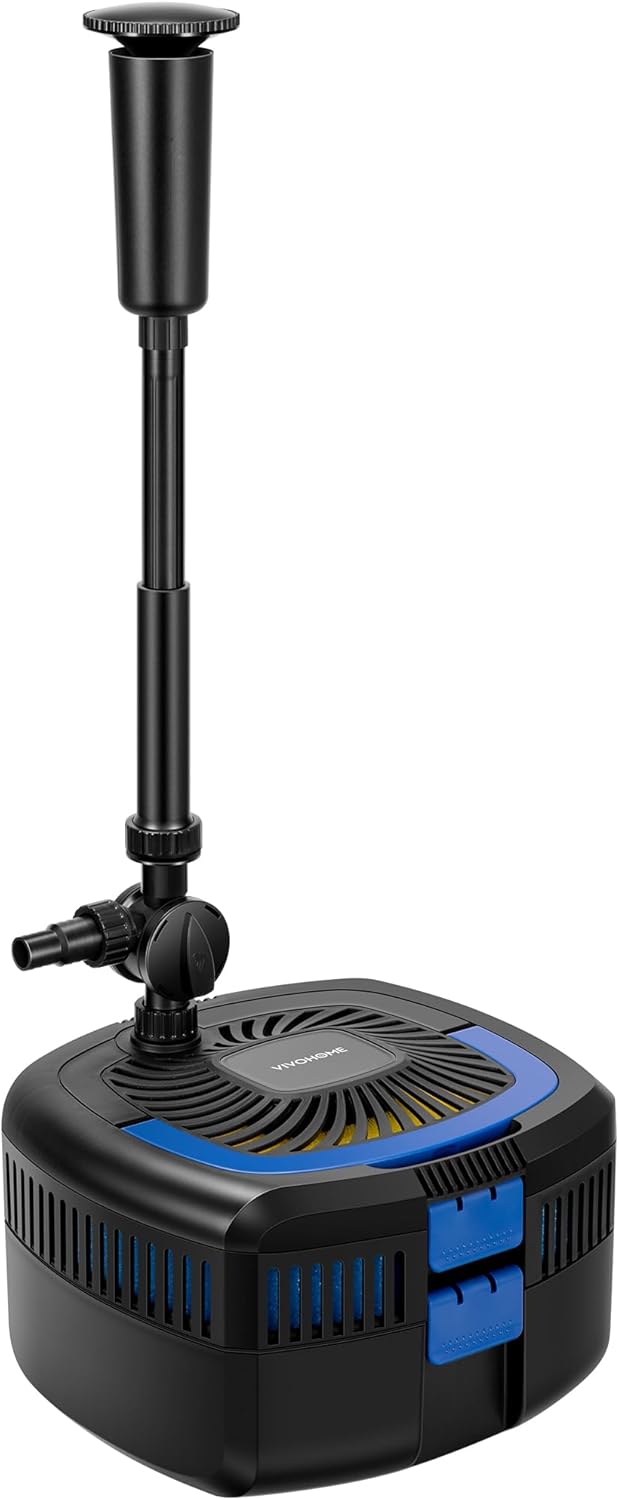
| Flow rate | 1370 GPH (5200 L/H) |
|---|---|
| Max head height | 15.7 ft |
| Total power | 57 W |
| Suitable for ponds | Up to 2,113 Gallons |
| Power cord length | 33 ft |
This VIVOHOME 4-in-1 pond filter pump is designed to move and clean large volumes of pond water while giving you a configurable fountain display. It combines a 57W variable-speed motor and a 1370 GPH (5200 L/h) output with a three-stage filter (dual sponges and filter stone) and a replaceable 13W UV lamp to limit algae and keep water clearer for koi or goldfish ponds. Setup is plug-and-play with a long 33 ft cord and included nozzles and an adjustable rod to tailor spray pattern and height up to about 15.7 ft. The variable-speed motor helps match flow to your pond needs while using less power than equivalent higher-wattage pumps. Maintenance is straightforward thanks to accessible filter compartments and a simple lamp-replacement guide, though the integrated unit means heavy debris or very large ponds may require pre-filtering or a separate skimmer. Expect solid performance for medium to large backyard ponds and decorative waterfalls, with the benefit of combined filtration, circulation, and lighting in one kit.
Best for: Buyers who prioritize strong circulation and predictable filtration performance for medium to large backyard ponds and want an all-in-one system that handles pumping, filtering, and decorative fountain effects.
Less Ideal for: Not the best choice for small tabletop water features or for owners who need a lightweight, highly portable pump for frequent relocation.
- High flow rate suitable for medium to large ponds (1370 GPH)
- Variable-speed 57W motor balances power and energy use
- Integrated multi-stage filtration and included UV lamp to reduce algae
- Adjustable fountain nozzles and rod for customizable water effects
- Long 33 ft cord and plug-and-play setup simplify installation
- Integrated design can struggle with very heavy debris without a separate skimmer
- Relatively heavy unit may be awkward to move during maintenance
Verdict: Choose this kit if you want a single, performance-focused pond unit that combines high-flow circulation, multi-stage filtration, and a customizable fountain for medium to large backyard ponds.
Danner Pondmaster Clearguard Pressurized Pond Filter, 2.7 (05610)

| Capacity | 2700 gallons |
|---|---|
| Power Source | Corded Electric |
| Installation Type | Freestanding |
| Material Type | Acrylonitrile Butadiene Styrene |
The Danner Pondmaster Clearguard is a pressurized canister filter built to deliver clearer water in medium to large backyard ponds. It uses Bio-Matrix media plus a reusable foam pad to trap fine debris and promote biological filtration, while a seven-function valve makes switching between filter, backwash, rinse, winterize, empty, circulate and close quick and straightforward. Because it is pressurized it can be buried or hidden at pondside and hooked to standard 1 1/2" fittings, and it supports pumps up to about 3,000 GPH so it pairs well with high-flow systems. Practical benefits include easier maintenance thanks to backwash and rinse positions, good mechanical polishing from the foam pad, and versatile installation options. Limitations are that it does not include a UV clarifier, so algae control relies on biological/ mechanical filtration and any separate UV unit you add, and the unit is relatively heavy and needs electrical power for the pump. Overall it is a strong choice when you prioritize throughput and serviceable filtration over integrated UV treatment.
Best for: Buyers who prioritize strong circulation and easy maintenance for medium to large backyard ponds and want a durable pressurized filter they can bury or hide at pondside.
Less Ideal for: Gardeners seeking an all-in-one solution that controls algae without adding separate UV equipment or those who need a lightweight, portable filter for very small ponds.
- Bio-Matrix media plus foam pad provides both biological filtration and fine mechanical polishing
- Seven-function valve simplifies filtering, backwashing, rinsing and winterizing for easier maintenance
- Pressurized canister can be buried for a discreet installation and connects to common 1 1/2" fittings
- Supports pumps up to about 3,000 GPH, suitable for higher-flow pond systems
- No integrated UV clarifier, so additional equipment is required for stubborn algae control
- Requires an electric pump and is relatively heavy to move or install
Verdict: Choose this pressurized filter when you need high-flow, serviceable biological and mechanical filtration for a clear medium to large pond.
POPOSOAP 660 GPH Pond Pump and Filter Kit with Fountain Attachments

| Power Source | Corded Electric |
|---|---|
| Flow Rate | 2500 liters per hour |
| Maximum Lifting Height | 8.2 feet |
| Voltage | 110 volts |
| Horsepower | 40 watts |
This POPOSOAP kit combines a 660 GPH corded pump with an integrated filter box and a small fountain kit to keep pond water circulating and clearer with minimal setup. It is typically used in backyard koi ponds, water gardens, or decorative courtyard waterfalls where a single unit that handles mechanical and biological filtration plus a fountain display is preferred. The kit includes two filter pads, filter balls, bio-ceramic rings and multiple nozzle heads with a diverter so you can run a fountain, a secondary outlet, or both while adjusting flow. Practical benefits include straightforward installation and easy maintenance thanks to the clip-access lid and replaceable media, plus the pump’s adjustable flow for matching different water features. Important limitations are that the unit is a compact, plastic-bodied system intended for ponds up to the stated capacity so larger or heavily stocked koi ponds may need a dedicated external filter and higher-capacity pump for heavy waste loads. The included components cover basic filtration and aeration but advanced multi-stage filtration or UV sterilization are not part of this single-unit kit.
Best for: Buyers who want a compact, easy-to-install solution that combines filtration, circulation, and a decorative fountain for small to medium backyard ponds and who prioritize convenience and low-maintenance operation.
Less Ideal for: Owners of large, heavily stocked koi ponds or hobbyists seeking advanced multi-stage filtration and professional-grade, long-term durability should consider separate high-capacity pumps and external filters.
- Integrated pump and filter simplifies installation and reduces plumbing work
- 660 GPH pump provides strong circulation suitable for small to mid-size ponds (manufacturer-rated up to 1,180 gallons)
- Includes multiple filter media (pads, balls, bio-ceramic rings) for mechanical and biological filtration
- Fountain kit with three nozzles and diverter enables different water displays and adjustable flow
- Easy-access lid and simple clips make routine cleaning and media replacement straightforward
- Plastic construction may be less durable than heavier-duty external filters over many years
- Not a substitute for large-capacity, multi-stage filtration in heavily stocked or very large koi ponds
Verdict: A convenient, all-in-one pump and filter kit that delivers strong circulation and basic mechanical and biological filtration plus fountain options for small to mid-size koi ponds.
AquaMiracle MF2000 Pond Pump and 4-Layer Filter Kit (550 GPH, 35W)

| Power Source | Corded Electric |
|---|---|
| Flow Rate | 9.16 gpm |
| Maximum Lifting Height | 8 feet |
| Horsepower | 35 watts |
The AquaMiracle MF2000 combines a submersible pond pump with an integrated 4-stage filter box to keep pond water clear while adding a decorative fountain. In practice you place the unit in the pond, connect the included fittings and choose one of three interchangeable spray heads (bell, volcano, daisy) or route water to a secondary outlet for a stream or small waterfall. The filtration stack (coarse sponge, fine sponge, ceramic rings, bio-balls) provides mechanical and biological cleaning that reduces suspended particles and supports beneficial bacteria for toxin breakdown. The 35 W motor delivers up to 550 GPH and about 8 feet of head so it can aerate and circulate 350 to 500 gallon ponds effectively. Maintenance is straightforward because the media are removable and reusable, though periodic cleaning is required to avoid clogging. Limitations to note are that the kit is corded only and best suited to small and mid-size ponds rather than large water features, and one fountain jet should not be used with the secondary outlet per the instructions. For a budget-focused owner this kit packs pump, filter media, and fountain heads into a single, easy-to-install unit.
Best for: Ideal for budget-conscious pond owners who want a single, ready-to-install unit that both filters and aerates small to medium outdoor ponds while adding a fountain feature.
Less Ideal for: Not a good choice for owners of large ponds or for installations that require wireless or remote power placement away from an outlet.
- Integrated 4-layer filtration (coarse sponge, fine sponge, ceramic rings, bio-balls) for mechanical and biological cleaning
- 550 GPH flow with 8 feet max head suitable for 350–500 gallon ponds
- Three interchangeable fountain nozzles for visual variety and aeration
- Removable, reusable media and simple clips make cleaning and maintenance easy
- Corded electric design limits placement without a nearby outlet
- Not powerful enough for larger ponds beyond the 350–500 gallon range
- Bell fountain jet must not be used with the secondary outlet, reducing some spray combinations
Verdict: This all-in-one pump and 4-stage filter kit is the most cost-effective way to add reliable circulation, biological filtration, and a fountain display to a small or medium pond.
Goplus 2642 GPH Bio Pressure Pond Filter with 13W UV-C Light

| Flow rate | 2642 GPH |
|---|---|
| UV light | 13W UV-C |
| Suitable pond capacity | Up to 1321 gallons (koi) / 2642 gallons (ornamental) |
| Materials | ABS and PP |
This Goplus pressure pond filter combines a multi-stage mechanical and biological system with a 13W UV-C lamp to reduce suspended particles, organic waste, and free-floating algae in backyard koi and ornamental ponds. It is typically installed inline above ground with provided adapters to match common hose sizes and uses stacked sponges, density-varied media and bio balls to trap debris while promoting beneficial bacteria. The top-mounted mode switch and built-in sponge-clean indicator make routine maintenance straightforward: flip to the clean position and backflush the sponges without opening the housing. The unit’s claimed 2,642 GPH flow rating supports larger ponds when paired with an appropriately sized pump, and the pressurized design allows plumbing to run a distance from the pond. Limitations to note are that it is not submersible so it must sit on a level surface and requires a compatible external pump, and the UV module means electrical safety and seasonal winter care must be observed. For someone prioritizing reliable, low-maintenance clarity, the filter’s combination of mechanical, biological, and UV steps is a practical solution.
Best for: Gardeners who want a dependable, low-intervention filtration system for medium to large koi or ornamental ponds and who prefer a pressurized unit that integrates mechanical, biological, and UV treatment.
Less Ideal for: People seeking a fully submersible, plug-and-play pump/filter combo or very small backyard water features that do not need high flow capacity.
- Multi-stage filtration (sponges, density-varied media, bio balls) for mechanical and biological cleaning
- 13W UV-C lamp reduces free-floating algae and helps clarify water
- High flow capacity rated at 2,642 GPH suitable for larger ornamental or koi ponds
- Top-mounted clean mode and sponge indicator simplify routine maintenance
- Not submersible and requires an external pump and proper electrical setup
- Sponges and UV bulb require periodic cleaning or replacement to maintain performance
Verdict: Choose this pressurized multi-stage filter if you want a reliable, easy-to-maintain system that combines mechanical, biological, and UV cleaning for clearer pond water.
VIVOHOME VH556 530 GPH All-in-One Submersible Pond Filter Pump with Fountain

| Power Source | Corded Electric |
|---|---|
| Flow Rate | 2000 liters per hour |
| Maximum Lifting Height | 6.5 feet |
| Horsepower | 42 watts |
| Material Type | PP+ Copper |
The VIVOHOME VH556 is an all-in-one submersible filter pump designed to clean and circulate water while creating a decorative fountain. It houses a 42 W pump that moves up to 530 GPH (about 2000 L/h) through an internal sponge and bio-ball filter before returning water through one of three fountain nozzles. Typical use is simple: set the unit submerged in a backyard pond or water feature, choose a nozzle pattern, and plug in the long 33 ft cord. Notable features include multi-stage filtration to reduce debris and improve clarity, an integrated 9 W LED for nighttime display, and an IPX8 sealed design for weather resistance. Practical benefits are easy setup, reduced maintenance compared with separate pump and filter components, and added aeration from the fountain that helps pond health. Limitations are that it is sized for small to medium ponds and may need occasional cleaning of sponges and bio-balls; the unit is not intended for very large water gardens or heavily silted installations where a larger external filter would be better.
Best for: Buyers who want a low-hassle, single-unit solution to keep a small to medium garden pond clear and attractive with minimal installation and routine maintenance.
Less Ideal for: Gardeners with large water gardens, heavy fish loads, or ponds with substantial sediment buildup should consider a higher-capacity external filter and pump system instead.
- Integrated pump and multi-stage filtration simplifies setup and reduces equipment clutter
- 530 GPH (2000 L/h) flow rate suitable for aeration and circulation in small to medium ponds
- Three interchangeable nozzles let you change fountain patterns for decoration
- IPX8 sealed construction and a 33 ft UL-certified power cord for safe outdoor use
- Built-in LED light adds nighttime visual interest and shows when the light is functioning
- Not designed for very large ponds or heavy sediment where an external canister filter is preferable
- Requires periodic cleaning of sponge and bio-balls to maintain flow and filtration performance
Verdict: A convenient all-in-one pump and filter that adds aeration and a decorative fountain while keeping small to medium ponds cleaner with minimal fuss.
Choosing the Right Pond Filter for Clear Water: Key Factors to Consider
Filtration Stages and Media
Different filtration stages serve distinct roles in clearing pond water. Mechanical media trap leaves, fish waste, and suspended solids so they can be removed before breaking down into nutrients that fuel algae growth.
Biological media provide surface area for beneficial nitrifying bacteria that convert toxic ammonia and nitrite into less harmful nitrate. Look for filters with separate chambers or layered media so you can clean mechanical pads while preserving biological colonies. The amount and type of biological media affect how quickly the system can process waste during warm months when fish metabolism and waste production rise.
Flow Capacity and Head Height
A filter must be matched to your pond volume and the lift required to return water to the surface feature. Manufacturers often state flow rate at zero head, but actual performance drops with higher head heights and long runs of tubing.
Calculate the total head from pump outlet to return point and choose a filter rated to handle the reduced flow. Oversizing slightly is safer than undersizing because consistent circulation reduces dead spots where debris and algae accumulate. However, too much flow across biological media can compress mechanical pads and reduce contact time for beneficial bacteria.
Compatibility with UV Clarifiers
UV clarifiers are commonly used alongside filters to control free-floating algae that cause green water. Some pond filters incorporate a UV chamber or are designed to accept an inline clarifier so water passes through the bulb after mechanical and before biological stages.
Verify whether the filter is designed for an integrated or external UV unit, and ensure the UV placement allows maximum contact time. A poorly matched UV unit or incorrect plumbing order will reduce effectiveness and can make clear-water goals harder to achieve.
Maintenance Access and Winter Care
Routine cleaning frequency depends on pond debris load, but filters that are easy to open and service reduce the risk of neglect. Look for accessible media trays, drain plugs, and removable lids that allow quick flushing of mechanical pads without disturbing biological media more than necessary.
Consider winterization needs for your climate. Some filters can remain in place with minimal winter servicing, while others require draining and indoor storage to avoid freeze damage. Ease of dismantling and available spare parts also affect long-term ownership.
Durability of Housings and Fittings
Outdoor pond equipment faces UV exposure, temperature swings, and contact with water and pond chemicals. Durable housings and corrosion-resistant fittings extend service life and reduce leaks.
Inspect for solid unions, reinforced seal points, and robust inlet/outlet connections that work with standard pond tubing sizes. Durable materials reduce the likelihood of cracks from freezing or brittle fittings failing after a few seasons in sun-exposed locations.
Pond Size and Stocking Levels
Pond volume and fish stocking density determine how much biological processing capacity you need. Alarger pond or heavy fish load produces more waste and requires greater biological media surface area and higher circulation rates to keep water clear.
Do not rely on pump-only turnover rates posted by some sellers. Evaluate how the filter is rated for gallons per hour relative to pond volume and consider additional filtration or staged systems for heavily stocked setups or ponds with lots of leaf fall.
Matching Filter Type to Your Pond Setup
Pond filters come as pressurized units, gravity-fed multi-chamber filters, and simple skimmers. Each style behaves differently in a real garden. Pressure filters can sit remotely and connect to external UV clarifiers but need pumps sized to overcome pressure. Gravity-fed multi-chamber filters often handle larger debris loads and are easier to service because gravity helps settle solids into a dedicated chamber.
Choose a style that fits your landscape and maintenance habits. If you prefer hidden equipment and have a strong pump, a pressurized unit might be convenient. If routine access and large debris loads are typical, a gravity-fed filter placed at the pond edge or in a filter box is usually more forgiving.
- Pressurized filters: easier remote placement, require pump power
- Gravity-fed multi-chamber: better solids handling, easier servicing
- Skimmers: good for surface debris, pair with subsurface filters for full clarity
Integrating UV Clarification Effectively
A UV clarifier can rapidly clear green water by neutralizing free-floating algae when water flows at the correct rate through the UV chamber. For best results, place the UV after mechanical filtration so particles do not block the bulb and reduce output.
Ensure the UV unit you choose matches the filter flow and pond volume. If flow is too high, contact time will be insufficient; if flow is too low, the clarifier may be overkill for modestly sized ponds.
- Install UV after mechanical filtration for maximum bulb efficiency
- Match UV rating to realistic flow after head losses
- Consider lamp replacement interval as part of annual maintenance
Practical Installation Tips for Clear Water
Position the filter where it can be accessed easily for spring cleaning and routine checks. Keep plumbing runs short when possible to reduce head loss and preserve pump efficiency. Use unions or quick-disconnect fittings so you can remove the filter or pump without digging up hoses.
Slope return lines to avoid airlocks and ensure that the pump and filter remain primed. If your pond has heavy leaf fall, add a surface skimmer upstream of the filter to capture debris before it enters the main unit.
- Place filters near pond edge for easy access
- Use unions for removable plumbing
- Add skimmers for ponds with lots of leaves
Seasonal Care and Troubleshooting
During warmer months expect more frequent maintenance because fish are more active and biological processes accelerate. Check mechanical pads weekly or biweekly depending on debris load, and avoid replacing all biological media at once to preserve beneficial bacteria.
If you see a sudden drop in clarity, check for clogged mechanical media, reduced flow from pump cavitation, or a failed UV lamp. Cloudiness after a heavy rain often signals stirred-up sediment rather than filter failure; allow the system to run and perform a targeted cleaning of pre-filter pads.
- Inspect mechanical media more often in summer
- Retain some biological media when cleaning
- Investigate flow drops before replacing media
Planning for Expansion or Upgrades
Think ahead about whether you may increase pond stocking or add features like waterfalls. Choose a filter that can scale with additional biological media or accept a larger UV clarifier. Modular systems or filters with room for extra media give you flexibility without full replacement.
If you plan to add a waterfall, account for the additional head and ensure the pump and filter combination can maintain both flow and adequate contact time through filtration and UV stages.
- Select modular systems for easier upgrades
- Account for extra head from waterfalls or long plumbing runs
- Reserve space in filter boxes for additional media
How We Chose the Best Pond Filter for Clear Water
We focused on criteria that directly affect how well a pond filter delivers and maintains clear water. Primary evaluation metrics were the effectiveness of mechanical filtration to remove debris, the quality and configuration of biological media for beneficial bacterial colonization, and rated flow capacity relative to pond volume and head height. We also looked at ease of maintenance and access for seasonal cleaning, robustness of the housing and fittings for outdoor exposure, and compatibility with common pond pumps and UV clarifiers. We excluded units that lacked clear specification for flow rate or media capacity, filters intended only for decorative tabletop fountains, and products with plastic fittings that commonly fail in outdoor pond conditions. Units that required extensive custom plumbing without clear instructions were deprioritized. The final list favors filters that balance debris capture with ample biological surface area, provide predictable flow performance for typical backyard pond sizes, and keep routine maintenance straightforward for gardeners.
FAQ
How do I size a pond filter for my pond?
Size filters based on pond volume and stocking density rather than surface area alone. Use the filter and pump flow ratings adjusted for actual head height and aim for multiple turnovers per hour for heavily stocked ponds. When in doubt, choose a unit with greater biological media capacity rather than only a higher flow rating.
Can I use a UV clarifier with any pond filter?
Often yes, but placement and matching are important. Install the UV after mechanical filtration and ensure the clarifier's rated flow matches the actual flow through your filter after head losses. Some filters have integrated UV chambers while others accept external inline units.
How often should I clean pond filter media?
Cleaning frequency depends on debris load and pond activity. Mechanical pads may need rinsing every one to two weeks during heavy use, while biological media should be rinsed gently only when flow is compromised to preserve beneficial bacteria. Replace disposable mechanical media as needed and avoid aggressive cleaning of biological media.
Will a bigger pump always make water clearer?
Not always. Excessive flow can reduce contact time across media and stress biological colonies, while undersized pumps cause stagnation. Match pump output to the filter design and account for head height. Balanced flow with adequate mechanical and biological processing is more important than raw flow alone.
How do I winterize a pond filter?
Winter care depends on climate and filter type. Many gravity-fed filters can stay in place if you remove easily frozen water and protect fittings, while some pressurized units should be drained and stored indoors to prevent freeze damage. Follow manufacturer guidance for draining and protecting seals, and avoid disturbing biological media unnecessarily.
Final Verdict
Prioritize a filter that balances effective mechanical debris removal with ample biological media and a flow rate that suits your pond volume and head height. Consider maintenance access, durability, and whether you will add a UV clarifier or expand pond features when selecting a unit. Focus on predictable flow performance and media capacity rather than chasing the highest pumped flow. That approach will deliver clearer water and a healthier pond ecosystem over seasons with manageable maintenance.
