

Note: This article contains affiliate links. If you click on these links and make a purchase, I may earn a small commission at no extra cost to you. This helps support my research and content. Read my full affiliate disclosure here.
When tomatoes begin to set fruit, the feeding needs change from leafy growth to supporting flowers and ripening fruit. Choosing the right fertilizer for tomatoes when fruiting helps you promote consistent fruit set, fuller-sized tomatoes, and sweeter flavor without causing excess foliage or blossom drop. The right product will deliver the nutrients tomatoes need at this stage and allow you to apply them safely in a garden, raised bed, or container. This guide outlines the top shortlisted options for feeding fruiting tomatoes, explains why each made the list, and summarizes the practical criteria used to evaluate them. Expect clear notes on nutrient balance, application method, and how each choice behaves in real garden conditions.
Top Picks at a Glance
| Best Overall The best all-around choice for most situations | Jack's Classic Veggie FeED 12-15-30 Water-Soluble Fertilizer, 1.5 lb |  |
| Best Quality Built to a higher standard if you want something more solid | Espoma Organic Tomato-tone 3-4-6 Organic Fertilizer (4 lb) |  |
| Best Value The sweet spot between price and what you get | Neptune's Harvest Organic Tomato & Vegetable Liquid Fertilizer (2-4-2), Pint |  |
| Best Budget The cheapest option that still gets the job done reliably | Jobe's Tomato Fertilizer Spikes, 18 Count |  |
| Highest Rated A top-rated pick with lots of positive feedback | FoxFarm Happy Frog Tomato & Vegetable Fertilizer, 5-7-3, 4 lb |  |
| Most Popular A crowd favorite that many people choose with confidence | Miracle-Gro Water Soluble Tomato Plant Food, 1.5 lb |  |
| Best Seller A high-volume bestseller chosen again and again | Burpee Organic Tomato & Vegetable Granular Plant Food, 4 lb |  |
Jack's Classic Veggie FeED 12-15-30 Water-Soluble Fertilizer, 1.5 lb

| Item Form | Powder |
|---|---|
| Specific Uses For Product | Fruit and Vegetable Production |
| Application Method | Spray or Mix with Water |
| Mixing Ratio | 12:15:30 |
| Unit Count | 24 Ounce |
Jack's Classic Veggie FeED is a concentrated, water-soluble powder designed to support vigorous vegetative growth, abundant flowering, and fruit set in vegetables and other fruiting plants. You mix the measured powder with water and apply it as a root drench or foliar spray, or use it in continuous-feed systems; the included scoop and clear mixing directions make preparation straightforward. The 12-15-30 N-P-K formulation emphasizes higher potassium for flowering and fruit development while delivering micronutrients that help prevent common deficiencies. In practical use it stretches farther than liquid feeds, so a single 1.5 pound package can produce many gallons of ready-to-use solution. Important limitations are that it is a general veggie formula rather than a crop-specific complete program and users still need to follow the recommended mixing schedule to avoid overfeeding. Also, being a powdered concentrate it requires careful measuring and thorough dissolving to avoid clogging sprayers.
Best for: Gardeners who want a reliable, flexible all-purpose feed for backyard vegetable beds and containers and who prefer a concentrated powder they can mix to scale.
Less Ideal for: Growers seeking a single-product, crop-specific fertility program or those who prefer ready-to-use liquid fertilizers should consider other options.
- High-potassium 12-15-30 ratio supports flowering and fruit set
- Water-soluble powder stretches farther than premixed liquids
- Includes micronutrients to reduce the need for additional supplements
- Can be applied as foliar spray, root drench, or in continuous-feed systems
- Requires precise measuring and complete dissolution to avoid sprayer clogging
- Not a crop-specific program so advanced growers may need additional products
Verdict: A concentrated, water-soluble vegetable fertilizer that delivers potassium-forward nutrition and micronutrients in a flexible, economical powder for productive backyard veggie gardens.
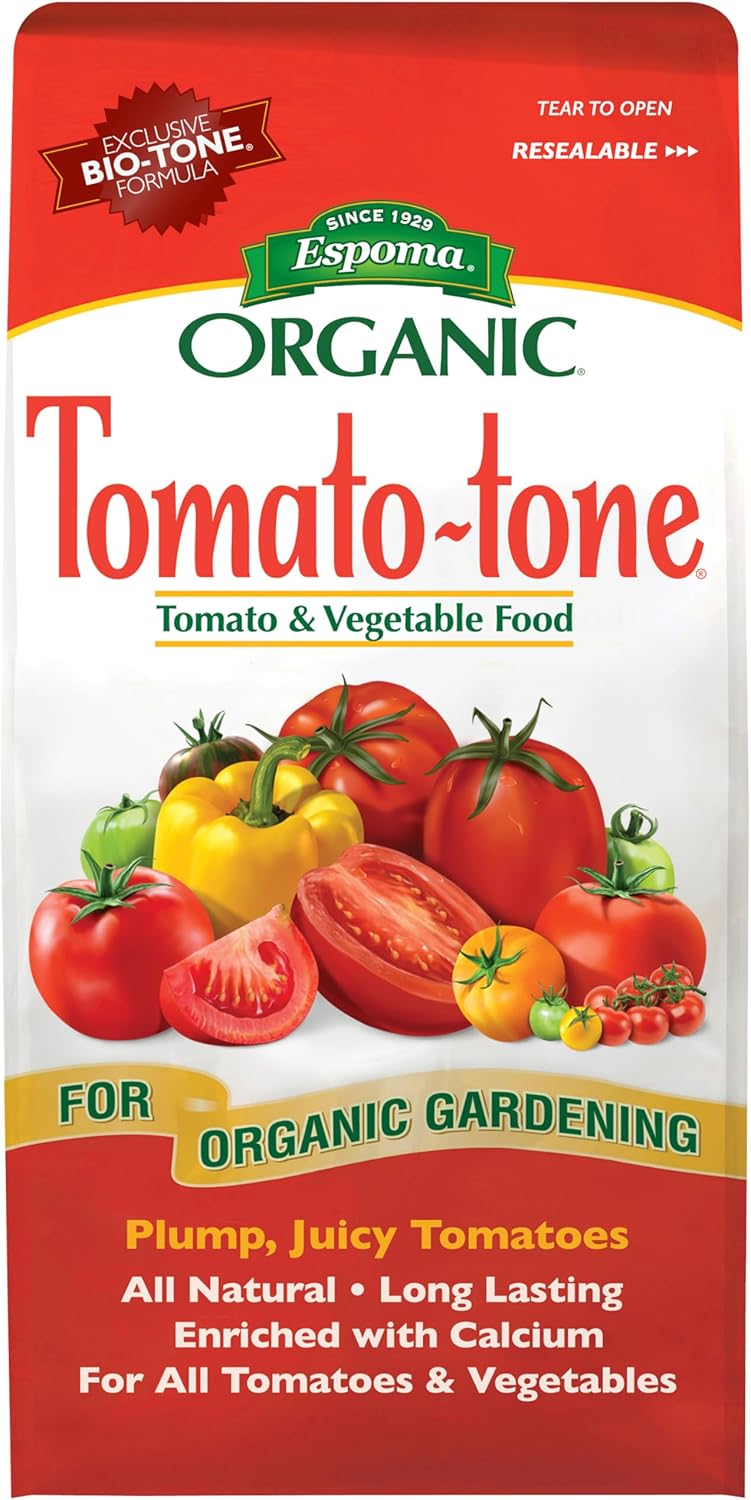
Espoma Organic Tomato-tone 3-4-6 Organic Fertilizer (4 lb)
| Item Form | Granules or Pellets |
|---|---|
| Specific Uses For Product | Gardening |
| Target Species | tomatoes and vegetables |
| Mixing Ratio | 3:4:6 |
Espoma Tomato-tone is a ready-to-use granular organic fertilizer aimed at producing fuller fruit and reducing blossom end rot through its 3-4-6 nutrient ratio and 8% calcium. You apply it to the soil around the plant drip line every two weeks during the growing season and water it in, which makes it simple to integrate into regular tomato care. Notable features include organic ingredients, Bio-tone microbial enhancement, and a formulation designed to promote flower and fruit production rather than excessive foliage. For practical gardening use this product supplies a steady, balanced feed that works well for heirloom and hybrid tomatoes as well as other vegetables, and its calcium content helps address a common physiological disorder. The granules are easy to broadcast or place in furrows, but because it is a granular product you cannot make fine adjustments as quickly as with a liquid feed, and repeated applications are required for continuous results. This is a straightforward organic option for growers focused on fruit yield and plant health rather than quick foliar boosts.
Best for: Gardeners who prioritize consistent fruit production and organic inputs and who want an easy, repeat-apply granular feed for tomatoes and mixed vegetable beds.
Less Ideal for: Growers who need rapid corrective feeding or precise, adjustable nutrient delivery should consider soluble or foliar fertilizers instead.
- Organic formula approved for organic gardening
- Includes 8% calcium to help prevent blossom end rot
- Balanced 3-4-6 NPK favored for flower and fruit production
- Granular form is easy to apply around the drip line and does not require mixing
- Requires frequent applications every two weeks for best results
- Granules deliver slower short-term nutrient availability compared with soluble fertilizers
Verdict: Choose Espoma Tomato-tone when you want a simple organic granular fertilizer that consistently supports tomato and vegetable fruiting while reducing blossom end rot.
Neptune's Harvest Organic Tomato & Vegetable Liquid Fertilizer (2-4-2), Pint

| Item Form | Liquid |
|---|---|
| Application Method | foliar and root feed |
| Mixing Ratio | 1:128 |
| Liquid Volume | 473.18 ml |
| Ingredients | Nitrogen-2% Phosphate-4% Potash-2% Calcium-1% |
Neptune's Harvest Tomato & Vegetable fertilizer is a concentrated liquid feed designed for regular use on tomatoes, vegetables, and potted plants. It combines hydrolyzed fish, seaweed, molasses, humates, yucca extract, biological microbes, and liquid calcium to supply N-P-K and micronutrients through both root drench and foliar spray. Typical use is simple: dilute according to the label (about 1 oz per gallon for outdoor crops, a tablespoon per gallon for houseplants) and apply every 1 to 2 weeks outdoors or weekly indoors. The formula promotes leafy vigor, stronger stems and roots, and improved soil biology that can enhance nutrient uptake and flavor in edible crops. Because it is organic and liquid, it mixes easily and integrates into routine feeding schedules and drip or foliar applications. Limitations to expect are a modest N-P-K ratio compared with synthetic feeds, so heavy-feeding crops may need supplemental fertility during peak fruiting, and the fish-based odor can be noticeable when applying. Still, it is a practical, multiuse option for gardeners who want an organic baseline feed that supports soil life and steady growth.
Best for: Gardeners who prioritize steady, organic feeding and want a convenient liquid fertilizer they can use across vegetable beds, containers, and houseplants with minimal fuss.
Less Ideal for: Growers seeking quick, high-N synthetic strength for aggressive fruiting or those who need an odorless product for indoor use near living spaces.
- Concentrated liquid formula that mixes easily for foliar or root feeding
- Organic blend of fish, seaweed, molasses, humates and biological microbes to support soil biology
- Clear dosing guidance for regular feeding of outdoor vegetables and houseplants
- Supports stronger stems, root development, and improved nutrient uptake
- Lower N-P-K numbers than many synthetic fertilizers, so may not fully meet peak nutrient demands
- Fish-based ingredient can produce a noticeable odor during application
Verdict: A dependable, easy-to-use organic liquid feed that consistently boosts foliage, roots, and soil life for practical vegetable and container gardeners.
Jobe's Tomato Fertilizer Spikes, 18 Count

| Unit Count | 18 Count |
|---|---|
| NPK | 6-18-6 |
| Application Method | Insert spikes around the plants |
| Target Species | Tomato |
Jobe's Tomato Fertilizer Spikes are pre-measured sticks that deliver slow-release nutrients directly to tomato roots, designed to feed plants for up to eight weeks. Use them at planting or early in the season by inserting spikes around each plant; the concentrated 6-18-6 NPK emphasizes phosphorus to support flowering and fruit set. The spikes are mess-free, waterproof in a resealable pouch option, and reduce nutrient loss from surface runoff, so you get targeted feeding without mixing or measuring. Practical benefits include simple application, consistent dosing that lowers the chance of overfertilizing, and reduced maintenance for containers and garden beds. Limitations are that each pack has only 18 spikes so larger plantings will require multiple packs, and the fixed NPK means you cannot tailor the ratio midseason. Also, because they are designed for tomato plants, they are not a one-size-fits-all solution for every vegetable or soil condition.
Best for: Gardeners who want a low-effort, no-mess feeding method for a few tomato plants and who prioritize straightforward, reliable results over custom fertilizing plans.
Less Ideal for: Growers managing large vegetable plots, mixed crops, or those who need adjustable nutrient ratios should consider bulk granular or liquid fertilizers instead.
- Slow-release formula feeds roots for up to eight weeks, reducing application frequency
- Pre-measured spikes provide consistent dosing and minimize mess or measuring errors
- High phosphorus content (6-18-6) supports flowering and fruit development
- Waterproof packaging option and spikes resist washout compared with surface fertilizers
- Small 18-count pack means repeated purchases for larger gardens or multiple plants
- Fixed NPK ratio prevents easy midseason nutrient adjustments
Verdict: A simple, low-effort way to feed a small number of tomato plants with targeted slow-release nutrition.
FoxFarm Happy Frog Tomato & Vegetable Fertilizer, 5-7-3, 4 lb

| Item Form | Granules |
|---|---|
| Specific Uses For Product | Vegetables, Tomatoes, Soft Fruits, and Berries |
| Mixing Ratio | 5:7:3 |
| Unit Count | 64 Ounce |
This granular fertilizer is designed to feed vigorous vegetables and fruiting plants through vegetative and fruiting stages. You apply it to containers, in-ground beds, or rows following the package instructions; the 5-7-3 NPK balance favors leafy growth early and supports fruit development later. Notable features include added calcium to help prevent blossom end rot and mycorrhizal fungi to improve root nutrient and water uptake, and it is OMRI listed for organic use. In practice the granules are easy to work into soil or mix per directions and can be used on tomatoes, peppers, berries, and other heavy feeders. The primary benefits are dependable, plant-focused nutrition and versatility across containers and beds, which simplifies a seasonal feeding routine. Limitations are that granules require incorporation or watering to activate and are less convenient than liquid feeds for on-the-spot corrections, and the fixed 5-7-3 ratio may not suit every growth stage or all crop types without supplementary products.
Best for: Gardeners who prioritize consistent, plant-focused feeding for tomatoes, vegetables, and berries and who prefer an organic-friendly granular fertilizer that can be used across containers and beds.
Less Ideal for: Growers who need quick corrective feedings or who prefer the convenience and precision of liquid fertilizers for frequent foliar or fertigation applications should consider alternatives.
- Balanced 5-7-3 NPK tailored for vegetative growth and fruit production
- Contains calcium to reduce risk of blossom end rot in fruiting crops
- Includes mycorrhizal fungi to support root efficiency and nutrient uptake
- OMRI listed, making it suitable for organic gardening practices
- Granular form requires soil incorporation or watering to be effective
- Fixed nutrient ratio may require additional products for specific growth stages
Verdict: Choose this OMRI-listed granular fertilizer when you want reliable, plant-focused nutrition for tomatoes and other vigorous vegetable and fruiting crops.
Miracle-Gro Water Soluble Tomato Plant Food, 1.5 lb

| Item Form | Liquid |
|---|---|
| Application Method | Water Soluble |
| Target Species | Tomatoes and vegetables |
| Mixing Ratio | 18-18-21 |
| Unit Count | 24 Ounce |
This Miracle-Gro water-soluble tomato plant food is a concentrated liquid formula meant to boost vegetable growth when used every one to two weeks. It mixes easily in a watering can or the Miracle-Gro Garden Feeder and is labeled safe for outdoor and indoor use when directions are followed. Notable features include a vegetable-focused nutrient ratio and a clear mixing guideline for outdoor (1 tablespoon per gallon) and indoor (1/2 teaspoon per gallon) watering. In practice the product makes regular feeding straightforward and provides quick uptake because it dissolves in water, so you can feed while you water without special equipment. The practical benefits are faster visible response compared with unfed plants and compatibility with standard garden routines. Limitations are that it is a short-acting water-soluble fertilizer so it requires repeated applications during the season, and you need to follow dilution instructions carefully to avoid overfeeding. It is not a slow-release solution for gardeners who prefer low-maintenance fertilizing schedules.
Best for: Gardeners who watch for reliable results and prefer products with proven popularity and clear usage guidance; ideal for growers who will perform regular feedings during the growing season to maximize vegetable yields.
Less Ideal for: People who want a set-and-forget slow-release fertilizer or who cannot commit to biweekly feeding during the growing season.
- Water-soluble formula that mixes quickly for use with a watering can or garden feeder
- Clear mixing instructions for outdoor and indoor applications
- Designed specifically for tomatoes and vegetables for targeted feeding
- Feeds plants immediately for visible improvement versus unfed plants
- Requires reapplication every 1–2 weeks rather than providing long-term slow release
- Not suitable if you want a single-season, low-maintenance fertilizer
Verdict: A reliable, water-soluble tomato and vegetable fertilizer that delivers quick results when used consistently every one to two weeks.
Burpee Organic Tomato & Vegetable Granular Plant Food, 4 lb

| Item Form | Granules |
|---|---|
| Application Method | Sprinkle |
| Coverage | 160 Square Feet |
| Specific Uses For Product | Gardening, Plant Growth, Root Development |
| Mixing Ratio | 3-6-4 |
This Burpee granular plant food is an organic, all-purpose fertilizer designed for vegetable gardens, containers, and bedding plants. You apply it by sprinkling the granules around the plant base and watering in; the nutrients are available immediately and continue releasing for up to three months, so you do not need to reapply often. The formula is OMRI-listed for organic use and lists a 3-6-4 mixing ratio, making it straightforward to follow on seed-starting flats, in raised beds, or around established tomato plants. Coverage is stated at about 160 square feet per bag, which makes a single 4 lb bag useful for small plots or several container groups. Because it is granular and not a liquid, it is easy to store and less messy to use but requires attention to even distribution and timely watering to activate nutrients. If you want a quick, organic boost with multi-month feeding and minimal fuss, this product does the job; gardeners needing very precise nutrient control or larger-area coverage may prefer concentrated or bulk options.
Best for: Gardeners who prefer low-risk, organic solutions and want a straightforward, low-maintenance fertilizer for tomatoes, vegetables, and containers.
Less Ideal for: Large-scale vegetable growers or those who need finely tuned, frequent nutrient adjustments should consider concentrated or bulk fertilizers instead.
- OMRI-listed organic formula suitable for organic vegetable gardens
- Granular form provides up to three months of continuous nutrient release
- Simple sprinkle application that is easy to use for beds and containers
- Includes macronutrients and calcium to support growth and root development
- 4 lb bag covers a limited area (about 160 sq ft) so multiple bags may be needed for larger gardens
- Granules require even application and watering to ensure nutrients reach roots
Verdict: A dependable, OMRI-listed granular fertilizer that gives organic vegetable gardeners an easy, multi-month feed with minimal fuss.
Choosing the Right Fertilizer for Tomatoes When Fruiting: Key Factors to Consider
Nutrient Ratio and Timing
Tomatoes need different proportions of nitrogen, phosphorus, and potassium once they begin to fruit. Too much nitrogen at this stage drives leafy growth and can reduce fruit set and flavor. Phosphorus supports flowering and early fruit development while potassium helps fruit size, texture, and sugar accumulation. Look for formulas with reduced nitrogen and elevated P and K, or use a two-part feeding plan that shifts the balance as fruit sets. Timing matters because a well-timed application at blossom drop and again during early fruit swell can make the difference between a few small fruits and a heavier, more uniform harvest.
Soluble Versus Controlled-Release Formulas
Soluble fertilizers deliver nutrients quickly and are ideal for correcting a deficiency or giving a fast boost when flowers start to set. They are useful for container-grown tomatoes or when you need immediate results. Controlled-release or slow-release granules feed over weeks and reduce the need for frequent applications, which is handy for busy gardeners and long-producing indeterminate varieties.
Consider the watering pattern and whether you can reliably irrigate on schedule. Inconsistent water can limit nutrient release from slow-release granules, while overwatering soluble feeds can increase leaching. For many gardeners a mix of both approaches works well: a slow-release base at planting followed by periodic soluble feedings once fruiting begins.
Application Method and Practicality
How you apply fertilizer affects both effectiveness and convenience. Foliar feeds can be useful for quick correction of micronutrient deficiencies but typically provide only a short-term boost for fruiting tomatoes. Soil-applied liquid feeds and water-soluble fertilizers are straightforward for containers and raised beds, and fertigation works well for drip-irrigated in-ground plots. Granular top-dressings are low-effort but require incorporation or adequate watering to move nutrients into the root zone.
Practical considerations include how easy the product is to measure and dilute, whether it leaves residues on fruit or foliage, and whether application can be done without specialized tools. Choose products that match the scale of your garden and your preferred watering method.
Plant Safety and Salt/Burn Risk
Fertilizer salt index and concentration determine the risk of burning tender roots and foliage. High-soluble-strength feeds applied too concentrated can cause blossom drop or scorched leaf margins. Many fruiting-stage formulas intentionally lower immediate nitrogen concentrations and recommend diluted blends to lower risk.
For container-grown tomatoes, where root volume is limited, pick lower-salt options or use more frequent, weaker applications. In-ground plants tolerate stronger feeds but still benefit from following label dilution and application intervals. If you use a liquid concentrate, mix carefully and avoid applying during hot, sunny midday conditions to reduce stress.
Impact on Soil Biology and Long-Term Soil Health
Some fertilizers are formulated to support microbial life, using organic matter, slow-release organics, or mineral blends that feed both plants and soil organisms. These options can improve soil structure and nutrient cycling over time, reducing dependency on frequent feeding. Synthetic soluble fertilizers supply nutrients immediately but do little for soil organic matter.
If you want to build long-term fertility, consider products that contribute carbon and beneficial microbes, or pair mineral feeds with compost and mulches. For short-term yield focus, soluble mineral feeds can be appropriate, but integrating biological inputs will help sustain production over multiple seasons.
When to Start Switching Feeds
Shift feeding strategy when fruits are set and about the size of a marble or pea. At that point, reduce applications that promote leafy vigor and begin using formulas that favor phosphorus and potassium to support fruit development and ripening. Timing that first adjustment to fruit set helps minimize blossom drop and encourages even sizing across the cluster.
- Check blossom clusters and wait until small fruits are visible before changing feed balance
- Avoid heavy high-nitrogen applications after the first fruit set
- Make gradual changes over one to two feed cycles to avoid shock
Feeding Frequency and Practical Schedules
Feeding schedules depend on product type and growing situation. For soluble water-soluble feeds, garden growers often apply every one to two weeks during peak fruiting. Controlled-release granules typically require a single application that covers several weeks to months, with supplemental liquid feedings as needed for heavy-fruiting varieties. Containers generally need more frequent, lighter feedings because nutrients wash out with regular watering.
- In-ground indeterminate tomatoes: slow-release at planting plus biweekly soluble boosts during heavy fruiting
- Containers: weekly diluted soluble feedings or a combination of slow-release and fortnightly liquids
- Apply liquid feeds in the morning or evening to avoid hot sun stress
Adjusting for Soil Tests and Leaf Symptoms
A soil test gives baseline fertility and pH information that guides fertilizer choice. Low potassium in soil tests calls for K-focused applications, while low phosphorus indicates the need for P support. Leaf symptoms also guide adjustments: pale new growth might point to nitrogen need, while poor fruit set and spots can indicate other imbalances or deficiencies. Avoid overcorrecting from visual symptoms alone. If a soil test is not available, use balanced, moderate-strength feeds and watch plant response over a couple of weeks before increasing concentration.
- Use soil or tissue tests for persistent issues
- Treat visual symptoms with modest, measured applications to avoid burn risk
- Monitor fruit set and flavor as indicators of adequate nutrition
Compatibility with Organic and No-Dig Practices
Organic gardeners have options that supply P and K from mineral or plant-based sources and often improve soil life. Organic liquid feeds and compost teas can be effective but usually act more slowly than soluble mineral concentrates. For no-dig or sheet-mulch systems, top-applied granular organics or liquid teas integrated into surface mulches can deliver nutrients without disturbing roots. Remember that organic sources may need to be applied earlier or in slightly greater quantities to match the immediate availability of synthetic solubles, especially during peak fruiting.
- Choose lower-salt organic options for containers
- Combine compost and targeted feeds for no-dig setups
- Plan for slower nutrient release with organic amendments
Watering and Nutrient Uptake
Consistent moisture is critical once fruiting begins because water stress can cause blossom drop and uneven ripening. Nutrient uptake is impaired in drought-stressed plants, so coordinate fertilizer applications with reliable watering. Drip irrigation paired with periodic soluble feedings provides precise delivery and reduces leaching compared with overhead watering. Avoid fertilizing dry soils with concentrated feeds; pre-water if needed so nutrients move into the root zone and are taken up efficiently.
- Match feeding schedule to your irrigation routine
- Pre-water before applying granular top-dressings
- Use drip fertigation when possible for consistent uptake
How We Chose the Best Fertilizer for Tomatoes When Fruiting
We focused on attributes that matter for tomatoes after they start forming fruit. First, nutrient profile and ratio were key: formulas with moderate nitrogen but higher phosphorus and potassium scored better because they support fruit development and flavor without encouraging excessive leaf growth. Second, release pattern mattered. We prioritized both soluble options for quick correction and controlled-release formulations for steady feeding during long fruiting periods. Third, application safety and burn risk were evaluated to ensure gardeners can apply feedings without harming plants. Fourth, ease of use in common setups like in-ground beds, raised beds, and containers was considered to reflect real garden practices. Fifth, compatibility with organic gardening and soil biology was included to cover gardeners preferring biological approaches. We excluded fertilizers designed only for early vegetative growth or those with extreme high nitrogen formulas that are unsuitable at fruiting stage. Products that required specialized equipment or high-risk handling were also filtered out. The remaining choices balance practical nutrient delivery, application flexibility, and predictable results under typical home garden conditions.
FAQ
How often should I feed tomatoes once they start fruiting?
Feeding frequency depends on the formula and container size. For water-soluble feeds, every one to two weeks during peak fruiting is common. Slow-release granules may only need one application that lasts several weeks, with occasional supplemental liquid feedings.
Will too much fertilizer make tomatoes taste worse?
Yes. Excessive nitrogen can dilute sugars and flavors by promoting leafy growth at the expense of fruit development. Overfeeding can also stress the plant and reduce overall fruit quality, so follow recommended dilutions and focus on P and K during fruiting.
Can I use foliar sprays to feed fruiting tomatoes?
Foliar sprays can correct micronutrient deficiencies quickly but are not a primary source of macronutrients for fruit development. Use them as a supplement for specific deficiencies or to provide a quick, short-term nutrient boost.
Are organic fertilizers effective during the fruiting stage?
Organic fertilizers can be effective, but many act more slowly than soluble mineral feeds. If you rely on organics, apply them slightly earlier or combine them with faster-acting feeds to ensure nutrients are available when flowers set and fruit develops.
How should I adjust feeding for container-grown tomatoes?
Containers require gentler, more frequent feeding because nutrients leach with watering and root volume is limited. Use lower-strength solutions more often or combine a light slow-release granule at planting with weekly diluted liquid feeds once fruiting begins.
What signs indicate my fruiting tomatoes need more potassium?
Signs of potassium deficiency include poor fruit filling, reduced fruit size, and sometimes marginal leaf browning or spotting. If fruiting is weak despite adequate watering, consider a targeted potassium boost while avoiding sudden high-concentration applications.
Final Verdict
When tomatoes begin fruiting, prioritize nutrient balance and predictable delivery over high nitrogen. Favor formulas or feeding plans that shift emphasis to phosphorus and potassium, match the release pattern to your watering routine, and minimize burn risk with appropriate dilution. Containers need more frequent, gentler applications while in-ground plants tolerate steadier, stronger feeds. Focus on the specific tradeoffs that matter to your garden: immediate soluble feeds for quick correction, controlled-release for low-effort steady nutrition, and organic inputs for long-term soil health. Use soil or tissue checks and adjust conservatively to keep fruit set, size, and flavor on track.
