

Note: This article contains affiliate links. If you click on these links and make a purchase, I may earn a small commission at no extra cost to you. This helps support my research and content. Read my full affiliate disclosure here.
Clover mites can invade lawns, flower beds, and the edges of patios in large numbers. Choosing the right insecticide for clover mites matters because some products provide fast contact knockdown while others offer longer residual protection or gentler formulations for use near ornamentals and pets. In this guide we shortlisted the six most useful insecticide options for clover mite control across typical home garden situations. Each pick was evaluated for how it behaves in a real garden: how to apply it, how long control lasts, and what precautions to take. The guide explains the practical tradeoffs so you can select an option that fits your yard layout, plant sensitivity, and timing needs. Read on for the criteria we used and the factors that should determine your choice.
Top Picks at a Glance
| Best Overall The best all-around choice for most situations | Atticus Fervid Abamectin Miticide/Insecticide (32 oz) |  |
| Best Quality Built to a higher standard if you want something more solid | Quali-Pro Bifenthrin I/T 7.9F Insecticide (1 Gallon) |  |
| Best Value The sweet spot between price and what you get | Bonide Captain Jack's Deadbug Brew Ready-to-Use Insecticide, 32 oz |  |
| Highest Rated A top-rated pick with lots of positive feedback | Monterey 1 Gallon Mite & Insect Control Concentrate |  |
| Most Popular A crowd favorite that many people choose with confidence | BioAdvanced 3-in-1 Insect, Disease & Mite Control Spray, 32 fl oz |  |
| Best Seller A high-volume bestseller chosen again and again | Atticus Talak 7.9% Bifenthrin Indoor/Outdoor Insecticide Concentrate (32 oz) |  |
Atticus Fervid Abamectin Miticide/Insecticide (32 oz)

| Unit Count | 32 Fluid Ounces |
|---|---|
| Active Ingredients | abamectin |
| Formulation | Emulsifiable Concentrate |
| Target Species | Aphids, thrips, whiteflies, leafminers, mites |
| Specification Met | EPA |
Fervid is a professional-style miticide/insecticide for ornamentals that uses 2% abamectin to rapidly stop sap-feeding pests. It is applied as a spray to landscape and greenhouse ornamentals, foliage plants, and nursery stock; the formulation moves from the leaf surface into the tissue so it reaches mites and leafminers hiding on undersides without specialized application equipment. You can expect feeding to cease within hours of ingestion and visible plant recovery soon after. The product is rainfast once dry and designed to leave little odor or residue, which is helpful around sensitive plantings and customer areas. Practical limitations are that it is labeled for ornamentals only and not for turf, and users must follow EPA label directions and reentry intervals. The 32-ounce Tip N’ Measure bottle makes measuring and pouring easier for repeat treatments, but because it is a concentrated, professional product it requires careful handling, correct dilution, and compatible spray equipment for safe, effective use.
Best for: Gardeners, greenhouse operators, and landscapers who need fast, reliable control of mites and leafminers on ornamental plants and who prefer a professional-strength product with predictable results.
Less Ideal for: Homeowners seeking an all-purpose, ready-to-use garden spray or products for lawn/turf pest control should look for alternatives better labeled for those uses.
- Contains 2% abamectin, a proven active for mite and leafminer control
- Systemic movement within the leaf reaches pests on undersides after foliar spray
- Rainfast after drying, so short-term weather will not quickly reduce efficacy
- Low odor and minimal visible residue after application
- 32 oz bottle with Tip N’ Measure design simplifies measuring and pouring
- Labeled for ornamentals only and not suitable for turf applications
- Requires careful dilution and handling due to concentrated active ingredient
Verdict: Choose Fervid when you need a professional-strength miticide that acts quickly on mites and leafminers in ornamentals.
Quali-Pro Bifenthrin I/T 7.9F Insecticide (1 Gallon)

| Item Form | Spray |
|---|---|
| Target Species | Termites, Carpenter Ants |
| Liquid Volume | 1 gallons |
| Active Ingredients | Bifenthrin |
Quali-Pro Bifenthrin I/T 7.9F is a concentrated flowable insecticide designed to deliver long residual control across lawns, ornamentals and commercial turf. It is applied as a spray after dilution and is labeled for tough targets such as termites and carpenter ants while also effective against fleas, ticks, mites and other pests. The formulation claims no visible residue or strong odor and is compatible with many herbicides, fungicides and liquid fertilizers, which makes it easy to integrate into routine landscape maintenance. Notable for its persistent activity, this product is best used where multi-week protection is desired and when treating perimeter or soil zones that require a dependable residual. Important limitations are that it is a professional-grade pesticide requiring careful handling and adherence to safety directions and label restrictions, and it must be mixed and applied properly to avoid non-target exposure and environmental runoff. Users should follow label rates and local regulations for application near water, children, and pets.
Best for: Gardeners and landscape professionals who prioritize reliable, long-lasting chemical control of persistent insect pests and want a product that integrates with routine turf and ornamental treatments.
Less Ideal for: Homeowners seeking organic, low-toxicity or DIY spot treatments or those unwilling to follow professional safety and application procedures should consider alternative products.
- Long-lasting residual control against termites, carpenter ants and other turf/ornamental pests
- Flowable spray formulation compatible with many herbicides, fungicides and liquid fertilizers
- Non-irritating, low-odor formula that dries with no visible residue
- Professional-strength pesticide that requires careful mixing and strict adherence to label safety instructions
- Not suitable for users seeking an organic or non-chemical pest control option
Verdict: Choose this bifenthrin flowable when you need dependable, long-lasting chemical control of tough turf and ornamental pests.
Bonide Captain Jack's Deadbug Brew Ready-to-Use Insecticide, 32 oz

| Item Form | Spray |
|---|---|
| Target Species | Insects |
| Liquid Volume | 32 fluid ounces |
| Active Ingredients | Spinosad 0.5% |
Bonide Captain Jack's Deadbug Brew is a convenient, ready-to-use spray that brings spinosad-based pest control to home vegetable beds, fruit trees, and ornamental plantings. The push-button spray bottle lets you apply the product directly to foliage and undersides of leaves without mixing, which speeds routine spot treatments and makes it easy to treat scattered infestations. It is labeled for many chewing and leaf-feeding insects and is approved for organic gardening, so it is a good fit when you want an effective product that is less disruptive to many beneficial predators. The product’s immediate practical benefits are simple application, broad crop compatibility, and a single active ingredient recognized for effective control of caterpillars, beetles, thrips, and similar pests. Important limitations are that it only controls the listed target insects and should be applied carefully to reduce exposure to pollinators; repeated applications may be necessary for heavy or persistent infestations because it is a contact and stomach poison rather than a systemic fix.
Best for: Gardeners who prioritize practical, low-prep pest control for mixed vegetable beds, fruit trees, and ornamentals and who prefer products compatible with organic gardening practices.
Less Ideal for: People needing a long-term systemic treatment or a single-application solution for severe, established infestations should consider professional options or systemic products instead.
- Ready-to-use spray bottle for direct application without mixing
- Contains spinosad, an approved active ingredient for organic gardening
- Labeled for use on a wide range of vegetables, fruits, flowers, and ornamentals
- Targets many chewing and leaf-feeding insect pests while sparing some beneficial predators
- Not systemic, so heavy infestations may require repeated applications
- Should be applied carefully to avoid exposure to pollinators and non-targets
Verdict: If you want a low-effort, organic-compatible spray to quickly control common chewing and leaf-feeding pests across vegetables, fruits, and ornamentals, this ready-to-use spinosad product is a practical choice.
Monterey 1 Gallon Mite & Insect Control Concentrate

| Item model number | LG 6253 |
|---|---|
| Manufacturer | Monterey |
| Intended use | Lawns, trees, shrubs, roses and ornamentals |
| Pest targets | Mites, aphids, caterpillars, chinch bugs, fleas, mole crickets |
| Form | Concentrate (mix in pump sprayer) |
This Monterey 1 gallon concentrate is an outdoor insecticide formulated to control mites, aphids, caterpillars, chinch bugs, fleas and mole crickets on lawns, trees, shrubs, roses and other ornamentals. It ships as a concentrate that you mix in a pump sprayer, so typical use involves measuring the recommended dilution, applying evenly over affected plants or around foundations, and following safety directions such as wearing gloves and eye protection. Notable features include a broad pest list, labeled use around home foundations for roach control, and residual activity that the brand states can last up to six weeks. The practical benefits are straightforward: one container treats multiple applications across a yard and ornamental beds, and the concentrate format reduces storage volume compared with multiple ready-to-use bottles. Important limitations are that it is for outdoor use only and requires proper personal protective equipment and careful mixing; it is not an indoor or ready-to-spray product and will not be effective if used incorrectly. Follow the label for safety and timing to get reliable results.
Best for: Gardeners who prioritize consistent, professional-style pest control and want a single concentrated product to protect lawns and ornamentals over multiple treatments. Ideal for homeowners who are comfortable mixing and applying pesticides safely.
Less Ideal for: People seeking a ready-to-use spray for indoor pests or those unwilling to handle concentrated pesticides and protective gear should consider alternatives.
- Concentrated formula treats multiple applications from one gallon
- Labeled for use on lawns, trees, shrubs, roses and ornamentals
- Broad spectrum control including mites, aphids, caterpillars and mole crickets
- Advertised residual activity of up to six weeks for longer protection
- Must be mixed and applied with a pump sprayer rather than ready-to-use
- Requires personal protective equipment and careful handling due to concentrated active ingredients
Verdict: Buy this if you need a single, concentrated outdoor insecticide that reliably treats a wide range of lawn and ornamental pests when mixed and applied properly.
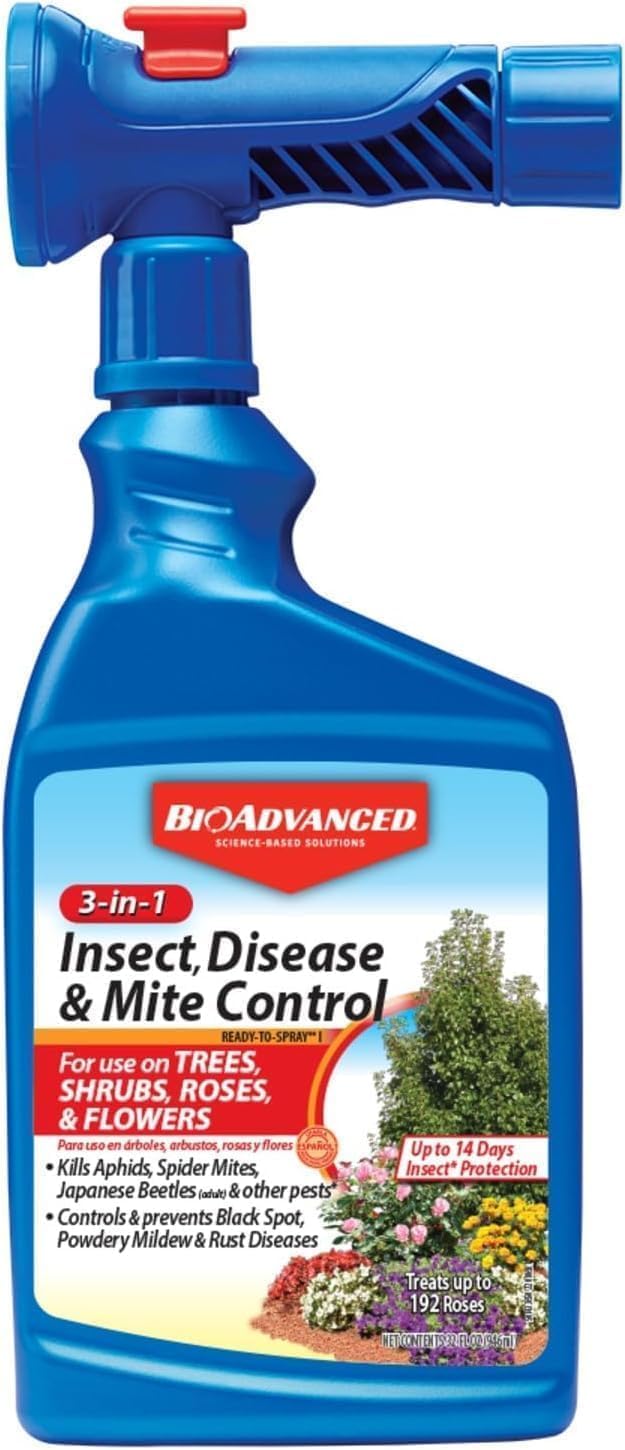
BioAdvanced 3-in-1 Insect, Disease & Mite Control Spray, 32 fl oz
| Unit Count | 32 Fluid Ounces |
|---|---|
| Item Form | Spray |
| Target Species | Aphids, caterpillars, leafminers, whiteflies and other listed pests |
| Active Ingredients | Tau-fluvalinate 0.61%, Tebuconazole 0.65% |
This BioAdvanced 3-in-1 spray combines insecticide, miticide, and fungicide in a single hose-attachment bottle for simple backyard use. You attach it to a garden hose, switch the valve, and spray evenly over foliage including leaf undersides; the manufacturer says one bottle treats up to 192 rose bushes. The formula contains active ingredients that provide contact knockdown of aphids, whiteflies, caterpillars and Japanese beetles while also preventing and curing diseases like black spot and powdery mildew, and offering residual control that the brand describes as rainproof for up to 14 to 30 days. Practical benefits include quick application across many plants and multi-target protection so you do not need separate products for pests and fungal issues. Important limitations are that it is a chemical treatment with systemic ingredients, so you should follow label safety directions and avoid use on sensitive plants or where pollinator exposure is a concern. Also it requires a hose hookup so it is less convenient for isolated container plants without an adapter or alternative sprayer.
Best for: Buyers who want an efficient, single-product solution to manage common garden pests and fungal diseases across many ornamentals and roses and who prioritize proven performance and straightforward application.
Less Ideal for: Gardeners focused on organic or pollinator-safe approaches or those who only need spot treatments for a few potted plants should consider alternatives.
- Combines insect, mite, and disease control in one ready-to-use hose-attach bottle
- Covers a large number of plants per bottle when used as directed
- Provides both contact knockdown and residual control described as rainproof
- Easy to apply with hose attachment to reach shrubs and rose bushes
- Requires hose attachment so not ideal for hand-spraying small or isolated containers
- Contains systemic and synthetic active ingredients that require careful handling and label compliance
Verdict: If you need a single, easy-to-apply product to control common insects, mites, and fungal diseases across many roses and ornamentals, this ready-to-spray 3-in-1 bottle delivers reliable, broad-spectrum protection.
Atticus Talak 7.9% Bifenthrin Indoor/Outdoor Insecticide Concentrate (32 oz)

| Formulation | Suspension Concentrate |
|---|---|
| Active Ingredient | Bifenthrin |
| Liquid Volume | 32 fluid ounces |
| Target Species | Insects |
| Length of Control | Up to three months |
Talak 7.9% is a liquid concentrate that dilutes with water to create sprays for lawns, landscapes, hardscapes, and interior perimeter treatments. It contains 7.9% bifenthrin, a long-established active ingredient, and the label lists more than 75 target pests from ants and mosquitoes to spiders and ticks. Typical use is mixing the product into a pump sprayer or hose-end sprayer at the recommended teaspoons-per-gallon rates and applying as a perimeter barrier, landscape drench, or lawn treatment; the product is also labeled for indoor application around baseboards and cabinets. The formula dries clear, is odor-free, and is not phytotoxic so it should not harm plants when used as directed. Important limitations are that mixed solutions should be used the same day and it is not approved for foggers; local sales restrictions apply in a few states. As with any bifenthrin product, follow label safety guidance carefully, keep people and pets away until sprays are fully dry, and wear appropriate protective equipment during mixing and application.
Best for: Buyers who prioritize dependable, label-backed pest control for both yard and home and who prefer products with established active ingredients and clear application instructions.
Less Ideal for: People seeking non-chemical or organic pest control solutions or those who need fogging or long-term stored mixtures for repeated use.
- Broad-spectrum control against more than 75 listed indoor and outdoor pests.
- Versatile water-based concentrate for lawns, landscapes, hardscapes, and indoor perimeter treatments.
- Dries clear and is odor-free so it does not leave residues or noticeable smells after application.
- Label notes up to three months of residual control per application when applied at recommended rates.
- Mixed spray cannot be stored and must be prepared fresh for each application.
- Not approved for use in foggers, limiting some application methods.
Verdict: Choose Talak 7.9% when you want a versatile, water-based bifenthrin concentrate that delivers proven, long-lasting control for a wide range of indoor and outdoor pests.
Choosing the Right Insecticide for Clover Mites: Key Factors to Consider
Efficacy Against Life Stages
Clover mites reproduce quickly and the population you see is usually mostly adults and nymphs. A good insecticide choice addresses both life stages. Some active ingredients kill on contact but offer little residual action, so they reduce visible numbers fast but require follow-up visits. Others provide several weeks of residual protection that can suppress re-infestation from adjacent turf or mulch areas.
Understanding whether a product targets eggs, nymphs, and adults influences timing and frequency of applications. If you apply only a contact-only product during a heavy surge, you may need additional treatments. Choosing a product with at least short-term residual control can reduce the need for frequent retreatment in most garden settings.
Residual Duration and Reapplication Timing
Residual duration determines how long treated zones remain unfavorable to clover mites. Products with longer residuals are useful for perimeter treatments where mites migrate from lawns or cracks in foundations. Short-residual options work well for spot control or where you want to avoid extended exposure to beneficial insects.
Reapplication intervals vary by formulation and weather exposure. Rain, irrigation, and heavy mowing can shorten residual life, so plan treatments for dry periods and follow label directions on reapplication timing. Overlapping treatments too soon can increase plant stress or environmental load, while waiting too long may allow populations to rebound.
Plant Safety and Phytotoxicity
Many insecticides list restrictions for certain ornamentals, newly planted transplants, or hot-weather applications. Phytotoxicity risk rises when products are applied during high heat or on sensitive species such as newly leafed perennials. Always check label guidance for flowering plants and edible gardens; some formulations require avoiding application to blooms or to plants intended for food within a set preharvest interval.
When treating borders, choose options labeled as safe for use around ornamental beds or select application methods that minimize direct contact with foliage, such as soil drench or perimeter sprays directed at foundation cracks rather than on plant tissue.
Application Method and Equipment
Insecticide formulations come as sprays, concentrates, dusts, or granules, and each suits different garden contexts. Spray concentrates mixed in a pump sprayer or hose-end applicator are good for broad perimeter treatment and foliage contact. Dusts and microencapsulated formulations work for cracks and crevices where mites congregate. Granules are easier to deploy over turf but may not reach mites hiding under mulch or at foundation seams.
Consider what equipment you already own and how comfortable you are calibrating a sprayer. Some gardeners prefer ready-to-use sprays for small patches; others use concentrates for larger lawns. The application method also affects drift and non-target exposure, so choose the form that best targets mite hotspots while limiting contact with desirable plants.
Safety For People and Pets
Because clover mite treatments are often applied close to walkways, patios, and foundation walls, human and pet safety matters. Products differ in required personal protective equipment and reentry intervals. Some require only basic gloves and avoid prolonged exposure, while others call for respirators or restricted entry after treatment.
When treating areas used by children or pets, favor formulations with lower acute toxicity and clear reentry guidance. For immediate-use areas, plan treatments when people and pets can stay away until the spray dries or until the labeled reentry period has elapsed. Also factor in where runoff might occur to avoid contaminating play areas or water features.
Environmental Persistence and Non-target Effects
Residual insecticides can affect beneficial arthropods, pollinators, and soil organisms if applied directly to flowering plants or where pollinators forage. Choosing a product with limited off-target persistence or using application techniques that avoid blooms reduces unintended impacts.
If your garden includes pollinator-attracting ornamentals, schedule treatments for early morning or late evening when pollinators are less active, and avoid direct spray onto flowers. Also consider the product's potential to move offsite with runoff and select options with lower mobility if you have nearby water features.
When To Treat For Clover Mites
Clover mite activity peaks in spring and fall in many temperate regions, often showing as dense red specks along foundations, window sills, or on indoor windows after they wander inside. Treat outdoor perimeters and turf edges at the first sign of large numbers rather than waiting until they push indoors. Early intervention on the lawn and mulch strip can keep populations from building to nuisance levels.
For indoor sightings, vacuuming visible mites and sealing entry points is an important complement to outdoor treatment. Focus insecticide applications outdoors along the foundation, under eaves, and in landscaped borders where mites congregate. Repeat treatments according to label intervals if weather or heavy irrigation reduces residual effectiveness.
- Target early morning or late afternoon for treatments to reduce heat stress on plants.
- Address both the turf edge and the strip of bare soil or mulch immediately next to the foundation.
- Combine perimeter treatments with physical exclusion like sealing cracks and improving drainage to reduce long-term pressure.
Application Tips For Gardeners
Calibrate your sprayer so you apply the correct volume per area. Over-diluting reduces efficacy while over-applying increases phytotoxicity risk and environmental load. A labeled rate is designed to balance kill with safety for typical garden settings.
Spot-treat heavy infestation sites rather than broadcasting indiscriminately across the landscape. For foundation cracks and window sills, use targeted dusts or a low-volume spray to place product where mites aggregate. Avoid spraying during windy conditions to prevent drift onto desirable plants.
- Wear gloves and eye protection at a minimum; follow the product label for specific PPE.
- Do not apply to blooming plants unless the label explicitly allows it.
- Rinse and store application equipment away from edible garden areas.
Integrating Nonchemical Controls
Nonchemical measures reduce reliance on repeated insecticide applications. Improve the immediate habitat by trimming vegetation away from foundation walls, removing excessive mulch thickness, and keeping turf trimmed to reduce favorable mite habitat.
Sealing small cracks and weatherstripping windows and door frames helps limit indoor incursions. For heavy indoor sightings, use a HEPA vacuum and inspect potential entry points rather than applying indoor insecticides unless a product is labeled for indoor use against clover mites.
- Thin mulch to a shallow layer where mites hide.
- Create a vegetation-free strip next to foundations to discourage mite migration.
- Use physical exclusion and regular cleanup to lower the need for chemical treatments.
Protecting Pollinators And Beneficials
Avoid direct sprays onto flowering plants and time treatments when pollinators are least active. If nearby ornamentals are in bloom, use methods that limit foliage contact, such as treating soil or mulch at the base of plants instead of broadcast spraying.
Consider spot-targeted applications and short-residual options in landscapes that prioritize beneficial insects. Read labels for pollinator protection instructions and observe treated areas for return of beneficial activity after the residual period has passed.
- Treat early morning or late evening to reduce pollinator exposure.
- Prefer targeted applications over broad broadcasts when ornamentals are present.
- Allow treated areas to dry before allowing pets or children to reenter if the label requires it.
How We Chose the Best Insecticide for Clover Mites
We focused on treatments that are appropriate for typical residential and small-scale garden settings where clover mites are a recurring nuisance. We filtered for products suitable for perimeter and spot treatments around foundations, lawns, flower beds, and patios. Key evaluation criteria included contact efficacy against clover mite life stages, residual protection duration, application versatility (spray, dust, granular), and labeled safety around ornamentals and common garden plants. We also assessed ease of mixing and applying for gardeners using handheld sprayers or hose-end applicators, and whether the formulation requires reentry or special personal protective equipment for typical home use. Excluded items were broad-spectrum agricultural-only fumigants and products labeled solely for indoor structural use without outdoor perimeter directions. We prioritized products with clear, garden-relevant instructions and those offering options for sensitive landscapes. The scoring emphasized real-world usability: how straightforward the product is to use, how reliably it reduces mite numbers, and how manageable any safety or reapplication constraints are for a home gardener.
FAQ
Can I use general garden insecticides for clover mites?
Often you can use products labeled for turf and perimeter pest control, but always confirm the label explicitly lists clover mites or mite control. Labels detail application rates, safe use around ornamentals, and reentry intervals that matter for home garden use.
Will treating indoors solve a clover mite problem?
Indoor treatments alone rarely stop infestations because clover mites typically originate outside. Vacuuming visible mites and sealing entry points helps, but outdoor perimeter treatments are usually necessary to reduce the source population.
How soon after treatment will I see fewer mites?
Contact-active products can produce visible knockdown within hours, while residual products may reduce reappearance over days as migrating populations decline. Heavy weather can shorten residual life and require follow-up applications per label directions.
Are there options safe to use around pets and children?
Some formulations have lower acute toxicity and short reentry recommendations, making them more suitable where pets and children frequent. Always read the product label for safety instructions and keep people and pets away from treated areas until the spray has dried or the labeled reentry period has passed.
Can I use insecticidal soaps or horticultural oils against clover mites?
Insecticidal soaps and oils can suppress small, exposed mite populations on plants but often lack long-term residual control. They work best for spot treatments on foliage but may require frequent reapplication and are generally less effective for perimeter control.
Final Verdict
Focus first on application method and safety when choosing an insecticide for clover mites. Prioritize products with the right balance of contact knockdown and residual duration for your situation, and pick formulations that match where you need to treat: turf edges, foundation perimeters, or foundation cracks. Factor plant sensitivity, pollinator presence, and reentry guidance into your decision so you can reduce mite numbers while protecting people, pets, and beneficial insects. A clear plan that combines targeted outdoor treatment, habitat modification, and exclusion measures will give the most reliable results. Select a product that fits your garden layout and follow label directions closely for timing and safety to achieve consistent control.
