

Note: This article contains affiliate links. If you click on these links and make a purchase, I may earn a small commission at no extra cost to you. This helps support my research and content. Read my full affiliate disclosure here.
Choosing the right fertilizer for alfalfa matters because this forage crop has specific nutrient needs that directly affect stand longevity, cutting frequency, and protein content. Whether you manage a small hayfield, a larger forage stand, or rotational grazing acres, the correct fertilizer strategy keeps plants vigorous without wasting inputs. This guide shortlists seven top alfalfa fertilizers suited to common soil situations and management goals. We evaluated options for nutrient balance, soil compatibility, and ease of application so you can match a product to your field conditions and cutting schedule. Read on for practical guidance that leads into the product shortlists.
Top Picks at a Glance
| Best Overall The best all-around choice for most situations | Greenway Biotech Organic Alfalfa Meal Fertilizer 4 lb (2.5-0-2.5) with Triacontanol |  |
| Best Quality Built to a higher standard if you want something more solid | Espoma Organic Alfalfa Meal Fertilizer, 3 lb |  |
| Best Value The sweet spot between price and what you get | Alfagrow Alfalfa Pellets 10 lb — Organic Soil Amendment, Fertilizer and Mulch |  |
| Best Budget The cheapest option that still gets the job done reliably | Walt's Organic Alfalfa Meal, 4 lb |  |
| Highest Rated A top-rated pick with lots of positive feedback | Growing Organic Liquid Alfalfa Fermented Plant Extract (0.5 Gallon) |  |
| Most Popular A crowd favorite that many people choose with confidence | Down To Earth Organic Alfalfa Meal Plant Food 2-0-1, 0.5 lb |  |
| Best Seller A high-volume bestseller chosen again and again | Back to the Roots Organic All-Purpose Plant Food, 5 lb |  |
Greenway Biotech Organic Alfalfa Meal Fertilizer 4 lb (2.5-0-2.5) with Triacontanol

| Item Form | Powder |
|---|---|
| Target Species | Flowers, Vegetables, Herbs |
| Unit Count | 64 Ounce |
| Mixing Ratio | No mixing required |
This alfalfa meal supplies quick-starter organic nutrition and a natural growth stimulant to encourage basal breaks and stronger blooms. It is a finely ground powder intended for top-dressing, side-dressing, making alfalfa tea, or blending into compost; the texture breaks down faster than pellet products so plants see benefits within a week while continued feeding occurs over 4 to 8 weeks. The balanced 2.5-0-2.5 formula delivers nitrogen for foliage and potassium for bloom quality while avoiding added phosphorus, which is useful on soils that already have adequate P or for runoff-sensitive sites. Because it is non-GMO, organic, and described as gentle, it is safe to use on roses, vegetables, herbs, container plants, and lawns without burning if slightly overapplied. Limitations are that nutrient analysis is light compared with synthetic fertilizers so larger or nutrient-depleted beds will need higher-rate applications or supplemental feeding, and feeding cadence is slower than soluble fertilizers for immediate heavy-feeding needs.
Best for: Gardeners who want an organic, soil-building fertilizer that improves foliage and flowering across roses, vegetables, and ornamentals while supporting long-term soil health.
Less Ideal for: Growers who need immediate, high-analysis nutrition for rapid heavy feeding or large, nutrient-depleted beds should choose a stronger synthetic or specialized amendment instead.
- Organic, non-GMO formula that builds soil and feeds beneficial microbes
- Finely ground powder breaks down quickly for faster initial response
- Includes triacontanol to stimulate basal growth and improve blooming
- Phosphorus-free formulation suitable for soils with adequate P or runoff concerns
- Low N and K percentages provide gentler feeding than concentrated synthetic fertilizers
- Not a quick fix for heavily depleted soils without additional amendments
Verdict: Choose this alfalfa meal if you want a gentle, organic booster that speeds early growth and promotes bigger blooms while building long-term soil health.
Espoma Organic Alfalfa Meal Fertilizer, 3 lb

| Item Form | Granules |
|---|---|
| Specific Uses For Product | Blooming, Plant Growth |
| Application Method | Soil or Make Alfalfa Tea Fertilizer |
| Target Species | Roses, flowers, vegetables, trees, and shrubs |
| Mixing Ratio | 1:2.5 |
Espoma Organic Alfalfa Meal is a granular, slow‑release organic fertilizer intended for gardeners who want a natural nitrogen boost and mild potassium support. You can sprinkle it around the base of roses, vegetables, shrubs and trees or mix it into water to make an alfalfa "tea" for foliar or soil feeding. Its all‑natural formula contains no fillers and is approved as an organic input material, so it fits into certified organic routines and compost applications. The product provides steady nutrient release that supports steady growth and improved bloom over several weeks rather than an immediate surge. Notable features include its simple granule form, suitability for diverse ornamentals and edibles, and a published mixing ratio for liquid feed. Limitations are the modest NPK profile for growers seeking fast corrective feeding or high‑nitrogen performance and the small 3 lb bag size that may require frequent repurchasing for larger beds or multiple trees.
Best for: Gardeners focused on steady plant performance and organic fertility who want a natural, maintenance‑friendly feed for ornamentals and edibles.
Less Ideal for: Growers who need rapid corrective feeding, high nitrogen output, or bulk quantities for large landscapes should consider concentrated synthetic or larger‑volume options.
- 100% alfalfa meal with no fillers, suitable for organic gardening
- Granular form usable directly in soil or brewed into a liquid fertilizer tea
- Provides slow, steady release of nitrogen and some potassium to support growth and blooms
- Works on a wide range of plants including roses, vegetables, trees, shrubs and flowers
- Low NPK value means it is not a quick fix for severe nutrient deficiencies
- Small 3 lb bag may be insufficient for larger gardens or frequent applications
Verdict: Buy this if you want a small‑batch, certified organic alfalfa meal that delivers steady nitrogen and bloom support for garden beds and container plants.
Alfagrow Alfalfa Pellets 10 lb — Organic Soil Amendment, Fertilizer and Mulch

| Item Form | Pellets |
|---|---|
| Specific Uses For Product | Lawns, Organic, Plant Growth |
| Target Species | roses, various plants |
| Unit Count | 160 Ounce |
Alfagrow arrives as easy-to-spread alfalfa pellets that can be mixed into potting soil, sprinkled as a top dressing, or dissolved for use in irrigation. The product supplies organic matter and a modest 3.5% nitrogen plus trace nutrients, while also acting as a mulch to help retain moisture and reduce erosion. Because it contains naturally occurring triacontanol, it can stimulate growth in ornamentals like roses and other garden plants without synthetic chemicals. The drawstring canvas bag is convenient for storage and repeated use. Practical gardeners will appreciate the multiple application methods and the child- and pet-safe, toxin-free composition. Expect gradual soil improvement rather than a quick nutrient spike; this is better suited to long-term soil building than rapid green-up for lawns that need instant nitrogen. Quantity and pellet form make dosing straightforward, but heavy feeders or commercial operations may need higher-nitrogen supplements for immediate results.
Best for: Gardeners who prioritize building healthy soil and steady plant growth with safe, natural inputs and who want flexible application methods for beds, containers, and roses.
Less Ideal for: Gardeners needing fast, high-nitrogen results for large lawns or heavy-feeding crops should choose a concentrated synthetic fertilizer instead.
- Multiuse product that serves as fertilizer, soil amendment, and mulch
- Pellet form allows easy spreading, mixing into soil, or dissolving for liquid applications
- Toxin-free and safe for use around children and pets
- Contains natural growth stimulant triacontanol beneficial for roses and ornamentals
- Lower nitrogen content means slower, gentler nutrient release compared with concentrated synthetic fertilizers
- Not formulated for rapid correction of severe nutrient deficiencies
Verdict: Choose Alfagrow if you want a safe, multiuse organic pellet that steadily improves soil and stimulates plant growth over time.
Walt's Organic Alfalfa Meal, 4 lb

| Item Form | Powder |
|---|---|
| Specific Uses For Product | Plant Growth |
| Coverage | Medium |
| Target Species | roses |
| Mixing Ratio | [EO] 100:10 |
Walt's Organic Alfalfa Meal is a powdered, slow-release organic fertilizer designed primarily for roses and general garden use. You can apply it directly around established plants or mix it into compost to boost nitrogen and trace minerals while improving soil structure and water retention. The product lists a typical N-P-K of about 2-0.25-2, so it supplies modest nitrogen and potassium without forcing rapid growth, which suits steady feeding schedules. Notable features include its powder form for easy spreading or incorporation and its suitability as a compost additive. Because it releases nutrients slowly, it reduces the need for frequent feeding but will not produce quick greening or fast pushes of growth that synthetic fertilizers can. Packaging is straightforward and the product includes basic mixing guidance. If you want a simple, organic feed to gradually improve soil and support flowering plants, this alfalfa meal performs that role well; gardeners needing fast, high-nitrogen correction or a single-application complete fertilizer may prefer an alternative.
Best for: Gardeners on a budget who want an affordable organic feed to gradually improve soil and support flowering plants, particularly roses, and those who add amendments to compost regularly.
Less Ideal for: Growers seeking quick greening, fast vegetative growth, or a high-concentration fertilizer for immediate nutrient correction.
- Slow-release organic nutrient source that supports steady plant growth
- Works well as a compost additive to increase organic matter and improve soil absorbency
- Powder form is easy to spread or mix into soil and compost
- Contains a modest N-P-K (approx. 2-0.25-2) suitable for flowering plants like roses
- Low nutrient concentration so it is not suitable when rapid correction of deficiencies is needed
- May require repeated applications for noticeable effects in poor soils
Verdict: A simple, budget-friendly organic alfalfa meal that steadily feeds roses and improves compost and soil structure over time.
Growing Organic Liquid Alfalfa Fermented Plant Extract (0.5 Gallon)

| Item Form | Liquid |
|---|---|
| Specific Uses For Product | Organic,Plant Food,Plant Growth |
| Coverage | Full |
| Unit Count | 64 Fluid Ounces |
Growing Organic Liquid Alfalfa is a ready-to-use fermented plant extract intended to boost plant vigor by making nutrients more bioavailable and increasing soil microbial diversity. You can apply it as a soil drench or foliar spray, which makes it useful for feeding vegetables, ornamentals, and container plants during the growing season. The product highlights triacontanol as a natural growth stimulant and is made from sustainably sourced, organic ingredients fermented with lactic acid bacteria and molasses. In practice this means quicker uptake of nutrients and a mild immune boost for stressed plants, especially when used regularly as part of a feeding schedule. The 0.5 gallon size suits small to medium gardens and hobby growers but means frequent repurchase for larger landscapes. It is not a complete fertilizer replacement since it enhances nutrient availability rather than providing balanced NPK on its own, so plan to use it alongside a base fertilizer when feeding heavy feeders.
Best for: Gardeners who prioritize consistent, natural supplements to support steady plant health and who want a reliable organic boost for vegetables, ornamentals, and potted plants.
Less Ideal for: Large-scale landscapers or growers who need a single product to supply complete macronutrient requirements should consider concentrated or balanced fertilizers instead.
- Fermented alfalfa extract increases nutrient bioavailability for faster uptake
- Works as both soil drench and foliar spray for flexible application
- Contains triacontanol, a natural growth stimulant that supports vigor
- Formulated with organic, sustainably sourced ingredients and beneficial microbes
- 0.5 gallon volume may be small for large gardens or frequent use
- Not a complete NPK fertilizer so additional feeding may be required
Verdict: Choose this liquid alfalfa if you want a dependable organic supplement that reliably improves nutrient uptake and plant vigor when used as a drench or foliar feed.
Down To Earth Organic Alfalfa Meal Plant Food 2-0-1, 0.5 lb
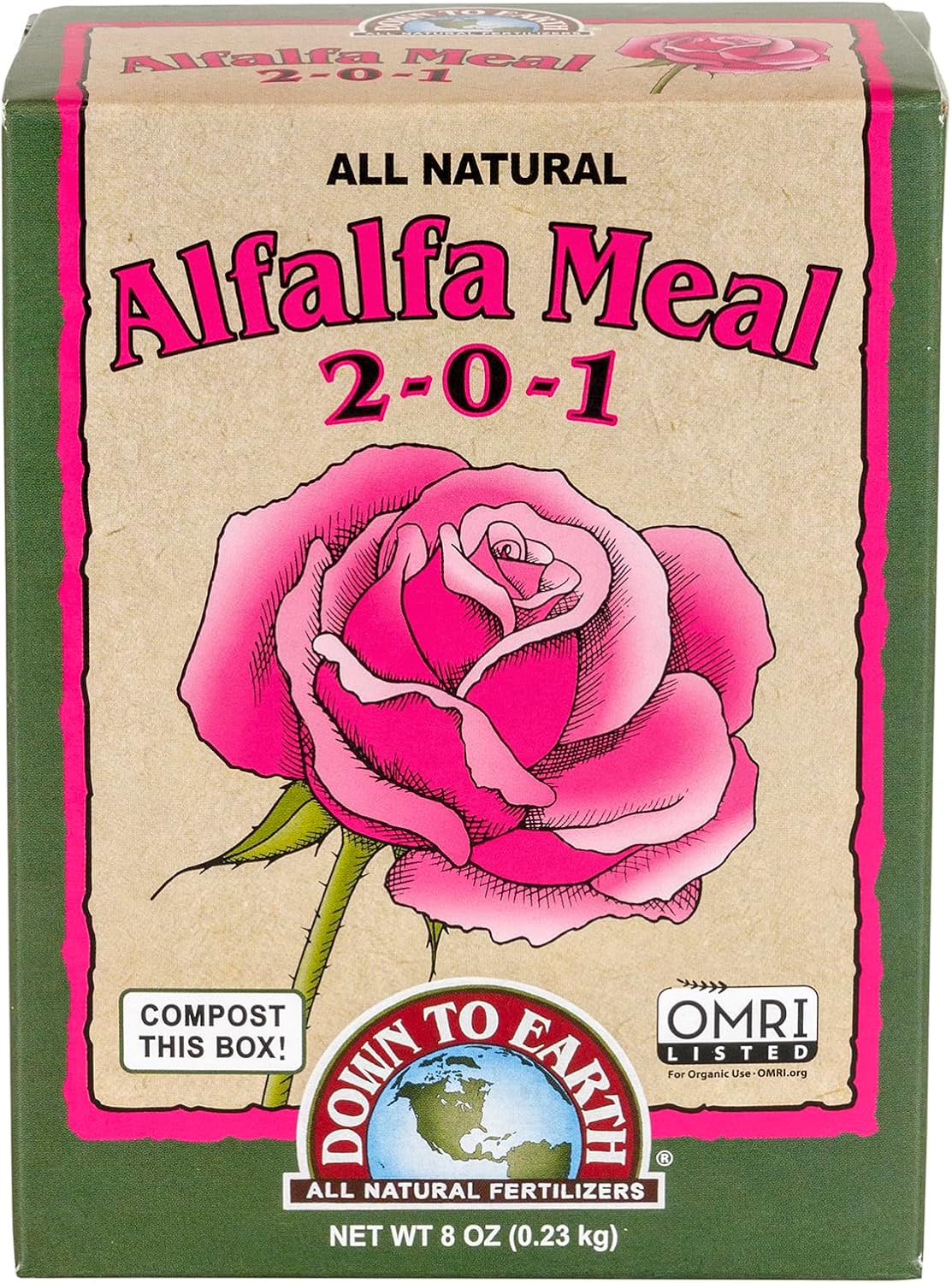
| Item Form | Powder |
|---|---|
| Specific Uses For Product | Plant Growth |
| Coverage | Organic |
| Target Species | Flower |
| Mixing Ratio | 2-0-1 |
Down To Earth Alfalfa Meal is a powdered, organic plant food formulated to give sustained, gentle feeding to flowers, bulbs and ornamentals. Gardeners typically work it into planting mix, topdress established beds, or add small amounts to container potting media; the product directions provide clear application rates for transplanting, pots and compost. Notable features include an OMRI listing for organic use, a mild 2-0-1 nutrient profile that emphasizes slow-release nitrogen, and naturally occurring growth stimulants and trace minerals that support microbial soil activity. Because it is a low-analysis, slow-acting amendment it enhances soil structure and plant vigor over weeks rather than producing a quick green-up, which is useful for steady growth and for reducing burn risk. The 0.5 pound size is convenient for trialing on a small bed or for container gardeners, but frequent users or larger plots will need larger packages. Safety notes and mixing ratios are printed on the label, so follow those to avoid overapplication.
Best for: Gardeners who prioritize organic, low-risk feeding and want a gently acting amendment to improve soil health and steady flowering rather than fast green-up.
Less Ideal for: Gardeners needing rapid nutrient correction, large-scale vegetable production, or those who prefer concentrated synthetic fertilizers for quick results.
- OMRI listed and 100% organic alfalfa meal suitable for certified organic gardens
- Provides slow-release nitrogen and natural growth stimulants to support steady plant vigor
- Improves soil microbial activity and structure rather than just supplying quick nutrients
- Clear label directions with specific mixing ratios for transplants, containers and compost
- Low nutrient analysis means it is not a quick corrective for severe nitrogen deficiency
- Small 0.5 lb package size is limiting for larger beds or frequent applications
Verdict: Choose this OMRI-listed alfalfa meal if you want a safe, organic slow-release feed that builds soil health and supports steady flowering.
Back to the Roots Organic All-Purpose Plant Food, 5 lb

| Unit Count | 80 Ounce |
|---|---|
| Item Type | Organic All-Purpose Plant Food |
| Item Highlight | Vegan organic fertilizer with kelp, alfalfa meal, mycorrhizae, rock phosphate |
| NPK | 2-3-3 |
This 5 lb bag of Back to the Roots All-Purpose Plant Food is a plant- and mineral-based granular fertilizer designed for routine feeding of houseplants, herbs and edible container crops. It mixes easily with water (directions recommend 1 tablespoon per gallon applied every 2 to 4 weeks) and uses kelp, alfalfa meal, rock phosphate and mycorrhizae to supply slow-release nutrients and support stronger root growth. The no-burn formulation makes it forgiving for indoor use and for beginners who might overapply synthetic feeds. Because it is organic and free of synthetic chemicals and animal byproducts, it fits gardens where sustainable inputs are a priority. Limitations are that the NPK is relatively low at 2-3-3, so heavy-feeding or fast-growing plants may need more frequent applications or a complementary feed for quick nitrogen response. Also being a granular/tea-style feed it requires mixing and regular application rather than a one-and-done slow-release stake.
Best for: Practical indoor gardeners who want an easy-to-use, sustainable organic feed for houseplants, herbs and mixed container plantings and who prefer predictable, repeatable feedings over complex regimens.
Less Ideal for: People seeking a single-application slow-release fertilizer or those who need high-nitrogen quick-growth boosts for heavy-feeding vegetables.
- 100% plant and mineral based formula without synthetic chemicals
- Includes kelp, alfalfa meal and mycorrhizae to support root health and sustained nutrition
- No-burn recipe suitable for indoor plants and beginner-friendly application
- Value-sized 5 lb bag reduces trips to replenish supply for multiple pots
- Relatively low NPK (2-3-3) may not satisfy heavy-feeding or very fast-growing plants
- Requires regular mixing and application rather than a single long-term release product
Verdict: A practical, beginner-friendly organic feed that reliably supports indoor plants and herbs with plant-based nutrients and root-supporting mycorrhizae.
Choosing the Right Alfalfa Fertilizer: Key Factors to Consider
Nutrient Balance and Ratios
Alfalfa needs a fertilizer program tailored to its lifecycle. During establishment, a blend with available nitrogen and higher phosphate supports root development and early vigor. For established stands, emphasis shifts toward potassium and secondary nutrients to support regrowth after cutting and to improve winter survival.
Look at the N-P-K numbers and the form of each nutrient. Water-soluble nutrients provide immediate correction, while controlled-release or polymer-coated components sustain nutrition between cuts. Balanced micronutrients like boron, sulfur, and molybdenum can be critical in soils that test low because they influence nitrogen fixation and overall forage quality.
Soil pH and Compatibility
Soil pH strongly affects nutrient availability for alfalfa. This crop prefers neutral to slightly alkaline soils, so pick fertilizers and amendments that correct acidity or supply nutrients in forms available at your field pH. Some fertilizers include liming materials or have acidifying effects; understand how a product will shift pH over time.
Consider soil texture too. Sandy soils may leach soluble nutrients quickly and demand split applications or slow-release formulations. Heavy clay can bind phosphorus and micronutrients, so products that improve root access or are band-applied near the seed/pulse may be more effective.
Release Profile and Timing
Alfalfa receives multiple cuts in a season, so matching fertilizer release with cutting intervals maximizes uptake and reduces loss. Fast-release fertilizers correct deficiencies quickly but may require repeat applications. Slow-release formulas provide steady nutrition but may not address an acute shortage before a cutting.
Plan fertilizer timing around establishment, pre-first-cut feeding, and mid-season regrowth. Products that allow split applications or are designed for in-season topdressing give you flexibility to react to tissue tests and visual growth cues.
Application Method and Equipment Fit
How you apply fertilizer affects how efficiently alfalfa uses it. Broadcast spreading is common on hayfields but can be wasteful on uneven soils. Banding places nutrients closer to roots and reduces fixation losses for phosphorus. Liquid options work well with fertigation or foliar sprays for quick correction, while granular or blended feeds may better suit dry application equipment.
Choose fertilizers compatible with your existing spreaders, sprayers, and handling systems. Consider product abrasiveness, caking risk, and whether the formulation needs special nozzles or agitation for uniform distribution.
Environmental Loss Risk
Alfalfa stands can be vulnerable to nutrient loss through leaching and surface runoff, especially on slopes or sandy soils. Select fertilizers and application schedules that reduce environmental risk, such as split applications, incorporation where feasible, or using products with lower solubility during wet seasons.
Timing applications to avoid heavy rains and using buffer strips at field edges also helps. Products that minimize volatilization loss of nitrogen are helpful where surface broadcasting is unavoidable.
Storage, Handling, and Farm Logistics
Farm-scale handling matters. Fertilizers that cake or degrade in storage create application problems and uneven feeding. Choose formulations with predictable shelf life and storage needs that match your infrastructure. Bulk blends may need different storage than packaged bags, and liquids require tanks and pumps.
Also consider safety and labeling. Corrosive or hygroscopic materials need special handling, and products that are easier to load, measure, and mix reduce labor time during busy planting and cutting windows.
Adjusting Fertilizer Strategy by Stand Age
Young seeding stands and established production stands have distinct nutrient priorities. In the first year prioritize phosphorus and readily available nitrogen to build roots and canopy. After the stand is established, shift emphasis to potassium and micronutrients to support repeated regrowth and winter survival.
Monitor stand vigor and cutting response; if regrowth is slow or stems are thin after a cut, that usually points to potassium or sulfur limitations rather than just nitrogen. Tissue tests taken after a cutting give the best insight for adjustments.
- Establishment: higher P, starter N, root-building focus
- Established stands: K and micronutrients for regrowth
- Use tissue tests to fine-tune mid-season corrections
Using Soil and Tissue Tests Effectively
Soil tests set the baseline for what the field lacks and how pH adjustments will influence nutrient availability. Take samples at a consistent depth and time relative to fertilizer applications for comparable results. Use tissue tests after a cutting to see what the plants actually removed and to target in-season corrections.
Match fertilizer formulations to the deficiencies found. For example, low boron on a soil test can be corrected with specific micronutrient blends or foliar applications timed for early regrowth when uptake is highest.
- Soil tests for baseline pH and reserve nutrients
- Tissue tests to measure what plants actually need
- Coordinate test timing with cutting schedule
Selecting Formulation Type for Your Operation
Granular blends are simple to handle and often economical for broad-acre applications. Liquids and water-soluble fertilizers work well with fertigation and foliar feeding but require pumps, tanks, and agitation. Slow-release or polymer-coated products reduce the number of passes but may cost more upfront.
Think through labor and equipment tradeoffs. If you have access to irrigation for fertigation, soluble fertilizers give excellent uniformity. If you rely on a single pass of a spreader each season, a product with a longer release profile can reduce repeat applications.
- Granular: bulk handling, simple spreading
- Liquid: fast correction, needs equipment
- Slow-release: fewer applications, steady supply
Managing Fertilizer Around Cutting and Weather
Timing applications relative to cutting is crucial. Apply main nutrient loads early enough for plants to use them before harvest but not so early that nutrients are lost or diluted over time. Avoid heavy applications immediately before forecasted heavy rains to limit runoff and leaching.
When wet weather is likely, consider split applications or controlled-release formulations. After a cutting, plants need an immediate nutrient supply to support rapid regrowth, so quick-acting sources or foliar feeds can be useful in that window.
- Avoid heavy applications before heavy rain
- Use quick-acting feeds for immediate regrowth needs
- Split applications reduce loss and match uptake timing
Practical Tips for Small Acreage and Hobby Fields
Small fields and hobby growers should prioritize simple, low-handling options. Packaged granular blends or small-volume liquid concentrates are easier to store and measure. Focus on correct rates for the area to avoid over-application, and consider spot-treating poor patches rather than whole-field blanket feeding.
If you lack sophisticated sampling tools, basic soil tests and visual monitoring across the season still allow practical adjustments. Keep records of application timing, rates, and observed regrowth to refine your plan year to year.
- Use small-package blends for easier storage
- Spot-treat weak areas instead of whole-field feeding
- Keep application records to track responses
How We Chose the Best Alfalfa Fertilizer
We focused on the attributes that most influence alfalfa performance in real-world fields. Primary evaluation criteria included nutrient balance and rates tailored to alfalfa's N-P-K and secondary element needs, soil compatibility covering pH and texture responses, and application flexibility for common delivery methods such as broadcast, banding, and fertigation. We also checked solubility and release profile to distinguish quick-acting formulations from those that sustain nutrition between cuts, plus handling and storage traits important for farm-scale use. Excluded items included general-purpose lawn fertilizers, products designed only for other forage species, and blends lacking clear nutrient analysis. We prioritized products with transparent nutrient labels and formulation traits relevant to alfalfa cropping: readily available nitrogen sources for establishment, phosphate levels that support root development, potassium for winter hardiness and regrowth, and adequate sulfur, boron, and molybdenum when needed. The scoring emphasized measurable specs and practical application fit rather than marketing claims.
FAQ
How much fertilizer does alfalfa need per cutting?
Needs vary by soil fertility and yield goal. Often growers apply a baseline at establishment and make smaller in-season applications targeted by soil or tissue tests. Follow nutrient test recommendations rather than fixed per-cut numbers because uptake depends on yield and existing soil reserves.
Can I use a general-purpose fertilizer on alfalfa?
You can, but general-purpose blends may not supply the balance alfalfa needs, especially potassium and certain micronutrients. Use soil and tissue tests to see whether a general mix matches the crop's specific deficiencies before relying on it long term.
When is the best time to apply fertilizer relative to cutting?
Apply main nutrients early enough to be taken up before harvest but close enough to cutting that the plants benefit during regrowth. Quick corrective applications are most effective immediately after a cutting when new growth is fastest. Avoid spreading right before heavy rainfall.
Do I need micronutrients for alfalfa?
Micronutrients are often important, particularly boron, sulfur, and molybdenum, which influence nitrogen fixation and protein production. Their need depends on soil test results and regional deficiency patterns; treat deficiencies based on testing rather than routine blanket applications.
How does soil pH affect fertilizer choice for alfalfa?
Soil pH controls nutrient availability and can limit uptake even when nutrients are present. Alfalfa prefers neutral to slightly alkaline soils, so if pH is low, correcting acidity or choosing fertilizers that supply available forms of phosphorus and micronutrients is important.
Final Verdict
Prioritize fertilizers that match your field's soil test profile and the stand age of your alfalfa. Focus on nutrient balance, proper timing around cuts, and application methods that fit your equipment and landscape to maximize uptake and reduce losses. Accept tradeoffs between fast-acting corrections and longer-term supply when planning applications across the season. With clear testing, timed applications, and an eye toward environmental loss prevention, you can choose an alfalfa fertilizer strategy that supports healthy stands and consistent yields.
