

Note: This article contains affiliate links. If you click on these links and make a purchase, I may earn a small commission at no extra cost to you. This helps support my research and content. Read my full affiliate disclosure here.
Choosing the right compost for garden beds and containers makes a practical difference in how quickly plants establish, how well soils hold water, and how much effort you spend feeding and amending later. The right compost can lift poor soil structure, supply steady nutrients, and reduce the need for frequent fertilization. This guide covers six shortlisted composts suitable for common garden situations and evaluates them on texture, nutrient profile, and how they perform in real yard or patio conditions. Read on to understand the tradeoffs so you can match compost type to your soil, plants, and maintenance style.
Top Picks at a Glance
| Best Overall The best all-around choice for most situations | BRUT WORM FARMS Cow Compost — 1 cu ft Organic Compost |  |
| Best Quality Built to a higher standard if you want something more solid | Espoma Organic Land and Sea Gourmet Compost with Lobster & Crab Meal, 1 cu ft |  |
| Best Value The sweet spot between price and what you get | Blue Ribbon Organics OMRI Certified Organic Compost (Bag) |  |
| Best Budget The cheapest option that still gets the job done reliably | Gantessa Stone Premium Organic Compost, 2 lb |  |
| Highest Rated A top-rated pick with lots of positive feedback | BRUT Worm Castings Organic Plant Food, 5 lb |  |
| Most Popular A crowd favorite that many people choose with confidence | Wiggle Worm Pure Worm Castings Organic Fertilizer, 30 lb |  |
BRUT WORM FARMS Cow Compost — 1 cu ft Organic Compost

| Brand | BRUT WORM FARMS |
|---|---|
| Item Highlight | OMRI Certified, CDFA Listed, Finely Sifted Granules, Odor Free Texture, Seedling Safe |
| Volume | 1 cubic feet |
| Manufacturer | Brut Worm Farms, Inc. |
This cow compost is a straightforward, organic soil amendment for gardeners who want to increase nutrient content and improve soil structure. It arrives as finely sifted granules that are easy to work into garden beds, mixed into potting media, or used as a top dressing around established plants. Notable features include OMRI certification, CDFA listing, an odor‑free texture, and a formula the brand describes as seedling safe. In practice the compost adds organic matter and beneficial microbes that help with moisture retention and aeration, making it useful for vegetable plots, flower beds, lawns, and indoor containers. Limitations are practical: the bag is one cubic foot, so multiple bags are needed for larger beds, and as with any manure‑based product there is a slow decomposition schedule so nutrient release is gradual rather than immediate. For gardeners wanting a clean, certified organic compost that mixes easily and supports long‑term soil health this is a convenient option; those needing a fast‑acting fertilizer or large bulk volumes should plan accordingly.
Best for: Gardeners seeking a certified organic, low‑odor compost to improve soil structure and moisture retention in vegetable beds, lawns, and containers who value long‑term soil health over instant feeding.
Less Ideal for: People who need a quick‑acting, high‑strength fertilizer or who are planning very large landscaping projects and prefer bulk commercial compost deliveries.
- OMRI certified and CDFA listed for organic gardening
- Finely sifted granules that mix easily into soil or potting mixes
- Odor free texture suitable for indoor use and seedling areas
- Improves moisture retention and adds beneficial microbes to soil
- Sold in 1 cubic foot bags so larger projects require multiple purchases
- Nutrient release is gradual since it is a composted manure product
Verdict: A certified, finely sifted cow compost that quietly improves soil health and moisture retention for home vegetable gardens and containers.
Espoma Organic Land and Sea Gourmet Compost with Lobster & Crab Meal, 1 cu ft

| Item Form | Granules |
|---|---|
| Specific Uses For Product | Soil Conditioning, Plant Growth, Seed Development, Root Development |
| Included Components | Lobster and crab meal |
| Ingredients | Aged forest products, sphagnum peat moss, humus, limestone, lobster meal & crab meal |
Espoma Organic Land and Sea is a premium, ready-to-use compost intended for amending garden beds, planters, and transplant holes. The mix combines aged forest products, sphagnum peat moss, humus, limestone for pH adjustment, and lobster and crab meal to deliver organic nutrients and slow-release nitrogen. It also includes a mycorrhizae blend to help root establishment and nutrient uptake. In practice this product is mixed into native soil when planting or used to refresh container mixes, and it noticeably improves moisture retention and soil texture while adding a food source for vegetables, flowers, trees, and shrubs. Because it is a finished compost you do not need to wait for further decomposition before planting. Limitations are typical of peat-containing mixes: it is somewhat bulky to handle and not a concentrated fertilizer for rapid greening, so heavy feeders may still need supplemental feedings during the season. Overall it is a convenient, performance-focused soil amendment for gardeners who want an organic, biologically active boost at planting time.
Best for: Gardeners who prioritize reliable, organic soil improvement at planting time and want a biologically active amendment that supports root development and steady plant performance.
Less Ideal for: Buyers seeking an instant, high-nitrogen fertilizer or those who strictly avoid peat-based products should consider alternatives.
- Finished, ready-to-use compost suitable for immediate planting
- Contains lobster and crab meal for slow-release organic nutrients
- Includes endo and ecto mycorrhizae to support root growth and nutrient uptake
- Improves soil texture and moisture retention for containers and beds
- Contains peat moss which some gardeners avoid for sustainability reasons
- Not formulated as a high-concentration fertilizer for rapid greening
Verdict: A ready-to-use organic compost that boosts soil biology and root performance at planting for gardeners focused on steady, long-term results.
Blue Ribbon Organics OMRI Certified Organic Compost (Bag)

| Brand | Blue Ribbon Organics |
|---|---|
| Included Components | Compost |
| Item Type Name | Organic Compost |
| Volume | 7.48 gallons |
Blue Ribbon Organics compost is a finished, OMRI-certified organic compost intended to amend garden soil, topdress lawns, and act as a mulch around trees and shrubs. It is made from recycled food and yard residuals processed at a permitted facility and monitored for maturity, contaminants, and weed seed. Typical uses include tilling 3–4 inches into new beds, adding a thin 1/4–1 inch layer to existing beds, topdressing lawns in fall, or applying 2–3 inches around trees as a mulch. The product improves aeration and water retention while adding organic matter and nutrients such as nitrogen, phosphorus, potassium, calcium, and magnesium. Because it is a finished compost, it is safe for organic production and seedling starts and pairs well with other soil builders. Expect some variability in moisture content and weight since this is a natural product, and plan handling and storage to keep the bag dry. For gardeners who want a certified, low-effort soil improver, this compost delivers consistent, practical benefits for established beds and lawns.
Best for: Gardeners who prioritize practical, certified organic soil improvement and want a ready-to-use compost to boost beds, lawns, and landscape plantings with minimal processing.
Less Ideal for: People needing large-scale bulk compost delivery for commercial gardening or large acreage should consider bulk options rather than bagged product.
- OMRI certified and meets US Composting Council standards, so it is approved for organic production
- Finished compost tested for maturity, low weed seed, and monitored for trace metals and pathogens
- Improves soil structure, aeration, and water retention while adding balanced nutrients
- Multiple recommended application uses included for beds, lawns, and around trees
- Moisture content can vary, which may affect delivered weight and handling
- Sold as a single bag volume which may be inefficient for very large gardens without buying multiple bags
Verdict: A certified, ready-to-use organic compost that reliably improves soil health for gardeners wanting a low-effort, certified amendment.
Gantessa Stone Premium Organic Compost, 2 lb

| Item Form | Solid |
|---|---|
| Application Method | Soil Amendment, Top Dressing, Compost Tea |
| Coverage | Medium |
| Target Species | flowers, vegetables, herbs, and more |
| Unit Count | 32 Ounce |
This is a screened organic compost sold in a 32-ounce package and designed to enrich garden soil and improve structure. You can work it into potting mixes, sprinkle it as a top dressing around established plants, or steep it to make compost tea using the recommended 1:2 mixing ratio. The product highlights improved water retention, better aeration, and added beneficial microorganisms, which helps roots in both sandy and heavier soils. Because it is screened and presented as a medium-coverage amendment, it is convenient for spot-treating containers, raised beds, and small garden plots without needing bulk handling. The main limitation is the small unit size: this bag is best for small-scale projects rather than amending large areas, so heavy users will need multiple bags. Packaging and formulation make it a practical choice for hobby gardeners wanting an easy-to-use organic boost rather than contractors or large-scale applications.
Best for: Gardeners working on containers, small raised beds, or a few vegetable or flower plots who want an easy, organic soil boost without handling bulk compost.
Less Ideal for: Landscapers or gardeners with large lawns or extensive beds who need bulk compost or frequent heavy soil amendments.
- Screened organic compost suitable for soil amendment, top dressing, or compost tea.
- Includes beneficial organic matter that improves soil structure and moisture retention.
- Small, easy-to-handle package convenient for containers, raised beds, and spot applications.
- Mixing ratio provided for making compost tea or blending into mixes.
- Small 32-ounce unit is not cost-effective for large garden areas and requires buying multiple bags for bigger projects.
Verdict: A convenient small-bag organic compost for hobby gardeners who need an easy-to-use soil amendment for containers and small beds.
BRUT Worm Castings Organic Plant Food, 5 lb

| Item Form | Granules |
|---|---|
| Specific Uses For Product | Gardening,Organic |
| Coverage | Full |
| Target Species | All plants |
| Mixing Ratio | 1:5 |
BRUT Organic Worm Castings are a ready-to-use granular amendment made from earthworm castings intended to boost soil fertility and microbial life. Use it mixed into potting mixes at the recommended 1:5 ratio for new indoor plants, sprinkle as a top dressing for established containers, or work into garden beds and planting holes outdoors. Notable features include certified organic sourcing, an easy-to-handle granular form, and clear dosing guidance for lawns, beds, trees, and potted plants. In practice it supplies slow-release nutrients and beneficial microbes that improve aeration, water retention, and root development without burning plants. The product is versatile across vegetables, ornamentals, and houseplants and is safe for family gardens when handled with gloves. Limitations are its modest bag size for larger gardens and that results accumulate over repeated applications rather than delivering an immediate, high-NPK fertilizer effect, so expect gradual soil improvement rather than instant greening.
Best for: Gardeners who prioritize consistent, soil-first fertility and want a reliable organic amendment to maintain long-term plant health in containers and beds.
Less Ideal for: People needing an immediate, high-nitrogen boost or those managing large lawns and commercial plots who require bulk quantities and faster results.
- Certified organic and OMRI/CDFA listed for chemical-free gardening.
- Granular form with clear mixing and application instructions for indoor and outdoor use.
- Supports soil structure, water retention, and beneficial microbial life without burning plants.
- 5 lb bag may be insufficient for larger beds or lawns, requiring frequent reapplication.
- Provides slow-release nutrition so it is not a quick-acting, high-NPK fertilizer.
Verdict: Choose this certified organic worm casting when you want a dependable, low-risk soil amendment that steadily improves fertility and microbial health.
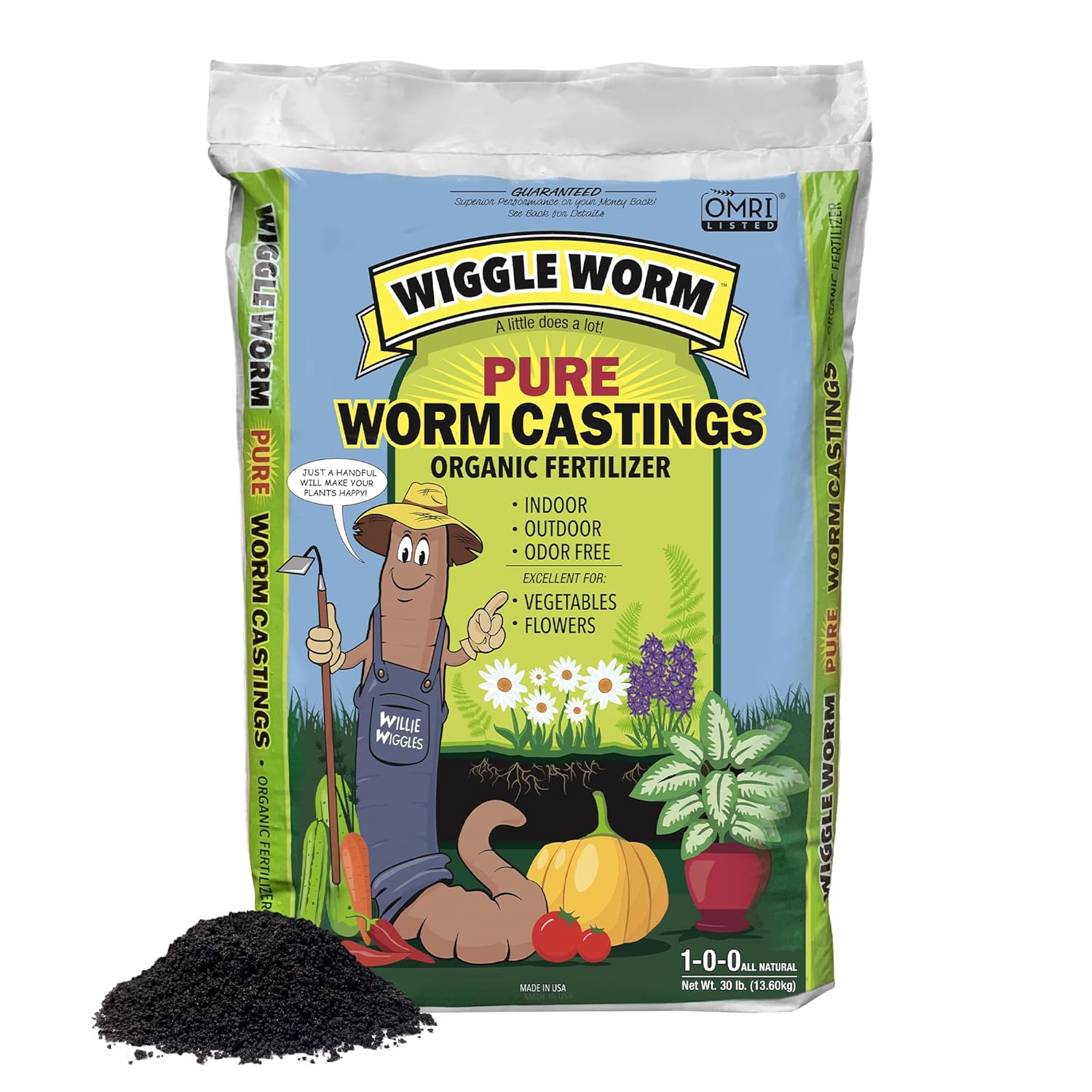
Wiggle Worm Pure Worm Castings Organic Fertilizer, 30 lb
| Item Form | Granules |
|---|---|
| Specific Uses For Product | Soil Conditioning |
| Application Method | Apply to soil |
| Unit Count | 480 Ounce |
Wiggle Worm Pure Worm Castings are a ready-to-use organic soil amendment made from concentrated earthworm castings. Gardeners typically mix a portion into potting mixes, top-dress established plants, work it into transplant holes, or brew it as a nutrient tea; the product page includes specific dosing for vegetables, containers, lawns, and roses. The castings are odorless, non-burning, and OMRI listed for organic use, so they supply water-soluble nutrients plus microbes that improve aeration, water retention, and root development without synthetic chemicals. Practical benefits include easy application, safe use on seedlings and mature plants, and versatility across raised beds, container gardens, and lawns. The main limitation is that this is a concentrated soil builder rather than an all-in-one fertilizer with NPK labels, so users seeking precise, fast-acting nutrient ratios may need to supplement for specific deficiencies; also a 30 lb bag is bulky to handle for small-space gardeners. For gardeners focused on long-term soil health and organic production, it functions as a low-risk, effective amendment.
Best for: Gardeners who prioritize building long-term soil health and want a safe, organic amendment for vegetables, ornamentals, and containers; buyers who value proven, low-risk inputs backed by strong user feedback.
Less Ideal for: Gardeners who need targeted, rapid nutrient correction based on precise NPK values or those who only want a lightweight product for very small balconies or indoor micro-gardens.
- OMRI listed organic and made from 100% worm castings
- Provides beneficial microbes that improve soil structure and water retention
- Odorless and non-burning so safe for seedlings and established plants
- Versatile dosing for containers, raised beds, lawns, and making worm casting tea
- No standard NPK nutrient label so not a precise standalone fertilizer for targeted feeding
- Large 30 lb bag can be heavy and awkward for gardeners with limited storage or mobility
Verdict: Choose this product when you want a proven, OMRI-listed worm casting that builds soil biology and improves plant health across beds and containers.
Choosing the Right Compost for Garden: Key Factors to Consider
Nutrient Balance and Availability
Compost supplies a range of macro and micronutrients, but the balance varies by feedstock and process. A compost with a moderate nitrogen-phosphorus-potassium profile and measurable trace elements will support steady growth without forcing rapid, leafy flushes that require frequent pruning. Consider how the compost will interact with your existing soil test results so you avoid over- or under-supplying particular elements.
For slow-release feeding, choose compost with a mix of well-decomposed plant material and some fine humus. Fresh or underfinished material can immobilize nitrogen as microbes continue breaking down carbon-rich inputs, temporarily reducing availability to plants.
Organic Matter Content and Soil Improvement
The percentage of organic matter in a compost determines how much it will change soil structure over the long term. Higher organic matter increases water-holding capacity in sandy soils and improves aggregation in heavy clay, letting roots penetrate more easily. When planning a soil-building program, estimate how many inches of compost incorporation are realistic for your space and choose a product that delivers meaningful organic content per cubic yard or bag.
Repeated light applications build soil over seasons with less disturbance, while larger incorporations produce faster changes. Consider how often you want to top-dress versus fully mix compost into planting beds.
Texture and Drainage
Particle size and the proportion of fine to coarse material control how compost handles water and air. Finer composts blend well into surface top-dressing and seedbeds, but they can compact and hold excess moisture if used alone in heavy clay. Coarser, woody compost provides better drainage and helps create pore space in container mixes and raised beds.
Assess the intended use: for containers and shallow-rooted plants, favor a lighter, well-draining blend. For deep bed renovations, coarser materials mixed with finer humus create a balanced profile that encourages long-term aggregation.
Stability, Maturity, and Weed Seed Content
Mature compost is biologically stable and will not continue vigorous decomposition that ties up nutrients or generates heat in the soil. Immature compost can smell, attract pests, and disrupt plant growth. Good compost should show dark, crumbly humus with an earthy smell and minimal recognizably woody or plant fragments.
Check whether the product has passed a curing stage and been screened for viable weed seeds. For gardeners who want low-maintenance beds, choose compost that is marketed or described as finished and screened to reduce the risk of introducing weeds.
Source Materials and Contaminant Risk
Feedstock matters for both performance and safety. Compost made from clean yard trimmings, vegetable scraps, and certified biosolids-free sources tends to be free of persistent herbicides or harmful residues. Compost derived from unknown or mixed industrial green waste has a higher risk of contamination.
Ask about the feedstock origin if you plan to use compost in edible gardens. When in doubt, use compost that documents its inputs and processing to minimize the chance of introducing toxins or persistent chemicals into your soil.
Application Rate and Practical Handling
How much compost you need and how easy it is to move and apply will influence choice. Bulk compost delivered in cubic yards suits large beds and renovation projects, while bagged compost works for small plots, containers, and spot improvements. Consider moisture content at purchase because wet, heavy compost increases labor for spreading and may compact more readily.
Think about storage, screening for rocks or roots, and whether you will incorporate compost with a rototiller or by hand. Practical handling also includes dust levels for dry composts and odor for storing near homes.
How Compost Affects Different Garden Soils
Compost interacts with soil texture in predictable ways. In sandy soils, organic matter increases water and nutrient retention by improving the soil's ability to hold moisture. In clay soils, compost helps break up dense aggregates, improving drainage and root penetration. For loam soils, compost acts as a buffer, supplying slow-release nutrients and supporting microbial life without dramatically changing texture.
When adding compost, consider gradual changes. A deep incorporation of compost can produce more immediate results but requires more effort and can disturb existing plantings. Surface top-dressing is lower impact and effective for long-term soil health.
- Sandy soil benefits from higher organic matter to retain moisture
- Clay soil improves with coarser compost to increase pore space
- Loam needs modest additions to support microbes without overloading
Using Compost in Containers and Raised Beds
Containers and raised beds need a lighter mixture that drains well. Pure compost is often too dense and water-retentive for many pots. Mix compost with coarse ingredients such as perlite, bark, or finished woody material to keep roots oxygenated and avoid rot.
For container-grown edibles, blend a lower percentage of compost into a base potting medium to supply nutrients without causing compaction. Replace or top-dress container mixes each season to maintain structure and fertility.
- Aim for no more than 20 to 30 percent compost by volume in most container mixes
- Use coarser compost fractions in raised beds to improve drainage
- Top-dress rather than deep-incorporate in established containers
Incorporating Compost Into Established Beds
For established garden beds, surface applications and shallow cultivation are common. Spread a 1 to 2 inch layer of compost as a top dressing and let soil organisms move organic matter downward over the season. If renovating a bed, remove plants if needed and mix compost into the top 6 to 8 inches for faster improvement.
Avoid deep tilling unless addressing compaction or severe structural issues. Minimal disturbance preserves soil structure and microbial communities while still allowing compost to enhance fertility.
- Top-dress annually for maintenance
- Mix deeper when renovating or establishing new beds
- Minimize tilling to protect soil biology
Compost and Organic Gardening Practices
Compost is a cornerstone of organic gardening because it recycles garden and kitchen waste into plant-available resources. Regular applications reduce dependence on synthetic fertilizers by supplying slow-release nutrients and improving soil biology.
Combine compost use with cover crops, mulching, and crop rotation to maintain long-term fertility. For edible gardens, prioritize composts with documented clean feedstocks to reduce the risk of contaminants.
- Use compost alongside mulches to conserve moisture
- Rotate crops and add compost to replenish nutrient removal
- Select documented feedstock composts for edible plots
Storing and Handling Compost Safely
Store compost in a dry, covered location to prevent nutrient loss and leaching. Keep bags or piles off paved surfaces to avoid contaminating runoff. For bulk deliveries, plan placement close to beds to minimize wheelbarrow distance.
When handling compost, wear gloves and a dust mask if the product is dry and dusty. For gardeners with respiratory sensitivities, moisten dry compost slightly before moving to reduce airborne particles.
- Cover stored compost to prevent rain leaching
- Place bulk compost near work areas before spreading
- Use personal protective equipment if dusty
How We Chose the Best Compost for Garden
We focused on the features gardeners actually encounter when using compost in beds, borders, containers, and soil-building projects. Selection emphasized nutrient balance and organic matter content because these determine how compost feeds plants and improves structure. Texture and drainage were weighted heavily since compost that is too fine or too woody affects water retention and root aeration. Stability and maturity were checked to avoid products that can tie up nitrogen or introduce weed seeds. Odor and cleanliness were considered for gardeners working in small yards, patios, or near living spaces. We excluded blends formulated primarily as potting mixes or seed-starting media, and we did not consider specialty amendments that act mostly as fertilizers rather than bulk organic matter. Final picks reflect composts that provide measurable soil improvement, consistent texture and moisture behavior, safe maturity levels, and practical suitability for container and in-ground garden use.
FAQ
How often should I apply compost to vegetable beds?
Often yearly top-dressings of 1 to 2 inches are sufficient for vegetable beds. For heavy feeders or newly established beds, mix in a larger amount every few years to build organic matter more quickly.
Can I use compost directly from a backyard pile without screening?
Usually you can, but unscreened backyard compost may contain larger woody pieces or undecomposed material that can slow plant establishment. Screening gives a finer, more uniform product for seedbeds and containers.
Will compost attract pests or rodents?
Compost that contains food scraps may attract rodents if not managed properly. Properly maintained and well-covered compost piles with good heat during the active phase are less likely to attract pests.
Is compost safe for edible gardens?
Compost from clean garden and kitchen waste is generally safe for edible gardens when fully mature. Avoid composts with unknown industrial inputs or persistent herbicide contamination if you plan to grow food.
How can I tell if compost is mature and ready to use?
Mature compost is dark, crumbly, and smells earthy rather than sour. It should have low temperatures and minimal visible plant fragments. A simple germination test can reveal whether immature compost affects seed growth.
Final Verdict
Match compost choice to how you garden. Prioritize nutrient balance and organic matter for long-term soil improvement, and choose texture appropriate to containers, raised beds, or in-ground use. Consider maturity and source to avoid introducing weeds or contaminants. By balancing these tradeoffs, you can confidently pick a compost that fits your planting style and maintenance rhythm.
