

Note: This article contains affiliate links. If you click on these links and make a purchase, I may earn a small commission at no extra cost to you. This helps support my research and content. Read my full affiliate disclosure here.
A heavy crabgrass infestation can quickly thin turf, invite erosion, and leave bare patches that are hard to repair. Choosing the right crabgrass killer for lawns makes the difference between a one-off treatment and season-long suppression. This guide covers the top shortlisted options for lawn use and explains how each solution fits different mowing, watering, and turf-type routines. We evaluate products on how they apply, how long they control crabgrass, and how they interact with common lawn grasses and care practices. Read on to match treatment style to your lawn schedule and goals.
Top Picks at a Glance
| Best Overall The best all-around choice for most situations | Scotts Halts Crabgrass & Grassy Weed Preventer, 10.06 lb |  |
| Best Quality Built to a higher standard if you want something more solid | Tenacity Turf Herbicide 8 fl oz (Mesotrione) |  |
| Best Value The sweet spot between price and what you get | Spectracide Weed Stop for Lawns Plus Crabgrass Killer with AccuShot Sprayer, 1.33 gal |  |
| Best Budget The cheapest option that still gets the job done reliably | Spectracide Weed Stop for Lawns Plus Crabgrass Killer Concentrate, 32 oz |  |
| Highest Rated A top-rated pick with lots of positive feedback | Quali-Pro Prodiamine Pre-Emergent Herbicide, 5 lb Granules |  |
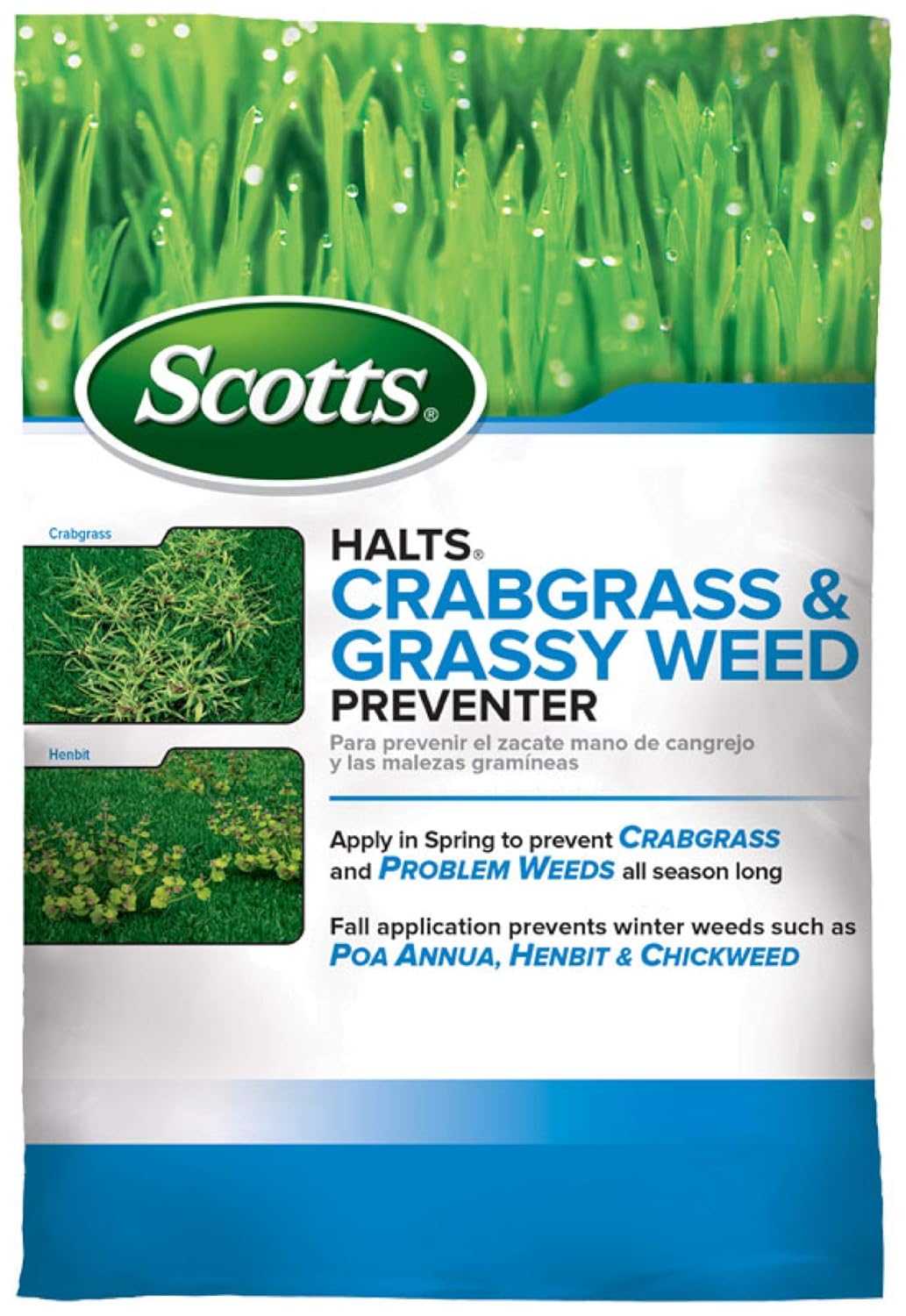
Scotts Halts Crabgrass & Grassy Weed Preventer, 10.06 lb
| Item Form | Granule |
|---|---|
| Coverage | 5000 square_feet |
| Active Ingredients | Pendimethalin 1.71% |
| Unit Count | 161 Ounce |
Scotts Halts is a straightforward pre-emergent granule designed to stop crabgrass and other grassy weeds from germinating rather than killing established plants. You apply it to an established, dry lawn in early spring or in fall and then water it in as directed; rain, snow, or freezing weather after application will not reduce effectiveness. The product covers up to 5,000 square feet per bag and uses pendimethalin as the active ingredient to form a chemical barrier at germination. Its main benefits are predictable seasonal prevention and easy application with a spreader for even coverage. Important limitations are that it will not control existing or mature weeds and should not be used on newly seeded or sprigged areas until after the recommended waiting period. Also you must avoid aerifying or raking after application because that disturbs the barrier. For homeowners who want a simple, seasonal prevention step, this product performs reliably; for tackling current infestations or for seeding projects you will need additional solutions.
Best for: Homeowners who want a simple seasonal prevention step to keep crabgrass and other grassy weeds from germinating on established lawns and prioritize low-effort, calendar-based lawn care.
Less Ideal for: Gardeners needing a solution for current crabgrass infestations, or those planning to overseed or establish new turf within four to five months should choose a different product.
- Pre-emergent action prevents crabgrass and listed grassy weeds all season when applied correctly
- Covers up to 5,000 sq ft per bag for single-application protection
- Rain, snow, or freezing temperatures after application do not reduce performance
- Granular form spreads evenly with a standard lawn spreader for consistent coverage
- Does not kill existing or mature weeds
- Not safe for newly seeded or newly sprigged lawns for several months after use
- Requires careful application and avoidance of aerifying or raking to maintain the soil barrier
Verdict: Use Scotts Halts when you want dependable, low-effort seasonal prevention of crabgrass and grassy weeds on an established lawn up to 5,000 sq ft.
Tenacity Turf Herbicide 8 fl oz (Mesotrione)

| Unit Count | 8 Fluid Ounces |
|---|---|
| Item Form | Liquid |
| Coverage | 2000 ft^2 per 1sp of product |
| Active Ingredients | Mesotrione |
Tenacity is a concentrated liquid herbicide designed to control both grassy and broadleaf weeds in turf, working as a systemic pre-emergent and post-emergent treatment. It is typically mixed and applied with a sprayer across established lawns to target crabgrass, foxtail, barnyardgrass and common broadleaf weeds like clover and dandelion. The active ingredient mesotrione provides contact and residual activity, so you get immediate suppression plus ongoing control during germination windows. A single 8 ounce bottle covers a large area when mixed to label rates, which makes it practical for homeowners who want professional-level performance without frequent reapplication. Important limitations are that it is a chemical treatment requiring careful dilution and timing, and it must be used according to label directions to protect desirable turf and surrounding plants. It is not a broadcast granular consumer weed killer, so you need a sprayer and some familiarity with lawn-care application to get best results.
Best for: For homeowners or turf managers focused on strong, long-lasting control of crabgrass and mixed weed pressure who are comfortable using concentrated liquid herbicides and spray equipment.
Less Ideal for: Not a good fit for casual users who prefer granular products, those who lack a sprayer, or homeowners who want an organic or non-chemical approach.
- Effective on both pre-emergent and post-emergent weeds including crabgrass and common broadleaf species
- Contains mesotrione for systemic control plus residual activity
- Small concentrated bottle covers a large lawn when mixed to labeled rates
- Requires proper mixing and a sprayer for correct application
- Needs careful timing and label adherence to avoid damage to some turf species
Verdict: Choose Tenacity when you need professional-grade, pre- and post-emergent control of crabgrass and other common lawn weeds with lasting residual activity.
Spectracide Weed Stop for Lawns Plus Crabgrass Killer with AccuShot Sprayer, 1.33 gal

| Item Form | Liquid |
|---|---|
| Coverage | up to 7,500 square feet |
| Liquid Volume | 1.33 gallons |
Spectracide Weed Stop for Lawns Plus Crabgrass Killer is a one-bottle solution for homeowners who need fast, targeted weed control. The formula kills more than 470 listed weeds by contact down to the root, with visible browning in as little as five hours. It is supplied with the AccuShot continuous-power sprayer that reduces hand fatigue, includes an extendable wand for better accuracy, and runs on included batteries so you can spray without pumping. Typical use is direct application to patches of crabgrass and common broadleaf weeds while avoiding desirable plants and following label temperature guidance. Practical benefits include wide weed coverage per bottle and an easy-to-use sprayer that helps keep spray on-target. Important limitations are temperature restrictions for safe application and a warning about temporary discoloration on bermudagrass; the product works by contact so repeat applications may be needed for heavy infestations. Read and follow label directions and safety precautions before using.
Best for: Homeowners who want a straightforward, ready-to-use treatment to quickly knock back crabgrass and common lawn weeds and who value an included pump-free sprayer for precise spot or small‑area applications.
Less Ideal for: People managing sensitive turf types year-round or very large lawns who need systemic long-term control or broadcast application methods should consider pro-grade or granular programs instead.
- Kills broadleaf and grassy weeds including crabgrass and yellow nutsedge with visible results in about five hours
- Includes AccuShot battery-powered sprayer with extendable wand for accurate, low-fatigue application
- Ready-to-use liquid requires no mixing and covers up to 7,500 square feet
- Contact-kill action may require repeat treatments for established or deep-rooted weeds
- Temperature limits and bermudagrass cautions restrict application windows
Verdict: A convenient, ready-to-use liquid with an included AccuShot sprayer that delivers fast, targeted control of crabgrass and common lawn weeds for homeowners who want quick results.
Spectracide Weed Stop for Lawns Plus Crabgrass Killer Concentrate, 32 oz

| Unit Count | 32 Ounce |
|---|---|
| Coverage | 5000 square_feet |
| Item Form | Liquid |
| Kills | 470+ listed weeds |
Spectracide Weed Stop Plus Crabgrass Killer is a ready-to-dilute concentrate designed to target grassy and broadleaf weeds across a typical yard. Mix and apply with a sprayer and the formula kills by contact down to the root with visible dieback in about 5 hours and becomes rainfast in roughly 3 hours. The 32 ounce bottle covers up to 5,000 square feet, making it a practical choice for treating whole lawns. Directions note best performance between 45 and 90 degrees daytime temperature and caution against treating Bermudagrass in very hot conditions to avoid temporary discoloration. Practical benefits include fast visible results, broad-spectrum control that includes dandelion and clover, and the convenience of a concentrated product that stretches across a larger area than ready-to-use sprays. Important limitations are the temperature restrictions for safe application, the need to let treated areas dry before people or pets return, and observing reseeding intervals after treatment. For routine crabgrass control on established lawns, this concentrate balances effectiveness and coverage for cost-conscious buyers.
Best for: Buyers who want an economical, concentrated treatment to control crabgrass and a wide range of weeds across a whole lawn and who are comfortable mixing and applying a spray product.
Less Ideal for: People with newly seeded lawns, very small patch treatments who prefer ready-to-use bottles, or those who cannot avoid applying during hotter daytime temperatures.
- Concentrated formula treats up to 5,000 sq ft from a 32 oz bottle
- Kills over 470 listed broadleaf and grassy weeds including crabgrass
- Visible results in about 5 hours and becomes rainfast in approximately 3 hours
- Designed to kill weeds down to the root when used as directed
- Must follow temperature limits to avoid lawn injury, particularly on Bermudagrass
- Requires mixing and a separate sprayer rather than being ready-to-use
Verdict: A budget-friendly concentrate that delivers fast, broad-spectrum crabgrass and weed control for established lawns while covering a large area per bottle.
Quali-Pro Prodiamine Pre-Emergent Herbicide, 5 lb Granules

| Item Form | Granule |
|---|---|
| Coverage | Pre-emergent grass and broadleaf weed control, season long crabgrass control |
| Active Ingredients | Prodiamine 65% |
| Unit Count | 80 Ounce |
Quali-Pro Prodiamine is a granular pre-emergent herbicide formulated to prevent common annual weeds and provide season-long crabgrass control when applied in spring or fall. It is typically broadcast over turf or landscape beds and can be tank-mixed with fertilizers or iron solutions for routine lawn care programs. The product lists prodiamine 65% as the active ingredient and is labeled for use on turf, golf courses, and other landscape sites, making it practical for both homeowners and professionals who want predictable prevention rather than post-emergent spot control. Because it is a pre-emergent, it works by stopping weed seedlings from establishing rather than killing established plants, so timing of application before seed germination is critical. The 5 lb granule package is convenient for treating moderate lawn areas without requiring dilution into large liquid volumes. Users should follow label directions for application timing and rate and avoid using it where newly seeded desirable grasses are expected to germinate soon.
Best for: Buyers who prioritize a dependable preventive solution for crabgrass and annual weeds and who plan lawn care around seasonal application windows.
Less Ideal for: Gardeners wanting to eliminate existing broadleaf or grassy weeds immediately or those reseeding lawns within the same season should consider post-emergent herbicides or wait until label-safe reseeding windows.
- Contains 65% prodiamine, a proven active ingredient for pre-emergent crabgrass control
- Suitable for spring or fall applications for flexible season-long prevention
- Granule form is easy to broadcast and mix with fertilizer or iron treatments
- Label supports use on turf, landscape beds, and golf course sites
- Does not control established weeds since it is strictly a pre-emergent
- Requires careful timing relative to weed germination windows to be effective
Verdict: Choose this product if you want a reliable, season-long pre-emergent specifically aimed at preventing crabgrass and other annual weeds.
Choosing the Right Crabgrass Killer for Lawns: Key Factors to Consider
Timing and Pre-emergent Vs Post-emergent Use
When you apply a crabgrass killer is often more important than which active ingredient you pick. Pre-emergent treatments form a chemical barrier that prevents seeds from germinating and are most effective when applied just before soil temperatures reach the germination threshold for crabgrass in your region. Post-emergent options work on seedlings and established plants but are less effective once plants are mature, and may require multiple applications.
Match timing to local climate and soil temperature trends. If you miss the pre-emergent window, a post-emergent product can still reduce visible crabgrass, but expect more follow-up and a greater chance of thin spots that need overseeding.
Active Ingredient and Turf Compatibility
Different active ingredients target crabgrass with varying modes of action and have different safety profiles for cool-season and warm-season turf grasses. Some chemistries are safe on one grass type but may stress or scorch another, especially when applied during heat or drought. Read label directions for turf type compatibility.
Consider whether you plan to overseed or establish new sod soon. Many pre-emergents restrict seeding for a specified waiting period, so ingredient choice affects renovation plans. If you maintain a mixed-species lawn, choose a product labeled safe for the predominant grass types you grow.
Application Method and Equipment
Crabgrass killers come as granules, liquids for broadcast sprayers, or ready-to-use hose-end sprays. Granules are easy to store and apply with a spreader but require even distribution for uniform control. Liquids can provide more precise coverage but need a calibrated sprayer and careful mixing. Hose-end options are convenient but can deliver uneven rates if water pressure varies.
Think about the size of your lawn and the tools you already have. For larger lawns, concentrated liquids that work with a backpack or tow-behind sprayer may be more efficient. For small yards, a ready-to-use product or a simple handheld spreader can be the most practical choice.
Turf Health and Cultural Integration
Herbicide choice should complement sound cultural practices because a dense, healthy lawn suppresses crabgrass naturally. Consider how the product fits with your fertilization, irrigation, and mowing schedule. Some herbicides interact poorly with recent fertilizer applications or with mowing too close to treatment, increasing the risk of turf stress.
Plan treatments around peak growth periods for your grass. Avoid applications during heat waves or drought unless the product label explicitly allows it. Combining proper mowing height and timely fertilizing with herbicide use produces better long-term control than relying on chemicals alone.
Coverage, Mixing Rates, and Safety Measures
Calculate how much product you need based on the coverage rate and the size of your lawn to avoid wasting material or under-treating. Labels list mixing rates per 1,000 square feet or per acre, and accuracy matters: low rates may not control crabgrass, while over-application risks turf injury. Protective measures such as gloves and eyewear are often recommended, and children or pets should be kept off treated areas for the period specified on the label.
Also factor in storage and disposal. Concentrated liquids and herbicide granules require secure storage away from children and pets and proper disposal of unused spray mix according to local regulations.
Environmental and Neighbor Considerations
Some active ingredients have higher potential to move off-target via runoff or spray drift. Consider proximity to flower beds, vegetable gardens, water features, and neighboring properties. Choose application methods and nozzle types that reduce drift and time treatments to avoid heavy rain events that could wash chemicals away.
If you have pollinator plantings or a vegetable garden nearby, select products with lower non-target risk and follow the label buffer recommendations. Communicating with neighbors about timing can also reduce accidental exposure to treated turf.
When to Treat Your Lawn
Soil temperature is the best guide for pre-emergent timing. For many regions, apply just before consistent daytime soil temperatures reach roughly 55 degrees Fahrenheit for several days. Local extension services or soil thermometers can help pinpoint the window.
Post-emergent treatments work best on young seedlings when plants are actively growing. Avoid applications during drought or heat stress because turf is more vulnerable to damage then. If you are unsure whether to apply a pre- or post-emergent, consider a preventive application timed to your area and follow with spot treatments as needed.
- Use a soil thermometer to time pre-emergent applications.
- Avoid treating during heat waves or dry spells.
- Spot-treat visible patches with a post-emergent when pre-emergent was missed.
Preparing the Lawn Before Application
Mow and remove clippings before applying most products so the active ingredient contacts the soil or leaf surface as intended. Some granular products work better if you lightly water in afterward, while others require dry application followed by a specific irrigation window.
Mark irrigation and fertilizer schedules around treatment. Many labels recommend waiting a set number of days after fertilization before applying herbicide, and some require a light irrigation after application to activate the product. Read and follow those timing windows to protect turf health.
- Mow at the recommended height and clear debris.
- Calibrate spreaders or sprayers for accurate rates.
- Note label instructions for watering after application.
Managing Treated Areas and Overseeding
If you plan to overseed or renovate, timing is critical. Many pre-emergents restrict seeding for weeks or months after application. If overseeding is a priority, choose a product with a shorter seeding restriction or delay pre-emergent treatments until after new grass is established.
After post-emergent treatments, wait until the herbicide activity has subsided and the lawn shows recovery before seeding. Light topdressing and targeted reseeding can repair thin areas created by past infestations, but aggressive chemical control followed by prompt cultural care yields the best results.
- Check seeding restrictions on the label before applying pre-emergents.
- Plan renovation when herbicide residuals have dissipated.
Safety, Storage, and Responsible Use
Follow all label-required personal protective equipment and keep children and pets off treated turf for the specified re-entry interval. Store concentrates and unused product in a locked, dry area away from heat and moisture.
Dispose of unused diluted spray according to label and local guidelines. Do not apply before heavy rain to reduce off-target movement. Practicing responsible use protects beneficial plants and reduces the chance of contamination to water features.
- Use gloves and eye protection when mixing concentrates.
- Keep people and pets off treated areas until safe re-entry time.
- Avoid applying before heavy rain to limit runoff.
Integrated Lawn Care to Reduce Future Crabgrass
Herbicides are most effective when combined with cultural practices that promote a dense, competitive lawn. Raise mowing height slightly to shade soil, follow a balanced fertilization plan, and fill bare spots promptly to deny space for crabgrass to establish.
Aeration and soil testing can correct compaction and nutrient imbalances that favor weed invasions. Over time, this integrated approach reduces reliance on chemical treatments and improves overall lawn resilience.
- Mow at the recommended height for your grass type to shade out weeds.
- Aerate and overseed thin areas during appropriate seasons.
How We Chose the Best Crabgrass Killer for Lawns
We evaluated products specifically for lawn use and prioritized attributes that matter to home gardeners managing turf. Selection focused on active ingredient suitability for common turfgrass species, labeled timing and seasonality for pre- or post-emergent control, and the practicalities of application on a typical home lawn. We checked how clearly instructions addressed mowing and irrigation windows, as well as recommended rates to avoid turf injury. Residual control length and re-treatment guidelines were important, along with compatibility notes for overseeding or renovating a lawn. We excluded products intended only for garden beds, agricultural row crops, or niche turf uses such as sports fields with specialized maintenance. We also filtered out options without clear homeowner labeling or without widely accepted application guidance for residential lawns. Final selections balance efficacy in preventing or controlling crabgrass, ease of use for a homeowner, and predictable interactions with common lawn care tasks like watering, fertilizing, and overseeding.
FAQ
Can I use a pre-emergent crabgrass product and overseed at the same time?
Usually no. Most pre-emergents prevent grass seed from germinating for a set period after application. If you need to overseed, either pick a product with a short seeding restriction or time overseeding for after the residual period has ended.
How soon after applying a crabgrass killer can I mow the lawn?
It depends on the product. Some products allow mowing shortly after application while others recommend waiting until the active ingredient has had time to settle or be watered in. Check the label for specific mowing windows tied to the product you use.
Will crabgrass treatments harm my flowers or vegetable garden nearby?
They can if drift or runoff reaches non-target areas. Use application methods that reduce drift, maintain buffer zones, and avoid applying before heavy rain. Choose products labeled with low off-target movement when working near sensitive plantings.
How many applications of a post-emergent product are usually required?
Often one to a few treatments are needed for satisfactory control, depending on infestation severity and product strength. Young seedlings respond better than mature plants, so follow-up spot treatments are common when a single pass does not eliminate all growth.
Is a granular or liquid formulation better for a small lawn?
For small lawns, convenience is a major factor. Granules are easy to apply with a handheld spreader and require minimal mixing. Liquids provide more uniform coverage but need calibration. Choose based on your comfort with application equipment and the lawn size.
Final Verdict
For most home lawns, prioritize timing, turf compatibility, and application accuracy when choosing a crabgrass control strategy. Pre-emergents give the best prevention when applied at the right soil temperature, while post-emergents handle escapes and visible patches. Balance ease of application with the seasonal restrictions that affect overseeding and renovation. Focus on integrating chemical controls with cultural practices like correct mowing height, adequate watering, and timely overseeding to reduce future crabgrass pressure. With those tradeoffs in mind, select the product whose application method and labeled turf safety fit your maintenance schedule and lawn type.
