

Note: This article contains affiliate links. If you click on these links and make a purchase, I may earn a small commission at no extra cost to you. This helps support my research and content. Read my full affiliate disclosure here.
Choosing the right organic manure for vegetable beds changes how your soil holds water, cycles nutrients, and supports steady yields through the season. The wrong material can burn young roots, compact beds, or leave gaps in the fertility plan. This guide shortlists six top organic manures suited for vegetable growing situations, from small raised beds to larger in-ground plots. We evaluate each option on practical gardener priorities including nutrient profile, ease of application, and impact on soil life. Read on to understand what matters when you add organic manure to vegetable beds and which characteristics will best match your garden's needs.
Top Picks at a Glance
| Best Overall The best all-around choice for most situations | Back to the Roots Organic Compost Mix for Vegetable Garden, 1 Cubic Foot |  |
| Best Quality Built to a higher standard if you want something more solid | R&M Organics Cow Manure Compost Soil Amendment, 10 lb |  |
| Best Value The sweet spot between price and what you get | BRUT Cow Compost Organic Composted Cow Manure — 10 Quart |  |
| Highest Rated A top-rated pick with lots of positive feedback | Wiggle Worm 100% Pure Organic Worm Castings Fertilizer, 30 lb |  |
| Most Popular A crowd favorite that many people choose with confidence | Brut Organic Worm Castings for Plants, 5 lb |  |
| Best Seller A high-volume bestseller chosen again and again | Espoma Organic Chicken Manure Granules, 3.75 lb |  |
Back to the Roots Organic Compost Mix for Vegetable Garden, 1 Cubic Foot

| Item Highlight | Organic compost soil amendment for raised beds, gardens and plants; peat-free blend with yucca and gypsum; 25.7 quart bag |
|---|---|
| Unit Count | 822.4 Ounce |
| Style Name | Compost |
| Volume | 23 cubic centimeters |
This Back to the Roots organic compost is designed as an all-purpose soil amendment for vegetables, herbs, fruits and flowers in raised beds, containers or the ground. It is peat-free and made from upcycled plant matter and wood fines, with added yucca extract to help with moisture control, dolomitic limestone to balance pH, and gypsum to improve water absorption. Typical use is to mix it into existing garden soil or top-dress raised beds to enhance nutrient availability and soil structure before planting. Practical benefits include improved moisture retention without compaction, a more balanced root environment for edible crops, and an organic ingredient list that suits organic vegetable beds. Limitations are that the bag size is modest for large beds so multiple bags are needed for wholesale soil replacement, and the product description does not list exact nutrient analysis for gardeners wanting specific N-P-K numbers. For a balanced home gardener wanting a peat-free, ready-to-use compost amendment, this is a straightforward choice.
Best for: Gardeners who want an organic, peat-free compost to boost soil health in raised beds or containers and prefer an easy-to-use, ready-mix amendment for vegetables and herbs.
Less Ideal for: Large-scale growers or landscapers who need bulk quantities or precise fertilizer formulations should look for bulk compost or products with explicit nutrient analysis.
- Peat-free formula made from upcycled plant matter and wood fines
- Includes yucca extract for improved moisture control
- Contains dolomitic limestone and gypsum to help pH balance and water absorption
- Suitable for raised beds, containers, and in-ground vegetable gardens
- Bag volume is relatively small for renovating large beds
- No detailed N-P-K nutrient breakdown provided
Verdict: A convenient peat-free organic compost mix that improves moisture control and soil balance for home vegetable and container gardens.
R&M Organics Cow Manure Compost Soil Amendment, 10 lb

| Item Form | Solid |
|---|---|
| Specific Uses For Product | Organic |
| Application Method | Apply a thin layer around plants or mix into soil |
| Target Species | fruits, vegetables, flowers, lawns, trees |
| Mixing Ratio | 5:1 |
This 10 pound bag of R&M Organics composted cow manure is a straightforward, all-purpose soil amendment for vegetable beds, container tomatoes, herbs, and other edible crops. It is fully cured to reduce odor and impurities, so you can apply a thin quarter-inch layer around established plants or mix it into planting beds and pots using the 5:1 mixing ratio specified. The product improves soil texture and moisture retention, which helps roots establish and reduces how often you need to water. Because it is manure-based and finished, it supplies a steady release of organic nutrients rather than a quick synthetic boost, making it better for long-term soil health and repeated seasonal use. The 10 lb size is convenient for small to medium plots and raised beds but means multiple bags are needed for larger vegetable gardens. If you prioritize improving soil biology and water-holding capacity for productive vegetable harvests, this composted manure performs well; gardeners seeking immediate high-nitrogen feeding or large-scale bulk amendments will want a different format.
Best for: Gardeners focused on building long-term soil fertility for vegetables and container crops who prefer organic, low-odor amendments and want steady moisture and structural improvement.
Less Ideal for: Those needing a rapid, high-nitrogen fertilizer for immediate green-up or growers managing large acreage where buying bulk amendments would be more economical.
- Fully composted cow manure with reduced odor suitable for indoor and outdoor use
- Improves soil structure and moisture retention for healthier root development
- Versatile all-purpose amendment for vegetables, fruits, flowers, lawns, and containers
- Convenient 10 lb bag size and clear mixing/application guidance
- 10 lb bag is small for larger vegetable gardens and requires multiple bags for full bed coverage
- Provides gradual nutrient release rather than an immediate high-nitrogen feed
Verdict: A low-odor, fully composted cow manure that reliably improves soil structure and moisture retention for productive organic vegetable gardening.
BRUT Cow Compost Organic Composted Cow Manure — 10 Quart

| Brand Name | BRUT WORM FARMS |
|---|---|
| Unit Count | 192 Ounce |
| Manufacturer | Brut Worm Farms, Inc. |
| Certified Organic | OMRI listed |
BRUT Cow Compost is a finely sifted, OMRI-listed composted cow manure intended as an all-purpose amendment for vegetable beds, containers, lawns and houseplants. You can work it into garden soil at planting, use it as a top dressing around established vegetables, or blend a small amount into potting mixes for seedlings. The formula emphasizes nutrient density with nitrogen, calcium and iron plus beneficial microbes that support healthier soil structure and better water retention. The product is advertised as odor-free and finely textured, which reduces mess and makes it easy to mix into soil without risking root burn. Practical gardeners will appreciate that it is additive-free and marketed as safe for indoor use when applied sparingly. Limitations to keep in mind are that it is a general compost rather than a balanced complete fertilizer, so heavy-feeding crops may still need targeted nutrients, and you should follow safe-handling guidance and use gloves when mixing larger quantities.
Best for: Gardeners who prioritize practical, organic soil improvement for vegetables and containers and want a safe, ready-to-use compost to boost soil biology and moisture retention.
Less Ideal for: Gardeners looking for a single product to meet all specific nutrient requirements for high-demand crops or those who need a formulated NPK fertilizer tailored to particular deficiencies.
- OMRI-listed certified organic compost suitable for organic vegetable gardens
- Finely sifted, low-odor texture that mixes easily into potting soil and garden beds
- Provides nitrogen, calcium, iron and beneficial microbes to improve soil health
- Versatile application as top dressing, soil amendment, or potting mix additive
- Not a complete fertilizer so additional specific nutrients may be needed for heavy feeders
Verdict: A practical, certified-organic cow compost that improves soil biology and moisture retention for healthier vegetable gardens and containers.
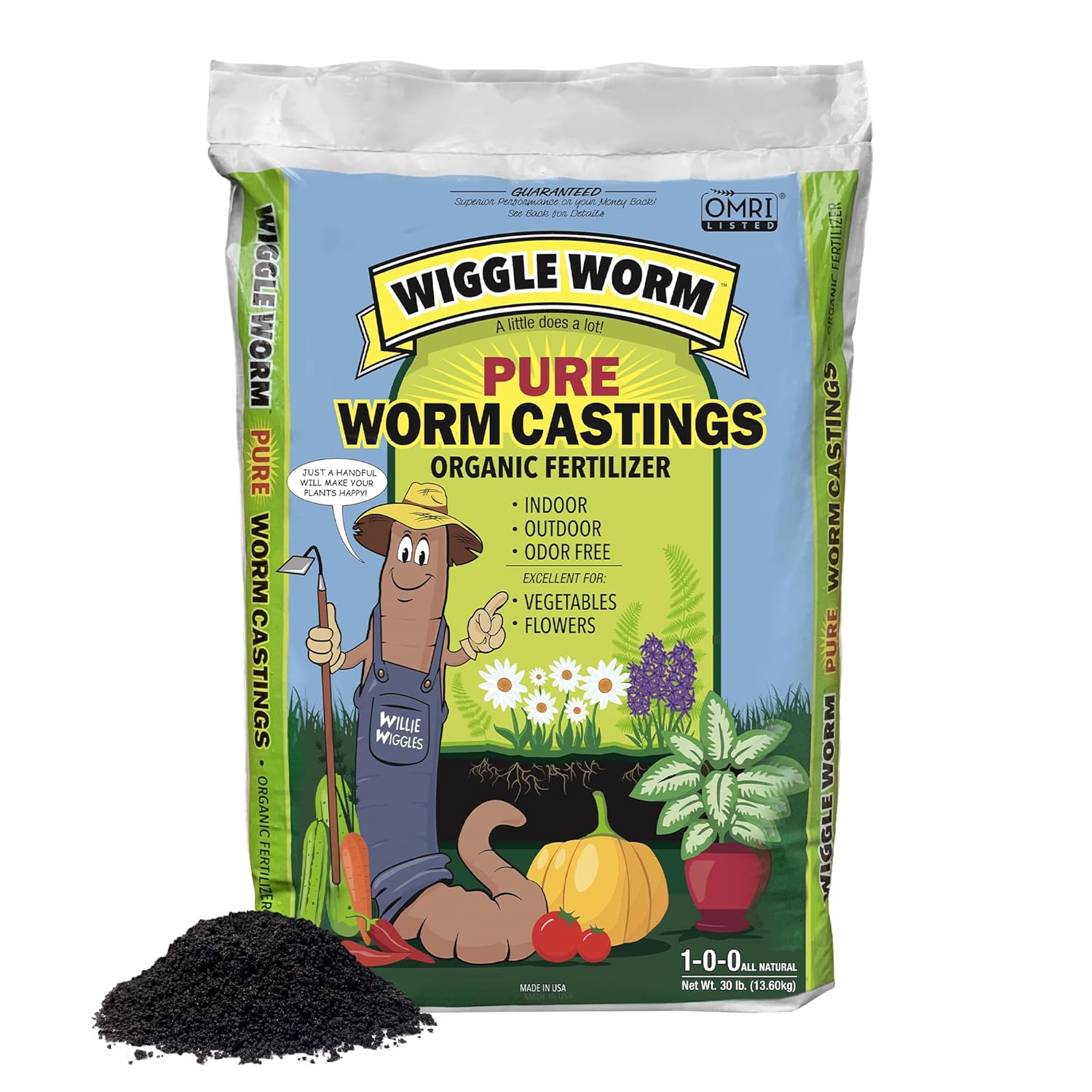
Wiggle Worm 100% Pure Organic Worm Castings Fertilizer, 30 lb
| Item Form | Granules |
|---|---|
| Specific Uses For Product | Soil Conditioning |
| Unit Count | 480 Ounce |
| OMRI Listed | Yes |
Wiggle Worm Pure Worm Castings are a straightforward organic soil amendment designed to strengthen soil biology and feed vegetable beds without risk of burning roots. Typically used as a top dressing, mixed into potting mixes, or added to planting holes, the product supplies water-soluble nutrients plus slow-release minerals and beneficial microbes that support root development and improved water retention. Notable features include OMRI listing for organic use, a screened product free of bedding and eggs, and clear application guidance for containers, raised beds, lawns, and transplanting. Practical benefits for a vegetable garden are faster nutrient uptake, better soil aeration, and reduced need for frequent synthetic feedings. The main limitations are that it is a low-NPK, gentle amendment rather than a complete, high-nitrogen fertilizer and you need to apply periodically or combine with higher-nutrient feeds for heavy-feeding crops. For gardeners focused on building long-term soil health it is a reliable, low-risk addition but expect incremental improvements rather than instant, dramatic growth spurts.
Best for: Gardeners who prioritize dependable, organic soil-building products for vegetables and want a safe, no-risk amendment to improve long-term fertility and plant health.
Less Ideal for: Growers who need a quick, high-nitrogen boost for leafy heavy feeders or those seeking a single-product, complete fertilizer solution should look elsewhere.
- OMRI listed and made from 100% screened worm castings suitable for organic vegetable gardens
- Boosts soil microbial activity and improves aeration and water retention
- Odorless and non-burning so safe for direct use around roots and in containers
- Versatile application: top dress, mix into potting soil, use in planting holes, or brew as tea
- Not a high-NPK fertilizer so may not meet immediate nutrient demands of heavy-feeding crops
Verdict: A reliably safe, OMRI-listed soil builder that steadily improves soil biology and structure for healthier vegetable gardens.
Brut Organic Worm Castings for Plants, 5 lb

| Item Form | Granules |
|---|---|
| Specific Uses For Product | Gardening,Organic |
| Target Species | All plants |
| Mixing Ratio | 1:5 |
Brut Organic Worm Castings are a ready-to-use organic soil amendment designed to boost soil fertility and support vegetable growth. They are sold as granules that you can mix into potting soil, top dress established containers, or work into garden beds; the brand recommends a 1:5 mixing ratio for new indoor plants and specific spreading rates for outdoor applications. The product emphasizes beneficial microbes and slow-release nutrients, so you get improved aeration, water retention, and steady nutrient availability rather than a quick chemical spike. It is OMRI/CDFA-listed and produced in controlled indoor facilities, which helps reassure buyers concerned about contamination. Practical limitations are that castings are not a complete fertilizer for every stage of vegetable growth so you may still need supplemental feeding for high-demand crops, and recommended application rates for large areas mean multiple bags for big gardens. Handle with gloves and follow spacing directions for lawns and trees to get predictable results.
Best for: Vegetable gardeners who prioritize organic, contamination-free amendments and want a microbial-rich product to steadily improve soil health over time.
Less Ideal for: Growers who need an immediate high-NPK boost or who want a single product to meet all feeding needs for heavy-feeding crops should look at concentrated fertilizers or blended feeds instead.
- Certified organic and OMRI/CDFA-listed which reduces contamination concerns
- Contains beneficial microbes that improve soil structure and water retention
- Versatile application: mix into potting soil, top dress, or work into beds
- Granular form and published mixing/spread rates make dosing straightforward
- Not a complete high-NPK fertilizer for heavy-feeding vegetables
- Coverage rates for lawns and beds mean you may need multiple bags for larger gardens
Verdict: A certified organic, microbe-rich soil amendment that reliably improves soil structure and fertility for organic vegetable gardens.
Espoma Organic Chicken Manure Granules, 3.75 lb

| Item Form | Granules |
|---|---|
| Application Method | Scatter around plants |
| Target Species | Flowers, Vegetables, Trees, Shrubs |
| Specific Uses For Product | Gardening, Organic, Plant Food |
Espoma Organic Chicken Manure is a ready-to-use, granulated poultry manure fertilizer aimed at home gardeners who want an organic nitrogen-rich soil amendment. With a 5-3-2 NPK analysis and added calcium, it is scattered around the plant drip line and watered in to release nutrients; the granulated, heat-treated form makes application tidy and eliminates the need for mixing. It is labeled for monthly use on vegetables and for seasonal use on trees and shrubs, which makes it practical for routine feeding of tomatoes, peppers and other vegetable beds. The product is registered for organic production and contains no fillers, so you get mostly poultry manure rather than blended proprietary mixes. Because it is dehydrated and granulated there is minimal odor and easier storage than fresh manure, but nutrient levels are moderate so heavy-feeding crops may need larger or repeated applications. Also it does not supply specific micronutrient balances or slow-release polymers, so pairing it with a balanced organic program will give best results.
Best for: Gardeners who prioritize certified organic inputs and want a simple, easy-to-apply manure fertilizer for regular feeding of vegetable beds and common garden plants.
Less Ideal for: Growers seeking a single-product, high-analysis or slow-release fertilizer for intensive commercial production should consider concentrated or formulated alternatives.
- Certified for organic gardening and made from dehydrated poultry manure
- Granulated, heat-treated form is easy to apply and has lower odor than fresh manure
- Straightforward 5-3-2 NPK plus calcium provides usable nitrogen for vegetables
- Ready-to-use with no mixing required and simple scatter-and-water application
- Moderate nutrient analysis may require more frequent applications for heavy feeders
- Does not list a full micronutrient profile or slow-release formulation
Verdict: A simple, certified organic chicken manure in granule form that makes monthly feeding of vegetable beds easy and low-odor.
Choosing the Right Organic Manure for Vegetables: Key Factors to Consider
Nutrient Balance and Release Pattern
Vegetables need steady, accessible nutrients across the growing season. Manure nutrient numbers differ widely and are typically lower than synthetic fertilizers, so understanding the N-P-K balance and how quickly those nutrients mineralize is important. A high immediate nitrogen release can boost leafy growth but may burn seedlings if applied fresh to young roots.
Consider the crop feeding habit when choosing manure. Fast-release materials suit heavy feeders planted after incorporation, while slower-release, well-composted manures are better for root crops and long-season plantings where steady supply prevents flushes and deficiencies.
Organic Matter and Soil Structure Improvement
One of the main benefits of organic manure is building long-term soil health. Good manure adds humus and improves tilth, drainage in clay soils, and water retention in sandy soils. The particle size and degree of decomposition affect how quickly structure improves; well-composted manure mixes into soil faster and stabilizes aggregates.
Regular applications over seasons create a cumulative benefit to microbial life and soil carbon content. If your beds are compacted or low in organic matter, prioritize manure types known for contributing significant stable organic material rather than those that only provide soluble nutrients.
Maturity, Composting, and Pathogen Risk
Fresh, uncomposted manure can contain pathogens, weed seeds, and ammonia that harm seedlings. For vegetable production, maturity matters: composted or heat-treated manures pose much lower risk and have more predictable nutrient release. Mature manure is also less likely to tie up nitrogen after incorporation.
If you use raw manure, apply it well before planting and work it into the soil early to allow time for decomposition and pathogen die-off. Composting on-site or selecting pre-composted products reduces health concerns and is often required for crops eaten raw.
Ease of Handling and Application
Practical use in the garden affects how often you will actually apply a product. Lightweight, crumbly materials spread quickly and mix into beds with minimal effort. Dense, wet manures are harder to transport and require more labor to incorporate. Bagged, screened manures are easier to use in raised beds and small plots, while bulk options can be more economical for large areas but need equipment or strong backs.
Think about how you will apply the manure: hand-spreading, wheelbarrow to raised beds, or tractor spreaders for larger plots. Ease of application also ties to particle size; very coarse chunks may need additional processing to avoid uneven nutrient distribution.
Weed Seed Content and Contamination Risk
Some manures contain undigested weed seeds that survive composting if heat was insufficient. Applying manure with viable seeds can increase weed pressure in vegetable beds, adding time to maintenance work. Choose products that specify weed-seed screening or that have been composted at temperatures high enough to destroy seeds.
Contamination with heavy metals or pesticide residues is rare but possible depending on source. Prefer manures with transparent sourcing and testing where available, especially when building soil for long-term vegetable production.
Odor, Neighborhood Tolerance, and Storage
Manures vary in smell and moisture, which affects storage and how neighbors tolerate applications. Strong-smelling materials are fine when worked into soil but can be problematic in small urban plots or when stored near living areas. Dry, composted manures store better and are less likely to attract pests.
Consider how much space you have to store incoming material and whether you need a product that can sit in a shed or covered area without causing odor complaints or runoff issues during heavy rain.
When to Apply Organic Manure in Vegetable Beds
Timing matters for both seed-starting and transplants. For spring-planted vegetables, incorporate well-composted manure in fall or early spring to give microbes time to stabilize and to avoid ammonia injury to young roots. For summer or fall crops, topdress with a light layer of stable manure several weeks before planting or apply as a side-dress after plants are established.
For root crops, avoid high fresh-manure rates right before planting. Instead, build soil with composted manure months in advance so nutrients are available without causing scarring or imbalanced growth.
- Incorporate composted manure 2 to 8 weeks before planting, depending on maturity.
- Topdress or side-dress with modest amounts during vegetative growth for heavy feeders.
- Delay raw-manure applications until well before harvest windows for edible crops.
How Much Manure to Add for Different Vegetable Beds
Application rates depend on the manure's nutrient content and the bed type. In small raised beds, a 1 to 2 inch layer of well-composted manure worked into the top 6 to 8 inches of soil is a common starting point. For large in-ground beds, a thinner incorporation followed by annual topdressings can build fertility without overwhelming soil microbes.
Avoid overapplication. Excessive organic input can create nutrient imbalances, increase salt levels, or lead to nitrogen drawdown as microbes decompose fresh material. When in doubt, apply less and supplement with targeted amendments based on soil tests.
- Raised beds: 1 to 2 inches mixed into topsoil.
- In-ground beds: 0.5 to 1 inch worked in or periodic topdressing.
- Use soil tests to adjust rates for specific nutrient deficiencies.
Composting and On-Site Preparation Tips
Composting raw manure before use reduces weed seeds and pathogen risk while stabilizing nutrient release. Turn windrows or piles, monitor temperatures, and allow adequate curing time. Mixing manures with carbon-rich materials like straw or wood chips helps balance the carbon-to-nitrogen ratio and avoids anaerobic odors.
If you cannot fully compost on-site, consider curing piles for several months and screening out coarse fragments. Even partial composting improves safety and garden performance compared with fresh raw manure.
- Aim for sustained pile temperatures that destroy weed seeds when possible.
- Add carbon amendments to moderate moisture and odor.
- Cure and screen before applying to fine-textured beds or seed rows.
Using Manure with Cover Crops and Crop Rotations
Combine manure applications with cover cropping to lock nutrients in living roots and build soil structure. Fast-growing covers planted after manure incorporation can capture nitrogen that might otherwise leach and then release it slowly when terminated. Rotating heavy feeders with legumes or deep-rooted crops helps balance nutrient demands and reduces disease pressure.
Coordinate timings so that manures and covers complement rather than compete. For example, apply manure early in the fall, plant a winter cover, and then terminate the cover in spring to release nutrients before planting vegetables.
- Use legumes to add nitrogen in rotations where manure supplies are lower.
- Deep-rooted covers help break compaction enhanced by heavy manures.
- Plan cover termination to align nutrient release with planting windows.
Testing Soil After Manure Applications
Regular soil testing tells you what the manure actually did to nutrient levels and pH. Manure can raise phosphorus or micronutrient levels over time, so testing prevents accidental buildup that could affect plant health or lead to runoff concerns. Test every one to three years depending on manure use intensity.
Use test results to tailor future applications. If phosphorus is already high, choose manures with lower P levels or reduce application frequency and focus on organic matter amendments that contribute carbon without adding nutrients.
- Test pH, available phosphorus, potassium, and organic matter annually in intensive beds.
- Adjust application frequency based on measured nutrient changes.
How We Chose the Best Organic Manure for Vegetables
We selected products based on attributes that matter to vegetable gardeners rather than brand recognition. Key evaluation criteria included nutrient balance and release patterns, because vegetables need reliable amounts of nitrogen, phosphorus, and potassium without sudden spikes. We checked ease of handling and application so gardeners can spread and incorporate manure effectively in bed preparation and topdress situations. Soil improvement and organic matter contribution were assessed to gauge long-term benefits to structure, water retention, and microbial activity. Odor and potential for weed seeds or pathogens were considered to prioritize safe, garden-ready materials. Finally, availability of clearly labeled composition and maturity information was a filter to exclude immature or unspecified manures. We excluded materials lacking clear nutrient analysis or that were described as raw and uncomposted. Products that require complex on-site processing before use or carry elevated weed-seed risk were not advanced. The result is a shortlist focused on safe, stable organic manures that gardeners can use directly for vegetable production with predictable outcomes.
FAQ
Is composted manure safe to use on vegetables I eat raw?
Composted manure that has reached adequate temperatures and completed a curing period is much lower risk than fresh manure and is generally acceptable for use in vegetable beds. Still, apply composted manure well before harvest and avoid placing it directly on edible plant parts to reduce contamination risk.
Can I use fresh manure right before planting?
Fresh manure often contains high levels of ammonia and active microbes that can burn roots and compete for nitrogen. It is usually best to compost fresh manure or apply it several months before planting to allow for stabilization.
How do I know if a manure product is mature enough?
Mature manure is crumbly, earthy-smelling, and lacks strong ammonia odor. Suppliers should provide maturity or composting information. In the absence of that, look for materials described as 'composted' or 'cured' and avoid products labeled raw or fresh for immediate use in vegetable beds.
Will manure change my soil pH?
Some manures can slightly alter soil pH depending on source and ash content, but most well-composted manures have a modest effect. Regular soil testing is the best way to monitor pH changes after repeated applications and adjust liming or acidifying practices if needed.
How often should I apply organic manure to vegetable beds?
Frequency depends on initial soil organic matter and crop needs. Many gardeners apply composted manure once per year or every other year as a base amendment, supplementing with targeted side-dresses for heavy feeders during the season.
Can manure increase weed problems?
Yes, manure that has not been heated sufficiently can contain viable weed seeds. Choosing composted and screened manures reduces that risk. If you suspect seed content, monitor beds and remove seedlings before they set seed.
Final Verdict
Prioritize well-composted, clearly labeled organic manures that match your vegetable garden's feeding rhythm and handling capabilities. Focus on nutrient balance, organic matter contribution, and maturity to avoid seed and pathogen issues while improving soil structure over time. By matching manure type and timing to your beds and crops, you can build fertility steadily and reduce the need for emergency nutrient corrections.
