

Note: This article contains affiliate links. If you click on these links and make a purchase, I may earn a small commission at no extra cost to you. This helps support my research and content. Read my full affiliate disclosure here.
Choosing the right chainsaw for cutting trees matters for safety, control, and the speed of the job. Whether you need to fell small to medium trunks, limb larger specimens, or buck felled timber, the right combination of bar length, power type, and safety features changes how a saw behaves in the real yard or forest. This guide shortlists seven top-rated chainsaws for cutting trees across typical homeowner and light-pro arborist needs. We evaluate each against practical criteria like bar length suitability, engine or motor power, chain quality and maintenance, and safety systems so you can match a saw to the trees and tasks on your property. Read on to compare the options and decide which fits your routine and skill level.
Top Picks at a Glance
| Best Overall The best all-around choice for most situations | SEESII 40V Cordless Electric Chainsaw, 16-Inch with Dual Batteries |  |
| Best Quality Built to a higher standard if you want something more solid | EGO POWER+ CS1611 16" Cordless Chainsaw with 2.5Ah Battery and Charger |  |
| Best Value The sweet spot between price and what you get | Husqvarna 130 16-Inch Gas Chainsaw |  |
| Best Budget The cheapest option that still gets the job done reliably | TECHMOO 62CC Gas Chainsaw with 20-inch Bar |  |
| Highest Rated A top-rated pick with lots of positive feedback | Husqvarna 120 Mark III 16-Inch Gas Chainsaw |  |
| Most Popular A crowd favorite that many people choose with confidence | Husqvarna 460 Rancher 24-Inch Gas Chainsaw |  |
| Best Seller A high-volume bestseller chosen again and again | SEESII 12-Inch Cordless Brushless Chainsaw (with 2×4.0Ah Batteries) |  |
SEESII 40V Cordless Electric Chainsaw, 16-Inch with Dual Batteries

| Power Source | Battery Powered |
|---|---|
| Horsepower | 2000 watts |
| Chain Speed | 35FT/S |
| Chain Length | 16 inches |
| Number of Batteries | 2 x 40V 4000mAh |
The SEESII 40V cordless chainsaw is built to handle typical homeowner tree cutting and storm cleanup without gas or a cord. It uses a 2000W brushless motor and a 16-inch bar to cut through medium to large branches and logs, while two included 40V 4.0Ah batteries and a fast dual charger extend runtime so you can swap batteries and keep working. The automatic chain oiler and tool-free tensioning reduce downtime and routine fiddly maintenance, and onboard safety features such as a chain brake, safety lock, and overload protection increase confidence during use. At about 10.3 pounds (with battery) it is easier to maneuver for overhead pruning than heavier gas saws, though the 16-inch bar limits how large a single cut it can make compared with longer professional bars. This kit arrives ready to run with batteries, charger, gloves, and goggles, making it a practical choice for homeowners who want strong, nearly gas-equivalent cutting power with quieter, cleaner operation.
Best for: Homeowners and DIYers who need a powerful, portable saw for tree trimming, firewood and storm cleanup and who prefer a quieter, low-maintenance alternative to gas models.
Less Ideal for: Professional arborists or landscapers who frequently need to cut very large trunks or require nonstop all-day commercial workloads.
- Native 40V brushless motor offers consistent high torque for demanding cuts
- Dual 40V 4000mAh batteries plus fast charger extend runtime for longer jobs
- Automatic chain oiler keeps chain lubricated and reduces maintenance
- Tool-free chain tensioning allows quick on-the-job adjustments
- Includes basic PPE (goggles and gloves) and arrives ready to use
- 16-inch bar limits maximum single-cut diameter compared with longer professional bars
- Not suitable for users who require commercial-grade continuous heavy-duty use
Verdict: A gas-free 16-inch chainsaw that delivers near-gas performance and long runtime for homeowners who want a powerful, low-maintenance tool for cutting trees and storm cleanup.
EGO POWER+ CS1611 16" Cordless Chainsaw with 2.5Ah Battery and Charger
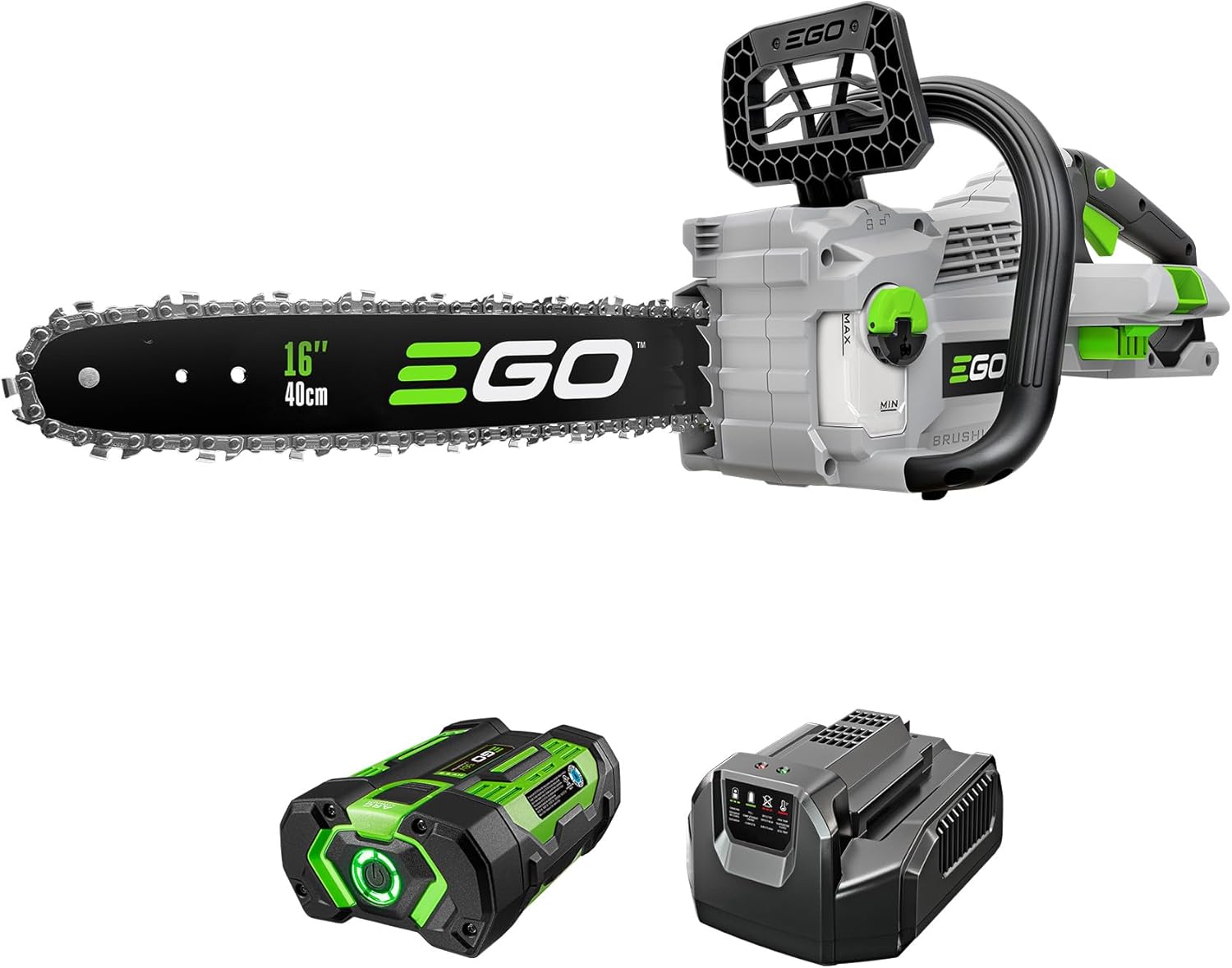
| Power Source | Battery Powered |
|---|---|
| Horsepower | 2.3 |
| Chain Length | 16 inches |
| Chain Speed | 20 m/s |
| Included Components | 2.5Ah Battery and Standard Charger |
The EGO POWER+ CS1611 is a battery-powered 16-inch chainsaw built to give gasoline-level performance without the noise and fumes. It pairs a 56V brushless motor with the included 2.5Ah ARC Lithium battery to deliver power equivalent to a 40cc gas saw and up to about 130 cuts through a 4×4 on a single charge. The saw is aimed at property owners and landscapers who want a portable, low-maintenance tool: features like tool-free chain tensioning, automatic oiling with a spill-resistant reservoir, metal bucking spikes, and a visible kickback brake make routine use faster and safer. The 20 m/s chain speed and low-kickback chain provide efficient, clean cuts for limbs and medium trunks. Expect shorter runtime compared with larger gas or higher-capacity battery models when tackling many large trees in a single session, and the included 2.5Ah battery is best for light-to-moderate cutting rather than extended professional work. For everyday tree pruning and small- to medium-size tree felling, it balances power, convenience, and quieter operation effectively.
Best for: Buyers who prioritize gas-level cutting performance with cordless convenience for routine tree pruning and medium-duty felling and who value low noise and simpler maintenance.
Less Ideal for: Professional arborists or users who need long continuous runtime for many large-diameter trees should consider higher-capacity battery systems or gas-powered saws.
- Brushless 56V motor provides gas-equivalent power for clean, efficient cuts
- Includes 2.5Ah ARC Lithium battery and charger for out-of-the-box use
- Tool-free chain tensioning speeds adjustments and maintenance
- Automatic oiling with spill-resistant reservoir keeps the chain lubricated
- IPX4 weather resistance allows use in light wet conditions
- Included 2.5Ah battery limits runtime for heavy, prolonged tree work
- 16-inch bar is less efficient than larger bars for very large trunks
Verdict: Choose this cordless 16" EGO saw if you want near-gas power and quiet, low-maintenance cutting for pruning and medium tree work without dealing with fuel.
Husqvarna 130 16-Inch Gas Chainsaw

| Power Source | Gas Powered |
|---|---|
| Horsepower | 2.2 hp |
| Chain Length | 16 inches |
The Husqvarna 130 is a compact, gas-powered chainsaw made for routine yard maintenance and light tree work. With a 38 cc X-Torq engine and a 16-inch bar it delivers enough power for limbing, pruning, and cutting small to medium branches while remaining easy to handle. Notable features include a fuel pump and combined choke/stop control for easier starting, an inertia-activated chain brake for safer operation, automatic oiler and a simple chain tensioning system for quick adjustments. LowVib dampening reduces vibration during extended use and Air Injection helps keep larger debris out of the air filter to extend engine life. Because it is a gas unit, expect the usual needs for fuel mixing, periodic maintenance and louder operation compared with battery models. It is well suited to homeowners who want a reliable, serviceable saw for seasonal cleanup rather than heavy professional felling or continuous commercial use.
Best for: Buyers who prioritize practical, reliable performance for seasonal yard cleanup and occasional tree work and who want a serviceable gas saw they can maintain themselves.
Less Ideal for: Professionals or users needing a saw for continuous heavy-duty felling or for those who prefer quieter, maintenance-free battery options.
- Enough power for typical homeowner tasks with a 38-cc X-Torq engine and 16-inch bar compatibility
- Fuel pump and combined choke/stop control make cold starts and restart attempts easier
- Inertia-activated chain brake and LowVib system improve safety and reduce operator fatigue
- Automatic oiler and simple tensioning system reduce routine upkeep time
- Requires gasoline and 2-stroke oil mixing and periodic engine maintenance
- Not intended for heavy commercial felling or prolonged professional use
Verdict: A no-nonsense, easy-to-start gas chainsaw that gives homeowners dependable cutting power for routine tree and yard maintenance.
TECHMOO 62CC Gas Chainsaw with 20-inch Bar

| Power Source | Gas Powered |
|---|---|
| Horsepower | 3.4 hp |
| Chain Length | 20 inches |
The TECHMOO 62CC gas chainsaw is a budget-friendly, high-displacement two-stroke saw aimed at felling trees and heavy yard jobs. It uses a 62CC, 3.4 hp engine driving a 20-inch chain and is designed for typical outdoor uses like cutting firewood, pruning large limbs, and taking down small to medium trees. Notable features include an automatic chain oiling system to reduce bar and chain wear, a fast-stop chain brake and safety switch for basic user protection, and an anti-skid ergonomic handle to ease long periods of use. Practical benefits are strong cutting power for the price and replaceable filter and chain components that simplify maintenance. Important limitations are that it is a heavier, louder gas unit that requires fuel mixing, routine engine tuning, and safe handling experience; assembly and initial setup may also take time for a first-time user. For buyers prioritizing raw cutting ability on a tight budget it delivers solid performance, but those wanting low maintenance or quieter operation should consider alternatives.
Best for: Buyers who need maximum cutting power for tree work on a tight budget and who are comfortable with basic engine maintenance and gas tools.
Less Ideal for: People who prefer low-maintenance, quiet electric or battery saws or who do mostly small trimming and occasional light yard tasks.
- High 62CC displacement and 3.4 hp for strong cutting performance
- 20-inch chain suitable for felling and cutting larger logs
- Automatic chain oiling reduces bar and chain wear during use
- Safety features including a fast-stop chain brake and safety switch
- As a gas two-stroke it needs fuel mixing, regular tuning, and generates significant noise and vibration
- Heavier and more physically demanding to operate than cordless or smaller models
Verdict: If you want raw cutting power for felling and heavy woodcutting without spending much, this 62CC gas chainsaw delivers strong performance for the price.
Husqvarna 120 Mark III 16-Inch Gas Chainsaw

| Power Source | Gas Powered |
|---|---|
| Horsepower | 1.88 hp |
| Chain Length | 16 inches |
The Husqvarna 120 Mark III is a small gas chainsaw built for homeowners who need a reliable saw for routine tree work and firewood. It uses a 38 cc X-Torq two-stroke engine that delivers about 1.8 hp to a 16-inch bar, making it well suited to light felling, pruning, and cutting medium-size logs. Practical features that make it easy to use include an air purge and combined choke/stop control for easier starting, an inertia-activated chain brake for added safety against kickback, and LowVib mounts to reduce operator fatigue during longer sessions. Air Injection centrifugal cleaning helps keep the engine running cleaner between filter services, and the simple chain tensioning system lets you adjust the chain quickly in the field. Expect solid, no-frills performance for seasonal and occasional professional tasks, but note it is not intended for heavy industrial use or very large trees where a larger bar and more horsepower are needed. For buyers who prioritize dependable starting, straightforward maintenance, and manageable vibration, this model delivers practical everyday performance.
Best for: Homeowners and weekend landscapers who need a dependable, easy-to-start gas saw for routine tree cutting, pruning, and firewood work and who value low maintenance and comfortable handling.
Less Ideal for: Arborists or professionals who regularly fell large trees or process high volumes of timber should choose a larger, more powerful saw built for continuous heavy duty work.
- Air purge and combined choke/stop control for easier, more reliable starting
- Inertia-activated chain brake improves safety against kickback
- LowVib technology reduces vibration and operator fatigue
- Air Injection centrifugal cleaning extends time between air filter maintenance
- 16-inch bar and 1.8 hp output limit suitability for large-tree felling or heavy commercial use
- Heavier than some comparable homeowner models, which may affect long sessions
Verdict: A dependable, easy-to-start 16-inch gas chainsaw well suited to homeowners who want reliable performance and low-maintenance operation for routine tree cutting.
Husqvarna 460 Rancher 24-Inch Gas Chainsaw

| Power Source | Gas Powered |
|---|---|
| Horsepower | 3.6 |
| Chain Speed | 24 inch |
| Included Components | Powerhead, bar, chain, tools, sample fuel mix |
The Husqvarna 460 Rancher is a workhorse chainsaw designed for large tree felling and extensive firewood cutting. Its 60.3-cc, 3.6-HP X-Torq two-stroke engine delivers sustained power at low RPMs, and Smart Start plus combined choke/stop controls make cold starts quicker with less pull effort. The saw includes Air Injection centrifugal cleaning to keep debris away from the air filter and a side-mounted tensioning system for fast chain adjustments on the job. Ergonomic touches such as LowVib technology, a 7-degree offset front handle, and an inertia-activated chain brake improve handling and reduce fatigue during long sessions. The 24-inch bar compatibility means it can tackle large-diameter trunks, but the machine’s size and fuel requirements make it better suited to experienced users comfortable with gas maintenance and noise. It comes with the bar, chain, basic tools, and a small pre-mix sample so you can start right away, though regular servicing and proper protective gear remain essential for safe, reliable use.
Best for: Buyers who need a robust, professional-capacity saw for felling large trees and processing firewood and who prioritize reliable power and proven performance over convenience.
Less Ideal for: Casual homeowners with small yards or users who prefer low-maintenance, quieter battery or electric saws for occasional pruning work.
- High power 60.3-cc X-Torq engine for demanding cuts
- Smart Start and combined choke/stop for easier starting
- Air Injection system helps extend engine life by removing large debris
- Ergonomic features including LowVib and offset front handle reduce operator fatigue
- Includes bar, chain, basic tools, and a starter fuel mix for immediate use
- Large, heavier unit that requires regular gas mixing and maintenance
- Not ideal for small yard tasks where a lighter electric or battery saw would be more convenient
Verdict: Choose the Husqvarna 460 Rancher when you need a proven, high-power gas chainsaw built to handle large trees and heavy firewood work.
SEESII 12-Inch Cordless Brushless Chainsaw (with 2×4.0Ah Batteries)

| Power Source | Battery Powered |
|---|---|
| Horsepower | 1200 watts |
| Chain Length | 12 inches |
| Included Components | chainsaw |
The SEESII 12-inch cordless chainsaw is a battery-powered saw intended for homeowners who need a portable tool for cutting branches, pruning, and small to medium tree work. It pairs a 1200W brushless motor with a 12-inch bar to deliver faster chain speed and enough power to handle hardwoods, storm cleanup, and occasional lumber cutting. Included dual 4.0Ah batteries extend runtime for longer sessions and the built-in battery indicator helps you monitor charge. Practical touches like tool-free chain tensioning and an automatic lubrication system with a 60 mL tank reduce downtime and routine maintenance. At about 12 pounds and fully cordless, it is easy to carry around the yard and use in remote spots without extension cords. Important limitations to note are the 12-inch bar size and consumer-focused design, which mean it is not meant for continuous heavy professional logging or very large-diameter trunks. Buyers should also follow safety guidelines and protective gear recommendations since cordless convenience does not remove typical chainsaw risks.
Best for: Best for homeowners and risk-conscious buyers who want a portable, easy-to-maintain chainsaw for pruning, storm cleanup, and cutting small to medium trunks without the hassle of cords or gas engines.
Less Ideal for: Not a good choice for professional loggers or anyone who needs continuous, heavy-duty cutting of large-diameter trees.
- 1200W brushless motor provides strong, efficient cutting performance for yard work
- Comes with two 4.0Ah batteries and a battery indicator for extended runtime and charge visibility
- Automatic oiling and tool-free chain tensioning simplify maintenance and reduce downtime
- Cordless, lightweight design improves portability for remote or rooftop work
- 12-inch bar limits safe cutting diameter for large trees and heavy professional use
Verdict: A convenient, battery-powered 12-inch chainsaw that balances strong cutting performance with low-maintenance features for homeowners tackling tree and yard work.
Choosing the Right Chainsaw for Cutting Trees: Key Factors to Consider
Bar Length and Cutting Capacity
Bar length determines the maximum trunk diameter you can cut safely in a single pass. A longer bar reaches further and lets you cut larger logs, but it adds weight and changes balance, making the saw harder to control during limbing or one-handed tasks.
Think about the typical tree sizes on your property. For occasional small-diameter trees, a shorter bar keeps the saw nimble. For mid-size trunks, a moderate bar gives effective cutting without excessive weight. If you regularly tackle large trees, you need a longer bar but also the power to drive it through wood without bogging down.
Engine or Motor Power and Torque
Power determines how fast the chain moves under load and how well the saw pulls through dense or knotty wood. Gas engines deliver high torque for sustained cutting, while battery-electric motors can match that torque at lower duty cycles depending on battery capacity.
Consider both peak power and how power is delivered under load. A saw that stalls on thicker sections will slow work and increase exposure time to hazards. For frequent large-tree work, prioritize models with higher torque ratings and proven load handling.
Chain Type, Cutting Teeth, and Sharpening
Chain pitch, gauge, and tooth profile affect cutting efficiency, smoothness, and how often you must sharpen. Aggressive chains remove wood quickly but dull faster, while finer-pitch chains cut cleaner and require less frequent sharpening.
Evaluate how easy it is to sharpen the chain in the field and whether replacement chains are standard sizes. Being able to re-sharpen quickly keeps you working and avoids delays that force unsafe improvisation in the middle of a job.
Safety Features and Kickback Protection
Kickback is one of the most common causes of chainsaw injuries. Effective safety features include low-kickback chain designs, chain brakes that stop the chain instantly on sudden movement, and good front-hand guards.
Beyond hardware, balance and ergonomics affect your ability to keep the saw steady during cuts. Reduced vibration systems and well-placed handles make it easier to maintain control, which lowers the chance of sudden, dangerous movements.
Weight, Balance, and Vibration
Weight affects fatigue and how long you can operate the saw comfortably. Balance determines how easy it is to keep the bar steady and follow a cutting line, especially during overhead limbing or angled cuts.
Vibration influences hand and arm fatigue over prolonged work. Look for designs that distribute weight closer to your center of gravity and include vibration-dampening mounts. These traits preserve precision and reduce the risk of mistakes caused by tiredness.
Start Reliability and Field Maintenance
A chainsaw that is difficult to start or complicated to service wastes time and increases frustration on the job. Reliable starting systems, accessible spark plug or filter locations, and tool-free chain tensioning speed up maintenance between cuts.
Field-friendly maintenance also means fuel or battery access that does not require special tools and clear instructions for basic tuning. This keeps the saw available when you need it and reduces downtime during tree work.
Choosing Bar Length for Specific Tree Tasks
Bar length should match the task. Use shorter bars for pruning and limbing where maneuverability and control are essential. For felling and bucking medium trunks, a mid-length bar gives the reach needed without excessive weight. When cutting large-diameter trunks, a longer bar or cutting in stages is required, but remember that longer bars demand more power and increase vibration.
- Short bars (12-16 in): best for pruning, limbing, and small trunks.
- Mid bars (16-20 in): versatile for felling medium trees and general property work.
- Long bars (20+ in): intended for large trunks or milling, need high power and experience.
Gas Vs Cordless: Real-World Tradeoffs
Gas chainsaws offer strong torque and long runtimes when refueled, which helps with continuous cutting of larger trees. They also require more maintenance such as fuel mixing, carburetor adjustments, and more frequent tune-ups. Cordless saws are quieter, easier to start, and need less routine mechanical maintenance, but their effective runtime and cutting power depend on battery capacity and clutching heat management.
A common approach is to match tool type to job scale. For occasional homeowners, a high-capacity cordless model may handle most tree tasks with less fuss. For repeated heavy cutting, gas remains the practical choice for sustained power delivery.
- Gas: high torque, long continuous use, higher maintenance.
- Cordless: low maintenance, quieter, runtime limited by battery capacity.
Maintaining Chains and Bars in the Field
Routine maintenance keeps cutting performance consistent and reduces safety risks. Carry a file or a compact sharpening kit and check chain tension frequently; a loose chain reduces cutting efficiency and increases kickback risk. Clean the bar groove and oil holes to ensure consistent lubrication during cuts.
Also inspect the chain for damaged teeth or bent drive links that can worsen with use. Keep spare chains or files on site so you can restore a dull chain quickly and avoid cutting with a compromised edge.
- Check chain tension before each cut.
- Carry a sharpening kit and spare chain.
- Clean bar groove and oil ports regularly.
Safe Cutting Practices for Trees
Good technique lowers risk more than any single feature. Plan your cuts, clear escape routes, and cut under controlled conditions. When felling, make a precise notch and back cut with stable footing. For limbing, cut branch weight carefully to avoid binding the chain or causing sudden movements.
Use personal protective equipment appropriate for tree work, including eye protection, hearing protection, chainsaw chaps, and gloves. Couple PPE with a saw that has responsive chain braking and low-kickback features to reduce injury severity when things go wrong.
- Plan the cut and clear the area first.
- Use proper notching and back-cut sequences for felling.
- Wear chainsaw-rated PPE and maintain a safe stance.
Transport and Storage Considerations
How you transport and store a chainsaw affects its readiness and lifespan. Secure the saw in a covered, ventilated space and drain fuel or remove battery packs for long-term storage. Use a scabbard for the bar and chain to protect the cutting edge and prevent accidental contact.
When transporting in a vehicle, secure the saw to prevent movement and keep it away from passenger areas. Regular cleaning after use, especially removing sap and sawdust, reduces corrosion and wear, extending the tool's service life.
- Use a protective scabbard for the bar.
- Drain fuel or remove battery for storage.
- Clean sap and sawdust after jobs to reduce corrosion.
How We Chose the Best Chainsaw for Cutting Trees
We focused on features and real-world performance that matter when cutting standing trees, limbing, and bucking. Selection prioritized chainsaws that delivered consistent cutting force, reliable chain and bar interaction, and safety controls that reduce kickback risk. Our evaluation considered bar length and its practical limits for different trunk diameters, engine or motor power relative to common tree sizes, chain quality and ease of sharpening, and vibration and balance since fatigue affects accuracy and safety during extended cuts. We also weighed starting reliability and basic maintenance accessibility because a stalled or poorly maintained saw can lengthen jobs and increase risk. We excluded ultra-light hobby models underpowered for trunk felling and heavy industrial saws designed exclusively for full-time professional logging. We did not include specialized chains meant only for carving or chains with unusual pitch profiles that complicate field sharpening. Final picks were those that met our performance criteria while offering practical safety and maintenance features for yard and small-site tree work.
FAQ
What bar length is best for most homeowners cutting trees?
Most homeowners find a mid-length bar around 16 to 18 inches balances reach and control. It covers the majority of small to medium tree trunks while remaining manageable for limbing and bucking.
Can a battery-powered chainsaw handle felling trees?
Battery-powered chainsaws can fell small to medium trees depending on motor output and battery capacity. For large or continuous felling work, gas engines typically provide more sustained torque and runtime.
How often should I sharpen the chain when cutting trees?
Sharpening frequency depends on wood type and workload. Expect to touch up the chain several times during extended cutting days, and sharpen immediately if the saw smokes, requires extra force, or produces powder instead of chips.
Is kickback avoidable when cutting trees?
Kickback cannot be eliminated entirely but is greatly reduced by using low-kickback chain designs, keeping the chain sharp and properly tensioned, and following safe cutting techniques. A responsive chain brake is also essential for reducing risk.
What PPE is essential for tree cutting with a chainsaw?
Wear eye and ear protection, chainsaw-rated chaps or pants, gloves, and sturdy boots. A helmet with face protection and a cut-resistant jacket are advisable for larger or professional jobs.
How should I transport a chainsaw after a tree job?
Use a locked scabbard on the bar, remove batteries or secure fuel caps, and place the saw in a ventilated compartment away from passengers. Clean heavy debris before storage to prevent corrosion.
Final Verdict
Selecting the right chainsaw for cutting trees is about matching bar length and power to the sizes you tackle, and prioritizing safety systems and maintainability. Lighter, shorter-bar saws offer maneuverability for limbing and small trunks, while longer bars and higher torque are needed for larger felling work. Balance tradeoffs between weight, runtime, and ease of maintenance when making a final choice. Focus your decision on the tree sizes and frequency of use you expect, and emphasize reliable safety features and field-friendly maintenance. That approach will help you pick a saw that performs well and keeps you safer during tree work.
