

Note: This article contains affiliate links. If you click on these links and make a purchase, I may earn a small commission at no extra cost to you. This helps support my research and content. Read my full affiliate disclosure here.
Picking the right soil tester changes how you garden. A reliable tester gives immediate feedback on pH, moisture, and nutrient levels so you can adjust amendments, choose compatible plants, and avoid trial-and-error planting. This guide shortlists the top options suited to common garden situations and container beds, highlighting tools that are easy to use, accurate in real conditions, and durable in outdoor settings. Each pick was evaluated on measurable performance criteria gardeners care about, including sensor accuracy and field usability. Read on to see the shortlisted Soil Testers and why they made the cut.
Top Picks at a Glance
| Best Overall The best all-around choice for most situations | HSLGOVE 7-in-1 Soil Test Kit with Dual Screen: Moisture, pH, Fertility, Temp, Light, Humidity |  |
| Best Quality Built to a higher standard if you want something more solid | Apera Instruments GroStar GS2 Soil pH Pen Tester Kit (Gen II) |  |
| Best Value The sweet spot between price and what you get | SONKIR MS02 3-in-1 Soil Moisture, pH and Light Tester |  |
| Best Budget The cheapest option that still gets the job done reliably | Soonkoda S-9 3-in-1 Soil Tester (Moisture, Fertility, pH) |  |
| Highest Rated A top-rated pick with lots of positive feedback | Jxikatx 7-in-1 Soil Test Kit with Dual Display (Moisture, pH, Fertility, Light, Temp, Humidity) |  |
| Most Popular A crowd favorite that many people choose with confidence | XLUX T10 Soil Moisture Meter, Battery-Free |  |
| Best Seller A high-volume bestseller chosen again and again | Luster Leaf Rapitest Soil Test Kit (20 tests) |  |
HSLGOVE 7-in-1 Soil Test Kit with Dual Screen: Moisture, pH, Fertility, Temp, Light, Humidity

| Manufacturer | HSLGOVE |
|---|---|
| Item model number | 001 |
| Item Weight | 4.8 ounces |
| Product Dimensions | 11.5 x 2.9 x 1.5 inches |
This HSLGOVE 7-in-1 soil tester combines a probe meter and an LCD readout to give quick, on-the-spot measurements for moisture, pH, fertility, light and both soil and air temperature and humidity. You use it by inserting the probe into potting mix or garden soil and switching the dial to the desired mode; the LCD shows numeric readings in a few minutes. The unit’s multi-metal probe and dedicated modes make it convenient for routine checks across houseplants, vegetable beds and container gardens, so you can adjust watering, fertilizing and siting decisions with more confidence. Its strengths are ease of use, the consolidated readings on one compact tool and the visible LCD that displays both soil and ambient conditions. Limitations are that it is a probe-style meter not designed for testing liquids, it does not provide laboratory-level accuracy for pH or nutrients, and results can vary by soil type and probe insertion depth. For gardeners seeking a practical, all-in-one field tester for frequent checks, it is a useful everyday instrument.
Best for: Gardeners who want a single, easy-to-use tool to monitor watering, light and basic soil conditions across indoor plants and outdoor beds and prefer practical, frequent checks over lab testing.
Less Ideal for: Users who need laboratory-grade soil analysis, detailed nutrient breakdowns, or a contactless/remote monitoring solution.
- Measures seven parameters (moisture, pH, fertility, light, soil temp, air temp and humidity) from one device
- Dual-display design shows probe readings and ambient data on the LCD for quick interpretation
- Simple dial-and-button operation that delivers results in a few minutes
- Probe construction with multiple metals designed for durability and consistent contact in soil
- Probe-style testers are less precise than laboratory analysis for pH and nutrient levels
- Not suitable for testing liquids and requires consistent insertion depth for repeatable readings
Verdict: A convenient, all-in-one field tester for gardeners who want quick, practical readings of moisture, pH, fertility and environmental conditions to guide everyday plant care.
Apera Instruments GroStar GS2 Soil pH Pen Tester Kit (Gen II)

| pH range | 0 to 14.0 pH |
|---|---|
| Temperature range | 0 to 50 ℃ (32 to 122 ℉) |
| Resolution | 0.1 pH, 0.1 ℃/0.1 ℉ |
| Accuracy | ±0.1 pH, ±1 ℃/±1 ℉ |
| Waterproof rating | IP67 |
The GroStar GS2 is a handheld, grower-oriented soil pH meter that lets you test pH and temperature directly in soil, coco coir, rockwool and nutrient solutions. It uses a replaceable Swiss spear glass probe for high-accuracy direct readings and an automatic temperature compensation to keep results consistent. The 3-color backlit HD display and TruRead mode simplify field work by showing averaged, min and max values across multiple spots so you can judge zone variability quickly. The unit supports 1 to 3-point automatic calibration, provides probe condition and calibration reminders, and is IP67 rated for wet and dusty conditions. Practical benefits include faster, more reliable soil measurements compared with making slurries and a complete kit that includes the probe and accessories needed to start testing. Important limitations are that it runs on four AAA batteries and probe longevity will depend on soil type and maintenance, so you should plan for eventual probe replacement and periodic calibration to retain lab-grade accuracy.
Best for: Gardeners and small-scale growers who prioritize precise, repeatable pH control and want a rugged, field-ready meter that speeds up routine soil and solution testing.
Less Ideal for: Casual gardeners who only test sporadically or users seeking a rechargeable device with minimal ongoing maintenance requirements.
- Direct in-media pH and temperature measurement avoids time-consuming slurry tests
- Replaceable Swiss spear glass probe designed for accurate soil penetration
- TruRead averaging mode helps assess variability across multiple test spots
- IP67 waterproof and dust-proof rating suitable for outdoor use
- Fast 1–3 point automatic calibration with on-screen guidance
- Uses AAA batteries rather than a rechargeable battery
- Probe will wear over time and requires replacement and maintenance
Verdict: Choose the GroStar GS2 when you need fast, field-ready, lab-grade soil pH readings with a replaceable spear probe and features that reduce measurement guesswork.
SONKIR MS02 3-in-1 Soil Moisture, pH and Light Tester
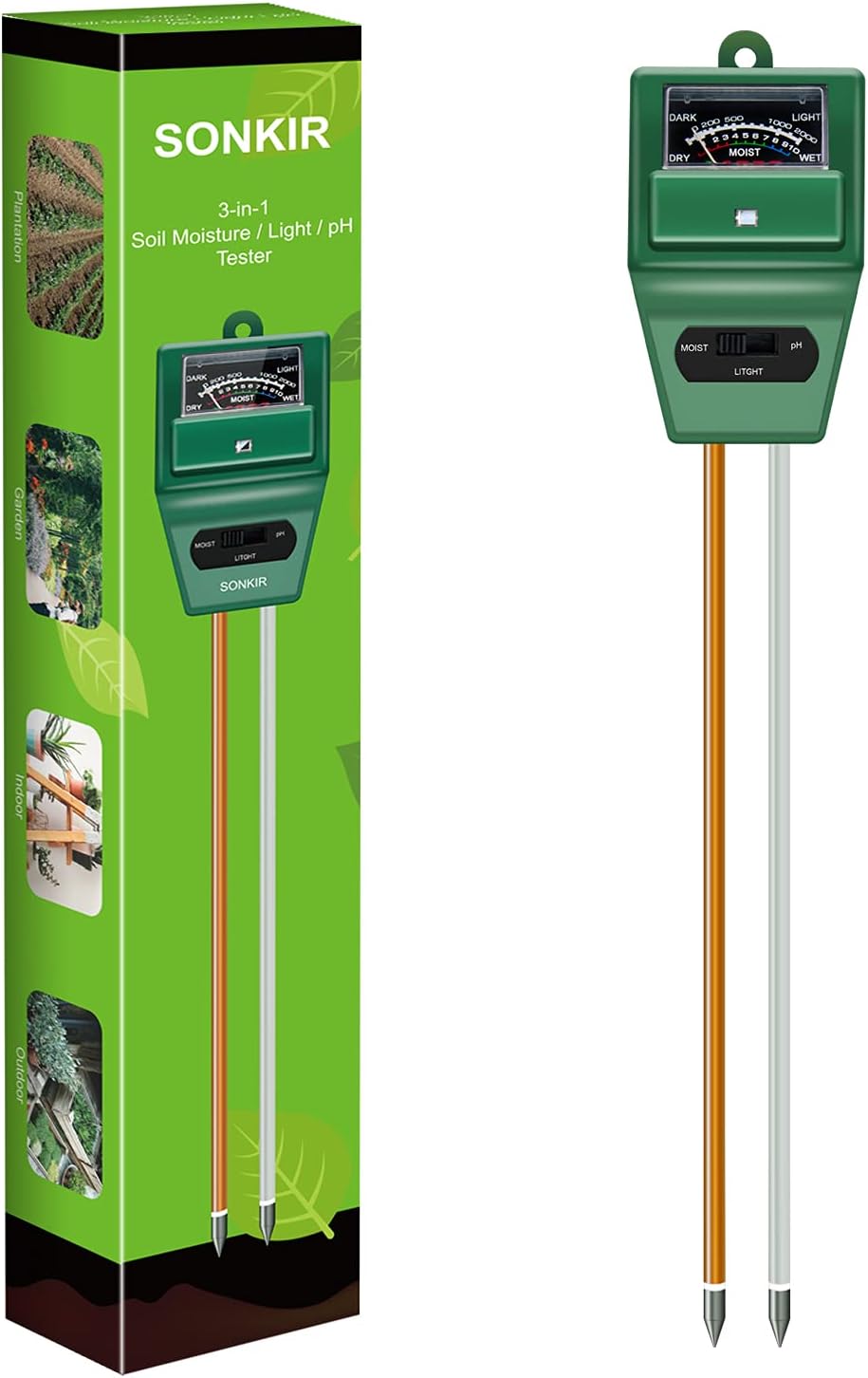
| pH range | 3.5-8 pH |
|---|---|
| Moisture range | 1-10 scale |
| Probe length | 7.9 inches |
The SONKIR MS02 is a simple analog soil meter that measures moisture, soil pH and light level with a single probe and a dial readout. To use it you switch the selector to the desired function, insert the probe into the soil about 6 to 7 inches and wait roughly ten minutes for a stable reading. Its main strengths are the no-battery operation and straightforward display, which make quick spot checks in pots, raised beds or lawn areas easy and repeatable. The meter covers a practical pH range for most garden soils and gives moisture readings on a 1 to 10 scale that help time watering. Important limits to keep in mind are the probe design and instructions: do not force it into hard ground, do not leave it in the soil, and it cannot test liquids. Readings are best used as general guidance rather than laboratory-accurate measurements, so pair it with observation and occasional lab tests if you need precision. For routine plant care this is a low-effort tool that speeds basic diagnostics.
Best for: Gardeners who want a low-effort way to monitor basic soil conditions and make smarter watering and light decisions for everyday houseplants, containers, vegetable beds and lawns.
Less Ideal for: Users who need precise, lab-accurate pH or moisture measurements or who work primarily in very compacted or rocky soils should consider professional meters or lab testing instead.
- No batteries required so it is always ready for quick spot checks
- Three measurements in one device: moisture, pH and light
- Simple dial readout that is easy to interpret for routine care
- Compact and portable design suitable for indoor and outdoor use
- Analog needle and probe give general trends rather than lab-grade accuracy
- Probe can be damaged if forced into hard or rocky soil and should not be left in place
Verdict: A cheap, maintenance-free 3-in-1 tester that gives quick, practical soil and light guidance for everyday plant care.
Soonkoda S-9 3-in-1 Soil Tester (Moisture, Fertility, pH)

| Brand Name | Soonkoda |
|---|---|
| Model | S-9 |
| Included Components | Soil Tester, English Manual, Paper Box |
| Unit Count | 1 Count |
The Soonkoda S-9 is a pocketable analog soil tester that checks moisture, nutrient level (fertility), and soil pH with a single probe. You use it by sliding the mode switch to MOIST, FERTILITY, or PH, inserting the probe about two thirds into the soil and reading the needle position after a few seconds. The meter gives color‑banded results (dry/ok/wet for moisture; low/ok/high for fertility; an acid-to-alkaline range for pH), which makes interpretation straightforward for casual gardeners. It is lightweight, requires no batteries, and comes with a manual and simple cardboard case. Limitations are that it provides approximate, relative readings rather than lab-accurate values, can struggle in very dry soils unless you moisten the sample first, and the single metal probe is not ideal for rocky or compacted beds. For a low-cost, entry-level tool it helps you spot watering mistakes and get a rough sense of soil condition before applying amendments.
Best for: Gardeners on a tight budget who want a quick, easy way to check soil moisture and get a rough sense of pH and nutrient level for lawns, raised beds, or potted plants.
Less Ideal for: Professional soil testing, precise pH management, or heavy clay/rocky sites where a single thin probe cannot be inserted reliably.
- Three-in-one function: moisture, fertility, and pH in one handheld unit
- Color-coded needle scale makes readings easy to interpret without training
- No batteries required and very lightweight for frequent spot checks
- Provides only approximate, relative values not lab-grade measurements
- Requires moist soil for reliable moisture readings in very dry conditions
Verdict: If you want the cheapest practical tool to spot-check moisture, pH, and fertility in the garden, this simple 3-in-1 tester gives fast, easy-to-read guidance.
Jxikatx 7-in-1 Soil Test Kit with Dual Display (Moisture, pH, Fertility, Light, Temp, Humidity)

| Measurements | Moisture, pH, Fertility, Light, Soil temp, Air temp, Humidity |
|---|---|
| Display | Analog dial + LCD screen |
| Probe | Multi-metal single probe |
| Adjustable head | 90° rotating with 6 viewing angles |
The Jxikatx 7-in-1 Soil Test Kit is a compact handheld meter that gives you a quick snapshot of soil and microclimate conditions. It uses a single multi-metal probe with an analog dial for moisture, pH, fertility and light and an LCD for soil temperature plus air temperature and humidity. Typical use is simple: insert the probe into moist soil (about 5 inches recommended), angle the rotating head for easy viewing, and read the dial and screen to guide watering, fertilizing and siting decisions. Notable features are the dual-display layout that separates stable analog readings from digital temperature and humidity, the 90° adjustable head for ergonomic use, and a durable probe designed to minimize root disturbance. Practical benefits include faster, consolidated checks across multiple parameters and the ability to use it across houseplants, raised beds and lawns. Limitations to note are that it is designed for moist soil only, will not work accurately in very dry or waterlogged media or hydroponics, and some parameters are analog rather than precise numeric outputs which can reduce resolution for fine adjustments.
Best for: Gardeners who want a dependable, all-in-one meter for routine checks and practical decision-making on watering and fertilizing across houseplants, vegetable beds and lawns.
Less Ideal for: Users who need laboratory-grade numeric precision, continuous monitoring, or devices built for hydroponics and very dry or saturated media should look elsewhere.
- Measures seven relevant parameters in one compact tool for quick spot checks
- Dual display separates digital temperature/humidity from analog soil readings for clear viewing
- 90° adjustable head reduces bending and makes readings easier in beds and pots
- Single-probe design minimizes root disturbance during testing
- Not accurate in dry soil, waterlogged media, stones, or hydroponic setups
- Analog dial for pH, moisture and nutrients provides approximate ranges rather than exact numeric precision
- Probe should not be left in soil for extended periods to prevent damage
Verdict: Buy this if you want a reliable, easy-to-use multi-parameter soil tester for routine, practical gardening checks rather than lab-grade precision.
XLUX T10 Soil Moisture Meter, Battery-Free

| Battery Description | No batteries required |
|---|---|
| Mounting Type | Tabletop |
| Operating Humidity | 1 to 10% |
| Upper Temperature Range | 45 °C |
The XLUX T10 is a straightforward analogue moisture meter that tells you the water level at the root zone without batteries or setup. You insert its slim 304 stainless-steel probe into the potting mix or garden soil and read a large, color-coded dial that ranges from Dry to Wet; the single slender probe is designed to minimize root disturbance. Typical use is quick spot-checking across houseplants, containers, and garden beds to decide whether to water. Notable features include the anti-rust probe, a clear ten-point scale, and a protective sleeve for storage. Practical benefits are immediate, low-cost readings, no ongoing power needs, and a form factor that is gentle in delicate pots. Important limitations are that it gives a relative moisture reading rather than a precise percentage and is intended for temporary insertion only, so it is not a continuous-monitoring device; accuracy can vary with very rocky or heavily amended soils and readings should be taken at root depth for best reliability.
Best for: Buyers who want a simple, reliable tool to spot-check moisture across many plants and prefer proven, well-reviewed gear that requires minimal maintenance.
Less Ideal for: Users who need continuous electronic logging, exact soil moisture percentages for scientific trials, or consistent readings in very coarse or rocky substrates.
- Battery-free operation provides immediate readings with no upkeep
- Slim 304 stainless-steel probe reduces root damage when testing
- Large color-coded dial is easy to read for quick watering decisions
- Protective sleeve helps prevent probe corrosion and transport damage
- Provides relative dial readings rather than precise moisture percentages
- Not suitable for continuous monitoring since probe should be removed after short tests
Verdict: A low-maintenance, battery-free moisture meter that delivers fast root-zone guidance for everyday plant watering decisions.
Luster Leaf Rapitest Soil Test Kit (20 tests)

| Brand Name | Luster Leaf |
|---|---|
| Unit Count | 20 Count |
| Number of Packs | 5 |
| Item Type Name | Soil Test Kit |
The Luster Leaf Rapitest Soil Test Kit is a simple, at‑home kit for checking soil pH plus basic N, P and K nutrient levels. It ships with capsules, reagents and a patented color comparator system that lets you match test vials to printed color charts, and includes enough components for 20 tests (five each for pH, N, P and K). Typical use is collecting small soil samples from different spots, mixing with the provided reagents, then comparing the resulting color to the chart to decide whether to amend or fertilize. The kit is compact, easy to follow and includes a plant pH preference list for guidance, which helps gardeners make actionable decisions without lab work. Limitations are that results are qualitative rather than lab‑grade numeric readings and the color matching can be influenced by lighting and user interpretation, so repeat tests or multiple sample locations are recommended for greater confidence. For routine checks and troubleshooting in home gardens and lawns, this kit delivers fast, usable guidance at low effort.
Best for: Practical home gardeners who want a low‑effort way to check soil pH and basic nutrient levels and prefer clear guidance to avoid over‑ or under‑amending. It suits people who value simple, repeatable checks across a lawn or garden beds.
Less Ideal for: Professional soil analysts or growers who need precise, quantitative lab results or digital readouts should choose a laboratory test or electronic meter instead.
- Measures pH plus nitrogen, phosphorus and potash in one kit
- Includes supplies for 20 tests so you can sample multiple spots
- Patented color comparator simplifies result interpretation
- Includes plant pH preference list and clear instructions for beginners
- Provides qualitative color-match results rather than precise numeric laboratory values
- Color comparison can vary with lighting and user interpretation
Verdict: A straightforward, beginner‑friendly kit for quick pH and basic N‑P‑K checks that helps cautious gardeners make confident amendment decisions.
Choosing the Right Soil Tester: Key Factors to Consider
Measurement Accuracy and Precision
Accurate pH and nutrient proxy readings determine whether you amend soil or change crop selection. Small pH differences can affect nutrient availability, so a tester that consistently returns similar results on repeated samples is valuable. Look for sensors and electronics that minimize drift and for products with clear stated measurement ranges.
Precision matters when you track changes over time. If you are monitoring the effect of lime or sulfur applications, a tester that shows small but repeatable shifts lets you judge whether the amendment worked or requires another application.
Sensor Type and Probe Design
Probe length and construction affect where and how you sample. Longer probes let you test deeper root zones in beds, while short probes are better for pots and shallow containers. Metal probes can corrode over time in acidic soils, so probe material and replaceability are important.
Probe design also affects how the sensor responds to compacted or rocky soils. Thin, sturdy probes penetrate easily and give more consistent contact with the soil matrix. Removable probe tips or replaceable sensors extend usable life in a rough outdoor environment.
Range of Measurements
Decide which soil properties you need to measure. Basic testers report pH and moisture, while more advanced units provide electrical conductivity or nutrient proxies. If you grow vegetables or acid-loving ornamentals, pH is critical. For container gardening and drought-prone beds, moisture and water-holding readings are essential.
Consider units that show both raw numbers and simple interpretive cues. A device that reports pH plus a color or advisory band helps you act quickly without translating numbers into recommendations every time.
Ease of Use and Readout
Gardeners need tools that work in muddy, wet, or cramped conditions. A clear display with backlighting and large digits matters when you test at dusk or in a crowded greenhouse. Controls should be operable with wet hands or gloves, and calibration steps should be minimal.
Also consider how results are recorded. Simple digital displays are convenient for quick checks, while models that log readings or pair with a phone app are helpful if you track soil changes over seasons.
Durability and Weather Resistance
Outdoor use exposes testers to humidity, dirt, and occasional drops. Devices with sealed electronics, robust housings, and corrosion-resistant probes last longer. Water resistance ratings or rubberized grips help when you use the tester in wet soil or during light rain.
Durability also relates to serviceability. Replaceable probes and available calibration solutions keep a unit usable for multiple seasons, reducing long-term cost and preventing premature replacement.
Maintenance and Calibration Requirements
Some testers require frequent calibration or special fluids to maintain accuracy. If you do not want extra upkeep, choose models with low-maintenance sensors or straightforward calibration routines. Calibration matters especially for pH readings; uncalibrated sensors can drift and give misleading results.
Factor in how easy it is to clean probes after use. Soil buildup can alter readings, so probes that wipe clean or rinse without damaging electronics reduce long-term variability.
When to Test Your Soil
Test before major planting or after applying amendments. Early-season checks show baseline pH and moisture so you can apply lime, sulfur, or fertilizer at the correct rates. Testing after amendments helps verify whether the application moved the soil in the intended direction.
Also test when plants show nutrient-deficiency symptoms or slow growth. A tester can quickly rule in or out pH issues and moisture stress before you start experimenting with fertilization.
- Test multiple spots across beds to account for variation
- Retest areas after heavy rain to avoid transient dilution effects
- Sample the root zone depth appropriate for the crop
Sampling Best Practices
Collect multiple samples and average readings. Soil can vary within a small area, so take several readings across a bed and at different depths if appropriate. For containers, test each pot separately since mixes and watering vary widely.
Avoid testing immediately after fertilizing or irrigating. Give amendments and water time to settle so that readings reflect the soil matrix rather than temporary surface conditions.
- Clean probes between samples to prevent cross-contamination
- Take samples at a consistent depth for comparable results
- Label and record readings with location and date
Interpreting pH and Moisture Results
pH readings indicate nutrient availability rather than fertilizer levels. Know the preferred pH range for your plants and use amendments to shift pH slowly over several months. A small change in pH can unlock or lock out nutrients, so act conservatively and retest.
Moisture values help schedule irrigation. Some testers report relative moisture while others use volumetric or percent scales. Learn how your device reports moisture and correlate readings with feel and plant response to hone irrigation decisions.
- Use pH bands to plan lime or sulfur applications
- Combine moisture readings with manual checks for root health
- Retest periodically to confirm amendment effects
Using Soil Testers in Containers and Small Beds
Containers and small raised beds have more variable conditions than in-ground plots. Potting mixes dry faster and can hold nutrients differently, so frequent checks with a reliable tester help avoid over- or under-watering and incorrect fertilization.
Because space is limited, choose a tester with probe length suitable for shallow mixes. For mixed beds, take readings in each distinct planting area rather than assuming uniform conditions across the whole bed.
- Short probes for pots, longer probes for beds
- Check moisture before fertilizing to avoid salt buildup
- Adjust watering schedules based on combined moisture and plant observation
Recording Results and Tracking Change Over Time
Keeping a simple log of readings by date and location helps identify trends and the effects of amendments. Seasonal patterns in moisture and pH can inform long-term planning and crop rotation choices.
If your tester supports data logging or app pairing, use those features to visualize changes. If not, a notebook or spreadsheet with a few consistent parameters is enough to spot meaningful shifts.
- Note weather, recent amendments, and irrigation events with readings
- Compare readings year over year to evaluate soil health trends
- Use recorded data to space out major amendments responsibly
How We Chose the Best Soil Tester
We focused on practical measurements gardeners use when planning beds, containers, and lawn care. Evaluation centered on concrete, testable criteria: sensor accuracy for pH and nutrient proxies, repeatability across multiple samples, ease of use in the field, robustness for outdoor conditions, and how well the device reports actionable values gardeners can act on. We favored units with clear readouts and straightforward sampling procedures so gardeners can take consistent readings without lab tools. Products that required complex calibration procedures or specialized consumables were deprioritized unless they offered substantially better measurement reliability. Units with flimsy probes, unclear measurement ranges, or evidence of frequent drift were excluded. The final list reflects tools that balance dependable readings, simple operation, and durability for real garden work.
FAQ
How often should I test soil in my vegetable garden?
Test at least once each growing season and before planting major crops. Additional checks after applying amendments or if plants show stress are useful to confirm changes.
Can a handheld soil tester replace professional lab tests?
Handheld testers give useful field-level data for pH and moisture but are not a full substitute for laboratory nutrient analyses. Use a handheld tester for quick decisions and labs for detailed nutrient profiles.
Do soil testers work in pots and raised beds?
Yes. Choose probe length and scale appropriate to the container depth. Test each pot or distinct bed because mixes and watering regimes vary.
How do I keep readings consistent between tests?
Use consistent sampling depth and locations, clean probes between samples, and calibrate the device per the manufacturer schedule. Record conditions like recent irrigation to interpret results.
What does a sudden pH change indicate?
Sudden shifts often reflect recent amendments, contamination, or sampling error. Retest after waiting a short period and evaluate whether an application or environmental event could explain the change.
Final Verdict
Choose a soil tester that matches how you garden and the measurements you need most. Prioritize accuracy for pH if you grow pH-sensitive crops, or fast, repeatable moisture sensing if irrigation scheduling is your primary concern. Balance probe length and durability against the environments you will test, and accept that some maintenance and periodic calibration are part of getting reliable readings. With a clear idea of what you want to measure and how often, you can pick a tester that provides the actionable information needed to improve soil health and plant performance.
