

Note: This article contains affiliate links. If you click on these links and make a purchase, I may earn a small commission at no extra cost to you. This helps support my research and content. Read my full affiliate disclosure here.
If sugar ants are invading countertops, pantries, or window sills, the right ant killer for sugar ants can end infestations with less mess and fewer repeat visits. You want products that appeal to sugar-feeding workers, let bait reach the colony, and fit routine cleaning and food-storage habits. This guide covers six top picks narrowed for indoor and near-entry use, each chosen for bait attractiveness, delivery form, and how easy it is to position where ants forage. Below we explain the evaluation criteria and what to expect from different bait types and application methods before the product summaries.
Top Picks at a Glance
| Best Overall The best all-around choice for most situations | TERRO Liquid Ant Killer 3-Pack (T200-3SR) |  |
| Best Quality Built to a higher standard if you want something more solid | Syngenta Advion Ant Gel (4 × 30 g tubes) |  |
| Best Value The sweet spot between price and what you get | Combat Max 2‑in‑1 Ant Bait Station, 4 Count |  |
| Best Budget The cheapest option that still gets the job done reliably | Raid Ant Killer Baits, Child-Resistant, 8 Count |  |
| Highest Rated A top-rated pick with lots of positive feedback | TERRO Ultra Complete Kill Ant Baits, 6 Dual-Formula Bait Stations |  |
| Most Popular A crowd favorite that many people choose with confidence | TERRO Liquid Ant Killer Bait Stations, 12-Pack |  |
TERRO Liquid Ant Killer 3-Pack (T200-3SR)

| Item Form | Liquid |
|---|---|
| Active Ingredients | Sodium Tetraborate Decahydrate (Borax) 5.40% |
| Target Species | Insects |
| Specification Met | EPA |
TERRO Liquid Ant Killer is a straightforward indoor bait system designed to eliminate common household ants by having workers feed on a borax-based liquid and transfer it to the colony. You apply drops of the bait onto the included cardboard tiles and place them along ant trails, baseboards, counters, and other activity hotspots. The 3-pack gives multiple bait stations for treating several rooms or repeated placements. The active ingredient, sodium tetraborate decahydrate, works slowly enough to be shared among nestmates so the queen and hidden workers are affected, which can produce visible reductions in a few days. Because the formulation is liquid and comes in drip bottles, placement and reapplication are simple and low-mess compared with granular or spray options. Limitations are that the product is intended for indoor use only and requires ants to find and feed on the bait, so heavily contaminated or outdoor nests may need additional measures. When used as directed it is a practical, low-effort solution for routine household infestations.
Best for: Homeowners wanting a low-effort, indoor-focused solution to eliminate sugar ants and other household species who prefer baiting over sprays.
Less Ideal for: People who need immediate knockdown of visible ants outdoors or who require a product for large external infestations should look at targeted outdoor nest treatments.
- Borax-based liquid attracts worker ants and allows transfer to the colony for more complete elimination
- Three 2 oz bottles provide multiple placements for whole-house coverage
- Simple drop application on included cardboard tiles makes setup and reapplication low-mess
- EPA specification met and formulated for common household ant species including sugar and ghost ants
- Only effective if ants discover and consume the bait, so results depend on placement and ant behavior
- Designed for indoor use and may not address outdoor nests feeding into the house
Verdict: A simple, effective indoor bait that uses borax to knock out sugar ant colonies by relying on worker-to-colony transfer.
Syngenta Advion Ant Gel (4 × 30 g tubes)

| Item Form | Gel |
|---|---|
| Active Ingredients | 0.05% indoxacarb |
| Target Species | Insects |
| Included Components | 4 Tubes x 30-Grams, 1 Plunger and 2 Tips |
Advion Ant Gel is a concentrated gel bait intended to eliminate entire ant colonies by encouraging worker ants to feed and carry the bait back to nestmates. It is applied in small spots or lines along active trails, in cracks and crevices, and around appliance perimeters where sugar-seeking ants forage. The product uses a non-repellent active ingredient that is highly attractive to many common species including Argentine and carpenter ants, and the included plunger and tips make targeted placement straightforward. In practice this bait is fast-acting compared with contact sprays because it delivers a colony-level kill when workers share the bait with the queen. It is suitable for indoor and outdoor use, but because it is a formulated insecticide buyers should follow safety guidance and avoid placing gel where children or pets can access it. The compact syringe packaging makes storage and repeated spot treatments easy, though users will need to inspect trails and reapply if heavily infested or after cleaning treated areas.
Best for: Buyers who prioritize fast, colony-level control of sugar-seeking ants and want a bait that professionals and experienced homeowners use for targeted indoor and outdoor treatments.
Less Ideal for: Households that prefer entirely non-chemical methods or need an immediate visible knockdown without relying on bait transfer should consider alternative control options.
- Non-repellent formula that encourages ants to feed and share bait with the colony
- Effective against many major ant species including sugar-seeking ants
- Includes plunger and application tips for precise placement in cracks and crevices
- Compact syringe packaging simplifies storage and targeted spot treatments
- Contains an active insecticide so it requires cautious placement away from children and pets
- May require repeat applications for very large or heavily established infestations
Verdict: Choose Advion Ant Gel when you want a professional-strength bait that attracts sugar ants and delivers colony-level control through worker-to-nest transfer.
Combat Max 2‑in‑1 Ant Bait Station, 4 Count

| Unit Count | 4 Count |
|---|---|
| Item Form | Gel |
| Target Species | Ant |
| Active Ingredients | Fipronil |
The Combat Max 2‑in‑1 Ant Bait comes as four transparent snap-off bait stations prefilled with two formulas to attract both sugar- and protein-preferring ants. You place the compact stations along ant trails, under sinks, or behind appliances and the foraging workers feed on the gel then carry it back to the nest to eliminate the queen and colony. The clear housing makes it easy to monitor bait levels and know when to replace a station, and the snap-off tab design makes setup quick and mess free. Fipronil acts fast, so you can see activity within hours and reduced traffic over days. Limitations: it excludes certain species such as harvester, carpenter, and pharaoh ants and the product directions advise monthly replacement or when empty, so ongoing maintenance is required for long infestations. Also this is a chemical bait so it should be kept out of reach of children and pets.
Best for: Buyers who want a practical, low‑effort way to stop sugar and protein‑seeking indoor ant infestations by placing monitored bait stations along trails and in tight spots.
Less Ideal for: People dealing primarily with carpenter, pharaoh, or harvester ant infestations or those who prefer nonchemical control methods should consider other options.
- Two bait formulas attract both sugar- and protein‑feeding ants for broader coverage
- Transparent station lets you monitor bait level without opening the unit
- Ready‑to‑use snap‑off design allows quick, mess‑free placement
- Contains fipronil for fast action that foragers can carry back to the colony
- Not labeled for certain species such as harvester, carpenter, and pharaoh ants
- Requires periodic replacement (every month or when empty) to maintain control
Verdict: A convenient, ready‑to‑use dual‑formula bait station that quickly attracts sugar ants and delivers colony‑level control.
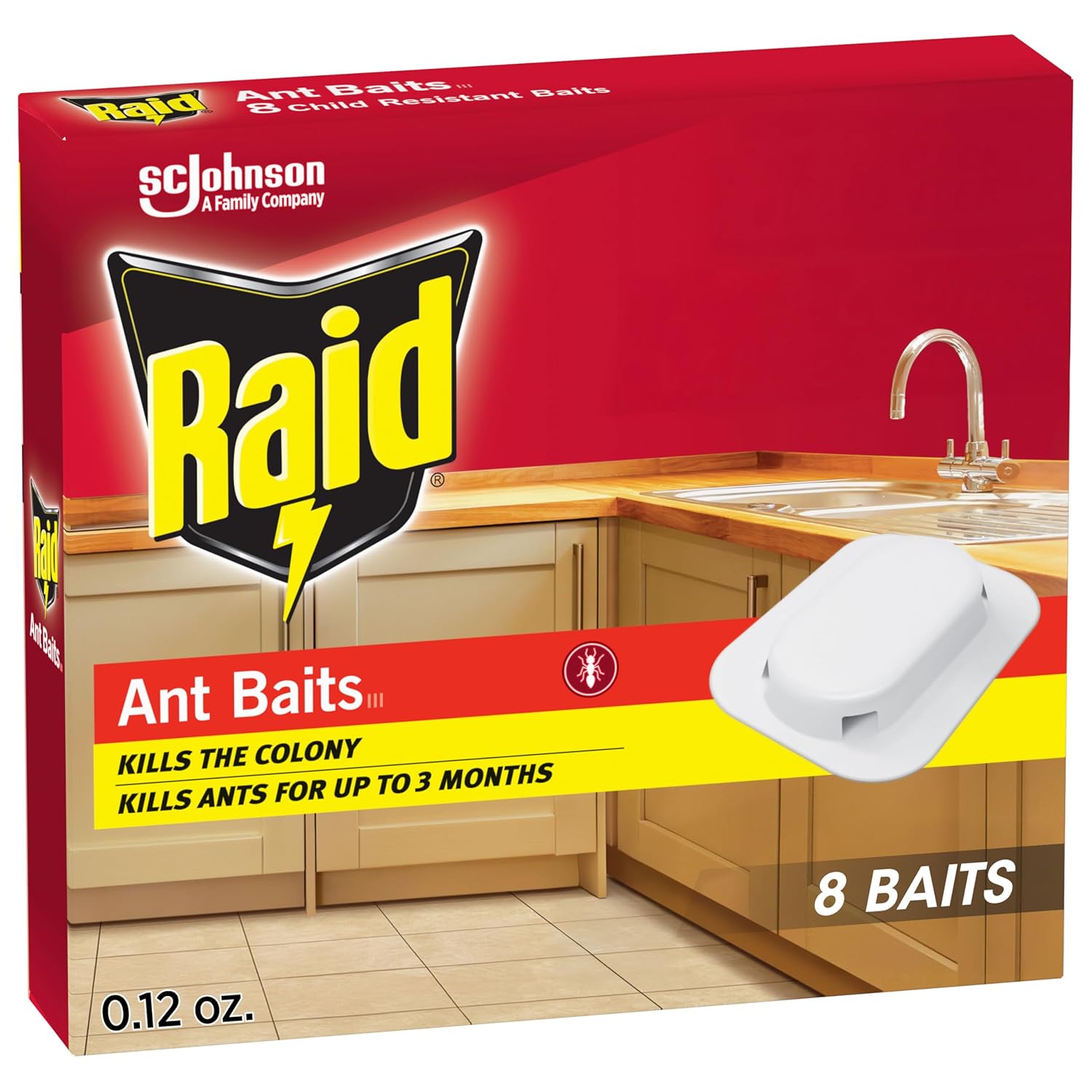
Raid Ant Killer Baits, Child-Resistant, 8 Count
| Count | 8 |
|---|---|
| Child-resistant | Yes |
| Uses indoors | Yes |
| Control duration | Up to 3 months |
These Raid Ant Killer Baits are small, child-resistant bait stations intended for indoor use along walls, in corners, and near entry points. They contain a slow-acting bait that foraging ants take back to the nest, which helps reduce or eliminate an entire colony over a period of weeks and can provide control for up to three months. In practice the stations are simple to place and low-maintenance since you only need to set them where ants are active and replace them when empty or spent. The design reduces accidental contact, and the prefilled stations are ready to use without mixing or pumps. Expect noticeable declines in worker ant activity within days, though complete colony elimination depends on placement and whether all nest sites are reached. These baits are focused on indoor use and on species attracted to sugary baits, so they work best as part of routine monitoring and targeted placement rather than as a one-time spot treatment for large infestations.
Best for: Someone looking for an affordable, low-effort indoor solution to reduce sugar-ant activity in kitchens and entryways who prefers ready-to-use products over DIY mixes.
Less Ideal for: Homeowners needing fast knockdown of large outdoor infestations or those dealing with ant species that prefer protein- or grease-based baits should consider different products.
- Transferable bait targets and can eliminate entire colonies over time
- Prefilled, ready-to-use stations require no mixing or setup
- Child-resistant design reduces accidental access
- Effective for up to three months when placed correctly
- Designed for indoor use only so not suitable for outdoor colony control
- Works best on ants attracted to sugary baits and may be less effective on other species
Verdict: A budget-friendly, ready-to-use indoor bait that effectively reduces sugar-ant colonies when placed where ants forage.
TERRO Ultra Complete Kill Ant Baits, 6 Dual-Formula Bait Stations

| Unit Count | 6 Count |
|---|---|
| Included Components | 4 Bait Stations |
| Target Species | Ant |
TERRO Ultra Complete Kill Ant Baits pairs a liquid sugar bait with a protein paste in a single, ready-to-use station so you do not have to guess which food source the ants prefer. You place the small stations where you see ant trails, along baseboards, counters, or entry points. Worker ants feed on the baits and carry the poisoned food back to the nest, which targets larvae and the queen and can reduce visible activity within days. The dual-formula approach is the main strength here because seasonal or species differences in appetite are covered without swapping products. Stations are compact and simple to position, and the bait lasts for weeks while ants continue visiting. Limitations: this product is formulated for common household sugar- and protein-seeking ants and excludes species like fire, pharaoh, carpenter, and harvester ants, and heavy or outdoor infestations may need perimeter or professional treatment for full control.
Best for: Buyers who want a dependable indoor solution that addresses both sugar- and protein-seeking ants without testing multiple baits, and who prioritize eliminating colonies rather than only knocking down visible workers.
Less Ideal for: Homeowners dealing primarily with fire ants, carpenter ants, pharaoh ants, or large outdoor/structural infestations should choose species-specific or professional/control perimeter options instead.
- Dual bait formula (liquid sugar plus protein paste) attracts ants in different feeding cycles
- Ready-to-use stations require no mixing or setup for quick placement indoors
- Designed to be carried back to the nest so it can eliminate the queen and reduce the colony
- Compact stations last for weeks while actively visited by ants
- Not labeled for certain species such as fire ants, pharaoh ants, carpenter ants, and harvester ants
- Single-purpose indoor stations are not a substitute for perimeter treatments on heavy outdoor infestations
Verdict: Use TERRO Ultra when you want a no-fuss, dual-formula indoor bait that reliably targets common sugar-seeking household ants and their colonies.
TERRO Liquid Ant Killer Bait Stations, 12-Pack

| Unit Count | 12 Count |
|---|---|
| Item Form | Liquid |
| Active Ingredients | Sodium Tetraborate Decahydrate (Borax), 5.40% |
| Specification Met | EPA |
TERRO Liquid Ant Killer bait stations are ready-to-use liquid traps designed for indoor control of sugar-loving ants. You place the small sealed stations where you see ant activity—along baseboards, corners, or on counters—and worker ants are attracted to the sweet borax-based liquid, carry it back to the nest, and spread it through the colony. The product is fast-acting enough that you typically see fewer ants within days, while full colony control can take two to four weeks depending on infestation size. The compact, low-profile stations are easy to set and require no mixing or messy handling, and a 12-pack gives ample coverage for several rooms. Because the active ingredient is borax at a modest concentration, it targets ants via ingestion rather than contact, which makes it effective against many common species but means it relies on ants discovering and feeding on the bait. The stations are intended for indoor use and should be monitored and replaced when depleted for continued effectiveness.
Best for: Buyers who want a proven, easy indoor solution to eliminate sugar-attracted ants and prefer a product with widespread consumer use and straightforward placement.
Less Ideal for: People needing immediate knockdown of visible ants or those addressing outdoor or non-sugar-preferring ant species should consider alternative or supplemental methods.
- Ready-to-use stations require no mixing or setup
- Attracts sugar-loving ants and lets workers carry bait to the colony for broad control
- 12-pack provides coverage for multiple rooms or hotspots
- Compact, low-profile design is easy to place along baseboards and under appliances
- Relies on ants discovering and feeding on the bait so results can take several days to weeks
- Intended for indoor use only and not suitable for outdoor infestations
Verdict: A reliable, easy-to-use indoor bait system that uses borax-based liquid stations to attract sugar ants and eliminate their colonies over time.
Choosing the Right Ant Killer for Sugar Ants: Key Factors to Consider
Bait Preference and Sugar Focus
Sugar ants are attracted primarily to sweet, carbohydrate-rich foods. Choosing a bait formulation that mimics those preferences increases the chance that foraging workers will accept and carry the bait back to the nest. A bait that tastes too bitter or is protein-focused will be ignored and provide only short-term relief from visible trails.
In practice, look for liquid, gel, or syrupy baits and observe whether resident ants sample them. Acceptance often varies with season and colony needs, so the most attractive option in one home may not be the same in another. Rotating bait types is sometimes necessary if one formulation is initially rejected.
Active Ingredient Mode of Action
The most effective household ant killers for sugar ants rely on slow-acting active ingredients that allow workers to return to the nest before dying. This delayed mortality enables transfer of the active ingredient through trophallaxis and contact, reaching queens and brood and reducing the whole colony.
Fast-acting contact killers can remove visible workers but do little to stop the colony from sending more foragers. Understand whether a product is intended for immediate knockdown or for colony elimination so you can use it in the correct situation.
Delivery Form and Placement Options
Baits come as gels, liquid stations, granules, or preloaded bait stations. Gel and liquid formats are often easiest to place directly on trails or inside crevices where sugar ants travel. Prebaited stations are tidy and reduce accidental access by pets and children but may be less accessible to ants if not placed on a high-traffic route.
Consider how your usual cleaning routines, food storage, and traffic patterns will affect bait placement. Options that cling to cracks or attach under appliances can maintain availability even during daily cleaning.
Persistence and Reapplication Needs
Persistence refers to how long a bait remains attractive and effective in the environment. Humidity, temperature, and household cleaning quickly degrade some formulations, requiring more frequent reapplications. Longer-lasting baits reduce maintenance but may lose attractiveness if they dry out.
Plan for monitoring and replenishing bait every few days at first, then less often as activity drops. Products that keep their texture and scent in common indoor conditions tend to yield more consistent colony control.
Safety Around People and Pets
Because sugar ant problems occur where people and pets live and eat, safety is a major consideration. Baits in sealed stations or pre-measured applicators reduce accidental ingestion, while exposed gels or liquids need careful placement. Read and follow label guidance about access restrictions and cleanup.
Seek products with lower acute toxicity profiles and those that limit exposure risk through bait station design. Even low-toxicity baits can be harmful if a curious pet ingests a large amount, so placement out of reach and supervision are important.
Monitoring and Follow-Up Strategy
Successful control requires checking bait uptake and ant activity after application. Monitoring helps you confirm that foragers are feeding and that bait is being carried away. If uptake stops, ant pressure or bait rejection may require moving bait closer to trails or switching formulations.
A sensible follow-up plan includes inspecting bait stations daily for the first week, moving or refilling as needed, and maintaining barrier cleanliness to reduce accidental food sources that compete with bait attractiveness.
Understanding Sugar Ant Behavior
Sugar ants forage widely for sweet resources and often establish predictable trails between indoor food sources and nest sites. They recruit nestmates rapidly to rich carbohydrate sources, so a well-placed bait can receive heavy attention and be efficiently transferred back to the colony.
Ant activity can vary by season and indoor humidity. During hot, dry weather, sugar-seeking behavior may intensify. Observing where ants travel and what they consume gives practical clues for bait placement and timing.
- Follow the foraging trail to identify the nest direction and best placement points
- Note times of day with peak activity to apply bait when workers are most active
- Keep counters and floors free of crumbs and spills to increase bait attractiveness
Best Placement Practices for Indoor and Near-Entry Use
Position baits along trails, near entry points, beneath appliances, and inside cabinets where sugar ants are seen. Avoid placing exposed gels on food prep surfaces. For sealed stations, place them flush against walls and in corners to intercept narrow trails.
If you have pets or children, choose tamper-resistant stations and place them under furniture or behind baseboards when possible. Check placement after routine cleaning to ensure stations were not moved or discarded.
- Place bait at the point where ants first appear, not necessarily where the largest activity is
- Use multiple small placements rather than one large dose to increase uptake by more foragers
- Avoid cleaning areas with harsh chemicals right after placing bait as that can mask attractiveness
When to Use Contact Treatments Versus Baits
Contact sprays or aerosols are useful for quick reduction of visible foragers and for creating temporary barriers, but they seldom eliminate colonies because they kill workers before they can transfer poison to nestmates. Use contact products to reduce heavy surface activity while baits are put in place.
Baits remain the primary tactic for colony control because they rely on worker-mediated transfer. Combining targeted contact control for immediate relief with strategically placed baits offers a balanced approach for persistent indoor infestations.
- Use contact treatments sparingly and away from bait placements to avoid deterring foragers
- Apply contact products to entry points and perimeters while keeping bait stations in protected interior spots
Adapting Strategy for Different Indoor Environments
Small apartments, large houses, and older buildings each present unique challenges. In compact spaces, bait placement is easier but contamination from food spills competes more strongly. Larger homes may require more bait stations spread across entryways and food storage areas.
In damp basements or kitchens, moisture can degrade some bait types. Choose formulations that maintain texture in humid conditions or use enclosed stations that protect the bait.
- In rental properties, discuss placement with landlords if structural access behind appliances is needed
- For high-humidity areas, monitor bait for drying and replace more frequently if needed
Integrating Sanitation and Exclusion
Baits work best when competing food sources are reduced. Keep surfaces clean, store sweets in sealed containers, and repair small gaps around windows and doors that provide easy access. Excluding ants reduces colony recruitment and makes baiting campaigns more effective.
Small repairs and routine sanitation are often as important as the choice of product because they remove competing food cues and trap routes that ants use to bypass bait stations.
- Seal food in airtight containers and remove spilled syrup or fruit residue promptly
- Use weather stripping and caulk to close common entry points
How We Chose the Best Ant Killer for Sugar Ants
We prioritized attributes that matter in real household sugar-ant problems. Primary evaluation criteria included bait attractiveness to sugar-feeding workers, bait persistence so ants can carry it back to the nest, and placement flexibility for kitchens and entryways. We also scored safety profile for homes with pets and children, and the ease of use for typical homeowners who need low-maintenance solutions. Products were excluded if they only target protein-feeding species, require professional-only equipment, or rely on broadcast sprays that prevent worker transport back to colonies. We favored options that facilitate worker-mediated transfer of active ingredients to other nest members, that are effective at low application rates, and that adapt to narrow foraging trails near doors and food storage. Laboratory-only claims without realistic home-use instructions were deprioritized. These filters ensured the shortlist focuses on pragmatic, transferable control that reduces colony numbers rather than only killing visible workers.
FAQ
How long does it take for a bait to reduce a sugar ant colony?
It often takes several days to a few weeks for a slow-acting bait to reduce colony activity because workers need time to find the bait and transfer it to the nest. Monitor bait uptake and ant activity; a steady decline over one to three weeks is common.
Can I use baits if I have pets in the house?
Many baits are safe when used in sealed, tamper-resistant stations, but exposed gels and liquids increase risk. Place stations out of pets' reach and follow label guidance. If you are unsure, choose enclosed delivery forms and monitor placements closely.
Why did ants stop taking the bait after a few days?
Uptake can stop because the colony's food preference changed, the bait dried out, or another food source became available. Move bait closer to active trails, replace dried bait, and reduce competing food sources to restore interest.
Are some baits better for winter or summer infestations?
Seasonal behavior influences bait success. In warmer months, colonies may forage more actively and accept sugary baits readily. In cooler periods, bait acceptance can decline. Adjust expectations and monitor more closely during seasonal shifts.
Should I use sprays around bait stations?
Avoid spraying near bait placements because contact insecticides can repel or kill foragers before they access the bait. Use sprays only for targeted knockdown away from baited routes and move stations if spraying is necessary nearby.
How many bait stations should I place for an indoor infestation?
Place multiple small stations at entry points, along trails, and near food storage rather than a single large station. The exact number depends on house size and activity, but starting with several placements improves the chance that foragers find and use the bait.
Final Verdict
Prioritize baits that match sugar-feeding preferences and support worker-mediated transfer to the nest. Focus on bait attractiveness, proper placement along foraging trails, and safety measures when pets or children are present. Expect to monitor and adjust placements for several days to weeks as colonies accept the bait. Balancing persistence, placement flexibility, and a low-risk safety profile will help you choose an effective ant killer for sugar ants and arrive at a practical, durable solution for indoor infestations.
