

Note: This article contains affiliate links. If you click on these links and make a purchase, I may earn a small commission at no extra cost to you. This helps support my research and content. Read my full affiliate disclosure here.
If spiders have moved into corners, closets, or crawl spaces, choosing the right bug bomb can make the difference between a temporary knockdown and long-term relief. A bug bomb for spiders should reach hidden cracks, suspend as a fine mist to contact crawling and web-building species, and leave a residue that reduces return activity without leaving a hazardous film on surfaces. This guide looks at seven carefully shortlisted bug bombs for spider control and explains the practical tradeoffs you should weigh in a real home or garage. We evaluated coverage patterns, active ingredients and persistence, label restrictions for indoor use, and ease of application so you can pick the best fit for the infestation and room type. Read on for the criteria we used and the key considerations that matter when you deploy a fogger against spiders.
Top Picks at a Glance
| Best Overall The best all-around choice for most situations | HOT SHOT Indoor Fogger with Odor Neutralizer, 3-pack (2 oz cans) |  |
| Best Quality Built to a higher standard if you want something more solid | Raid MAX Concentrated Deep Reach Fogger (Pack of 2) |  |
| Best Value The sweet spot between price and what you get | Bengal Roach & Flea Indoor Fogger, 3 x 2.7 oz Cans |  |
| Best Budget The cheapest option that still gets the job done reliably | Raid Concentrated Deep Reach Fogger, 1.5 fl oz (4 Count) |  |
| Highest Rated A top-rated pick with lots of positive feedback | HOT SHOT Fogger with Odor Neutralizer, 3 pack (2 fl oz cans) |  |
| Most Popular A crowd favorite that many people choose with confidence | HOT SHOT Total Release Fogger with Odor Neutralizer, 2 oz cans (12 oz unit count, 6-pack) |  |
| Best Seller A high-volume bestseller chosen again and again | HOT SHOT No-Mess! Total Release Fogger with Odor Neutralizer, 3 Pack (1.2 oz each) |  |
HOT SHOT Indoor Fogger with Odor Neutralizer, 3-pack (2 oz cans)

| Unit Count | 3 Count |
|---|---|
| Item Form | Aerosol |
| Target Species | Insects |
| Active Ingredients | Tetramethrin, Cypermethrin |
| Liquid Volume | 2 fluid ounces |
The HOT SHOT Indoor Fogger is a ready-to-use aerosol pest fogger supplied as three 2-ounce cans designed to treat up to 2,000 cubic feet per can. It disperses a fine insecticidal fog that reaches cracks, crevices and carpet fibers to kill roaches, ants (except fire ants), fleas, spiders and flies on contact, and the formula claims residual activity for up to two months. Typical use is straightforward: place a covered stand in the center of the room, set off one fogger per room, vacate and ventilate after the recommended waiting time. Notable features include an odor neutralizer to reduce lingering smell and active ingredients (tetramethrin and cypermethrin) that penetrate hidden harborages. Practical benefits are quick coverage of large rooms without spraying every surface and a short setup time compared with spot treatments. Limitations are that foggers are not selective so you must empty and cover fish tanks, food and sensitive items, and they are not suitable for very small, enclosed spaces or treating structural voids; they also exclude fire ants from the labeled ant control. For spider-heavy situations, this product can reduce visible adults and reach hiding spots but is best used as part of an integrated approach that includes sealing entry points and targeted residual treatments for webs and nesting sites.
Best for: Homeowners who want a simple, fast way to knock down visible indoor pests and reduce hidden infestations across rooms without performing detailed spot treatments.
Less Ideal for: People needing targeted long-term spider control for crawl spaces, wall voids, or outdoor perimeter treatments should choose professional or specialized residual products instead.
- Covers up to 2,000 cubic feet per can for quick whole-room treatment
- Kills a broad range of household insects on contact including spiders
- Includes an odor neutralizer to reduce lingering chemical smell
- Three cans per pack provide multiple treatments or coverage for several rooms
- Not labeled for fire ants and cannot reach deep structural voids
- Requires clearing and ventilating the room and removing sensitive items before use
- Residual control may vary and is not a substitute for targeted perimeter treatments
Verdict: A quick, easy fogger pack that knocks down spiders and other common indoor insects across whole rooms while neutralizing odor.
Raid MAX Concentrated Deep Reach Fogger (Pack of 2)

| Unit Count | 12.6 Ounce |
|---|---|
| Item Form | Spray |
| Target Species | Insects |
| Item Weight | 1 ounces |
The Raid MAX Concentrated Deep Reach Fogger is a high‑power aerosol fogger meant for treating large indoor spaces and heavy infestations. You set the unit in the room, activate the delayed fogging, leave the area, and the penetrating mist carries insecticide into cracks, crevices, attics and basements where spiders and other pests hide. The label claims one can treats up to 7,000 cubic feet and the formula lists many target species, so it is built for performance against widespread problems rather than spot treatments. Practical benefits include the delayed release so you can exit before fogging starts, no visible residue after use, and residual activity that helps suppress reemergence for weeks. Important limitations are that it is not for continuous use around people or pets during application, it treats enclosed spaces only so outdoor or highly cluttered areas may not get full coverage, and foggers will not remove webs or immediately remove large adult spiders you can see. Use alongside cleaning and sealing entry points for best spider control results.
Best for: Buyers who prioritize fast, whole‑room performance for heavy indoor infestations and want a product that reaches hidden harborages rather than spot sprays.
Less Ideal for: Those looking for a quick surface spray for single sightings, people who need continuous everyday protection around occupants, or gardeners who need outdoor perimeter control.
- Penetrating fog reaches cracks and crevices where spiders and hiding insects reside
- Formulated for large spaces with one can treating up to 7,000 cubic feet
- Delayed fogging action lets you leave the area before discharge
- Leaves no messy visible residue after use
- Residual activity continues to kill insects for up to two months when used as directed
- Not suitable for use when people or pets remain in the treated space during application
- Fogger coverage is limited to enclosed indoor areas and may miss inaccessible or outdoor harborages
- Does not physically remove webs or dead insects so follow-up cleaning is needed
Verdict: Choose this fogger when you need a powerful, whole‑room treatment that penetrates cracks and provides weeks of residual control against spiders and other indoor pests.
Bengal Roach & Flea Indoor Fogger, 3 x 2.7 oz Cans

| Included Components | 3 foggers (3 x 2.7 oz) |
|---|---|
| Item Type Name | Roach and Flea Indoor Fogger |
| Target Species | Insects |
The Bengal Roach & Flea Fogger is a three-can aerosol kit intended for whole-room indoor treatments where pests hide in cracks, attics, basements, or garages. Each can releases a fine, dry fog formulated to penetrate into voids and behind baseboards to flush and contact-kill insects listed on the label, including roaches, fleas, ants, spiders, and other common household pests. The dry, low-residue formula is convenient for indoor use because it minimizes visible mess and lingering odor after airing out the treated space. Practical features include concentrated coverage — the set is sized to treat multiple rooms or a large single space — and a simple one-time deployment when you need a fast knockdown. Limitations are typical for foggers: they are a broad-area contact treatment rather than a long-term barrier or targeted baiting solution, so follow-up measures and label precautions are necessary, and fogging requires vacating and thoroughly airing treated areas before re-entry.
Best for: Buyers who want a no-fuss, single-application fogger to rapidly knock down visible and hidden indoor pests across multiple rooms and who plan to follow up with preventive steps.
Less Ideal for: People seeking a long-term integrated pest management plan or spot treatments for isolated infestations should consider baits, traps, or professional services instead.
- Fine dry fog penetrates cracks and voids to reach hidden insects
- Three-can pack provides concentrated coverage for multiple rooms or a large area
- Low-residue formula reduces visible mess and minimizes lingering odor after airing out
- Targets a broad range of common indoor pests including roaches, fleas, ants, spiders
- Provides short-term contact control and does not replace targeted baits or long-term prevention strategies
- Requires vacating and ventilating treated spaces which can be inconvenient for frequent use
Verdict: A compact three-can fogger kit that quickly delivers penetrating dry fog for fast, room-scale knockdown of common indoor pests.
Raid Concentrated Deep Reach Fogger, 1.5 fl oz (4 Count)

| Unit Count | 4 Count |
|---|---|
| Item Form | LIQUID |
| Target Species | Insects |
| Specification Met | EPA |
| Active Ingredients | Cypermethrin |
Raid Concentrated Deep Reach Fogger is a multi-insect indoor fogger designed to send a fine insecticidal mist into cracks, closets and behind furniture where spiders and other pests hide. You set the can on a covered stand, activate the sprayer, vacate the room and let the fog work for several hours before airing the space. The formula lists cypermethrin as an active ingredient and claims residual control for up to two months, so a single treatment can reduce activity in a typical 25 x 25 ft room. Practical benefits include deep penetration into crevices and coverage of large rooms without leaving a wet residue. Important limitations are the safety precautions and ventilation requirements: people, pets and fish must be removed and you must not re-enter for several hours, and the product is highly flammable so open flames and pilot lights must be off. Also this product is labeled for indoor use but is not intended for bed bug control, and it can be harsh around sensitive occupants, so follow the label closely.
Best for: Buyers looking for an affordable, single-treatment fogger to reduce spiders and other insects in whole rooms who are comfortable following strict safety and ventilation steps.
Less Ideal for: Households with young children, medically sensitive people, or indoor fish/pet setups where removing animals and extensive ventilation is impractical.
- Penetrating fog reaches cracks and hidden spaces where spiders and other pests hide
- Covers a large room (up to about 5,000 cu ft) with one canister
- Provides residual killing action for up to two months according to the label
- Does not leave a wet or messy residue after use
- Requires vacating and extended ventilation after use due to hazardous vapors
- Contains a highly flammable ingredient and must be used away from flames and pilot lights
- Not labeled for bed bug control and not suitable for treating very small enclosed spaces
Verdict: A budget-friendly fogger that delivers penetrating insecticidal mist to treat whole rooms and reach hidden spider harborage when used exactly as directed.
HOT SHOT Fogger with Odor Neutralizer, 3 pack (2 fl oz cans)

| Item Form | Aerosol |
|---|---|
| Target Species | Insects |
| Liquid Volume | 2 fluid ounces |
The HOT SHOT Fogger releases a fine aerosol mist intended to reach into cracks, crevices and carpet fibers to flush out and kill flying and crawling insects, including spiders, in enclosed spaces. Typical use is to place a protected stand in the center of the room, set the can to release, leave the area and allow the fog to circulate; one can treats up to about 2,000 cubic feet. Notable features include an odor neutralizer so the treatment is unscented and a clear, nonstaining formula that the manufacturer says will not damage fabrics or finishes when used as directed. Practical benefits are broad coverage from each 2 fl oz can and residual activity that can continue to reduce bug activity for up to two months. Important limitations are that foggers must not be used in very small or highly enclosed spaces, they require vacating the area during application and follow-up ventilation, and they may not reach bugs deep inside heavy clutter or behind solid barriers where direct contact treatments would work better.
Best for: Buyers who prioritize a reliable, low-effort solution for whole-room insect control and want a product that neutralizes odor and leaves no visible residue.
Less Ideal for: People who need spot treatments for isolated nests, want immediate localized knockdown without leaving rooms empty, or who routinely treat heavily cluttered spaces where fog cannot penetrate.
- Creates a fine mist that penetrates cracks and carpet fibers for broad coverage
- Includes an odor neutralizer and is described as non-staining so it is suitable for use around fabrics and furnishings when directions are followed
- Each can treats up to 2,000 cubic feet, giving long coverage per unit
- Provides residual control that can reduce insect activity for up to two months
- Not suitable for very small enclosed spaces and requires vacating and ventilating treated areas
- Foggers cannot reach insects that are deep inside dense clutter or behind solid barriers where direct treatments are needed
Verdict: Choose this fogger when you want a reliable, unscented whole-room treatment that reaches cracks and carpet fibers and delivers weeks of residual control.
HOT SHOT Total Release Fogger with Odor Neutralizer, 2 oz cans (12 oz unit count, 6-pack)
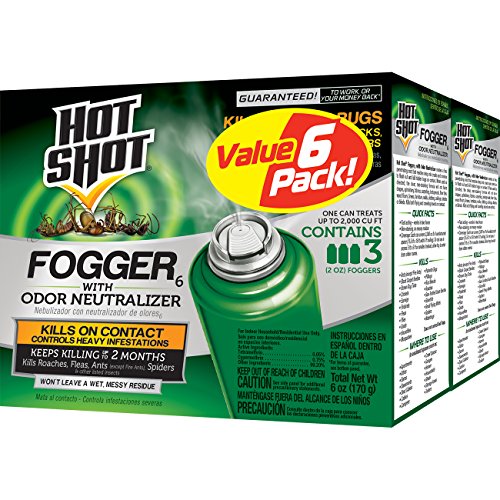
| Item Form | Aerosol |
|---|---|
| Target Species | Insects |
| Active Ingredients | Tetramethrin, Cypermethrin |
| Unit Count | 12 Ounce |
The HOT SHOT Total Release Fogger with Odor Neutralizer is a straightforward aerosol fogger designed to treat heavy indoor infestations by creating a penetrating mist that reaches hidden spaces. One can treats up to 2,000 cubic feet of unobstructed space and the formula is clear and non-staining so it can be used around upholstery, drapes, and floors when label directions are followed. It lists tetramethrin and cypermethrin as active ingredients and claims knockdown of many crawling and flying insects; however it does not control bed bugs. Typical use is to place a covered stand in a room, activate the fogger, leave the area for the recommended time, then ventilate thoroughly afterward. The odor neutralizer helps reduce lingering chemical smell compared with basic foggers. Important limitations are safety precautions for people and pets, the need to avoid small enclosed spaces, and that one fogger may not penetrate heavily cluttered rooms or reach insect harborage behind large furniture. For targeting spiders specifically, it can reduce visible populations and treat webs in corners but is best paired with cleaning and targeted residual treatments for long-term control.
Best for: Buyers who want a proven total-release fogger that quickly treats an entire room and reduces visible spider and insect populations, and who prioritize established brand performance and clear usage instructions.
Less Ideal for: People seeking a targeted, long-term residual solution for spider eggs or infestations in heavily cluttered spaces should consider spot sprays or professional treatment instead.
- Creates a fine mist that penetrates cracks and crevices to reach hidden insects
- Non-staining clear formula safe for fabrics and most household surfaces when used as directed
- Includes odor neutralizer to reduce lingering chemical smell after treatment
- Each can treats up to 2,000 cubic feet of unobstructed space
- Not labeled to control bed bugs
- Requires vacating the treated area and careful adherence to safety directions around people and pets
- Effectiveness is reduced in cluttered rooms or behind large furniture where fog cannot reach
Verdict: Choose this fogger if you want a trusted, whole-room aerosol that quickly knocks down visible spiders and other household insects while minimizing lingering odor.
HOT SHOT No-Mess! Total Release Fogger with Odor Neutralizer, 3 Pack (1.2 oz each)

| Item Form | Aerosol |
|---|---|
| Target Species | Insects |
| Liquid Volume | 4 fluid ounces |
| Active Ingredients | Tetramethrin, Cypermethrin, Piperonyl Butoxide |
The Hot Shot No-Mess! Fogger is a total-release aerosol designed to push a fine, dry fog into cracks, crevices and under furniture to flush out and kill hidden insects, with an added odor neutralizer so treated rooms are less likely to retain strong smells. Typical use is simple: place a covered stand in the center of the room, activate a single can, vacate the space for the recommended time and air out afterward; one can treats up to 2,000 cubic feet of unobstructed space. The formula lists tetramethrin and cypermethrin as active ingredients and claims contact kill plus residual control for several weeks, which helps manage recurring infestations without repeat daily application. Practical benefits include a dry, nonstaining mist that is safe for many household surfaces when used as directed and broad-spectrum activity against common household pests. Limitations are that it is for enclosed, ventilated spaces only, it does not control bed bugs, and safety precautions are essential because aerosols contain potent insecticides and must be used exactly per label instructions.
Best for: Buyers who prioritize a straightforward, one-shot indoor treatment to eliminate visible and hidden household insects and want a low-odor, nonstaining option that provides short-term residual control.
Less Ideal for: People seeking a solution specifically for bed bugs or those who need continuous, surface-safe daily treatments in occupied rooms should look at targeted baits, traps, or professional services instead.
- Creates a fine, dry fog that penetrates cracks and under furniture to reach hidden insects
- Contains odor neutralizer and is described as nonstaining for common household fabrics and surfaces
- Provides residual activity claimed up to six weeks to help reduce reoccurrence
- Single-can coverage up to 2,000 cubic feet for treating whole rooms without multiple devices
- Not effective for bed bug control
- Requires strict adherence to label safety steps and vacant, ventilated space during use
- Only intended for enclosed spaces and may not perform well in heavily cluttered or open areas
Verdict: A reliable single-can fogger for homeowners who want a low-odor, nonstaining way to reach and kill hidden household insects in enclosed rooms.
Choosing the Right Bug Bomb for Spiders: Key Factors to Consider
Aerosol Particle Size and Dispersal
How fine the aerosol is determines where the fog will travel and whether it contacts spiders in webbed corners or deep crevices. Finer particles suspend longer and can reach elevated webs and gaps under baseboards, but extremely fine aerosols may drift into HVAC returns and require stricter ventilation planning.
Dispersal design also matters. A timed-release canister that emits a steady fog will often create better room saturation than a short burst. Consider the square footage and ceiling height of the treatment area and choose a fogger whose recommended coverage aligns with the room geometry to maximize contact with spiders wherever they hide.
Active Ingredient Type and Residual Longevity
Different insecticide chemistries have different modes of action and residual lifetimes. Some act quickly on contact but leave little lasting residue, which is useful for a rapid knockdown. Others provide a residual film that can continue to affect wandering spiders for days or weeks after application.
Residual control reduces the need for repeat treatments but raises questions about surface contact for people and pets. Match the desired longevity with the room function and occupancy patterns. For areas where children or pets play, shorter residual options or targeted spot treatments may be preferable.
Label Restrictions and Indoor Safety
Labels specify where and how a bug bomb can be used safely. Check restrictions on occupied spaces, requirements for evacuating people and animals during treatment, and recommended reentry times. Some products also limit use on food-contact surfaces or in certain indoor structures like closets with stored fabrics.
Proper ventilation and following surface-cleaning instructions after treatment are critical to minimize exposure. If you plan to fog an attached garage, attic, or crawl space, confirm the label allows those uses and outlines how to seal vents, cover sensitive items, and verify safe reentry intervals.
Room Size, Layout, and Obstruction Management
Square footage and room layout influence how effective a fogger will be. Open rooms with minimal furniture allow the aerosol to circulate; cluttered spaces create pockets where spiders can survive. High ceilings, multiple alcoves, and packed storage areas reduce coverage unless you pair fogging with manual disturbance of webs and targeted spot sprays.
Plan to remove or cover food, dishes, and exposed pesticides, and understand that foggers are best used as part of an integrated approach. For multiroom infestations, use multiple foggers as directed by their coverage guidelines rather than expecting a single can to saturate adjoining closed rooms.
Application Ease and Cleanup Requirements
Ease of deployment affects whether you can safely and correctly use a bug bomb. Look for intuitive activation methods, clear timing guidance, and recommended ventilation steps. Some units have automatic timers that let you leave the room immediately, while others require manual handling to trigger the aerosol.
After treatment, labels often prescribe surface wiping for food-contact areas or laundering of exposed textiles. Consider the time and effort required for cleanup and whether the product's instructions fit your schedule and tolerance for post-treatment chores.
Impact on Non-Targets and Environmental Considerations
Fogging can affect beneficial arthropods and indoor air quality. Evaluate how the active ingredients behave in indoor settings and whether they have known effects on non-target insects that provide natural pest suppression. If you keep indoor plants, aquaria, or pollinator-attracting spaces nearby, plan protective measures before use.
Also consider how often you will treat. Frequent use increases cumulative exposure and the potential for residues to build up on surfaces. For long-term pest management, combine fogging with exclusion, habitat reduction, and targeted spot treatments to limit environmental impact.
Preparing the Room for a Fogging Treatment
Before you deploy a bug bomb, prep the space to maximize contact with spiders and minimize unnecessary exposure. Remove or cover exposed food, dishes, baby items, and pet bowls. Open cabinet doors slightly if the label permits to allow aerosol to enter enclosed spaces where spiders hide.
Seal or cover aquaria and houseplants, and disconnect or switch off sensitive electronics if the instructions recommend it. Create a checklist of items to remove or cover so you do not miss hidden storage boxes or clothing piles where spiders may be sheltering.
- Check the label for allowed indoor locations and reentry time
- Cover or remove food and dishes
- Move or cover pet bedding and toys
- Open closet doors and cracks if permitted by the label
Combining Fogging with Nonchemical Methods
Fogging is most effective when combined with mechanical controls. Remove webs, vacuum corners and crevices, and caulk gaps around doors and windows to reduce reinfestation. Clearance of clutter and regular sweeping make follow-up treatments less necessary.
Place sticky traps in basements and garages to monitor ongoing activity and confirm whether treatment reduced spider movement. Exclusion and sanitation lower spider attraction and limit the number of fogging events needed over a season.
- Vacuum and remove webs before treatment
- Use door sweeps and seal gaps to prevent entry
- Monitor with glue traps after treatment
Safe Ventilation and Reentry Practices
Follow the product reentry time exactly and ventilate aggressively before reoccupying the room. Open windows and run fans to move lingering aerosol out of the space. If the label suggests a post-treatment airing period, extend it slightly for added safety in poorly ventilated rooms.
After waiting the recommended interval, sweep and wipe accessible surfaces that might contact skin or food. Wash linens or clothing that were stored uncovered in the treated area if the label advises laundering.
- Adhere to label reentry intervals
- Ventilate with windows and fans for at least the recommended time
- Wipe high-contact surfaces after airing
Special Considerations for Garages, Attics, and Crawl Spaces
Outbuildings and seldom-used spaces have different risks and benefits. These areas often host more spiders, and fogging can be effective if the label permits structural use. However, ventilation is often limited, increasing residue persistence and the need for safe reentry planning.
In garages and crawl spaces, remove vehicles or cover them according to the instructions, and avoid applying foggers near stored fabrics or porous insulation unless the label allows it. For attics, ensure vents are sealed off to prevent aerosol from entering living spaces unexpectedly.
- Confirm label allows use in enclosed structures
- Cover or remove stored items that might absorb residues
- Plan longer ventilation for unventilated spaces
When to Choose Residual Versus Knockdown-Focused Foggers
If you have an active infestation with frequent sightings, a fogger with longer residual activity can reduce repeat treatments by affecting spiders that wander through treated surfaces. For occasional sightings or sensitive indoor environments, a knockdown-focused unit with minimal lasting residue may be safer.
Match your desired outcome to room use. High-traffic family rooms and kitchens usually favor lower-residue options, while storage areas and attics can tolerate longer persistence for extended control.
- Use residual foggers in low-occupancy storage spaces
- Prefer knockdown foggers in living areas and kitchens
- Combine with exclusion to limit future treatments
How We Chose the Best Bug Bomb for Spiders
We focused on products with labels that explicitly mention spider control or include broad-spectrum insecticides effective against crawling arachnids. Our editorial filters emphasized proven active ingredients with documented residual control and formulations designed to create a fine aerosol that penetrates cracks and elevated web sites. We prioritized clear, usable label directions for indoor and outbuilding applications and assessed safety information relating to reentry intervals and surface cleanup. Concrete evaluation criteria included aerosol particle size and dispersal design, active ingredient type and residual longevity, labeled indoor application scenarios and reentry/safety guidance, and practical usability such as trigger or timed release mechanisms and cleanup requirements. We excluded products labeled only for outdoor broadcast use or those lacking spider efficacy claims. We also filtered out foggers with unclear safety directions or with active ingredients unsuitable for typical occupied dwellings. The remaining entries reflect options that balance reach, lasting control, and practical deployment constraints gardeners and homeowners face.
FAQ
Are bug bombs effective against all common house spiders?
Bug bombs can reduce populations of many common house spiders when the aerosol contacts the insect directly or deposits a residual on pathways. Effectiveness varies by species behavior; web-building spiders high on walls or ceilings may require the aerosol to reach elevated webs or combined mechanical removal for best results.
How long should I stay out of the house after using a fogger?
Reentry intervals depend on the product label and the active ingredient. Many products recommend leaving the treated area closed for several hours and ventilating before returning. Always follow label directions and extend airing times for rooms with limited ventilation.
Can I use a bug bomb if I have pets or children at home?
Using foggers around pets and children requires extra caution. Remove people and animals during treatment and follow label guidance for when it is safe to return. Cover or remove pet dishes, toys, and bedding and ventilate thoroughly before allowing pets back into the space.
Will fogging eliminate spiders in an entire house from one room?
One fogging event in a single room rarely treats an entire house effectively unless doors and pathways are open and the product specifically covers multiple rooms. For whole-house activity, multiple cans placed per label coverage are usually needed, or targeted treatments in each affected room.
What should I clean after using a bug bomb indoors?
Clean food-contact surfaces, countertops, and dishes that may have been exposed to the aerosol according to label directions. Wipe down frequently touched surfaces and launder exposed fabrics if the instructions advise doing so. Cleaning reduces residue contact and any residual odor.
Final Verdict
Choose a bug bomb for spiders based on the space you plan to treat, how visible and active the infestation is, and the level of post-treatment cleanup you can manage. Prioritize units with labeled indoor uses, clear reentry guidance, and an aerosol design that matches your room geometry. Balance the desire for residual control against safety and surface persistence in living areas. With proper preparation, ventilation, and follow-up sanitation, fogging can be a practical component of a broader spider management plan.
