

Note: This article contains affiliate links. If you click on these links and make a purchase, I may earn a small commission at no extra cost to you. This helps support my research and content. Read my full affiliate disclosure here.
If you manage large landscapes, industrial sites, or commercial turf, selecting the right commercial weed killer affects labor, safety, and long-term plant health. You need something that eliminates target weeds reliably, fits your application routines, and reduces time spent on repeat spot treatments. This guide covers five top shortlist options for commercial weed control and explains how we evaluated coverage, persistence, and safety for different work settings. Read on to understand the practical tradeoffs of efficacy, application methods, and site protection so you can match a product to your maintenance schedule and legal requirements.
Top Picks at a Glance
| Best Overall The best all-around choice for most situations | Roundup Pro Concentrate Herbicide (2.5 gal) |  |
| Best Quality Built to a higher standard if you want something more solid | Roundup Pro Weed Killer 2.5 Gallon |  |
| Best Value The sweet spot between price and what you get | RM43 Total Veg Control Glyph Imazapyr Weed Preventer, 32 oz |  |
| Highest Rated A top-rated pick with lots of positive feedback | Roundup QuickPro Herbicide Powder |  |
| Most Popular A crowd favorite that many people choose with confidence | RM43 43% Glyphosate Plus Imazapyr Total Vegetation Control, 2.5‑Gallon |  |
Roundup Pro Concentrate Herbicide (2.5 gal)

| Unit Count | 300 Fluid Ounces |
|---|---|
| Liquid Volume | 2.5 gallons |
| Item Form | Liquid |
| Coverage | Up to 435,600 sq. ft |
Roundup Pro Concentrate is a high-concentration liquid herbicide intended for large-scale weed and brush control. It is mixed with water and applied with standard stainless steel or plastic sprayers, with dilution rates that let you adjust strength by target weed. The formulation advertises fast knockdown and becomes rainfast in about an hour, which helps after morning applications when weather is uncertain. A single 2.5 gallon jug covers a very large area, so it is cost effective for commercial properties, landscapers, and large turf or noncrop sites. Important practical points: it must be handled with care, kept away from people and pets until spray dries, and not used near water or runoff-prone areas. It requires following label directions for rates and timing to avoid off-target damage. This product is best for users who need broad, reliable control over extensive areas and have the right protective equipment and application gear.
Best for: Landscapers, groundskeepers, and commercial property owners who need reliable, large-area weed and brush control and prioritize efficiency and strong efficacy.
Less Ideal for: Small-plot gardeners, hobbyists, or anyone needing spot treatments near ornamentals or water features should consider lower-capacity or more targeted options.
- Concentrated formula covers very large areas from a single 2.5 gallon jug
- Becomes rainfast in about one hour, reducing loss from light rain after application
- Compatible with standard stainless steel or plastic sprayers for easy mixing and application
- Flexible dilution rates let you adjust strength for different weed types and densities
- Not suitable for use near water or where runoff is likely
- Requires careful handling and personal protective equipment due to toxicity
Verdict: A concentrated, professional-strength herbicide that delivers fast, large-area weed and brush control for commercial use.
Roundup Pro Weed Killer 2.5 Gallon

| Unit Count | 320 Fluid Ounces |
|---|---|
| Liquid Volume | 2.5 gallons |
| Item Form | Liquid |
| Coverage | non-selective broad spectrum coverage |
| Active Ingredients | Glyphosate |
Roundup Pro is a high-concentration glyphosate liquid designed for fast, broad-spectrum control of weeds, grasses, brush, and woody vegetation across large areas. It is mixed into stainless steel or plastic sprayers at label rates and applied for broadcast, spot, or directed treatments; label directions include calibrated rates for annuals, perennials, and woody plants so you can dial in intensity for the target. The 2.5 gallon concentrate treats many acres, making it economical for commercial users, municipalities, and contractors. Key practical benefits are a high active ingredient concentration for quicker kill, compatibility with non-ionic surfactants in hot weather to improve uptake, and a relatively short rainfast window so treatments are not easily washed off. Important limitations are that it is non-selective so it will kill desirable vegetation on contact and it requires careful handling and PPE because of the glyphosate concentration and safety precautions on the label.
Best for: Commercial landscapers, contractors, municipal vegetation crews, and farm or large-property managers who prioritize fast, economical control of extensive or tough vegetation.
Less Ideal for: Home gardeners, small-property owners, or anyone needing selective weed control near desirable plants should choose a targeted or lower-concentration product instead.
- High glyphosate concentration for faster, reliable control of tough weeds and woody vegetation
- Large 2.5 gallon concentrate treats many acres, lowering cost per acre for commercial use
- Clear label rates for annuals, perennials, and brush allow precise application for different targets
- Rainfast in about one hour which reduces the chance of rain washing away treatments
- Non-selective formulation will damage any desirable plants it contacts
- Requires careful mixing, appropriate sprayer materials, and protective equipment due to high concentration
Verdict: Choose this concentrate when you need a powerful, economical glyphosate solution for large-scale or commercial weed and vegetation control.
RM43 Total Veg Control Glyph Imazapyr Weed Preventer, 32 oz

| Unit Count | 32 Ounce |
|---|---|
| Liquid Volume | 0.25 gallons |
| Coverage | 4324 square foot |
| Item Form | Spray |
| Active Ingredients | surfactant |
RM43 Total Veg Control is a concentrated spray herbicide formulated with glyphosate and imazapyr for long‑term bare‑ground control and spot treatments. It is intended for use on noncrop areas such as fence rows, around farm buildings, vacant lots, and roadsides where no plant growth is desired. A single 32 oz bottle makes several gallons of spray solution and the manufacturer states it can treat up to about 4,324 square feet; the formula is rainfast in about two hours and has no entry restrictions once the spray has dried. Practical benefits include long residual prevention of regrowth, suitability for large areas, and the ability to kill woody brush and vines when used as directed. Limitations are that it must not be applied in the root zone of desirable trees, plants, or shrubs and it is for noncrop use only, so placement precision is important to avoid damage to wanted vegetation. Users should follow label safety directions and treat only locations where permanent vegetation control is required.
Best for: Buyers who need reliable, long‑term bare‑ground control on commercial properties, farm outbuildings, or large noncrop sites and prioritize efficiency and fewer repeat treatments.
Less Ideal for: Home gardeners who want spot control in mixed planting beds or anyone needing a selective product safe around desirable trees, shrubs, or turf should choose a different option.
- Long residual control that can prevent vegetation for up to 12 months
- Concentrated formula stretches a single 32 oz bottle into multiple gallons of spray solution
- Effective on a wide range of unwanted growth including brush, vines, and weeds
- Rainfast within about two hours and no reentry after spray dries
- Restricted to noncrop and bare‑ground areas and must be kept away from desirable plants' root zones
- Contains powerful active ingredients so careful application and PPE are required
Verdict: Choose RM43 if you need a concentrated, long‑lasting commercial solution to keep noncrop areas free of vegetation for up to a year.
Roundup QuickPro Herbicide Powder

| Item Form | Powder |
|---|---|
| Coverage | Non-selective broad spectrum coverage |
| Active Ingredients | Glyphosate, Diquat |
| Unit Count | 108.8 Ounce |
Roundup QuickPro mixes into water and is applied with standard sprayers to kill unwanted vegetation broadly and reliably. It combines a systemic ingredient, glyphosate, with the fast-acting contact herbicide diquat so you get both thorough root uptake and quicker visible control; the label states results can appear within 24 hours and treated foliage becomes rainfast in about an hour. Typical use is hand- or tank-spraying fence lines, industrial lots, driveways, and other non-crop areas where non-selective control is needed. The product is supplied as a powder with a clear mix rate of 1.5 ounces per gallon, which makes dosing straightforward for larger commercial jobs. Important limitations are safety and non-selectivity: it will damage or kill desirable plants if drift or overspray occurs, and standard protective practices are required. Also, because it contains glyphosate, users should follow local regulations and best practices for handling and disposal.
Best for: Commercial landscapers, facility managers, and grounds crews who prioritize dependable, fast-acting broad spectrum weed control for non-crop and hardscape areas.
Less Ideal for: Do not use this product where selective weed control is needed or in gardens with nearby desirable plants; homeowners seeking gentle or organic options should consider alternatives.
- Combines glyphosate and diquat for both systemic and fast contact control
- Powder form with a simple labeled mix rate for consistent dosing
- Rainfast in about one hour so treatments are less affected by short storms
- Suitable for large or commercial-scale non-selective weed control
- Visible results can appear within 24 hours
- Non-selective formulation can harm desirable plants if not carefully applied
- Contains glyphosate which requires careful handling and adherence to regulations
Verdict: Choose Roundup QuickPro when you need a fast, reliable, commercial-strength non-selective herbicide that combines systemic and contact action for rapid weed control.
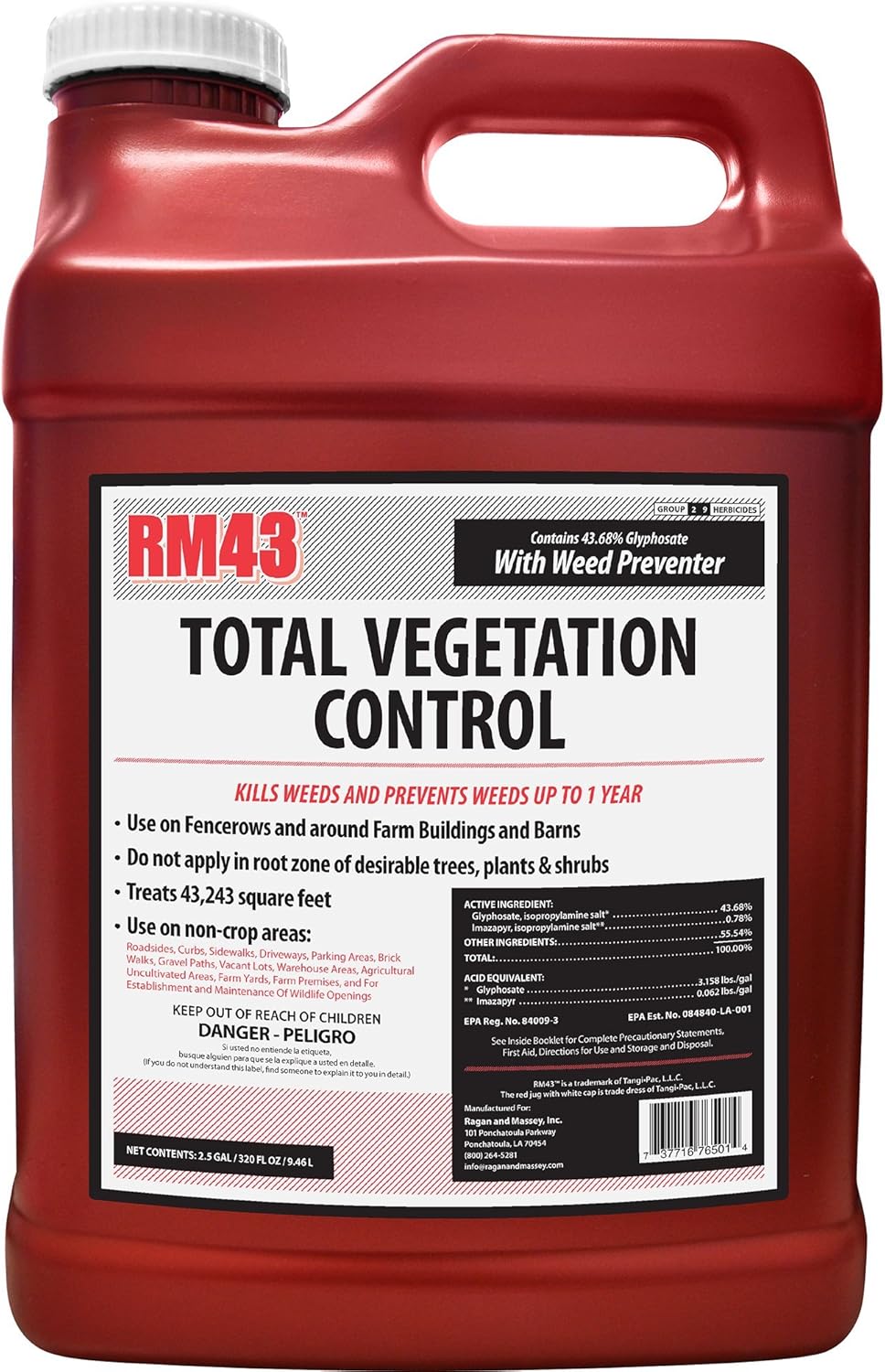
RM43 43% Glyphosate Plus Imazapyr Total Vegetation Control, 2.5‑Gallon
| Unit Count | 320 Fluid Ounces |
|---|---|
| Liquid Volume | 320 fluid ounces |
| Active Ingredients | Glyphosate isopropylamine salt, Imazapyr isopropylamine salt |
| Coverage | 43,243 square feet |
| Item Form | Liquid |
RM43 is a concentrated liquid herbicide that combines glyphosate and imazapyr to kill existing weeds and suppress regrowth for extended periods. It is designed for use on non‑crop areas such as fence rows, driveways, gravel paths, parking areas and around farm buildings where you want complete vegetation control. The product treats large areas from a single 2.5‑gallon container and becomes rain‑fast within about two hours, allowing treated areas to be reentered once the spray has dried. Notable features include a dual active‑ingredient formula effective against grasses, broadleaf weeds, vines, brush and small woody plants, and instructions for both spot treatments and blanket bare‑ground applications. Important limitations are that it is formulated only for non‑crop use and will damage desirable plants if sprayed over their root zones, and its long‑lasting control means treated soil will remain bare so plan accordingly. Users should follow label directions and wearing appropriate PPE when mixing and applying concentrated herbicides.
Best for: Buyers who need reliable, long‑lasting vegetation control on commercial or farm properties and prioritize efficacy and proven performance over selectivity. Ideal for property managers and landowners who want to treat large problem areas once and reduce follow‑up maintenance.
Less Ideal for: Home gardeners who need selective weed control around ornamentals, lawns, or vegetable beds should look for targeted products instead. Those unwilling to follow label safety precautions or who need short‑term, temporary control are not a good fit.
- Concentrated 2.5‑gallon formula covers large areas without frequent repurchasing
- Dual actives (glyphosate plus imazapyr) provide strong control of weeds, brush and vines
- Rainfast in about two hours which reduces the window for reapplication after light rain
- Can be used for both spot treatment and total vegetation control on bare ground
- Not selective and will kill desirable plants if contacted or applied over roots
- Intended for non‑crop areas only so it is unsuitable near gardens or lawns with desirable vegetation
- Requires careful handling and personal protective equipment when mixing and applying
Verdict: Choose RM43 when you need one application that reliably kills and prevents regrowth across large non‑crop areas for up to a year.
Choosing the Right Commercial Weed Killer: Key Factors to Consider
Weed Spectrum and Target Species
Different formulations control different groups of weeds. Some are primarily effective on annual broadleaf weeds, while others suppress deep-rooted perennials or grassy species. Knowing the dominant species in your landscape allows you to select a product whose active ingredients target those weeds specifically.
Misaligned selection leads to wasted applications and recurring problems. For commercial sites with mixed weed populations, choose a product labeled for broad-spectrum control or plan a tank mix strategy consistent with label directions to cover gaps.
Residual Activity and Re-treatment Interval
Residual control determines how long the herbicide prevents new weeds from emerging. Longer residuals reduce labor by extending the interval between treatments, but they can also limit planting or reseeding windows and increase risk to desirable plants. Consider how long you need soil activity to last based on site use and planting plans.
Short-residual products are useful for areas where reestablishment or overseeding is planned soon. For roadsides, industrial pads, or around hardscapes, longer residual control can be an advantage if label restrictions and environmental rules permit.
Application Method and Equipment Compatibility
Commercial application settings vary from boom sprayers to backpack units and handheld wands for spot control. Confirm the product label lists compatible equipment and calibration rates for the sprayer type you use. Some concentrates require precise dilution and pressure ranges to achieve proper coverage.
Application compatibility also affects labor and coverage speed. A product suited only to spot treatment may be inefficient for large acreages, while a formulation that tanks mixes and sprays evenly from booms will speed up large-area control.
Operator Safety, PPE, and Regulatory Requirements
Commercial herbicides carry specific safety requirements. Labels specify required personal protective equipment, re-entry intervals, and environmental precautions such as buffer zones near water. These restrictions affect staffing, timing, and permissible use in sensitive areas.
Always review label hazard statements and comply with local regulations. Products that require less restrictive PPE or have lower off-target risks can reduce operational complexity and potential liability.
Environmental Fate and Site Sensitivity
How a herbicide moves and breaks down in soil and water influences where and how it can be used. Products with high leaching potential or long soil half-lives may be unsuitable for sloped or sandy sites near waterways. Consider soil type, rainfall patterns, and proximity to sensitive vegetation when selecting a product.
On sites with pollinator plantings, ornamental beds, or adjacent crops, choose materials and application timings that minimize drift and non-target exposure, and follow label buffer zone guidance closely.
Mixing, Storage, and On-Site Handling
Commercial operations value formulations that are easy to measure, mix, and store. Concentrates that require complex multi-step mixing increase risk of measurement errors or spills. Look for clear calibration charts and packaging that reduces splash and waste during decanting.
Proper storage stability and instructions for disposal matter for large operations. Products with stable shelf life and simple cleanup instructions reduce downtime and the chance of accidental contamination.
Timing Treatments for Best Results
When you schedule applications matters as much as the product you choose. Pre-emergent options are most effective when applied before weed seeds germinate, usually in early spring or late summer depending on species. Post-emergent controls work best when target weeds are actively growing and not under drought or heat stress.
For perennial weeds, consider follow-up treatments timed to when carbohydrate reserves are moving to roots, typically late summer or early fall. Adjust timing for local climate and the specific biology of the weeds you need to control.
- Apply pre-emergents before weed germination for optimal prevention.
- Target post-emergents when weeds are actively growing and succulent.
- Schedule perennial treatments to coincide with root translocation periods.
Mixing and Calibration Best Practices
Accurate mixing and sprayer calibration ensure the right dose reaches the target and reduces waste. Use measuring tools calibrated to the product type and mix in a dedicated, ventilated area. Add adjuvants only if the label explicitly allows them and the combination is compatible.
Calibrate sprayers by measuring the output per nozzle at working pressure and walking speed. Record calibration numbers for repeatability across crews and jobs.
- Measure output per nozzle to set application rate.
- Rinse containers and equipment following label directions to avoid cross-contamination.
- Keep a written calibration and mixing log for each treatment.
Minimizing Off-Target Damage
Drift and runoff are the main ways herbicides harm non-target plants. Use proper nozzle selection, lower boom heights, and avoid spraying when wind is likely to carry droplets to sensitive areas. Consider using shielded applicators or wiper systems for targeted treatments next to desirable vegetation.
Maintain buffer zones and observe replanting restrictions. Where possible, use physical barriers or selective application tools to protect ornamental beds, pollinator strips, and water features.
- Avoid spraying during windy conditions or temperature inversions.
- Use shielded applicators or wipers near sensitive plants.
- Follow label-specified buffer zones and runoff precautions.
Tank Mixing and Compatibility Considerations
Tank mixes can expand weed control spectrum but increase the risk of incompatibilities. Always perform a jar test before mixing products at field rates and check label directions for prohibited combinations. Some active ingredients neutralize each other or change the pH, which can affect performance.
When combining products, track total surfactant load and any increased PPE or environmental precautions required by the labels in the mix.
- Do a small jar test for compatibility before field mixing.
- Keep a log of successful mixes and any observed phytotoxicity.
- Adjust spray schedules if tank mixes change re-entry or buffer requirements.
Recordkeeping and Compliance for Commercial Sites
Commercial applications often require documentation for regulatory compliance and liability control. Maintain records of product used, applied rate, application date, weather conditions, and applicator identity. This information helps with traceability if complaints or regulatory questions arise.
Include inspection notes and follow-up treatment plans in your records so you can evaluate efficacy and adjust strategies over time.
- Log product, rate, date, applicator, and weather for each job.
- Keep labels and safety data sheets on file for regulatory inspections.
- Document follow-up checks to verify control and note any re-treatments.
How We Chose the Best Commercial Weed Killer
We focused on factors that matter to professionals and grounds managers. We prioritized weed control products that demonstrate broad-spectrum efficacy against common annual and perennial weeds found on commercial properties, and that offer predictable residual activity when used according to label directions. Application flexibility was essential, so we included only products with multiple compatible delivery methods or clear instructions for boom, backpack, or spot treatments. Safety and environmental risk were weighed heavily. We favored formulations with detailed label instructions for buffer zones, protective equipment, and runoff prevention. Persistence and re-treatment interval informed suitability for high-traffic areas versus dormant-season treatments. We also considered ease of mixing, calibration guidance, and packaging options that reduce waste or simplify measuring in field conditions. Exclusions included products without clear commercial labeling, items lacking documented application rates for large-area treatments, and any formulae missing robust safety guidance for applicators and sensitive sites. The criteria we used align with the scoring metrics below to help you compare coverage, safety, and handling at a glance.
FAQ
Can commercial herbicides be used near water?
It depends on the active ingredient and label instructions. Many commercial formulations require buffer zones and have specific runoff precautions. Always follow label guidance and local regulations when applying near waterways.
How long should I wait to replant after applying a residual commercial product?
Replanting intervals vary by product and target species. Labels list planting restrictions and safe intervals. If you plan overseeding or installing new plantings, choose a product with an appropriate replant window or use a non-residual post-emergent instead.
Are there safer application methods to protect nearby ornamentals?
Yes. Shielded sprayers, wipers, and directed spot treatments reduce drift. Lower nozzle pressure and choose coarse droplet nozzles to minimize airborne movement. Physical barriers and careful timing also help protect ornamentals.
How do I decide between pre-emergent and post-emergent approaches?
Use pre-emergents to prevent seed germination in areas where you can predict weed flushes. Use post-emergents to kill existing weeds. Many commercial programs combine both strategies seasonally to reduce overall weed pressure.
What PPE is typically required for commercial applications?
PPE varies by formulation but commonly includes protective clothing, gloves, eye protection, and sometimes respirators for concentrated mixing. The product label specifies required PPE and must be followed for applicator safety and compliance.
Can I tank mix herbicides to broaden control?
Often you can, but compatibility and label directions matter. Perform a jar test before field mixing and ensure the combined labels do not prohibit the mix. Keep records of successful mixes and watch for any increased environmental or PPE requirements.
Final Verdict
Choose a commercial weed control product by matching the active ingredient profile to the weed species you need to manage, then confirm application methods and safety requirements fit your operation. Prioritize label clarity, environmental precautions, and ease of mixing to reduce the risk of off-target damage and regulatory issues. Balance residual needs against planting plans and site sensitivity. With clear records and properly timed applications you can reduce repeat treatments and maintain a professional landscape or site with predictable results.
