

Note: This article contains affiliate links. If you click on these links and make a purchase, I may earn a small commission at no extra cost to you. This helps support my research and content. Read my full affiliate disclosure here.
If you handle regular heavy cutting around your property, a prosumer chainsaw gives you the power and durability beyond consumer-grade tools without stepping up to full commercial gear. The right prosumer chainsaw performs reliably on large limbs, fallen trees, and frequent firewood cutting while remaining maintainable by a homeowner or small property manager. This guide shortlists the top prosumer chainsaws and explains why each made the list. We focused on cutting performance, durability, safety features, and ease of service so you can pick the saw that matches the workload and maintenance skills you have. Read on to see the evaluation criteria and the practical pros and cons to expect in this class of saws.
Top Picks at a Glance
| Best Overall The best all-around choice for most situations | Husqvarna 455 Rancher Gas Chainsaw, 20 in, 3.5 HP |  |
| Best Quality Built to a higher standard if you want something more solid | Husqvarna 460 Rancher Gas Chainsaw, 24-inch |  |
| Best Value The sweet spot between price and what you get | EGO POWER+ CS1611 16" Cordless Chainsaw with 56V 2.5Ah Battery and Charger |  |
| Highest Rated A top-rated pick with lots of positive feedback | EGO POWER+ 18" Cordless Chainsaw (CS1810) |  |
| Most Popular A crowd favorite that many people choose with confidence | Husqvarna 450 Rancher 20" Gas Chainsaw (50.2 cc, X-Torq) |  |
Husqvarna 455 Rancher Gas Chainsaw, 20 in, 3.5 HP

| Power Source | Gas Powered |
|---|---|
| Horsepower | 3.5 hp |
| Chain Length | 20 inches |
The Husqvarna 455 Rancher is a work-oriented gas chainsaw built for homeowners and landowners who need dependable cutting power without stepping up to professional-only models. It pairs a 3.5-HP X-Torq engine with a 20-inch bar to handle limb work, storm cleanup, and mid-size firewood cutting. Features such as Smart Start, inertia-activated chain brake, side-mounted chain tensioning, Air Injection centrifugal cleaning, and LowVib vibration dampening make the saw easier to start, maintain, and control during extended use. In practice you get strong cutting performance and fewer filter cleanings in dusty conditions, plus ergonomics that reduce arm fatigue on longer jobs. The trade-offs are the usual ones for a gas saw: it requires fuel mixing and routine 2-stroke maintenance, it is heavier and louder than battery models, and occasional tuning may be needed to keep peak performance. For a buyer seeking a durable, midweight chainsaw that balances user-friendly features with real cutting muscle, the 455 Rancher fits that niche well.
Best for: Best for prosumer buyers who want a single, dependable gas saw that handles routine property maintenance, firewood cutting, and storm cleanup while prioritizing reliable power and user-friendly features.
Less Ideal for: Not a good choice for users wanting a quiet, low-maintenance solution for occasional small yard tasks or for those who prefer battery-powered convenience and minimal upkeep.
- 3.5 HP X-Torq engine provides strong cutting power for mid-size jobs
- Smart Start and side-mounted tensioning simplify starting and on-the-fly adjustments
- Air Injection centrifugal system reduces debris reaching the air filter for longer engine life
- LowVib technology and ergonomic front handle improve comfort during extended use
- Requires 2-stroke fuel mixing and routine engine maintenance inherent to gas chainsaws
Verdict: A balanced, midweight gas chainsaw that delivers real cutting power and pro-style features for homeowners and landowners who need dependable, long-lasting performance.
Husqvarna 460 Rancher Gas Chainsaw, 24-inch

| Power Source | Gas Powered |
|---|---|
| Horsepower | 3.6 |
| Chain Speed | 24 inch |
| Manufacturer Warranty Description | 2 years |
The Husqvarna 460 Rancher is built for prosumers who need sustained cutting power for firewood, farm work, and large tree jobs. Its 60.3-cc, 3.6-HP X-Torq two-stroke engine delivers robust torque at low RPMs, and Smart Start plus combined choke/stop controls make cold starts easier and reduce the chance of flooding. Features like Air Injection centrifugal cleaning and an automatic adjustable oil pump help the engine run cleaner and reduce maintenance frequency. Ergonomic touches include LowVib vibration reduction, a 7-degree offset front handle for better grip, side-mounted chain tensioning for quick adjustments, and an inertia chain brake for safety. The 24-inch bar capacity extends cutting reach for large-diameter logs but also means the saw is heavier and less maneuverable for detailed work. This model is most useful for owners needing high-performance, gas-powered cutting rather than occasional light pruning, and it assumes familiarity with two-stroke fueling and routine maintenance.
Best for: A buyer who needs a high-performance, gas-powered saw for heavy-duty property work, firewood cutting, or frequent large-tree jobs and values reliable power and uptime over lightweight portability.
Less Ideal for: Casual gardeners, occasional users, or anyone who prefers low-maintenance battery or electric saws for small pruning and yard tasks.
- High power output from a 60.3-cc X-Torq engine for demanding cuts
- Smart Start and combined choke/stop controls for easier starting
- Air Injection system reduces debris reaching the air filter and extends engine life
- Side-mounted tensioning and automatic oil pump simplify on-the-job adjustments
- LowVib and ergonomic handle improve control during prolonged use
- 24-inch bar and heavier weight reduce maneuverability for fine trimming or overhead work
- Requires mixing two-stroke fuel and routine gas-engine maintenance
Verdict: Choose the 460 Rancher if you want a rugged, high-torque gas chainsaw built to handle regular heavy cutting and large-diameter logs.
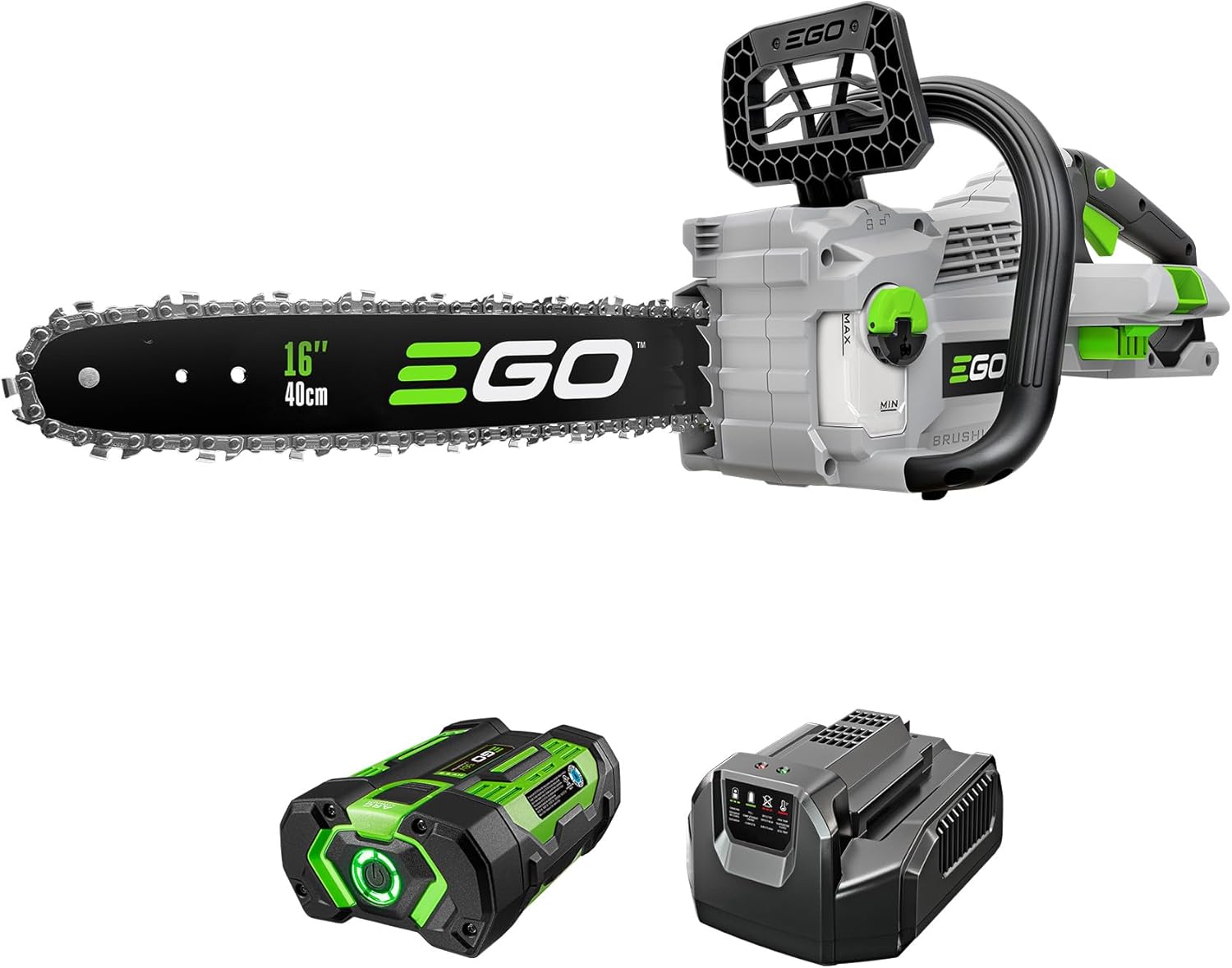
EGO POWER+ CS1611 16" Cordless Chainsaw with 56V 2.5Ah Battery and Charger
| Power Source | Battery Powered |
|---|---|
| Horsepower | 2.3 |
| Chain Length | 16 inches |
| Included Components | 2.5Ah Battery and Standard Charger |
| Chain Speed | 20 m/s |
The EGO POWER+ CS1611 is a battery-powered 16-inch chainsaw built to give prosumer-level cutting performance without gas. It uses a high-efficiency brushless motor rated as a 40CC equivalent and runs on the included 56V 2.5Ah ARC Lithium battery, which the manufacturer says delivers up to about 130 cuts through a 4×4 on a single charge. Notable features include a 20 m/s chain speed for efficient cuts, a tool-free chain-tensioning dial for quick on-the-job adjustments, automatic oiling with a spill-free reservoir, metal bucking spikes for secure cutting, and an IPX4 weather resistance rating. In real use this means quieter, low-maintenance operation compared with gas saws, fast setup between cuts, and enough runtime for routine property work like limb removal, small tree felling, and firewood prep. Limitations are battery runtime for very heavy or continuous commercial use and the saw’s 16-inch bar, which restricts maximum cut diameter compared with larger pro gas models.
Best for: Buyers wanting a low-maintenance, gas-free alternative that still delivers near-gas power for regular property maintenance, pruning, and medium-duty cutting tasks.
Less Ideal for: Users who need long uninterrupted runtime for commercial logging or must cut very large-diameter timber should consider larger gas or higher-capacity battery systems.
- Brushless motor with 40CC gas-equivalent power for strong cutting performance
- Includes 56V 2.5Ah battery and charger so it is ready to use out of the box
- Tool-free chain tensioning lets you adjust the chain quickly on site
- Automatic oiling with a spill-free reservoir keeps the chain lubricated during work
- IPX4 weather resistance and metal bucking spikes add durability and control in outdoor conditions
- 16-inch bar limits maximum cut diameter compared with larger pro chainsaws
- Runtime depends on battery capacity and may be insufficient for long, continuous heavy-duty jobs
Verdict: A ready-to-use cordless chainsaw that gives near-gas power and easy on-the-job adjustments, ideal for homeowners and pros doing regular medium-duty cutting.
EGO POWER+ 18" Cordless Chainsaw (CS1810)

| Power Source | Battery Powered |
|---|---|
| Model Number | CS1810 |
| Manufacturer Warranty Description | 5 Year Tool |
| Item Type Name | CHAINSAW |
The EGO POWER+ 18" cordless chainsaw aims to deliver gas-level cutting power without fumes or the noise of a gas engine. It is powered by EGO 56V ARC Lithium batteries (sold separately) and uses a 2500W brushless motor that the manufacturer equates to a 50cc gas unit. Typical tasks are cutting large branches, bucking logs, and felling medium trees where an 18" bar is useful. Notable features include a digital LED display for speed modes and battery readout, an adjustable LED work light for low-light jobs, IPX4 weather resistance, tool-free chain tensioning, and large bucking spikes for better leverage. In practice this makes the saw convenient to start, simple to maintain, and suitable for repeated cuts when paired with a higher-capacity battery. Limitations are the dependence on EGO batteries which must be purchased separately and reduced run time compared with gas for heavy continuous work; users doing extended remote jobs will need spare batteries or a generator-backed charging solution.
Best for: Buyers who prioritize dependable, low-maintenance power and want a cordless saw that performs like a mid-size gas model for property maintenance and prosumer tasks.
Less Ideal for: Those who need long continuous runtime for remote commercial logging without access to spare batteries or onsite recharging should consider gas-powered alternatives.
- Gas-equivalent brushless motor delivers strong chain speed for demanding cuts
- Tool-free chain tensioning makes adjustments quick and user-friendly
- Digital LED display and adjustable work light improve control and visibility on site
- IPX4 weather resistance and metal bucking spikes increase durability and cutting stability
- Battery and charger not included so sustained use requires purchasing compatible batteries separately
- Run time depends on battery capacity and may be shorter than a gas saw for long uninterrupted jobs
Verdict: If you want near gas-level cutting performance with the cleanliness and convenience of cordless operation, this 18" EGO chainsaw is a reliable prosumer choice.
Husqvarna 450 Rancher 20" Gas Chainsaw (50.2 cc, X-Torq)

| Power Source | Gas Powered |
|---|---|
| Horsepower | 3.2 hp |
| Chain Length | 20 inches |
| Included Components | Gas Chainsaw, Owners Manual |
The Husqvarna 450 Rancher is a workhorse-style gas chainsaw aimed at homeowners and prosumers who need pro-level cutting power without a commercial price. It uses a 50.2-cc X-Torq two-stroke engine rated at about 3.2 horsepower and is set up for bar lengths up to 20 inches, so it handles limb pruning, storm cleanup, and cutting firewood with authority. Notable features that improve usability are Smart Start for easier cranking, Air Injection centrifugal cleaning to reduce air filter maintenance, LowVib vibration reduction, an ergonomic asymmetrical rear handle and inertia-activated chain brake for safer stops. In practice those features mean faster starts, fewer tune-ups, and more comfortable sessions when cutting moderate to large-diameter wood. The main compromises are the usual ones for a gas saw: you need to mix fuel and oil and perform periodic maintenance, and it is heavier and louder than battery models. If you want a robust, serviceable saw that performs like a light professional unit, the 450 Rancher delivers consistent power and proven Husqvarna durability.
Best for: Buyers who want near-professional cutting performance for regular yard work or firewood without stepping up to commercial saws and who prefer proven, serviceable gas power.
Less Ideal for: Casual users who prioritize low noise, zero-emissions operation, or minimal maintenance should consider battery or corded electric models instead.
- Powerful 50.2-cc X-Torq engine suitable for heavy pruning and firewood cutting
- Smart Start and air purge features make starting and engine upkeep easier
- LowVib system and ergonomic handle improve comfort during extended use
- Centrifugal Air Injection reduces debris reaching the air filter for longer engine life
- Requires mixed fuel and routine engine maintenance typical of gas chainsaws
- Heavier and louder than cordless electric alternatives
Verdict: Choose the Husqvarna 450 Rancher when you need reliable, near-professional gas power and proven durability for demanding home and property cutting tasks.
Choosing the Right Prosumer Chainsaw: Key Factors to Consider
Engine or Motor Power Relative to Bar Length
Matching power to bar length determines how smoothly a prosumer chainsaw cuts through larger-diameter wood. Too little power on a long bar causes the chain to bog down, increases fuel or battery demand, and accelerates wear on the drive components. Consider the typical diameter of wood you will cut and choose a power output that allows the saw to pull through thick cuts without stalling.
For gas models, pay attention to displacement and torque curves. For battery-electric prosumer saws, look at continuous power ratings and battery capacity, since high loads over long cuts stress the battery and can change the saw's effective performance. A well-matched power-to-bar ratio reduces cutting time and component stress.
Build Quality and Component Durability
Prosumer use subjects a saw to repeated heavy cycles, so materials and construction matter. Look for robust crankcase materials, heat-resistant plastics around the engine or motor, and hardened bars and sprockets that resist wear. Chain grade and the presence of replaceable wear items influence long-term ownership costs and downtime.
Fasteners, housing vents, and the quality of the chain tensioner also affect how well a saw holds up after a season of heavy use. Durable components reduce the chance of sudden failures during critical jobs and make routine servicing less frequent.
Safety Systems and Ergonomics
A prosumer chainsaw will be used on large, sometimes unstable pieces of wood, so reliable safety features are essential. A responsive chain brake, effective hand guards, and anti-kickback chain designs lower the chance of injury. Ergonomic handle shapes, reachable controls, and effective anti-vibration mounts reduce fatigue, letting you maintain better control during long jobs.
Also consider visibility of the cutting line, throttle lock logic, and whether the saw allows gloved operation of key controls. Safer saws make tougher jobs both faster and less risky.
Ease of Routine Maintenance
Prosumer saws need regular service like chain sharpening, tensioning, air filter cleaning, and spark plug or brush replacement. A design that gives easy access to these points shortens downtime and keeps the saw performing at peak efficiency. Tool-less chain tensioners, accessible air filter doors, and clear marks for bar alignment are all features that speed maintenance.
If you prefer to do maintenance yourself, prioritize a saw with straightforward service steps and good parts availability. For battery models, also examine battery replacement and electronics access for longevity.
Weight, Balance, and Handling
Even a powerful chainsaw is only useful if you can control it comfortably. Weight and how that mass is distributed affects cutting accuracy and operator fatigue. A well-balanced saw stays steady in plunge cuts and when following a felling cut, while a top-heavy or poorly balanced unit increases wrist and shoulder strain.
Consider the typical duration of your cutting sessions. If you plan on repeated long shifts of firewood or storm cleanup, a lighter, better-balanced model reduces strain and the chance of sloppy cuts that lead to dangerous kickback or bind.
Gas Versus Battery Prosumer Options
Both gas and battery prosumer chainsaws have advantages depending on your site and workflow. Gas saws typically deliver consistent high torque for long cuts and are refueled quickly in the field, which is useful when working where recharging is not convenient. Battery saws offer cleaner operation, lower vibration in some designs, and simpler start-up; newer high-voltage battery systems can approach the cutting power of smaller gas engines for many homeowner use cases.
Think about how often you will be near a power source, how much continuous cutting you do, and your tolerance for routine engine maintenance. For occasional heavy use in remote areas, gas often remains the practical choice. For regular property maintenance near a garage or workshop, a battery prosumer saw can reduce emissions, noise, and routine engine servicing.
- Gas: better sustained torque for long, heavy cuts; requires fuel and routine engine care.
- Battery: quieter, cleaner, easier starting; limited by battery capacity and recharge time.
Bar Length Choices and Typical Uses
Bar length drives what size material you can cut safely and efficiently. Shorter bars, around 12 to 16 inches, are easier to handle and better for limbing and trimming. Mid-length bars in the 16 to 20 inch range are versatile for firewood and small tree felling, while long bars over 20 inches are intended for larger trunks and more demanding jobs.
Choose a bar length that covers most of your typical cuts rather than always reaching for the longest bar. Longer bars add weight and change handling characteristics, and they also require a powerplant that can sustain the load.
- 12-16 in: limbing, pruning, precise work.
- 16-20 in: general-purpose firewood and small trees.
- 20+ in: large trunks, heavy removals, more demanding operator skill required.
Maintaining Chain Sharpness and Tension
A sharp, correctly tensioned chain makes cutting faster and safer. Chains dull with use, especially when they contact dirt or frozen wood, so plan to sharpen or replace cutters regularly depending on the workload. Carry a round file sized to the chain, or keep a sharpener in your workshop, and check chain tension before each session.
Proper tension reduces wear on the bar and sprocket. Many prosumer saws include tool-less tensioners that simplify the process, but always follow the maker's guidance on tension and lubrication to avoid premature failure.
- Sharpen after noticeable drop in cutting speed or when cutters look rounded.
- Check tension and bar oil level before each use.
Noise, Emissions, and Site Considerations
Noise and emissions affect where and when you can run a chainsaw. Gas prosumer saws are louder and emit exhaust, which is important to consider on suburban lots or when working near neighbors. Battery saws reduce local emissions and can make long sessions more comfortable for the operator.
Also consider local regulations or neighborhood expectations about noisy work. If you frequently cut on restricted schedules, a battery unit or a low-noise gas model with good muffling can reduce conflicts.
- Battery models offer lower noise and zero local exhaust.
- Gas models often have higher noise and require fuel handling precautions.
Transport, Storage, and Winter Use
How you store and transport a chainsaw affects readiness and longevity. For gas saws, winter storage requires fuel management and periodic starting to keep the carburetor and seals in good shape. Battery saws need proper long-term battery care and cool, dry storage to preserve cell life.
Consider a dedicated case, bar cover, and a clean storage spot to prevent rust and accidental damage. If you expect to use the saw in freezing conditions, verify that the model's lubrication system and fuel management are rated for cold starts or that battery chemistry handles low temperatures.
- Protect the bar and chain with a cover during transport.
- Store batteries at recommended charge levels and temperatures.
How We Chose the Best Prosumer Chainsaw
We selected prosumer chainsaws by applying practical, gardener- and landowner-focused filters that predict real-world reliability and user experience. Primary evaluation criteria included engine or motor power measured against bar length to ensure adequate cutting force for larger limbs and small trees; build and materials quality such as crankcase construction, bar and sprocket durability, and chain metallurgy; and cooling and air filtration systems that affect runtime and maintenance intervals for heavy use. We also scored safety and user controls including chain brake responsiveness, anti-vibration systems, and throttle/stop ergonomics that reduce fatigue during longer jobs. Serviceability was another key filter: ease of routine maintenance tasks like chain tensioning, bar removal, spark plug access, and air filter cleaning were essential. Finally, we considered weight and balance because a powerful saw that is too unwieldy defeats its usefulness for homeowner operators. We excluded light consumer models and professional-only commercial chainsaws that require specialized servicing or commercial licensing. The final list focuses on prosumer-grade machines that strike a practical balance between power, durability, and homeowner-level serviceability.
FAQ
What bar length should I choose for a prosumer chainsaw?
Bar length depends on the diameter of wood you cut most often. Short bars around 12 to 16 inches are easier to control for limbing and pruning. Mid-length bars near 16 to 20 inches suit general firewood and small trees, while bars over 20 inches are for larger trunks and require more power and skill.
How often should I sharpen the chain during heavy use?
Sharpening frequency depends on wood type and contact with dirt, but with heavy use you may need to sharpen daily or every few hours of cutting. Monitor cutting speed and the shape of the cutters and file when cutters round off or cutting slows noticeably.
Are battery prosumer chainsaws powerful enough for property-scale work?
Modern high-voltage battery prosumer saws can handle many property-scale tasks, especially if you have a charging routine or spare batteries. They are quieter and cleaner, but for extended continuous heavy cutting in remote locations, gas models still provide longer runtime without recharging.
What maintenance should I do before storing a prosumer chainsaw for winter?
For gas saws, run the engine to use up or stabilize fuel, change the bar oil if contaminated, clean the air filter, and fog the cylinder if long storage is planned. For battery saws, store batteries at recommended charge levels and in a cool, dry place. In all cases, clean the chain and bar, and protect the bar with a cover.
How important is anti-vibration when choosing a prosumer chainsaw?
Anti-vibration reduces operator fatigue and helps maintain control during long jobs. It can also reduce the long-term strain on your hands and arms. For frequent or extended cutting sessions, choose a saw with effective vibration isolation and comfortable handle geometry.
Final Verdict
Choosing a prosumer chainsaw means balancing raw cutting capability with durability and maintainability. Prioritize a saw whose power and bar length match the diameter of wood you handle most often, and look for durable construction and accessible routine maintenance points so the saw stays reliable season after season. Safety features and good balance are essential tradeoffs to reduce fatigue and risk during heavy tasks. Focus on the factors that matter for your property: power-to-bar matching, ease of service, and whether a gas or battery platform fits your workflow. A thoughtful choice here yields a saw that cuts cleanly, lasts through heavy seasons, and is a dependable tool for serious homeowners.
