

Note: This article contains affiliate links. If you click on these links and make a purchase, I may earn a small commission at no extra cost to you. This helps support my research and content. Read my full affiliate disclosure here.
Bahia grass responds to feeding differently than common lawn grasses, so choosing the right fertilizer matters for color, density, and drought resilience. In practical garden terms, the best fertilizer for Bahia grass supplies the right type and timing of nitrogen, keeps soil pH and micronutrients balanced, and minimizes burn risk during hot summers. This guide covers seven shortlisted fertilizers that fit a Bahia lawn profile and explains the evaluation criteria we used, such as nutrient formulation and ease of application. Read on to understand how product features affect real-world lawn outcomes and which traits matter most for your yard.
Top Picks at a Glance
| Best Overall The best all-around choice for most situations | Simple Lawn Solutions 16-4-8 Liquid Lawn Fertilizer (32 oz) |  |
| Best Quality Built to a higher standard if you want something more solid | The Andersons Core 24-6-12 Professional All-Purpose Lawn Fertilizer, 18 lb (covers 6,200 sq ft) |  |
| Best Value The sweet spot between price and what you get | Scotts Green Max Lawn Food (covers 5,000 sq ft) |  |
| Best Budget The cheapest option that still gets the job done reliably | GreenView Lawn Food 22-0-4, 16 lb Bag (covers 5,000 sq. ft.) |  |
| Highest Rated A top-rated pick with lots of positive feedback | Scotts Turf Builder Southern Lawn Food, 14.06 lb |  |
| Most Popular A crowd favorite that many people choose with confidence | Scotts Turf Builder Weed & Feed5 Granular Lawn Fertilizer (33.95 lb) |  |
| Best Seller A high-volume bestseller chosen again and again | Scotts Turf Builder Lawn Food, 12.5 lb |  |
Simple Lawn Solutions 16-4-8 Liquid Lawn Fertilizer (32 oz)

| Item Form | Liquid |
|---|---|
| Specific Uses For Product | Lawn Fertilizer |
| Application Method | Spray |
| Mixing Ratio | 3-5 fl. oz. per gallon of water |
This 16-4-8 liquid lawn food supplies a balanced mix of nitrogen, phosphorus and potassium in a ready‑to‑use concentrated formula designed for hose‑end spraying. It is typically used during the growing season every 3 to 4 weeks to promote green up and steady growth while supporting root vigor. The product includes seaweed and fish emulsion for added organic matter and is marketed for use on a wide range of grasses including Bahia. Application is simple: dilute according to the mixing ratio or attach the bottle to a compatible sprayer and treat the full lawn for even coverage. Practical benefits include fast foliar uptake compared with granular feeds, ease of application for larger areas, and a formula that balances greening with root support. Limitations are that liquid feeds act quickly but do not provide the slow, long‑term nutrient reservoir of some granular, slow‑release fertilizers, so repeat applications are needed during the season and careful watering is required to ensure uptake.
Best for: Gardeners who want a straightforward, broad‑use lawn fertilizer for regular seasonal feeding and easy hose‑end application to maintain green growth on Bahia and other common turfgrasses.
Less Ideal for: Homeowners seeking a single, low‑maintenance, long‑duration feed should consider slow‑release granular fertilizers or professional soil amendment programs instead.
- Balanced 16-4-8 NPK formulation suitable for general maintenance feeding
- Includes seaweed and fish emulsion to improve nutrient uptake and soil biology
- Concentrated liquid for hose‑end spray application makes coverage quick and even
- Suitable for many grass types including Bahia as listed by the manufacturer
- Liquid formulation requires more frequent applications than slow‑release granular fertilizers
- No long‑term nutrient reservoir so benefits are shorter lived between treatments
Verdict: Choose this concentrated 16-4-8 liquid if you want an easy‑to‑apply, balanced feed to quickly green and maintain Bahia grass through the growing season.
The Andersons Core 24-6-12 Professional All-Purpose Lawn Fertilizer, 18 lb (covers 6,200 sq ft)

| Item Form | Granules |
|---|---|
| Coverage | 6200 sqft |
| Target Species | Lawn Grass |
| Mixing Ratio | 4:1:2 |
This granular fertilizer is built around a 24-6-12 N‑P‑K ratio with iron and micronutrients, designed to deliver both an immediate boost and several weeks of slow release nutrition. It spreads as super‑fine particles for even coverage and claims twice the number of particles per square foot versus coarser products, which helps deliver consistent greening across the lawn. Typical use is broadcast application over established turf followed by light watering to move granules into the soil; the label suggests reapplying every 4 to 6 weeks during the growing season. Practical benefits include fast greening from the quick‑release nitrogen, longer feeding from the slow‑release fraction, and added iron for deeper color. Limitations are that it is a general all‑purpose formula rather than Bahia‑specific, so soil testing is still recommended to check pH and nutrient needs, and granular application requires a spreader and cleanup around hard surfaces. Not for sale in MD per the packaging details.
Best for: Homeowners and turf managers who prioritize measurable performance and rapid greening and who plan to manage applications regularly throughout the growing season.
Less Ideal for: Those who want a Bahia‑specific, customized program based solely on soil test results or who prefer liquid or organic fertilizers for slow natural release.
- High 24-6-12 N‑P‑K formulation for strong nitrogen-driven growth
- Includes iron and micronutrients for deeper greening
- Super-fine granules for more even distribution across the lawn
- Combination of quick and slow release nitrogen extends feeding up to about 6 weeks
- Not tailored specifically to Bahia grass nutrient profiles
- Requires a spreader and post-application water to be effective
Verdict: Choose this for fast, uniform greening and extended feeding when you want a performance‑focused granular fertilizer you can apply regularly.
Scotts Green Max Lawn Food (covers 5,000 sq ft)

| Item Form | Granules |
|---|---|
| Coverage | 5000 square feet |
| Specific Uses For Product | Lawn |
| Target Species | lawn grass |
Scotts Green Max Lawn Food is a granular, 2-in-1 lawn fertilizer that feeds turf and supplies 5% iron to accelerate greening in as little as three days. It is applied with a broadcast or drop spreader and is suitable for use in spring, summer, or fall on any grass type. The product covers 5,000 square feet per 16.67 lb bag and the label gives spreader settings to simplify application and avoid over- or under-application. The iron content helps produce deeper green color without staining concrete when used as directed, and the manufacturer recommends lightly watering after spreading for faster results. Practical homeowners will appreciate the clear directions, immediate re-entry safety, and compatibility with routine four-times-per-year feeding plans. Limitations to consider are that it is a general-purpose lawn food rather than a Bahia-specific formulation and one bag only covers medium-size yards, so larger properties will need multiple bags to complete a single treatment cycle.
Best for: Homeowners who want an easy, no-fuss fertilizer to quickly improve lawn color and maintain turf health as part of a regular feeding schedule.
Less Ideal for: Owners of large acreage lawns or those seeking a fertilizer tailored specifically to Bahia grass conditions and soil needs should consider alternative formulations.
- Includes 5% iron for faster, deeper greening
- Granular formula that works with common Scotts spreaders and includes recommended spreader settings
- Covers 5,000 sq ft per bag, suitable for routine seasonal feedings
- Safe to re-enter the lawn immediately after application when used as directed
- Not formulated specifically for Bahia grass which may benefit from specialized NPK blends or regional products
- One 16.67 lb bag only covers medium lawns so larger areas require multiple bags
Verdict: A straightforward granular lawn food with added iron that reliably delivers fast greening for medium-sized lawns.
GreenView Lawn Food 22-0-4, 16 lb Bag (covers 5,000 sq. ft.)

| NPK | 22-0-4 |
|---|---|
| Form | Granules |
| Coverage | 5,000 sq. ft. |
| Application | Broadcast or drop spreader |
| Feeding duration | Up to 8 weeks |
GreenView Lawn Food is a broadcast-applied granular fertilizer formulated to promote root growth and steady green-up over an extended period. With a 22-0-4 NPK and MESA controlled-release nitrogen, it supplies both immediate and slow-release nitrogen so lawns receive gradual feeding for up to eight weeks when applied with a drop or broadcast spreader. The zero-phosphate formula is appropriate for standard lawn maintenance where phosphorus is restricted. Practical benefits include improved drought tolerance from deeper roots and consistent color without rapid surge growth. It covers about 5,000 square feet per 16-pound bag at the listed rate, making it straightforward to plan applications for moderate-size yards. Limitations are the single NPK ratio that may not suit lawns needing phosphorus or specific soil corrections and the need for a spreader for even application; hand spreading is not recommended. For Bahia grass this product supports root development and steady greening but you should confirm local soil nutrient needs before relying solely on this formula.
Best for: Homeowners wanting an affordable, easy-to-apply maintenance fertilizer to promote deeper roots and steady green color on warm-season turf such as Bahia grass.
Less Ideal for: Anyone managing a lawn with confirmed phosphorus deficiency or specific soil nutrient imbalances should choose a targeted or starter fertilizer instead.
- Controlled-release MESA nitrogen provides up to 8 weeks of feeding
- High nitrogen ratio promotes faster spring green-up and stronger root development
- Zero-phosphate formula complies with phosphorus-restricted areas
- Granular form works with standard broadcast or drop spreaders
- Covers approximately 5,000 sq. ft. per bag for predictable planning
- Single 22-0-4 NPK ratio may not address phosphorus or micronutrient deficiencies
- Requires a spreader for even application and should not be hand spread
Verdict: A budget-friendly granular lawn food that delivers steady, controlled nitrogen feeding to promote root development and consistent green-up on Bahia and other warm-season grasses.
Scotts Turf Builder Southern Lawn Food, 14.06 lb

| Item Form | Granules |
|---|---|
| Application Method | spreader |
| Coverage | 5,000 sq. ft. |
| Target Species | Southern lawns, Southern grass |
| Mixing Ratio | 32-0-10 |
Scotts Turf Builder Southern Lawn Food is a ready-to-use granular fertilizer designed for southern warm-season grasses like Bahia. It is applied with a broadcast or drop spreader and delivers slow-release nitrogen in an all-in-one granule so each particle feeds evenly across the lawn. Typical use is one application during the growing season, with the product keeping grass green for up to six weeks and helping build deeper roots that improve heat and drought tolerance. The bag is sized to cover about 5,000 sq. ft. and includes spreader settings for quick calibration. Practical benefits include predictable, uniform feeding across irregular lawns and a formulation aimed specifically at southern species, which reduces guesswork when treating Bahia. Important limitations are that it is a straight lawn food without weed control and it contains phosphorus so local restrictions on phosphorus use may apply; users also need a spreader and some care with application rates to avoid overlap or missed strips.
Best for: Homeowners who prioritize consistent, reliable feeding for Bahia and other southern grasses and want a proven granular product that builds root strength without mixing or measuring.
Less Ideal for: People who need a combined fertilizer and weed-control product or who must avoid phosphorus due to local regulations should consider alternative formulations.
- Formulated specifically for southern warm-season grasses including Bahia
- Slow-release, all-in-one granules for even feeding and sustained green-up for up to six weeks
- Bag covers approximately 5,000 sq. ft., suitable for mid-size lawns
- Includes recommended spreader settings for easy, repeatable application
- Does not include pre-emergent or broadleaf weed control
- Contains phosphorus which may be restricted in some localities
Verdict: A dependable granular lawn food tailored for Bahia and other southern grasses that delivers even, six-week feeding to strengthen roots and maintain green color.
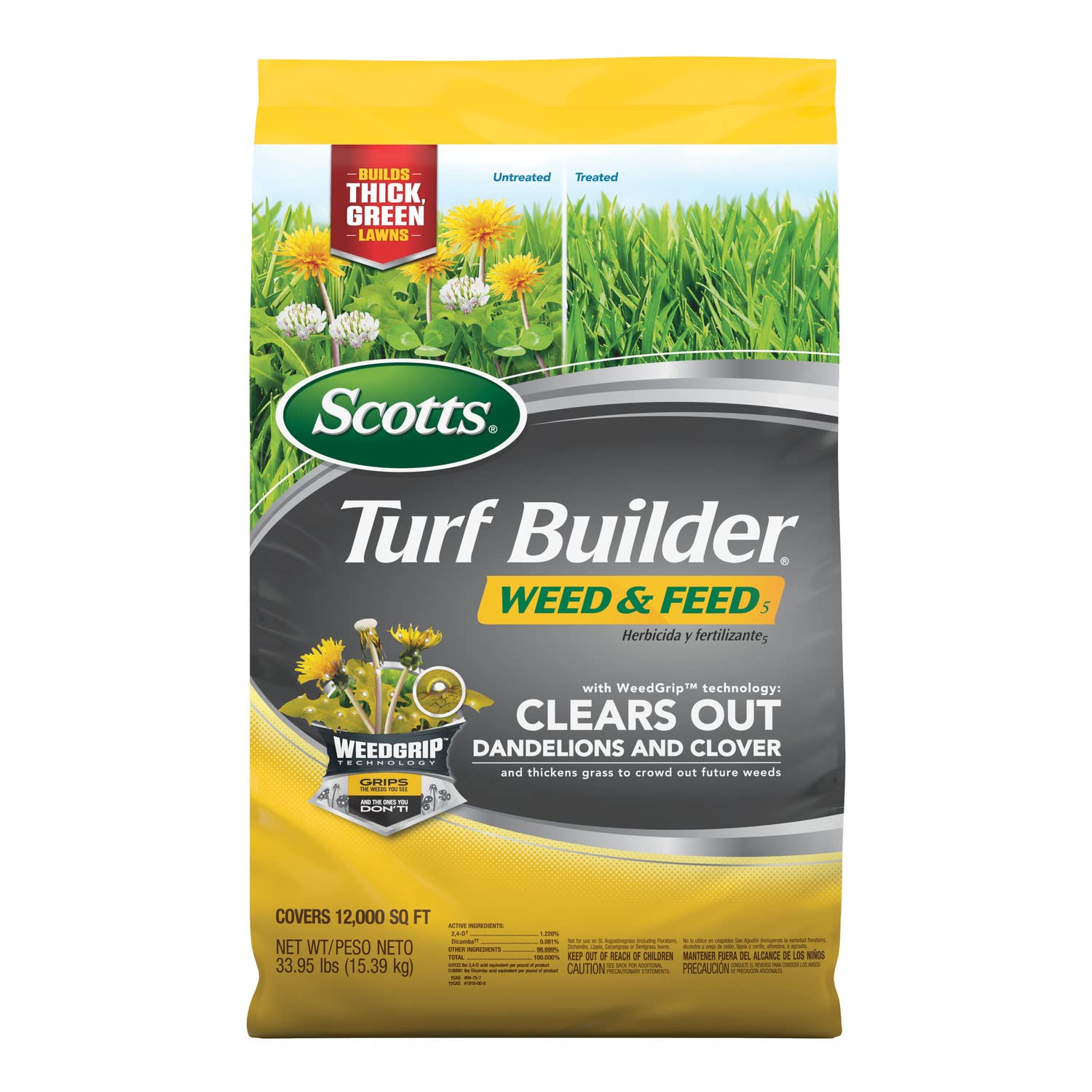
Scotts Turf Builder Weed & Feed5 Granular Lawn Fertilizer (33.95 lb)
| Item Form | Granule |
|---|---|
| Coverage | 12000 square feet |
| Active Ingredients | 2.4‑D and Dicamba |
| Unit Count | 1 Count |
Scotts Turf Builder Weed & Feed5 is a combined granular weed killer and lawn fertilizer intended for use when broadleaf weeds are actively growing and daytime temperatures are between 60°F and 90°F. You apply it to a wet lawn with a broadcast, drop, or hand spreader (Scotts publishes spreader settings) and then avoid watering for 24 hours to let granules stick to weed leaves. The formula uses WeedGrip technology and active ingredients 2,4‑D and dicamba to target common lawn weeds such as clover and dandelion while the fertilizer portion delivers nitrogen and potassium to thicken turf. A single 33.95 lb. bag is sized to cover about 12,000 square feet, making it convenient for medium to large yards. Important limits: do not use on St. Augustine, bentgrass, dichondra, carpetgrass, or lippia and do not apply if rain is expected within 24 hours; the product can also require keeping people and pets off treated turf until dust settles. For homeowners seeking a combined weed control plus feeding step, this simplifies late‑spring applications, but those with excluded grass types or who need precise spot treatments should consider alternatives.
Best for: Homeowners with warm‑season Bahia and other listed grass types who want a single late‑spring application to control broadleaf weeds while feeding the lawn and prefer products with established brand usage guidance.
Less Ideal for: Anyone growing St. Augustine, bentgrass, dichondra, carpetgrass, or lippia or gardeners who need spot treatments, organic options, or year‑round fertilization plans.
- Kills a wide range of listed broadleaf lawn weeds including clover and dandelion using WeedGrip technology
- Feeds lawn while treating weeds so it both reduces weeds and promotes thicker turf
- Large 33.95 lb. bag covers up to 12,000 sq ft, suitable for medium to large lawns
- Published application guidance and spreader settings make it straightforward to apply evenly
- Not safe for use on several turf types including St. Augustine and bentgrass
- Requires dry window after application and restriction on people and pets until dust settles
- Contains synthetic herbicides that require careful handling and label compliance
Verdict: A convenient, proven weed‑and‑feed option for Bahia and other compatible lawns that combines broadleaf weed control with feeding in one late‑spring application.
Scotts Turf Builder Lawn Food, 12.5 lb

| Item Form | Powder |
|---|---|
| Specific Uses For Product | Lawn |
| Coverage | 5,000 sq. ft. |
| Target Species | grass |
| Mixing Ratio | 32:0:4 |
Scotts Turf Builder Lawn Food is a granular lawn fertilizer designed to thicken and green turf by supplying nutrients that build stronger roots and improve water and nutrient uptake. It is applied with a broadcast or drop spreader to wet or dry lawns and can be used in spring, summer, or fall. Notable features include an all-grass formulation, clear spreader settings for Scotts spreaders, and a coverage claim of 5,000 square feet from the 12.5 lb bag. In practice this product makes routine feedings simple for homeowners who want predictable greening and improved root strength without specialized application steps. The powder formula can be lightly watered in for faster results but does not require immediate irrigation, which adds flexibility for different schedules. Limitations are that it is a broad lawn food rather than a Bahia-specific formulation and the bag size covers only small to medium lawns, so larger Bahia stands may need multiple bags or a larger product. Follow label safety directions and avoid application near open water.
Best for: Homeowners who want a straightforward, proven lawn food that makes scheduled feedings easy and produces predictable greening and stronger roots without complex application steps.
Less Ideal for: Specialists managing large Bahia-dominant lawns seeking a fertilizer tailored to Bahia-specific nutrient needs or those who prefer a single large-bag commercial solution.
- All-grass formula that can be applied to any turf type
- Clear application instructions and spreader settings for easy, consistent use
- Can be applied to wet or dry lawns and optionally watered in for quicker greening
- Builds stronger, deeper roots to improve water and nutrient uptake
- Not specifically formulated for Bahia grass and may lack targeted nutrients for that variety
- 12.5 lb bag only covers about 5,000 sq. ft., requiring multiple bags for larger lawns
Verdict: A simple, reliable lawn food that makes routine feeding easy for homeowners who want greener, stronger turf without complicated application.
Choosing the Right Fertilizer for Bahia Grass: Key Factors to Consider
Nutrient Formulation
The guaranteed analysis tells you how much nitrogen, phosphorus, and potassium the fertilizer delivers. Bahia grass typically benefits from moderate nitrogen levels and a higher potassium ratio to support drought tolerance and root strength. Too much phosphorus is unnecessary in established lawns and can contribute to runoff issues, so prioritize balanced N-P-K blends formulated for turf maintenance.
Also consider the form of nitrogen. Water-soluble nitrogen feeds quickly but raises burn risk and promotes lush top growth. A fertilizer that mixes quick-and-slow release or emphasizes controlled-release nitrogen supports steadier color and growth without frequent mowing.
Release Type and Longevity
Controlled-release technologies extend feeding over weeks or months, which reduces application frequency and evens out growth. For Bahia grass, a slow, steady nitrogen release helps maintain color through summer and reduces the flushes of soft growth that invite disease and pest problems. Look at the product label for months of activity and the proportion of slow-release nitrogen versus soluble forms.
Longevity also affects timing. Longer-duration products mean fewer applications during hot, dry periods when burn risk is higher. For many lawns, a 6- to 12-week release window is practical, but match the release profile to your local climate and mowing schedule.
Application Method and Ease
Application uniformity directly affects lawn appearance. Granular fertilizers should be evenly spread with a broadcast or drop spreader tuned to the product rate. Liquid or water-soluble options require proper dilution and even watering-in. Homeowners with irregularly shaped yards or limited equipment should prefer products that are forgiving to minor overlap or missed passes.
Instructions for calibration, recommended spreader settings, and clear rate guidance make a product easier to use correctly. Also check whether a fertilizer can be applied with commonly owned spreaders and whether it requires any special handling or additional irrigation after application.
Soil Health and Micronutrient Content
Beyond primary nutrients, Bahia lawns often show responses to potassium, iron, and other micronutrients, especially on sandy or low-organic-matter soils. A fertilizer that includes essential micronutrients can correct common deficiencies and improve color without triggering excessive leaf growth.
Consider how a product interacts with local soil tests. If your soil test shows iron deficiency or low potassium, choose formulations that address these needs. Also weigh whether a fertilizer supports beneficial soil organisms and whether it requires follow-up soil amendment to maintain long-term fertility.
Burn Risk and Safety
High soluble salt content and high rates of water-soluble nitrogen increase the chance of turf burn, particularly in hot, dry weather. Bahia grass is relatively hardy, but even hardy turf can brown when exposed to high salt levels or improper application.
Products with a higher proportion of slow-release nitrogen reduce burn risk. Pay attention to application timing, avoid fertilizing during peak heat or drought, and follow label rates carefully. Safety considerations also include runoff potential and recommendations for watering in after application to move nutrients into the root zone.
When to Fertilize Bahia Grass
Timing depends on climate and growth cycles. In warm-season regions where Bahia is common, feed during the active growing months when soil temperatures are consistently warm. Early spring applications support recovery from dormancy while late spring to early summer feedings maintain vigor through peak growth.
Avoid heavy feeding in late fall when the grass is entering dormancy. Also pause applications during extended drought or heat stress; apply only when the turf is actively growing and you can water lightly after application if needed.
- Aim for feeding windows when soil temps are warm and growth is steady
- Space applications according to the product's release profile
- Skip applications during prolonged drought or dormancy
Interpreting Lawn Color and Density
Color changes can indicate nutrient response or problems. A gradual improvement in green color usually signals successful nitrogen uptake, while yellowing may indicate iron or nitrogen deficiency or compacted soils. Density gains often lag behind color improvements because root development takes more time than leaf growth.
If color improves but the lawn remains thin, evaluate soil compaction, thatch accumulation, and mowing practices. Fertilizer alone may not solve density issues without addressing underlying cultural practices.
- Use color as an early signal, but check soil and cultural factors for thin turf
- Consider a soil test if changes are unclear or persistent
Adjusting Rates for Soil Type and Exposure
Sandy soils common in Bahia-growing areas drain quickly and may require more frequent but lower-rate applications to maintain nutrients in the root zone. Heavy clay or compacted sites retain nutrients longer and often need lower rates or longer-release formulas to prevent runoff and burn.
Shaded or less vigorous areas need reduced nitrogen rates since excess feeding can create weak, disease-prone growth. Match product rate to your site conditions and environmental exposure for safe, effective feeding.
- Sandy soil: prefer slow-release formulations and split applications
- Clay soil: reduce soluble nitrogen and favor longer-duration products
- Shaded areas: lower rates to avoid leggy, thin growth
Combining Fertilization with Watering and Mowing
Fertilizer works best as part of an integrated maintenance plan. Light, deep watering after application helps move nutrients into the root zone and reduces leaf burn risk for soluble products. Excessive irrigation can leach nutrients from sandy soils, so balance timing and volume to move nutrients without waste.
Mowing height affects how Bahia uses added nutrients. Maintain an appropriate mowing height to encourage deeper roots and avoid scalping after a heavy feed. Adjust mowing frequency following fertilization to manage fresh growth while preserving turf density.
- Water lightly after application for soluble products, but avoid overwatering on sandy soils
- Raise mowing height slightly after feeding to support root development
Addressing Specific Problems with Targeted Feeding
Iron chlorosis and potassium deficiency are common issues that targeted micronutrient-containing fertilizers can address. Use a soil test to confirm deficiencies before applying corrective products, and follow label guidance for rates and timing to avoid over-application.
For pest or disease problems, fertilizer can support recovery but will not replace integrated pest management. Avoid high-nitrogen boosts that create tender growth attractive to pests during vulnerable periods.
- Confirm deficiencies with a soil test before treating
- Use targeted micronutrient feeds rather than blanket high-nitrogen applications
How We Chose the Best Fertilizer for Bahia Grass
We focused on characteristics that affect how Bahia grass grows in home lawns and roadside turf. Key evaluation criteria included nutrient formulation and release type, because Bahia prefers moderate, slow-release nitrogen to encourage steady growth without excessive top growth. Application method and spreader compatibility were assessed to ensure homeowners can apply products evenly across typical yard sizes. Soil health and micronutrient content were checked to determine whether a fertilizer supplies iron, potassium, and trace elements that Bahia grass often needs on sandy soils. Safety and burn potential were evaluated using guaranteed analysis and release technology to avoid products that spike soluble salts. Environmental considerations such as leaching risk and suitability for drought-prone sites influenced inclusion. We excluded specialty products aimed only at overseeding, sod installation, or non-lawn agricultural blends that do not match home lawn practices. The final list favors balanced formulations suited to routine maintenance and seasonal feeding for Bahia grass, with an emphasis on predictable release behavior, practical application, and measurable soil and turf responses.
FAQ
How often should I fertilize Bahia grass?
It often depends on the product. With slow-release fertilizers, every 8 to 12 weeks during the growing season is common. For soluble products, shorter intervals at lower rates are safer, but always follow label instructions and adjust for soil type and local climate.
Can I apply fertilizer during drought conditions?
You should avoid fertilizing during prolonged drought or heat stress. Fertilizer can increase plant stress and burn risk when roots are not actively taking up water and nutrients. Wait until rainfall or irrigation can support active growth.
Do I need a soil test before choosing a fertilizer?
A soil test is usually helpful because it identifies pH and nutrient deficiencies, guiding whether you need extra potassium or iron. If you do not test, choose balanced, turf-specific formulations and monitor turf response closely.
What is the best time of day to apply granular fertilizer?
Apply in the morning or early evening when temperatures are milder to reduce burn risk and avoid the hottest part of the day. If the product requires watering-in, plan application when you can irrigate soon afterward.
Will fertilizer make my Bahia grass grow too fast?
High rates or fast-release nitrogen can trigger rapid top growth, leading to more mowing and potentially weaker roots. Choose moderate rates and slow-release formulations to promote steady growth rather than flushes of soft tissue.
How do I correct yellowing Bahia grass?
Yellowing can indicate nitrogen shortage, iron deficiency, or stress from compaction or pests. Start with a soil test to narrow causes. If nutrient-related, a balanced feed or targeted micronutrient application can help, applied at appropriate rates and timing.
Final Verdict
Choose fertilizers that match Bahia grass needs: moderate nitrogen delivered steadily, adequate potassium and micronutrients, and a release profile suited to your soil and climate. Prioritize slow-release or mixed-release formulations for lower burn risk and fewer applications. Combine feeding with proper watering, mowing, and soil management to get the best color and density without creating weak, disease-prone growth.
