

Note: This article contains affiliate links. If you click on these links and make a purchase, I may earn a small commission at no extra cost to you. This helps support my research and content. Read my full affiliate disclosure here.
Pots and containers have different needs than in-ground beds because soil volume is limited and nutrients wash out faster. Choosing the right fertilizer for container plants makes the difference between steady growth and plants that quickly show deficiency symptoms. This guide shortlists the top options suited for container gardening, focusing on nutrient balance, application method, and how each product behaves over weeks in a pot. Below you will find practical guidance on what to prioritize for patios, balconies, window boxes, and small raised planters, followed by our top picks and why they made the list.
Top Picks at a Glance
| Best Overall The best all-around choice for most situations | Miracle-Gro Water Soluble All Purpose Plant Food, 1.5 lb |  |
| Best Quality Built to a higher standard if you want something more solid | Osmocote Smart-Release Plant Food Plus, Outdoor & Indoor, 1 lb |  |
| Best Value The sweet spot between price and what you get | FOOP Organic All-Purpose Liquid Plant Food (32 oz) |  |
| Best Budget The cheapest option that still gets the job done reliably | Jobe's Organics Houseplant Fertilizer Spikes, 50 Count |  |
| Highest Rated A top-rated pick with lots of positive feedback | Miracle-Gro Water Soluble All Purpose Plant Food, 12.5 lb |  |
| Most Popular A crowd favorite that many people choose with confidence | Miracle-Gro Water Soluble All Purpose Plant Food, 3 lb |  |
| Best Seller A high-volume bestseller chosen again and again | TPS NUTRIENTS Indoor Plant Food Liquid Fertilizer, 8 oz |  |
Miracle-Gro Water Soluble All Purpose Plant Food, 1.5 lb

| Item Form | Powder |
|---|---|
| Application Method | Watering Can |
| Target Species | All flowers, vegetables, trees, shrubs and houseplants |
| Mixing Ratio | 24-8-16 |
This powder feed dissolves in water to deliver a fast nutrient boost to container and in-ground plants. It is mixed into a watering can or feeder and applied to the soil at the base of plants, with different measured doses for houseplants and outdoor gardens. Notable features include a high-nitrogen 24-8-16 formula that promotes leafy growth, a scoop for dosing, and instructions tailored for container use and garden feeders. For container gardeners the instant availability of nutrients helps correct deficiencies quickly and supports bigger, healthier foliage and flowering when used every 1 to 2 weeks as directed. Practical benefits are ease of use, wide compatibility with flowers, vegetables, shrubs and houseplants, and predictable coverage (about 600 sq ft from this size). Important limitations are that it is a quick-release fertilizer rather than slow-release, so it requires frequent reapplication and careful measuring to avoid overfeeding, and the high nitrogen balance may be less suitable when you want to maximize fruiting or bloom-specific performance without switching to a bloom-boost formula.
Best for: Container plant owners who want a simple, reliable weekly to biweekly feed that quickly corrects nutrient needs and supports vigorous leafy growth.
Less Ideal for: Gardeners who prefer low-maintenance slow-release feeding or those seeking a specialized bloom-boost or low-nitrogen formula for fruiting plants.
- Water-soluble formula delivers nutrients to roots quickly
- Clear dosing instructions for both indoor and outdoor container use
- Broadly compatible with flowers, vegetables, houseplants and shrubs
- Includes a scoop to simplify measuring and mixing
- Quick-release formula requires reapplication every 1–2 weeks for continuous feeding
- Higher nitrogen ratio may encourage foliage over blooms or fruit
Verdict: A dependable, fast-acting water-soluble fertilizer that makes regular feeding of container plants easy and effective.
Osmocote Smart-Release Plant Food Plus, Outdoor & Indoor, 1 lb
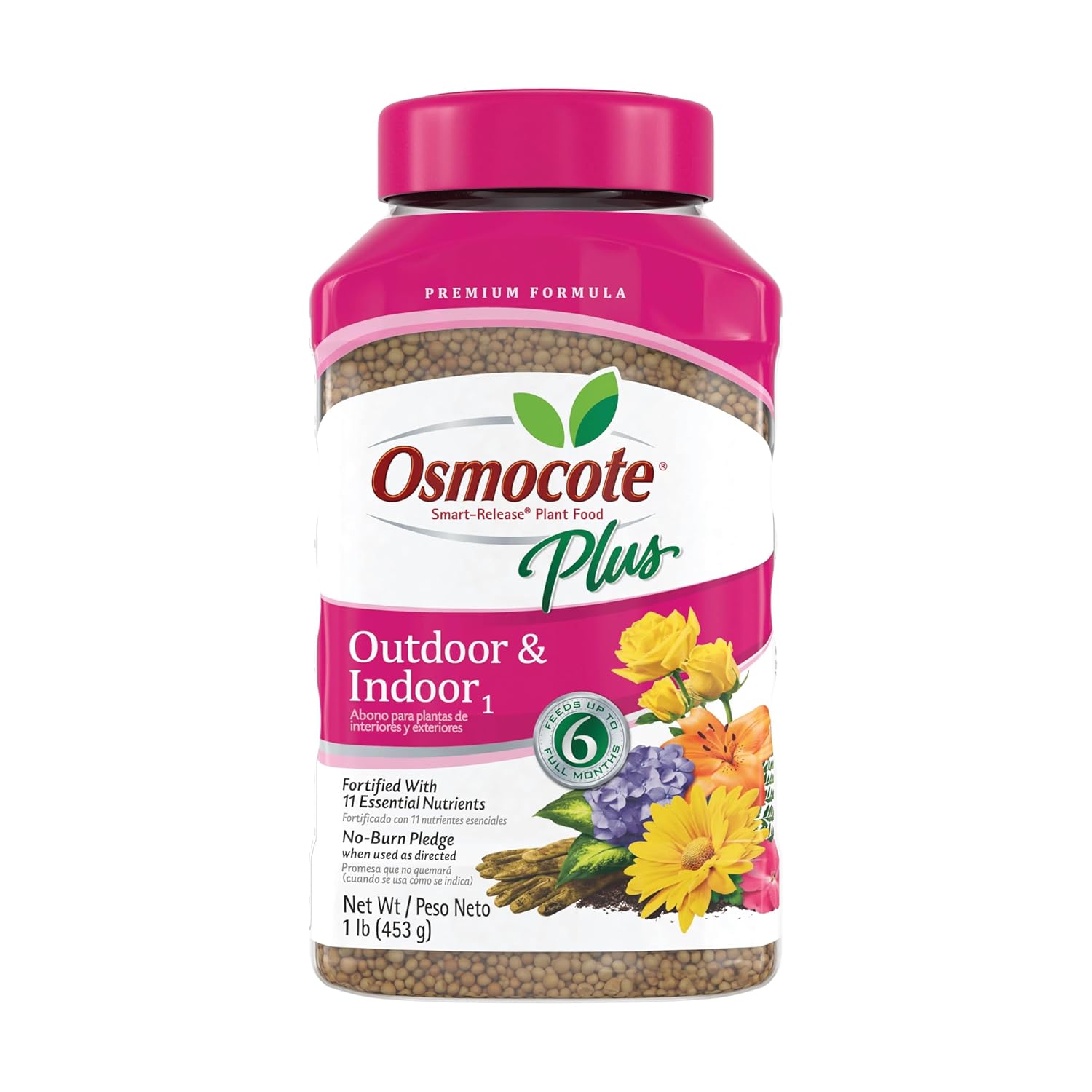
| Item Form | Granules |
|---|---|
| Specific Uses For Product | Plant Food |
| Application Method | sprinkle around the base and work into the soil |
| Unit Count | 16 Ounce |
| Coverage | Full |
Osmocote Smart-Release Plant Food Plus is a granular, resin-coated fertilizer designed for steady feeding of container and in-ground plants for up to six months per application. You apply it by sprinkling the recommended scoop into the top 1 to 3 inches of potting soil or garden bed, then watering to activate the resin coating that paces nutrient release. It contains 11 essential nutrients and a no-burn pledge when used as directed, which makes it suited to mixed containers of flowers, vegetables, and houseplants where consistent feeding is valuable. The long duration reduces how often you need to reapply compared with soluble feeds, and the controlled-release granules help avoid nutrient spikes that can stress roots. Limitations are that you must follow the rate guidance for containers versus indoor plants to avoid over-application, and a small 1 lb container only covers about 37 sq ft so frequent repurchase may be needed for many pots. It is not a liquid feed, so it will not correct acute deficiencies quickly.
Best for: Container and casual vegetable or flowering plant growers who want low-maintenance, reliable feeding and prefer fewer applications over the growing season.
Less Ideal for: Growers needing immediate nutrient corrections, frequent feed adjustments, or bulk fertilizer for large garden beds should consider a soluble feed or larger-format product.
- Controlled-release resin coating provides steady feeding for up to six months
- Formulated with 11 essential nutrients for balanced plant nutrition
- Easy application by sprinkling and light incorporation into potting soil
- No-burn pledge when used according to directions
- Small 1 lb container covers limited area so larger projects need multiple containers
- Not suitable for quickly correcting acute nutrient deficiencies since it is slow-release
Verdict: Choose this smart-release granule when you want dependable, low-maintenance feeding for container plants that lasts up to six months.
FOOP Organic All-Purpose Liquid Plant Food (32 oz)

| Item Form | Liquid |
|---|---|
| Specific Uses For Product | General Plant Food |
| Coverage | Large |
| Target Species | vegetables, herbs, flowers, trees, shrubs |
| Mixing Ratio | 1:32 |
FOOP Organic All-Purpose Liquid Plant Food is a concentrated 32 oz liquid fertilizer that mixes 1:32 and is designed as a one-feed solution for a wide range of plants. Typical use is diluting the concentrate and applying it to container-grown vegetables, herbs, and ornamentals or to beds and shrubs; the included microbes and mycorrhizae are intended to improve soil biology in addition to supplying N-P-K and secondary elements. The product is easy to measure and apply, fast-acting compared with bulky compost, and convenient for regular feeding schedules in pots where nutrients wash out with frequent watering. Because it is an organic formulation based on fish emulsion, kelp, and beneficial microbes, it supports plant vigor and root health but can have an odor typical of fish-based feeds and may require careful dilution to avoid overfeeding sensitive seedlings. For container gardeners who want an all-purpose organic feed that also inoculates soil biology, this is a practical, easy-to-use option; gardeners seeking sterile or synthetic precision N-P-K blends should look elsewhere.
Best for: Container gardeners who prioritize easy, organic feeding and want a single product that feeds a variety of edible and ornamental plants while improving soil life.
Less Ideal for: Growers who need exact synthetic nutrient ratios for flowering or specialty crops or those who dislike fish-based smells should consider other options.
- Concentrated 32 oz formula stretches to many gallons at 1:32 mixing ratio
- Organic ingredients with mycorrhizae and beneficial microbes to support soil biology
- Suitable for a wide range of container and outdoor plants including vegetables, herbs, and flowers
- Fish-emulsion base can have a noticeable odor
- Not a precise synthetic N-P-K formulation for targeted nutrient management
Verdict: A practical, concentrated organic liquid feed that simplifies regular container plant feeding while boosting soil microbes.
Jobe's Organics Houseplant Fertilizer Spikes, 50 Count

| Unit Count | 50 Count |
|---|---|
| Item Form | Granules, Liquid, Sticks |
| Application Method | Insert spikes into soil |
| Coverage | Medium |
| Mixing Ratio | 13-4-5 |
Jobe's Organics houseplant fertilizer spikes are pre-measured slow-release sticks designed to deliver nutrients directly to the root zone of indoor flowering and foliage plants. You insert the spikes into potting mix around the root ball and replace them every 60 days, which makes feeding routine container plants a low-effort task. The NPK 13-4-5 formula supports growth and bloom production while the solid spike form eliminates spills, smells, and liquid runoff common with feedings. Practical benefits include consistent nutrient delivery without mixing or measuring and reduced chance of overfertilizing compared with liquid concentrates. Limitations are that the fixed dosage may not suit very large or very small pots and spikes must be spaced properly for even coverage. Also they release nutrients on a fixed schedule so you cannot quickly correct a deficiency. For someone managing many small to medium containers on a budget, these spikes simplify regular feeding and keep maintenance tidy.
Best for: Budget-minded container gardeners who want a low-effort, no-mess way to feed multiple small to medium potted plants on a regular schedule.
Less Ideal for: Serious growers who need precise, adjustable nutrient control for large specimens, heavy feeders, or plants with specific deficiency issues.
- Pre-measured slow-release spikes remove the need to mix or measure liquid fertilizer
- Designed to deliver nutrients directly at the root zone to reduce runoff and mess
- Simple 60-day replacement schedule makes routine feeding low maintenance
- 13-4-5 NPK formulation supports both foliage growth and flowering
- Fixed spike dosage may be inappropriate for very large or very small containers
- Cannot provide an immediate corrective feed for nutrient deficiencies
Verdict: An inexpensive, no-mess way to keep multiple small to medium container houseplants fed on a simple two-month schedule.
Miracle-Gro Water Soluble All Purpose Plant Food, 12.5 lb

| Item Form | Powder |
|---|---|
| Specific Uses For Product | Plant Food |
| Coverage | general purpose, suitable for various plants |
| Mixing Ratio | 1 tablespoon per gallon of water |
| Unit Count | 200 Ounce |
This Miracle-Gro water-soluble plant food is a general-purpose powdered fertilizer designed to deliver fast nutrition to flowers, vegetables, houseplants, shrubs and trees. It dissolves in water using the included scoop and is applied with a watering can or compatible garden feeder; the label gives clear mixing rates for indoor and outdoor use so it is straightforward to dose for containers. The 24-8-16 NPK formula supplies a strong nitrogen boost for leafy growth while still providing phosphorus and potassium for blooms and root health. Practical benefits for container gardeners include instant availability to plant roots, compatibility with both in-ground and potted plants, and a large 12.5 lb container that covers a lot of area between feedings. Important limits are that the formula is a general all-purpose feed rather than a crop-specific mix and it requires regular reapplication every one to two weeks to maintain results; users must measure carefully to avoid overfeeding. For reliability-focused gardeners this product is easy to use and makes routine feeding predictable and repeatable.
Best for: Container gardeners who value a dependable, easy-to-mix feed that gives predictable, quick nutrition for a wide variety of potted plants and regular maintenance routines.
Less Ideal for: Growers seeking slow-release feeding, organic-certified fertilizers, or specialty formulas tuned to a single crop should consider alternatives.
- Fast-acting water-soluble formula that feeds plants immediately
- Clear mixing instructions for indoor and outdoor applications
- Broad compatibility with many plant types including containers and in-ground beds
- Large 12.5 lb package covers a lot of garden area between purchases
- Requires frequent reapplication (every 1–2 weeks) to sustain results
- General-purpose NPK ratio may not match needs of specialized crops
Verdict: A reliable, easy-to-use water-soluble fertilizer that delivers fast, predictable feeding for container plants.
Miracle-Gro Water Soluble All Purpose Plant Food, 3 lb

| Item Form | Powder |
|---|---|
| Application Method | Mix with water in a watering can |
| Specific Uses For Product | Plant Food |
| Mixing Ratio | 5.875d-1 |
| Fertilizer Analysis (NPK) | 24-8-16 |
Miracle-Gro Water Soluble All Purpose Plant Food is a powdered fertilizer you mix into water to feed houseplants, container plants, flowers and vegetables on a regular schedule. It dissolves quickly and supplies nitrogen, phosphorus and potassium (24-8-16) so plants get an immediate nutrient boost when you water. Typical use is mixing the included scoop with a gallon or more of water and applying to soil at the base of plants every 1 to 2 weeks for containers or every 7 to 14 days outdoors. The product is versatile across plant types and can be used with a watering can or the Miracle-Gro Garden Feeder for larger beds. Practical benefits include fast uptake for visible growth, a clear dosing routine, and broad compatibility with common garden and houseplants. Important limitations are that it is a quick-release formula rather than slow-release, so it requires frequent feeding and careful dosing to avoid overfertilizing, and it does not address micronutrient or organic-amendment needs.
Best for: For container gardeners who want a simple, proven feed routine and expect fast visible growth from houseplants, annuals and vegetables while valuing reassurance from a widely used product.
Less Ideal for: Not the best choice for gardeners seeking slow-release, low-maintenance feeding or those prioritizing fully organic or micronutrient-focused fertilizers.
- Water-soluble powder for rapid nutrient uptake
- Clear mixing instructions and included scoop for easy dosing
- Broadly labeled safe for indoor and outdoor/container plants
- Contains primary macronutrients with a high nitrogen formula for leafy growth
- Quick-release formula requires feeding every 1–2 weeks rather than long-term feeding
- Does not supply a detailed micronutrient profile or organic matter
Verdict: A reliable, fast-acting water-soluble fertilizer that makes regular feeding of container and houseplants easy and effective.
TPS NUTRIENTS Indoor Plant Food Liquid Fertilizer, 8 oz

| Item Form | Liquid |
|---|---|
| Specific Uses For Product | Plant Food |
| Application Method | Watering can |
| Unit Count | 8 Fluid Ounces |
| Mixing Ratio | 2:1 (oz/gallon) or 1:64 (tbsp/gallon) |
This 8 oz TPS NUTRIENTS liquid indoor plant food is a concentrated, kelp-enriched fertilizer designed to mix with water and be applied during regular watering. It is intended for common houseplants such as pothos, monstera, snake plants and tropical foliage and is used by adding the measured dose to a watering can then watering as usual. Notable features include a liquid concentrate format that dissolves quickly, a gentle formula suitable for weekly or regular feeding, and a manufacturer mixing ratio printed on the bottle to simplify dosing. Practical benefits for container gardeners include easy integration into existing watering routines and support for greener leaves, steady new growth, and stronger roots without bulky granular products. Limitations are the small 8 oz volume, which will require repurchase for larger collections, and the single standard dilution that may still require user judgment for very young or sensitive plants. The product lists basic safety guidance so users should avoid skin or eye contact and keep it away from children and pets.
Best for: Buyers who want a simple, low-effort liquid fertilizer to add to routine watering for common container houseplants and prefer clear dosing instructions to avoid guesswork.
Less Ideal for: Growers managing large collections, outdoor gardens, or those who need detailed nutrient profiles and larger-volume concentrates for heavy feeders.
- Liquid concentrate mixes easily for quick, mess-free feeding during normal watering
- Kelp-enriched formula aimed at promoting foliage color and new growth
- Clear mixing ratio and directions make dosing straightforward for routine use
- Suitable for a wide range of common indoor houseplants
- Small 8 oz bottle means frequent repurchasing for households with many plants
- No detailed N-P-K breakdown provided on the available product information
Verdict: A dependable, easy-to-use liquid fertilizer for indoor container plants that simplifies weekly feeding and supports healthier foliage.
Choosing the Right Fertilizer for Container Plants: Key Factors to Consider
Nutrient Balance and Micronutrients
Plants in containers rely entirely on what you supply because their root zone is limited. A good container fertilizer provides an appropriate ratio of nitrogen, phosphorus, and potassium for the plant type and includes key micronutrients like magnesium, iron, and calcium to prevent common deficiencies.
High-nitrogen formulas encourage foliage but can delay flowering; bloom-focused mixes shift the ratio toward phosphorus and potassium. Read labels for guaranteed nutrient analysis and pick a balance that matches whether you are growing foliage plants, flowering annuals, or edible herbs in pots.
Release Type and Feeding Schedule
Fertilizers come as soluble liquids or granules, slow-release coated granules, and spikes. Soluble feeds deliver nutrients quickly and are easy to dose at each watering, which is useful during active growth. Slow-release options provide steady nutrients over weeks and reduce the risk of accidental overfeeding.
For containers that dry out quickly, choose a release profile that matches how often you water. Frequent waterers may prefer slow-release to avoid nutrient pulses, while seasonally pushed patio plants may benefit from regular liquid feedings for rapid correction.
Concentration and Salt Index
Because potting mixes hold less soil, concentrated fertilizers can raise soluble salts and stress roots. Low to moderate concentration feeds reduce the risk of fertilizer burn. If using a concentrated product, dilute carefully to recommended container concentrations and flush pots periodically to prevent salt buildup.
Look for fertilizers labeled safe for pots or with specific container dosing guidance. For sensitive plants and seedlings, err on the side of weaker, more frequent feedings rather than strong single doses.
Formulation Compatibility With Potting Mixes
Not all fertilizers behave the same in soilless mixes versus mineral soils. Some slow-release coatings may break down differently in light, fast-draining potting mixes. Water-soluble formulas require a wetting cycle to move nutrients through the mix.
Consider the components of your potting mix and whether it contains a lot of peat, coir, or perlite. Choose a fertilizer recommended for soilless blends or one with clear guidance for container mixes to ensure predictable nutrient availability.
Application Practicality and Clean-Up
Potted plants are often on balconies, window sills, or in tight beds where messy application is a nuisance. Liquid concentrates that measure easily, granular formulas that spread evenly, or premeasured packets reduce hassle. The application method also affects how evenly nutrients reach all pots when feeding multiple containers at once.
Think about storage size, whether you need measuring tools, and how much time you want to spend feeding. Practical packaging and clear instructions will make routine feeding less error prone.
Plant Type and Growth Stage Targets
Different container-grown plants have different nutrient needs. Fast-growing annuals and vegetables require steady nitrogen and frequent feeding, while succulents and some perennials need lower, less frequent nutrition. Seedlings and transplants are sensitive to high salts and need gentler formulas.
Match the fertilizer to the growth stage: starter feeds for transplants, balanced maintenance feeds for foliage, and bloom-boosting mixes for peak flowering. Adjust frequency and concentration as plants move through growth cycles.
Feeding Schedules for Different Container Types
Small pots, window boxes, and large planters all dry and leach nutrients at different rates. Small containers on sunny patios often need light, frequent feedings because they lose moisture and nutrients fast. Larger planters with more soil buffer nutrient swings and can go longer between applications.
For edible containers and herbs that you harvest, maintain a consistent, mild feeding routine to keep productivity up. For decorative pots, alternate between maintenance feeding and occasional bloom-targeted feedings during peak flower production.
- Small pots: lighter dose every 1 to 2 weeks
- Large planters: moderate dose every 2 to 4 weeks
- Seedlings and transplants: half-strength, more frequent feedings
- Succulents: infrequent, low-concentration feeding in active season
How to Prevent Salt Build-Up in Pots
Salt accumulation is a common problem with repeated fertilizing and frequent watering. Flush containers periodically with plain water to leach excess soluble salts from the potting mix. Allow good drainage during flushes to avoid waterlogging roots.
Use lower-concentration feedings for sensitive species and monitor leaves for tip browning or stunted growth which can indicate salt stress. Replacing or refreshing the top layer of potting mix annually also reduces long-term salt problems.
- Flush pots every 4 to 8 weeks when using concentrated feeds
- Ensure containers have adequate drainage holes
- Replace potting mix periodically for long-term container plantings
Organic Versus Synthetic Options for Containers
Organic fertilizers release nutrients more slowly as microbes break down material, which can be gentler in small pots and improve long-term soil life. However, they may not correct acute deficiencies quickly and can be variable in nutrient concentration.
Synthetic soluble fertilizers offer predictable nutrient analyses and faster correction when plants show deficiency signs. Many gardeners blend approaches: using organic amendments for baseline nutrition and occasional synthetic feeds for targeted boosts.
- Organics: steady release, improves soil biology
- Synthetics: predictable, fast-acting
- Combine both for steady baseline nutrition and occasional correction
Practical Dos and Don'ts for Container Feeding
Do follow label directions for container application and dilute concentrated products as instructed. Do observe plants after feeding for signs of improvement or stress and adjust concentration accordingly.
Do not assume in-ground dosing translates directly to pots. Avoid overfertilizing and reduce strength for seedlings and newly repotted plants. Keep a schedule and note what works for specific species so you can repeat successful routines.
- Do measure carefully and keep a feeding log for containers
- Do flush periodically to avoid salt stress
- Don't over-apply based on in-ground recommendations
Storing and Handling Fertilizer Safely
Store fertilizers in a cool, dry place away from children and pets. Keep powders and granules dry to preserve effectiveness and prevent caking. Liquids should be sealed tightly and stored upright to avoid leaks.
Label containers with the date opened and any dilution instructions you use for pots so you can repeat successful mixes. Dispose of empty containers according to local guidance and avoid contaminating water sources.
- Keep products dry and sealed
- Store out of direct sunlight and extreme heat
- Mark dilution ratios and dates on containers
How We Chose the Best Fertilizer for Container Plants
We focused on features that matter for plants grown in restricted soil volume. Key evaluation criteria included nutrient balance and form to supply balanced N-P-K and essential micronutrients appropriate for container crops; release profile and predictability to match common feeding rhythms in pots; ease of application because gardeners often need simple, low-mess solutions for small containers; salt index and fertilizer concentration to avoid root burn in limited soil; compatibility with common container mixes and watering patterns; and packaging size and reusability so small gardeners do not waste product. We excluded products formulated exclusively for lawns, trees, or bulk agricultural use that are not practical for repeated dosing of small pots. We also filtered out fertilizers with unclear labeling on nutrient analysis or those lacking directions for container application. The remaining products were assessed against the same practical criteria to ensure each pick is appropriate for container gardening realities.
FAQ
How often should I fertilize container plants during the growing season?
Frequency depends on fertilizer type and pot size. Water-soluble feeds are often applied every 1 to 2 weeks, while slow-release granules can last 6 to 12 weeks. Adjust frequency for small pots and heavy feeders like vegetables.
Can I use regular garden fertilizer in pots?
Many garden fertilizers are too concentrated or formulated for larger soil volumes. Use products with explicit container dosing or dilute general formulas heavily to avoid root burn in limited potting mixes.
What signs show a container plant is nutrient deficient?
Common signs include yellowing between leaf veins indicating iron or magnesium issues, overall pale foliage from nitrogen deficiency, and poor flowering when phosphorus is low. Confirm with consistent symptoms before increasing feeding.
Are slow-release fertilizers safe for all container plants?
Slow-release options are safe for many container-grown species, but coatings break down at different rates depending on temperature and moisture. For very small pots or seedlings, use lower rates or soluble feeds to avoid excessive early release.
How do I avoid overfertilizing my pots?
Use the lowest effective concentration and follow container-specific label instructions. Keep a regular but moderate feeding schedule, flush pots occasionally, and reduce strength for sensitive plants and new transplants.
Is organic fertilizer effective in containers?
Organic fertilizers can be effective and improve potting mix biology, but they often release nutrients more slowly. They work well as a baseline feed, while soluble products can provide targeted corrections when needed.
Final Verdict
Pick a fertilizer that matches the size of your pots, your plants, and how often you water. Prioritize predictable nutrient balance, a release profile that suits your watering routine, and low salt risk for sensitive roots. Tradeoffs exist between convenience and control: slow-release products reduce chores but liquids let you correct deficiencies quickly. Use the criteria outlined above to choose the best approach for your container garden and adjust feeding strength as you observe plant response.
