

Note: This article contains affiliate links. If you click on these links and make a purchase, I may earn a small commission at no extra cost to you. This helps support my research and content. Read my full affiliate disclosure here.
Picking the right weed and feed fertilizer can mean the difference between patchy lawn maintenance and a visibly healthier yard. These combined products deliver nutrients while targeting common broadleaf weeds, but they behave differently depending on lawn type, application method, and timing. This guide covers the top seven weed and feed fertilizer choices for home lawns and explains the practical tradeoffs you should expect in the garden. We evaluated spread pattern, active-ingredient balance, application flexibility, and safety considerations to shortlist these options and help you pick what fits your lawn conditions.
Top Picks at a Glance
| Best Overall The best all-around choice for most situations | Scotts Turf Builder Weed & Feed 3, Granular Lawn Fertilizer with Weed Control, 14.29 lb. |  |
| Best Quality Built to a higher standard if you want something more solid | The Andersons Professional Surge Weed & Feed 16-0-9 (40 lb) |  |
| Best Value The sweet spot between price and what you get | BioAdvanced 5-in-1 Weed and Feed Granules, 9.6 lb |  |
| Best Budget The cheapest option that still gets the job done reliably | Bonide Liquid Weed & Feed 20-0-0, 32 oz Ready-to-Spray |  |
| Highest Rated A top-rated pick with lots of positive feedback | Scotts LawnPro Step 2 Weed Control Plus Lawn Fertilizer (14.63 lb) |  |
| Most Popular A crowd favorite that many people choose with confidence | Scotts Turf Builder Weed & Feed (42.87 lb) |  |
| Best Seller A high-volume bestseller chosen again and again | Scotts Turf Builder WinterGuard Fall Weed & Feed, 11.43 lb |  |
Scotts Turf Builder Weed & Feed 3, Granular Lawn Fertilizer with Weed Control, 14.29 lb.

| Item Form | Granule |
|---|---|
| Coverage | 5000 square_feet |
| Active Ingredients | 2,4-D 1.220%, Mecoprop 0.081% |
Scotts Turf Builder Weed & Feed 3 combines a granular fertilizer with selective broadleaf weed control to treat a typical home lawn in a single application. It is applied with a broadcast or drop spreader to a wet lawn when temperatures are between 60°F and 90°F so the granules stick to weed leaves. The included WeedGrip Technology and active ingredients target dandelions, clover and many other broadleaf weeds while the fertilizer component helps thicken grass to crowd out future weeds. Practical benefits are convenience and dual action: you fertilize and treat visible weeds at once rather than doing two separate steps. Important limitations are seasonal and grass-type restrictions you must follow for safety and effectiveness, plus the need to keep people and pets off the treated lawn until dust settles and avoid watering for 24 hours after application. For a balanced homeowner wanting a straightforward, combined feed-and-weed solution for common weeds, this bag is an effective, easy-to-use option.
Best for: Homeowners who want a simple, all-in-one treatment to both feed their lawn and reduce common broadleaf weeds without separate products or multiple visits into the season.
Less Ideal for: People managing specialized turf varieties, overseeding projects, or lawns that require year-round granular feeding schedules should consider targeted products or season-specific formulations instead.
- Combines fertilizer and broadleaf weed control in one granular product
- WeedGrip Technology helps granules adhere to weed leaves for better control
- Covers up to 5,000 sq. ft. from a single 14.29 lb. bag
- Designed for easy application with standard broadcast or drop spreaders
- Not safe for certain turf types such as St. Augustinegrass, Bentgrass, and Carpetgrass
- Must be applied only when weeds are actively growing and within a narrow temperature window
Verdict: A convenient single-step granular product for homeowners who want to feed their lawn and control common broadleaf weeds in one application.
The Andersons Professional Surge Weed & Feed 16-0-9 (40 lb)

| Item Form | Granule |
|---|---|
| Coverage | 16000 square_feet |
| Unit Count | 640 Ounce |
| Active Ingredients | Herbicide |
The Andersons Professional Surge Weed and Feed is a granular, four‑way herbicide plus fertilizer designed to eliminate common broadleaf weeds while improving turf density. It is applied with a broadcast spreader to established lawns when weeds are actively growing, and works best when granules stick to damp foliage and the lawn is kept dry for 24 hours after application. Notable features include small particle granules for better coverage, a 16,000 sq ft coverage per bag, and a fertilizer analysis of 16-0-9 to promote greener, thicker turf. The product is useful across the growing season and is formulated to perform in cooler spring and fall conditions as well as warmer periods when applied according to label timing. Limitations include restrictions on use over certain turf types such as Floratam St. Augustine, dichondra, carpetgrass, creeping bentgrass, and lawns with desirable clover, plus a need to follow specific timing and watering instructions to avoid reduced effectiveness or turf injury on new grass.
Best for: Gardeners who prioritize season‑long weed control and visible turf improvement and who need a high‑coverage product for larger lawns that they will apply with a spreader.
Less Ideal for: Owners of newer lawns, specialty turf varieties, or lawns with desirable clover should avoid this product and choose a gentler or turf‑specific treatment instead.
- Four‑way herbicide that targets over 250 common broadleaf weeds
- Includes 16-0-9 fertilizer to encourage thicker, greener turf
- Small granule size for improved coverage per square inch
- Large coverage area up to 16,000 sq ft per 40 lb bag
- Not safe for use on several turf types including Floratam St. Augustine and creeping bentgrass
- Requires precise pre‑watering and a 24 hour dry window after application to be effective
Verdict: Choose this product if you want a professional‑strength weed and feed that treats broadleaf weeds while feeding large lawns for season‑long performance.
BioAdvanced 5-in-1 Weed and Feed Granules, 9.6 lb

| Item Form | Granule |
|---|---|
| Coverage | 4000 square_feet |
| Active Ingredients | Dicamba, Quinclorac |
This granulated 5-in-1 Weed and Feed is designed to simplify lawn care by combining weed control and fertilizer in one application. You apply it with a broadcast or drop spreader to established, dry turf, then water the lawn to activate the formula. Notable features include a multi-ingredient herbicide blend (Dicamba and Quinclorac) that targets over 200 broadleaf weeds and kills large crabgrass down to the root, plus a fertilizer that greens and feeds lawns for up to three months. The product also claims up to six months of prevention against listed weeds when used as directed. Practical benefits are convenience and reduced application frequency since one treatment handles both weeds and feeding across up to 4,000 square feet. Important limitations are that it is for established lawns only, must be kept off wet surfaces and applied carefully to avoid drift, and safety precautions are needed around children and pets until treated areas dry. It is not labeled for sale in a few states, so check local guidance before planning use.
Best for: A homeowner who wants a simple, low-maintenance solution to control common lawn weeds and feed existing turf in one step and reduce repeat treatments.
Less Ideal for: People establishing new lawns, managing vegetable or ornamental beds, or those who need state-approved products for restricted areas should look at alternative, targeted treatments.
- Combines targeted weed control and fertilizer in a single application for convenience
- Controls both broadleaf weeds and large crabgrass with proven active ingredients
- Provides multi-month prevention of listed weeds and up to three months of lawn feeding
- Covers up to 4,000 square feet per bag when applied as directed
- Not suitable for newly seeded or recently sodded lawns
- Requires careful application and precautions to protect children, pets, and non-target plants
- Not available for sale in certain states or territories
Verdict: Buy this if you want a single, convenient granulated treatment that kills common weeds and crabgrass while feeding and protecting an established lawn for months.
Bonide Liquid Weed & Feed 20-0-0, 32 oz Ready-to-Spray

| Liquid Volume | 32 fluid ounces |
|---|---|
| Coverage | 2,500 square feet |
| Item Form | Spray |
| Active Ingredients | Nitrogen |
The Bonide Liquid Weed & Feed is a hose-end spray that treats up to 2,500 square feet with a 20-0-0 fertilizer plus selective herbicides (2,4-D and 2,4-DP) for common broadleaf weeds. Use it by attaching the built-in sprayer to a garden hose and applying evenly across the lawn; no measuring or mixing is required. In practice it speeds up spring or early-summer maintenance by delivering nitrogen for greener grass while targeting clover, dandelions, chickweed and similar weeds. The ready-to-spray format is convenient and reduces setup time compared with granular applications or concentrated mixes, and one quart covers a modest lawn area. Important limitations are that it is only formulated for outdoor turf and contains synthetic herbicides, so it should not be used near water or where sensitive ornamentals are present. Protective clothing is recommended during application and it is not suitable for situations where non-chemical or organic weed control is required.
Best for: Buyers who want a simple, low-effort lawn maintenance product that combines feeding and common broadleaf weed control in one application and prefer straightforward, ready-to-use solutions.
Less Ideal for: Homeowners seeking organic, non-chemical weed control or those with lawns adjacent to ponds, streams, or sensitive ornamentals should consider alternative approaches.
- Ready-to-spray hose-end applicator requires no mixing or extra equipment
- Provides both fertilizer (20% nitrogen) and selective herbicide in one step
- Covers up to 2,500 square feet per quart, suitable for small to medium lawns
- Targets a broad list of common broadleaf weeds like dandelions, clover, and chickweed
- Contains synthetic herbicides (2,4-D and 2,4-DP) and must be kept away from water sources and sensitive plants
- Not suitable for organic gardening or indoor use
Verdict: A convenient ready-to-spray option that feeds turf and knocks back common broadleaf weeds in a single easy application.
Scotts LawnPro Step 2 Weed Control Plus Lawn Fertilizer (14.63 lb)

| Item Form | Granules |
|---|---|
| Specific Uses For Product | Treating lawns with broadleaf weeds |
| Coverage | Full |
| Target Species | lawn grasses |
This Scotts LawnPro Step 2 product combines a granular fertilizer with broadleaf weed control to both feed lawn grasses and reduce dandelions and similar weeds. It is applied with a broadcast or drop spreader according to package rates and is intended as the middle step in Scotts Best Annual Program for overall turf health. Notable features include a granule form that spreads evenly and explicit instructions to avoid use on dichondra, St. Augustinegrass, creeping bentgrass, bahia, and centipedegrass. In practice the fertilizer helps thicken turf from the roots up while the weed control targets common broadleaf species, so lawns with mixed grassy turf and surface weeds will see visible improvement after proper timing and application. Important limitations are the species exclusions and standard safety precautions for chemical lawn treatments; follow label directions for pet and child safety and do not use on incompatible grass types. This product is best used on full-coverage lawns where you can follow a seasonal program and application schedule.
Best for: Buyers who prioritize a dependable, program-based lawn care approach and want a single product to both feed turf and reduce common broadleaf weeds.
Less Ideal for: Homeowners with dichondra, St. Augustinegrass, creeping bentgrass, bahia, or centipedegrass lawns or those seeking an organic or nonchemical weed control method.
- Combines fertilization and broadleaf weed control in one application
- Granular form spreads evenly with common broadcast or drop spreaders
- Designed to thicken turf by feeding from the roots up
- Includes clear usage guidance as part of a seasonal lawn program
- Not safe for several grass types listed on the label
- Contains chemicals that require keeping product away from children and pets
Verdict: A reliable, program-friendly weed-and-feed that thickens turf while knocking back broadleaf weeds on compatible lawns.
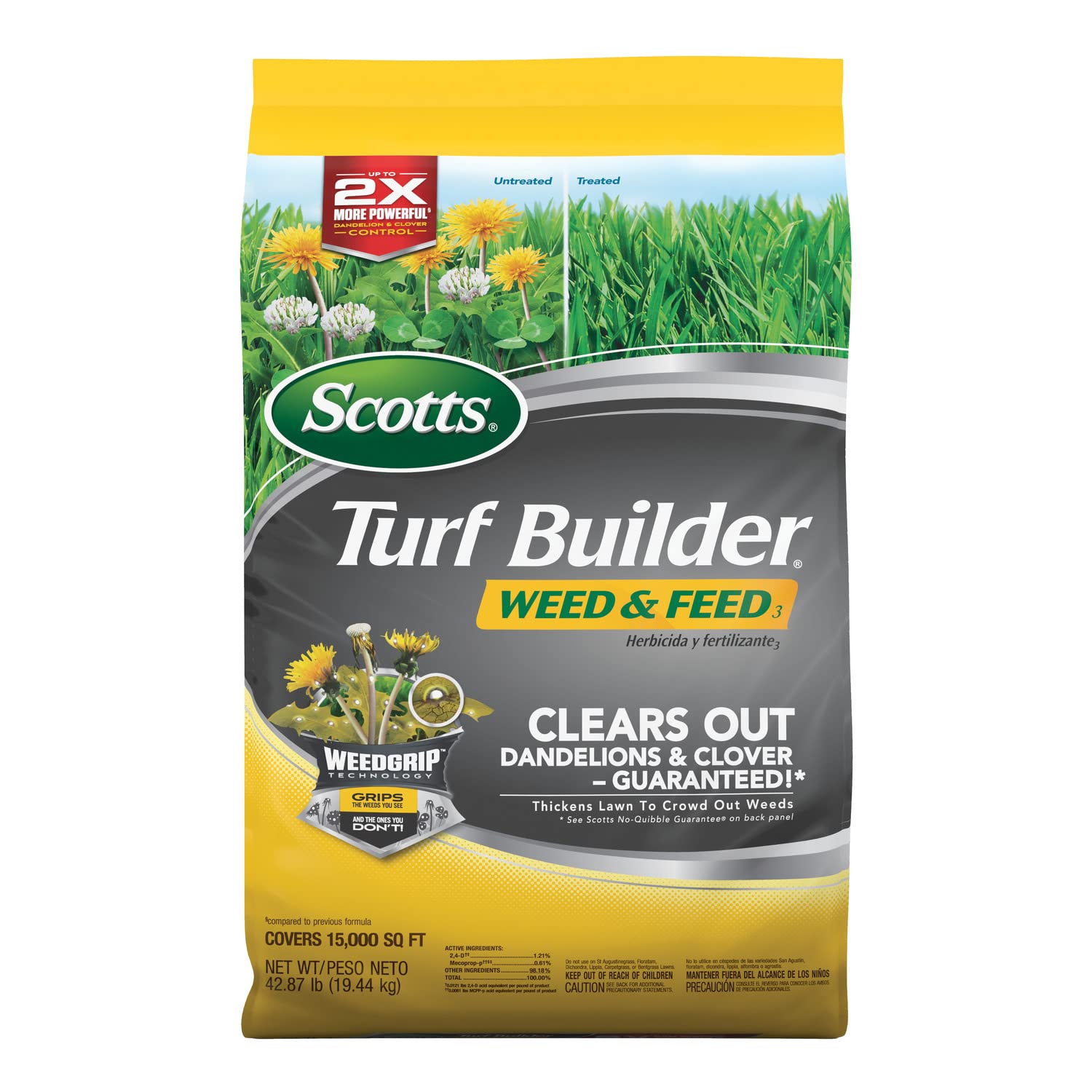
Scotts Turf Builder Weed & Feed (42.87 lb)
| Item Form | Granule |
|---|---|
| Coverage | 15000 square_feet |
| Active Ingredients | 24-D Mecoprop-p |
Scotts Turf Builder Weed & Feed is a granular lawn treatment that kills broadleaf weeds while feeding grass to encourage thicker turf. It is applied with a spreader when weeds are actively growing and temperatures are between 60°F and 90°F; the label recommends applying to a wet lawn so granules stick to weed leaves and waiting 24 hours before watering. The formula uses WeedGrip technology and lists active ingredients including 2,4-D and Mecoprop-p, and the 42.87 lb bag covers about 15,000 square feet. In practice this product is straightforward to broadcast across medium to large lawns and gives visible reduction of common weeds like dandelions and clover while supplying nutrients to help crowd out future weeds. Important limitations are application timing and grass restrictions: do not use on St. Augustinegrass, bentgrass, carpetgrass, dichondra, or lippia, and do not apply if rain is expected within 24 hours. Also keep people and pets off treated turf until dust settles. For homeowners who follow label directions, it is an efficient one-step option for late spring weed control and feeding.
Best for: Homeowners who want a single product to both reduce common broadleaf weeds and feed a cool- or warm-season lawn and who prefer a proven brand with clear label instructions and wide user adoption.
Less Ideal for: People with lawns made of excluded grass types or those needing immediate spot treatment for individual weeds should consider alternatives designed for those specific situations.
- Combines selective broadleaf weed control and fertilizer in one application
- Large bag covers up to 15,000 sq. ft., suitable for medium to large lawns
- WeedGrip technology helps granules adhere to weed leaves for better control
- Granular form is compatible with common broadcast or drop spreaders
- Not safe for several grass types including St. Augustine and bentgrass
- Requires specific temperature and moisture conditions for best results
Verdict: A convenient, proven one-step weed-and-feed for homeowners who want broadleaf weed control plus lawn feeding across large yards.
Scotts Turf Builder WinterGuard Fall Weed & Feed, 11.43 lb

| Item Form | Granule |
|---|---|
| Coverage | 4000 square feet |
| Item Highlight | Kills over 50 listed lawn weeds |
Scotts Turf Builder WinterGuard is a fall-focused granular weed-and-feed designed to control common broadleaf weeds while supplying nutrients to strengthen turf before winter. You apply it with a spreader on a moist lawn when temperatures are between 60 and 90°F and avoid watering for 24 hours after application so granules adhere and the herbicide can work. The formula claims control of more than 50 listed weeds including dandelion and clover and is labelled for common grasses such as fescue, bluegrass, ryegrass and bermudagrass. Practical benefits include simplified one-step treatment for small yards and the brand guidance for spreader settings makes consistent application easier. Limitations to note are the restricted grass list — do not use on St. Augustine, bentgrass, dichondra or certain warm-season grasses — and the need to time application carefully for weed activity and weather. This bag covers 4,000 sq. ft., so larger lawns will require multiple bags or a higher-coverage product.
Best for: Homeowners who want a low-risk, single-step fall treatment to reduce common broadleaf weeds and feed turf for winter recovery and stronger spring growth.
Less Ideal for: Owners of lawns planted with St. Augustine, bentgrass, dichondra, carpetgrass or other excluded species and anyone who needs year-round or large-area coverage without reapplication.
- Combines weed control and fertilizer in a single fall application
- Covers up to 4,000 sq. ft. per 11.43 lb bag, suitable for small to medium lawns
- Labelled for use on a wide range of common turfgrasses
- Includes manufacturer spreader settings to help achieve even application
- Not safe for several grass types including St. Augustine and bentgrass
- Requires specific temperature and moisture conditions for best effectiveness
- One bag is only appropriate for smaller lawns and may be insufficient for larger properties
Verdict: Use this if you need a trusted, fall-specific weed-and-feed that simplifies winter prep for small to medium common turf lawns.
Choosing the Right Weed and Feed Fertilizer: Key Factors to Consider
Nutrient Formulation and Turf Needs
Different lawns require different nitrogen, phosphorus, and potassium ratios. A fertilizer with a higher first number favors quick green-up while a balanced formulation supports root development. Consider your soil test results and local turf species when choosing an N-P-K ratio.
Release type matters too. A mix of readily available nitrogen and modest slow-release sources offers quick color without forcing excessive rapid growth. Excessive nitrogen in late season can stress some cool-season grasses, while warm-season lawns often benefit from midsummer feeding schedules.
Herbicide Active Ingredient and Target Weeds
Weed control in these products relies on one or more herbicide active ingredients that vary in what broadleaf weeds they manage. Some act systemically and control deep-rooted perennials while others are contact herbicides effective on young, small weeds. Match the active ingredient profile to the most common weeds in your yard.
Timing influences herbicide effectiveness. Most weed-control components work best on actively growing weeds in spring or fall. Perennial weed control may require repeat treatments or complementary methods such as spot treatment or hand-pulling for large infestations.
Application Method and Spreader Compatibility
Many weed and feed fertilizers are granular and require a broadcast or drop spreader for even distribution. Spread pattern and recommended spreader settings should match the equipment you own. Poor spread uniformity creates streaks of over- and under-fertilized turf, which leads to uneven color and variable weed pressure.
Also check label instructions for calibration, overlap technique, and recommended walking speed. Some granules are formulated to flow better, improving accuracy in older spreaders; others require more careful calibration.
Timing, Weather, and Rainfastness
Timing the application around plant growth and weather is critical. Many herbicide ingredients require dry foliage for a few hours to a day to be rainfast. Applying just before heavy rain can wash granules off leaves and reduce effectiveness, or in some cases move active ingredients into sensitive areas.
Seasonality matters too. Spring applications focus on early broadleaf control and green-up, while fall applications can target different weed life stages. Avoid late-season heavy nitrogen on certain grass types to prevent winter injury.
Safety, Label Restrictions, and Turf Tolerance
Labels define safe uses, lawn types, and re-entry periods for people and pets. Some active ingredients have specific limitations for certain grass species or newly seeded lawns. Following label intervals for watering, mowing, and pet access reduces risk and maximizes results.
If you have children, pets, ornamental beds, or nearby waterways, consider products with clear buffer-zone instructions, lower toxicity profiles, and clear guidance for cleanup of overspray or spills.
Storage Stability and Shelf Life
Granular weed and feed fertilizers stored in damp or humid conditions can clump, losing spreader performance and accuracy. Choose products with robust packaging or plan for resealable, dry storage. Shelf life affects whether you can buy in bulk or should purchase smaller quantities.
Also consider whether the product's herbicide efficacy degrades over time. Old or improperly stored mixes can lose uniformity between fertilizer and herbicide distribution in the bag, producing inconsistent results after application.
When to Apply Weed and Feed Fertilizer
Application timing depends on your grass type and the weeds you want to control. For cool-season grasses, early spring and mid-fall are prime times because weeds are actively growing and will take up herbicide. For warm-season grasses, late spring through early summer is often better once turf is actively growing and tolerant of treatment.
Avoid applying before heavy rain or when temperatures are extreme. Follow label guidance on minimum dry periods after application to ensure the herbicide becomes rainfast. Also account for recent seeding; many weed and feed products are not safe for new lawns until the turf is established for several months.
- Apply during active weed growth for best herbicide uptake
- Wait recommended interval after seeding before applying
- Avoid applications before forecasted heavy rain
Equipment Tips for Even Coverage
Calibrate your spreader before applying any granular weed and feed. Use a consistent walking speed and overlapping pattern to prevent stripes. Check the manufacturer settings on the product label and test on a driveway to observe flow before treating the lawn.
After application, do not rush to water unless the label requires it. Some formulations need a light irrigation to activate fertilizer but require a dry window for herbicide uptake first. Clean spreader components after use to prevent corrosion and cross-contamination with other lawn products.
- Test spreader flow on a hard surface first
- Overlap passes slightly to avoid missed strips
- Clean spreader after use and store dry
Managing Weeds That Resist Blanket Treatments
Not all weeds respond equally to a single weed and feed product. Tough perennials, large clumps, or weeds emerging after application may need follow-up measures. Spot-treating with a more targeted herbicide or manually removing persistent weeds will complement blanket treatments.
Rotate approaches across the season. Mechanical removal, improving turf density through proper mowing and irrigation, and applying the right fertilizer schedule all reduce the advantage weeds have. Thin lawns often encourage weed pressure, so addressing turf health alongside weed control yields longer-term benefits.
- Use spot treatments for large or resistant weeds
- Improve turf density to reduce future weed establishment
- Combine cultural practices with chemical control for best results
Environmental and Runoff Considerations
Herbicide and fertilizer movement into storm drains or water bodies is a concern. Follow label buffer zone instructions and avoid application up-slope of water features. Sweep granules from hard surfaces back onto the lawn to prevent runoff during irrigation or rain events.
Choose application times and formulations that minimize the chance of immediate runoff. Some municipalities also have seasonal restrictions on fertilization and pesticide use, so check local rules before applying weed and feed products.
- Keep granules off driveways and sidewalks
- Respect buffer zones around water sources
- Know local regulations that may restrict timing or ingredients
Using Weed and Feed with Other Lawn Care Tasks
Coordinate feeding and weed control with your mowing, aeration, and overseeding schedule. Do not apply weed and feed directly before overseeding unless the product label permits, because herbicides can interfere with seed germination. Aeration can improve root development and help turf better utilize the nutrients delivered by fertilizer.
If you plan to apply liquid broadleaf controls later in the season, allow label-recommended intervals between treatments to avoid crop safety issues. Integrate soil testing into your long-term plan so fertility decisions are data driven rather than reactive.
- Avoid overseeding immediately after herbicide application
- Use aeration to maximize nutrient uptake after feeding
- Space different herbicide or fertilizer treatments per label directions
How We Chose the Best Weed and Feed Fertilizer
We focused on attributes that matter to home gardeners using weed and feed products on residential lawns. Primary evaluation criteria included nutrient formulation to match common turfgrass needs, herbicide active-ingredient type and labeled weed spectrum, spreader compatibility and granule uniformity for even coverage, and persistence of both fertilizer and herbicide effects. We also measured application flexibility such as timing windows, rainfall tolerance after application, and safety guidance for pets and children. Durability in storage and ease of following label directions were considered for usability. We excluded any granular products that lacked a clear herbicide active ingredient or that were solely slow-release fertilizers without weed control. Products intended only for commercial turf managers or requiring special licenses were not considered. The result is a list of widely applicable weed and feed fertilizer options suited to typical home lawn situations along the decision metrics above.
FAQ
Can I use weed and feed on newly seeded lawns?
Usually no. Most weed and feed products have a waiting period after seeding to protect germinating grass. Follow the label for the recommended establishment time, which often ranges from several weeks to a few months depending on the product.
How long after application is it safe for pets to re-enter the lawn?
Re-entry intervals vary by product and active ingredients. Many labels recommend keeping pets off treated areas until granules have been watered in or the area is dry. Check the specific label instructions for precise re-entry times.
Will a single application eliminate all broadleaf weeds?
Not always. A properly timed application can reduce many common broadleaf weeds, but perennial or well-established weeds may require repeat treatments or additional control methods. Cultural improvements to turf health also help reduce recurring weed problems.
Can I apply weed and feed before heavy rain?
Avoid applying immediately before heavy rain. Most herbicides require a dry window to adhere to foliage and become rainfast. If heavy rain is expected, postpone application until conditions are suitable.
Is it safe to use weed and feed near flower beds or vegetable gardens?
Care is needed. Keep granules off non-target plants and respect label buffer zones to prevent damage. For vegetable gardens, avoid drift and consider alternative, targeted weed control methods to protect edible crops.
How often can I apply weed and feed in a season?
Application frequency depends on product labeling and local recommendations. Many granular weed and feed formulations are intended for one to two applications per year. Follow label intervals to avoid over-application of nutrients or herbicides.
Final Verdict
Choosing the right weed and feed fertilizer means balancing nutrient needs, the weed spectrum in your lawn, and practical application constraints like timing and equipment. Prioritize formulations that match your soil test and turf species, and plan applications when weeds are actively growing and weather conditions support herbicide uptake. Remember that blanket treatments work best as part of a broader lawn-care program that includes proper mowing, irrigation, and targeted follow-up for stubborn weeds.
