

Note: This article contains affiliate links. If you click on these links and make a purchase, I may earn a small commission at no extra cost to you. This helps support my research and content. Read my full affiliate disclosure here.
Centipede lawns have unique nutrient needs and a low tolerance for harsh herbicides, so picking the right weed-and-feed matters for long-term turf health. You want a product that controls common broadleaf weeds while supplying the modest nitrogen Centipede prefers, without causing scorch or excessive growth. This guide covers five carefully shortlisted weed-and-feed options suited for Centipede lawns. We focus on how well each product controls relevant weeds, how gentle it is on Centipede growth, and practical use factors like timing and application method. Read on to understand the evaluation criteria and how each type of product behaves in a real home lawn setting.
Top Picks at a Glance
| Best Overall The best all-around choice for most situations | Scotts Turf Builder Weed & Feed5 Granular Lawn Fertilizer (33.95 lb) |  |
| Best Quality Built to a higher standard if you want something more solid | The Andersons Premium Weed and Feed 24-0-16 (18 lb) |  |
| Best Budget The cheapest option that still gets the job done reliably | GreenView Weed & Feed Lawn Fertilizer, 13 lb (covers 5,000 sq. ft.) |  |
| Most Popular A crowd favorite that many people choose with confidence | Scotts Turf Builder Weed & Feed3 Granular Lawn Fertilizer (42.87 lb) |  |
| Best Seller A high-volume bestseller chosen again and again | Scotts Turf Builder Weed & Feed 3, 14.29 lb |  |
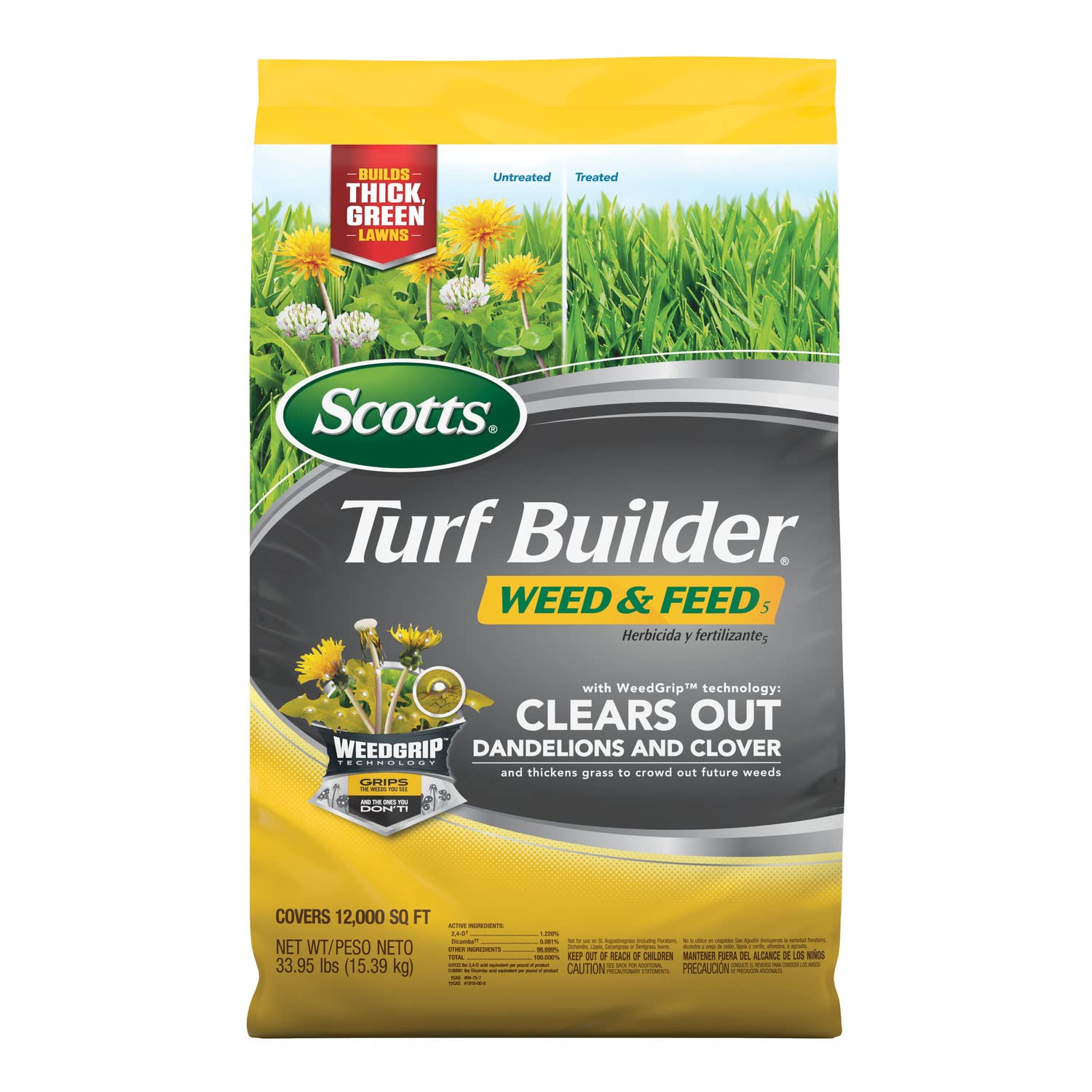
Scotts Turf Builder Weed & Feed5 Granular Lawn Fertilizer (33.95 lb)
| Item Form | Granule |
|---|---|
| Coverage | 12000 square feet |
| Active Ingredients | 2,4-D and Dicamba |
Scotts Turf Builder Weed & Feed5 is a granular combination product that kills many common broadleaf lawn weeds while supplying nitrogen and potassium to strengthen grass. It is typically applied with a broadcast or drop spreader when weeds are actively growing and temperatures are between 60°F and 90°F; the bag covers about 12,000 sq. ft. Notable features include WeedGrip technology to help granules stick to weed leaves and a nutrient blend with both quick-release and slowly available nitrogen for sustained feeding. Practical benefits are visible weed control of species like dandelion and clover plus thicker turf that can help crowd out future weeds. Important limitations: it must be applied to wet grass and you should not water for 24 hours after application, so timing around rain is important, and it is explicitly not for use on St. Augustinegrass, Bentgrass, Carpetgrass, Dichondra, or Lippia. Also it targets broadleaf weeds and will not control grassy weeds or provide selective post-emergent control for all species.
Best for: Homeowners who want a practical, once-or-twice-a-year treatment to reduce common broadleaf weeds while feeding and thickening their lawn.
Less Ideal for: Owners of St. Augustine, Bentgrass, Carpetgrass, Dichondra, or Lippia lawns and anyone needing control of grassy weeds or specialized post-emergent solutions.
- Combines weed control and fertilization in a single granular application
- Covers up to 12,000 square feet per 33.95 lb. bag for large lawns
- Formulation includes both fast-release and slowly available nitrogen for sustained feeding
- WeedGrip technology helps granules adhere to weed foliage for better uptake
- Not safe for several turf types including St. Augustine and Bentgrass
- Requires precise timing and dry window after application to be effective
Verdict: A convenient large-coverage granular product that combines broadleaf weed control with sustained lawn feeding for homeowners aiming to thicken and tidy ordinary lawns.
The Andersons Premium Weed and Feed 24-0-16 (18 lb)

| Item Form | Granule |
|---|---|
| Coverage | 5,000 sq ft |
| Unit Count | 288 Ounce |
| Active Ingredients | Herbicide, Iron, Nitrogen, Sulfur |
This premium granule product treats broadleaf weeds while feeding the turf in a single application cycle. It is designed for use on common warm- and cool-season grasses listed on the label and is applied with a rotary or drop spreader to dry turf; directions recommend splitting the first application into two half-rates spaced 4 to 6 weeks apart and watering after application to activate weed control. Notable features include an herbicide plus iron for deeper greening and a 24-0-16 N-P-K formula that combines quick- and slow-release nitrogen for immediate color and extended feeding. Practical benefits are visible weed control of dandelions and many broadleaf weeds and improved turf color without frequent feeding. Important limitations are label restrictions for certain states and grass types and the need to follow the spreader settings and timing precisely for safe, effective results; it is not suitable for dichondra or carpet grass and cannot be sold in some states.
Best for: Gardeners who prioritize visible performance and want a one-step product that quickly reduces common broadleaf weeds while improving lawn color on approved grass types.
Less Ideal for: Homeowners with dichondra or carpet grass, or those in states where the product is restricted, should choose a different weed-and-feed or a grass-safe targeted herbicide program.
- Combined herbicide and fertilizer simplifies lawn care by controlling broadleaf weeds while feeding turf.
- Contains both quick- and slow-release nitrogen for immediate green-up and sustained feeding.
- Includes iron for deeper greening and improved turf color.
- Coverage rated up to 5,000 sq ft per bag for straightforward planning and application.
- Not labeled for use on dichondra or carpet grass and restricted from sale in several states.
- Requires careful adherence to spreader settings and staged application instructions for safe, effective results.
Verdict: Buy this if you want a high-performance one-step weed-and-feed that delivers fast green-up and broadleaf weed control on labeled centipede and other approved lawns.
GreenView Weed & Feed Lawn Fertilizer, 13 lb (covers 5,000 sq. ft.)

| NPK | 27-0-4 |
|---|---|
| Item Form | Granule |
| Coverage | 5000 square_feet |
| Unit Count | 208 Ounce |
| Active Ingredients | Nitrogen |
GreenView Weed & Feed is a granular lawn treatment that combines a controlled-release nitrogen fertilizer with a broadleaf herbicide to kill common weeds while feeding established turf. You spread it over the lawn when weeds are actively growing, water it in, and avoid mowing for two days to let the granules work. Notable features include MESA controlled-release nitrogen for steady feeding up to eight weeks and a selective herbicide that targets more than 250 broadleaf weeds such as dandelion and clover. Practical benefits are simpler maintenance because one application both nourishes grass and reduces weeds, helps green-up without surge growth, and supports root development to improve drought resistance. Important limitations are that it is designed for established lawns only and should not be used on certain grasses like dichondra, carpetgrass, or St. Augustine in Florida; centipedegrass is listed among compatible types but follow label directions carefully. Also, a single 13 lb bag treats about 5,000 sq ft, so larger properties will need multiple bags.
Best for: Homeowners with established centipede or other common turfgrasses who want a low-effort, all-in-one application to reduce weeds and provide steady feeding across a mid-size lawn.
Less Ideal for: People establishing new lawns, managing delicate or excluded turf species, or those who need targeted grub or grass-specific treatments rather than broadleaf control.
- Controlled-release nitrogen feeds lawn steadily for up to 8 weeks
- Selective herbicide claims control of over 250 common broadleaf weeds
- Covers up to 5,000 square feet per 13 lb bag for one-pass treatment
- Zero phosphate formula reduces risk of waterway nutrient runoff
- Not safe for some turf types including dichondra, carpetgrass, and St. Augustine in Florida
- Single bag may be insufficient for larger yards requiring multiple purchases
Verdict: A practical one-application weed-and-feed that gives established centipede lawns steady fertilizer for weeks while knocking back broadleaf weeds.
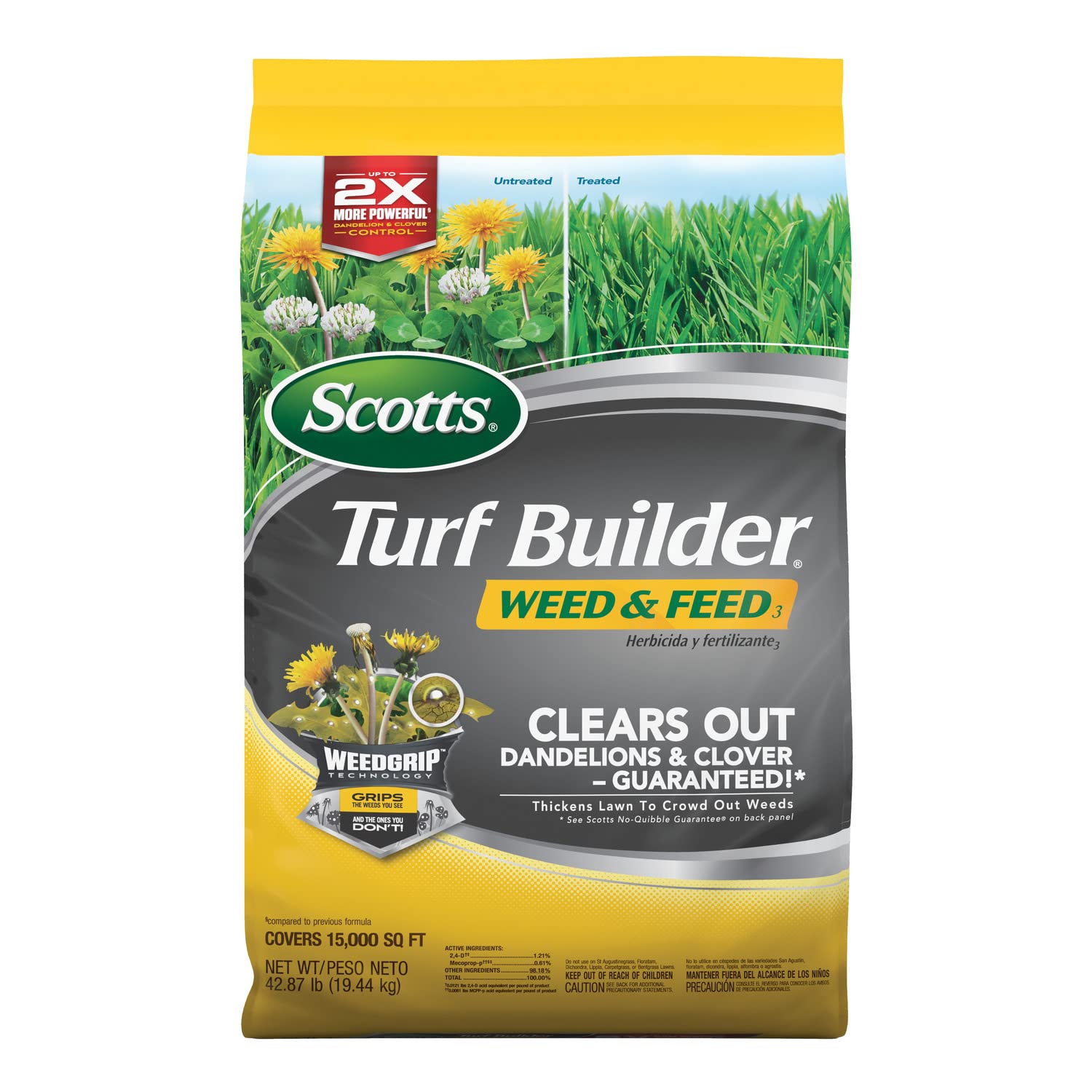
Scotts Turf Builder Weed & Feed3 Granular Lawn Fertilizer (42.87 lb)
| Item Form | Granule |
|---|---|
| Coverage | 15000 square_feet |
| Active Ingredients | 24-D Mecoprop-p |
Scotts Turf Builder Weed & Feed3 combines a broadleaf weedkiller with a granular lawn fertilizer to both reduce visible weeds and thicken turf. In practice you apply it with a broadcast or drop spreader to a moist lawn when daytime temperatures are between about 60°F and 90°F, allow dust to settle, then avoid watering for 24 hours so the active ingredients adhere to weed leaves. Notable features include WeedGrip Technology and an active-ingredient mix listed as 2,4-D and Mecoprop-p, which the brand says controls dandelion, clover and many other common weeds and feeds to promote denser grass. The large bag covers roughly 15,000 sq. ft., so it is convenient for established lawns. Important limitations for centipede lawns: the label specifically prohibits use on several warm-season grasses and similar plants, and centipedegrass can be sensitive to some broadleaf herbicides, so label directions and local extension guidance must be checked before use. Also, chemical weed-and-feed products work best on actively growing weeds and will not replace spot treatments or cultural fixes for persistent weed problems.
Best for: Homeowners who prioritize proven products and peer-tested results and who manage established lawns where a combined feed-and-weed application is appropriate.
Less Ideal for: Gardeners with small patch repairs, newly seeded or sodded centipede areas, or anyone unwilling to check label compatibility with centipedegrass should consider gentler or targeted options instead.
- Combines weed control and fertilizer in one application for time savings
- Covers up to 15,000 sq. ft. per bag, suitable for medium to large established lawns
- WeedGrip Technology helps granules stick to weed leaves for better contact
- Granular form works with standard broadcast or drop spreaders and is easy to apply
- Label restrictions and grass sensitivities mean it may not be safe for all warm-season lawns
- Requires specific timing and dry window after application to be effective
Verdict: Use this product if you want a single, large-coverage granular mix that both feeds turf and targets many common broadleaf weeds.
Scotts Turf Builder Weed & Feed 3, 14.29 lb

| Item Form | Granule |
|---|---|
| Coverage | 5000 square_feet |
| Active Ingredients | 2,4-D 1.220%, Mecoprop 0.081% |
Scotts Turf Builder Weed & Feed 3 is a ready-to-use granular product that combines lawn fertilizer with selective herbicides aimed at common broadleaf weeds such as dandelion and clover. It is applied with a broadcast or drop spreader to an actively growing lawn when daytime temperatures are between 60 and 90°F and the grass is wet so granules stick to weed leaves. Notable features include WeedGrip Technology for better herbicide contact, a formulation that feeds to thicken turf while killing over 50 listed weeds, and coverage of approximately 5,000 sq ft per 14.29 lb bag. Practically, it simplifies two tasks in one pass: feeding and broadleaf weed control, which can reduce the number of separate treatments needed. Important limitations for centipede lawns are that this product should not be used on certain grass types listed by the maker and centipede grass is sensitive to many weed-and-feed formulations; always verify label guidance for centipede before applying. Also, avoid application if rain is expected within 24 hours and keep people and pets off treated areas until dust settles.
Best for: A cautious homeowner who wants a single-product approach to reduce task frequency and prefers clear directions and established brand formulations when managing common broadleaf weeds on a small to medium lawn.
Less Ideal for: Owners of centipede lawns who have not confirmed this formulation is safe for centipede grass or those who need a product labeled specifically for centipede compatibility should look for alternatives formulated for that turf type.
- Combines fertilizer and broadleaf weed control in one granular application.
- WeedGrip Technology helps granules adhere to weed leaves for improved contact.
- Covers about 5,000 square feet per bag, suitable for small to mid-size lawns.
- Granule form works with common broadcast and drop spreaders and has clear application instructions.
- Label lists grass types that must not be treated, requiring careful compatibility checks for centipede lawns.
- Requires dry, settled conditions for 24 hours after application which limits timing flexibility.
Verdict: Choose this product if you want a single, well-known granular weed-and-feed that simplifies feeding and broadleaf control on lawns after confirming it is safe for centipede turf.
Choosing the Right Weed and Feed for Centipede Lawn: Key Factors to Consider
Herbicide Spectrum and Target Weeds
Centipede lawns are most often invaded by broadleaf weeds and certain winter annuals. Matching the product's active ingredients to the weeds you actually see matters more than blanket claims. Read the label to confirm control of dandelion, clover, chickweed, plantain, and common chickweed in your region.
A product that lists the right weeds will give predictable results when applied at the recommended timing. Avoid products whose herbicide mix includes actives labeled primarily for cool-season turf weeds unless the label explicitly lists Centipede. Knowing what you need to control reduces unnecessary chemical exposure and helps you choose the correct timing for application.
Centipede Tolerance and Turf Safety
Centipede grass is sensitive to high nitrogen rates and some herbicides can cause leaf burn or stolon damage. Look for materials with a demonstrated safety margin for Centipede and follow label rates closely. Timing and weather matter: avoid applications during drought stress, extreme heat, or prolonged wet conditions to reduce the risk of injury.
Consider the product's recommended seeding or overseeding windows and whether post-application irrigation is advised. Products that require less aggressive nitrogen or include slow-release fertilizer elements tend to produce steadier turf response and lower the chance of scorch or excessive top growth.
Fertilizer Formulation and Nitrogen Release
Centipede lawns thrive on lower, steady nitrogen inputs rather than frequent heavy feeds. Check the fertilizer analysis and the proportion of slow-release nitrogen. A balanced formulation that provides modest N with adequate potassium and phosphorus supports root health and stress tolerance without forcing rapid top growth.
Slow-release sources reduce flush growth and lower mowing frequency. If the product uses a quick-release high-nitrogen formula, expect faster green-up but also a higher risk of burn if rates or timing are off. Pay attention to the guaranteed analysis and any notes about expected duration of feed.
Application Method and Equipment Compatibility
Weed-and-feed products come as granular blends or liquids for spray application. Granular products designed for broadcast or drop spreaders are often easier for homeowners, while liquids may give more uniform coverage but require a tank sprayer and mixing skills. Choose a format that matches your equipment and comfort level.
Also consider calibration needs. For broadcast spreaders, clear application rate per 1,000 square feet makes correct application straightforward. For sprays, look for spray volume ranges and nozzle recommendations. Proper coverage is essential for consistent weed control without overapplication.
Timing and Seasonal Use
Correct timing maximizes control and limits stress. For many regions, late spring to early summer is the main window because weeds are actively growing and Centipede is recovering from spring slow growth. Prevalent winter annuals may need a late winter or early spring approach if the product label supports it.
Avoid applying during drought, extreme heat, or immediately before expected heavy rains. Some formulations advise watering in after a set number of hours to activate the herbicide or to settle granules into the canopy. Planning applications around weather and lawn condition will improve results and reduce injury risk.
Label Instructions, Safety, and Environmental Notes
The product label is the legal and practical guide to safe, effective use. It contains rate charts, timing, re-entry intervals, turf tolerance notes, and instructions for handling off-target drift. Read and follow the label carefully. Consider environmental factors such as proximity to desirable ornamentals, water bodies, and pollinator habitat.
Products with clear, homeowner-friendly labels reduce the chance of mistakes. Also note recommended personal protective equipment, disposal instructions, and any guidance on pet or child re-entry to ensure safety after application.
When to Apply on Centipede Lawns
Timing is critical with Centipede because the grass has a narrow window of active growth and lower tolerance for stress. For many temperate lawns, the best single application window is late spring to early summer when both weeds and Centipede are actively growing but not heat-stressed. Early spring can work for certain winter annuals if the product label supports cool-season weed control and lists Centipede tolerance.
Avoid applications during drought or sustained high temperatures. If soil moisture is low, lightly irrigate a day before applying to reduce the risk of burn, and follow label guidance on post-application watering.
- Apply when weeds are young and actively growing for better control.
- Avoid application during drought or heat waves to protect stolons.
- Check label for specific seasonal windows and reapplication limits.
Granular Vs Liquid Formats for Homeowners
Granular weed-and-feed blends are often the simplest option for homeowners because they require a spreader and minimal mixing. They are useful for spot treatments or whole-yard applications and can be easier to calibrate with clear spreader settings. However, distribution can be uneven if the spreader is not calibrated or the yard has varied canopy density.
Liquid formulations can deliver more uniform herbicide coverage and better contact on broadleaf weeds, but they require a sprayer, correct mixing, and attention to nozzle selection. Liquids are also better for small, precise spot treatments where spreader drift or granular pickup is a concern.
- Use a calibrated broadcast spreader for even granular application.
- Choose liquid sprays for precise spot control and uniform coverage.
- Consider labor, equipment, and weather when selecting format.
Managing Turf Response After Application
Expect the herbicide to take several days to show effect on weeds, and do not overreact by applying additional product too soon. Some browning of targeted weeds is normal as they die back. Monitor the lawn for any signs of phytotoxicity on Centipede and be prepared to adjust future timing or rates if you see consistent damage.
Follow label guidance for post-application irrigation. Some products recommend light watering after a set period to move granules into the canopy, while others advise waiting to avoid reducing herbicide contact time. Record application dates and conditions so you can refine timing next season.
- Do not reapply before the label interval has passed.
- Watch for weed decline over 7 to 21 days depending on the herbicide.
- Adjust future applications if you notice persistent turf injury.
Spot Treatment and Integrated Weed Management
Not all lawn areas need blanket treatment every season. For low weed pressure, spot-treating visible patches of broadleaf weeds reduces chemical use and limits stress to your Centipede grass. Combine mechanical removal of large weeds with targeted herbicide spot applications for efficient control.
Integrate cultural practices that favor Centipede health, such as proper mowing height, modest fertilization, and adequate irrigation. Healthy, dense Centipede turf resists weeds better than a stressed or thin lawn, reducing the need for repeated weed-and-feed treatments.
- Use hand-pulling or spot spray for isolated weeds.
- Improve turf density with overseeding and balanced, low-rate fertilization.
- Rotate control methods to reduce reliance on a single herbicide mode of action.
Common Mistakes to Avoid
Over-application is a frequent cause of Centipede damage. Follow the label rate for your lawn size and avoid applying more frequently than allowed. Mis-calibrated spreaders or guesswork on spray volumes lead to uneven results and higher injury risk.
Another common error is applying during or immediately before extreme weather events. Heavy rain after application can wash herbicide toward non-target areas, while drought can magnify phytotoxic effects. Finally, neglecting to read re-entry and safety instructions increases risk to people, pets, and nearby plants.
- Do not exceed labeled rates or shorten reapplication intervals.
- Avoid applying before heavy rain or during drought stress.
- Calibrate equipment and follow safety instructions on the label.
How We Chose the Best Weed and Feed for Centipede Lawn
We prioritized products with active ingredients and nutrient formulations that match Centipede grass physiology and common weed pressure. Key evaluation criteria included the herbicide spectrum relevant to broadleaf and winter annual weeds that typically invade Centipede turf, fertilizer formulation and nitrogen release rate to avoid excessive top growth, and documented tolerance levels for Centipede under normal use. We also judged application flexibility, including granular versus liquid formats and the availability of walk-behind or broadcast spreader compatibility. Safety and label guidance were considered, specifically re-entry intervals and recommended watering after application to reduce burn risk. Ease of use and clarity of label instructions were included because homeowner application errors are a major cause of turf damage. Exclusions: we excluded treatments that contain herbicides known to injure warm-season stoloniferous grasses or products lacking clear label guidance for Centipede. We also set aside specialty weed controls that require professional application or are designed only for cool-season lawns. The filters used were herbicide match to common Centipede weeds, nutrient balance for low-maintenance Centipede turf, application method practicality, and safety margin for home gardeners. These dimensions shaped the final shortlist and the scoring approach used throughout the guide.
FAQ
Can I use a general weed-and-feed on Centipede lawn?
Often you can, but only if the product label lists Centipede tolerance and the herbicide targets the weeds you have. General lawn products may contain herbicides or nitrogen rates that stress Centipede, so always verify the label before applying.
How long after application should I water my Centipede lawn?
That depends on the product. Some granular formulas recommend light irrigation after a specified number of hours to move granules into the canopy, while others advise waiting to maintain herbicide contact. Follow the label instructions for post-application watering.
Will weed-and-feed speed up mowing needs on Centipede?
Products with high quick-release nitrogen can stimulate faster top growth, which may increase mowing frequency. Choosing a balanced formula with slow-release nitrogen helps minimize rapid growth while maintaining steady green-up.
Is spot-treatment safer than whole-lawn application for Centipede?
Spot-treatment reduces chemical use and limits exposure of healthy turf, making it a safer option when weed pressure is low. However, for widespread infestations a whole-lawn approach may be more practical if the product is labeled safe for Centipede.
How often should I apply weed-and-feed on Centipede turf?
Frequency depends on the product label and local conditions. Many labels restrict the number of applications per year and have minimum intervals. For Centipede, err on the side of fewer, well-timed applications to reduce stress on the grass.
Final Verdict
Choosing the right weed-and-feed for a Centipede lawn means balancing effective broadleaf weed control with a fertilizer profile Centipede can tolerate. Prioritize products with herbicide spectra that match the weeds you face, modest slow-release nitrogen, and clear label guidance for Centipede turf safety. Plan applications around active growth windows and favorable weather, use spot treatments when possible, and follow label instructions precisely. That approach will minimize turf stress and deliver steady weed control while keeping your Centipede lawn healthy and low-maintenance.
