

Note: This article contains affiliate links. If you click on these links and make a purchase, I may earn a small commission at no extra cost to you. This helps support my research and content. Read my full affiliate disclosure here.
A steady-feeding fertilizer can change how your lawn grows and how much time you spend maintaining it. Slow release fertilizers for lawns release nutrients over weeks or months, reducing the peaks and troughs that lead to weak growth or burner spots. Choosing the right formula and granule type matters for turf density, spring green-up, and long-term soil health. This guide summarizes six top slow release lawn fertilizers shortlisted for common turf goals. We evaluate each by how long nutrients last, how easy they are to apply, and how they behave in real garden conditions to help you pick the right product for your lawn size and schedule.
Top Picks at a Glance
| Best Overall The best all-around choice for most situations | Milorganite 6-4-0 Slow-Release Organic Fertilizer, 32 lb (with Feeding Tips Brochure) |  |
| Best Quality Built to a higher standard if you want something more solid | The Andersons Professional PGF Complete 16-4-8 Granular Fertilizer with Humic DG (coverage for 5,000 sq ft) |  |
| Best Value The sweet spot between price and what you get | GreenView Fairway Formula Lawn Fertilizer, 33 lb (covers 10,000 sq. ft.) |  |
| Best Budget The cheapest option that still gets the job done reliably | Milorganite Slow-Release Organic Fertilizer, 5 lb |  |
| Highest Rated A top-rated pick with lots of positive feedback | Ferti-lome Slow Release Nitrogen Lawn Fertilizer 15-0-15 with Iron (2 × 16 lb Bags) |  |
| Best Seller A high-volume bestseller chosen again and again | Scotts Turf Builder WinterGuard Fall Lawn Food, 10 lb. |  |
Milorganite 6-4-0 Slow-Release Organic Fertilizer, 32 lb (with Feeding Tips Brochure)

| Item Form | Pelletized |
|---|---|
| Application Method | Broadcast, Rotary or Manual |
| Coverage | 2,500 Square Feet |
| Specific Uses For Product | Lawns, Flowers and Gardens |
| Unit Count | 512 Ounce |
Milorganite 6-4-0 is a slow-release, pelletized organic fertilizer designed for routine lawn and garden feeding. It supplies low-salt nitrogen that releases over roughly 8–10 weeks, and includes organically complex iron to deepen green without the staining associated with some synthetic iron salts. The product is applied with a broadcast, rotary, or manual spreader and a single 32 lb bag claims coverage up to about 2,500 sq ft, making it a practical choice for regular seasonal applications. Because it is high in organic matter, it also contributes to soil structure and microbial activity, which helps in clay and sandy soils by improving drainage or reducing nutrient leaching. It has an earthy odor at first that fades after rain or watering, and it does not require watering in after application. The main limitations are its modest N-P-K ratio for users wanting quick, high-nitrogen greening or precise nutrient formulations, and the pellet form means it works slowly compared with soluble fertilizers. For a balanced, maintenance-focused lawn program this product delivers steady feeding and soil-building benefits.
Best for: Homeowners who want a low-maintenance, soil-improving fertilizer for regular lawn and garden care and prefer steady, long-lasting feeding over rapid results.
Less Ideal for: People seeking fast, high-nitrogen results for rapid green-up or those who require exact, high-phosphorus or high-potassium formulations for specific garden problems.
- Slow-release nitrogen feeds lawns and gardens steadily for about 8–10 weeks
- Low-salt formulation reduces risk of burn and streaking in hot or dry conditions
- Contains organically complex iron for improved greening without common iron salt stains
- Pelletized form is compatible with broadcast, rotary, or manual spreaders
- Adds organic matter that improves soil structure and microbial activity
- Lower N-P-K numbers mean slower visible greening compared with high-nitrogen synthetic options
- Has an initial earthy odor that dissipates only after a few days or watering
Verdict: Choose Milorganite if you want a reliable, slow-release organic fertilizer that builds soil health while providing steady, low-risk feeding for lawns and gardens.
The Andersons Professional PGF Complete 16-4-8 Granular Fertilizer with Humic DG (coverage for 5,000 sq ft)

| N-P-K | 16-4-8 |
|---|---|
| Form | Granules |
| Target species | lawn grasses |
| Coverage | Full |
| Mixing ratio | 4-1-2 ratio |
The Andersons Professional PGF Complete 16-4-8 is a granular lawn fertilizer designed for performance-minded users who want both immediate green-up and extended feeding. It blends quick-release and methylene-urea slow-release nitrogen to deliver an early boost and sustained nutrition for up to eight weeks, while added iron and micronutrients help darken turf and address minor deficiencies. The product includes Humic DG to improve soil contact and nutrient movement into the rootzone and is formulated for full-coverage application across lawns; the manufacturer provides spreader settings and a recommended walk speed for even distribution. Practical benefits include fewer applications over the season and measurable turf response from both the fast and slow nitrogen fractions. Important limitations are that it is a granular product requiring a broadcast spreader and water-in to activate the DG technology, and it is not labeled for sale in California so availability and local use may be restricted there.
Best for: Homeowners or lawn care pros focused on high-performance turf who want fewer applications and steady nutrition across an entire lawn.
Less Ideal for: Small containerized turf projects or gardeners who need a liquid or foliar feed solution; also not appropriate where granular fertilizers are restricted locally.
- Combination of quick- and slow-release nitrogen for immediate green-up and sustained feeding
- Includes iron and micronutrients to improve turf color and correct minor deficiencies
- Humic DG formulation improves soil contact and helps move nutrients into the root zone
- Coverage and spreader setting guidance simplifies application for whole lawns
- Requires a broadcast spreader and watering-in to activate the DG technology
- Not approved for sale in California which limits use in that state
Verdict: Choose this product if you want a professional 16-4-8 granular fertilizer that delivers quick green-up plus extended slow-release feeding for strong, consistent lawns.
GreenView Fairway Formula Lawn Fertilizer, 33 lb (covers 10,000 sq. ft.)

| Item Form | Granules |
|---|---|
| Coverage | 10,000 sq. ft. |
| Specific Uses For Product | Root Development, Seed Development, Soil Conditioning |
| Mixing Ratio | 27-0-5 |
GreenView Fairway Formula is a granular lawn fertilizer designed to provide steady nutrition without frequent reapplication. It blends immediate-release and time-released nitrogen so lawns receive an initial boost followed by up to 12 weeks of continuous feeding, which helps green and thicken turf while reducing surge growth. Typical use is a single application when grass is actively growing in spring or whenever the lawn needs sustained feeding; the bag covers about 10,000 sq. ft. Notable features include a high proportion of slow-release nitrogen and a phosphate-free formula intended to limit impact on waterways. Practical benefits are fewer applications across the season, more consistent color and density, and suitability for all common grass types. Important limitations are that it does not include weed or crabgrass control and it should not be applied to frozen turf or right before heavy rain; users must also avoid hand spreading and follow precautions around water and hard surfaces. For seeding, it should be raked in and watered to aid germination.
Best for: Homeowners who want a low-maintenance, reliable feeding schedule to maintain green, dense turf across a medium to large lawn without frequent reapplications.
Less Ideal for: Gardeners who need combined fertilizer plus preemergent or postemergent weed control or those who require an immediate liquid greening treatment.
- Provides both immediate and controlled-release nitrogen for up to 12 weeks of feeding
- Covers approximately 10,000 sq. ft. per 33 lb bag, suitable for medium to large lawns
- Phosphate-free formulation reduces risk to waterways
- Granular form can be applied with common spreaders and worked into seed beds for new lawns
- Does not include any weed or crabgrass control
- Not suitable for application to frozen turf or when heavy rain is expected
Verdict: Choose this product if you want a phosphate-free granular fertilizer that delivers steady, up-to-12-week nitrogen feeding to keep a medium to large lawn consistently green with fewer applications.
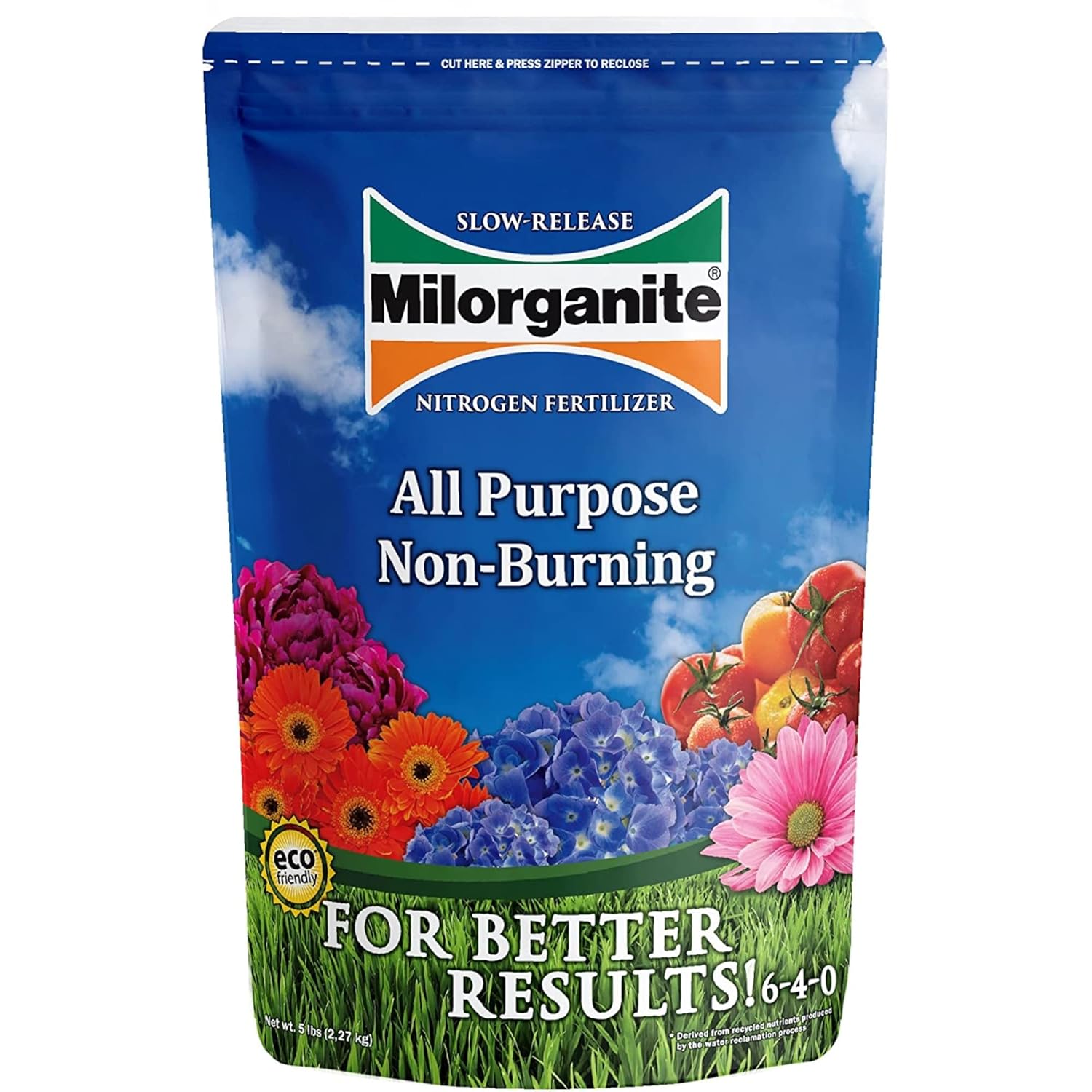
Milorganite Slow-Release Organic Fertilizer, 5 lb
| N-P-K | 6-4-0 |
|---|---|
| Form | Granules |
| Coverage | 390 Square Feet |
| Unit Count | 80 Ounce |
Milorganite is a granulated, organic slow-release fertilizer meant for routine feeding of lawns, flower beds, and garden plants. Applied by hand or with a broadcast spreader, a 5 pound bag covers about 390 square feet and supplies low-salt nitrogen on an 8 to 10 week release schedule, which reduces the need for frequent applications. The product also contains organically complexed iron to promote deeper green color without staining concrete. Because it is mostly organic matter, it improves soil structure and works well in both clay and sandy soils by enhancing drainage and microbial activity. Practical benefits include low burn risk, no need to water in after application, and long-lasting feeding that fits a seasonal "holiday" schedule. Limitations are that a single 5 lb bag covers only a modest area, so larger lawns will need multiple bags, and the earthy odor reported by some users when first applied may be noticeable until it dissipates or is watered in.
Best for: Gardeners seeking an inexpensive, low-maintenance slow-release fertilizer for small lawns or beds who prioritize safety and soil health over rapid results.
Less Ideal for: Homeowners with large lawns who need high-concentration synthetic feeding for quick green-up or who want a single large-bag solution.
- Slow-release nitrogen feeds lawns and plants for 8–10 weeks reducing application frequency
- Low salt formula greatly reduces risk of burning turf or plants
- Organically complexed iron promotes lasting green color without concrete staining
- High organic matter content improves soil structure and supports microbial activity
- 5 lb bag covers only about 390 sq ft, so multiple bags are required for medium to large lawns
- Has an initial earthy odor that some people and pets may find noticeable
Verdict: Choose Milorganite if you want an affordable, slow-release organic fertilizer that safely feeds and improves soil for small lawns and garden beds.
Ferti-lome Slow Release Nitrogen Lawn Fertilizer 15-0-15 with Iron (2 × 16 lb Bags)

| Form | Granules |
|---|---|
| NPK | 15-0-15 |
| Intended Use | Lawn Care |
| Pack Count | 2 |
This two-pack of Ferti-lome slow-release granular fertilizer is built for steady, low-maintenance lawn feeding. Each 16 lb bag supplies a 15-0-15 formula with added iron and micronutrients; the slow-release nitrogen helps deliver nutrients over time so you do not need to reapply frequently. It is intended for spring and fall applications and is compatible with a wide range of grasses including centipede, Bermuda, zoysia, St. Augustine, fescue, rye and bluegrass. Typical use is broadcast spreading at the recommended rate (16 lb per 4,000 sq ft) to maintain turf vigor and color; the iron boost helps deepen greenness without extra liquid feeds. The practical benefit is fewer application rounds and reliable seasonal coverage for mid to large lawns thanks to the two-bag bundle. Important limitations are that this product contains no phosphorus and is formulated specifically for general lawn maintenance rather than rapid repair of bare or nutrient-deficient patches, and proper spreading equipment and adherence to the package rate are needed to avoid uneven results.
Best for: Homeowners who prioritize a dependable, low-maintenance feeding schedule for mid to large lawns and want consistent seasonal color without frequent reapplication.
Less Ideal for: Gardeners needing a fertilizer for rapid repair of bare spots or to correct phosphorus-deficient soils should choose a different, targeted product.
- Slow-release nitrogen provides extended feeding and reduces application frequency
- Includes iron and micronutrients to improve lawn color
- Two 16 lb bags provide enough material for larger lawns or multiple applications
- Compatible with a wide range of common turfgrass species
- No phosphorus in the formulation, so it will not address phosphorus deficiencies
- Requires proper spreader calibration to avoid uneven application
Verdict: Choose this two-pack slow-release 15-0-15 fertilizer if you want a reliable, low-effort seasonal feed that keeps common lawn grasses green with fewer applications.
Scotts Turf Builder WinterGuard Fall Lawn Food, 10 lb.

| Item Form | Granules |
|---|---|
| Specific Uses For Product | Lawn Fertilizer |
| Application Method | spread |
| Coverage | 4000 |
| Target Species | lawn grasses |
Scotts Turf Builder WinterGuard is a granular fall lawn food designed to strengthen grass roots and help recovery after summer heat, drought, or heavy use. It is applied with a broadcast or drop spreader to dry or wet turf and covers about 4,000 square feet per 10 lb. bag, so it is suited for small to medium yards. Notable features include a formulation intended for autumn use and clear spreader settings on the label, which simplify DIY application. In practice it helps thicken lawns and prepare them for winter when used as directed; light watering after application can speed results but is not required. Because it is a single-season bag that focuses on fall feeding, repeat applications or complementary products may be needed for year-round nutrient management. Users should follow spreader calibration instructions to avoid uneven coverage and sweep granules off hard surfaces back onto turf. For homeowners who prefer a straightforward fall feed, this product is easy to use and fits into a basic lawn-care routine.
Best for: Homeowners who want a low-effort, reliable fall fertilizer to strengthen roots and help lawns recover from summer stress and prepare for winter.
Less Ideal for: Those managing large properties, needing a complete year-round slow-release program, or seeking multi-purpose weed and feed solutions should consider other options.
- Formulated specifically for fall to build strong, deep roots before winter
- Simple granular form that works with common broadcast or drop spreaders
- Covers up to 4,000 sq. ft. per 10 lb. bag, suitable for small to medium lawns
- Can be applied to wet or dry grass and does not require watering-in
- Pack covers a limited area so multiple bags are needed for larger lawns
- Product focuses on fall feeding and is not a complete year-round program
Verdict: A straightforward, easy-to-apply fall lawn food that reliably strengthens roots and preps small to medium lawns for winter.
Choosing the Right Slow Release Fertilizer for Lawns: Key Factors to Consider
Nutrient Release Longevity
How long a fertilizer steadily supplies nutrients determines how often you need to apply and how uniform growth will be. Longer release windows smooth out growth spurts and reduce the chance of quick flushes that require extra mowing. In practice this means a fertilizer labeled for 8 to 12 weeks will give a different maintenance rhythm than one that feeds for 16 weeks.
Consider the season and your lawn's growth rate when choosing release longevity. Faster-growing cool-season grasses may benefit from shorter, repeatable windows in spring and fall, while warm-season grasses often respond well to longer, less frequent feeds through summer.
Usable Nitrogen Ratio
Not all nitrogen in a formula is available to the grass immediately or equally. The usable nitrogen ratio describes the portion of nitrogen that is slow-release versus quick-release. A higher slow-release share reduces burning risk and provides steady color and growth.
Look for formulations that match your turf goals: higher immediate nitrogen can green up a stressed lawn quickly, but predominately slow-release formulations are safer for general maintenance and give more predictable results across varying irrigation schedules.
Application Ease and Compatibility
How simple a product is to apply affects coverage uniformity and the likelihood of user error. Granules that flow cleanly through common broadcast or drop spreaders, clear application rate guidance, and consistent particle size make it easier to achieve even nutrient distribution.
If you have a small or irregularly shaped lawn, products that work well at low spreader settings or have clear per-square-foot application instructions reduce waste and overfeeding. Consider packaging that is easy to pour and reseal for storage as well.
Granule Durability and Particle Size
Physical characteristics of the granules influence both spreader behavior and release performance. Durable, intact granules resist breaking during transport and spreading, preserving the manufacturer's intended release profile. Very small fines or dust can clump in humid conditions and create uneven application or immediate-release patches.
Particle size also affects how evenly granules distribute; uniform size helps prevent streaking. For homeowners, a mid-range granule size that works with standard spreaders is usually the best compromise between broadcast distance and coverage control.
Environmental Behavior and Leaching Risk
Slow release formulations are often chosen to limit nutrient runoff and leaching into waterways, but formulations differ in how they behave under irrigation and rainfall. Products that lock nitrogen into coated particles or chemically stabilize release are generally less prone to immediate leaching than straight soluble fertilizers.
Consider your soil type and local precipitation patterns. Sandy soils and heavy rainfall increase the chance of nutrients moving below the root zone, so pick a product whose release timing aligns with your irrigation practices to minimize loss and environmental impact.
Seasonal Suitability and Turf Type
Different turfgrasses have distinct growth seasons and nutrient needs, so choose a product compatible with your grass type and the season when feeding will be most effective. Cool-season grasses respond best to feeds in spring and fall, while warm-season varieties benefit from feeding during their peak growth in summer.
Also consider whether the fertilizer contains other nutrients such as potassium or iron, which can be valuable in certain seasons or for addressing specific soil deficiencies. A product that fits your turf's seasonal cycle reduces wasted nutrients and improves results.
How Slow Release Technology Works in the Lawn
Slow release fertilizers use physical coatings or chemical forms that moderate the speed at which nitrogen becomes available to plants. In a lawn setting this translates to steadier leaf growth, fewer sudden color changes, and less risk of burning compared with a high percentage of soluble nitrogen.
In practical terms, coated granules shed nutrients gradually as they warm and when soil moisture is present. Other technologies rely on polymer matrices or stabilized nitrogen compounds that release based on microbial activity and moisture. Understanding the mechanism helps you match a product to your irrigation schedule and climate.
- Coated granules often depend on temperature to adjust release rate
- Stabilized chemistries may rely on soil microbes for breakdown
- Release performance varies with moisture, temperature, and granule integrity
Application Tips for Even Coverage
Use a calibrated spreader and overlapping passes to avoid missed strips or double-fed zones. For rectangular lawns, apply in alternating directions on consecutive applications to even out any spreader bias.
Keep track of spreader settings and the area treated so you can replicate the application rate at each feeding. When treating near flower beds or vegetable areas, avoid overspray and sweep any stray granules off hard surfaces to prevent unintended growth in planted areas.
- Calibrate your spreader using a small test area
- Apply at recommended rates by weight per 1,000 square feet rather than by bag volume
- Water lightly after application if directed to activate the release mechanism
Matching Fertilizer Timing to Your Lawn Schedule
Plan applications based on your grass type and the labeled release window. For cool-season grasses, target early spring and early fall feedings when roots are active. For warm-season grasses, schedule the main slow-release application during active summer growth when the plant will take up steady nutrition.
Avoid heavy nutrient applications immediately before heatwaves or drought unless you can irrigate effectively. Slow-release products reduce the need for repeated treatments but still require correct seasonal timing to maximize uptake and performance.
- Coordinate feeding with aeration and overseeding for best results
- Avoid late-season high-nitrogen applications on cool-season lawns that could delay winter hardening
- Adjust timing if prolonged rain is forecast to prevent runoff
Storage, Handling, and Safety Notes
Store slow-release fertilizers in a cool, dry place in their original packaging to protect granules from humidity and crushing. Moisture exposure can cause some coatings to degrade early and shorten the expected release period.
Handle granules carefully to avoid crushing or creating dust. Use gloves if you have sensitive skin, and keep fertilizers away from children and pets. When cleaning spreaders, do so away from storm drains and rinse equipment over permeable ground to reduce runoff risk.
- Seal bags tightly after use and keep off concrete to avoid moisture pickup
- Clean spreader residue into soil or grass rather than washing into drains
- Keep fertilizers labeled and out of reach of animals
How We Chose the Best Slow Release Fertilizer for Lawns
We focused on characteristics that directly affect lawn performance and practical backyard use. Key evaluation criteria included nutrient release longevity, measured as the expected weeks or months of steady release; nutrient balance and usable nitrogen fraction, to ensure the fertilizer supports leaf growth without forcing excess that risks burning. Application method and spreader compatibility were tested for ease of accurate coverage on common spreaders and in small to large yards. Granule uniformity and physical durability were considered because broken or dust-prone granules change release patterns and increase dust loss. Environmental behavior and leaching potential were part of the selection, looking for formulations that reduce runoff and match typical irrigation schedules. Finally, seasonal suitability and timing flexibility were reviewed to make sure products can be used in spring, summer, or fall schedules depending on turf type. We excluded fast-release or liquid-only products, specialty sports-field treatments, and fertilizers that require professional application only. The resulting shortlist emphasizes slow release formulations that a typical homeowner can apply safely and consistently, while balancing steady nutrient delivery and practical handling.
FAQ
How often should I apply slow release fertilizer to my lawn?
It depends on the product's labeled release window and your grass type. Many slow release formulas feed for 8 to 16 weeks, so homeowners often apply two to three times per growing season for cool-season grasses and one to two times for warm-season varieties.
Can slow release fertilizers prevent lawn burn?
Slow release formulations reduce burn risk compared with mostly soluble nitrogen because they release nutrients gradually. However, overapplication or applying before heavy irrigation or rain can still cause localized stress, so follow recommended rates and spreader guidance.
Will slow release fertilizer reduce how often I need to mow?
Not necessarily. Slow release fertilizers promote steady growth, which can lead to consistent mowing needs rather than sudden growth spurts. Mowing frequency depends more on grass species, season, and desired height than on release type alone.
Are slow release fertilizers better for the environment?
They can be, because controlled delivery reduces the amount of immediately soluble nitrogen that can run off or leach. Effectiveness depends on matching release timing to irrigation and rainfall and choosing formulations designed to limit runoff in your soil and climate conditions.
Can I mix slow release fertilizer with other lawn products?
Often you can combine applications with compatible products, but check label directions. Mixing with certain herbicides or soil amendments may change efficacy or safety, so follow manufacturer guidance for combined treatments and timing separation when required.
Final Verdict
Focus on matching release longevity and usable nitrogen ratio to your turf type and seasonal schedule. Prioritize products with consistent granule size and clear spreader guidance to achieve even coverage and lower the chance of localized burn. Balance steady feeding with sensible timing and irrigation to minimize environmental loss. Choosing a slow release fertilizer that fits your lawn's growth pattern and handling preferences will simplify maintenance and produce healthier, more uniform turf over the season.
