

Note: This article contains affiliate links. If you click on these links and make a purchase, I may earn a small commission at no extra cost to you. This helps support my research and content. Read my full affiliate disclosure here.
Tall fescue responds to feeding differently than warm-season turf. Picking the right fertilizer for tall fescue matters because nutrient ratio and release pattern affect spring green-up, winter hardiness, and root development rather than just quick surface greening. This guide presents our seven shortlisted fertilizers for tall fescue and explains the practical differences that matter in a cool-season lawn. We evaluated products on nutrient balance, release type, and ease of application so you can match a feed program to soil test results and seasonal goals. Read on for what to consider when planning a feeding schedule for established or new tall fescue turf.
Top Picks at a Glance
| Best Overall The best all-around choice for most situations | The Andersons Professional PGF 16-0-8 Granular Lawn Fertilizer with Humic DG (40 lb) |  |
| Best Quality Built to a higher standard if you want something more solid | The Andersons Professional PGF Complete 16-4-8 Granular Fertilizer with Humic DG |  |
| Best Value The sweet spot between price and what you get | Simple Lawn Solutions 16-4-8 Liquid Lawn Fertilizer (32 oz) |  |
| Best Budget The cheapest option that still gets the job done reliably | GreenView Lawn Food 22-0-4, 16 lb bag |  |
| Highest Rated A top-rated pick with lots of positive feedback | Espoma Turf‑Tone All Season Organic Lawn Food with Iron, 28 lb |  |
| Most Popular A crowd favorite that many people choose with confidence | Scotts Turf Builder WinterGuard Fall Lawn Food, 10 lb. |  |
| Best Seller A high-volume bestseller chosen again and again | Scotts Green Max Lawn Food, 16.67 lb (covers 5,000 sq. ft.) |  |
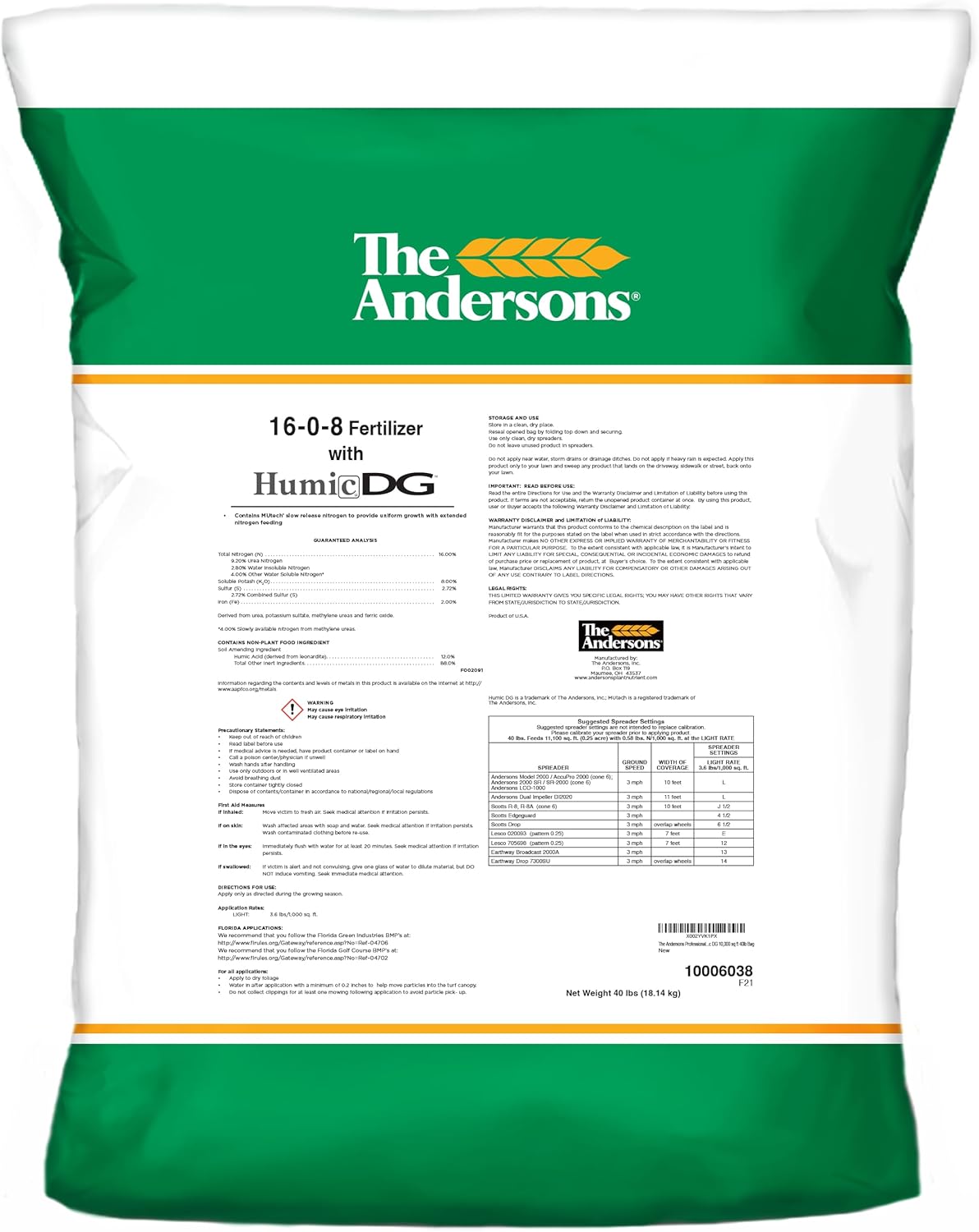
The Andersons Professional PGF 16-0-8 Granular Lawn Fertilizer with Humic DG (40 lb)
| N-P-K | 16-0-8 |
|---|---|
| Item Form | Granules |
| Specific Uses For Product | Lawns |
| Mixing Ratio | 1:4.5 |
The Andersons Professional PGF 16-0-8 is a granular lawn fertilizer formulated to give steady feeding through a blend of quick- and slow-release nitrogen plus added iron, micronutrients, and humic DG. It is applied with a broadcast or drop spreader at 3.6 pounds per 1,000 sq ft and is intended for routine lawn maintenance every 6 to 8 weeks. The super-fine granules promote even coverage which helps reduce streaking and improves uniformity on dense cool-season grasses like tall fescue. Because the formulation is phosphorus-free, it is a good choice for established lawns where phosphorus is not needed. Practical benefits include extended feeding so you do not need to fertilize frequently and added humic material that can improve nutrient uptake and soil health over time. Limitations are that it is not labeled for use in certain states and it is a general maintenance fertilizer rather than a corrective treatment for severe nutrient deficiencies or soil pH problems.
Best for: Gardeners who want an easy, balanced maintenance fertilizer for cool-season lawns and prefer infrequent feeding and even coverage.
Less Ideal for: Those trying to correct specific phosphorus deficiencies, address major soil pH issues, or needing a product cleared for use in restricted states should look elsewhere.
- Blend of quick- and slow-release nitrogen for immediate green-up and up to eight weeks of feeding
- Super-fine granules for more even spread pattern and reduced streaking
- Includes iron, micronutrients, and humic DG to support color and nutrient uptake
- Resealable bag for easier storage between applications
- Phosphorus-free formula not suitable when a phosphorus soil amendment is specifically required
- Directions specify avoiding application near water and drains, limiting use on slopes or near sensitive areas
Verdict: A dependable, low-maintenance granular fertilizer that keeps tall fescue lawns green with evenly distributed, extended feeding.
The Andersons Professional PGF Complete 16-4-8 Granular Fertilizer with Humic DG

| Item Form | Granules |
|---|---|
| Specific Uses For Product | Soil Conditioning |
| Target Species | lawn grasses |
| Mixing Ratio | 4-1-2 ratio |
The Andersons Professional PGF Complete 16-4-8 is a granular lawn fertilizer designed to feed and condition turfgrass over several weeks. It combines quick-release and slow-release nitrogen so you get an initial green-up plus extended feeding for up to eight weeks, while iron and a suite of micronutrients help correct color and address minor deficiencies. The product uses very fine particles for even spreader coverage and includes Humic DG to improve immediate movement of nutrients into the soil when watered in. Typical use is broadcast application with a walk-behind or drop spreader, following the recommended spreader settings and watering in 0.2 inches to activate the DG technology. Practical benefits include reliable, balanced nutrition for cool-season grasses and easier color recovery after spring or fall applications. Important limitations are that it is a granular product requiring even spreading and occasional calibration of your spreader, and it is not formulated for sale in California so availability may vary regionally.
Best for: Buyers focused on turf performance who want reliable, longer-lasting nutrition and improved color for cool-season lawns like tall fescue.
Less Ideal for: Casual gardeners who prefer liquid concentrates or daily feeding schedules or those managing native or low-input lawns that avoid regular fertilization.
- Balanced 16-4-8 N-P-K ratio provides both immediate and extended nitrogen release
- Includes iron and micronutrients to improve turf color and correct deficiencies
- Humic DG helps move particles into the soil quickly after light watering
- Super-fine granules promote even distribution and more consistent coverage
- Requires proper spreader calibration and steady walking speed for even application
- Not labeled for sale in California which limits use in that state
Verdict: A performance-focused granular fertilizer that delivers balanced, quick-plus-extended feeding and micronutrients to boost color and sustained growth in tall fescue lawns.
Simple Lawn Solutions 16-4-8 Liquid Lawn Fertilizer (32 oz)

| Item Form | Liquid |
|---|---|
| Specific Uses For Product | Lawn Fertilizer |
| Application Method | Spray |
| Mixing Ratio | 3-5 fl. oz. per gallon of water |
| Liquid Volume | 946 ml |
This 16-4-8 liquid lawn food is a ready-to-use concentrated fertilizer designed to be mixed with water and applied through a hose-end sprayer. It supplies a balanced ratio of nitrogen, phosphorus, and potassium plus seaweed and fish emulsion to support greening, root vigor, and stress tolerance. Typical use is a spray application every 3 to 4 weeks during the growing season to maintain color and encourage steady vertical and lateral growth. The hose-attach application and clear mixing ratio (3 to 5 fl. oz. per gallon) make coverage quick and straightforward for medium to large yards. Because it is a liquid, nutrients are available to grass quickly, which is useful when you want faster visual results than a granular product. Limitations are that it is intended for maintenance rather than heavy renovation or correcting severe nutrient imbalances and it requires regular watering after application for best uptake; repeated applications add ongoing cost compared with slow-release granular options.
Best for: Buyers who want a practical, no-fuss maintenance fertilizer to keep established tall fescue lawns green and growing with minimal mixing or equipment fuss.
Less Ideal for: Those planning major overseeding, soil rebuilding, or long-term slow-release feeding programs should consider specialized granular or amendment-based alternatives.
- Balanced 16-4-8 NPK formula suitable for regular feeding
- Includes seaweed and fish emulsion for added organic micronutrients
- Concentrated liquid that delivers quick nutrient availability when sprayed
- Hose-end compatible with a clear mixing ratio for easy application
- Not formulated as a slow-release product so effects are shorter-lived than some granular fertilizers
- Better for maintenance than for major lawn renovation or rebuilding
Verdict: A straightforward, hose-applied liquid fertilizer that makes regular maintenance feeding of tall fescue lawns fast and effective.
GreenView Lawn Food 22-0-4, 16 lb bag

| NPK | 22-0-4 |
|---|---|
| Form | Granules |
| Coverage | 5,000 sq. ft. |
| Application | Broadcast or drop spreader |
GreenView Lawn Food is a granular 22-0-4 fertilizer designed for broadcast or drop spreader application to home lawns. It combines readily available nitrogen with MESA controlled-release nitrogen so the turf gets an initial boost and steady feeding for up to eight weeks. In practice it is applied in spring or fall to encourage faster green-up, deeper roots, and improved water retention during heat or drought. The zero-phosphate formula meets restrictions in most states while the 16 lb bag covers about 5,000 sq ft, which makes it practical for small to medium yards. Important limitations are that it is not a complete starter fertilizer for new seedings because it contains no phosphorus and that proper spreader calibration is required to avoid uneven application. Also it is a single NPK ratio so users needing different nutrient balances will need other products.
Best for: Homeowners with established tall fescue lawns who want an affordable, easy-to-apply fertilizer to improve color and root strength through the season.
Less Ideal for: People establishing new lawns from seed or those needing a fertilizer tailored to specific soil test deficiencies should consider starter fertilizers or custom blends.
- Controlled-release MESA nitrogen for steady feeding up to 8 weeks
- High nitrogen ratio for faster spring green-up and improved turf color
- Zero-phosphate formulation compliant with most state restrictions
- Covers roughly 5,000 sq ft from a single 16 lb bag when applied per directions
- No phosphorus so not suitable as a starter fertilizer for new seedings
- Single fixed NPK ratio limits flexibility for soils needing different nutrient balances
Verdict: A budget-friendly, high-nitrogen granular feed that gives established tall fescue lawns quicker green-up and sustained feeding for up to eight weeks.
Espoma Turf‑Tone All Season Organic Lawn Food with Iron, 28 lb

| Item Form | Granules |
|---|---|
| Application Method | Spread evenly on a dry, mowed lawn |
| Target Species | Lawn Grass |
| Unit Count | 448 Ounce |
Espoma Turf‑Tone is an organic granular lawn food designed for routine seasonal feeding of fescue and other common lawn grasses. You apply it with a drop or broadcast spreader to a dry, recently mowed lawn; one 28 lb bag covers up to about 5,000 sq ft and the slow‑release nitrogen (9‑0‑1) feeds turf steadily rather than forcing a quick green-up. The formula includes iron and Espoma's Bio-tone biological additives, which support deeper roots and longer lasting color while reducing the need for frequent applications. Because it is made from organic materials such as feather meal and poultry manure, it is less likely to burn turf or leach out of the soil, which is helpful for established tall fescue stands. Limitations are that its nutrient ratio is modest for rapid recovery from extreme thinning or heavy traffic and it requires proper spreading for even results, so expect slower, steadier improvement rather than instant greening.
Best for: Homeowners who prioritize reliable, low‑risk feeding and want steady, long‑term improvement in tall fescue lawns without synthetic chemicals.
Less Ideal for: People needing a fast, high‑nitrogen fix for newly seeded lawns or heavily damaged turf should consider a higher‑strength or starter fertilizer alternative.
- Organic slow‑release nitrogen (9-0-1) gives steady feeding without burning turf
- Contains iron and biological additives to improve color and root development
- Formulated for use across spring, summer, and fall on common lawn grasses
- Spreads easily with a drop or broadcast spreader and covers up to ~5,000 sq ft
- Lower NPK ratio is not optimized for rapid recovery of severely thin or damaged lawns
- Granular form requires correct spreader calibration for uniform coverage
Verdict: Choose this if you want a dependable organic, slow‑release fertilizer that improves color and root health in tall fescue with minimal risk of burning.
Scotts Turf Builder WinterGuard Fall Lawn Food, 10 lb.

| Item Form | Granules |
|---|---|
| Specific Uses For Product | Lawn Fertilizer |
| Application Method | spread |
| Coverage | 4000 |
| Target Species | lawn grasses |
Scotts Turf Builder WinterGuard Fall Lawn Food is a granular lawn fertilizer intended for fall application to strengthen root systems and help turf recover from summer heat, drought, and wear. It is applied with a broadcast or drop spreader to any grass type and one 10 lb. bag covers 4,000 sq. ft.; Scotts provides spreader settings and simple directions so even DIY homeowners can get an even application. The formula focuses on feeding and root development to prepare grass for winter, and it can be lightly watered in for faster uptake though watering is not required. Practical benefits include straightforward instructions, compatibility with common spreaders, and a coverage size suited to small to medium yards. Limitations to consider are that the product is a general-purpose fall food without species-specific NPK details listed here, so users with precise nutrient needs or fertilizing schedules for tall fescue may want to confirm formulation or pair this with a tailored plan.
Best for: Buyers who want a simple, no-fuss fall fertilizer to strengthen lawns and recover turf after summer stress and who prefer clear application guidance and proven brand formulas.
Less Ideal for: Gardeners needing a tall fescue–specific nutrient plan or those managing large acreage who require higher-volume or custom-formulated fertilizers.
- Designed for fall use to build deeper roots and improve winter hardiness
- Works on any grass type, simplifying selection for mixed or unknown lawns
- Covers up to 4,000 sq. ft. per 10 lb. bag, practical for small to medium yards
- Easy application with recommended spreader settings and no mandatory watering-in
- Product description here does not list the exact NPK ratio in the provided data
- Single 10 lb. bag may be insufficient for larger properties
Verdict: A straightforward fall lawn food that reliably builds root strength and makes seasonal feeding simple for small to medium yards.
Scotts Green Max Lawn Food, 16.67 lb (covers 5,000 sq. ft.)

| Item Form | Granules |
|---|---|
| Coverage | 5000 square feet |
| Specific Uses For Product | Lawn |
| Target Species | lawn grass |
| Unit Count | 266.67 Ounce |
Scotts Green Max is a granular lawn food formulated to feed turf and deliver faster greening thanks to a 2-in-1 formula that includes 5% iron. It is applied with a broadcast or drop spreader and is intended for use in spring, summer, or fall on any grass type, so for tall fescue you can use it as part of a seasonal feeding plan. Notable features include guaranteed nonstaining when used as directed, clear spreader settings from the label for consistent application, and a coverage claim of 5,000 sq. ft. Practical benefits are visible deep greening in about three days after light watering and the convenience of single-bag coverage for small to medium lawns. Limitations are that it is a general-purpose lawn food rather than a fescue-specific formulation so it does not address some regional nutrient or soil pH needs, and repeated seasonal use still requires following label rates to avoid overapplication. Users should also sweep and remove excess from hard surfaces to protect waterways.
Best for: Homeowners who want a simple, reliable lawn fertilizer that produces quick greening and who prefer straightforward application instructions and predictable results.
Less Ideal for: Gardeners seeking a turf formulation tailored to tall fescue soil nutrient profiles or those needing a combined weed control and fertilizer product.
- Includes 5% iron for faster, noticeable greening in a few days
- Granular formula compatible with common broadcast and drop spreaders
- Clear application instructions and spreader settings reduce dosing errors
- One 16.67 lb. bag covers up to 5,000 sq. ft., convenient for single-application lawns
- Not tailored specifically to tall fescue nutrient needs or local soil conditions
Verdict: Choose this product if you want an easy-to-apply granular lawn food that delivers fast, reliable greening for a 5,000 sq. ft. lawn.
Choosing the Right Fertilizer for Tall Fescue: Key Factors to Consider
Nitrogen Source and Release Pattern
Tall fescue benefits from nitrogen delivered over time rather than large single pulses. Look for fertilizers that list the nitrogen sources on the label and provide a mix of soluble and slow-release nitrogen so turf gets steady nourishment. Slow-release forms lower the risk of leaf scorch on hot days and reduce the number of applications needed.
Timing matters: early spring applications promote green-up while late summer or early fall feeds should favor formulations that encourage root growth and carbohydrate storage rather than topgrowth. Understand how long the product releases nitrogen so you can sync applications with seasonal growth patterns.
N-P-K Ratio and Secondary Nutrients
The primary N-P-K ratio tells you what growth the fertilizer will encourage. For established tall fescue, higher nitrogen with moderate phosphorus and potassium suited to soil test results is usually best. Avoid assuming one ratio fits all; phosphorus is often unnecessary in lawns with adequate soil P, while potassium can aid stress tolerance and winter hardiness.
Also check for important secondary nutrients and micronutrients such as iron, sulfur, and magnesium. Iron can quickly darken green color without driving excessive growth, and sulfur helps with some soil pH interactions. Micronutrients are most valuable when your soil test shows deficiencies.
Application Method and Coverage
How you apply fertilizer affects uniformity and the risk of streaking. Granular products should have a consistent granule size and be compatible with common broadcast and drop spreaders. Water-soluble fertilizers need either a hose-end applicator or liquid sprayer and often produce faster visible effects.
Consider the workload: granular slow-release feeds generally require fewer passes per season, while soluble feeds let you correct short-term deficiencies quickly. Weather and lawn access also influence the choice-wet or uneven turf favors granular materials that are less likely to wash away immediately after application.
Soil Type and pH Compatibility
Soil texture and pH change how nutrients are held and released. Sandy soils leach nutrients faster and benefit from slow-release nitrogen and split applications. Clay soils retain nutrients but may lock up some elements unless pH is adjusted.
A soil test is the best first step. If pH is outside the optimal range for tall fescue, some nutrients will be less available and choosing a fertilizer with chelated micronutrients or including amendments will be more effective than increasing application rates.
Seasonal Planning and Feed Frequency
Match fertilizer choice to seasonal goals. Early spring feeds should prioritize nitrogen for green-up, midseason applications should aim to maintain color without excessive growth, and late summer to early fall feeds should support root development and carbohydrate storage for winter survival.
Feeding frequency depends on release type and lawn vigor. Slow-release products often let you apply two to three times per growing season, while soluble feeds require more frequent, lighter applications. Plan around mowing and irrigation schedules to avoid clippings with concentrated granules.
Safety, Environmental Impact, and Runoff Risk
Fertilizers can contribute to nutrient runoff that affects nearby water bodies. Choose formulations with lower soluble phosphorus if your lawn does not need it and apply at rates recommended by soil tests. Slow-release nitrogen reduces the chance of leaching and volatilization.
Follow label directions for setback distances from water features and avoid application before heavy rain. Consider granule coatings and polymer-stabilized formulations that reduce immediate nutrient loss to the environment.
Interpreting the Product Label
Labels include the guaranteed analysis and a breakdown of nitrogen sources. Instead of just scanning the N-P-K numbers, read the fine print to see how much nitrogen is water-soluble versus slow-release. That split tells you how quickly turf will respond and how long the feeding effect will last.
Also look for application rates given as pounds of nitrogen per 1,000 square feet. Those rates are the starting point for scheduling feeds and avoiding over-application. The label will often provide seasonal timing recommendations tailored to cool-season grasses.
- Find the percent of water-soluble nitrogen versus slow-release nitrogen
- Note recommended application rate in pounds of nitrogen per 1,000 sq ft
- Check reapplication interval guidance to match your maintenance plan
When to Feed New Versus Established Turf
Newly sown or overseeded tall fescue has different needs than established turf. Starter feeds for new seed favor phosphorus to support root establishment, but once roots are established you should shift to nitrogen-focused maintenance feeds.
For established lawns, aim for lower-frequency, steady-release programs that build root depth and stress tolerance rather than pushing rapid topgrowth. Timing around cooler parts of the day and avoiding very hot spells reduces stress after feeding.
- Use starter formulations or a mild soluble feed shortly after seeding if recommended
- Switch to maintenance feeds once turf density and rooting are adequate
- Avoid high-nitrogen quick-release feeds in late summer when heat stress is likely
Watering After Fertilizer Application
Appropriate post-application irrigation varies by formulation. Many granular products require light watering in to dissolve soluble nutrients and reduce burn risk, while some coated slow-release granules intentionally delay release and recommend minimal immediate watering.
Overwatering can cause nutrient runoff, especially on slopes or compacted soils. Follow label watering guidance and time irrigation to move nutrients into the root zone without flushing them away.
- Light irrigation often helps granular fertilizers activate
- Avoid heavy watering in the first few hours after application when labels warn against it
- Consider split irrigation for soluble feeds to reduce short-term leaching
Addressing Specific Turf Issues with Targeted Feeds
If your tall fescue shows pale color without thinning, an iron supplement or a formulation with added micronutrients can quickly improve turf color without excess growth. If the lawn is thin or slow to recover from wear, focus on nitrogen programs that support tillering and root vigor.
For lawns subject to drought or winter kill, feeds higher in potassium and with stable slow-release nitrogen can improve stress tolerance and recovery. Match the feed to the observed turf problem rather than applying a broad high-nitrogen product as a default.
- Use iron-containing feeds to darken color without driving growth
- Increase potassium for stress tolerance and winter hardiness
- Target applications to the problem area rather than blanket feeding
Sustainable Practices and Minimizing Waste
Adopt practices that reduce waste and environmental impact, such as calibrating your spreader, using soil tests to tailor applications, and timing feeds to avoid heavy rain. Proper mowing height and dethatching also improve fertilizer uptake and reduce the need for repeat applications.
Consider blending a slow-release regimen with targeted soluble corrections only when tests indicate deficiencies. That approach provides good turf performance while limiting excess nitrogen inputs to the landscape.
- Calibrate spreaders before each season
- Base applications on soil test recommendations
- Combine slow-release base feeds with occasional targeted soluble treatments
How We Chose the Best Fertilizer for Tall Fescue
We prioritized criteria that reflect how fertilizers behave in cool-season turf and what gardeners can reasonably verify before purchase. Key evaluation dimensions included nitrogen source and release profile, since slow-release nitrogen reduces burn risk and supports steady growth; complete nutrient balance, focusing on appropriate N-P-K ratios and inclusion of secondary nutrients that tall fescue needs; ease and flexibility of application, including granule size and spreader compatibility for even coverage; and performance in typical temperate lawn schedules, meaning how well a product supports spring green-up, summer stress tolerance, and fall root development. We also considered formulation type, such as granular versus soluble, because that affects timing and labor. Exclusions: we excluded specialty blends intended solely for overseeding mixes, products formulated only for warm-season grasses, and experimental hobby blends without clear analysis of nutrient release. We relied on label nutrient data, common agronomic principles for cool-season turf, and real-garden usability factors when assembling the shortlist. The scoring labels below map directly to these selection priorities.
FAQ
How often should I fertilize tall fescue?
It depends on the product and season. Many gardeners use two to three applications of slow-release fertilizer during the active season, with timing focused on spring and early fall. Soluble products may be applied more frequently in lighter doses.
Can I use a high-nitrogen lawn fertilizer on tall fescue?
High-nitrogen formulas can green turf quickly but may stimulate excessive topgrowth and increase mowing needs. For long-term health, favor products with a significant slow-release component and follow soil test recommendations.
Is phosphorus necessary for tall fescue lawns?
Phosphorus is important for root establishment, so it can be useful for new seedings. For established lawns, phosphorus is often unnecessary if soil tests show adequate levels. Check a soil test before applying phosphorus-heavy feeds.
Will slow-release fertilizers prevent lawn burn?
Slow-release nitrogen reduces the risk of leaf scorch compared with quick-release forms, but burn can still occur if rates are too high or the lawn is stressed. Apply at label rates and avoid feeding during extreme heat.
How does soil pH affect fertilizer performance?
Soil pH influences nutrient availability. If pH is outside the optimal range for tall fescue, some nutrients will be less available even when present in the soil. Adjust pH based on a soil test before changing fertilizer practices.
Should I water immediately after applying granular fertilizer?
Follow the product label. Many granular products benefit from a light watering to move nutrients into the root zone, but heavy irrigation can cause runoff. Some coated slow-release granules require minimal immediate watering to maintain their timed-release properties.
Final Verdict
Choosing the right fertilizer for tall fescue comes down to matching nitrogen source, nutrient balance, and release profile to your lawn's seasonal needs and soil conditions. Prioritize slow-release nitrogen for steady growth, use soil tests to guide phosphorus and potassium choices, and select application methods that give even coverage without runoff. Balance short-term color goals against long-term root strength and environmental stewardship. With a clear plan for timing and rates, you can maintain a vigorous tall fescue lawn while minimizing risk and unnecessary inputs.
