

Note: This article contains affiliate links. If you click on these links and make a purchase, I may earn a small commission at no extra cost to you. This helps support my research and content. Read my full affiliate disclosure here.
Keeping pests off your garden plants matters for yield, appearance, and long-term plant health. The right insect repellent for plants controls chewing and sucking insects while avoiding harm to beneficial insects, foliage, or soil life. This guide covers six top shortlist options suited for a range of garden situations, from container vegetables on a balcony to large backyard beds. We evaluated each choice for how quickly it reduces pest pressure and how safely it can be used around desirable pollinators and edible crops. Read on to understand the practical tradeoffs between efficacy, safety, and ease of use before you pick the repellent that fits your plot.
Top Picks at a Glance
| Best Overall The best all-around choice for most situations | Natria Neem Oil Ready-to-Use Spray, 24 oz |  |
| Best Quality Built to a higher standard if you want something more solid | BioAdvanced 3-in-1 Insect, Disease & Mite Control Spray, 32 fl oz |  |
| Best Value The sweet spot between price and what you get | Garden Safe Insecticidal Soap Spray, 32 oz |  |
| Best Budget The cheapest option that still gets the job done reliably | BioAdvanced Rose & Flower Insect Killer Spray, 24 oz |  |
| Highest Rated A top-rated pick with lots of positive feedback | Sevin Insect Killer Concentrate II, 32 fl oz |  |
| Most Popular A crowd favorite that many people choose with confidence | Bonide Captain Jack's Ready-to-Use Neem Oil Spray, 32 oz |  |
Natria Neem Oil Ready-to-Use Spray, 24 oz

| Unit Count | 24 Fluid Ounces |
|---|---|
| Item Form | Spray |
| Target Species | Insects |
| Active Ingredients | Clarified Hydrophobic Extract of Neem Oil – 0.9% |
Natria Neem Oil Spray is a 24 oz ready-to-use botanical spray formulated to kill common pests like aphids, whiteflies, spider mites and to suppress fungal diseases such as powdery mildew and black spot. You simply point and spray for spot treatments or broader coverage on roses, vegetables, ornamentals and houseplants without measuring or mixing. The product’s active ingredient is a clarified neem oil extract (0.9%) and the label allows use up to the day of harvest, which makes it practical for vegetable gardens and edible container crops. The spray combines insecticidal and fungicidal action, so it can reduce the number of separate products you need to keep on hand. Limitations to expect are that it is a contact product, so thorough coverage and repeat applications are required for good control, and it will be less effective against pests hidden in dense foliage or inside buds. For gardeners who prefer a low-toxicity botanical option and want a convenient ready-to-use format, this is an easy-to-use, multi-purpose choice.
Best for: Gardeners who want a low-toxicity, all-purpose spray they can use on vegetables, ornamentals and houseplants without mixing or juggling multiple products.
Less Ideal for: Growers needing a systemic or long-residual insecticide or those managing severe, established infestations that require professional-strength treatments.
- Ready-to-use trigger spray requires no mixing for quick application
- Controls both listed insects and several fungal diseases with a single product
- Label allows use up to the day of harvest, so safe for many edible crops when used as directed
- Active ingredient concentration is relatively low, so repeated applications may be needed for heavy infestations
- Effectiveness depends on thorough contact coverage and will be limited against hidden or systemic pests
Verdict: A convenient ready-to-use neem spray that delivers combined insect and fungal control for gardeners who want a low-toxicity, easy application.
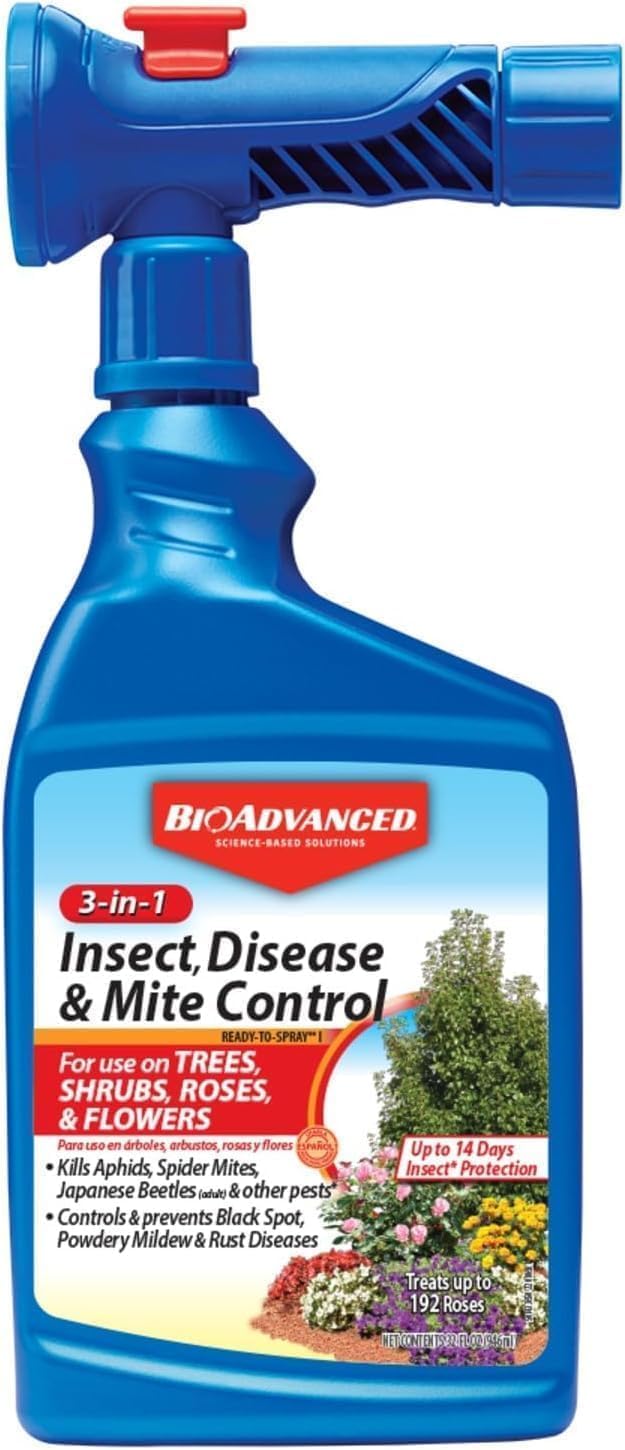
BioAdvanced 3-in-1 Insect, Disease & Mite Control Spray, 32 fl oz
| Unit Count | 32 Fluid Ounces |
|---|---|
| Item Form | Spray |
| Target Species | Aphids, caterpillars, leafminers, whiteflies and other listed pests |
| Active Ingredients | Tau-fluvalinate 0.61%, Tebuconazole 0.65%, Imidacloprid 0.47% |
This BioAdvanced 3-in-1 spray is designed for gardeners who want a single product to handle insects, mites, and fungal diseases on roses, shrubs, flowers, and small trees. It attaches to a garden hose for quick coverage and is labeled to kill aphids, caterpillars, whiteflies, Japanese beetles and other listed pests while also controlling diseases such as black spot and powdery mildew. The formula includes systemic and contact actives and the manufacturer says it provides rainproof control that lasts up to 14 days and can treat dozens of plants per bottle. In practice the hose-attachment makes treating a bed or many rose bushes fast compared with hand-sprayers, and coverage of leaf undersides is straightforward. Important limitations are that it is a broad-use pesticide with multiple active ingredients so users should follow safety directions and avoid use where pollinators are active, and the label restricts sale in certain states. Reapplication every 7 to 14 days is recommended for ongoing problems, so expect recurring treatments during active pest or disease periods.
Best for: Gardeners who prioritize fast, effective control across insects, mites, and fungal diseases and need a time-saving solution for treating multiple roses or ornamental beds.
Less Ideal for: Organic gardeners or anyone seeking a pollinator-safe or single-target treatment should consider specialized or organic alternatives instead.
- Combines insecticide, miticide, and fungicide in one ready-to-use spray
- Hose-end applicator lets you treat multiple plants quickly and reach leaf undersides
- Rainproof protection advertised to last up to 14 days reducing frequency of spot treatments
- Labeled to control a wide list of common pests and diseases found on roses and ornamentals
- Contains multiple active pesticides so requires careful handling and timed applications to protect pollinators
- Not intended for sale or use in all regions and may have local restrictions
Verdict: If you want a single, fast-acting hose-end product to control common insects, spider mites, and several fungal diseases on roses and ornamentals, this 3-in-1 spray delivers broad and convenient coverage.
Garden Safe Insecticidal Soap Spray, 32 oz

| Item Form | Spray |
|---|---|
| Target Species | Insects |
| Liquid Volume | 32 fluid ounces |
| Active Ingredients | Potassium Salts Of Fatty Acids |
Garden Safe Insecticidal Soap is a ready-to-use contact spray formulated with potassium salts of fatty acids to control aphids, mealybugs, mites, whiteflies and other soft-bodied pests. You spray thoroughly over all plant parts, including leaf undersides, and pests must be hit directly for the product to work. The bottle is suitable for use on vegetables, fruit trees, ornamentals, shrubs, flowers and in greenhouses, and the label permits application up to the day of harvest, which makes it practical for vegetable beds. Because it is a soap-based product, it is low in residual toxicity compared with stronger synthetic insecticides, but it will not give systemic protection and may require repeated applications if pest pressure is high. Avoid spraying in full sun and keep it away from water bodies since it can harm aquatic invertebrates. For routine, hands-on garden pest control where quick contact kills and edible-safety are priorities, this is an easy-to-use option.
Best for: Gardeners who want a straightforward, low-toxicity spray to manage visible soft-bodied pests on edible and ornamental plants and who prefer products they can apply right up to harvest.
Less Ideal for: Gardeners seeking a long-lasting systemic insecticide or those needing broad-spectrum control of hard-shelled pests should look for alternative products.
- Ready-to-use formula requires no mixing for quick application
- Labeled for use on vegetables and can be applied up to day of harvest
- Effective on a range of soft-bodied pests when sprayed directly
- Suitable for indoor, outdoor and greenhouse use
- Works by contact only so it offers no systemic or long-term residual control
- Can be hazardous to aquatic invertebrates if it enters waterways
Verdict: A convenient, edible-safe contact spray that quickly knocks down soft-bodied garden pests without mixing.
BioAdvanced Rose & Flower Insect Killer Spray, 24 oz

| Unit Count | 24 Fluid Ounces |
|---|---|
| Item Form | Spray |
| Target Species | Insects |
| Active Ingredients | Cyfluthrin |
| Specification Met | EPA |
This ready-to-use BioAdvanced spray is designed for quick control of common rose and flower pests. The trigger sprayer lets you coat leaves and blooms until evenly covered without mixing or measuring, so it is convenient for spot treatments across beds, shrubs, and vegetable gardens. The active ingredient cyfluthrin provides fast contact kills for pests such as aphids, whiteflies, caterpillars, and Japanese beetles and offers residual protection of up to two weeks. Because the label lists many target species and outdoor application sites, it is useful as a general-purpose garden insect killer rather than a specialty product. Limitations are that it is a conventional synthetic insecticide, so users who prefer organic or systemic treatments will need an alternative, and safety directions should be followed to avoid contact with beneficial insects and to protect people and pets. For gardeners who want an affordable, easy-to-use spray to deal with recurring insect pressure, this bottle delivers straightforward, effective results.
Best for: Budget-minded gardeners who want an affordable, easy-to-apply spray to quickly knock down common pests on roses, flowers, and nearby plants.
Less Ideal for: Growers focused on organic practices, pollinator-friendly plantings, or those who prefer systemic or nonchemical pest control methods.
- Ready-to-use trigger spray for fast, no-mix application
- Kills over 100 listed garden pests on contact
- Provides up to 14 days of residual protection
- Label covers use on roses, flowers, shrubs and vegetable gardens
- Contains synthetic insecticide (cyfluthrin) which may harm beneficial insects
- Not suitable for gardeners seeking organic or systemic control options
Verdict: A low-effort, budget-friendly ready-to-use spray that quickly kills many common garden insects and protects plants for up to two weeks.
Sevin Insect Killer Concentrate II, 32 fl oz

| Item Form | Liquid |
|---|---|
| Target Species | Insects |
| Liquid Volume | 32 fluid ounces |
| Active Ingredients | Zeta Cypermethrin |
Sevin Insect Killer Concentrate is a ready-to-measure garden insecticide you mix with water and apply with a handheld, tank, or hose-end sprayer to protect plants from many common pests. The product is used by measuring the label dose (for example 4 fl oz per gallon), pouring into a sprayer, and applying the spray about one foot from foliage while avoiding open blooms. It kills by contact and the manufacturer lists control for over 500 insect species and more than 200 fruits and vegetables, with residual control lasting up to three months in many cases. The concentrate format keeps storage footprint small and lets you treat multiple beds or trees from a single bottle. Important limitations are safety and pollinator precautions you must follow, such as avoiding blooms when bees are active, and the product is not registered for use on certain pests or in some states, so check local restrictions and label directions before use.
Best for: Gardeners and homeowners who prioritize a dependable, broad-spectrum insect control solution and prefer a concentrated product they can mix to cover multiple beds, fruiting plants, and landscape areas.
Less Ideal for: People who prioritize organic or pollinator-safe-only products or those who need insect control options approved everywhere should consider alternatives.
- Concentrated formula lets you treat many plants from one bottle
- Works on a broad spectrum of listed insects and protects many common fruits and vegetables
- Compatible with common sprayers including hand-held, tank, and hose-end types
- Provides residual control that can persist for up to three months in treated areas
- Contains the active ingredient zeta-cypermethrin which requires careful handling and adherence to label safety and pollinator protection instructions
- Not registered for use in all jurisdictions for certain pests
Verdict: A concentrated, broad-spectrum garden insecticide that reliably protects a wide range of edible and ornamental plants when used according to label instructions.
Bonide Captain Jack's Ready-to-Use Neem Oil Spray, 32 oz

| Item Form | Liquid |
|---|---|
| Liquid Volume | 32 fluid ounces |
| Target Species | Insects |
| Active Ingredients | Clarified Hydrophobic Extract of Neem Oil |
Bonide Captain Jack's Ready-to-Use Neem Oil Spray is a 32 oz trigger-spray formulated from clarified hydrophobic neem oil to control a wide range of garden pests and some fungal diseases. You use it by shaking the bottle and spraying all plant surfaces, including leaf undersides, at the first sign of pests or powdery mildew, then reapplying every 7 to 14 days as needed. Its strength is eliminating eggs, larvae, and adults of common pests such as aphids, whiteflies, and spider mites while also helping prevent powdery mildew, blight, and rust. Being ready-to-use in a spray bottle makes it convenient for spot treatments on roses, vegetables, herbs, houseplants, shrubs, and trees without mixing. Important limitations are that it is best applied outside of peak sunlight to avoid leaf burn and that repeated applications are required for ongoing infestations; it is not a systemic product. Follow safety directions to keep it away from children and pets and adhere to label timing when using on edible plants.
Best for: Gardeners who prioritize proven, widely used solutions and want a convenient, organic-compatible spray for spot treating pests and common fungal problems in home gardens and indoor plants.
Less Ideal for: People seeking a one-time systemic treatment or long residual protection for large-scale commercial plantings should consider professional contact or systemic products instead.
- Ready-to-use trigger bottle for quick spot treatments
- Controls insects at all life stages including eggs and larvae
- Also acts as a fungicide and miticide for common garden diseases and mites
- Approved for organic gardening and safe for use up to harvest when label directions are followed
- Requires repeated applications for sustained control rather than providing long-term systemic protection
- Should not be sprayed in peak sunlight to avoid potential leaf burn
Verdict: Choose this ready-to-use neem oil spray if you want a convenient, organic-compatible product that knocks down common garden pests and controls powdery mildew and mites.
Choosing the Right Insect Repellent for Plants: Key Factors to Consider
Target Pest Spectrum
Different repellents work better on specific pest types. Some formulations primarily deter chewing insects like caterpillars and beetles, while others are aimed at sap-suckers such as aphids, whiteflies, and scale. Knowing which pests are most problematic in your garden focuses your choice and reduces unnecessary exposure to broader-acting products.
Match the repellent to the insects you actually see. For mixed infestations, choose options with broader activity or plan to combine cultural controls with the repellent for full-season protection.
Plant Safety and Phytotoxic Risk
Plants vary in sensitivity to spray treatments, especially under hot, sunny, or drought-stressed conditions. Some repellents can scorch leaves, cause spotting, or interfere with flowering if applied at the wrong rate or time of day. Check whether a formulation is labeled for use on tender ornamentals, young transplants, and edible crops before applying.
To reduce risk, test on a small area first, avoid spraying at midday or during heat waves, and follow any dilution and reapplication guidance closely. Plant safety often determines whether a repellent is suitable for container-grown vegetables or delicate annuals.
Impact on Beneficial Insects
Beneficial insects like pollinators and predatory wasps or lacewings keep pest populations manageable. Some repellents are broad-spectrum and will repel or harm beneficials, while others are more selective or have lower toxicity to pollinators when used as directed. Consider timing sprays to avoid bloom periods, using spot treatments instead of blanket applications, or selecting formulations known to be less disruptive.
Choosing a product that preserves beneficial populations reduces long-term pest pressure and can cut down on how often you need to treat.
Residual Protection and Reapplication Interval
How long a repellent keeps working affects labor and scheduling. Short-lived options may require frequent reapplications after rain or irrigation, increasing time and potential plant exposure. Longer residual protection can be convenient but may also mean longer exposure of non-target organisms to the active ingredients.
Balance desired convenience with your tolerance for follow-up treatments and the likely rainfall and irrigation patterns in your garden.
Ease of Application and Coverage
Practical application matters. Ready-to-use sprays, hose-end sprayers, concentrated mixes, and foliar dusts each behave differently in the garden. Consider how easy it is to get even coverage, whether a product clogs sprayers, and how measurable the dosing is. Ergonomics and time per treatment influence whether a product is realistic for larger plots or small patios.
Also weigh cleanup needs and whether the product leaves residues on leaves that require post-harvest washing for edible crops.
Compatibility With Edible Crops and Organic Practices
If you grow food or follow organic methods, check whether the repellent is labeled for edible plants and whether it fits within organic certification standards or accepted household use. Some garden-safe repellents are explicitly cleared for fruit and vegetable use, while others are restricted to ornamentals.
Using compatible formulations avoids harvest delays, reduces the need for crop-specific workarounds, and keeps your overall garden stewardship consistent.
When to Use Repellents Versus Other Controls
Repellents are best for reducing pest pressure before populations explode or as part of an integrated approach that includes sanitation, resistant varieties, and habitat for beneficials. They tend to work well as a barrier or deterrent when pest activity is light to moderate, or when you need a short-term reduction to protect new growth.
If pests are already established in large numbers, combine repellents with targeted removal, sticky traps, or biological controls. Using repellents alone against heavy infestations often provides only temporary relief.
- Use repellents preventively during known pest seasons.
- Pair sprays with physical controls like row covers for added protection.
- Monitor plants after treatment to confirm reduced activity.
Application Timing and Weather Considerations
Apply repellents during calm, cool periods such as early morning or late evening to reduce drift and avoid leaf scorch. Rain within a day or two can wash away many foliar repellents, so check the forecast and plan applications when rain is not expected shortly after.
High temperatures and direct sun increase the risk of phytotoxicity for some formulations. On very hot days, delay treatment or use more dilute mixes and test on a small area first.
- Avoid spraying during bloom to protect pollinators.
- Reapply after heavy rain if the product label recommends it.
- Spot-treat high-pressure areas rather than blanket-spraying when possible.
Safe Use Around Pollinators and Wildlife
Protect pollinators by using targeted applications, choosing lower-toxicity options, and avoiding treatments during flowering. Where possible, apply repellents to the lower leaf surfaces or to non-flowering vegetation to reduce exposure to bees.
Keep products away from water features and avoid over-application near habitats used by beneficial insects. Creating diverse plantings that support predators and parasitoids reduces the reliance on chemical repellents over time.
- Time applications for early morning or late evening outside peak pollinator activity.
- Remove flowering debris before treating to limit non-target exposure.
- Consider non-chemical barriers for pollinator-heavy beds.
Application Tools and Techniques
Choose a sprayer that gives even coverage without excessive drift. Handheld pump sprayers, battery mist sprayers, and hose-end applicators each suit different garden sizes and treatment styles. For small containers, a gentle trigger sprayer often provides adequate coverage without waste.
Aim sprays at the underside of leaves where many pests shelter, and keep nozzle distance and pressure consistent to avoid run-off or missed spots. Clean equipment after use to prevent cross-contamination of different treatments.
- Label your sprayer for the type of product used to prevent mixing.
- Rinse and flush sprayers thoroughly before storing.
- Use protective gear recommended on the product label, typically gloves and eye protection.
Integrating Repellents Into a Seasonal Plan
Plan repellent use around crop stages and pest life cycles. For spring-sown vegetables, preventive treatments early in the season protect vulnerable seedlings. For perennials, schedule periodic monitoring and spot treatments rather than routine blanket spraying.
Keep records of what you apply and when so you can adjust timing and choice based on observed pest pressure and plant response in subsequent seasons.
- Map pest hotspots and focus control there.
- Use cultural practices like crop rotation and timely pruning to reduce pests.
- Rotate repellent strategies to avoid relying on a single control method.
How We Chose the Best Insect Repellent for Plants
We shortlisted insect repellents for plants using criteria that matter in everyday gardening. Effectiveness against common pests was a primary filter, focusing on products or formulations that reduce chewing and sap-feeding insects under normal garden conditions. Safety for plants and beneficial insects was assessed by looking at plant phytotoxicity risk and known impacts on pollinators and predatory insects. Application practicality examined how easy a product is to apply correctly, including required frequency, spray coverage, and whether it integrates with standard watering and feeding routines. Residual protection measured how long a single application continues to repel or reduce pests under typical weather exposure. Finally, compatibility with edible crops and organic practices was considered for gardeners who grow food or follow organic approaches. We excluded products with known high phytotoxicity, unclear labeling for garden use, or formulations that require specialist protective gear beyond typical gardener precautions. The final list emphasizes options that balance real-world pest control, predictable reapplication schedules, and low risk to the plants and beneficial organisms in garden settings.
FAQ
Can I use insect repellents on edible plants?
Often yes, but it depends on the product labeling. Choose repellents specifically labeled for edible crops and follow harvest interval guidance if provided. Rinse produce when in doubt and avoid spraying directly on fruit that will be eaten soon after treatment.
How often should I reapply a foliar repellent?
Reapplication frequency usually depends on the formulation and weather. Many need repeating every 7 to 14 days under normal conditions and sooner after heavy rain. Check label instructions and monitor pest activity to adjust timing.
Will repellents harm bees and other pollinators?
Some repellents can affect pollinators, especially if applied during bloom. Using targeted applications, lower-toxicity options, and avoiding sprays when plants are flowering reduces risk. Timing applications for early morning or late evening also helps protect bees.
Are there effective non-chemical repellent options?
Yes. Physical barriers, sticky traps, reflective mulches, and introducing predator-attracting plants can reduce pest pressure. These options often work best combined with spot treatments of repellents when pest pressure spikes.
Can repellents damage young seedlings?
Young seedlings are often more sensitive to sprays and can experience leaf burn or stunting if treated improperly. Use diluted mixtures, test on a small area first, and avoid application during heat stress or strong sunlight to minimize risk.
What should I do if plants show signs of spray damage?
Rinse affected foliage with clean water to remove residual product and move plants out of direct sun if possible. Stop further applications until plants recover, and re-evaluate concentration and timing before treating again.
Final Verdict
Choose an insect repellent for plants that matches the pests you see, fits the sensitivity of your plants, and aligns with how much time you can spend on reapplication. Prioritize plant safety and pollinator compatibility when treating areas with flowers or food crops. Balance residual protection with the need to preserve beneficial insects and plan repellent use as one component of a seasonal pest management strategy so you minimize treatments while keeping pest damage in check.
