

Note: This article contains affiliate links. If you click on these links and make a purchase, I may earn a small commission at no extra cost to you. This helps support my research and content. Read my full affiliate disclosure here.
Ants in the kitchen behave differently than outdoor pests. You need treatments that act on trails and nests, leave minimal residue where you prepare food, and are safe around countertops, pet bowls, and children. This guide focuses on ant killer options specifically for kitchen use and explains the tradeoffs between speed, longevity, and indoor safety. We shortlisted six leading ant control approaches and evaluated them on safety for indoor use, effectiveness against common household ant species, and how easy they are to apply and clean up. Read on for clear decision steps and the criteria we used to pick these kitchen-suitable solutions.
Top Picks at a Glance
| Best Overall The best all-around choice for most situations | Terro Liquid Ant Killer 3-Pack (T200-3SR) |  |
| Best Quality Built to a higher standard if you want something more solid | Syngenta Advion Ant Gel Bait, 30 g |  |
| Best Value The sweet spot between price and what you get | Combat Max Ant Killing Gel, 27 g syringe |  |
| Best Budget The cheapest option that still gets the job done reliably | Raid Ant Killer Baits, 8 Count (Child-Resistant) |  |
| Highest Rated A top-rated pick with lots of positive feedback | ROUTADE 48-Pack Slow-Acting Ant Gel Bait Stations |  |
| Most Popular A crowd favorite that many people choose with confidence | TERRO Liquid Ant Bait Stations, 18 Count (3 Pack) |  |
Terro Liquid Ant Killer 3-Pack (T200-3SR)

| Item Form | Liquid |
|---|---|
| Target Species | Insects |
| Active Ingredients | Sodium Tetraborate Decahydrate (Borax) 5.40% |
| Included Components | Ant Bait |
Terro Liquid Ant Killer is a simple, bait-based indoor solution designed to eliminate whole ant colonies rather than only killing foraging workers. You apply small drops of the liquid onto the included cardboard tiles and place them along ant trails, baseboards, counters, and other kitchen hotspots. Worker ants are attracted to the sweet borax formula, ingest it, and bring it back to share with nestmates so the colony, including the queen, can be affected over several days. The product comes as three 2 oz bottles, giving multiple bait stations to cover a typical kitchen and adjacent rooms. Its main benefits are ease of use and targeted placement that keeps bait out of open surfaces, plus an EPA-recognized active ingredient. Limitations are that results take several days as the bait must be carried back to the nest, and it is intended for indoor ant species that prefer sweet baits so effectiveness can vary with ant type and local food availability. Follow label directions to keep pets and small children from accessing the bait tiles.
Best for: Homeowners who want a straightforward, low-effort indoor solution to eliminate kitchen ant infestations by targeting colonies rather than just visible workers.
Less Ideal for: People needing immediate knockdown of visible ants or control of species that do not prefer sweet baits should consider alternative contact sprays or baits formulated for those ants.
- Targets entire colony by having worker ants carry bait back to the nest
- Includes three 2 oz bottles and cardboard tiles for multiple indoor placements
- Easy application with drop-on-tile method for discreet bait stations
- EPA-recognized active ingredient (borax) for a standard, proven mechanism
- Not instant — requires days for the colony-level effect to develop
- Most effective on sweet-feeding ant species and may be less effective on species with different food preferences
Verdict: Use this three-pack of borax-based liquid baits when you want a low-effort indoor solution that eliminates kitchen ant colonies rather than just killing foragers.
Syngenta Advion Ant Gel Bait, 30 g

| Item Form | Gel |
|---|---|
| Target Species | Insects |
| Active Ingredients | Indoxacarb |
Syngenta Advion Ant Gel is a concentrated gel bait intended to attract and eliminate a wide range of ant species, especially sweet-feeding ants commonly found in kitchens. You apply small dabs of the translucent, low-odor gel where ants trail or forage; worker ants consume the bait and carry it back to the colony, which helps suppress nests rather than just killing visible foragers. The formulation uses indoxacarb, a distinct active ingredient that remains palatable over time and resists staining, so treated spots stay discreet on counters or baseboards. Its homogenous gel texture makes placement precise and reduces mess compared with granular or spray options. Limitations are that it requires correct placement and patience for colony-level control and it is a pesticide so keep it away from children and pets; it does not provide an immediate spray-style knockdown of every worker you see. For kitchen use, it performs as a targeted, professional approach when used according to label directions.
Best for: Buyers who want a performance-focused, targeted solution for recurring or established kitchen ant problems and are willing to follow label directions to achieve colony control.
Less Ideal for: Those seeking instant visible knockdown or a non-chemical approach should consider traps, exclusion, or mechanical cleaning methods instead.
- Targets a broad range of sweet-feeding ant species including common kitchen invaders
- Indoxacarb active ingredient promotes colony-level control by allowing ants to carry bait back to the nest
- Translucent, low-odor, non-staining gel is easy to place discreetly in food-prep areas
- Stable, homogenous formulation stays palatable over time for extended effectiveness
- Works more slowly than contact sprays and requires correct bait placement for best results
- Contains a pesticide active ingredient so it must be stored and used with caution around children and pets
Verdict: Choose this gel when you want a professional, colony-level ant control method that works discreetly in the kitchen.
Combat Max Ant Killing Gel, 27 g syringe

| Active ingredient | Fipronil (0.001%) |
|---|---|
| Net weight | 27 grams (0.95 oz) |
| Use | Indoor and outdoor spot application |
| Application | Syringe applicator for cracks and crevices |
Combat Max Ant Killing Gel is a syringe-applied bait designed for precision placement in cracks, crevices, and along ant trails inside and just outside the home. You apply small dots of the odorless, water-rich gel where you see foraging ants; workers feed on the bait and carry it back to the nest, which can eliminate the queen and brood within about 3 to 5 days. The syringe applicator makes it easy to target tight kitchen gaps and other spots where spraying would be messy or inappropriate. Notable features include the fast-acting fipronil active ingredient, a nearly scentless formula safe for use in living areas when used as directed, and suitability for many common household ant species. Limitations are the small 27 gram dose, which means you may need multiple syringes for large or persistent infestations, and the product must be kept away from food-preparation surfaces and out of reach of children and pets. Regular inspection and reapplication are needed where baits are removed by cleaning or weather outdoors.
Best for: Buyers who prioritize targeted, low-odor spot treatments in the kitchen and want a bait that eliminates colonies rather than just killing visible workers.
Less Ideal for: Not a good choice for someone who wants a non-chemical approach or needs a bulk solution for heavy outdoor infestations across a large property.
- Precision syringe applicator for placing small bait dots in tight gaps
- Odorless, vapor-free formula suitable for use in kitchens and living areas when used per directions
- Fast-acting fipronil-based bait that initiates colony-wide control within days
- Water-rich gel formulation encourages quick feeding by foraging ants
- Small 27 gram syringe may not be sufficient for large or widespread infestations
- Contains an insecticide and requires careful placement to avoid contact with food, children, or pets
Verdict: A precise, low-odor bait that reliably destroys household ant colonies and is ideal for targeted kitchen spot treatments.
Raid Ant Killer Baits, 8 Count (Child-Resistant)
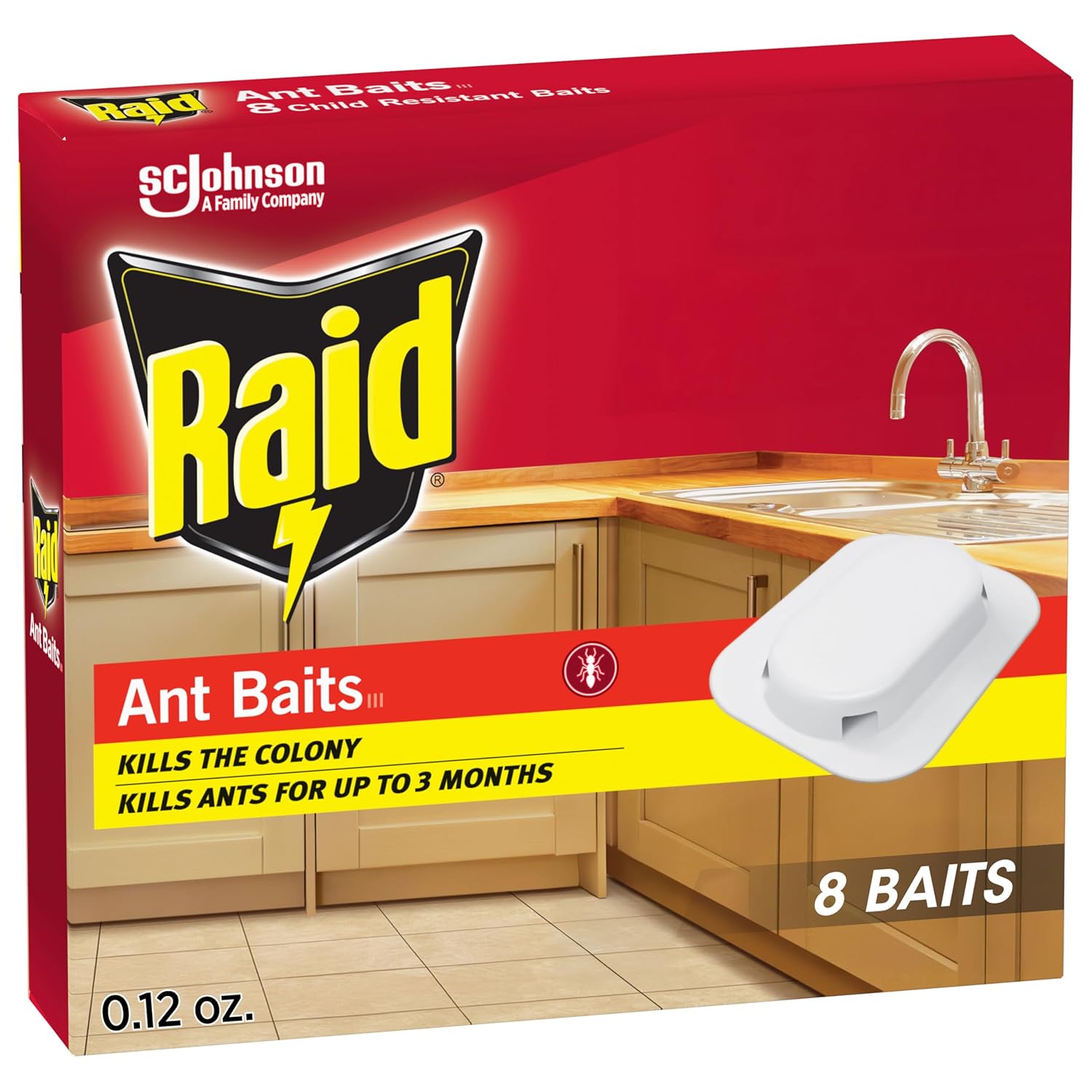
| Count | 8 count |
|---|---|
| Use | For household indoor use |
| Child-resistant | Yes |
| Residual activity | Up to 3 months |
These Raid Ant Killer Baits are small, child-resistant bait stations that deliver a liquid bait inside a plastic housing for indoor use. You place them in corners, along baseboards, and near common entry points in the kitchen where ants travel; foragers feed on the bait and carry it back to the colony, which helps reduce the whole nest over several weeks. The product advertises up to three months of activity from a placed bait, which makes it useful for ongoing prevention as well as active infestations. Practical benefits include easy placement, low maintenance, and the safety feature of a child-resistant design. Limitations are that results take time since the method relies on ants transporting bait, and heavy, fast-moving infestations may require multiple stations or a complementary control method for quicker knockdown. The plastic stations are compact but visible, so they work best tucked against trim or behind appliances where pets and kids have limited access.
Best for: Best for budget-minded homeowners who want an easy, low-effort indoor solution to control kitchen ants and prevent re‑infestation over time.
Less Ideal for: Not ideal for someone needing rapid knockdown of a severe infestation or for those wanting an invisible treatment—professional liquid or spray options may be better in those cases.
- Targets whole colony by having foraging ants carry bait back to nest
- Child-resistant station improves safety in homes with children
- Simple, low-maintenance placement along walls and near entry points
- Advertised residual activity up to three months for continued protection
- Not an instant kill; reduction can take days to weeks as bait is shared within the colony
- May need multiple stations for large or heavily trafficked infestations
Verdict: A simple, low-cost indoor bait that quietly reduces ant colonies over time while offering child-resistant safety for kitchen use.
ROUTADE 48-Pack Slow-Acting Ant Gel Bait Stations

| Unit Count | 48 Count |
|---|---|
| Item Form | Gel |
| Target Species | Ants |
| Included Components | Ant gel bait |
This 48-pack of ROUTADE slow-acting ant gel bait stations is built for systematic, long-term ant control in and around the kitchen. Each station contains a gel formula that worker ants consume and carry back to the nest, which helps reduce the entire colony rather than only visible foragers. The product is supplied in ready-to-use stations with adhesive tape so you can place them along baseboards, in cabinets, near sinks, and on entry thresholds without messy sprays or frequent repositioning. The large pack lets you deploy multiple stations in high-traffic areas and replace them over time for continuous coverage. Because the formula is slow-acting, it is effective against a range of common household species including carpenter ants and sugar ants, but it requires several days to weeks to knock down a colony and will not give instant removal of visible ants. Also the stations are small and contain gel rather than a tamper-resistant hard block, so keep them away from children and pets. For someone wanting a low-maintenance, colony-focused approach to kitchen ant problems, this kit makes it easy to set and forget while the bait works.
Best for: Homeowners who prioritize reliable, long-term elimination of ant colonies in kitchens and want a low-maintenance bait they can deploy across multiple hotspots.
Less Ideal for: People who need an immediate knockdown of visible ants or who require childproof solid bait stations should consider alternatives.
- Slow-acting gel designed for worker ants to carry bait back to the nest for colony-level control
- Ready-to-use bait stations with adhesive for easy placement along baseboards and in cabinets
- 48-count pack provides broad coverage around a kitchen and enough replacements for extended use
- Versatile for indoor and outdoor placement to block entry points and high-traffic ant routes
- Slow-acting formula takes days to weeks to eliminate a colony so visible results are not immediate
- Gel in small stations may require careful placement to keep away from children and pets
Verdict: A practical, deploy-and-forget gel bait kit for reliable colony-level control of kitchen ant infestations.
TERRO Liquid Ant Bait Stations, 18 Count (3 Pack)

| Unit Count | 18 Count |
|---|---|
| Item Form | Liquid |
| Target Species | Insects |
| Active Ingredients | Sodium Tetraborate Decahydrate (Borax) |
| Specification Met | EPA |
TERRO Liquid Ant Bait Stations are compact, ready-to-use traps that use a sweet liquid bait containing borax to attract foraging ants and carry the poison back to the colony. Typical use is placing the small stations along baseboards, in corners, behind appliances, or on counters where you see ant trails; no mixing or setup is required beyond opening the tab. The kit includes 18 bait stations (three packs of six) and the liquid formula is kept from drying by the sealed station design so it stays attractive for extended periods. Practical benefits include quick visible reduction in worker ants within a few days and the potential to eliminate the colony if placements are maintained until the bait is gone. Limitations: it is for indoor use only and works on ants that take sweet baits, so species that prefer greasy or protein foods may be less affected; results can take up to two to four weeks for full control and you should remove competing food sources for best results.
Best for: Homeowners or renters who want a low-effort, evidence-backed way to target kitchen ant trails and remove colonies without sprays, and who prefer products with a strong track record and social proof.
Less Ideal for: People needing immediate knockdown of visible ants or those dealing with species that avoid sweet baits should consider fast-acting sprays or alternative bait types instead.
- Ready-to-use stations require no mixing or tools
- Sealed liquid design resists drying so bait remains attractive over time
- Attracts worker ants that share bait, which can eliminate the colony
- Includes multiple stations for widespread placement around a kitchen
- Indoor-only product not formulated for outdoor use
- Relies on ants accepting a sweet bait so may be less effective on non-sugar-seeking species
Verdict: A ready-to-use, proven liquid bait kit that targets kitchen ant trails and can eliminate colonies with minimal effort.
Choosing the Right Ant Killer for Kitchen: Key Factors to Consider
Active Ingredient Safety
Active ingredients determine both how the ant control works and how safe it is in a kitchen. Some actives are designed for long residual contact and can leave measurable residues on surfaces. Others are bait-based and rely on minimal amounts of insecticide transported back to the nest, which lowers surface contamination.
When evaluating safety, consider documented toxicity, whether the product is approved for indoor use, and how easy it is to keep the treated area out of reach of children and pets. Also check the label for reentry intervals and cleaning instructions to reduce risk around food preparation zones.
Bait Versus Contact Treatments
Baits work by exploiting forager behavior to deliver a toxicant back to the nest, offering potential colony-level control with less surface residue. Contact sprays and aerosols can provide fast knockdown for visible ants but often do not eliminate the colony and may require more frequent use.
Decide whether you need immediate visible control or long-term reduction. Baits usually take days to show effects but address the source. Contact products can give peace of mind for quick cleanup of a visible infestation but plan for follow-up measures to prevent return.
Placement and Application Control
In a kitchen, precise placement matters. Look for formats that allow targeted application like narrow-tip gel syringes, contained stations, or small trigger sprays. These reduce accidental contamination of counters and utensils.
Consider whether the product includes childproof bait stations or tamper-resistant packaging. Also evaluate how easily you can remove or clean the treated area if needed, and whether instructions require covering or wiping surfaces before food use.
Attractiveness to Local Ant Species
Different ant species prefer different foods. Sugar-feeding ants are drawn to sweet baits, while protein-feeding species seek greasy or protein-based options. A bait that is unattractive to the resident species will be ignored, rendering it ineffective.
Identify the type of ants you see by behavior and food preference, then choose a formulation that matches. In multi-species situations, you may need a combination approach or to rotate bait types to find what works.
Speed Versus Longevity
Some kitchen ant solutions prioritize immediate visibility reduction, others focus on long-term colony suppression. Quick-acting contact treatments will reduce live ants quickly but often lack persistence. Long-lasting residuals or slow-acting baits may take longer to show results but can prevent future foraging if they reach the nest.
Weigh how urgent the problem is against the level of acceptable residue and application frequency. For heavy traffic kitchens, shorter residuals and frequent cleaning may be preferred; for infrequent infestations, slower but more durable control that targets the colony may be better.
Cleanup and Surface Compatibility
Kitchen surfaces vary from sealed quartz to porous wood. Some sprays and gels can stain or leave films that are difficult to remove. Check whether a product can be wiped away without damaging countertops, cabinets, or seals.
Also plan how you will clean treated areas after the required dwell time. Products that specify safe wiping methods or that come in removable stations simplify maintenance and keep food contact surfaces safe.
How to Identify Kitchen Ants and Their Trails
Knowing what kind of ants you are dealing with helps you choose the right bait or treatment. Observe the size, color, and behavior. Sugar-seeking ants will visit spilled drinks and fruit while protein-seeking ants may be found near pet food or grease.
Follow the foraging trails from the food source back along baseboards, under appliances, or through gaps in cabinetry to locate entry points. Trail observation also tells you where to place targeted baits or where to block access.
- Look for consistent lines of ants rather than individual stragglers to find active trails.
- Check behind and under appliances where crumbs accumulate and humidity is higher.
- Inspect gaps around plumbing and baseboards as common indoor entry routes.
Best Practices for Safe Indoor Application
Always read and follow label directions for indoor use and any food-contact surface instructions. When applying near counters, remove plates, utensils, and food items, and cover or temporarily relocate pet dishes.
Use contained formats when possible. Place bait stations in low-traffic corners, behind appliances, or under shelving rather than on open countertops. For sprays, apply into cracks and crevices rather than broad surface spraying.
- Keep children and pets away from treated zones until the product is dry or set per label guidance.
- Wipe food prep surfaces with a food-safe cleaner after the recommended dwell time if the label requires it.
- Store unused product out of reach and in original packaging to avoid accidental exposure.
Nonchemical and Preventive Measures
Mechanical and sanitation steps reduce the need for chemical treatments. Seal food in airtight containers, clean spills promptly, and remove crumbs from counters and floors. Trim vegetation away from exterior walls to reduce ant pathways into the kitchen.
Physical barriers and exclusion work well for long-term prevention. Caulk gaps around plumbing, repair screen or door seals, and install door sweeps. Use sticky traps or simple barrier products as interim measures while baits work on the colony.
- Regularly empty and clean under appliances where debris accumulates.
- Store pet food in sealed containers and remove uneaten portions promptly.
- Maintain dry areas under sinks and fix leaks that attract ants.
When to Call a Professional
If trails persist despite correct bait placement and sanitation, or if you repeatedly find large numbers of ants, professional help can diagnose nesting sites inside walls or deep under structures. Professionals can offer access to control methods not available to homeowners and advice on long-term exclusion.
Consider a pro if you have sensitive occupants such as very young children, elderly people, or pets with known chemical sensitivities and you need an integrated plan that minimizes indoor exposure.
- Document where you see ants and what treatments you tried before contacting a pro.
- Ask about non-surface treatments and containment strategies to reduce indoor residues.
- Request information on follow-up visits and sanitation recommendations.
Cleaning After Treatment
Follow the product's wipe or reentry instructions before resuming normal food prep. Many baits require no surface cleaning because they are contained, but sprays or spot treatments may specify a rinsing window. Use food-safe cleaners or soap and water on surfaces that may contact food.
Remove and dispose of spent bait stations according to label directions. If visible residue remains after the recommended dwell time, use a gentle cleaner compatible with the countertop material to avoid damage.
- Keep a log of treated locations and dates to track effectiveness and reapplication needs.
- Avoid scrubbing treated cracks too aggressively, which can remove bait sources that foragers rely on.
- Ventilate the kitchen briefly after application if the product recommends it.
How We Chose the Best Ant Killer for Kitchen
We prioritized measures that matter most in indoor kitchen settings and excluded outdoor-only or heavy agricultural products. Selection began by filtering for formulations labeled or commonly used for interior surfaces and bait strategies that target colony elimination rather than only temporary knockdown. We prioritized products and application types with clear guidance for use around food prep areas, pets, and children. Key evaluation criteria included active ingredient safety for indoor use and potential residue; bait attractiveness and colony reach to judge whether the product actually stops future trails; application control and cleanup ease to reduce exposure and staining; and speed versus persistence to balance rapid control with lasting protection. We also considered packaging and user instructions that reduce misuse risk, such as childproof bait stations and clear reapplication intervals. We excluded outdoor perimeter treatments, foggers intended for structural fumigation, and any products without publicly available ingredient information or indoor use instructions. The final list reflects options that perform in real kitchen scenarios while minimizing risk and cleanup burden.
FAQ
Are kitchen-safe ant baits effective against the nest?
Often baits are designed to be carried back to the nest by foragers and can suppress or eliminate colonies over time. Effectiveness depends on bait attractiveness, species behavior, and correct placement. It may take several days to weeks to see colony decline.
Can I use contact sprays on countertops and food prep areas?
Usually contact sprays are not recommended directly on food prep surfaces. Follow label instructions closely. If a treated surface might touch food, the label will specify cleaning steps or reentry times to make the area safe again.
How long should I leave bait stations in place?
Leave bait stations until activity stops and no new ants are taking the bait, which can take several days to a few weeks. Replace stations only when depleted or damaged and follow disposal instructions on the label.
Will sealing gaps and cleaning be enough to stop ants?
Sanitation and exclusion reduce attractants and entry points, which can significantly lower ant activity. However, if a nearby colony is established, these measures alone may not eliminate it; baiting or targeted treatments are often needed to remove the source.
Are there pet-safe options for indoor ant control?
There are lower-toxicity bait formulations and contained stations that reduce direct exposure to pets. Even with these options, keep pets away from stations and follow label guidance. Consult a veterinarian if you have concerns about exposure.
Final Verdict
For kitchen ant problems, prioritize solutions that reduce indoor residue while actually reaching the colony. Baits in contained stations often provide the best balance of low surface contamination and colony-level control, while targeted contact treatments can be used for immediate visible reduction. Choose a product format that matches how you use your kitchen: contained baits for frequent food handling areas, targeted gels for cracks and crevices, and careful spot sprays for urgent knockdown. Combine any chosen product with exclusion and sanitation to prevent recurrence and minimize repeat treatments.
