

Note: This article contains affiliate links. If you click on these links and make a purchase, I may earn a small commission at no extra cost to you. This helps support my research and content. Read my full affiliate disclosure here.
If pests are chewing leaves, sucking sap, or spreading disease, the right anti insecticide spray can keep plants productive and reduce garden stress. You need a product that controls the specific pests you see, works in the environment where you garden, and fits with your pest-management plan. This guide shortlists seven top anti insecticide sprays chosen for reliable knockdown, reasonable residual control, and compatibility with common ornamental and vegetable plants. Below we explain how each product was evaluated and what to consider when matching a spray to your yard, patio, or greenhouse.
Top Picks at a Glance
| Best Overall The best all-around choice for most situations | Raid Ant & Roach Killer Spray, Fragrance Free, 17.5 oz (2 pack) |  |
| Best Quality Built to a higher standard if you want something more solid | Quali-Pro Bifenthrin I/T 7.9F Insecticide (1 Gallon) |  |
| Best Value The sweet spot between price and what you get | Ortho Home Defense Insect Killer Refill, 1.33 gal |  |
| Best Budget The cheapest option that still gets the job done reliably | Raid Ant & Roach Killer, Fragrance Free, 17.5 oz |  |
| Highest Rated A top-rated pick with lots of positive feedback | Envu Tempo SC Ultra Insecticide Concentrate, 240 ml |  |
| Most Popular A crowd favorite that many people choose with confidence | Ortho Home Defense Insect Killer for Indoor & Perimeter, 1.33 gal with Comfort Wand |  |
| Best Seller A high-volume bestseller chosen again and again | Atticus Talak 7.9% Bifenthrin Indoor/Outdoor Insecticide Concentrate (32 oz) |  |
Raid Ant & Roach Killer Spray, Fragrance Free, 17.5 oz (2 pack)

| Unit Count | 35 Ounce |
|---|---|
| Included Components | Two 17.5 oz aerosol sprays |
| Target Species | Insects |
| Special Features | Washable |
| Active Ingredients | Imiprothrin (0.060%), Cypermethrin (0.100%) |
Raid Ant & Roach Killer is an indoor aerosol intended for targeted surface treatment of ants, roaches and many other crawling insects. You shake and spray onto baseboards, cracks, garbage areas and other infestation sites; the formula kills on contact and leaves a residual that the label says can continue killing for up to about 12 to 13 weeks on nonporous surfaces. It is fragrance free so there is no lingering odor after application, and the product lists a broad spectrum of target pests including silverfish, crickets, stinkbugs and even scorpions and black widow spiders when sprayed directly. Practical benefits include easy application, clear directions for spot and perimeter use, and long-lasting residual action in high‑traffic trouble spots. Important limitations: it is for indoor residential use only, cannot be applied to people, pets or food-contact surfaces, and it contains flammable, pressurized contents and petroleum distillates so users must follow safety and ventilation instructions and keep kids and pets away during use.
Best for: Homeowners who want a straightforward, no-odor spray for spot treatments and perimeter control against common household crawling insects and who are comfortable following label safety steps.
Less Ideal for: People seeking pet-safe or food-contact solutions or those who prefer non-chemical or outdoor-only pest control methods should consider other options.
- Kills on contact and lists long residual control on nonporous surfaces for weeks
- Fragrance free formulation leaves no lingering chemical odor indoors
- Broad spectrum of target pests for versatile indoor use
- Clear, simple directions for spot, trail and perimeter applications
- Contains flammable, pressurized contents and petroleum distillates requiring careful handling
- Label restricts use to indoor residential areas and warns against contact with people, pets and food surfaces
Verdict: A practical, fragrance-free indoor spray that delivers broad-spectrum, long-lasting control for household crawling insects when used as directed.
Quali-Pro Bifenthrin I/T 7.9F Insecticide (1 Gallon)

| Item Form | Spray |
|---|---|
| Target Species | Termites, Carpenter Ants |
| Liquid Volume | 1 gallons |
| Active Ingredients | Bifenthrin |
Quali-Pro Bifenthrin I/T 7.9F is a concentrated, flowable pyrethroid insecticide designed to deliver long residual control against a broad range of pests including termites, carpenter ants, fleas, mites and ticks. It is typically diluted and applied as a spray across lawns, around foundations, ornamental beds and commercial turf where extended prevention is needed. The formula is described as non-irritating with no odor and dries without visible residue, which helps when treating planted areas. It is compatible with many commonly used herbicides, fungicides and liquid fertilizers so it can be integrated into existing spray programs. Practical benefits include durable knockdown and a lasting barrier effect that reduces the need for frequent reapplication. Important limitations are that this is a professional-strength chemical with standard safety restraints — it must be handled and applied according to label directions, kept away from children, and is not a selective solution for use-sensitive indoor environments or edible gardens.
Best for: Gardeners, turf managers, and property owners who prioritize strong, long-lasting pest control and want a product they can integrate into regular spray programs.
Less Ideal for: Homeowners looking for organic, food-safe, or indoor-ready pest solutions should consider alternatives designed for those settings.
- Long-lasting residual control against termites, carpenter ants and a wide range of other pests
- Flowable formulation that dries with no visible residue and low odor
- Compatible with many herbicides, fungicides and liquid fertilizers for integrated spray programs
- Contains a professional-strength pyrethroid so users must follow label safety precautions and PPE requirements
- Not appropriate for treating edible crops or indoor living spaces without specific label authorization
Verdict: Choose this bifenthrin concentrate when you need dependable, long-lasting residual control for tough outdoor pest problems.
Ortho Home Defense Insect Killer Refill, 1.33 gal

| Unit Count | 170.24 Fluid Ounces |
|---|---|
| Liquid Volume | 1.33 gallons |
| Item Form | Spray |
| Target Species | Insects |
This Ortho Home Defense refill is made to top up the brand's Comfort Wand applicator and deliver extended insect control around the home. It is used as an indoor treatment on nonporous surfaces and as an outdoor perimeter spray on foundations, patios, decks and garages. The formula claims up to 12 months of residual protection against ants, roaches and spiders when applied as directed and is advertised to kill a wide range of insects including mosquitoes, fleas and ticks. Practical features include Invisi‑Shield Technology that dries clear with no fumes and a refill size that stretches a reusable sprayer for multiple treatments. The product is straightforward for DIY use: hold the wand 12 inches from the surface and apply a band until slightly wet. Limitations to note are that the 12 month protection applies only to specific indoor pests on nonporous surfaces and you still need to follow safety instructions for people and pets until treated areas are dry. It is best used as a preventive barrier or targeted perimeter treatment rather than a spot treatment for heavily infested areas.
Best for: Homeowners who prioritize efficient, long‑lasting perimeter and indoor prevention and want to reuse a single applicator for repeated treatments.
Less Ideal for: People seeking an immediate fast‑acting solution for heavy indoor infestations or those who do not have a compatible spray applicator should consider a ready‑to‑use product instead.
- Large 1.33 gallon refill extends use of a reusable Comfort Wand for multiple treatments
- Formula dries clear with no fumes for low‑odour indoor application
- Advertised residual control up to 12 months for ants, roaches and spiders on nonporous indoor surfaces
- Works for both indoor and perimeter outdoor applications against a broad list of common pests
- 12 month protection is limited to specific pests and to indoor nonporous surfaces
- Refill requires the compatible Comfort Wand or sprayer to apply correctly
Verdict: Choose this refill if you want a reusable applicator setup that delivers long‑lasting indoor and perimeter insect protection with low odor.
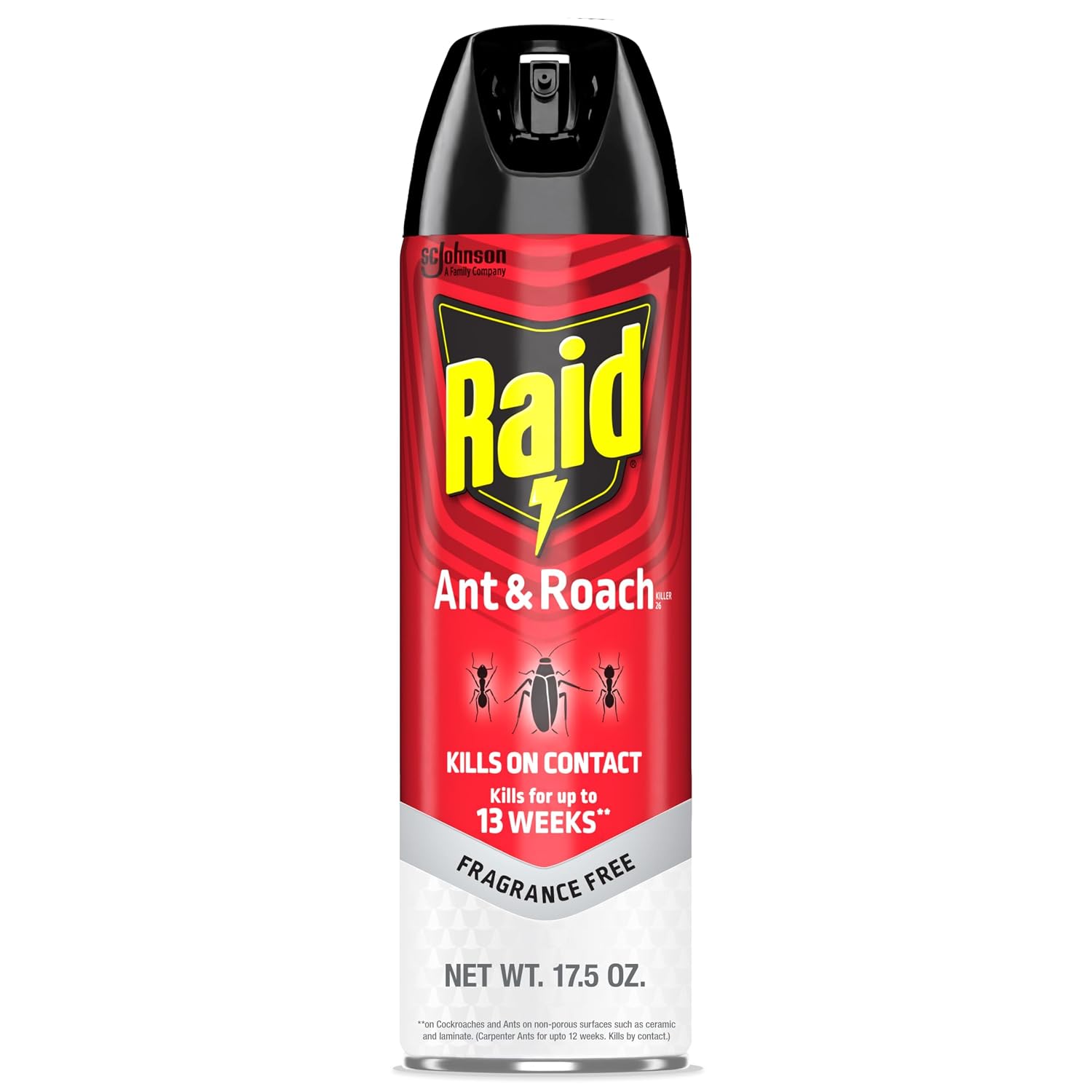
Raid Ant & Roach Killer, Fragrance Free, 17.5 oz
| Unit Count | 17.5 Ounce |
|---|---|
| Item Form | LIQUID |
| Target Species | Insects |
| Liquid Volume | 1 deciliters |
This Raid Ant & Roach Killer is a straightforward aerosol insecticide intended for indoor use on floors, baseboards, garbage cans, under sinks, basements and garages. It kills on contact and leaves a residual that the manufacturer says can keep killing roaches and carpenter ants for up to 13 weeks after application. The formula is fragrance free so it does not leave a lingering chemical smell, and it lists a broad range of target pests including silverfish, crickets, earwigs and some spiders. Use is simple: shake, spray the infestation sites and repeat as needed every few months. Important practical points are that the product is flammable and comes in a pressurized can so it must be stored and used with care, and treatment is limited to surfaces listed on the label rather than food-prep areas. For someone looking for a no-frills, effective surface spray with long residual action, this is a convenient option, but it is not a replacement for integrated pest management when infestations are heavy or structural.
Best for: Buyers who want an inexpensive, no-frills surface spray to control common indoor crawling insects and who plan to use occasional spot treatments rather than ongoing professional services.
Less Ideal for: People facing heavy or widespread infestations that need baiting, traps, or professional structural treatments should choose a more comprehensive approach.
- Kills a wide variety of crawling insects on contact and offers residual control up to 13 weeks
- Fragrance-free formula that avoids leaving a chemical odor in treated areas
- Easy to use aerosol spray for spot treatments on floors, baseboards and similar surfaces
- Suitable for many indoor locations such as basements, garages and under sinks
- Pressurized, flammable aerosol requires careful storage and cannot be used near open flames
- Label restricts use to specified surfaces which limits application in some food-prep zones
Verdict: A budget-friendly, fragrance-free aerosol that delivers simple, effective spot treatment and long residual control for common indoor crawling insects.
Envu Tempo SC Ultra Insecticide Concentrate, 240 ml

| Item Volume | 240 ml |
|---|---|
| Item Form | Liquid |
| Target Species | Ants, flies, cockroaches, crawling pests, and ticks |
| Scent Name | Chalk-like |
| Material Features | No Ordor and Non-Staining |
Tempo SC Ultra is a suspension concentrate insecticide that mixes with water to create a spray for treating home perimeters, garages, basements, doorways, and known harborage areas. It uses beta-cyfluthrin to deliver quick knockdown of ants, spiders, cockroaches and other crawling pests and provides residual protection so treated surfaces continue to control insects after application. The liquid concentrate is low-odor, non-staining, and designed to cover large areas efficiently when diluted per label directions, which makes it practical for routine maintenance and targeted spot treatments. As a professional-strength concentrate it requires correct dilution and application to avoid overuse and to meet safety directions for indoor versus outdoor spots. People looking for an easy ready-to-use spray will need to mix it first and follow label precautions for handling and application near sensitive areas.
Best for: A buyer who prioritizes dependable, long-lasting perimeter pest control and is comfortable mixing a professional-style concentrate to maintain home and yard protection.
Less Ideal for: Casual users who want a ready-to-use spray or those unwilling to follow pesticide label safety and dilution instructions should consider simpler alternatives.
- Broad-spectrum active ingredient effective against ants, spiders, cockroaches and other crawling pests.
- Residual formula provides ongoing control after application for perimeter maintenance.
- Water-based suspension concentrate mixes and sprays evenly for good surface coverage.
- Low odor and non-staining formulation suitable for use around living spaces when applied as directed.
- Requires careful dilution and proper application equipment since it is a concentrate.
- Contains beta-cyfluthrin which requires following label safety precautions around people, pets, and plants.
Verdict: Choose Tempo SC Ultra when you need a reliable, low-odor concentrate that delivers fast knockdown plus lasting residual control for routine perimeter pest management.
Ortho Home Defense Insect Killer for Indoor & Perimeter, 1.33 gal with Comfort Wand

| Item Form | Spray |
|---|---|
| Target Species | Insects |
| Liquid Volume | 1.33 gallons |
| Active Ingredients | Bifenthrin 0.05%, Zeta-Cypermethrin 0.0125% |
This ready-to-use Ortho Home Defense insect killer is designed to treat both indoor problem spots and the outdoor perimeter around a house. It comes in a 1.33 gallon container with a battery-powered Comfort Wand that delivers a continuous spray for easier, less-fatiguing application to baseboards, windowsills, door frames and foundation perimeters. The formula lists bifenthrin and zeta-cypermethrin as active ingredients and claims up to 12 months of protection against ants, roaches and spiders on non-porous indoor surfaces while providing fast knockdown of many listed pests. Practical benefits include notching large coverage without mixing, a clear, fast-drying finish meant to avoid staining, and an applicator that reaches low areas without bending. Important limitations are that the long-lasting indoor barrier is specified for non-porous surfaces only and this is a chemical control that requires following safety directions around children and pets; it is not a one-time cure for every insect type listed and repeat spot treatments may be needed for heavy infestations.
Best for: Buyers who want a proven, easy-to-apply chemical option to prevent and control common home-invading insects around entry points and perimeter areas, and who prioritize straightforward application and documented effectiveness.
Less Ideal for: People seeking organic or non-chemical pest control methods or those who prefer targeted baits/traps over perimeter sprays should consider alternatives.
- Ready-to-use 1.33 gal container covers large areas without mixing.
- Battery-powered Comfort Wand provides continuous spray and reduces hand fatigue.
- Formula dries clear and is labeled to leave up to 12 months of indoor barrier protection on non-porous surfaces.
- Works on a wide range of common household insects listed on the label.
- Long-lasting barrier claim applies only to non-porous indoor surfaces, limiting some indoor applications.
- Contains synthetic insecticides so users must follow safety instructions around children, pets and food-prep areas.
Verdict: A large ready-to-use spray with a comfort wand that delivers long-lasting perimeter and indoor protection for homeowners who want a straightforward chemical solution.
Atticus Talak 7.9% Bifenthrin Indoor/Outdoor Insecticide Concentrate (32 oz)

| Liquid Volume | 32 fluid ounces |
|---|---|
| Active Ingredients | Bifenthrin |
| Formulation | Suspension Concentrate |
| Target Species | Insects |
| Specification Met | EPA |
Talak 7.9% is a liquid concentrate that mixes with water to treat lawns, landscapes, outdoor surfaces and interior perimeter areas for a wide range of pests. You mix the amount needed per label rates and apply with a pump sprayer or hand sprayer; one gallon of mixed solution treats roughly 1,000 sq ft at typical rates. The product uses bifenthrin as the active ingredient and is advertised to kill on contact while leaving a residual effect lasting up to three months. Practical benefits include a water-based formula that dries clear, leaves no odor or visible residue, and is labeled safe around plants when used as directed. The bottle includes pre-marked pour sections to help control dosing. Important limitations are that concentrates must be mixed fresh and not stored, it is not approved for fogger applications, and some states restrict sale. Follow the label carefully for rates and reentry times to protect people, pets, and beneficial insects.
Best for: Buyers who prioritize reliable, proven pest control for both lawns and home perimeters and want a product with clear label directions and long-lasting results.
Less Ideal for: People seeking an odorless ready-to-use spray without any mixing or those in states where this product is not registered should look for alternatives.
- Broad-spectrum control listed for more than 75 indoor and outdoor insect pests
- Water-based formula dries clear, leaves no odor, and is nonphytotoxic to plants when used correctly
- Long residual activity up to three months per application
- Easy-to-pour bottle with pre-marked dosing for simpler mixing
- Concentrate must be mixed fresh and cannot be stored for later use
- Not labeled for fogger use and restricted from sale in some states
Verdict: Choose Talak 7.9% if you want a water-based bifenthrin concentrate that delivers broad, long-lasting indoor and outdoor insect control when mixed and applied per the label.
Choosing the Right Anti Insecticide Spray: Key Factors to Consider
Target Pest Spectrum
Knowing which insects you need to control is the first step. Some sprays are formulated mainly for chewing insects like caterpillars and beetles, while others target sap-sucking pests such as aphids and whiteflies. A broad-spectrum product might handle many pests but can also affect beneficial insects, so weigh the tradeoffs.
Match the spray to the pest stage you observe. Several products list effectiveness by life stage, for example targeting larvae versus adults. Choosing a product that names the pest or pest group on the label helps ensure legal and effective use.
Residual Activity and Reapplication Interval
Residual control determines how long treated foliage remains protected. Short-residual sprays give fast knockdown but require more frequent reapplication, which can be acceptable for spot treatments or in small plots. Longer-residual options reduce application frequency but can increase exposure risk to pollinators and beneficial predators.
Check label-specified reapplication intervals and the recommended preharvest interval for edibles. Align residual expectations with the timing of flowering and pollinator activity in your garden to reduce non-target impacts.
Plant Safety and Crop Compatibility
Plant safety covers both phytotoxicity and label acceptance for edible crops. Some formulations can cause leaf burn or fruit spotting on sensitive species, particularly in hot or sunny conditions. Others have explicit restrictions for certain ornamentals or young transplants.
Always cross-check the label for listed crops and application conditions. If you grow a mix of ornamentals and vegetables, pick a spray that is approved for both or plan to use separate, crop-appropriate treatments.
Application Method and Equipment
How you apply the spray affects coverage and effectiveness. Ready-to-use trigger sprays are convenient for small jobs and close-up inspections, while concentrate products give more value and flexibility for treating larger beds with a pump sprayer. Drench or systemic applications provide internal protection for some products but require precise mixing and timing.
Think about nozzle type, spray droplet size, and whether the product requires specific sprayer compatibility. Good coverage of leaf undersides and new growth is often the difference between effective control and disappointing results.
Environmental and Pollinator Safety
Minimizing harm to pollinators and beneficial insects is a key consideration in garden pest management. Some active ingredients have high toxicity to bees and predatory insects, especially when applied during bloom or in warm sunlight. Other options break down quickly and pose less long-term risk.
Plan applications for times when pollinators are less active, such as early morning or late evening, and avoid spraying open flowers. Choose formulations and rates that the label indicates are lower risk around beneficials if you want to preserve biological control agents.
Label Clarity and Legal Use
The product label is a legal document and the primary source for safe, effective use. Clear labels list target pests, application rates, allowed crops, personal protective equipment, and environmental precautions. Ambiguous or incomplete labels increase the chance of misuse, crop injury, or regulatory problems.
Prioritize sprays with straightforward mixing instructions, measurable rates, and explicit preharvest and reentry intervals. Labels that state the active ingredient and mode of action help you rotate chemistries to manage resistance.
When to Use Spot Treatment Vs Area Spray
Spot treatments concentrate product where pests are obvious and limit exposure to beneficial insects. Use spot spray for isolated infestations on individual plants or small clusters, especially when pollinators are active nearby.
Area sprays address widespread or hidden infestations across beds or hedgerows. They are more efficient for entrenched problems but increase non-target exposure and should be used with attention to timing and residual properties.
- Reserve area sprays for widespread outbreaks or when pest pressure is high across multiple plants.
- Use spot treatments for early detection, smaller gardens, or when beneficial insects are present.
Integrating Sprays Into an IPM Plan
Anti insecticide sprays are a tool within an integrated pest management approach. Pair chemical control with cultural practices such as crop rotation, resistant varieties, regular scouting, and physical controls like barriers and hand removal.
Rotate sprays with different modes of action when repeated applications are needed to reduce the chance of resistance. Also consider biological controls and selective products that spare natural enemies to sustain long-term suppression.
- Scout weekly and treat only when pest thresholds are exceeded.
- Record applications and modes of action to inform rotation decisions.
Spray Timing and Weather Considerations
Weather affects both efficacy and safety. Avoid spraying before rain unless the label states rainfastness, because rain can wash active ingredients off foliage and reduce effectiveness. High temperatures and intense sun can increase risk of phytotoxicity for some formulations.
Apply treatments during calm conditions to prevent drift and in periods when pollinators are least active. Pay attention to wind speed, recent rainfall, and forecasted conditions for the first 24 to 48 hours after application.
- Do not spray during or immediately before rainfall unless permitted by label instructions.
- Choose early morning or late evening applications to minimize pollinator exposure.
Safe Mixing, Storage, and Disposal
Follow label directions for mixing concentrates and wear recommended personal protective equipment. Measure accurately and never mix different active ingredients unless the label permits a tank mix.
Store products in a cool, dry place away from children and pets, and keep them in their original labeled containers. Dispose of leftover product and rinsate according to local regulations and label instructions to avoid contaminating soil or water.
- Triple-rinse empty containers if required and follow local disposal rules.
- Keep a garden log of application dates, rates, and conditions for future reference.
Using Sprays on Edibles and Ornamentals
When treating edible crops, check the preharvest interval and any crop-specific restrictions on the label. Some sprays are labeled for ornamentals only and should not be used on vegetables, fruits, or herbs.
For ornamentals, test-spray a small area first if you are unsure about phytotoxicity, and avoid treatments during heat waves or under strong sunlight when plant stress is higher.
- Observe preharvest intervals before harvesting treated produce.
- Perform a small test application on sensitive ornamentals before broad use.
How We Chose the Best Anti Insecticide Spray
We focused on practical performance characteristics gardeners can verify in real use. Our selection criteria emphasized four to six measurable dimensions: speed of knockdown against common garden pests, residual control duration on foliage, plant safety across common ornamentals and edibles, ease of application and mixing, and label clarity for target pests and rates. We favored formulations that list target insects clearly and provide crop-specific directions, because a usable label reduces misapplication risk. Products were excluded if labels lacked clear rates for edible crops, if the formulation type prevented safe backyard use, or if manufacturer directions required equipment beyond typical homeowner sprayers. We also filtered out options that relied solely on poorly described “natural” claims without specifying active ingredients or documented modes of action. The resulting shortlist balances fast initial control with manageable residual activity and practical safety for common garden situations.
FAQ
Can I use anti insecticide sprays on vegetables and herbs?
It depends on the product label. Many sprays list specific edible crops and state preharvest intervals. Always follow the label for allowed crops and wait the recommended number of days before harvesting.
How often should I reapply an anti insecticide spray?
Reapplication frequency depends on the product's residual activity and pest pressure. Short-residual sprays may need repeating every few days, while longer-residual options might be applied weekly or less. Follow the label intervals and adjust for heavy infestations.
Will an anti insecticide spray harm pollinators?
Some active ingredients can be toxic to bees and other beneficials, particularly when sprayed on open flowers. To reduce risk, avoid spraying during bloom and apply when pollinators are less active, such as early morning or late evening.
What is the best way to reduce resistance to sprays?
Rotate products with different modes of action and avoid repeated use of the same chemistry. Integrate nonchemical controls like cultural and biological tactics to lower reliance on sprays and reduce selection pressure on pest populations.
Can I tank-mix different anti insecticide sprays?
Only mix products when the label explicitly permits the tank mix. Incompatible combinations can reduce efficacy, increase plant injury, or create unsafe exposures. When in doubt, test a small mix on a noncritical plant area first.
How should I protect myself when applying sprays?
Wear the personal protective equipment specified on the label, which may include gloves, long sleeves, eye protection, and a respirator for some concentrates. Avoid contact with skin and wash exposed clothing separately after use.
Final Verdict
Prioritize the pest spectrum and plant safety when choosing an anti insecticide spray. Consider how long you need protection, whether the crop is edible or ornamental, and how the product fits into a broader IPM plan. By balancing knockdown speed, residual control, and environmental precautions you can choose a spray that solves short-term pest problems without undermining long-term garden health.
